
Prone means lying in a facedown position. This is a position that everyone is able to maintain at birth, but adults often find uncomfortable. Sometimes the discomfort is a result of restricted movement in the neck and upper back that makes it hard to turn the head to the side. This position can also feel suffocating because the movement of the abdomen is inhibited by the weight of the body, and the back of the body has to be more mobile to breathe comfortably.
For some people this position has even more of a connotation of surrender than kneeling. In many religious traditions, placing the entire front surface of the body on the floor is known as a full prostration.
For others this position feels safer than being supine, because the vulnerable front body and organs are more protected.
From a prone position the easiest movement is extension in the spine and limbs, which uses the posterior musculature of the body. For this reason many back strengthening exercises begin in this position. Although the center of gravity in this position is close to the floor, poses that evolve from here are mostly brhmana (see page 20) because of the effort needed to lift the body away from the floor.
Bhujangasana
Cobra Pose
boo-jang-GAHS-anna
bhujanga = serpent (bhuja = arm, shoulder; anga = limb)

Classification
Symmetrical prone backward-bending pose


Notes
It is important to find the deeper intrinsic back muscles to do the action of spinal extension in this pose. Using the latissimus dorsi and other more superficial muscles affects the scapulae and rib cage and interferes with breathing by inhibiting the movement of the ribs.
In this pose, the serratus anterior is active to maintain a neutral position of the scapulae against the push of the arms. When the arms push, the shoulders don’t elevate but the spine is lifted.
The latissimus dorsi are not helpful as extensors of the spine, because they create flexion of the upper back and internal rotation in the arms.
Many people assume the legs should be passive in cobra, but numerous actions in the legs are required to keep the joints in alignment. The hamstrings, especially the semitendinosus and semimembranosus, extend the hips and maintain adduction and internal rotation. The extensor portion of the adductor magnus, along with the deep and medial fibers of the gluteus maximus, also extends the hips without externally rotating the legs. The vastus lateralis, vastus medialis, and vastus intermedius work to extend the knees. Weakness in the medial hamstrings can cause the gluteus maximus to do more than its share of hip extension, in which case the legs externally rotate or abduct, or both.
Weakness in the pronators of the forearms or shortness in the supinators (or interosseus membrane) makes the elbows flare out to the sides and affects both the elbow and shoulder joints. The forearms should stay parallel to each other for the best alignment of action through the arms into the spine.
Breathing
Although the standard instruction is to inhale while entering into a back bend, it can be very helpful to enter into this basic back bend on an exhalation. For many people who are locked into a belly breathing pattern, their inhalation actually restricts thoracic extension and rib cage expansion (this is because a belly breath is accomplished by restricting rib movement while the diaphragm contracts).

Bhujangasana Variation
With Knees Flexed

Notes
In this position, the hamstrings are used for both actions of hip extension and knee flexion. This position of the legs puts the hamstrings at a very short working length, which greatly increases the chances of cramping in the muscles.
This position also makes it more likely that the outer fibers of the gluteus maximus will fire to help with the hip extension, which will also externally rotate and abduct the legs. Often, a student who can keep the legs adducted and parallel when the knees are extended will find it much more challenging when the knees are flexed. In this position, all of the quadriceps are lengthened, and the range of motion in the rectus femoris can restrict the range of motion in knee flexion too.
Dhanurasana
Bow Pose
don-your-AHS-anna
dhanu = bow

Classification
Symmetrical prone backward-bending pose


Notes
The fronts of the shoulder joints are structurally vulnerable in this position. If the scapulae are not mobilized in the direction of adduction and some elevation, too much pressure could be put into the anterior shoulder joints, resulting in an overmobilization of the subscapularis or damage to the joint capsules. Because this is a bound pose, the pressure into these vulnerable joints is greater.
This pose can be explored in a variety of ways by emphasizing different actions: by deepening the action in the spine, by increasing hip extension, or by using knee extension to deepen spinal and hip extension. The balance of actions in the hips and knees will be affected depending on whether the hamstrings or the quadriceps are more activated. Because this is a bound pose, with the hands grasping the ankles, it is also possible to put too much pressure into the knees. Thus, the alignment of the legs at the hips and the activation of the feet are important to maintain the integrity of the knees.
Breathing
It is a common practice to rock back and forth in this pose by pushing the belly into the floor with each inhalation. It is also interesting to practice not rocking by directing the inhalation into the already expanded chest region.
Salabhasana
Locust Pose
sha-la-BAHS-anna
salabha = grasshopper, locust

Classification
Symmetrical prone backward-bending pose


Notes
It can be a challenge to lift the arms in this relationship to gravity, with the spine in extension. If the latissimus dorsi are used to extend the spine (rather than the deeper, intrinsic spinal muscles), they will inhibit the movement in the arms.
This position of the legs uses a complex interaction among adductors, medial rotators, and hip extensors. This is because many of the muscle actions that lift and support the body in this position create other actions that must be neutralized by opposing or synergistic muscles. For example, because the gluteus maximus, a powerful hip extensor, also externally rotates the legs, it’s preferable to use the hamstrings for hip extension. People will have different priorities, or challenges, depending on where they start and their preexisting patterns of strength and weakness as well as flexibility and tightness.
Breathing
To rock, or not to rock? All the weight of the body is brought to bear on the abdomen in this variation. While holding the pose for several breaths, the body rocks back and forth with the action of the diaphragm if the primary breathing pattern is belly breathing. An interesting challenge is to keep from rocking, which necessitates a release in the thoracic structures and diaphragm, allowing the floor to push into the abdomen, rather than the abdomen to push into the floor.
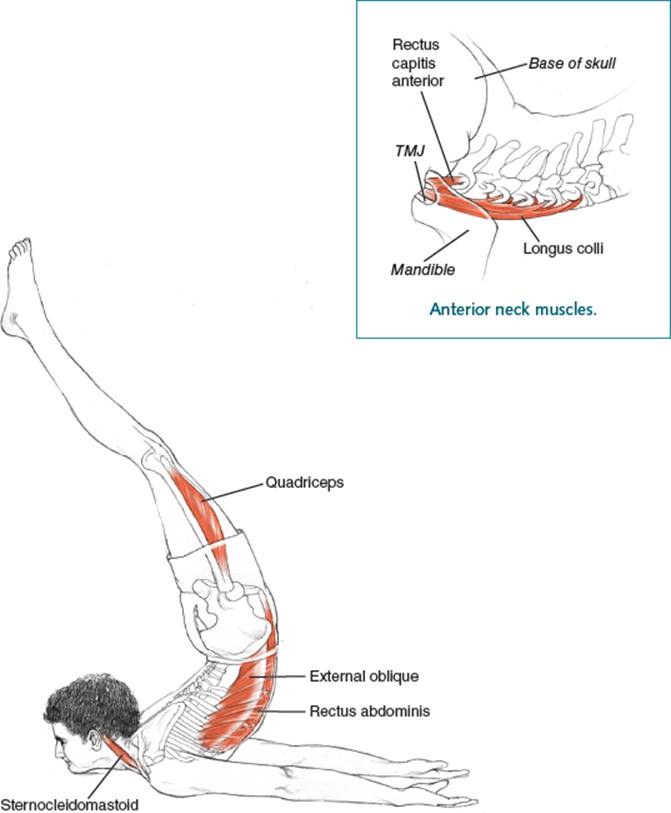
Viparita Salabhasana
Full Locust Pose
vip-par-ee-tah sha-la-BAHS-anna
viparita = reversed, inverted; salabha = grasshopper, locust
Classification
Symmetrical prone backward-bending pose

Notes
What it takes to move into this pose is almost completely the opposite of what it takes to remain in it. Lifting the weight of the body into spinal extension requires a strong, integrated action of the arms and spinal extensors. Once past vertical, gravity pulls the weight of the body into extension, so the trunk flexors must engage to prevent hyperextension. Based on their balance of strength and flexibility in the extensor and flexor muscle groups, some people may have the ability to get into full locust but not to sustain it, whereas others can’t get there themselves but can stay there if assisted into the pose.
Breathing
The standard instruction to inhale while entering into a back bend can be counterproductive here. This is because a strong contraction of the diaphragm draws the base of the rib cage and lumbar spine toward the central tendon. This can create considerable resistance to the lengthening in the deep front line of the body. Exhaling while lifting the body into the pose works better for many people.
Remaining in the pose requires the abdominal wall to be both lengthened and engaged, which can limit abdominal breath movement, while the actions that synergize the push of the arms into the floor tend to limit thoracic excursion. In addition, having the neck in weight-bearing extension can add resistance to the airway—not to mention that all of this is happening in an inverted position. All in all, this is a very challenging position to breathe in. Efficiency of effort is the key.