
Andrew C.Y. To and L. Leonardo Rodriguez
BASIC PRINCIPLES OF ULTRASOUND
Sound waves are mechanical vibrations produced by a source that are transmitted through a medium such as air. As sound waves travel through a medium, the particles of the medium are packed (compression), alternating with being spaced apart (rarefaction). Sound waves can be represented graphically as sine waves (Fig. 9.1). The wavelength (λ) is the distance between two similar areas along the wave path and is measured in millimeters. The frequency (f) is the number of wavelengths per unit time. Frequency is expressed in hertz (Hz), which is equivalent to cycles per second. Hence, the velocity of sound in a medium (c) is the product of wavelength and frequency; and wavelength and frequency are inversely related.
c = λf

FIGURE 9.1 Figure of sound wave.
The amplitude of the sound wave (loudness) is measured in decibels (dB), which is in logarithmic scale.
The propagation velocity of sound is determined by the stiffness of the medium and is also related inversely to its density. In human tissue, sound wave propagation velocity is 1,540 m/s (Table 9.1). Humans hear sound waves with frequencies between 20 Hz and 20 kHz; hence, ultrasound is defined as sound with frequencies higher than 20 kHz. Diagnostic medical ultrasound uses transducers with frequencies between 1 and 20 MHz.
TABLE
9.1 Velocity of Sound through Different Media

INTERACTION OF ULTRASOUND WITH TISSUE
Ultrasound beam travels in a straight line in a homogeneous medium; however, when the beam travels through a medium with two or more interfaces or in a heterogeneous medium, the path is altered. The interaction of ultrasound with tissue can be in the form of reflection, scattering, refraction, or attenuation.
When the ultrasound beam encounters a boundary between two different media, part of the ultrasound is reflected back toward the transducer and another part continues into the second medium. The amount of reflection depends on the difference in acoustic impedance between the two media. The amount of ultrasound reflected back is constant, but the amount received back at the transducer varies with the angle of the ultrasound beam to the tissue interface. Because the angles of incidence and reflection are equal, optimal return of the reflected ray occurs when the beam is perpendicular (90 degrees) to the tissue interface.
Scattering occurs when the ultrasound beam strikes smaller structures, less than one wavelength in the lateral dimension. This results in the ultrasound beam being radiated in all directions, with a minimal amount returning to the transducer. Scattering of ultrasound produced from moving red blood cells is the principle behind Doppler echocardiography.
When the speed of sound differs in the two media, the acoustic impedance is different, and the ultrasound waves in the second medium are deflected from their original orientation. This is known as refraction.Because blood and most tissues have similar sound velocities, this is not a prominent effect in echocardiography.
When ultrasound travels through a biologic medium, part of the energy is absorbed and converted into heat. This process whereby ultrasound signal strength reduces is called attenuation. The degree of attenuation depends on the ultrasound frequency and on the differences in acoustic impedances between the two media. Lower ultrasound frequencies have a lower attenuation and penetrate deeper into tissues. Air has high acoustic impedance, which causes significant attenuation if there is any air between the transducer and the body tissue. Applying water-soluble gel on the transducer minimizes contact with air and hence attenuation.
TRANSDUCERS
The ultrasound transducer is the small hand-held probe that transmits acoustic energy and receives the returning echoes. Piezoelectric crystal converts electrical energy into sound energy and vice versa. Piezoelectric elements lack a center of symmetry and are anisotropic. When an electric current is applied, the polarized particles within the crystal are aligned, causing the crystal to expand and produce a mechanical effect. This is known as the direct piezoelectric effect. An alternating current causes the crystal to compress and expand alternately, which produces an ultrasound wave by compressions and rarefactions. Piezoelectric crystals generate an electric current when their shapes are altered while being struck by ultrasound waves. Therefore, the transducer functions both as a transmitter, transmitting a burst of ultrasound, and as a receiver, receiving the ultrasound signals reflected by internal tissue interfaces. A typical pulse lasts for only 1 to 6 µs.
The transducer frequency is determined by the nature and thickness of the piezoelectric element.
Image formation is based on the time interval between the ultrasound transmission and the arrival of its reflected signal. Deeper structures have longer flight times (Fig. 9.2). The time delay between transmission and reception is determined by the depth (d) of a certain structure and the speed of sound in blood:

FIGURE 9.2 The time for the ultrasound beam to return to the transducer from a particular structure is a measure of the structure’s distance from the transducer.
d = ct / 2
The factor 2 appears because t includes the time to and from the object. Knowing that the speed of sound in blood is 1,540 m/s,
d = 77t cm (t in ms)
Resolution of the imaging system is defined as the smallest distance between two points that can be distinguished by the system as separate entities. Axial resolution refers to the ability to differentiate between points lying along the path or axis of the ultrasound beam. Lateral resolution refers to the ability to differentiate between points that are lateral to the beam, relative to the beam. Axial resolution is related to the ultrasound’s wavelength, frequency, and the duration of the transmitted pulse. Lateral resolution is dependent on the distance of the specular reflector to the transducer and is a function of the beam width, which is defined as the diameter of the beam at a particular point. In the near field, the beam is maintained as a cylinder with a diameter comparable to the transducer. However, at points farther away from the transducer, the beam diverges and widens into a cone. This area is the far field. Beam width is a function of transducer size, shape, frequency, and focusing. The larger the transducer, the longer the near field is.
The lateral resolution is dependent on the gain of the system. Specular reflectors along the center of the beam produce stronger echoes than those that are at the beam margins. When the gain or sensitivity is set low, echoes from beam margins with lower amplitude may not be recorded, which makes the beam appear narrower. With higher gain, the echoes at the margins are recorded, and the beam width appears greater.
IMAGING MODALITIES
There are several imaging modalities in echocardiography. A and B modes have only historical importance. M mode (motion) displays axial information along a single scan line, displaying depth on the vertical axis and time on the horizontal axis. This provides high temporal resolution and rapid sampling rates, with the ability to visualize wall or valve motion. M-mode measurements have been the standard in echocardiography in quantifying chamber size and endocardial thickening (Fig. 9.3).

FIGURE 9.3 M-mode display.
Through parallel processing, the data from each scan line are analyzed separately, which increases the frame rate.
Two-dimensional (2-D) echocardiographic imaging is generated by sweeping ultrasound beam through an arc across a particular area of the heart. Electronic sweeping is accomplished by the use of phased array transducers. Transducer arrays are groups of individual transducers or transducer elements. Linear arrays are a group of transducers or transducer elements lined up next to each other in a straight row. The transducers are then pulsed individually or in groups. This requires a large window, which limits their use in cardiac imaging. Phased arrays contain multiple element transducers that sweep the ultrasound beam electronically through an arc. Exciting the transducers in sequence generates an ultrasound wave that propagates at an angle to the transducer and sweeps the beam from side to side.
A focused transducer is used to decrease diversion in the far field of the ultrasound beam. By placing a concave acoustic lens on the transducer surface or by altering the transducer curvature, the ultrasound beam is narrowed at a point away from the transducer. The focal zone is the area where the beam is narrowest and divergence is smallest. Phased array transducers can also focus the beam electronically by altering the shape of the wavefront according to the timing of firing of the individual transducer elements.
Two-dimensional echocardiography displays ultrasound data in a spatial orientation relative to time and localize depth by the reflected wave timing. This limits the amount of data that can be collected in a period of time and hence temporal resolution. The pulse duration (PD) is the time needed for the pulse to travel from the transducer to the tissue and back. This is dependent on the depth of the tissue and the speed of sound in that tissue:
PD = 2d / c
The pulse repetition frequency (PRF) is the rate at which individual pulses are transmitted (per second) and is equal to c/2d. Since the speed of sound in human tissue is 1,540 m/s, this translates to:
PRF = 77/d pulses/ms
The number of lines per sweep depends on the time taken to produce one scan line and the time set for each sweep. The frame rate is the number of images acquired per second. In cardiac applications, the frame rate is typically >30 frames per second. A higher frame rate is preferred to visualize myocardial and valvular motion well. However, increasing the frame rate leads to fewer scan lines per frame, resulting in less data acquired per frame and therefore decreased image quality.
Echoes received by tissues produce vibrations within the piezoelectric crystal that translate into a small voltage. To form a final image, the electrical signal goes through complex signal processing that initially is amplified by a radiofrequency amplifier and compressed logarithmically in order to be displayed in varying shades of gray.
Serial processing occurs when one scan line is produced for each ultrasound pulse. This method limits the frame rate. With phased array transducers, it is possible to send out several scan lines simultaneously in different directions. Through parallel processing, the data from each scan line are analyzed separately, which increases the frame rate.
Dynamic range (expressed in decibels) refers to the amplitude ratio of largest signal displayed to the smallest signal detected above the system noise. Noise is a combination of all signals that reach the transducer from structures outside the ultrasound beam axis. These signal amplitudes are compressed into shades of gray, where the gray scale displays strong and weak echoes in various shades of gray. The dynamic range consists of the number of levels of gray in an image and can be adjusted.
Echo image data are obtained in a polar coordinate system and are converted into a video image by means of a digital scan converter.
Attenuation occurs when deeper structures produce weaker echoes than structures closer to the transducer. Electrical energy produced by these echoes is therefore less. Time gain compensation applies greater amplification for echoes returning at longer intervals from the initial pulse, which corresponds to the depth of the structure. As attenuation varies in individuals, time gain compensation can be adjusted by the user. Near-field gain can be set lower while far-field gain can be gradually increased to achieve better image quality.
HARMONIC IMAGING
When a sound pulse of frequency fo propagates through tissues, nonlinear interactions occur, generating a pulse with frequencies at multiples of the fundamental frequency fo: 2fo (second harmonic), 3fo (Fig. 9.4A,B). This is caused by minor distortions in the tissue, producing a very slight change in the shape of the wave as it propagates.

FIGURE 9.4 A: Tissue harmonic imaging utilizes pulse frequencies at multiples of the fundamental frequency f0. B: Harmonic frequencies are of lower energy than the fundamental frequency.
The energy of these harmonic frequencies returning from the tissue is significantly less than the fundamental frequency. In order to benefit from harmonic imaging, the fundamental frequency needs to be filtered out, so that only the harmonic frequencies are passed to the demodulator.
Harmonic generation increases with the distance of propagation and that there is a nonlinear relation between fundamental and harmonic frequency energies. These aspects of harmonic imaging help to understand why it is useful in reducing near-field artifacts (low harmonic energy close to the transducer) and side-lobe artifacts.
Second harmonic tissue imaging is now used routinely in adult echocardiography. The benefits can be striking particularly in patients with difficult images. In general, there is an improved signal-to-noise ratio with brighter tissue and superior endocardial definition. Of note, valvular structures appear thicker when imaged using second harmonics compared to fundamental imaging. In some cases, it may be useful to turn harmonic on and off when evaluating valve leaflets.
Another use of harmonic imaging is contrast echocardiography. New contrast agents have been manufactured with very small (1- to 5-μm) bubbles capable of crossing the pulmonary capillary bed. The contrast effect is produced by microbubbles having different acoustic impedances than blood, causing the reflection and scattering of ultrasound. Ultrasound causes compressions and rarefactions of the microbubbles with a resonant frequency that is inversely related to the diameter of the microbubble. This ultrasoundmicrobubble interaction also generates harmonic frequencies. Compared to soft tissue, the microbubbles are strong reflectors, so tuning the ultrasound receiver to the second harmonic frequency displays the contrast agent preferentially within the image.
The approved indication for contrast imaging is left ventricle opacification. In patients with limited views, contrast significantly improves endocardial definition. Its main application is in suspected wall motion abnormalities at rest and after stress, or in suspected left ventricular (LV) thrombus. The use of contrast agents for myocardial perfusion, although promising, is still investigational. Myocardial perfusion and viability are potential uses of this technique, although they have not been approved for clinical use.
THREE-DIMENSIONAL ECHOCARDIOGRAPHY
Two-dimensional echocardiography is now the standard ultrasound imaging modality, although 3-D imaging is increasingly adopted as it provides a different imaging approach and several distinct advantages over 2-D echocardiography. Initially, 3-D images are constructed and displayed using conventional 2-D imaging with a multiplanar transducer. Tomographic slices of the heart are obtained and constructed into a 3-D image.
Image acquisition relies on matrix array transducer that replaces a single row of elements found in the conventional linear 1-D transducer with a 2-D grid of elements. As in a linear array transducer, the timing of individual transducer elements transmitting and receiving ultrasound energy controls the direction of the ultrasound beam. A matrix array transducer offers steering in both within a slice and elevation of a beam, allowing for interrogating the entire pyramid-shaped volume.
Parallel processing allows the volumetric device to receive multiple lines for any given transmit line to generate the 3-D volume. Real-time 3-D, “Live 3-D,” imaging can be performed at a lower temporal resolution (volume per second). Alternatively, a segmented “full-volume” 3-D dataset is obtained at higher temporal resolution by combining data from several cardiac cycles via ECG gating. The latter has the option of displaying images with color Doppler mapping. In the above 3-D image acquisition modes, datasets can be analyzed offline in either volumerendered or multiplanar reconstruction modes. Offline analysis tools are especially useful for accurately quantifying volume and mass, as well as visualizing complex anatomical abnormalities.
Three-dimensional echo is commercially available for both transthoracic and transesophageal echocardiography. This technique has distinct advantage over 2-D echocardiography including chamber quantification, valvular heart disease especially mitral valve diseases, congenital heart disease, and intraoperative applications.
DOPPLER ECHOCARDIOGRAPHY
Doppler echocardiography utilizes the Doppler principle to determine the direction, velocity, character, and timing of blood flow within the cardiovascular system. The Doppler principle states that the frequency reflected on a moving object is a higher observed frequency than when it moves away from the observer. The Doppler shift ( F) is the difference in frequency between the received frequency (Fr) and the transmitted frequency (Ft):
ΔF = Fr - Ft
Signal backscatter from small moving objects such as red blood cells produces a change in frequency of the signal, creating a Doppler effect. The Doppler shift is related to the velocity of the moving source (V):
ΔF.α.V =ΔF = V / λ
Knowing that λ = c/f, and that the speed of sound tends to remain constant in tissue, change in the transmitted frequency will alter the wavelength. Therefore,
λ = c / Ft = V / ΔF
Rearranging this expression produces:
ΔF = V ·Ft / c
The ultrasound beam may be at an angle to the direction of blood flow. The true velocity is equal to the measured velocity divided by the cosine of the angle θ. Therefore,
ΔF = F t·V·cosθ/c
where V is the true velocity of blood flow. As the sound path consists of the transmitted portion from the transducer to tissue and the reflected portion from the tissue back to the transducer, the equation is multiplied by 2, which produces the final Doppler equation:
ΔF = 2Ft·V· cosθ/c
Since it is the velocity of the moving object that is of interest, rearranging the equation produces:
V = ΔF·c/(2Ft· cosθ)
The angle the ultrasound beam makes with the direction of blood flow is important. When the beam is parallel to the direction of flow, the angle is 0 degrees and cos 0 degrees = 1. When the beam is perpendicular to the direction of flow, the angle is 90 degrees and cos 90 degrees = 0, which means that there is no Doppler shift. Angles <20 degrees result in a <6% change in the recorded velocity. Thus, the effect of the beam angle on Doppler shift becomes more important when the angle is greater. For example, if the angle is 60 degrees, cos 60 degrees = 0.5, which leads to a 50% velocity error. This is important when calculating velocities in areas with abnormal blood flow, as in valvular stenosis.
The difference between transmitted and backscattered signals received by the transducer is determined by comparing the two waveforms. The frequency content is analyzed by fast Fourier transform. The display generated is known as a spectral analysis, with time displayed on the x axis and frequency shift or blood velocity on the y axis. Frequency shifts toward the transducer are displayed above the baseline, whereas frequency shifts away from the transducer are below the baseline. There are multiple frequencies for every given point in time, and each amplitude is displayed corresponding to its brightness (by gray or color scale). Therefore, the spectral display produces information on the direction of blood flow, the velocity (or frequency shift), and the signal amplitude.
Three different modalities are used in Doppler echocardiography: continuous-wave Doppler, pulsed-wave Doppler, and color Doppler flow mapping. Each modality is processed differently (Table 9.2).
TABLE
9.2 Comparison of Continuous Wave, Pulsed Wave, and Color Doppler

In continuous-wave Doppler, sound beam is continuously transmitted and received. The transducer contains two crystals, one for continuous transmission and a second for continuous reception of the ultrasound signal. The spectral signal displayed is smooth in contour, showing the maximum velocity and defining the onset and end of flow. The Doppler profile is filled in because lower velocities are also recorded. This modality is useful for calculating high-frequency shifts or velocities encountered in stenotic or regurgitant lesions. The disadvantage is that continuous-wave Doppler simultaneously records all signals along the ultrasound beam. Thus, the detected Doppler shift may have occurred at any point along the scan line (Fig. 9.5A).

FIGURE 9.5 A: Continuous-wave Doppler. B: Pulsed-wave Doppler. C,D: High velocities—continuous wave (C) versus pulsed wave (D) Doppler with aliasing.
In pulsed-wave Doppler echocardiography, pulses of ultrasound are transmitted intermittently. This allows the pulse to traverse to a desired depth and, after a specific time delay, the backscattered signals are received by the transducer (Fig. 9.5B). As mentioned above,
d = ct/2 and PD = 2d/c
The Doppler shift and velocity at the depth of interest is based on the time delay measured. This is useful in assessing low-velocity flows such as in transmitral flow, although this may not be a reflection of the true maximum velocity. The PRF is the interval that the transducer waits after a signal before it sends out the next signal. The time interval is dependent on the depth of interest, and the PRF is also dependent on the depth. From earlier,
PRF = 77 / d
In pulsed-wave Doppler, the sample volume is the depth of interest. Pulsed Doppler echo samples the returning signal repeatedly, and there is a limit to the frequency shift (or velocity) that can be displayed unambiguously. The frequency of the ultrasound is determined by sampling the waveform for at least twice the wavelength. This requires sampling the pulse at twice the rate. The maximum detectable frequency shift is called the Nyquist limit, which is one-half the PRF.
When the velocity of interest is higher than the Nyquist limit, the signal wraps around into the reverse channel and then back to the forward channel. This is known as signal aliasing (Fig. 9.5D). Various methods can be used to resolve aliasing, including using continuous-wave Doppler ultrasound, shifting the baseline, increasing the PRF, or using a lower-frequency transducer.
Color Doppler flow mapping differs from pulsed Doppler echo in that multiple sample volumes (or multigates) are evaluated along each scan line. The 2-D image obtained from sweeping the scanning line across the echo sector is superimposed on color-coded velocity patterns. Flow toward the transducer is displayed in red, whereas flow away from the transducer is displayed in blue. The shade of color that is displayed indicates the velocity up to the Nyquist limit. As velocity increases, aliasing may occur. This is displayed by reversal of color.
STRAIN IMAGING
Strain imaging is a new echocardiography tool that has increasing use in clinical practice. Strain is a measure of tissue deformation and strain rate is the rate by which this tissue deforms. Ventricular contraction is characterized by myocardial shortening in the longitudinal and circumferential dimensions, that is, negative strain, and myocardial thickening in the radial direction, that is, positive strain. Strain is analogous to regional ejection fraction, where strain rate is analogous to regional contractility. Considering longitudinal strain, total systolic strain that occurs at end-systole and peak systolic strain rate are negative due to myocardial shortening in the longitudinal dimension. Myocardial relaxation during diastole results in positive longitudinal strain as the myocardium lengthens. Diastolic positive strain rate has two peaks, at early diastole and late diastole, coinciding with the E and A waves on pulse Doppler measurements at the mitral valve leaflets.
Echocardiography assesses strain by two major methods, tissue Doppler imaging and speckle tracking techniques. Tissue Doppler techniques display myocardial velocity of each pixel relative to the transducer. The instantaneous velocity gradient along a sample length can be quantified from the velocities from adjacent sites along the scan line that generate the strain rate data. Strain is subsequently derived by integrating the derived strain rate versus time curves. Such data are obtained at a high temporal resolution, which is the major advantage of this technique.
Speckle tracking techniques measure strain by another approach. Speckles are tissue ultrasound reflectors that are highly reproducible and can be tracked throughout the cardiac cycle. Regional deformation can therefore be derived by tracking speckles from frame to frame. The differential of the resulting strain versus time curves yields the instantaneous strain rate curves (Fig. 9.6). Compared to tissue Dopplerbased techniques, speckle tracking has a lower frame rate and higher noise, although this angle-independent approach made radial and circumferential strain measurements, as well as torsion, practical.

FIGURE 9.6 Speckle tracking strain measurements on transthoracic echocardiogram. Shown are the normal strain measurements from the apical four-chamber view. Top left panel illustrates the region of tracking; top right panel illustrates the derive strain versus time curve; bottom right panel illustrates the color-coded strain measurements with time according to LV segments on the y-axis; bottom left panel illustrates the peak systolic strain at aortic valve closure of the various LV segments.
IMAGING ARTIFACTS
Imaging artifacts can be produced from displaying structures that are not there, failing to display structures that are actually there, or forming an image of a structure that is different in shape or size from what it actually is. Side lobe artifacts occur when ultrasound energy disperses laterally from the main ultrasound beam and are produced from the edges of the transducer elements. The side lobes may reflect or backscatter signals and produce an artifactual image as though it were originating from the center of the ultrasound beam. The amplitude of these waves is generally much lower and as a result may not produce a strong image artifact. The extraneous beams produced from phased array transducers produce grating lobe artifacts that are more serious and affect the transducer lateral resolution.
Beam-width artifacts occur when structures that are in the far field of the ultrasound beam produce images that are superimposed on structures that are in the center of the ultrasound beam. This can produce artifactual images creating distorted images or the display of artifactual structures such as the appearance of vegetations on a valve leaflet, an intracardiac mass, or an aortic dissection. This also affects lateral resolution.
Reverberation artifacts are produced when ultrasound waves are being bounced back and forth between two or more highly reflective surfaces. This produces multiple linear echo signals that appear as parallel lines. This limits evaluation of structures in the far field.
Acoustic shadowing occurs when structures with high echo density block transmission of the ultrasound. This can be seen with calcified or prosthetic valves. This presents a problem in imaging structures that are distal to these dense structures because no reflected signals return to the transducer. In these cases, an alternate window is necessary to visualize structures of interest.
Range ambiguity occurs when an echo signal from a previous pulse reaches the transducer on the next pulse cycle. This causes deeper structures to appear as though they are closer to the transducer. Range ambiguity can be eliminated by increasing the depth setting and decreasing the PRF.
PRINCIPLES OF FLOW
Blood flow is defined as the volume of blood moved per unit time. Flow is related to the pressure, the vessel radius, and the blood viscosity. In steady flow, the fluid particles move along parallel lines to the vessel wall, described as laminar flow. Turbulent flow occurs when blood cells move in different directions at different velocities. This can occur in stenotic valves, regurgitant valves, or intracardiac shunts.
The velocity of blood flow changes when there is a change in size of the vessel diameter. This is expressed by the Bernoulli principle, which is based on the principle of conservation of energy (kinetic and pressure energy). The kinetic energy from the blood flow is proportional to the density and the square of the blood flow velocity. When there is a change in the blood flow velocity, the kinetic energy (KE) also changes:

Because total energy is conserved, the total energy at point 1 (P1) must equal the total energy at point 2 (P2).
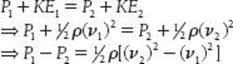
It is important to realize that some of the energy lost when going from point 1 to point 2 is due to energy required to overcome forces caused by changes in flow rate over time, that is, flow acceleration, as well as energy lost because of viscous friction. Therefore, the complete Bernoulli equation is:

The energy lost to viscous resistance (R(v)) and flow acceleration (ρ(dv/dt)dx) is negligible and can be eliminated from the Bernoulli equation. The velocity across stenotic lesions (such as valves) is much higher than the velocity proximal to the stenosis. The velocity proximal to the mitral valve is typically 0.2 m/s, and it is 0.8 m/s for the aortic valve. Because these numbers are small, (ν1)2 can usually be dropped from the equation, except when ν1 > 1 m/s, such as in severe aortic regurgitation or subaortic obstruction. Using appropriate unit of measurements (m/s for velocity and mm Hg for pressure), 1/2ρ is approximately 4. Therefore, the simplified Bernoulli equation is often used to calculate the pressure gradient across the valve:
ΔP = 4(v2)2
Blood flow also must obey the principle of conservation of mass. The average velocity of blood at a particular point (V) is defined as the flow rate (Q) divided by the cross-sectional area (A) across the vessel at that point:
ν = Q / A
Knowing that the volume of blood entering the vessel is the same as the volume leaving (conservation of mass), the volume flow rate (Q) remains constant:
Q = ν1 × A1 = ν2 × A2
This equation is referred to as the continuity equation. Therefore, as vessel size increases, cross-sectional area increases, causing velocity to decrease and a resultant decrease in kinetic energy. In stenotic lesions, the cross-sectional area decreases, causing the velocity to increase. The increase in velocity causes the parallel streamlines to converge and is called convective acceleration (Fig. 9.7).

FIGURE 9.7 Flow through a stenotic lesion (e.g., valve).
Applying the continuity equation, the area across a stenotic lesion such as aortic stenosis can be calculated. This requires knowing the velocities proximal to the valve and across the valve in addition to the area proximal to the valve (r = radius, d = diameter at point 1).

For example,

BASIC PRINCIPLES OF JETS
Flow accelerates as it approaches a restricted orifice, achieving maximal velocity at the orifice or slightly distal from the obstruction. The point of maximal velocity and minimal cross-sectional area is called the vena contracta (Fig. 9.8). The location of the vena contracta depends on the geometry of the orifice and may occur downstream from the orifice. After exiting the orifice, flow remains laminar for about five orifice diameters before becoming turbulent. Downstream, the flow loses velocity and reattaches to the wall, recovering part of the pressure. This phenomenon of pressure recovery has implications in prosthetic valves and helps to explain some of the discrepancies between Doppler-derived gradients and those measured with catheters.

FIGURE 9.8 Vena contracta—the point of maximal velocity and minimal cross-sectional area.
Apart from the conservation of mass and energy, a jet also follows the conservation of momentum. Momentum equals mass multiplied by velocity. Jet momentum (M) is:
M = ρ×Q×v
where p = density, Q = flow rate, and v = velocity. Knowing that Q = A × V, where A is the orifice area,
M = p×A×v2
As jet flows into a receiving chamber, it will generate turbulent eddies entraining surrounding fluid. This phenomenon causes the jet to increase in size and decrease velocity, keeping the momentum constant. The momentum is the best predictor of jet appearance by color flow mapping. Jet flow can also be affected by the Coanda effect, which occurs when the jet attaches to and flows around nearby structures such as the atrial wall. These confined jets typically look smaller when imaged by color Doppler and may underestimate the severity of the regurgitation.
SUGGESTED READINGS
Feigenbaum H. Echocardiography. 5th ed. Philadelphia: Lea & Febiger; 1994.
Otto C. The Practice of Clinical Echocardiography. 2nd ed. Philadelphia: WB Saunders; 2002.
Otto C. Textbook of Clinical Echocardiography. 3rd ed. Philadelphia: Elsevier Saunders; 2004.
Weyman A. Principles and Practice of Echocardiography. 2nd ed. Philadelphia: Lea & Febiger; 1994.
QUESTIONS AND ANSWERS
Questions
1. All of the following statements regarding the Doppler equation are true except:
a. In order to obtain the true velocity of blood flow at a certain point, the beam needs to be parallel to the direction of blood flow.
b. The measured velocity of blood is overestimated when the beam is at a greater angle to the direction of blood flow.
c. There is no Doppler shift when the beam is perpendicular to the direction of blood flow.
d. The true velocity of blood flow is equal to the measured velocity divided by the cosine of the angle the beam makes with the direction of blood flow.
2. Continuous-wave Doppler echocardiography is useful for all of the following except:
a. Determining peak velocity across the aortic valve
b. Determining the pressure gradient across the aortic valve
c. Determining precise location of flow obstruction
d. Assessing the presence of dynamic left ventricular outflow tract obstruction
3. All of the following are used to resolve aliasing except:
a. Decreasing the pulse repetition frequency
b. Using continuous-wave Doppler ultrasound
c. Using a lower-frequency transducer
d. Shifting the baseline
4. Which of the following is true?
a. The modified Bernoulli equation is used to calculate the area of a stenotic valve.
b. The velocity of blood remains constant.
c. The continuity equation is used to calculate the area of a stenotic valve.
d. The continuity equation only requires knowing the velocities proximal to and across the valve.
5. Which of the following is true regarding contrast echocardiography?
a. Harmonic imaging is used in contrast echocardiography.
b. Contrast agents typically use microbubbles that are 50 mm in dimension.
c. Commercial microbubbles are used for determining the presence of an atrial septal defect or a patent foramen ovale.
d. Contrast echocardiography is a standard modality in determining myocardial perfusion.
6. Ultrasound wave propagation speed increases with:
a. Higher stiffness and lower density
b. Lower stiffness and higher density
c. Higher stiffness and higher density
d. Lower stiffness and lower density
7. Which of the following statements about the Bernoulli principle is incorrect?
a. It relies on the principle of the conservation of energy.
b. The simplified Bernoulli equation may underestimate the true aortic valve area when used in patients with severe aortic regurgitation.
c. The simplified Bernoulli equation assumes that the effects of viscous resistance and flow acceleration are negligible.
d. The mean pressure gradient across a stenotic aortic valve is derived from 4v2, where v is the peak velocity recorded on Doppler echocardiography.
8. A 76-year-old patient with a loud systolic murmur undergoes echocardiography. The following parameters were measured:
LVOT diameter = 2.0 cm
LVOT peak velocity = 0.8 m/s
Aortic peak velocity = 4 m/s
Tricuspid regurgitation peak velocity = 3 m/s
Estimated right atrial pressure = 10 mm Hg
Which of the following calculations are correct?
a. Transaortic peak pressure gradient is approximately 65 mm Hg.
b. Estimated right ventricular systolic pressure is approximately 35 mm Hg.
c. Estimated right ventricular systolic pressure is approximately 65 mm Hg.
d. Transaortic peak pressure gradient is approximately 35 mm Hg.
e. Estimated right ventricular systolic pressure is approximately 25 mm Hg.
9. Which of the following statements about the interaction of ultrasound with tissue is incorrect?
a. Backscatter is the major source of ultrasound information used to create a two-dimensional (2-D) image.
b. Maximum amount of specular reflection is received by the transducer when the ultrasound beam is perpendicular to the tissue interface.
c. Refraction is a common cause of artifact in echocardiography.
d. Refraction is caused by ultrasound wave is deflected from the original direction due to difference in acoustic impedance.
e. Significant attenuation is observed at tissue–air interface due to high acoustic impedance of air.
10. What is the major disadvantage of continuouswave Doppler over that of pulsed-wave Doppler?
a. Aliasing
b. Range ambiguity
c. Angle dependence of velocity measurements
d. Signal processing
Answers
1. Answer B: The true velocity of blood flow is equal to the measured velocity divided by the cosine of the angle the beam makes with the direction of blood flow. The Doppler equation enables us to measure the velocity based on knowing the frequency shift, the transmitted frequency, and the speed of sound in blood. When the beam is parallel to the direction of blood flow, the angle is 0 degrees and cos 0 = 1; therefore, the true velocity is equal to the measured velocity. However, when the beam is perpendicular to the direction of blood flow, the angle is 90 degrees; cos 90 = 0, so there is no Doppler shift. The greater the angle between the beam and the direction of blood flow, the greater is the error in measuring the velocity of blood flow. In actuality, the measured blood flow will be underestimated in this scenario, and the true velocity will actually be higher than what is reported. Therefore, it is essential to keep the beam parallel to the direction of blood flow in order to minimize velocity errors because it is important to assess the velocity of blood flow in cases such as valvular stenosis. Angles that are <20 degrees may be acceptable because there is less velocity error.
2. Answer C: Continuous-wave Doppler is a useful modality for determining peak flow velocity and is used for high velocities such as in stenotic and regurgitant lesions. Therefore, it is used for determining peak velocity and pressure gradient across the aortic valve. It is also used in assessing whether there is dynamic left ventricular outflow tract (LVOT) obstruction, which is observed in hypertrophic cardiomyopathy. Provocative maneuvers such as Valsalva or use of inhaled amyl nitrate increase the obstruction across the LVOT, which is manifested by a higher peak velocity and is determined by continuous-wave Doppler. Continuous-wave Doppler measures the highest velocity along the scan line but does not allow spatial location.
3. Answer A: Aliasing occurs when the signal wraps around into the reverse channel and then back to the forward channel. This occurs when the velocity of interest is higher than the Nyquist limit. The Nyquist limit is the maximum detectable frequency shift and is equal to one-half the pulse repetition frequency. To resolve aliasing, the Nyquist limit needs to be raised, which means increasing the pulse repetition frequency.
4. Answer C: The velocity of blood flow changes when there is a change in the size of the vessel diameter, as can occur across a stenotic valve. The Bernoulli principle is based on the conservation of energy, and the modified Bernoulli equation is used to calculate the pressure gradient across the valve. The continuity equation is based on the principle of conservation of mass, and that the volume of blood entering a vessel is equal to the volume leaving, implying a constant flow rate (area × velocity). As the vessel size increases, the cross-sectional area increases, causing the velocity to decrease. The continuity equation therefore allows us to measure the area across a stenotic valve and requires knowing the velocities proximal to and across the valve as well as the area of the vessel proximal to the valve (e.g., LVOT area [or diameter]) when calculating the area across the aortic valve.
5. Answer A: Contrast echocardiography is dependent on contrast agents that use bubbles that are small (1 to 5 mm) and are able to cross the pulmonary capillary bed, in order to better visualize the left ventricle. The main indication for using contrast is to improve endocardial definition to assess for wall motion abnormalities or presence of a left ventricular thrombus. Its use in myocardial perfusion is still investigational. The interaction between ultrasound and the microbubbles generates harmonic frequencies, so tuning the ultrasound receiver to the second harmonic frequency will preferentially display the contrast agent, which is a stronger reflector than tissue.
6. Answer A: Wave propagation speed is determined by the square root of the coefficient of stiffness, or bulk modulus divided by the density of the propagation medium. Hence, propagation speed increases with higher stiffness (e.g., bone) and lower density.
7. Answer D: The Bernoulli principle describes the phenomenon reflected by the conversation of energy. The simplified Bernoulli equation assumes that the effects of viscous resistance and flow acceleration are negligible, as well as that the velocity proximal to a stenosis is small compared to the velocity across the stenosis. This is not the case in severe aortic regurgitation where the proximal velocity can be elevated due to increased transaortic flow. This also applies to cases of subaortic obstruction. The equation p = 4v2 describes the relationship between the peak pressure gradient and the peak velocity, not the mean pressure gradient. The latter is given by integrating the peak gradient over the duration of systole.
8. Answer A: By the simplified Bernoulli equation, transaortic peak pressure gradient is given by 4v2 where v = 4 m/s, that is, 64 mm Hg. The LVOT velocity of 0.8 m/s is <1 m/s, which makes the assumption of the simplified Bernoulli equation valid. The estimated right ventricular systolic pressure is given by the equation of 4v2 + estimated right atrial pressure, where v = 3 m/s, hence 46 mm Hg.
9. Answer C: Diffuse backscatter redirects sound energy in many directions, including back toward the transducer. The received sound waves are used to create an image; hence A is correct. The angle of incidence to the tissue interface directly determines the amount of reflected ultrasound beam toward the transducer. It is maximum when the beam is at 90 degrees to the tissue interface; hence B is correct. Attenuation at tissue–air interface is due to the significant acoustic impedance of air, hence causing significant attenuation; hence E is correct. Refraction occurs when there is a large difference in acoustic impedance at a medium interface. This does not occur prominently between blood and most soft tissues; hence refraction does not feature prominently in echocardiography.
10. Answer B: The major differences between pulsedwave and continuous-wave Doppler are aliasing seen in pulsed-wave Doppler and range ambiguity (inability to localize the identified velocity) in continuous-wave Doppler. While range ambiguity can happen in pulsed-wave Doppler when the deeper structures are interrogated with high pulse repetition frequencies, it is a property that is always present in continuous-wave Doppler. Signal processing and the angle dependence of velocity measurements are identified in both techniques.