

Balancing Your Diet
I’m not a doctor and—sadly—I don’t even get to play one on TV. For that reason, I’m gun-shy when it comes to giving advice on vitamins and supplements. I also believe there is no one-advice-fits-all standard for supplements. Some people are deficient in one area but strong in another. Paying attention to your body and how it feels and responds to what you ingest (often by trial and error) is the only real way to “know” what’s right for you. For that reason, I’m going to offer you broad strokes when it comes to supplements and let you fill in the blanks.
Good health is all about self-monitoring. If I’m tired or run down or have no energy, I start paying close attention to my diet and sleep patterns. Am I not getting enough iron, or do I simply need more sleep? Am I spending at least a little time in the sun each day to boost my vitamin D, or is all my time spent indoors?
Our eating doesn’t exist in a vacuum outside of everything else in our world. You can eat to perfection every day but still feel run down because you’re not doing things like getting enough sleep, spending time outdoors, or making time to move and have fun. It’s all tied in together.
It’s funny—I was about to write, “Do you want to be thin if it means you’re going to be miserable?” when I had a reality check. For way too many years I was chunky and I know during that time period I would have answered that question with a resounding, “Yes. Yes, I want to be thin even if it means I’m miserable because I believe being thin will bring me the happiness I want in life.”
I’m older (and thinner) now, and I can say that while being healthy, fit, and thin does absolutely add to my pleasure in life, it is by no means a fix-all. There will always be job stress, relationship issues, the cat puking again on the front hall carpet…
In other words, life will always be there. So while it’s fine to strive for fit and healthy, don’t get so bogged down in the quest for perfection that you miss all the great things in life going on around you. Look at the people around you that matter. Would you feel different about them—better—if they dropped 5.5 pounds? No? Well, guess what. They probably won’t love you any more or less if you’re not at your goal weight. Just something to keep in mind.
So getting back to the point at hand, where do sleep and supplements come in? As a vegetarian, you’re most susceptible to iron, calcium, and protein deficiencies. “Talk to your doctor before starting this or any diet/exercise program” sounds like a cop-out, but it’s not a bad idea. They know you, know your body, and if you make it clear this is how you’re choosing to eat, they can help point out where there might be nutritional deficiencies. Meanwhile, below are a few broad guidelines to get you started.
PROTEIN
The way I track my protein is through my weight, using Mark Sisson’s method from MarksDailyApple.com. In Mark’s words:
At a minimum you need 0.5 grams of protein per pound of lean mass per day on average to maintain your “structure.” If you are moderately active you need 0.7 or 0.8, and if you are an active athlete you need as much as 1 gram of protein per pound of lean mass. That’s at a minimum, but it’s on a daily average. So a 155-pound moderately active woman who has 25 percent body fat28 and thus has 116 pounds of lean body mass needs 93 grams of protein29 on average per day (116 × .8).
You may be saying to yourself, that seems like a crazy amount of protein. And it is, compared to standard dietary guidelines. But let’s face it: The food pyramid has always been a step behind the times. This is a high-fat, high-protein, low- to medium-carb diet. And yes, it can be a challenge to hit that protein number, especially without meat as an easy and available protein source. That’s why it’s so important to track your protein intake, at least initially, to make sure you’re coming close to getting what you need. Otherwise, you’ll be left feeling hungry and tired.
CARBOHYDRATES
Again, we turn to Mark Sisson. Mark suggests 100 to 150 grams of carbohydrates per day for people who are at their preferred weight and body composition. If you’re trying to lose weight, keep your carbs to less than 100 grams/day. If you are a heavy exerciser (loosely defined as training hard for more than one hour a day), you’ll need to throw more carbs onto the mix. Mark suggests a guideline of up to 100 grams extra carbs/day for every additional hour you train over one hour.
SUGAR
To be honest, the only thing I am careful to always track in my diet is my sugar intake. If I control my sugar, I control my carbs. If I’m controlling my carbs, that means I’m eating plenty of other healthy fat- and protein-based foods to fill me up. For me, everything comes down to sugar, and I find it much, much easier to track just this one thing versus trying to create a macro flowchart of my dietary intake every single day.30
What follows is probably the greatest single weight-loss tip I can offer to anyone, PV, pure Paleo, vegetarian, or other. Here it is: If you want to lose weight, keep your sugar intake under 20 grams per day.
If you want to lose weight, keep your sugar intake under 20 grams per day.
That’s it. Stay true to this one rule of thumb and it’s almost impossible for the pounds not to come sliding off. That’s not to say it doesn’t require discipline. Consider, for example, that an apple or banana has close to that amount of sugar in a single serving. Even an egg has 1 gram of sugar. But high fat and high protein and lots of veggies translates to very little sugar, meaning you can eat to satiation and still lose the weight.
IRON
Nuts and seeds contain iron, although not enough for you to get your daily intake, approximately 50 mg per day.31 Infuse your diet with other iron-rich plant foods like Swiss chard and collard greens, mushrooms, and tomato sauce (watch for added sugars). Also, have you ever read that cooking with a cast-iron skillet boosts your iron intake? Turns out it’s true. Plus, have you ever lifted a cast-iron skillet? I’m pretty sure cooking with one of those hefty bad boys counts as an upper-body workout.
CALCIUM
Contrary to what the rest of America believes, you don’t have to partake in dairy to hit your daily calcium requirement. Tons of vegetables are rich in calcium, and as these will form the basis of many of your meals, you should be in good shape. Some of my favorites include collards, kale, sweet potatoes, butternut squash, turnip greens, almond butter, broccoli and fennel.32
VITAMIN D
Vitamin D deficiency is widespread in America. A simple way to counteract this is to get more sun. Mark Sisson recommends 20 minutes of sunlight each day without (brace yourselves) sunscreen. If that’s not possible, a vitamin D supplement is a good idea. But make an effort to get outside, breathe some fresh air, and stand or go for a walk in the sun.
Sleep
Get your zzz’s. This point is non-negotiable. Lack of sleep causes stress in the body and leads to an “alarmist” state where your body hangs on to every calorie and bit of fat as a defense mechanism. You might be able to battle your way through and get really strict with your diet to even out the lack of sleep, but you’re still doing more harm than good. Everyone needs a good seven to eight hours of sleep a night, period. Getting enough sleep makes you more alert, improves your workouts, and makes you less hungry throughout the day. That’s right, sleep deprivation is strongly linked to feelings of being constantly hungry and overeating throughout the day.
Rearranging our schedules to ensure we’re getting the proper amount of sleep can be as life-altering as changing our diet. Speaking from personal experience, this is an area where I really struggled. I’m usually at the gym by 5:15 or 5:30 every morning, which means I’m up around 4:30. This gives me a bedtime of about 9 p.m. when there are things I feel I need to be doing, like laundry and e-mails and spending time with the cat.
Like everything in life, choosing to get enough sleep is just that: a choice. There are still some days where I only get five to six hours and I feel every minute of it during the day. And yes, on those days it seems like I can’t get enough food in my system. So I chose to go to bed early or—and this was a hard one for me—I’ve learned to recognize that I’ll be better off in the long run choosing an extra two hours of sleep over doing a sleep-deprived cardio workout that burns 800 calories. For most of my life, I’ve been programmed to suck it up and do the workout because calorie burn is where it’s at. Folks, we’ve been lied to. Exercise is not the magic elixir to losing weight.
Let’s take a closer look at why that is.
Exercise
Don’t act so surprised. You knew this was coming. Has there ever been a diet book in the history of the earth that didn’t include the obligatory section on exercise? My favorites are a couple of straight-up Paleo cookbooks I own with nothing but recipes—and 20 pages in the back on the proper technique to do standing lunges, chair dips, and flys. Stir the sauce, but drop and give me ten push-ups before you add the pepper. Classic!
Here’s the good news. I’m not here to teach you technique or to guilt you into exercising. When it comes to losing weight—and remember when we say we want to lose weight what we really mean is we want to lose fat—diet alone will get you 80 percent of the way there. Can I get an “Amen!” from the crowd?
The mainstream media is just now catching on to this. For decades we’ve been told that cardio three times a week is the key to losing weight. Instead, it turns out all that cardio did little more than to make us hungry. Especially as we were filling up before and after our workouts on “protein” or “granola” bars that were (and still are) the nutritional equivalent of eating a Snickers.
The purpose of this book is to advise you on how to start and maintain a Paleo Vegetarian diet. Whether you chose to incorporate exercise into that plan is up to you. The beauty of a PV diet is that you can maintain or lose weight without exercise. This isn’t to say that exercise isn’t beneficial. You’re not going to get a super-toned, lean, muscle-y body just sitting on the couch.33 But that may not be your goal. You may just want to feel good in your clothes and in your life. Or you may feel the need to only tackle one major challenge at a time, and changing up your diet comes first. After you’re good with that, you’ll move your attention to exercise.
I know, however, there are a lot of you out there who are already dedicated or even hardcore exercisers. We need to have a little discussion around that. You may be astounded, surprised, or shocked (or even ticked off) when I tell you that you may be going at this exercise/weight loss thing the wrong way. In fact, especially if you’re what the Paleo world refers to as a “chronic cardio” person, your workouts may actually be what’s holding you back from losing weight instead of moving you toward your goal.
How can this be? Let’s think about the different types of exercise. There’s everything from “couch-potato mode” where you do no movement, to performing average, everyday “life” movements like walking to your car or carrying in groceries, to moderate exercise such as hitting the gym a couple of times a week or power walking, to those people you see on the TV exercise infomercials with crazed, bulging eyes to match their crazed, bulging muscles. We’ll call them “hardcore.”
Levels of Exercise
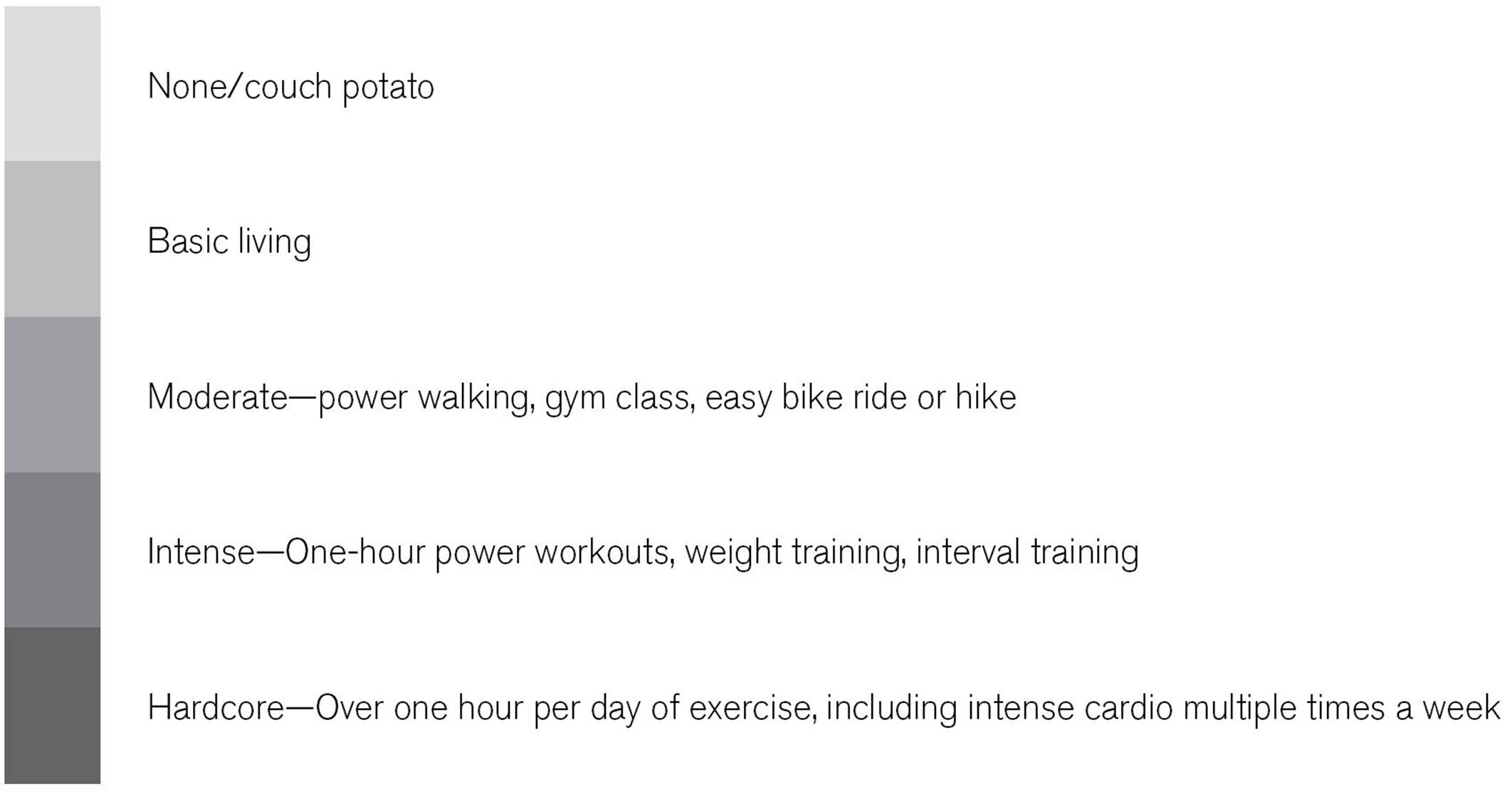
Where do you fit on the spectrum? I hope you realize by now that feeling guilty—“I’m only basic but I should be intense!”—is not only a waste of time, but the negativity can cause adverse effects on your body. Stress, even self-induced, pumps cortisol into your system that triggers your body into a defensive mode. There should not be stress here, especially when you now know that you don’t have to exercise to lose weight. Yes, exercise goes far beyond weight loss in terms of improving heart health and circulation, and releasing endorphins, which make us feel good. Exercise is important. But it’s not the focus of this book.
Coming clean, I fall into the highly intense to hardcore categories, depending on if I’m training for a marathon or ultra event. I recognize, however, that I work out too much. Exercising as much as I do to train for ultras and marathons puts me at risk. My body is constantly under stress. Luckily, I recognize this and am able to take actions to compensate.
Whether you’re a fitness demon or beginner exerciser, there are really only three things you must do in order to get the best performance and life out of your body. Here they are, in order of importance:
 Eat right
Get plenty of sleep
Lift heavy things occasionally
Ta-dah! Doesn’t sound that hard, does it? And it isn’t. We like to overcomplicate or overthink things and, sometimes, analysis can be fun. (You’re talking to the girl who has tracked the mileage on each pair of running shoes she owns for the past nine years.) But when you have those moments where you’re feeling overwhelmed, dial it back to basics. Eat right. Get your sleep. These two things alone will catapult (yes, catapult) you into good health. Adding in some occasional strength training is the sugar-free icing on the gluten-free cake that will shape your body and bring on additional health.
I can’t emphasize the importance of these three items enough. I mentioned above that chronic cardio of the type I do places a constant stress on the body. My way of compensating for all that stress is to—you guessed it—eat right, get plenty of sleep, and do strength training to balance out the muscle groups being worked in my body.
But what does eating right for an athlete look like? And what constitutes being “an athlete” to begin with? Let’s take a look.
AM I AN ATHLETE?
Let me tell you a story. This past summer, my friend Christie and I signed up to pace the two-hour group for a local half-marathon. When it comes to being loving and touchy-feely, Christie is a 30 on a 10-point scale. She lives to nurture. Me, not so much. The joke among our friends was that Christie would offer the “You all are doing wonderful, I’m so proud of each of you!” pep talks to the runners in our pace group while I would be behind the group screaming, “Why are you crying?! Run faster, b**ches!”34
I tell that story to share that I am in no way a touchy-feely person. And yet I hold the unshakable belief that anyone who shows up for the workout is an athlete. Whether you’re winning races or simply walking on the treadmill at the gym once or twice a week, you’ve got your game on. Anyone who exercises understands that working out is not the hard part. It’s showing up for the workout that requires fortitude. I’ve been running for almost ten years and yes, there are many, many days where I have to drag, beg, plead, and cajole myself to show up. I’m always glad I did, as I inevitably feel great once I’ve got a few miles under my feet, but the struggle never entirely goes away.
So before I dive into PV eating for athletes, I want to be clear that, as a former couch potato, I have complete and utter respect for anyone who is doing any level of exercise. With that said, as we talk about how to modify the PV diet for athletes, I am referring to a specific level of exercise. Namely, you’ll need to make modifications and allowances in your diet if you’re someone who exercises at a high-intensity level for over an hour at a time or if you’re completing intense or hardcore workouts several days a week. If you’re someone who performs low to moderate workouts, you shouldn’t need to vary your eating other than allowing for a few more carbs on heavy workout days.
PRE-WORKOUT TIPS
Even for high-intensity workouts, you’d be surprised how little food you need to complete a workout. As a runner, I had it drummed into me that I needed to carbo-load the night before a run and eat a solid carbohydrate-based meal a couple of hours before the run as well. It took a long time for me to drop that mindset. And really the only thing that changed my mind was experimenting and seeing firsthand how my runs and workouts didn’t suffer, and even improved, all without the carbo load.
Now, I eat a normal meal the night before a long (even 20 miles) run. I’m careful to make sure my meal contains protein and maybe some extra fat (More avocado? Yes, please), but I don’t eat huge portions and I certainly don’t load up on pasta and bread.
What really opened my eyes was working out in the fasted state. I always, always, always made sure to eat before any type of workout, strength or cardio. I thought I’d lose energy midworkout without the boost from food. But once I began intermittent fasting (see page 118), I ended up doing a couple of CrossFit workouts in the fasted state and—to my great surprise—I crushed them.
This isn’t to say you need to fast before a workout. But it does give you some freedom in that you know you don’t have to calorie load before a workout. If you prefer to eat before exercising, try to give yourself at least one to two hours in between a snack and your workout. A good pre-workout should be low on the glycemic index, so avoid fruit. A hard-boiled egg, a small cup of soup, or a small salad are all good choices.
Here are some tips I’ve tried that have worked well for me.
A small cup of soup or broth an hour before a workout is satisfying and can stave off hunger during the workout.
Eliminate carbo-loading. If you’re an endurance athlete, you might up your fat and carb uptake gradually in the week before your race, but training with your regular PV diet should be enough to get you through your workout.
Don’t use exercise as an excuse to reward yourself with food. This often happens with cardio workouts. The machine tells us we just burned 500 calories so we splurge and go eat a 480-calorie bagel or a smoothie with 30 grams of sugar. No, no, and no.
A tablespoon of almond butter before a workout sticks to the stomach without weighing you down.
I’m a huge fan of sweet potatoes as a healthy source for carbs. I’ll eat a small sweet potato before a long run or follow up my run with a sweet potato covered in butter or ghee.
Try exercising in the fasted state and note the results. Did you have more or less energy?
If you’re exercising at a high-intensity level for more than an hour, you’ll need to replenish midworkout. Please don’t rely on GUs and energy drinks that are filled with sugar and fake ingredients. Instead, bring a piece of fruit and some almond butter. I (no surprise) still like my sweet potato. I’ll microwave one in the morning and scoop the insides into a little baggie that I’ll carry with me on a long run. A hard-boiled egg is an easy-to-carry-along snack as well.
POST-WORKOUT TIPS
For endurance workouts that last over an hour, you’ll want to replenish with foods that have a 5:1 carb-to-protein ratio. For hard workouts, post-workout is the time when you can fudge a bit on the PV diet and go heavier on the carbs and sugar, as your body is in high-burn mode.
If you’ve done hard cardio, it’s okay to replenish the body with something like a banana or apple smeared with almond butter, or a hard-boiled egg and some dried (no-sugar-added) fruit. Sweet potato pancakes or any starchy vegetable such as squash, turnips, pumpkin, or yams are great post-workout choices. If you eat fish, a little smoked salmon is an ideal protein source, even better if it’s eaten alongside a carb source.
After a workout you want to focus more on carbs and protein. Save the fat for later meals. Why? You’re trying to get the carbs and protein absorbed into your system as quickly as possible, and fats slow down that process. Try to eat within 30 minutes of completing your workout, as the body is most susceptible to absorbing nutrients during that window. That’s when the post-fuel food aids in replenishing tired and depleted muscles.
Bear in mind that your need for replenishment will vary by individual and workout type. A one-hour yoga workout or 20 minutes of light weights won’t require anywhere near the same replenishment as 45 minutes on the bike or a super-heavy 30-minute weight-lifting session. Again, experiment, experiment, experiment to find out what works best for you.
Simple grab-on-the-go foods for the 30-minute post-workout recovery window include:
Banana or apple with almond butter
Handful of raisins or berries
Small sweet potato with a hard-boiled egg on the side
Mashed sweet potato mixed with pure, unsweetened, organic applesauce
Fried or scrambled eggs alongside Paleo toast with ghee, butter, or avocado spread
Any roasted root vegetables (turnips, parsnips, butternut squash, etc.) with a side of sautéed greens
PV Pancakes (page 84)
Cup of Spicy Coconut-Curry Lentil Stew (page 95)
IF YOU REALLY WANT A NUMBER…
I know, I know. If you’re like me, you don’t want to be told to experiment. You want guidelines. Okay. On average, when I’m trying to lean out and shed some weight, I aim to keep my sugars under 20 grams per day and my carbs under 120 grams. However, on the days I do heavy cardio, I’ll allow up to 100 extra grams of carbs. On heavy weight-lifting days, I’ll allow up to an extra 50. I’ve found I can do this and maintain my weight or even lose weight (fat). On heavy exercise days I still try to keep my sugars around 20 grams, but this number does go up slightly if I’m eating more sweet potato or fruit due to a big workout.
If you’re determined (like me) to indulge in the chronic cardio, it’s important you add those extra carbs so you don’t stress your body out. Deprive it of the replenishment it needs and it will react by holding on to fat. If you’re starting out at a much lower or beginning level of exercise, hold off on adding extra carbs to your diet. Once you transform from sugar-burning to fat-burning, you ought to have plenty of energy and resources available to you on that 120 to 150 grams of carbs per day base level.
Please use the above only as a guideline. You’re a different weight, height, body build, and probably exercise intensity level from me. What works for me may not be ideal for you. But start here and play with carb ratios until you find your sweet spot where you have plenty of energy to get through your workouts, feel satiated by your post-workout meals, and are still losing weight.
ONE MORE WORD ON EXERCISE AND EATING
Before we leave the world of eating and exercise, I must emphasize this fact: Have a plan. I can’t tell you the number of times I’ve made poor food choices after a workout simply because I failed to plan ahead. Running 18 miles and then walking into a bagel shop? Recipe for disaster. Now I know to make sure I have the right kinds of foods available to me after my workouts. I keep a bunch of hard-boiled eggs in the fridge. The day before an intense workout, I’ll go to the store and buy an apple to carry in my gym bag alongside some almond butter. I’ll even cook an omelette or roast a sweet potato and asparagus the night before a workout so I can come home, heat the food up in my microwave, and have a delicious and filling post-workout meal at hand. Premade vegetable frittatas are also really fun and a delicious option for a post-recovery meal. And here’s a down-and-dirty trick for when you’re really pressed for time—canned pumpkin. That’s right, you heard it here first.
If you’re starting to feel overwhelmed, take a deep breath and go back to the three basics: Eat right, get plenty of sleep, and lift some weights a couple of times a week. Keep it that simple.
What I’ve learned from this journey is that our bodies are amazingly adaptable. When fueled on an ongoing basis with high-quality whole foods, we don’t need all the extra sugars and food fillers to “get us through” a workout. Instead, our bodies remain in a highly prepared and energy-laden state.
To our health!

28Calculate BMI by dividing weight in pounds (lbs) by height in inches (in) squared and multiplying by a conversion factor of 703.
29That’s the equivalent of about 14 large eggs. http://www.marksdailyapple.com/definitive-guide-to-the-primal-eating-plan/#ixzz3IZfH2vMp
30I would recommend when you start out that you track your protein intake as well. Once you’ve got a handle on that, you can focus more exclusively on sugar as suggested here.
31At least, not without ballooning up in weight due to the amount you’d need to eat.
32If you’ve never roasted raw fennel in your oven you are missing out on a heavenly aroma filling your home. Drizzled with just a bit of olive oil—delicious!
33Damn it.
34True story: My office requires everyone take a personality test before hiring. The CEO sat down with me to go over my results and he was whipping through them, “Self-motivated. Good. Strong attention to detail. Good,” when he came to an abrupt stop. He looked at me, looked at the page, looked back at me. “So,” he said. “Nurturing. Uh, you scored a 7 out of 100.” To this day, friends and coworkers refer to me as “Seven.”