
Endoscopically, the unremarkable esophagus has smooth, homogenous pink-tinged mucosa (Fig. 1.1). Clinicians often label the biopsy location in centimeters, which refers to the distance from the patient’s incisors to the biopsy site (Fig. 1.2). Consequently, the gastroesophageal junction varies with the patient’s height and anatomy, although it is most typically at 40 cm in men. Histologically, the esophagus can be compartmentalized into four layers (mucosa, submucosa, muscularis propria, and adventitia) (Fig. 1.3). The mucosa consists of epithelium, lamina propria, and muscularis mucosae. Lamina propria is a loose fibroconnective tissue rich in inflammatory cells, lymphovascular channels, and esophageal glands and ducts. It spans the space between the epithelium and the muscularis mucosae. Proceeding deeper into the esophageal wall, the submucosa is the next encountered layer. It sits between the muscularis mucosae and the muscularis propria and it consists of loose fibroconnective tissue and lymphovascular channels. The muscularis propria constitutes the largest portion of muscle in the esophageal wall. It consists of inner circular and outer longitudinally oriented muscle fibers. In the proximal esophagus, the muscularis propria is composed of skeletal muscle and in the distal esophagus, it is composed of smooth muscle. The outermost layer is the adventitia, which lacks serosa, facilitating potentially rapid spread of infectious agents and malignancy.
Normal esophageal epithelium is stratified squamous epithelium (Fig. 1.4). The basal layer is 1 to 2 cells thick and the vascular papillae are within the lower one-third of the epithelium. Esophageal biopsies can also contain cardiac mucosa, which is almost always chronically inflamed (Fig. 1.5). As a result, it is not necessary to routinely diagnose “chronic inflammation” in the cardia. Since many specimens are submitted with a request to “rule-out Barrett esophagus,” diagnoses specifically including phrases such as “no goblet cells are seen” can be helpful to clinicians in unremarkable esophageal biopsies from adult patients.
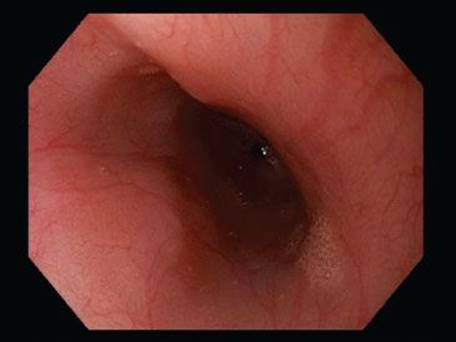
Figure 1.1 Unremarkable endoscopic appearance of the esophagus. The pink-tinged mucosal surface appears relatively smooth and homogenous throughout the esophagus. There are no visible plaques, nodules, masses, ulcers, erythema, blood, varices, stenoses, or diverticula. Variations of luminal caliber in the image may stem from esophageal peristalsis, anatomic bends, and constriction points.
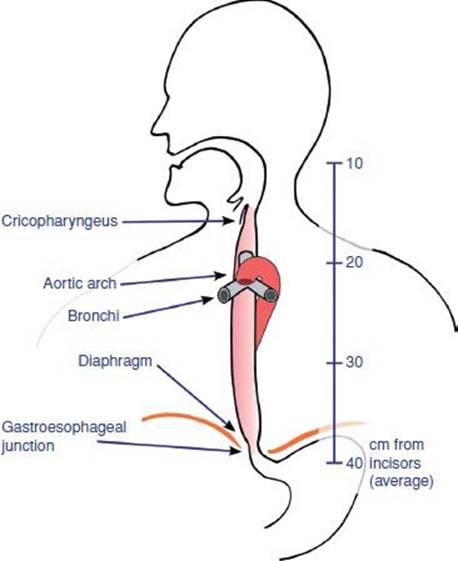
Figure 1.2 Anatomic esophageal constriction points include the esophageal inlet, crossing of the aortic arch, left main bronchus, and diaphragmatic hiatus. These sites are prone to narrowing and can lead to pill impaction and associated local tissue damage.
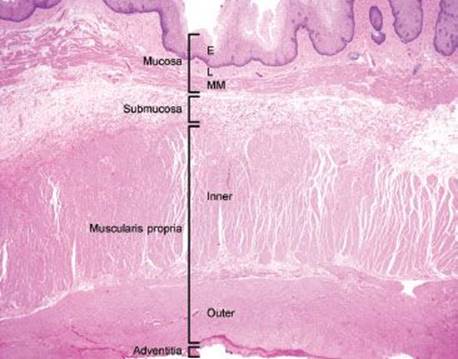
Figure 1.3 This resection specimen illustrates the four main layers of the esophagus: Mucosa, submucosa, muscularis propria, and adventitia. The mucosa consists of epithelium (E), lamina propria (L), and muscularis mucosae (MM). The submucosa sits between the muscularis mucosae and the muscularis propria (MP) and it consists of loose fibroconnective tissue and lymphovascular channels. The MP consists of inner circular and outer longitudinally oriented muscle fibers. Finally, the outermost layer is the adventitia. The esophagus lacks a serosa.
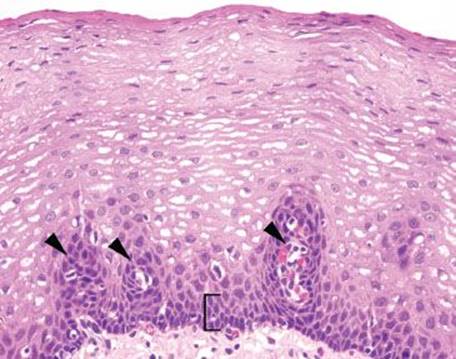
Figure 1.4 Unremarkable esophageal squamous mucosa. Note the basal layer is only a few cell layers thick (bracket) and the vascular papillae are confined to the lower one-third of the epithelial thickness (arrowheads).
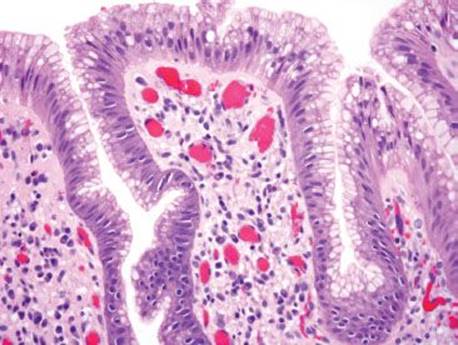
Figure 1.5 Unremarkable cardiac mucosa at the gastroesophageal junction. The columnar cells are of foveolar type, with apical intracytoplasmic neutral mucin that would be magenta on a PAS/AB.
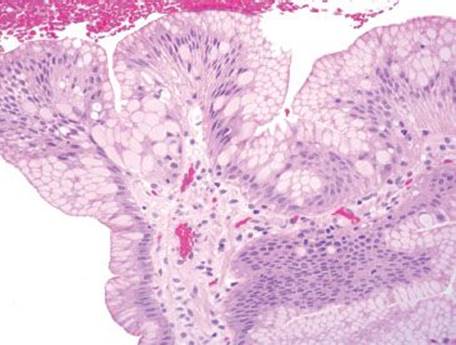
Figure 1.6 Pseudogoblet cells. Pseudogoblet cells are important mimics of true goblet cells of Barrett esophagus and are typically found in clusters. They can be mistaken for true goblet cells due to their abundant cytoplasmic mucin.
PEARLS & PITFALLS
Beware of pseudogoblet cells, which are important mimics of true goblet cells. Pseudogoblet cells are foveolar epithelial cells with prominent cytoplasmic distention and key distinctions from true goblet cells include the following: (1) Pseudogoblets tend to aggregate in clusters, whereas true goblet cells are more sparsely distributed among absorptive cells (complete metaplasia) or foveolar cells (incomplete metaplasia). (2) Pseudogoblet cells have predominantly neutral mucin (magenta, PAS/AB) in contrast to the acid mucin of a true goblet cell (deeply basophilic, PAS/AB) (Figs. 1.6–1.10).
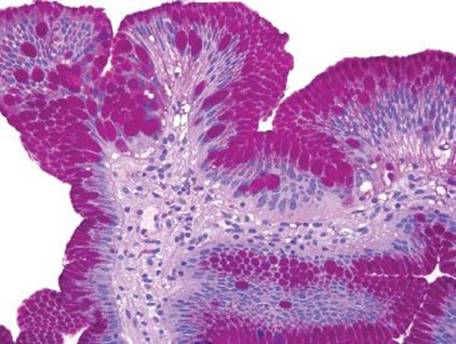
Figure 1.7 Pseudogoblet cells (PAS/AB). On PAS/AB stain, the neutral mucin in the pseudogoblet cells is magenta. True goblet cells contain acidic mucin, and are deeply basophilic on PAS/AB.
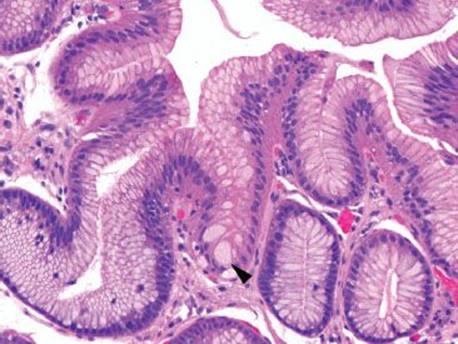
Figure 1.8 Pseudogoblet cells (arrowhead).
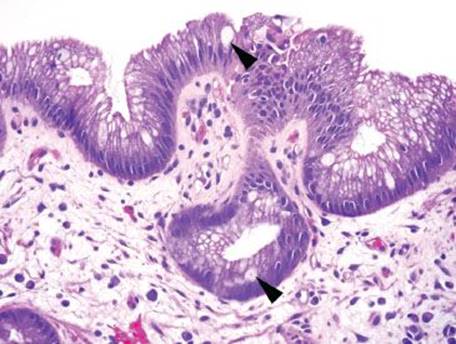
Figure 1.9 True goblet cells. In contrast to pseudogoblet cells, true goblet cells are sparsely distributed (arrowheads).
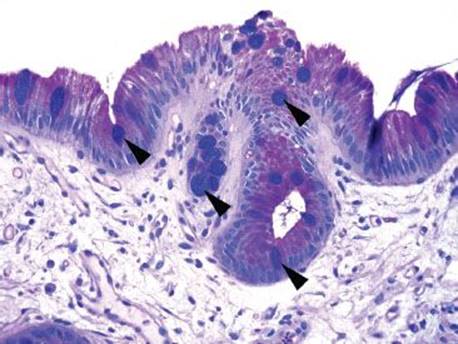
Figure 1.10 True goblet cells (PAS/AB). In contrast to pseudogoblet cells, true goblet cells (arrowheads) have a deeply basophilic appearance on a PAS/AB.
FAQ: What is the utility of and recipe for Periodic acid Schiff/alcian blue, pH 2.5 special stain (PAS/AB)?
Answer: The combination PAS/AB allows for simultaneous evaluation of a number of important diagnostic features, such as fungal forms (magenta), goblet cells (deeply basophilic), an intact small bowel brush border (crisp and uniform stain condensation). The stain also highlights the mucin of sneaky adenocarcinomas.
1% ALCIAN BLUE, pH 2.5 RECIPE*
Alcian blue 8GX……..5 g
Acetic acid, 3% solution….500 mL
Adjust the pH to 2.5. Filter and add a few crystals of thymol.
*This solution is commercially available.
PAS/AB pH 2.5 RECIPE
1. Deparaffinize and hydrate to distilled water.
2. One minute in 3% acetic acid. Do not rinse.
3. Stain in Alcian Blue pH 2.5 for 30 minutes.
4. Rinse in tap, then distilled water.
5. Oxidize in 0.5% periodic acid solution for 10 minutes.
6. Rinse in distilled water.
7. Place slides in Schiff reagent for 20 minutes.
8. Wash in running tap water for 5 minutes, or until water is clear and sections are pink.
9. Stain in Harris hematoxylin for 3 minutes.
10. Wash in tap water.
11. Clarifier for 1 minute.
12. Wash in tap water for 1 minute.
13. Bluing reagent for 1 minute.
14. Wash in running water for 1 minute.
15. Dehydrate through 95% alcohol, absolute and clear in xylene.
16. Mount.
Recipe courtesy of Deborah Duckworth, Johns Hopkins Hospital, Histology Laboratory.
FAQ: Are there histologic clues that confirm the biopsy site as esophagus (and not cardia, for example)?
Answer: Yes. Establishing the tissue origin as esophagus is critical for the diagnosis of Barrett mucosa, a diagnosis that necessitates periodic surveillance based on an increased risk of neoplasia. Usually correlation with the endoscopic report provides the most effective means to determining the tissue site of origin. Unfortunately, detailed reports are not always provided, and clinicians may not be confident that they are in the tubular esophagus, especially if a patient has a sliding hiatal hernia. Since esophageal ducts transmit secretions from the esophageal submucosal glands to the luminal surface, their histologic identification can establish the tissue site as esophagus, providing helpful diagnostic clues (Figs. 1.11–1.20).
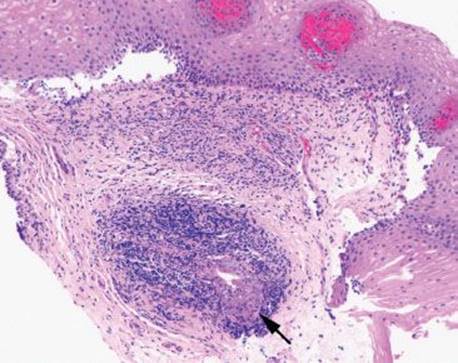
Figure 1.11 Esophageal ducts. Esophageal ducts confirm the site of origin as esophageal (arrow). If goblet cells were present on this tissue fragment, they would signify Barrett esophagus, assuming an abnormal endoscopic examination.
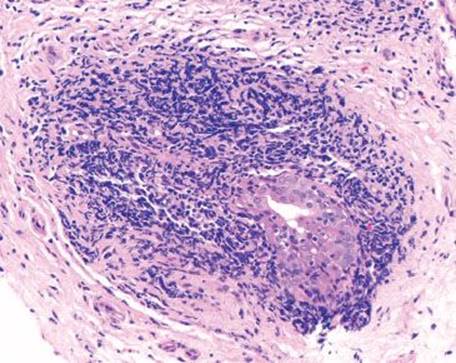
Figure 1.12 Esophageal duct. Higher power of previous figure. Periductal chronic inflammation is a typical finding. Squamoid metaplasia of the ducts is not uncommon.
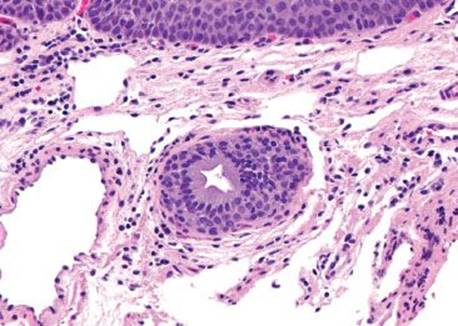
Figure 1.13 Esophageal ducts. This esophageal duct is present in the lamina propria, amidst a background of lymphovascular spaces. The overlying squamous epithelium can be seen (top).
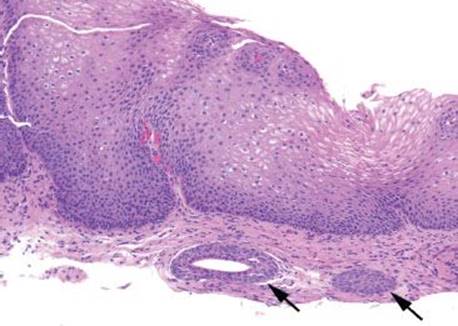
Figure 1.14 Esophageal ducts (arrows).
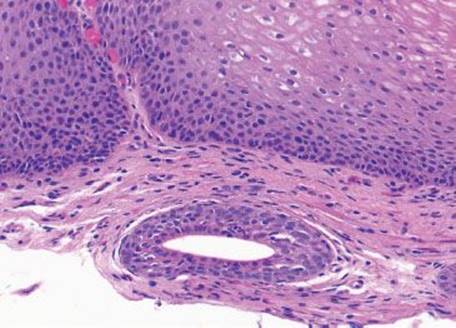
Figure 1.15 Esophageal duct. Higher power of previous figure.
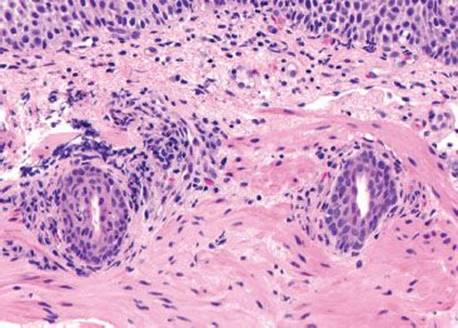
Figure 1.16 Esophageal ducts. These ducts are traversing the muscularis mucosae en route from submucosal glands. Their presence indicates that the tissue origin is esophageal.
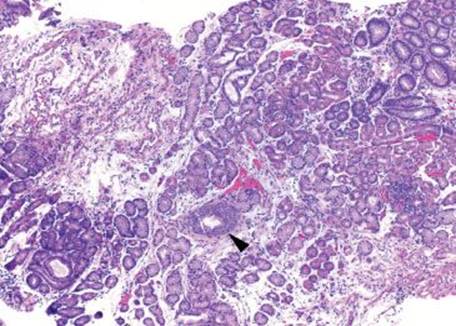
Figure 1.17 Esophageal duct (arrowhead). This biopsy predominantly consists of oxyntic-type glandular mucosa. An esophageal duct (arrowhead) signifies that this biopsy was taken from the tubular esophagus. The proximity to gastric oxyntic glands emphasizes the variability of gastric cardia length among patients; while some patients may demonstrate several centimeters of gastric cardiac-type mucosa, others transition directly from esophagus to oxyntic mucosa, like this patient.
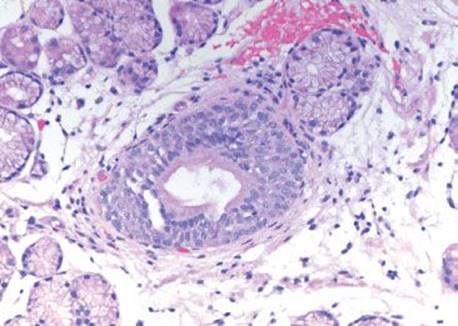
Figure 1.18 Esophageal duct. Higher power of previous figure.
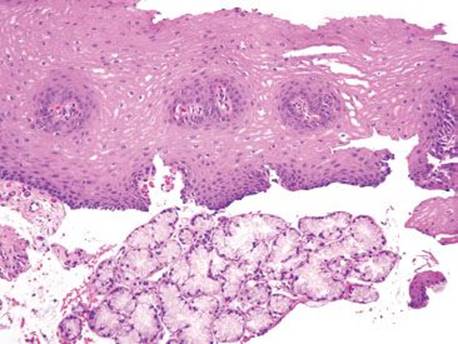
Figure 1.19 Esophageal glands. Esophageal glands produce mucoprotective products that help lubricate the passage of food and, at the same time, protect the integrity of the esophageal mucosa.
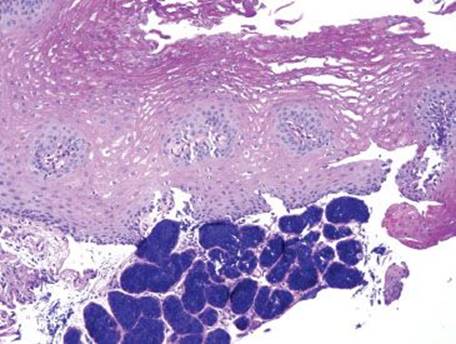
Figure 1.20 Esophageal glands (PAS/AB). The esophageal glands stain deeply basophilic on PAS/AB. In contrast, cardiac-type mucosal glands would appear magenta on PAS/AB (Fig. 1.7).