
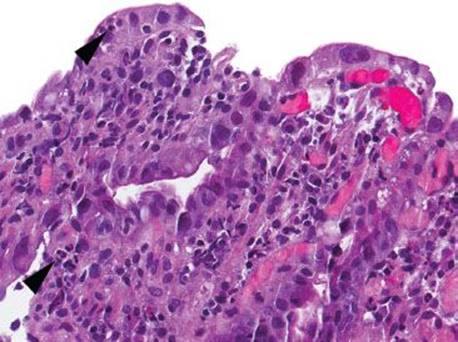
Figure 3.38 Acute duodenitis pattern. Acute duodenitis refers to acute inflammation in the duodenal epithelium (arrowheads). In this particular example, infiltrating pancreatic adenocarcinoma (not shown) was identified lurking within the acute inflammation, underscoring the importance of recognizing seemingly bland clues, such as acute duodenitis, to help uncover critical diagnoses.
CHECKLIST: Etiologic Considerations for the Acute Duodenitis Pattern (Fig. 3.38)
 Peptic Injury (due to excess acid)
Reactive Duodenitis (mild histologic changes)
Peptic Ulcer Disease (marked histologic changes)
Infection
Medication (NSAIDs)
Cigarette Smoking
Zollinger–Ellison Syndrome
Inflammatory Bowel Disease
Infiltrative Processes
Radiation Injury
Ischemia
Vasculitis
The acute duodenitis pattern refers to acute inflammation in the epithelium of the duodenum. This injury pattern is most commonly seen in the setting of peptic injury, infection, and medication injury, but can also be a clue to inflammatory bowel disease (IBD), infiltrative processes, ischemia, radiation injury, and others. Careful attention to the clinical presentation and scrutiny of the surrounding mucosa is critical to arriving at the correct diagnosis. Acute duodenitis can be further classified as “mild,” “moderate,” or “marked” based on the qualitative distribution of the acute inflammation; counting neutrophils is not necessary. For a simple rule of thumb, “mild” includes villitis and cryptitis, “moderate” is indicated by crypt abscesses, and “marked” is indicated by sheets of neutrophils with or without erosion/ulceration. By definition, histologic features of chronic injury are absent, that is, architectural distortion, gastric foveolar metaplasia, and pyloric gland metaplasia are not seen with simple acute duodenitis. When features of chronic damage are established, the injury has occurred over a longer time period and the differential diagnostic considerations expand to include chronic injury of any sort (i.e., chronic peptic injury, chronic infections, chronic medication injury, in addition to IBD and others).
PEPTIC INJURY
Peptic injury describes a broad morphologic range of duodenal injury ranging from spotty acute inflammation to deep, penetrating ulcers. At the mild end of the spectrum, peptic injury manifests with the following histologic features:
1. Increased plasma cell infiltration
2. Neutrophils in the lamina propria or epithelium (or in both) (Figs. 3.39 and 3.40)
3. Reactive epithelial changes including villous blunting
4. Gastric foveolar (mucin cell) metaplasia
This mild injury pattern is interchangeably referred to as “reactive duodenopathy,” “gastric foveolar metaplasia,” “chronic peptic duodenopathy,” “chronic peptic duodenitis” and “peptic-type duodenopathy.” Based on the variable villous blunting, the pattern is more extensively discussed in the Malabsorption Pattern, this chapter. Briefly, this pattern is historically associated with excessive gastric acid production coupled with insufficient protective effects of bicarbonate. Strong links with Helicobacter are not seen in reactive duodenopathy, in contrast to peptic ulcer disease (PUD). PUD represents the extreme range of peptic injury characterized by ulcerations, marked acute and chronic inflammation, mucin attenuation, and reactive changes. PUD is attributable to Helicobacter in the majority of cases, although nonsteroidal anti-inflammatory drugs (NSAIDs) and cigarette smoking are also implicated. Recurrent, multifocal, or marked peptic ulcer disease may serve as an important red flag to Zollinger–Ellison syndrome. Recall that Zollinger–Ellison syndrome is characterized by gastrinoma (and tumor-mediated hypergastrinemia), hyperplasia of the oxyntic compartment, increased gastric acid production, and gastric and small bowel ulcerations. See also Hyperplasia Pattern, Stomach Chapter.
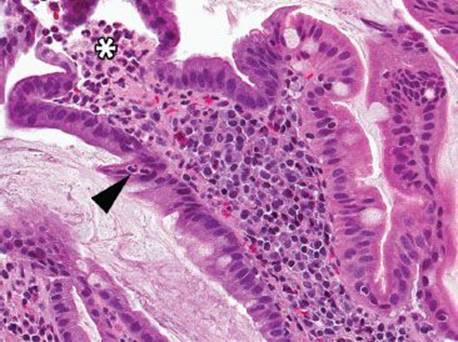
Figure 3.39 Acute duodenitis pattern, peptic injury. Acute duodenitis is an etiologically nonspecific injury pattern most commonly seen in the setting of peptic injury, infection, and medication injury. Neutrophils are seen in the epithelium (arrowhead) and lamina propria (asterisk).
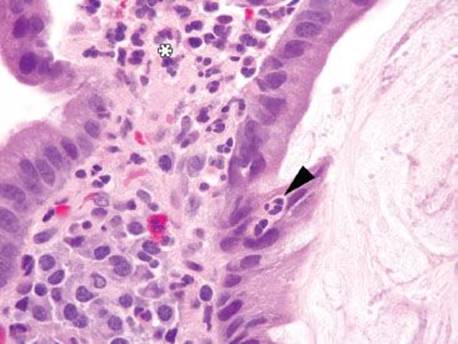
Figure 3.40 Acute duodenitis pattern, peptic injury. Under oil immersion, the neutrophils are more easily seen in the epithelium (arrowhead) and lamina propria (asterisk). The cause of the injury is unknown.
INFECTION
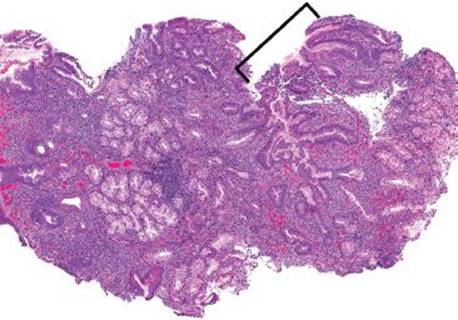
Figure 3.41 Acute duodenitis pattern, Helicobacter pylori. This case of Helicobacter pylori duodenitis shows similar features to Helicobacter pylori gastritis. At low power, increased acute and chronic inflammation is seen, which is particularly prominent toward the superficial mucosa. Gastric foveolar metaplasia (bracket) provides a hospitable environment for Helicobacter and should always be carefully checked for organisms.
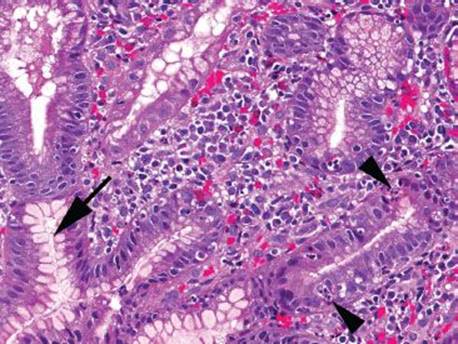
Figure 3.42 Acute duodenitis pattern, Helicobacter pylori. At higher power, intraepithelial acute inflammation (arrowheads) and prominent superficial plasma cells provide helpful red flags to the underlying Helicobacter infection. A rare Helicobacter organism is seen (arrow). Since this case had no corresponding stomach biopsy, the only opportunity to diagnosis and treat the infection stemmed from recognizing this injury pattern and carefully searching for the rare Helicobacter organisms.
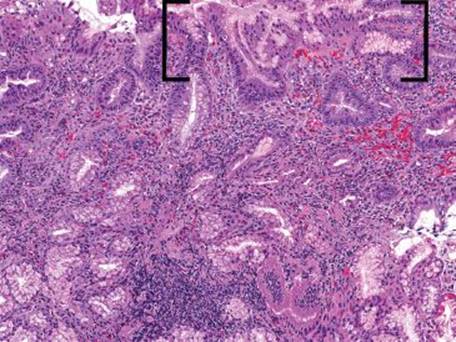
Figure 3.43 Acute duodenitis pattern, Helicobacter pylori. This low power image shows features highly suspicious for a Helicobacter infection with a prominent superficial lymphoplasmacytic infiltrate, acute inflammation (not seen at this power), and gastric metaplasia (brackets). The organisms were seen in abundance on a Diff–Quik special stain (not shown) in the gastric metaplastic zones.
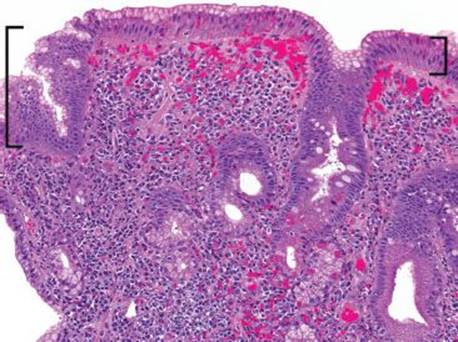
Figure 3.44 Acute duodenitis pattern, Helicobacter pylori. This low power image shows features reminiscent of those of exuberant Helicobacter gastritis. Note the prominent superficial lymphoplasmacytic infiltration and gastric metaplasia (brackets). Brisk acute inflammation and Helicobacter organisms were seen on higher power (not shown).
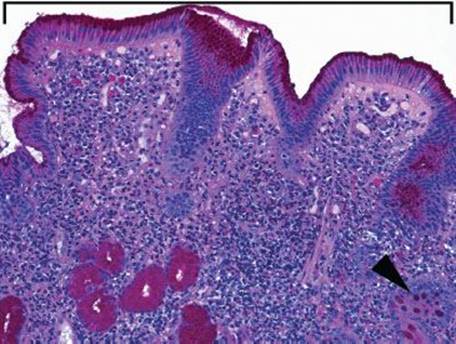
Figure 3.45 Acute duodenitis pattern, gastric foveolar metaplasia (PAS/AB). A PAS/Alcian blue pH 2.5 special stain highlights the neutral mucin characteristic of gastric foveolar metaplasia (bracket), similar to native stomach mucosa. In contrast, goblet cells display basophilia because of acidic mucin (arrowhead).
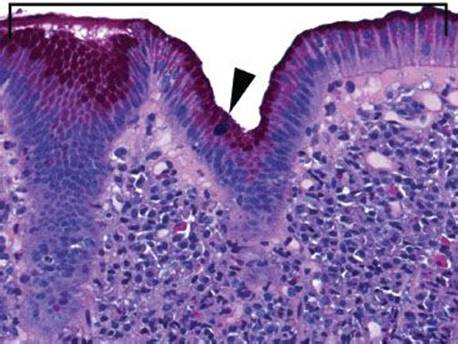
Figure 3.46 Acute duodenitis pattern, gastric foveolar metaplasia (PAS/AB). Gastric foveolar metaplasia appears eosinophilic because of neutral mucin (bracket); goblet cells are basophilic because of acidic mucin (arrowhead). Note the abundant superficial plasma cells with a sprinkling of acute inflammation, features suggestive of Helicobacter duodenitis (organisms not shown).
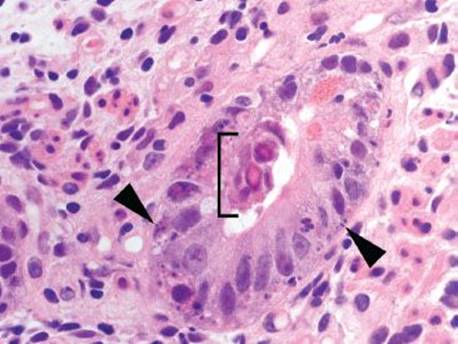
Figure 3.47 Acute duodenitis pattern, adenovirus infection. Prominent apoptotic bodies (arrowheads) and scattered intraepithelial neutrophils serve as helpful red flags to the characteristic adenovirus inclusions (bracket). Note the glassy and eosinophilic intranuclear inclusions typical for adenovirus. Since similar findings can be seen with degenerative change, a confirmatory adenovirus immunostain was performed and was reactive (not shown).
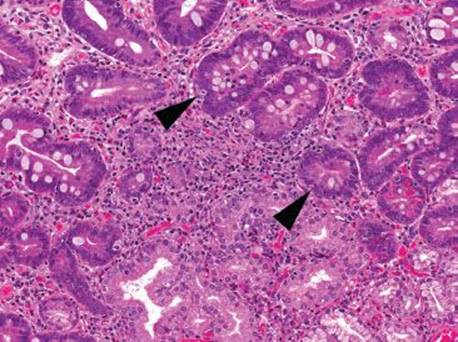
Figure 3.48 Acute duodenitis pattern, CMV infection. In this case, a smattering of acute inflammation and increased apoptotic bodies (arrowheads) serve as important clues to the diagnosis of CMV enteritis.
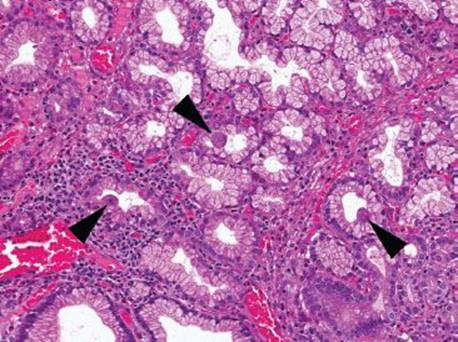
Figure 3.49 Acute duodenitis pattern, CMV infection. Careful inspection of the nearby mucosa revealed abundant Brunner epithelium with classic CMV viral cytopathic effect (arrowheads): cytolomegaly, prominent nucleoli, and both nuclear and cytoplasmic viral inclusions are seen. In the stomach and small bowel, viral cytopathic effect is often more conspicuous in the epithelium than the stromal and endothelial cells. These viral inclusions were diagnostic (a CMV immunostain was not required).
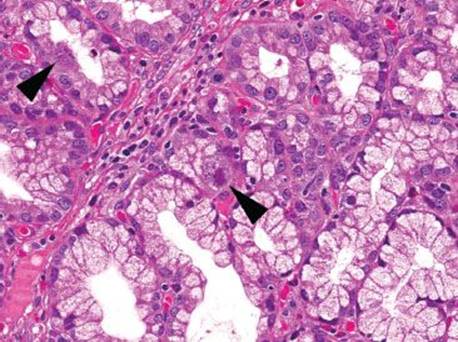
Figure 3.50 Acute duodenitis pattern, CMV infection. Higher power of another field shows classic CMV viral cytopathic effect with cytolomegaly and prominent nuclear and cytoplasmic viral inclusions (arrowheads). Although not included on the requisition, chart review revealed a history of febrile diarrhea, metastatic colorectal carcinoma, and concurrent chemotherapy. This case underscores the importance of recognizing this acute enteritis pattern, even when the history of immunosuppression is not apparent on the requisition.
Helicobacter remains a leading contender in infectious agents associated with the acute duodenitis pattern. Its histology can show similar features to the analogous gastric process with brisk acute and chronic inflammation and conspicuous superficial plasma cells (Figs. 3.41–3.46). If not apparent on H&E, a Helicobacter immunostain can be utilized for suspicious cases.7 Not to be missed, adenovirus and CMV are similarly important infectious agents, particularly in immunocompromised patients. The characteristic intranuclear adenovirus inclusions are glassy eosinophilic, and can be highlighted with an adenovirus immunostain (Fig. 3.47). Adenovirus treatment involves lowering immunosuppressive agents, making the distinction from graft versus host disease (GVHD) critical because GVHD therapy requires increased immunosuppressive therapy. See also GVHD, Lymphocytic Pattern, Esophagus Chapter. Similar to CMV infections of other sites, the characteristic inflammatory backdrop shows a prominence of mononuclear inflammation (lymphocytes, macrophages, lymphocytes, and plasma cells), in addition to active background injury and increased apoptotic bodies. The classic CMV viral cytopathic effect includes nuclear enlargement, prominent nuclear inclusions (with an “owl’s eye” appearance), and cytoplasmic inclusions (Figs. 3.48–3.50). In the stomach and small bowel, CMV viral cytopathic changes can be more prominent in the epithelium rather than the stromal and endothelial cells; the latter changes more common in CMV esophagitis, colitis, and proctitis.
KEY FEATURES of the Acute Duodenitis Pattern:
• Acute duodenitis refers to acute inflammation in the epithelium of the duodenum.
• The most common etiologies include peptic injury, infection, and medication injury.
• Reactive duodenopathy shows mild mucosal damage and is due to excess gastric acid; it has no strong association with Helicobacter.
• Peptic ulcer disease is due to Helicobacter in the majority of cases, although NSAIDs and cigarette smoking also play a causal role.
• Helicobacter remains the most common identifiable infectious etiology of the acute duodenitis pattern.