
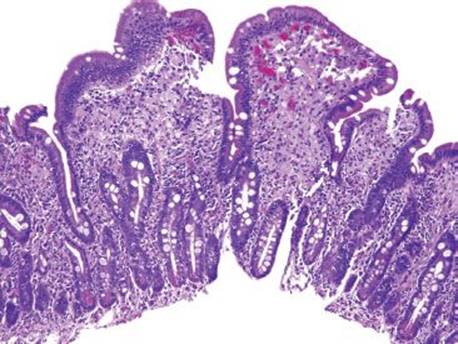
Figure 3.225 Foamy macrophage pattern, Whipple disease. When foamy macrophages are particularly prominent, Mycobacterium avium-intracellulare infection and Whipple disease are the front-line differential considerations. This case was ultimately diagnosed as Whipple disease based on the abundant, coarsely globular, PAS reactive cytoplasmic inclusions, a reactive Whipple immunohistochemical stain (not shown), and a negative AFB special stain (not shown).
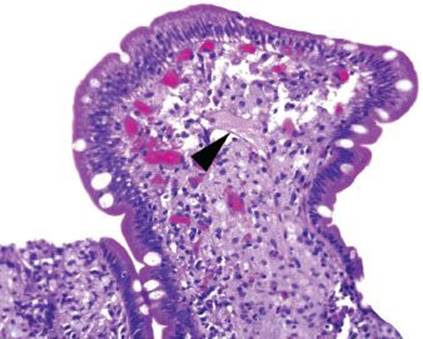
Figure 3.226 Foamy macrophage pattern, Whipple disease. On higher power, the foamy macrophages are better appreciated. Note the dilated lacteal (arrowhead), a distinctive feature of Whipple disease.
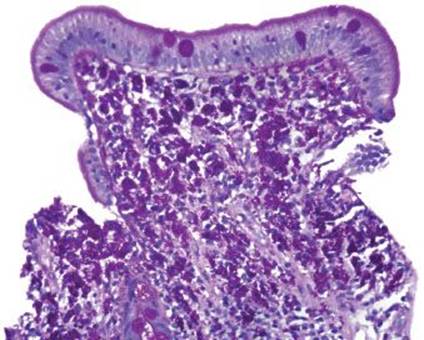
Figure 3.227 Foamy macrophage pattern, Whipple disease (PAS/D). The PAS/D special stain highlights the contents of the foamy macrophages: abundant, coarsely globular, PAS reactive cytoplasmic inclusions are seen. This patient presented with arthralgias and diarrhea, and all symptoms responded to antibiotic therapy.
The foamy macrophage pattern in the small bowel primarily invokes the differential diagnosis of Mycobacterium avium intracellulare, Whipple disease, and nonspecific histiocytosis (Figs. 3.225–3.227). This pattern generally refers to sheets of foamy macrophages in the lamina propria, exclusive of organized epithelioid histiocytes seen in granulomatous inflammation. If the clinical impression is of a mass lesion, other neoplastic considerations on H&E include Langerhans cell histiocytosis, mast cell neoplasms, melanoma, and infiltrating carcinomas. Sorting through these histologically similar processes usually requires ancillary special stains and chart review. In this section, the most common and clinically relevant diagnoses will be discussed.
CHECKLIST: Etiologic Considerations for the Foamy Macrophage Pattern
 Mycobacterium avium intracellulare
Whipple Disease
Nonspecific Histiocytosis
Other considerations, Langerhans Cell Histiocytosis, Mast Cell Neoplasms, Melanoma, and Carcinomas
MYCOBACTERIUM AVIUM-INTRACELLULARE
Mycobacterium avium and intracellulare are two species of atypical mycobacterium that are collectively referred to as mycobacterium avium-intracellulare (MAI), previously termed mycobacterium avium complex (MAC). MAI is ubiquitous in the environment and the most common human pathogen of the atypical mycobacteria. It is transmitted by inhalation into the respiratory tract and by ingestion into the gastrointestinal tract. MAI is considered an AIDS-defining opportunistic infection primarily affecting those with CD4 counts less than 50 cells/μL, but it can also be seen in the non-HIV setting, such as in individuals otherwise immunocompromised (i.e., patients on chemotherapy or heavy immunosuppressive agents). Mycobacterium avium accounts for more than 95% of infections in AIDS patients, whereas Mycobacterium intracellulare is responsible for 40% of infections in the immunocompetent. Infection of the bowel most commonly is associated with weight loss, abdominal pain, and diarrhea. Histologically, MAI is characterized by variably blunted villi engorged with foamy macrophages (Figs. 3.228–3.230). In contrast to Whipple disease, MAI organisms are delicate, uniform rods on both PAS and AFB special stains (Figs. 3.231 and 3.232). In addition, dilated lacteals and fat droplets are absent, providing further helpful points of distinction from Whipple disease. Treatment includes two or three antimicrobials for at least 12 months.
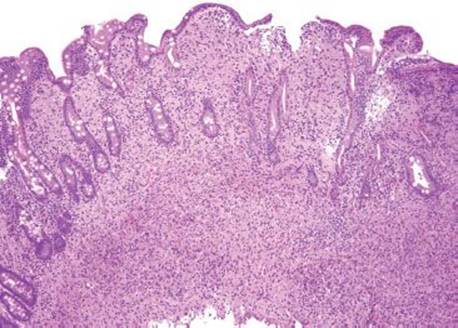
Figure 3.228 Foamy macrophage pattern, Mycobacterium avium-intracellulare (MAI). This biopsy features blunted villi and an expansion of the lamina propria by abundant foamy macrophages. Dilated lacteals and fat droplets are absent, features favoring a low power diagnosis of MAI over Whipple disease. Moreover, chart review revealed a history of HIV/AIDS, a clinical feature more common to MAI than Whipple disease.
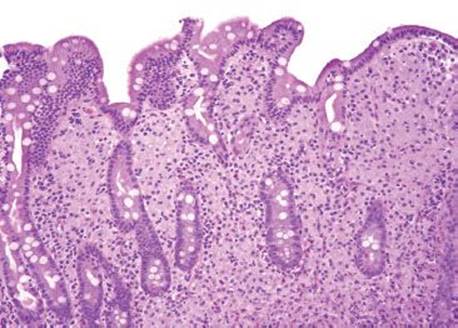
Figure 3.229 Foamy macrophage pattern, Mycobacterium avium-intracellulare (MAI). Higher power better illustrates the expansion of the lamina propria by numerous foamy macrophages.
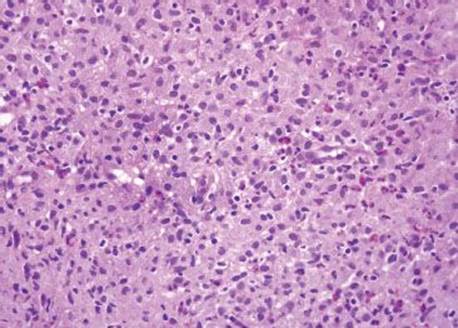
Figure 3.230 Foamy macrophage pattern, Mycobacterium avium-intracellulare (MAI). Highest power reveals a sprinkling of lamina propria neutrophils among the foamy macrophages.
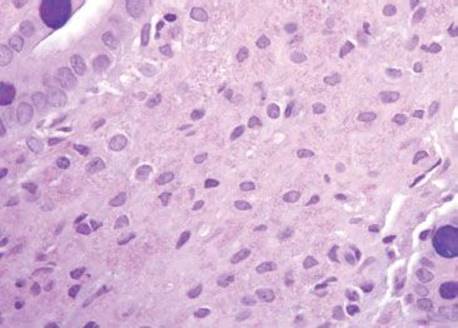
Figure 3.231 Foamy macrophage pattern, Mycobacterium avium-intracellulare (MAI) (PAS/D). A PAS/D special stain highlights the red, uniform bacilli characteristic of MAI. They are almost difficult to appreciate, even on oil magnification, due to their delicate size. Compare to the more globular and coarse PAS reactive inclusions characteristic of Whipple disease (Fig. 3.236).
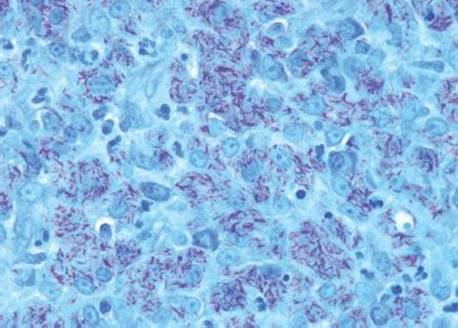
Figure 3.232 Foamy macrophage pattern, Mycobacterium avium-intracellulare (MAI) (AFB). An AFB special stain confirms the mycobacterium infection by highlighting the abundant red bacilli (Whipple disease is AFB nonreactive).
KEY FEATURES of Mycobacterium avium-intracellulare:
• Mycobacterium avium-intracellulare (MAI) is the most common human pathogen of the atypical mycobacteria.
• It is transmitted by inhalation into the respiratory tract and by ingestion into the gastrointestinal tract.
• MAI is considered an AIDS-defining opportunistic infection but also affects individuals otherwise immunocompromised.
• Histologically, MAI is characterized by variably blunted villi engorged with foamy macrophages on H&E.
• In contrast to Whipple disease, MAI organisms are delicate, uniform rods on both PAS and AFB special stains.
• Dilated lacteals and fat droplets are absent.
PEARLS & PITFALLS
Since MAI is consistently identified in immunocompromised patients, it serves as an important red flag that the patient is at risk for other sneaky infectious agents and malignancies. Look twice for these easily miss-able additional infectious agents in biopsies of the tubular gastrointestinal tract:
• Cytomegalovirus
• Adenovirus
• Herpes simplex virus
• Cryptosporidium
• Isospora
• Candida
• Spirochetosis
• Syphilitic or Lymphogranuloma venereum proctocolitis
WHIPPLE DISEASE
Whipple disease is very rare and caused by the gram-positive actinobacterium Tropheryma whipplei. Although the mode of transmission is not entirely understood, fecal–oral transmission has been postulated based on an increased incidence among sewage treatment workers and identification of the organisms in human waste and oral samples.151–153 Despite over a hundred years of experience with Whipple disease, the core clinical features endure: Whipple disease remains a disease of adult white men who often report years of arthralgias followed by abdominal pain, malabsorption, weight loss, and diarrhea.154 More recently, an association with non-HIV immune-mediated conditions has been reported, which may reflect overlapping and complicated disease presentations or perhaps a predisposition to Whipple disease by particular immunosuppressed hosts, such as those patients on high-dose steroids for sarcoidosis, ankylosing spondylitis, IBD, or rheumatoid arthritis. Prior to antibiotics, Whipple disease was universally fatal. Although antibiotics can lead to rapid resolution of disease symptoms, unfortunately up to 30% of patients relapse, particularly those with CNS involvement. Consequently, antibiotic therapy for Whipple disease is often long term (at least 12 months), and can sometimes be lifelong. Histologically, classic Whipple disease is characterized by villous blunting, lamina propria expansion by numerous foamy macrophages, and scattered dilated lacteals and fat droplets (Figs. 3.233 and 3.234). The foamy macrophages contain abundant PAS reactive, variably-sized cytoplasmic inclusions (Figs. 3.235 and 3.236). The organisms can be confirmed by a T whipplei immunohistochemical stain (Fig. 3.237) or PCR assay targeting T. whipplei’s 16 S ribosomal genes. Importantly, direct (inadvertent) antibiotic treatment of Whipple disease can result in dramatic treatment effects that can resemble normal or near normal histology, requiring a low-threshold for a careful chart review, discussion with a clinician, and ordering confirmatory ancillary studies (Figs. 3.238–3.244).
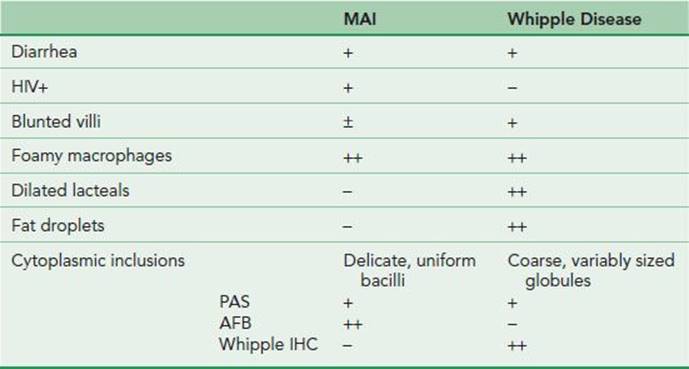
A summary of the distinguishing features of MAI versus Whipple disease can be found in Figure 3.245 and Table 3.8.
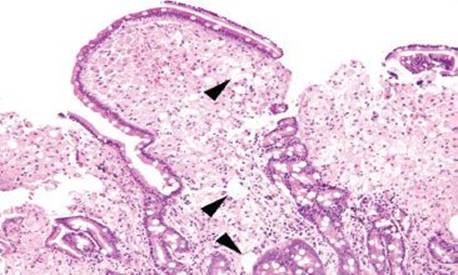
Figure 3.233 Foamy macrophage pattern, classic Whipple disease. This biopsy originated from a 62-year-old man with a history of arthralgias, diarrhea, and significant weight loss. The small bowel biopsy shows blunted villi with prominent foamy macrophages and scattered dilated lacteals and fat droplets (arrowheads). These clinicopathologic features are highly suggestive of Whipple disease.
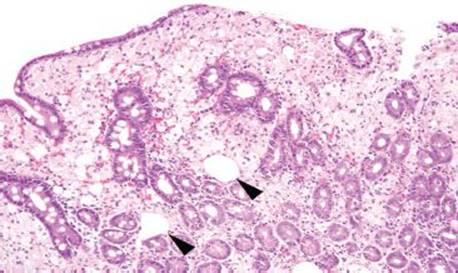
Figure 3.234 Foamy macrophage pattern, classic Whipple disease. This case of Whipple disease also features blunted villi, prominent foamy macrophages, and scattered dilated lacteals and fat droplets (arrowheads), histologic features of classic Whipple disease. A PAS/D special stain highlighted abundant, variably sized cytoplasmic inclusions, a Whipple immunohistochemical stain was reactive, and an AFB special stain was nonreactive (not shown).
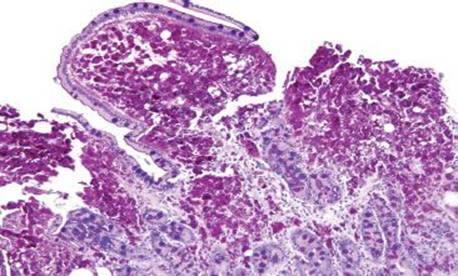
Figure 3.235 Foamy macrophage pattern, classic Whipple disease (PAS/D). A PAS/D special stain highlights abundant variably-sized cytoplasmic inclusions.
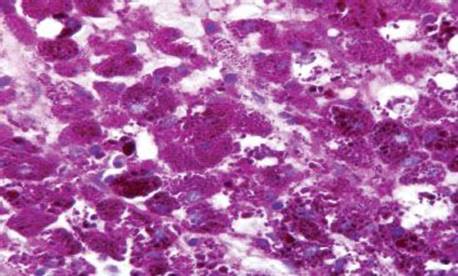
Figure 3.236 Foamy macrophage pattern, classic Whipple disease (PAS/D). On highest power, the variably sized cytoplasmic inclusions characteristic of Whipple disease are best appreciated. The coarse and globular nature of these inclusions contrast with the more delicate and uniform bacilli seen with MAI(compare with the characteristic inclusions of MAI in Figure 3.231).
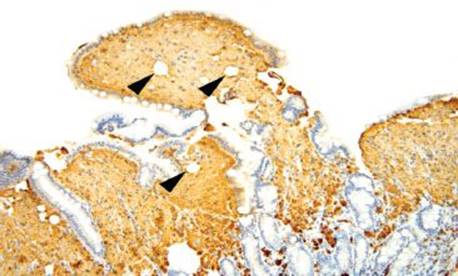
Figure 3.237 Foamy macrophage pattern, classic Whipple disease (Whipple immunohistochemical stain). The Whipple immunostain is diffusely reactive is this classic case of Whipple disease. Dilated lacteals and fat droplets are also seen (arrowheads). This immunostain is not widely available, but can be accessed via reference centers and large consultation-based centers.
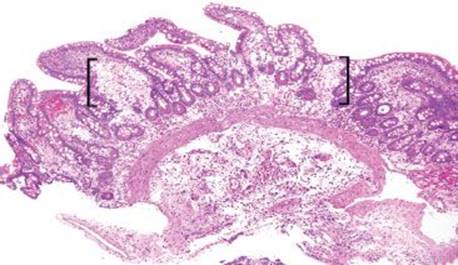
Figure 3.238 Foamy macrophage pattern, Whipple disease with partial histologic treatment effect. Following 6 months of Whipple-based therapy, the biopsy shows less prominent features of Whipple disease. Although foamy macrophages (brackets) and scattered dilated lacteals and fat droplets are still seen on H&E, these features are much less prominent than those seen in classic Whipple disease histology. Such dampened features have been described with patients early in their antibiotic course for Whipple disease and are referred to as Whipple disease with partial histologic treatment effect. Compare this image with classic Whipple disease seen in Figures 3.233–3.234.
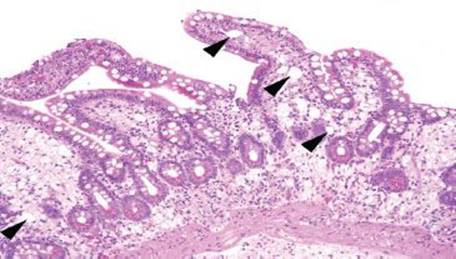
Figure 3.239 Foamy macrophage pattern, Whipple disease with partial histologic treatment effect. Higher power of previous image. Whipple disease with partial histologic treatment effect refers to cases with attenuated features of Whipple disease on H&E, PAS/D, and a Whipple immunostain. As seen here, villous blunting, foamy macrophages, dilated lacteals, and fat droplets (arrowheads) are detectable but not prominent. Compare this image with classic Whipple disease seen in Figures 3.233–3.234.
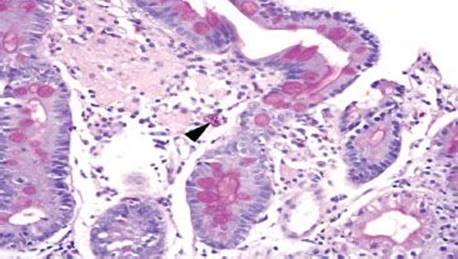
Figure 3.240 Foamy macrophage pattern, Whipple disease with partial histologic treatment effect (PAS/D). Characteristic of Whipple disease with partial histologic treatment effect, cytoplasmic inclusions (arrowhead) are present on a PAS/D special stain; however they are very subtle compared to those of classic Whipple disease. Compare this image with classic Whipple disease in Figure 3.236.
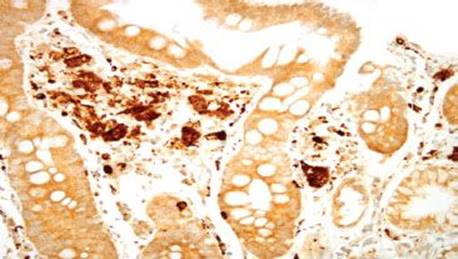
Figure 3.241 Foamy macrophage pattern, Whipple disease with partial histologic treatment effect (Whipple immunostain). A Whipple immunostain is reactive but shows attenuated reactivity compared to that seen with classic Whipple disease. Compare this image with classic Whipple disease (Fig. 3.237).
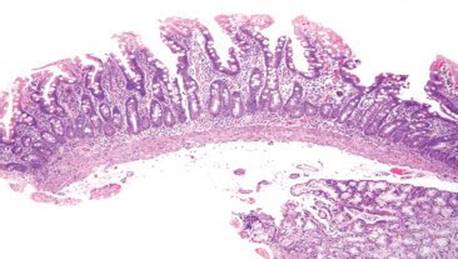
Figure 3.242 Foamy macrophage pattern, Whipple disease with complete histologic treatment effect. Of note, Whipple disease can histologically appear as an essentially normal biopsy, as depicted in this case. When there are no histologic features of Whipple disease on both the H&E and a PAS/D, and a Whipple immunohistochemical stain is positive, the preferred designation is Whipple disease with complete histologic treatment effect. Patients with this morphology have often been on Whipple disease antibiotic therapy for an extended period of time or had a remote history of Whipple disease therapy. Based on limited long-term clinical follow-up data, the clinical significance of Whipple disease with histologic treatment effect is unknown.
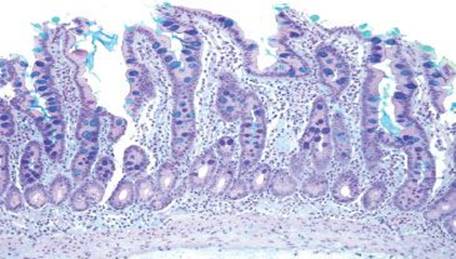
Figure 3.243 Foamy macrophage pattern, Whipple disease with complete histologic treatment effect (PAS/AB). By definition, a PAS/AB fails to demonstrate any characteristic Whipple cytoplasmic inclusions with complete histologic treatment effect.
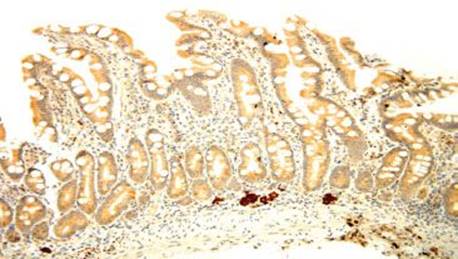
Figure 3.244 Foamy macrophage pattern, Whipple disease with complete histologic treatment effect (Whipple immunostain). The Whipple immunostain is focally positive in rare macrophages deep in the mucosa. This subtle pattern of reactivity is typical for Whipple disease with complete histologic treatment effect. If this biopsy had been more superficial, the rare diagnostic macrophages would have been entirely missed.
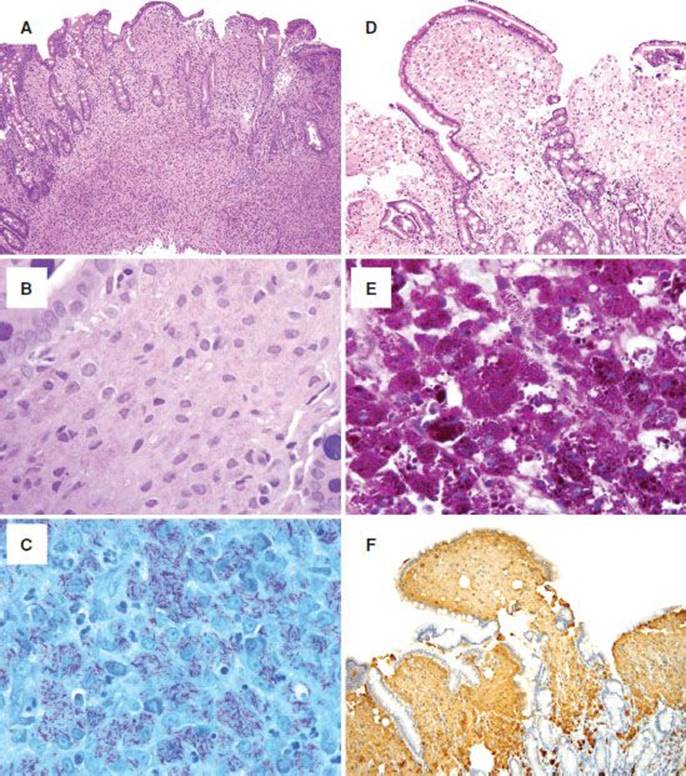
Figure 3.245 MAI versus classic Whipple disease. A: MAI, H&E, blunted villi and an expansion of the lamina propria by abundant foamy macrophages are seen and dilated lacteals and fat droplets are lacking, features favoring a low power diagnosis of MAI over Whipple disease; B, MAI, a PAS/D special stain highlights the red, uniform, almost difficult to appreciate bacilli. C: MAI, an AFB special stain confirms the mycobacterium infection by highlighting the abundant red bacilli (“red snappers”) within the macrophage cytoplasm. D: Whipple disease, H&E, blunted villi with prominent foamy macrophages and scattered dilated lacteals and fat droplets favor a low power diagnosis of Whipple disease over MAI. E: Whipple disease, a PAS/D highlights abundant, coarsely globular, variably sized cytoplasmic inclusions. F: Whipple disease, the Whipple immunohistochemical stain is diffusely reactive is this classic case of Whipple disease.
TABLE 3.8: A Comparison of Mycobacterium intracellulare (MAI) versus Whipple Disease
KEY FEATURES of Whipple Disease:
• Whipple disease is caused by the gram-positive actinobacterium Tropheryma whipplei.
• It is much less common than MAI.
• Fecal–oral transmission is presumed.
• Adult white men constitute the most common demographic, but it is also seen enriched in non-HIV immune-mediated conditions.
• Up to 30% of patients relapse, especially those with CNS involvement.
• Histologically, classic Whipple disease is characterized by villous blunting, lamina propria expansion by numerous foamy macrophages, and scattered dilated lacteals and fat droplets.
• The foamy macrophages contain abundant PAS reactive, variably-sized cytoplasmic inclusions.
• Confirmatory tests include the T whipplei immunohistochemical stain or PCR assay.
• Histologic treatment effects resemble normal or near normal histology.
• The T. whipplei immunohistochemical stain cannot distinguish viable from nonviable organisms.
PEARLS & PITFALLS
Whipple disease with histologic treatment effect can be seen in patients who are not specifically treated for Whipple disease! For example, we have seen Whipple disease with histologic treatment effect in patients on broad spectrum antibiotics for myocarditis, urinary tract infections, and pneumonia. These patients had unrecognized Whipple disease and were indirectly (and unknowingly) treated for Whipple disease as a consequence of broad spectrum antibiotics for unrelated medical conditions. Although the antibiotics resulted in near normal small bowel histology on H&E, additional studies confirmed the sparsely distributed PAS/D, T. whipplei reactive cytoplasmic globules, confirming the diagnosis of Whipple disease with histologic treatment effect. In summary, a low threshold for routinely considering Whipple disease is worthwhile, particularly in patients with complicated clinical presentations.
FAQ: Can the T. whipplei immunostain distinguish viable from nonviable organisms?
Answer: No.
Unfortunately, this immunostain cannot distinguish viable from nonviable organisms, and bacterial remnants can persist in macrophages for years.155–157 Von Herbay et al. found conversion from positive to negative Whipple PCR results occurred before clearance of PAS positive foamy macrophages.157 This suggests that DNA degradation of the organism occurs early in treatment and that bacterial protein remnants can persist for some time thereafter. As such, the biologic significance of Whipple disease with histologic treatment effect is unclear. In these cases, it is worthwhile to correlate with the patient’s clinical symptoms and PCR studies to help guide clinical management decisions. For example, in the symptomatic patient with Whipple disease and histologic treatment effect, resuming or continuing treatment is required; however in those asymptomatic patients with histologic treatment effect, close clinical follow-up with a low threshold to resume Whipple disease therapy may be a reasonable approach.
NONSPECIFIC SCATTERED MACROPHAGES
The lamina propria of the normal small bowel is populated by mononuclear inflammatory cells, such as lymphocytes, plasma cells, and macrophages. Occasionally macrophages can be mildly increased (particularly after reading about Whipple disease with treatment effect!), raising concerns for Whipple disease and or MAI. In general, a chart review coupled with PAS and AFB special stains can sort through the majority of these problematic cases. For example, MAI is easy to dismiss in an immunocompetent individual lacking a history of diarrhea and where no PAS or AFB positive cytoplasmic inclusions are seen. More often than not, a slight prominence of macrophages signifies nothing more than a slight prominence of macrophages. Perhaps their presence represents a reparative response to a nonspecific, incidental, or incipient mechanical, medication, or infectious related injury. Regardless, when this finding is rare or seen in isolation, it carries no specific meaning.