
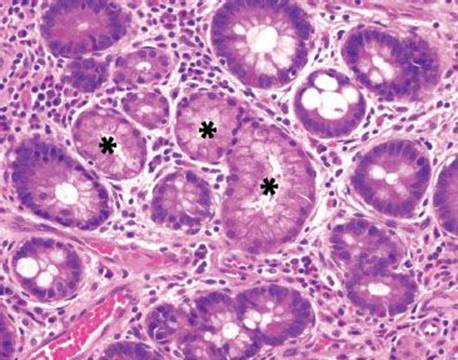
Figure 3.256 The small bowel mucosa can feature nonnative epithelium, such as in reactive duodenopathy, gastric heterotopia, pyloric gland metaplasia, and pancreatic heterotopia. The clinical significance of recognizing these changes varies. For example, a patch of gastric metaplasia, gastric heterotopia, or pancreatic heterotopia can explain the clinical impression of a nodule, bump, or polyp. Gastric foveolar metaplasia can serve as a diagnostic clue to carefully look for Helicobacter, and gastric foveolar metaplasia and pyloric gland metaplasia can serve as evidence of chronic mucosal injury. In the illustrated example, pyloric gland metaplasia is shown (asterisks). Pyloric gland metaplasia is histologically identical to pyloric glands of the gastric cardia and antrum and to Brunner glands of the duodenum. These glands are composed of neutral mucus-secreting cells with abundant clear foamy cytoplasm and basally located nuclei.
CHECKLIST: Etiologic Considerations for Metaplasia, Heterotopia, and Ectopias (Fig. 3.256):
 Reactive Duodenopathy
Gastric Heterotopia
Pancreatic Heterotopia
Pyloric Gland Metaplasia
Meckel Diverticulum
REACTIVE DUODENOPATHY
As discussed in the malabsorption pattern, reactive duodenopathy refers to gastric foveolar epithelium in the small bowel mucosa as a result of chronic acid exposure (Figs. 3.257–3.259). The surface gastric foveolar metaplasia can be seen on H&E, but subtle cases may be highlighted by a PAS special stain, staining the neutral mucin eosinophilic. Similarly, if a combination PAS/Alcian blue stain is employed, the gastric metaplastic zones still remain eosinophilic, but the acidic mucin of goblet cells stains basophilic (Figs. 3.260 and 3.261). Histologic changes also include variable increased plasma cell infiltration, neutrophils, villous blunting, and Brunner gland hyperplasia. In contrast to peptic ulcer disease, the histologic findings of reactive duodenopathy are milder and they lack a strong association with Helicobacterinfections. As such, some experts suggest abandoning the previously interchangeable terms “chronic peptic duodenopathy,” “active chronic peptic duodenitis, and “peptic-type duodenopathy” due to their misguided inference of a Helicobacter etiology. See also Malabsorption Pattern, this Chapter.
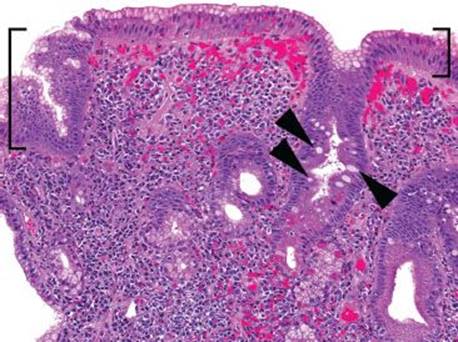
Figure 3.257 Reactive duodenopathy refers to metaplastic gastric foveolar epithelium (brackets) in the small bowel mucosa. It is most commonly associated with excessive acidity, Helicobacter, or NSAID-related damage. Zones of surface gastric foveolar metaplasia are composed of back-to-back metaplastic cells that create regions that lack goblet cells or enterocytes. By comparison, the normal small bowel mucosa is punctuated by goblet cells (arrowheads) that are scattered singly between enterocytes. Further comparison shows that individual goblet cells contain a voluminous mucin vacuole, in contrast to the more delicate apical mucin cap seen in the gastric metaplastic cells (brackets).
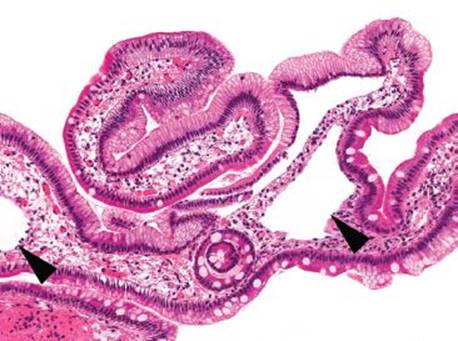
Figure 3.258 Reactive duodenopathy, small bowel obstruction. This case features scattered dilated lacteals (arrowheads) in addition to gastric foveolar metaplasia.
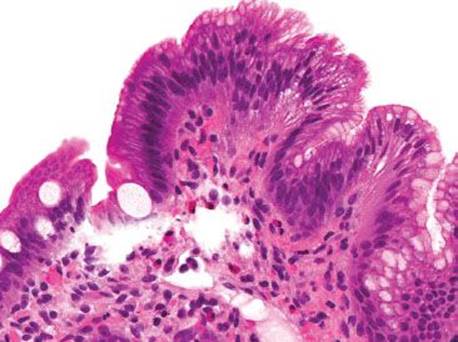
Figure 3.259 Reactive duodenopathy, small bowel obstruction. Higher power of an alternate field from the same patient. Note the tiny apical mucin caps in a zone lacking goblet cells.
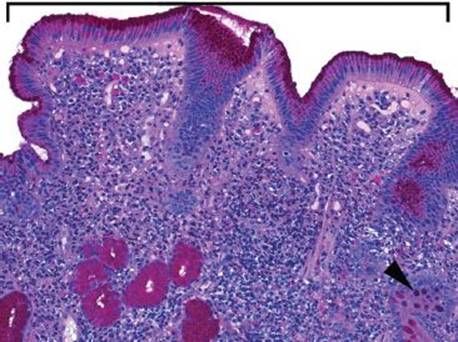
Figure 3.260 Metaplastic gastric foveolar epithelium (PAS/AB). For junior trainees, the distinction between metaplastic gastric foveolar epithelium and goblet cells can be challenging on H&E. In subtle cases, a PAS/AB can be especially useful. On a PAS/AB, the neutral mucin of the metaplastic gastric foveolar epithelium appears eosinophilic (bracket); in contrast, the acidic mucin of the goblet cells appears deeply basophilic (arrowhead). Again, note that metaplastic gastric foveolar epithelial cells are lined up back to back and create long runs or zones of metaplasia, as opposed to goblet cells, which are more sparsely distributed among the enterocytes. Although the distinction between metaplastic gastric foveolar epithelium and goblet cells is not critical to discern in the small bowel, these distinctions become clinically important when evaluating for Barrett mucosa in the esophagus, for example.
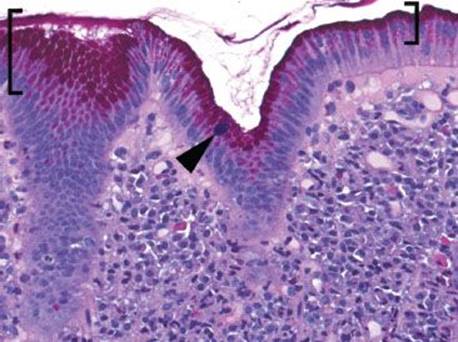
Figure 3.261 Reactive duodenopathy (PAS/AB). The eosinophilic metaplastic gastric foveolar epithelium (highlighted by brackets) and the basophilic goblet cell (highlighted by an arrowhead). This case was complicated by Helicobacter duodenitis, emphasizing the importance of routinely looking for Helicobacter in gastric metaplastic zones.
KEY FEATURES of Reactive Duodenopathy:
• Reactive duodenopathy is seen in up to 7% of small bowel mucosal biopsies.
• Alternative terms include gastric foveolar mucin cell metaplasia, active chronic peptic duodenitis, chronic peptic duodenopathy, and peptic-type duodenopathy.
• Common causes include excessive acidity, Helicobacter, or NSAID-related damage.
• Severe cases with ulcerations are termed peptic ulcer disease, which has a stronger association with Helicobacter.
GASTRIC HETEROTOPIA
Heterotopic tissue refers to histologically normal tissue found in abnormal anatomic sites. More specifically, gastric heterotopia describes the presence of both gastric foveolar epithelium and oxyntic glands in the small bowel mucosa (Figs. 3.262–3.266). Although some experts advocate this finding is an embryologic remnant, others suggest it is a metaplastic response to small bowel injury.92,163–166 In the largest study, gastric heterotopia was identified in 1.9% of over 28,000 duodenal biopsies and was found in the duodenal bulb in 66% of cases.92 Patients with gastric heterotopia were 1/5 as likely to have Helicobacter pylori gastritis, compared to those patients with a normal duodenum, suggesting this phenomenon is not a metaplastic response to mucosal injury. Further, this finding was associated with three times the number of fundic gland polyps, leading the authors to suggest these presumed congenital patches may be influenced by proton pump inhibitors. Similar findings were recently replicated by others.166
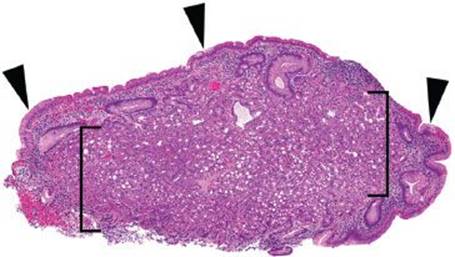
Figure 3.262 Gastric heterotopia. On low power, the polypoid nature of this biopsy is appreciated. Both gastric foveolar epithelium (arrowheads) and oxyntic glands (brackets) are seen in the small bowel polypectomy specimen, meeting the diagnostic criteria for gastric heterotopia.
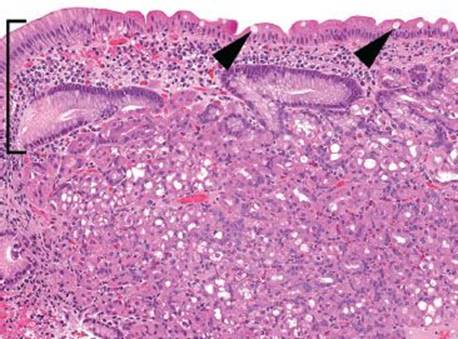
Figure 3.263 Gastric heterotopia. On higher power, gastric foveolar epithelium (brackets) and oxyntic glands are better seen. An area of normal small bowel epithelium is lined by back-to-back enterocytes punctuated by goblet cells (arrowheads).
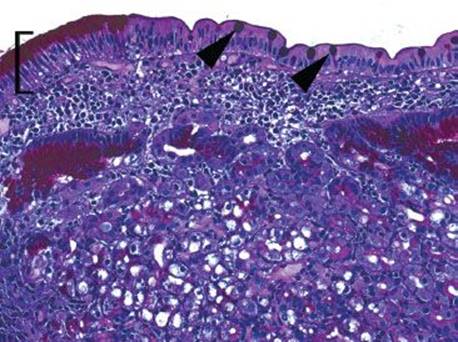
Figure 3.264 Gastric heterotopia (PAS/AB). A PAS/AB easily distinguishes between the diffuse zones of eosinophilic gastric foveolar epithelium (bracket) and the scattered basophilic goblet cells (arrowheads).
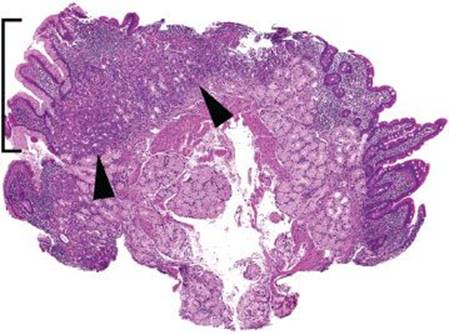
Figure 3.265 Gastric heterotopia. The nodular nature of this duodenal polyp is easily appreciated at low power. The diagnosis of gastric heterotopia was rendered based on the identification of both gastric foveolar epithelial cells (bracket) and oxyntic glands (arrowheads).
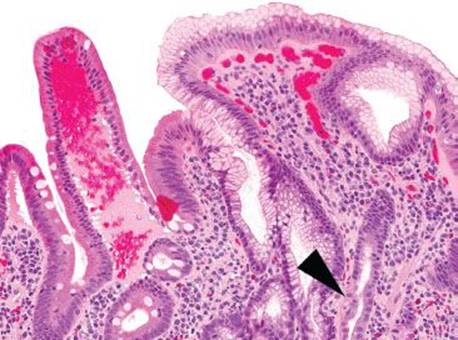
Figure 3.266 Gastric heterotopia is generally a low power diagnosis, but some cases require high power to appreciate the focal oxyntic glands (arrowhead), as in this case.
KEY FEATURES of Gastric Heterotopia:
• Gastric heterotopia is seen in 1.9% of duodenal biopsies.
• It is most common in the duodenal bulb and is associated with fundic gland polyps.
• Histologically, it consists of gastric foveolar epithelium and oxyntic glands.
• The histogenesis is controversial; embryologic remnant versus metaplastic response to injury, possibly responsive to proton-pump inhibitors.
FAQ: What if only superficial gastric foveolar epithelium is present and underlying gastric glands are not seen?
Answer: “Reactive duodenopathy” is the preferred term when only superficial gastric foveolar epithelium is seen.
PANCREATIC HETEROTOPIA
Pancreatic tissue identified at sites not anatomically or vascularly connected to the pancreas is termed pancreatic heterotopia, also known as pancreatic rest, or ectopic or aberrant pancreas (Fig. 3.267). The putative etiologic origin is aberrant embryonic rotation of the dorsal and ventral buds, such that “pancreas bits” are positioned in nonphysiologic sites. Although the incidence of pancreatic heterotopia is not well established, it is seen in 13.7% of autopsies in one small series.167 Pancreatic heterotopia has been reported in a variety of sites, including the gastrointestinal tract, lung, mediastinum, and fallopian tube.168 It is most commonly seen in the gastrointestinal tract, particularly in the stomach and small bowel. Most cases are asymptomatic, especially small lesions. Symptomatic patients can present with abdominal pain, gastrointestinal bleeding, pancreatitis, or obstruction.169 Although not required, nor routinely practiced, pancreatic heterotopia can be stratified into four types based on the modified Heinrich classification scheme170:
Type 1: Acini, ducts, and islets
Type 2: Ducts only
Type 3: Acini only
Type 4: Islets only
KEY FEATURES of Pancreatic Heterotopia:
• Pancreatic heterotopia is pancreatic tissue at ectopic sites.
• Seen in up to 13.7% of autopsies.
• Sites of involvement include the gastrointestinal tract (most common in the stomach and small bowel), lung, mediastinum, and fallopian tube.
• Most cases are asymptomatic.
• Among symptomatic patients, abdominal pain, gastrointestinal bleeding, pancreatitis, or obstructive symptoms are common.
• Lesions can include clinically significant diagnosis: chronic pancreatitis, pseudocysts, and neoplasia.

Figure 3.267 Pancreatic heterotopia refers to pancreatic tissue identified at sites not anatomically or vascularly connected to the pancreas. This high power image reveals the characteristic two-tone nature of pancreatic acinar cell cytoplasm with peripheral basophilia and centroluminal eosinophilia.
FAQ: Are there any clinically significant diagnoses linked to pancreatic heterotopia?
Answer: Yes.
Any diagnosis that occurs in the native pancreas can theoretically occur in heterotopic pancreas. Be sure to look carefully for chronic pancreatitis, pseudocysts, and neoplasia.168,171,172
PYLORIC METAPLASIA
Pyloric metaplasia (pseudo-pyloric metaplasia) arises secondary to chronic mucosal damage and is characterized by the replacement of the normal mucosal crypts with glands that resemble pyloric glands of the stomach or Brunner glands of the duodenum. Morphologically, pyloric metaplasia can be identified by its acinar structure lined by epithelial cells with abundant clear-to-foamy cytoplasm and small ovoid or round nuclei which may be flattened against the basement membrane (Figs. 3.268–3.273). These cells which appear adjacent to ulcers and have been termed ulcer-associated cell lineage (UACL). The UACLs produce endothelial growth factors and trefoil peptides that promote mucosal proliferation and healing.173,174 Although pyloric metaplasia has been cited as highly predictive of Crohn disease,175 it can also be a nonspecific reparative reaction found in intestinal ulcers, NSAID-induced injury, or chronic pouchitis.
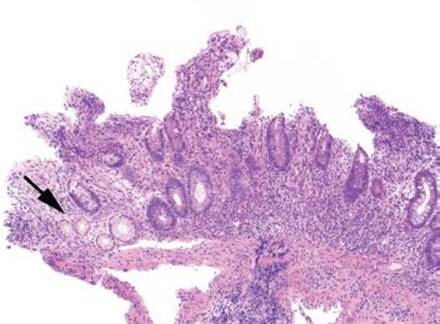
Figure 3.268 Pyloric metaplasia. This biopsy is from the terminal ileum of a patient with Crohn disease. Pyloric metaplasia (arrow) is visible from low magnification because the pale cytoplasm contrasts nicely with the darker inflammatory background. Note also the background crypt dropout, crypt shortfall, and basal lymphoplasmacytosis, in keeping with the established history of Crohn disease.
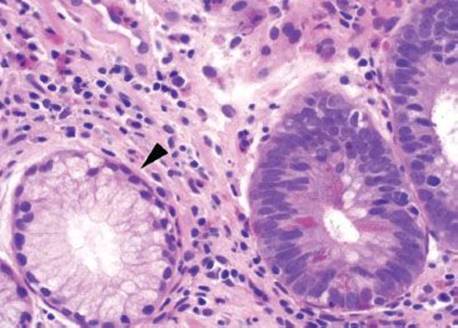
Figure 3.269 Pyloric metaplasia. The pyloric gland (arrowhead) is histologically indistinguishable from true pyloric glands found in the gastric antrum. The acinar structure is composed of cells with abundance clear to foamy cytoplasm and small round or ovoid, basally located nuclei. The base of a small bowel crypt is pictured at right for comparison.
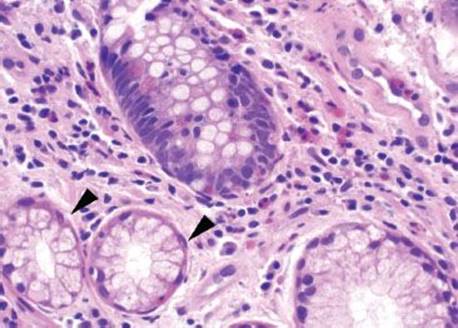
Figure 3.270 Pyloric metaplasia. The glands of pyloric metaplasia (arrowheads) are identical to those of the gastric antrum. In this example, some of the nuclei are pressed flat against the basement membrane. This example is from a case of ileal Crohn disease.
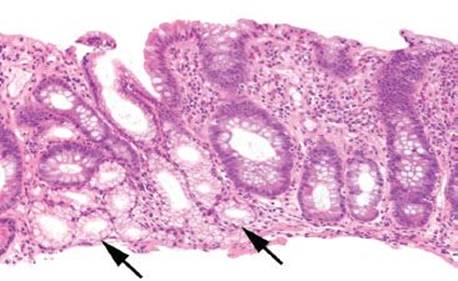
Figure 3.271 Pyloric metaplasia. Although pyloric metaplasia is associated with Crohn disease, the finding is nonspecific and indicates only the presence of chronic injury. This biopsy with pyloric metaplasia (arrows) is taken from near an ileostomy site. As with most nonneoplastic biopsies, clinical history is imperative.
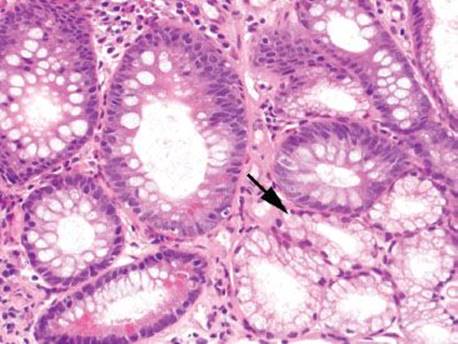
Figure 3.272 Pyloric metaplasia. These pyloric glands (arrow) have replaced the crypts in the small bowel as a result of chronic injury.
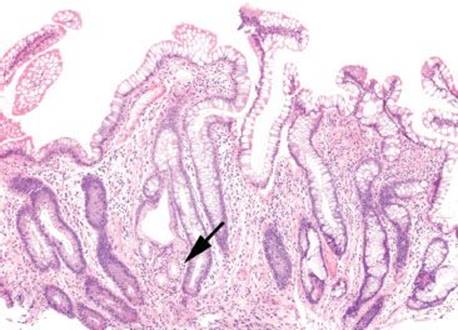
Figure 3.273 Pyloric metaplasia. This biopsy comes from an 83-year-old man with chronic NSAID use. Note the slight architectural distortion, and the presence of pyloric metaplasia (arrow). This finding may be subtle in some cases, and the glands are most often found in the deep mucosa, as seen here.
FAQ: Is pyloric gland metaplasia in ileal pouch biopsies a definitive marker for Crohn disease?
Answer: No.
Pyloric gland metaplasia is more common in patients who experience complication following an IPAA (55%) as compared to those who follow a normal postoperative course (12%). The prevalence is higher in patients with Crohn disease of the pouch (77%) as compared to ulcerative colitis patients with chronic pouchitis (22%), but cannot be used as a definitive marker for Crohn disease.77
PEARLS & PITFALLS
Consider Meckel Diverticulum When Gastric or Pancreatic Tissue Is Seen in the Small Bowel
Meckel diverticulum is the most common congenital anomaly of the small bowel. It arises as a result of failure of involution of the omphalomesenteric duct (also termed “vitelline duct”). The omphalomesenteric duct connects the embryonic midgut to the yolk sac ventrally, and normally narrows progressively until its obliteration by the tenth week of gestation. Failure to involute results in this congenital outpouch on the antimesenteric border of the ileum (Fig. 3.274). Meckel diverticulum is an example of a true diverticulum because it contains all layers of the small bowel wall: mucosa, submucosa, and muscularis propria. It is also described as “the rule of 2’s” because it occurs in approximately 2% of the population, is located within 2 feet of the ileocecal valve, is 2 inches in length, presents most commonly at 2 years of age, and has a male:female ratio of 2:1.176–178 Although most cases are asymptomatic, approximately 2% come to medical attention and require surgical resection based on obstruction, bleeding, intussusception, volvulus, perforation, or inflammation. Up to 1/2 of cases contain heterotopic gastric (52%) or pancreatic tissue (5%) and neoplasia is rare (but can include gastrointestinal tract stromal tumors, neuroendocrine tumors, and adenocarcinoma).
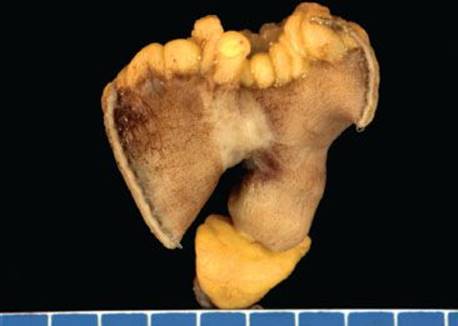
Figure 3.274 Meckel diverticulum. This gross image depicts a congenital outpouching on the antimesenteric border of the ileum. Although the majority of patients are asymptomatic, common indications for resection include persistent gastrointestinal bleeding (as in this case), obstruction, intussusception, volvulus, perforation, or inflammation. Histologically unremarkable small bowel mucosa is common with heterotopic tissues seen in up to 50% of cases (gastric > pancreas). Neoplasia is rare.