
Endoscopically, the unremarkable colon appears as homogeneous pink mucosa, but regional landmarks allow for reasonably accurate anatomic localization; for example, proximally, the ileocecal valve and appendiceal orifice identify the cecum, whereas the appearance of a triangular lumen signifies entrance into the transverse colon. Moving distally, the acute bend of the splenic flexure indicates the approach of the descending colon. Further anatomic localization at the sigmoid and rectum become more difficult but is aided by luminal narrowing, thickened mucosal folds, presence of diverticula, and ultimately calibration marks on the colonoscope.
Histologically, the colon divides into the mucosa, submucosa, muscularis propria, and serosa (Fig. 4.1). The mucosa is composed of a single cell layer of columnar cells lining colonic crypts, the investing lamina propria, and a thin underlying layer of smooth muscle&emdash;the muscularis mucosae. These mucosal crypts are oriented parallel to one another and perpendicular to the muscularis mucosae, such that crypts appear orderly and uniform, like a row of test tubes when seen on a well-oriented cross section (Figs. 4.2–4.5). When cut en face, these crypt openings remain orderly and evenly spaced, providing a top–down view of test tubes in a rack or a “bed of flowers” architecture (Figs. 4.6 and 4.7). Lining the surface epithelium is a combination of absorptive columnar cells and mucous-secreting goblet cells that may be punctuated by very rare intraepithelial eosinophils and mast cells; neutrophils in the epithelium are never normal. By comparison, the deep crypt epithelium additionally contains Paneth cells and endocrine cells (Figs. 4.8 and 4.9). These Paneth cells are normally limited to the cecum and ascending colon, and their presence distal to the transverse colon signifies metaplasia, typically due to chronic injury.

Figure 4.1 Normal colon. This resection specimen illustrates the four main layers of the colon: mucosa, submucosa, muscularis propria, and serosa. The mucosa consists of epithelium (E), lamina propria (L), and muscularis mucosae (MM). The submucosa sits between the muscularis mucosae and the muscularis propria, and it consists of loose fibroconnective tissue and lymphovascular channels. The muscularis propria consists of inner circular and outer longitudinally orientated muscle fibers. This is covered by subserosal fibroadipose tissue and the outermost serosa.

Figure 4.2 Test tubes in a rack, profile view. Normal colonic architecture is analogous to a profile view of test tubes in a rack, with each test tube (or crypt) superimposable upon its neighbor based on uniform size and distribution.

Figure 4.3 Normal colon. A well-oriented colonic section illustrates the orderly nature of the colonic crypts. They are evenly spaced and arranged in parallel, like a row of test tubes in a rack. The crypt bases extend down to almost touch the muscularis mucosae.
Similarly, the contents of the colonic lamina propria vary depending on location. This supportive stroma contains a wide variety of cells arranged among loosely organized strands of collagen, occasional slips of smooth muscle, nerve twiglets, and small lymphovascular spaces that lack the potential for lymphovascular spread of tumor.1 The cellular composition is predominantly lymphocytic and plasmacytic, with varying numbers of eosinophils and mast cells. This normal complement of inflammatory cells decreases in concentration approaching the rectum; knowledge of this prevents overdiagnosis of “chronic colitis” (Figs. 4.10–4.13). See also Chronic Colitis, this chapter. A rare neutrophil in the lamina propria or capillary vessel is likely insignificant. The right colon contains more absorptive cells and fewer goblet cells than the left colon, a reflection of the differing functions of the right colon (to absorb excess fluid) versus the left colon (to lubricate the lumen and facilitate elimination of the luminal contents). Muciphages, while not native inhabitants, are so commonly found in the rectum that they are considered by many as normal variants. These colonic macrophages contain abundant cytoplasmic mucin from “clean up” of nonspecific mucosal injury (Figs. 4.14 and 4.15)2; when excessive, one might consider pathologic entities such as metabolic storage disorders or infection with Mycobacterium avium-intracellulare. See also Muciphages, Near Misses, this chapter.

Figure 4.4 Normal colon. An innominate groove in the colon shows crypts branching from a central lumen (arrows). This is a normal structure in the colon and should not be mistaken for the crypt distortion seen in chronic colitis.
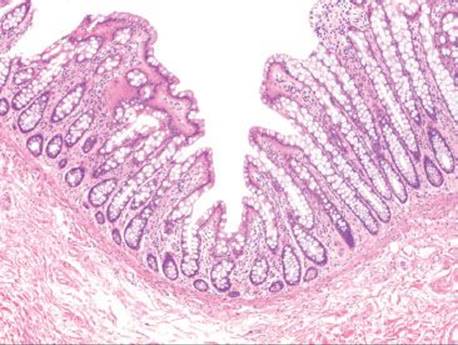
Figure 4.5 Normal colon. An innominate groove in the colon shows crypts extending away from a central lumen in an orderly and symmetric fashion. Note that the background crypts are evenly spaced, indicating a lack of chronic injury (chronicity). This normal structure, seen periodically along the length of the colonic mucosa, should not be mistaken for the crypt branching of chronic colitis.

Figure 4.6 Test tubes in a rack, tangential view. When viewed from above, the test tubes are superimposable upon their neighbors based on uniform size and distribution, analogous to a tangential view of normal colonic architecture.

Figure 4.7 Normal colon. When cut in cross section, the colonic crypts appear like an evenly spaced bed of flowers. Even when maloriented, or tangentially sectioned, the normal colonic mucosa shows an orderly distribution of colonic crypts.
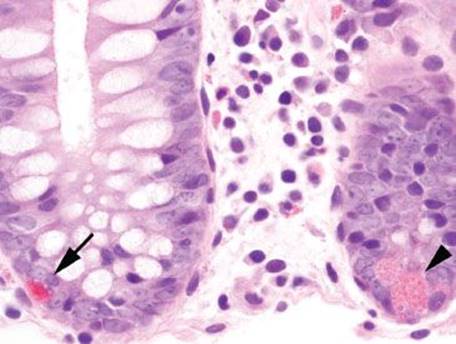
Figure 4.8 Normal colon, Paneth cell versus endocrine cell. Paneth cells (arrowhead) are found in the crypt bases of the right and transverse colon. Their nuclei abut the basement membrane, while their coarse, pink cytoplasmic granules polarize toward the crypt lumen. By comparison, endocrine cells (arrow) are found scattered throughout the crypt bases along the length of the colon. Their nuclei face the lumen, while their fine, reddish cytoplasmic granules abut the basement membrane.

Figure 4.9 Normal colon, Paneth cell versus endocrine cell. The Paneth cell (arrowhead) contains larger, coarse, pink granules released toward the crypt lumen, whereas the endocrine cell (arrow) contains small, fine, reddish granules released toward the crypt basement membrane. Paneth cells in the left colon signify evidence of chronic injury.

Figure 4.10 Normal right colon. The right colon is rich in Paneth cells at the crypt bases. In addition, mixed chronic inflammatory cells are abundant in the lamina propria, including scattered eosinophils.

Figure 4.11 Normal right colon. The lamina propria of the right colon contains substantial numbers of lymphocytes, plasma cells, and eosinophils.
The cellular composition of the submucosa is similar to that of the lamina propria, but includes larger lymphovascular structures that, in contrast to those of the lamina propria, can facilitate lymphovascular spread of tumor cells. Other submucosal cells include adipocytes, ganglion cells, and nerve axons, the latter two of which compose the superficial Meissner plexus and the deeper Henle’s plexus. These ganglion cells are not normally present in the mucosa, and when found there indicate prior mucosal injury.

Figure 4.12 Normal left colon. Compared to the right colon (Figs. 4.10 and 4.11), the normal left colon contains fewer lamina propria inflammatory cells. Although eosinophils may be present in the left colon, they are far less common as compared to the right colon. Note, also, the lack of Paneth cells at the crypt bases.

Figure 4.13 Normal rectum. The rectal lamina propria is paucicellular and more goblet cells are seen compared to their density in proximal sites. Red-colored endocrine cells are normally present throughout the colon, but note the absence of Paneth cells in the crypt bases.
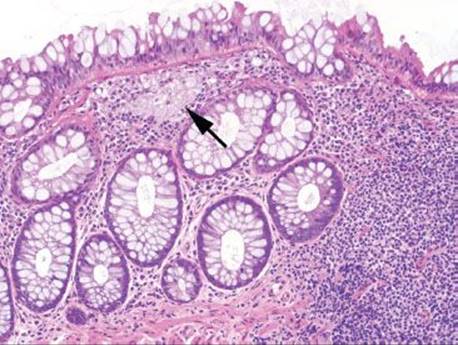
Figure 4.14 Near-normal rectum, muciphages in the rectum. Muciphages (arrow) may cluster or can be found dispersed singly in the lamina propria, particularly in the rectum. They are a nonspecific sign of mucosal injury.

Figure 4.15 Near-normal rectum. Higher magnification of previous figure shows the amphophilic and bubbly cytoplasm of the muciphages.
The muscularis propria surrounds the submucosa with its inner circular and outer longitudinal layers of smooth muscle, which sandwich the myenteric plexus of Auerbach. Externally, the subserosal connective tissue and the mesothelial-derived serosa encase the bowel. Sites not entirely covered by serosa include the posterior surface of the ascending and descending colon and portions of the rectum (posterior aspect of the upper third, posterior and lateral aspects of the middle third, and the entire lower third), features important for assessing radial margins in resection specimens of colonic neoplasms. Grossly visible through the serosa are the external longitudinal layers of the muscularis propria, which appear as three distinct bands, or taenia coli, on the right colon and become confluent on the left.
TABLE 4.1: Distinctive Differences among Regions of the Large Bowel
