
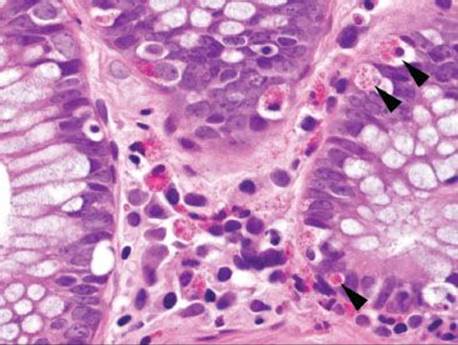
Figure 4.198 Intraepithelial eosinophils. Scattered eosinophils may be present within the normal colonic epithelium, but they are typically solitary. Aggregates of intraepithelial eosinophils (arrowheads), such as seen here, are abnormal.
In the colon, eosinophils and other constituent inflammatory cells follow a decreasing gradient along the length of the colon, from proximal to distal (Fig. 4.198).79,80 As a result of this gradient, the interpretation of eosinophilic density must be performed in the context of anatomic site. Normal eosinophil counts range from 10 to 70 eosinophils per high-power field (HPF) in the cecum to 1 to 30 in the rectum, but no universally accepted normal range has been established.81–83 Moreover, geographic and seasonal differences, and participation of eosinophils in various nonspecific inflammatory responses further contribute to eosinophil count variability.84–86 Although mild increases in lamina propria eosinophil counts are difficult to delineate, definitive abnormal features include increased intraepithelial eosinophils with eosinophil crypt abscesses, extensive degranulation, epithelial regenerative changes, and minimal active and chronic inflammation.87 The differential diagnosis is broad, and includes idiopathic eosinophilic colitis, inflammatory bowel disease, allergy, medication reaction, parasitic infections, collagen vascular disorders such as scleroderma, and vasculitides such as Churg–Strauss syndrome.
CHECKLIST: Etiologic Considerations for the Colonic Eosinophilia Pattern
 Idiopathic Eosinophilic Colitis
Inflammatory Bowel Disease
Allergy
Medications
Infection
Parasite
Collagen Vascular Disorder and Vasculitis
IDIOPATHIC EOSINOPHILIC COLITIS
Primary eosinophilic gastrointestinal disorders represent a spectrum of inflammatory gastrointestinal disorders in which eosinophils infiltrate the gut in the absence of known causes, and can only be diagnosed following exclusion of all other known causes of eosinophilia (Figs. 4.199–4.201).88
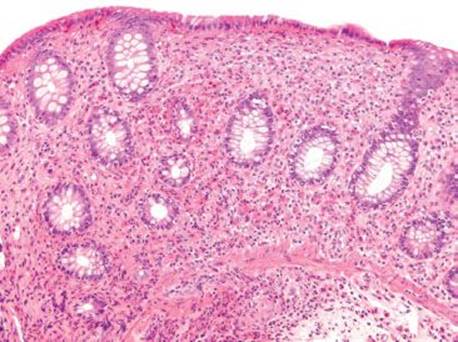
Figure 4.199 Colonic eosinophilia pattern, idiopathic eosinophilic colitis. At scanning magnification, the crypt architecture is essentially preserved; however, the increase in eosinophils within the mucosa and submucosa is striking.
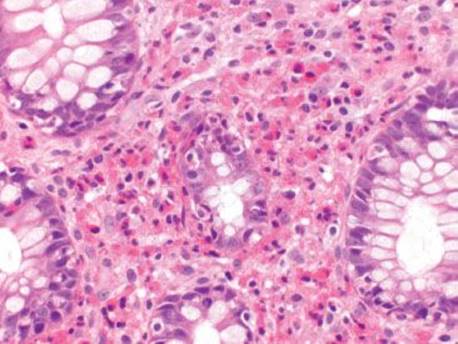
Figure 4.200 Colonic eosinophilia pattern, idiopathic eosinophilic colitis. Higher magnification of the previous case shows a condensation of eosinophils around a single crypt. The etiology of this eosinophilic infiltrate is not apparent in the biopsy.
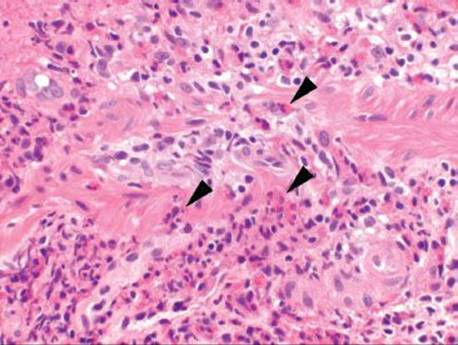
Figure 4.201 Colonic eosinophilia pattern, idiopathic eosinophilic colitis. Another high magnification area from the previous case shows abundant eosinophils traversing the muscularis propria (arrowheads).
INFLAMMATORY BOWEL DISEASE
Eosinophils comprise a conspicuous component in the inflammatory infiltrate of both active and inactive IBD, including both ulcerative colitis and Crohn disease.89,90 Sheets of eosinophils and significant intraepithelial infiltration, however, are absent in IBD, and when found in cases of established IBD, should prompt further investigation. In comparison, among patients without an established diagnosis of IBD, the finding of an eosinophil-rich infiltrate in the lamina propria is nonspecific, particularly in the absence of features of chronicity. As such, one might suggest the possibility of an emerging or early IBD among a list of differential diagnoses.
ALLERGY
Allergic colitis results in an extensive eosinophilic infiltration of the mucosa (Figs. 4.202– 4.204). The most common antigens are found in cow milk and soy formulas, and allergic eosinophilic gastrointestinal disorders are among the most common causes of diarrhea and rectal bleeding in infants less than 1 year of age. Other causative agents include wheat, eggs, corn, fish, seafood, and nuts, which may cause failure to thrive or food refusal in infants and toddlers. Adults may demonstrate a hypersensitivity reaction to medications such as 5-amino-salicilates, NSAIDs, and antiepileptic drugs (see medications later). Eosinophilia involves any of the gastric layers, including the muscularis propria and serosa. Mucosal involvement is the most common, reported to occur in 25% to 100% of cases, and patients typically present with nausea, vomiting, diarrhea, and abdominal pain.84 Some patients show occult blood loss, anemia, and protein-losing enterocolopathy. Peripheral eosinophilia occurs in 50% to 60% of cases and the sedimentation rate is elevated in approximately 25% of cases, both of which return to normal following effective diet modification.84 Other medical treatments include montelukast (a leukotriene receptor antagonist), cromolyn sodium (a mast cell stabilizer), and oral steroids such as budesonide.91
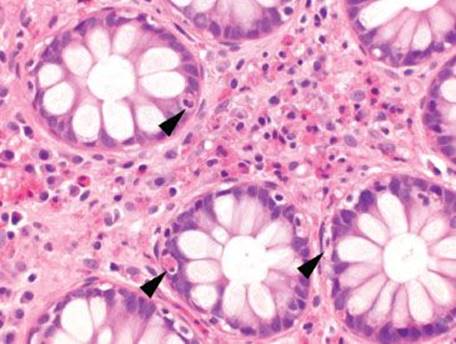
Figure 4.202 Colonic eosinophilia pattern, allergic colitis. This intense focus of lamina propria eosinophilia is accompanied by intraepithelial eosinophils (arrowheads). The increased colonic eosinophilia in this case was attributed to that patient’s known clinical history of food allergies.
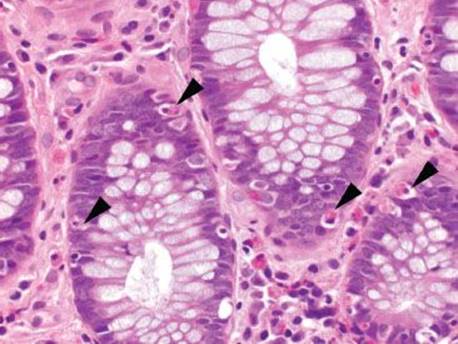
Figure 4.203 Colonic eosinophilia pattern, allergic colitis. This biopsy comes from another patient with eosinophilia due to known allergic colitis. Note the prominence of intraepithelial eosinophils (arrowheads).
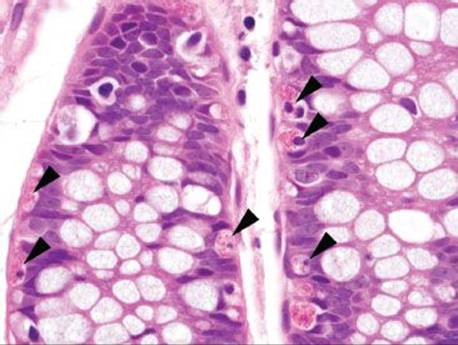
Figure 4.204 Colonic eosinophilia pattern, allergic colitis. Another field from the previous figure with prominent intraepithelial eosinophils (arrowheads).
MEDICATIONS
A laundry list of medications is associated with medication-induced mucosal eosinophilia (Figs. 4.205–4.208), including aspirin, clozapine, carbamazepine, diclofenac, enalapril, gemfibrozil, ibuprofen, nimesulide, rifampicin, tacrolimus, ticlopidine, therapeutic gold compounds.92–100 Note that a number of these are NSAIDs, a commonly implicated class of drugs in various mucosal injuries of the GIT. Practically speaking, an effort to review the patient’s drug list for known offenders and other pertinent clinical findings (such as concurrent dermatitis that might suggest drug reaction) may be helpful to include in the note.
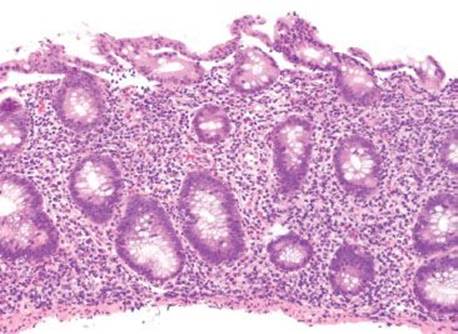
Figure 4.205 Colonic eosinophilia pattern, chemotherapy medication reaction. This colonic biopsy shows an increased density of lamina propria inflammatory cells, but is otherwise not remarkable. It was taken from a patient with chronic diarrhea following chemotherapy for a gynecologic malignancy.
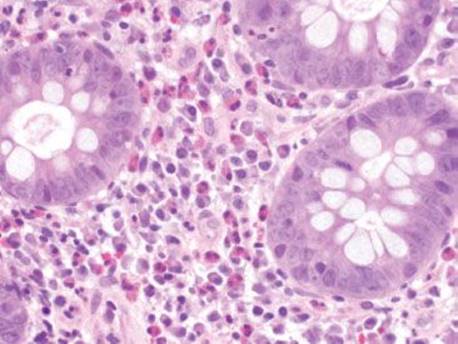
Figure 4.206 Colonic eosinophilia pattern, chemotherapy medication reaction. Higher magnification of the previous case. Eosinophils comprise a significant proportion of the lamina propria inflammatory cells. A concurrent skin biopsy showed findings compatible with medication reaction.
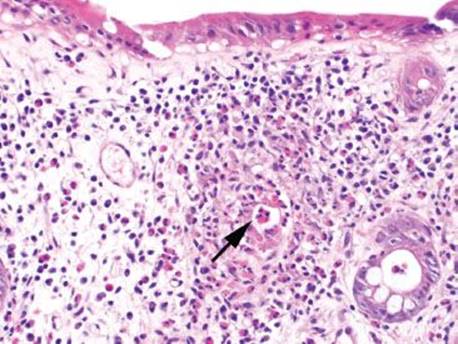
Figure 4.207 Colonic eosinophilia pattern, mycophenolate medication reaction. This colon biopsy shows a single focus of crypt destruction (arrow) surrounded by an inflammatory infiltrate. This biopsy is from a kidney transplant patient taking mycophenolate mofetil (an immunosuppressant).
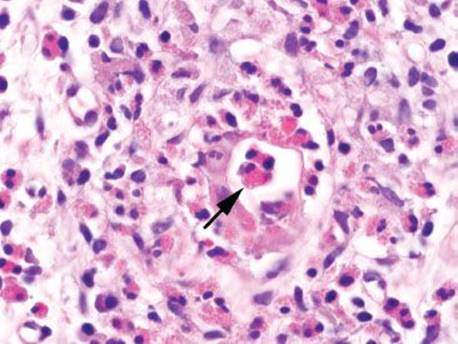
Figure 4.208 Colonic eosinophilia pattern, mycophenolate medication reaction. Higher magnification of the previous case shows prominent eosinophilia with an eosinophilic crypt abscess (arrow).
INFECTION
Tissue invading helminths elicit significant eosinophilic responses in the colonic mucosa. Thus, the detection of a focal but dense eosinophilic infiltrate should prompt a search for helminthic larvae (Strongyloides stercoralis,Schistosoma spp. ova, or fragments of Trichuris trichiura) (Fig. 4.209–4.211). Some lumen dwelling helminthes do not elicit an eosinophilic response, including: tapeworms, Enterobius vermicularis, Angiostrongylus costaricensis,Gnathostoma spp, Ascaris lumbricoides, hookworms, and nonhuman parasites such as Ancylostoma caninum or A. sum.87 Although initial tissue sections do not always contain the organism, obtaining deeper levels and suggesting serologic and stool evaluation may be appropriate in these cases.
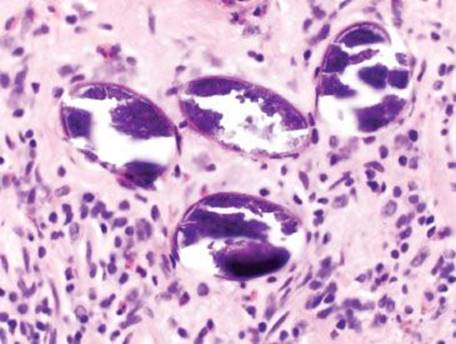
Figure 4.209 Colonic eosinophilia pattern, Schistosoma ova. An eosinophilic infiltrate should prompt examination for parasitic infections in the colon. Schistosoma ova can be mistaken for small calcified concretions or psammoma bodies. Higher magnification reveals the calcified shell. The presence and location of a spine (not pictured) can help speciate the organism.
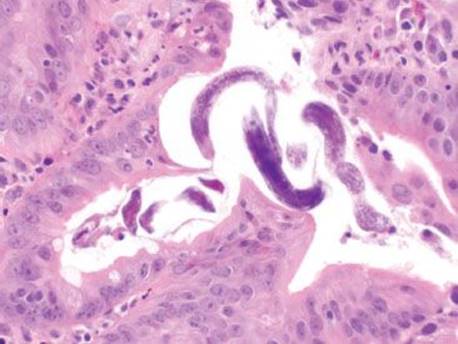
Figure 4.210 Colonic eosinophilia pattern, Strongyloides larvae. This colon biopsy shows Strongyloides larvae associated with background acute and chronic inflammation.
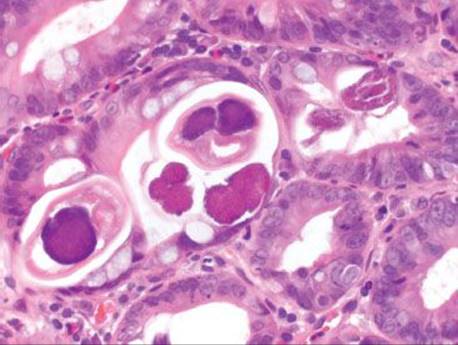
Figure 4.211 Colonic eosinophilia pattern, adult female Strongyloides. Cut in cross section, the adult female Strongyloides is larger than the larvae seen in the previous figure. The cross section also reveals the reproductive organs of the adult organism.
COLLAGEN VASCULAR DISORDER AND VASCULITIS
The presence of increased eosinophils in the colon should raise the differential diagnosis of connective tissue disorders such as systemic lupus erythematosus, scleroderma, dermatomyositis, and polymyositis. The gastrointestinal findings in connective tissue disorders are nonspecific but may prompt a note suggesting ancillary studies for serum autoantibodies. By comparison, specific histologic features of vasculitis may be found in the submucosa, which contains abundant blood vessels and lymphatics; for example, Churg–Strauss syndrome shows systemic necrotizing vasculitis, and the GI tract is affected in 30% of patients (Fig. 4.212).101 Eosinophil-rich granulomas with necrosis involving medium- to small-sized vessels are characteristic findings.102 Another systemic necrotizing inflammatory disease of small- and medium-sized arteries is polyarteritis nodosa, and it affects the GIT in up to 25% of cases.103These lesions often involve bifurcations of arteries that lead to aneurysm, thrombosis or rupture of vessels&emdash;vessels that are often unavailable for review due to the superficial nature of endoscopic biopsies. The presence of an eosinophil-rich mucosal infiltrate and correlation with serologic or radiographic findings, however, can prompt steroid treatment.
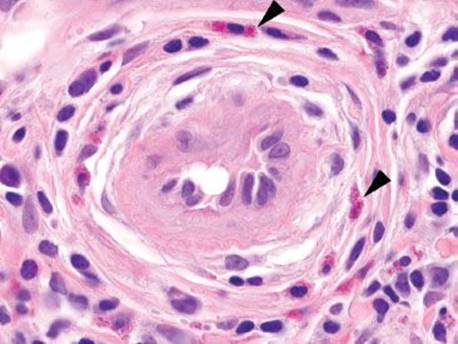
Figure 4.212 Colonic eosinophilia pattern, Churg–Strauss syndrome. A small submucosa vessel in a patient with known Churg-Strauss syndrome is ringed by eosinophils (arrowheads).
PEARLS & PITFALLS
Eosinophils may be the first clue to a neoplastic process.
Systemic mastocytosis and Langerhans cell histiocytosis are often accompanied by a background infiltrate of benign eosinophils, likely drawn in by chemokines. In the setting of increased mucosal eosinophilia, take a moment to examine the surrounding area for subtle neoplastic processes (Figs. 4.213–4.218).
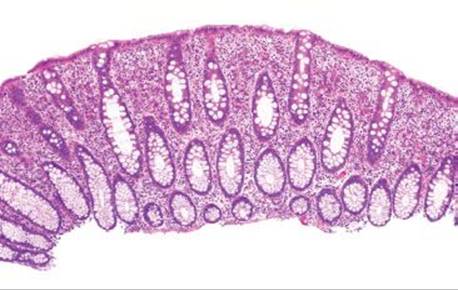
Figure 4.213 Colonic eosinophilia pattern, systemic mastocytosis. At low magnification, this colonic biopsy shows intact crypt architecture. The lamina propria appears abnormal with a mixture of pallor and eosinophilia.
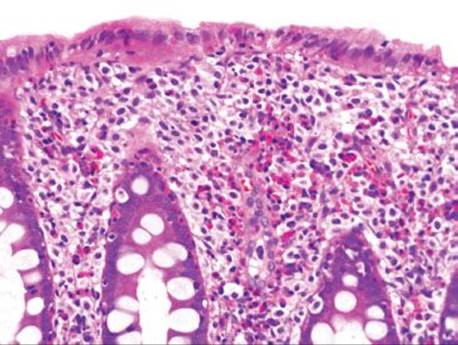
Figure 4.214 Colonic eosinophilia pattern, systemic mastocytosis. Higher magnification of the previous case shows an intense eosinophilia in the lamina propria. Recall that eosinophils can be bystanders of neoplastic processes.
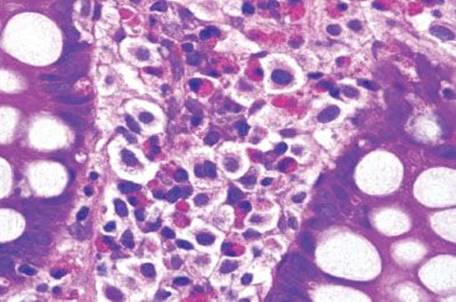
Figure 4.215 Colonic eosinophilia pattern, systemic mastocytosis. Higher magnification of the previous Figure shows an abundance of mast cells in the background lamina propria. These cells have a “fried egg” appearance, with basophilic granular cytoplasm and a peripheral halo.
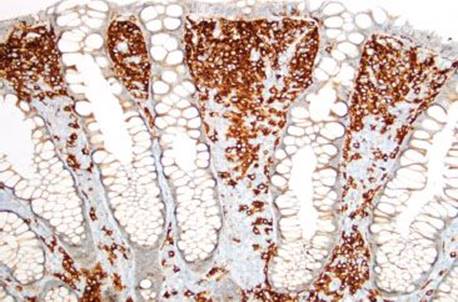
Figure 4.216 Colonic eosinophilia pattern, systemic mastocytosis (CD117 immunostain). CD117 is a normal marker for mast cells. The mast cells are densely packed in sheets.
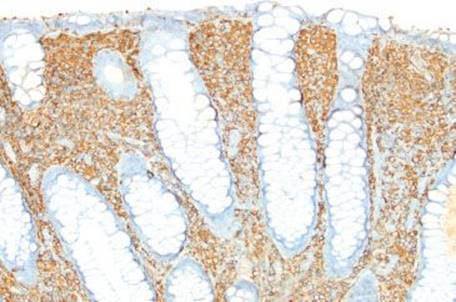
Figure 4.217 Colonic eosinophilia pattern, systemic mastocytosis (tryptase immunostain). Tryptase is also a normal marker for mast cells. Again, note the abnormal density of mast cells.
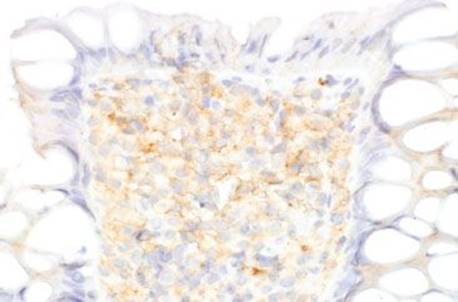
Figure 4.218 Colonic eosinophilia pattern, systemic mastocytosis (CD25 immunostain). CD25 is a cytoplasmic stain that highlights an aberrant marker in systemic mastocytosis.