
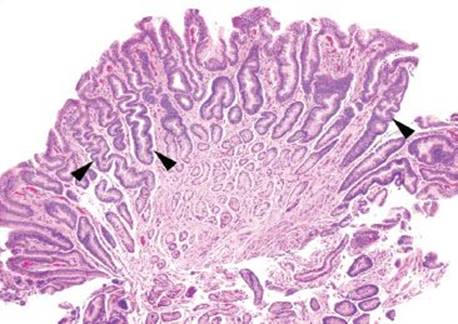
Figure 2.18 Reactive gastritis/gastropathy pattern. Reactive gastritis/gastropathy is another example of an entity that is best appreciated at scanning magnification. At low power, the surface epithelium appears dark because of the mucin loss, and it is easy to appreciate the corkscrew-like appearance of the gastric pits (arrowheads). As true for most cases of reactive gastritis/gastropathy, the background inflammation is minimal.
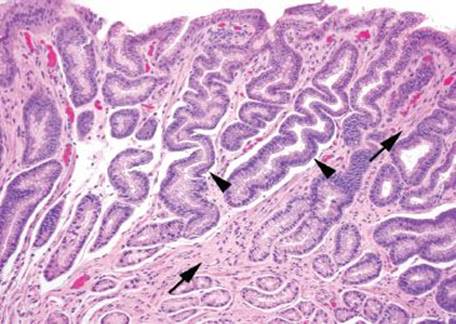
Figure 2.19 Reactive gastritis/gastropathy pattern. On higher power, the mucin loss is apparent: the surface foveolar epithelium has tiny apical caps of mucin, instead of the normal tall mucin-rich cytoplasm seen in normal apical epithelium. At this power, it is also easy to appreciate the smooth muscle bundles (arrows) between the corkscrew-like gastric pits (arrowheads) which extend toward the surface.
CHECKLIST: Etiologic Considerations for the Reactive Gastritis/Gastropathy Pattern
 Bile Reflux
Medications
Alcohol
Portal Hypertensive Gastropathy
Gastric Antral Vascular Ectasia
Autoimmune Metaplastic Atrophic Gastritis
Reactive gastritis/gastropathy constitutes the most common gastric injury pattern (Figs. 2.18 and 2.19). In a recent study of over 500,000 gastric specimens, reactive gastritis/gastropathy was reported in up to 15.6% of cases.15 There is no geographic predilection, and its incidence increases with patient age, seen in only 2% of patients under 10 years and in greater than 20% of patients over 80 years.15 Histologically, this injury pattern refers to foveolar mucin cell depletion, a corkscrew-like appearance of the gastric pits, lamina propria edema, smooth muscle fibers extending between the pits and toward the surface, and little to no inflammation (Figs. 2.20–2.23).
Reactive gastritis/gastropathy is another example of a nonspecific injury pattern. In the majority of cases, no precise etiology can be established.16 Of those with identifiable causes, bile reflux, medications (e.g., NSAIDs), alcohol, portal hypertensive gastropathy, gastric antral vascular ectasia, and autoimmune metaplastic atrophic gastritis have been implicated.15,17–22 Although the etiologic possibilities are broad, the previously mentioned etiologies are thought to induce a chemical-type damage, which result in this characteristic gastric injury pattern. Reactive gastritis is most commonly seen in the gastric antrum, supporting the theory that bile reflux is an important contributing factor. In severe cases, this injury pattern can extend into the oxyntic mucosa, sometimes even involving the cardiac mucosa. These cases must be diligently inspected for dysplasia, intestinal metaplasia, and neoplasia because chronic mucosal injury of any sort can increase a patient’s risk of neoplasia. Specimens should be carefully inspected for congested mucosal vessels (which can be seen with portal hypertensive gastropathy) and thrombosed mucosal vessels, which would suggest a diagnosis of gastric antral vascular ectasia (GAVE), in the appropriate clinical setting. See also Vascular and Hemorrhagic Injury pattern in this chapter.
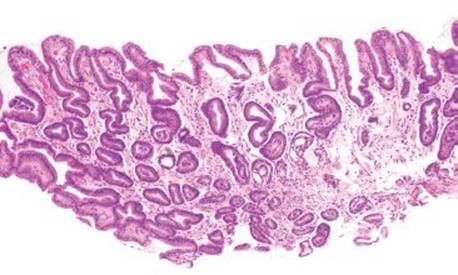
Figure 2.20 Reactive gastritis/gastropathy pattern. Again, the key features of reactive gastritis/gastropathy “jump off the slide” at scanning magnification: gastric surface foveolar mucin cell depletion, a corkscrew-like appearance of the gastric pits, lamina propria edema, smooth muscle bundles splaying foveolar epithelium, and little to no inflammation. If you have to go to 40× to appreciate the key features of reactive gastritis/gastropathy, it is not reactive gastritis/gastropathy! These features should be apparent at scanning magnification.
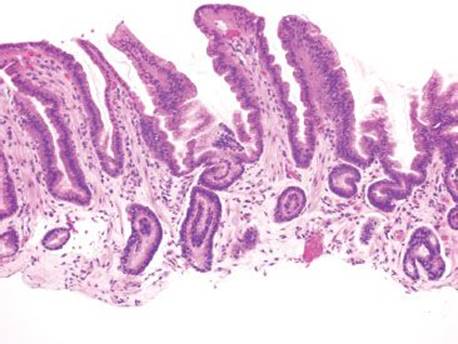
Figure 2.21 Reactive gastritis/gastropathy pattern. This case manifests all the key features of reactive gastritis/gastropathy: surface foveolar mucin cell depletion, a corkscrew-like appearance of the gastric pits, lamina propria edema, smooth muscle bundles extending to toward the surface, and little to no inflammation.
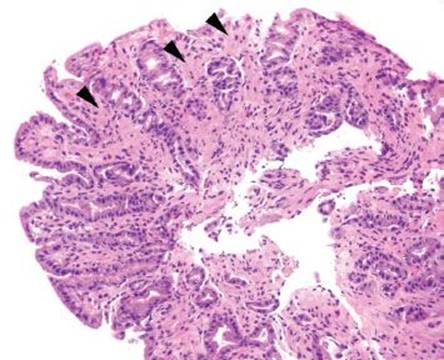
Figure 2.22 Reactive gastritis/gastropathy pattern. This case is a bit more subtle than the previous cases (Figs. 2.18–2.21) since the gastric foveolar epithelium is not quite as dark or corkscrew-like and lamina propria edema is not seen. Instead, this case features prominent smooth muscle hypertrophy (arrowheads) as it splays and envelopes the involved gastric pits. Gastric foveolar mucin cell depletion and a smattering of chronic inflammation are seen.
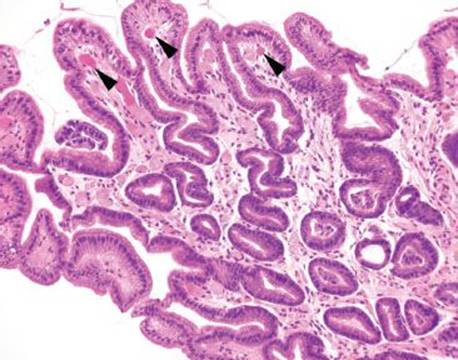
Figure 2.23 Reactive gastritis/gastropathy pattern with occasional congested vessels. This case illustrates that congested vessels are occasionally seen in the reactive gastritis/gastropathy pattern (arrowheads). In this case, a quick chart review was helpful to assess for a history of portal hypertension (as would be expected if these congested vessels were a part of portal hypertensive gastropathy) or if a striped watermelon endoscopic appearance was seen (to suggest a diagnosis of gastric antral vascular ectasia). A chart review was noncontributory in this case.
Despite its relatively high prevalence, the terminology surrounding reactive gastritis/gastropathy is a bit contentious. Equivalent terms include “chemical gastritis,” and “chemical gastropathy.” In 1996, a diverse group of gastrointestinal pathology experts convened to discuss key issues related to the classification and grading of gastritis, culminating in the updated Sydney system recommendations.16 Some preferred “chemical” since it more explicitly states the mechanism of injury; some advocated for “gastropathy” instead of “gastritis” since most cases lack clinically significant inflammation to warrant a “gastritis” designation. This nomenclature controversy is trivial and only important in so far as the reader knows that these terms all refer to the same injury pattern.
KEY FEATURES of the Reactive Gastritis/Gastropathy Pattern:
• Reactive gastritis/gastropathy is the most common gastric injury pattern.
• Morphologic features include gastric surface foveolar mucin cell depletion, a corkscrew-like appearance of the gastric pits, lamina propria edema, smooth muscle bundles extending toward the surface, and little to no inflammation.
• Implicated etiologies include bile reflux, medications (NSAIDs, e.g.,), alcohol, portal hypertensive gastropathy, gastric antral vascular ectasia, and autoimmune metaplastic atrophic gastritis.
PITFALLS & PEARLS
Reactive gastritis/gastropathy pattern can “jump off the slides” and be so eye-catching that it is easy to overlook other important diagnoses. Remember to look at every biopsy for the following sneaky entities, which can be easily obscured by a marked reactive gastritis/gastropathy pattern.
CHECKLIST: Select Diagnoses Not To Miss
Erosion (Figs. 2.24 and 2.25)
Ulceration (Fig. 2.26)
Iron Pill Gastritis (Figs. 2.27 and 2.28)
Intestinal Metaplasia
Portal Hypertensive Gastropathy (Fig. 2.29)
Gastric Antral Vascular Ectasia (Fig. 2.30)
Dysplasia
Sneaky Malignant Neoplasms (including Signet Ring and Neuroendocrine Tumors)
Autoimmune Metaplastic Atrophic Gastritis
Granulomata
Amyloid
Lymphocytic Gastritis Pattern
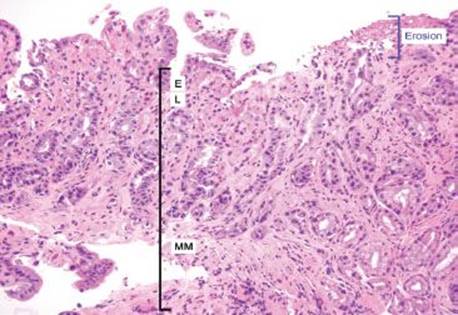
Figure 2.24 Reactive gastritis/gastropathy pattern and erosion. Erosions (blue bracket) are denudations limited to the mucosa and are often accompanied by fibrino-inflammatory debris. The fibrin deposition is “biologic proof” that true tissue damage has occurred prior to the biopsy, that is this is not a histologic artifact of tissue mishandling. The mucosa consists of the E, epithelium; L, lamina propria; MM, muscularis mucosae.
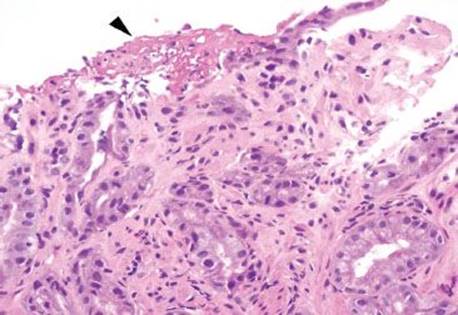
Figure 2.25 Reactive gastritis/gastropathy pattern with erosion. This example of reactive gastritis/gastropathy features an erosion with focal fibrin deposition (arrowhead).
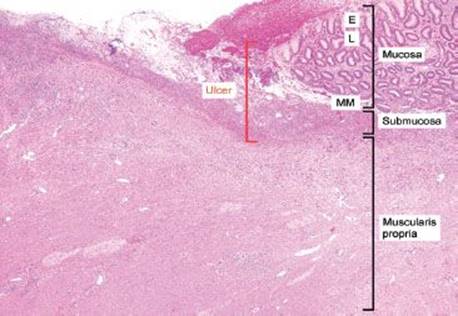
Figure 2.26 Reactive gastritis/gastropathy pattern and ulceration. In contrast to erosions which are confined to the mucosa, ulcerations extend through and beyond the muscularis mucosae and involve at least the submucosa (red bracket). The mucosa consists of the E, epithelium; L, lamina propria; MM, muscularis mucosae and the submucosa is between the muscularis mucosae and the muscularis propria.
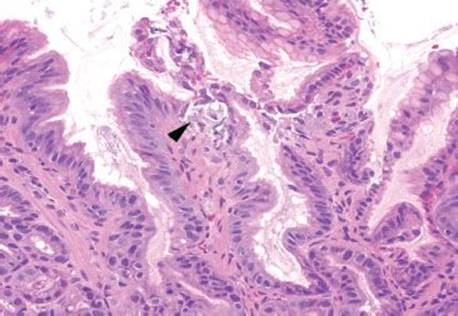
Figure 2.27 Reactive gastritis/gastropathy pattern, iron deposition. Reactive gastritis/gastropathy is a nonspecific injury pattern, that can be caused by a variety of unrelated entities. Careful scrutiny of the background can occasionally uncover clues to the etiologic injury, such as iron deposition in this case.
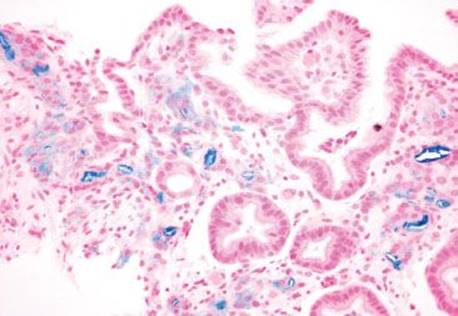
Figure 2.28 Reactive gastritis/gastropathy pattern, iron deposition (Prussian blue). A Prussian blue iron stain highlights the iron deposition.
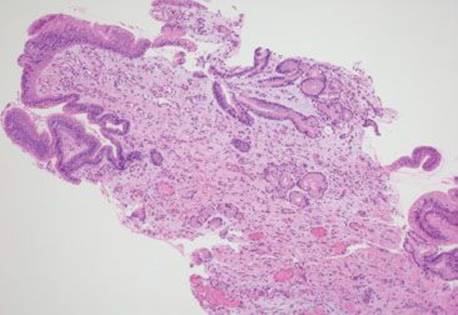
Figure 2.29 Reactive gastritis/gastropathy pattern, portal hypertensive gastropathy. This case shows the usual features of reactive gastritis/gastropathy in addition to a prominence of congested mucosal vessels. A careful chart review uncovered the red flags of cirrhosis, portal hypertension, and endoscopic abnormalities suggestive of portal hypertensive gastropathy. These features support the clinicopathologic diagnosis of portal hypertensive gastropathy.
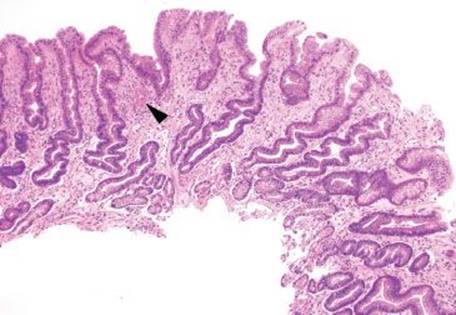
Figure 2.30 Reactive gastritis/gastropathy pattern, gastric antral vascular ectasia. Reactive gastritis/gastropathy can be an important clue to the diagnosis of gastric antral vascular ectasia. Other diagnostic features include mucosa thrombi (arrowhead) and an endoscopic image showing a striped-watermelon-like pattern.
FAQ: What is the preferred terminology for cases of reactive gastritis/gastropathy with prominent acute and chronic inflammation (Figs. 2.31 and 2.32)?
Answer: Historically, only minimal chronic inflammation was typical of reactive gastritis/gastropathy; however, an occasional case will feature slightly more acute and chronic inflammation. If the predominant pattern is reactive gastritis/gastropathy, the preferred terminology is “active chronic reactive gastritis/gastropathy.” The alternative wording, “reactive gastritis/gastropathy with acute and chronic inflammation” is often translated by clinicians as “Helicobacter infection.” Certainly, a Helicobacter special stain can be easily performed, although it is almost always negative owing to the microenvironment shifts common to this injury pattern.
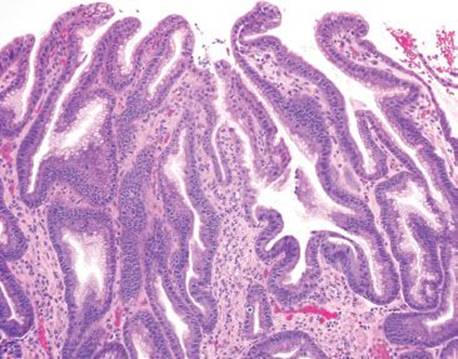
Figure 2.31 Active chronic reactive gastritis/gastropathy. In exceptionally striking examples of reactive gastritis/gastropathy, sometimes a prominence of acute and chronic inflammation is seen, as in this case.
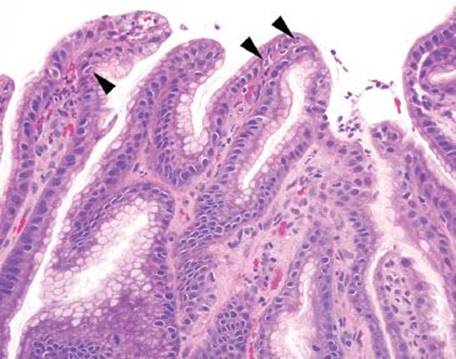
Figure 2.32 Active chronic reactive gastritis/gastropathy. The acute inflammation is best appreciated on higher power (arrowheads). The prominent pattern is reactive gastritis/gastropathy with a minimal amount of acute and chronic inflammation.