
Budi Wiweko1
(1)
Department of Obstetric and Gynecology, Dr. Cipto Mangunkusumo General Hospital, Jl. Diponegoro 71, Jakarta, 16430, Indonesia
Budi Wiweko
Email: wiwekobudi@yahoo.co.id
Abstract
Luteal phase is the period between ovulation and either the establishment of a pregnancy or the onset of menses 2 weeks later [1]. Being the latter phase of the ovarian cycle, the luteal phase coincides with the secretory phase of the endometrium.
Keywords
Luteal phaseOvarian cycleOvulationPregnancyLuteal phase defectSecretory phaseEndometrium
Introduction
Luteal phase is the period between ovulation and either the establishment of a pregnancy or the onset of menses 2 weeks later [1]. Being the latter phase of the ovarian cycle, the luteal phase coincides with the secretory phase of the endometrium.
Luteal phase defect (LPD) is described as a condition in which endogenous progesterone is not sufficient to maintain a functional secretory endometrium and to allow normal embryo implantation and growth [2]. It may be caused by inadequate progesterone secretion by the corpus luteum or inadequate response between the endometrium towards progesterone as a result of inadequate priming by estrogen. By consensus, LPD has been defined as a lag of more than 2 days in endometrial histological development compared with the expected day of the cycle [3, 4]. In LPD, there is an incompatibility between the endometrial cycle with the ovarian cycle, hence the term out-of-phase.
Luteal phase defect has been shown to be associated with ovarian stimulation alone, ovulation induction with or without gonadotropin-releasing hormone (GnRH) agonists, and assisted reproductive techniques (ARTs) [2, 5, 6]. It is also associated with other medical conditions such as anorexia, starvation, and other eating disorders [7], excessive exercise [8], stress [9], obesity and polycystic ovary syndrome (PCOS) [10], endometriosis [11], ovarian aging [12], thyroid dysfunction, and hyperprolactinemia [13]. These conditions should be ruled out, or treated adequately if present, before initiating other forms of therapy for infertility.
In ARTs, luteal phase defect results in higher failure rates. To manage the defect, luteal phase support is needed. Luteal phase support refers to the administration of medication to support the process of implantation [14]. It is commonly used in IVF cycles and has been well accepted. Nevertheless, there have been numerous researches and publications regarding the regimen, timing, dosage, and route of administration for luteal phase support [15]. These topics will be discussed in this chapter, along with the role of low molecular weight heparin (LMWH) during the luteal phase.
Rationale for Luteal Phase Support
There have been several hypotheses regarding the etiology of LPD in stimulated IVF cycles, most of which have been disproved (Table 11.1) [16]. These include removal of granulosa cells, prolonged pituitary recovery after administration of GnRH agonists, and suppression of LH by the administered human chorionic gonadotropin (hCG) [17–19]. Cycles co-treated with GnRH antagonists were also thought to enhance the recovery of pituitary function, but studies have shown that premature luteolysis also occurs in these cycles [20–22].
Table 11.1
Proposed etiologies of LPD and reason(s) for disproval
|
Etiology |
Reason(s) for disproval |
|
Removal of granulosa cells during oocyte retrieval |
Aspiration of a preovulatory oocyte in a natural cycle did not diminish the luteal phase |
|
Prolonged pituitary recovery after treatment with GnRH agonist |
Luteolysis is also initiated prematurely in cycles co-treated with GnRH antagonists |
|
Administration of hCG could suppress LH production |
hCG did not downregulate LH secretion in the luteal phase of normal, unstimulated cycles in normo-ovulatory women |
The most plausible explanation of LPD in stimulated IVF cycles is due to the multifollicular development during ovarian stimulation, resulting in supraphysiological level of steroids secreted by the abundant amount of corpora lutea during the early luteal phase. This condition causes a negative feedback at the hypothalamic-pituitary axis that directly inhibits LH release [23]. Inhibitions of LH will the cause the corpora lutea to degenerate and undergo premature luteolysis.
Considering the abnormal luteal phase in stimulated IVF cycles, exogenous support is crucial to achieve pregnancy [24]. There are two forms of exogenous support: administration of exogenous LH or hCG to save the corpus luteum and administration of products synthesized by the corpus luteum (progesterone and estrogen).
Choosing Regimens
The role of progesterone (P) in the luteal phase has been widely recognized and accepted. Progesterone-receptor blockers such as Mifepristone are known for their abortive properties. In stimulated IVF cycles, luteolysis of the corpus luteum results in reduced production of progesterone; therefore, exogenous supplementation of progesterone is needed for luteal phase support.
Different progestogen preparations have different characteristics, mainly in terms of the chemical structure, metabolism, pharmacokinetics, and potency [25]. The potency of progestogens to induce normal secretory transformation of the endometrium in luteal phase support is known as the transformational dose. The transformational dose of various progestogens are shown in Table 11.2.
Table 11.2
Transformational dose of various progestogens [26]
|
Progestin |
Transformational dose (mg per cycle) |
Transformational dose (mg per day) |
|
Progesterone |
4200 |
200–300 |
|
Dydrogesterone |
140 |
10–20 |
|
Medrogestone |
60 |
10 |
|
Medroxyprogesterone acetate |
80 |
5–10 |
|
Chlormadinone acetate |
20–30 |
10 |
|
Cyproterone acetate |
20 |
1.0 |
|
Norethisterone |
100–150 |
/ |
|
Norethisterone acetate |
30–60 |
/ |
|
Lynestrenol |
70.0 |
/ |
|
Ethynodiol |
15.0 |
/ |
|
Levonorgestrel |
6.0 |
0.15 |
|
Desogestrel |
2.0 |
0.15 |
|
Gestodene |
3.0 |
/ |
|
Norgestimate |
7.0 |
/ |
|
Dienogest |
6.0 |
/ |
|
Drospirenone |
50 |
/ |
|
Promegestone |
10 |
0.5 |
|
Nomegestrol acetate |
100 |
5.0 |
|
Trimegestone |
/ |
/ |
Reproduced with permission from Schindler et al. [26]
Phases of Endometrial Transformation
A recent study by Wiweko et al. [27] revealed that serum progesterone level on the hCG day in pregnant women is significantly lower compared to women who failed to achieve pregnancy (p = 0.024) (Table 11.3). However, serum progesterone and hCG levels are higher in women with ongoing pregnancy compared to women only achieving clinical pregnancy (p < 0.001) [27].
Table 11.3
Serum progesterone on hCG day and pregnancy rate
|
Variable |
Non-pregnant (n = 118) |
Pregnant (n = 37) |
p |
||
|
Mean |
± SD |
Mean |
± SD |
||
|
LH (mIU/mL) |
1.9 |
1.6 |
1.4 |
1 |
0.164 |
|
P4 (ng/mL) |
1.2 |
0.6 |
0.9 |
0.4 |
0.024* |
|
P4/E2 ratio |
0.7 |
0.5 |
0.5 |
0.3 |
0.01* |
|
E2 (pg/mL) |
2318 |
1472 |
2268 |
1132 |
0.829 |
|
Number of mature oocytes |
6.2 |
3.7 |
7.3 |
2.7 |
0.023* |
|
Number of 8 cells embryos |
1.5 |
1.8 |
2.8 |
1.5 |
<0.05* |
|
Variable |
Clinical pregnancy (n = 73) |
Ongoing pregnancy (n = 57) |
p |
|
Progesterone (ng/mL) |
40 (7.6–955) |
60 (15–955) |
0.000 |
|
hCG (mIU/mL) |
377 (16–1868) |
413 (47–1868) |
0.000 |
|
No |
Variable |
AUC |
Cut-off point |
p |
Sensitivity (%) |
Specificity (%) |
|
1 |
Progesterone (n = 73) |
0.982 |
58.8 ng/mL |
0.000 |
82.2 |
81 |
|
2 |
hCG (n = 228) |
0.860 |
74.05 mIU/mL |
0.000 |
93.2 |
93.3 |
Data from Wiweko et al. [27]*p<0.05
Regimen for Luteal Phase Support
Combined Estrogen + Progesterone
Var et al. [28] compared three different luteal phase support protocols among 280 samples: daily P + 4 mg of estradiol (E2), daily P + 1500 IU of hCG, and daily P-only. Pregnancy rates were similar in the first and second group but were significantly lower in women who only received daily P. However, Fatemi et al. [14] concluded that the addition of estradiol to progesterone did not significantly increase pregnancy rates in patients stimulated with GnRH antagonist/r-FSH. Similar findings were reported by Tonguc et al. [29] and Lin et al. [30] with long GnRH agonist protocols. Meta-analyses by Jee et al. [31] and Kolibianakis et al. [32] concluded that the clinical pregnancy rate and live birth rate did not differ significantly between women who received a combination of progesterone and estrogen and women who only received progesterone (Table 11.4).
Table 11.4
Comparison of pregnancy rates between E2 + P group and P-only group
|
Study |
E2 + P |
P-only |
||
|
Regimen |
Pregnancy rate |
Regimen |
Pregnancy rate |
|
|
Fatemi et al. [14] |
4 mg oral E2 valerate + 600 mg vaginal micronized progesterone |
30/101 (29.7 %) |
600 mg vaginal micronized progesterone |
26/100 (26 %) |
|
Tonguc et al. [29] |
2 mg E2 + 90 mg/day vaginal P 4 mg E2 + 90 mg/day vaginal P 6 mg E2 + 90 mg/day vaginal P |
30/95 (31.6 %) 38/95 (40 %) 31/95 (32 %) |
– |
– |
|
Lin et al. [30] |
6 mg E2 + 60 mg intramuscular P |
103/202 (50.9 %) |
60 mg intramuscular P |
116/200 (58 %) |
|
Jee et al. [31] |
7 studies with GnRH agonist cycles Clinical pregnancy rate per patient: RR 1.32 (95 % CI 0.79–2.19) Ongoing pregnancy rate per patient: RR 1.34 (95 % CI 0.37–4.82) 3 studies with GnRH antagonist cycles Clinical pregnancy rate per patient: RR 0.94 (95 % CI 0.62–1.42) Ongoing pregnancy rate per patient: RR 1.09 (95 % CI 0.79–1.50) |
|||
|
Kolibianakis et al. [32] |
4 studies with GnRH analogs Clinical pregnancy rate: RR 0.94 (95 % CI 0.78–1.13) Live birth rate: RR 0.96 (95 % CI 0.77–1.21) |
|||
Progesterone-Only
In the most recent and large-scale systematic review, van der Linden et al. [33] concluded that progesterone is the best regimen as luteal phase support, favoring synthetic progesterone over micronized progesterone. The addition of estrogen or hCG to progesterone did not significantly increase the pregnancy rates, while addition of GnRH agonists significantly increased the odds of live birth, clinical, and ongoing pregnancy (Table 11.5). These findings are in contrast with the past systematic review by Fatemi et al. [1], which concluded that both hCG and progesterone increased the pregnancy rate. In both the reviews, hCG was associated with a significantly higher risk of ovarian hyperstimulation syndrome (OHSS).
Table 11.5
Comparison of regimens for luteal phase support
|
Regimen |
Live birth rate (OR, 95 % CI) |
Clinical pregnancy rate (OR, 95 % CI) |
Ongoing pregnancy rate (OR, 95 % CI) |
Miscarriage rate (OR, 95 % CI) |
OHSS (OR, 95 % CI) |
|
hCG vs. placebo/no treatment |
2.25, 0.37–13.80 |
1.30, 0.90–1.88 |
1.75, 1.09–2.81a |
0.67, 0.15–3.09 |
0.28, 0.14–0.54b |
|
P vs. placebo/no treatment |
2.95, 1.02–8.56a |
1.83, 1.29–2.61a |
1.87, 1.19–2.94a |
0.84, 0.33–2.11 |
0.06, 0.00–3.55 |
|
P vs. hCG |
2.43, 0.84–6.97 |
1.14, 0.90–1.45 |
1.09, 0.66–1.80 |
0.75, 0.39–1.44 |
0.63, 0.38–1.03 |
|
P vs. hCG + P |
1.93, 0.46–8.05 |
0.96, 0.74–1.25 |
1.04, 0.65–1.68 |
1.14, 0.27–4.74 |
0.45, 0.26–0.79a |
|
P vs. estrogen + P |
1.13, 0.43–2.94 |
1.25, 0.99–1.59 |
1.00, 0.77–1.31 |
0.99, 1.69–1.43 |
0.14, 0.01–2.21 |
|
P vs. GnRH agonist + P |
2.44, 1.62–3.67b |
1.36, 1.11–1.66b |
1.31, 1.03–1.67b |
0.59, 0.14–2.45 |
n/a |
Adapted and modified from van der Linden et al. [33]
aStatistically significant favoring the first regimen
bStatistically significant favoring the second regimen
Route of Progesterone Administration
The route of progesterone administration has been a debatable issue. There have been many theories and studies trying to prove which route is the best: oral, vaginal, or intramuscular progesterone, each with their own merits and weaknesses (Table 11.6).
Table 11.6
Facts regarding route of progesterone administration
|
No |
Route |
Fact |
Note |
|
1 |
Oral |
Very low level in blood Bioavailability < 10 % Very high transformational dose (600 mg/day) |
Inactivated by hepatic metabolism |
|
2 |
Vaginal |
Low level in blood but still causing endometrium transformation |
Directly distributed from vagina to uterus (first uterine pass effect) |
|
3 |
Intra Muscular |
Very high level in blood (2 h) but low in endometrium |
Uncomfortable because of pain |
Van der Linden et al. [33] found that any route of progesterone administration provides comparable results. This means that progesterone, as luteal phase support, may be administered orally, vaginally, or intramuscularly. Compared to micronized progesterone, synthetic progesterone significantly increases the clinical pregnancy rate (OR 0.79, 95 % CI 0.65–0.96) but not the live birth rate (OR 1.11, 95 % CI 0.64–1.91).
Patient preference and doctor’s experience must be taken into account when choosing the regimen and route. Levine and Watson [34] reported that over 90 % of patients preferred vaginal over intramuscular progesterone, as it is less painful, easier to administer, and takes less time. A survey among various reproductive centers in different continents also showed different trends of route of progesterone administration (Table 11.7).
Table 11.7
Trends of progesterone administration in various continents
|
Center |
Cycles |
Vaginal |
im |
Vaginal + im |
|
Asia |
8095 |
4285 (52.9 %) |
810 (10.0 %) |
2250 (27.8 %) |
|
Europe |
19,620 |
14,770 (75.3 %) |
1250 (6.4 %) |
1200 (6.1 %) |
|
North America |
14,600 |
6020 (41.2 %) |
441 (30.2 %) |
3960 (27.1 %) |
|
Africa |
1420 |
700 (49.3 %) |
0 |
120 (8.5 %) |
|
South America |
2620 |
2620 (100 %) |
0 |
0 |
|
Australia |
4800 |
4800 (100 %) |
0 |
0 |
Timing of Luteal Phase Support
In controlled ovarian hyperstimulation (COH), GnRH agonist is used in order to suppress LH secretion. However, LH still declines for at least 10 days after cessation of GnRH agonists and causes negative effects on progesterone or hCG secretion [35]. As discussed before, progesterone is used as luteal phase support in order to maintain the LH level during declining levels of exogenous hCG in the luteal phase and the rise in endogenous hCG after IVF [36].
Another debatable issue regarding luteal phase support is when to initiate treatment. Time to start luteal phase support administration is diverse, ranging from the day before oocyte retrieval to 4 days after embryo transfer [35]. In a worldwide survey regarding progesterone usage in 81 countries during May to June 2012, progesterone supplementation was mostly initiated on the day of egg collection (80.1 %), followed by on the day of embryo transfer (15.4 %), on hCG administration (3.2 %), and a few days after ET (1.3 %) [37]. However, ongoing pregnancy rates and live birth rates, as the outcome of IVF, are not different clinically. The ongoing pregnancy rates after progesterone supplementation, given on day of oocyte retrieval (OR) compared to hCG administration on the day of ET were 20.8 % and 23.6 %, respectively [35].
In general practice, progesterone supplementation is frequently continued even after the patient has conceived; 44 % continue treatment until a gestational age of 8–10 weeks, 28 % continue until more than 12 weeks, 15 % continue until the pregnancy is present, and 13 % continue until fetal heart beats can be detected [37]. However, prolonged progesterone supplementation is not necessary and does not significantly impact the miscarriage and delivery rate. Progesterone supplementation can safely be withdrawn at the time of positive hCG test, 2 weeks after embryo transfer [36].
Schmidt et al. [36] also showed that there is no correlation between prolonged progesterone supplementation and delivery rates. In patients who received progesterone until 3 weeks of pregnancy after positive hCG, 4.6 % (95 % CI: 1.9–9.4) miscarried; the results are comparable to the miscarriage rate in the group of patients who withdrew progesterone (3.3 %, 95 % CI: 1.1–7.5). Moreover, delivery of babies reached 78.7 % in the group with continued progesterone administration and 82.4 % in the group who withdrew progesterone [36].
Role of Heparin to Prevent Recurrent Implantation Failure During the Luteal Phase
Implantation failure is defined as the failure to reach a stage in which there is no intrauterine gestational sac, confirmed by ultrasonography examination. A patients’ failure to conceive after 2–6 IVF cycles in which more than 10 high-grade embryos were transferred to the uterus is called recurrent implantation failure [38].
Recurrent implantation failure is associated with thrombophilia patients, and low molecular weight heparin (LMWH) is used to prevent such condition [39]. LMWH can also increase the success rate for unknown etiology of recurrent spontaneous miscarriage patients [40]. Studies show that LMWH has an important role in increasing the endometrial receptivity towards embryo implantation due to its ability to interact with a wide variety of substances in the physiological process of implantation and trophoblastic development, a process that may be adversely influenced by assisted conception [41].
Heparin Plays a Role in Trophoblast Invasion During Implantation Mechanism and Endometrial Receptivity
There are three stages of embryo implantation in the human body: apposition, adhesion, and invasion. The first event is apposition, which is characterized by the attachment of microvilli on the apical surface of the syncytiotrophoblast with pinopodes on the apical surface of uterine epithelium. Furthermore, the blastocyst adheres to uterine epithelium and progresses into syncytiotrophoblast penetration. After the blastocyst is completely bonded in the uterine stromal tissue, the site of implantation (usually in the upper posterior area of uterus) is covered by uterine epithelium, and the trophoblast layer is developed. Cytotrophoblasts then invade the entire endometrium, and the uterine vasculature gets organized to arrange uteroplacental circulation [42]. These steps involve complex molecular signaling mechanisms that are not discussed in detail here.
Heparin has been known to influence the implantation of embryo in humans. There are some mechanisms in trophoblastic apposition, adhesion, and invasion that are regulated by heparin, such as [43]:
· LMWH reduces L-selectin on the entire embryo surface.
· LMWH interferes directly with the binding of APAs to the trophoblast and maintain normal trophoblast invasion.
· Heparin binds and activates epidermal growth factor (EGF) receptors. Heparin-binding epidermal growth factors (HB-EGF)-like growth factors induce trophoblast invasion and inhibit the apoptosis process. Furthermore, heparin also enables the improvement in matrix metalloproteinase (MMP) activation, which leads to the prevention of trophoblast apoptosis.
· LMWH also increases insulin-like growth factor binding protein (IGF-BP) synthesis, which modulates IGF-I and IGF-II effects in improving implantation.
· LMWH also improves selectins, which induce leukocytes for implantation.
· LMWH works as an E-cadherin downregulator. E-cadherin is already known to limit trophoblast invasion.
· LMWH improves trophoblast invasion by reducing transforming growth factor beta (TGF-β).
· LMWH increases interleukin-1 (IL-1) which increases integrin in the epithelial surface that facilitate adhesion and possibly implantation.
The use of heparin to facilitate implantation is still controversial and still needs to be studied furthermore (Fig. 11.1). Patients undergoing IVF cycles under LMWH treatment have higher pregnancy rates compared to the control group. However, the results are not significantly different. Some studies suggest the administration of heparin at a dose of 1 mg/kg/day after egg collection in women without laboratory findings of thrombophilia due to the beneficial effect of LMWH on the clinical outcome of pregnancy [44, 45].
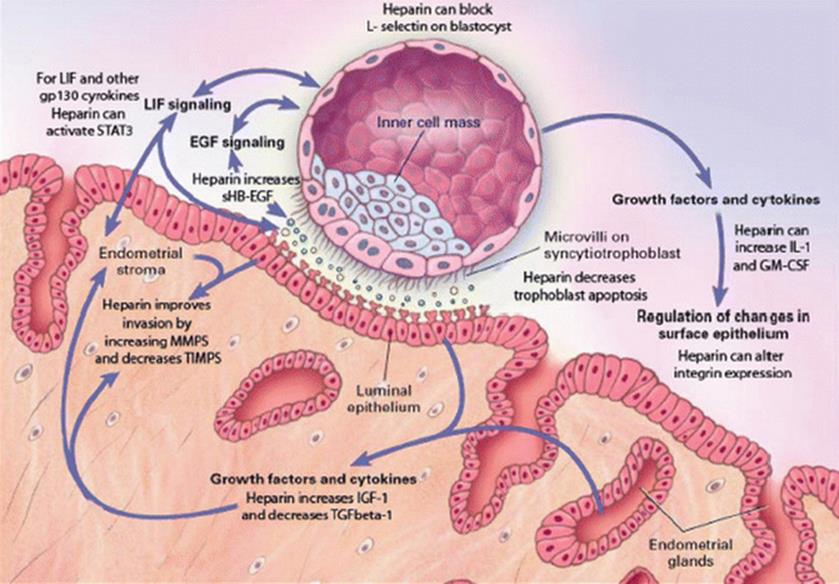
Fig. 11.1
Potential actions of heparin on implantation
In patients with thrombophilia, there is no doubt about using LMWH as it has been reported to significantly increase the success of implantation and prevent recurrent miscarriage. However, 0.25–2.5 IU/mL daily for 2 weeks can be given as a treatment during luteal phase support for patients without thrombophilias. Within the doses of 0.25–2.5 IU/mL, LMWH enhances trophoblast proliferation and invasion significantly, while high concentration of LMWH (25–250 IU/mL) will suppress its benefits in preventing miscarriage (Fig. 11.2).
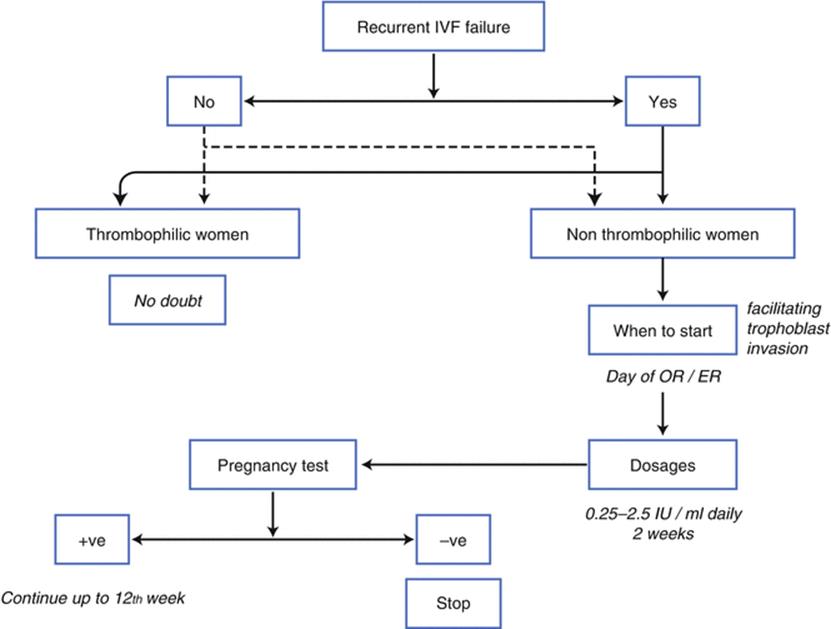
Fig. 11.2
Algorithm of LMWH usage for recurrent IVF failure
References
1.
Fatemi HM, Popovic-Todorovic B, Papanikolaou E, Donoso P, Devroey P. An update of luteal phase support in stimulated IVF cycles. Hum Reprod Update. 2007;13(6):581–90.CrossRefPubMed
2.
Practice Committee of the American Society for Reproductive M. The clinical relevance of luteal phase deficiency: a committee opinion. Fertil Steril. 2012;98(5):1112–7.CrossRef
3.
Jones GS. Luteal phase defect: a review of pathophysiology. Curr Opin Obstet Gynecol. 1991;3(5):641–8.CrossRefPubMed
4.
Dawood MY. Corpus luteal insufficiency. Curr Opin Obstet Gynecol. 1994;6(2):121–7.CrossRefPubMed
5.
Olson JL, Rebar RW, Schreiber JR, Vaitukaitis JL. Shortened luteal phase after ovulation induction with human menopausal gonadotropin and human chorionic gonadotropin. Fertil Steril. 1983;39(3):284–91.PubMed
6.
Tavaniotou A, Albano C, Smitz J, Devroey P. Impact of ovarian stimulation on corpus luteum function and embryonic implantation. J Reprod Immunol. 2002;55(1–2):123–30.CrossRefPubMed
7.
Pirke KM, Schweiger U, Lemmel W, Krieg JC, Berger M. The influence of dieting on the menstrual cycle of healthy young women. J Clin Endocrinol Metab. 1985;60(6):1174–9.CrossRefPubMed
8.
De Cree C. Sex steroid metabolism and menstrual irregularities in the exercising female. Rev Sports Med. 1998;25(6):369–406.CrossRef
9.
Kajantie E, Phillips DI. The effects of sex and hormonal status on the physiological response to acute psychosocial stress. Psychoneuroendocrinology. 2006;31(2):151–78.CrossRefPubMed
10.
Filicori M, Flamigni C, Meriggiola MC, Ferrari P, Michelacci L, Campaniello E, et al. Endocrine response determines the clinical outcome of pulsatile gonadotropin-releasing hormone ovulation induction in different ovulatory disorders. J Clin Endocrinol Metab. 1991;72(5):965–72.CrossRefPubMed
11.
Cunha-Filho JS, Gross JL, Bastos de Souza CA, Lemos NA, Giugliani C, Freitas F, et al. Physiopathological aspects of corpus luteum defect in infertile patients with mild/minimal endometriosis. J Assist Reprod Genet. 2003;20(3):117–21.PubMedCentralCrossRefPubMed
12.
Prior JC. Ovarian aging and the perimenopausal transition: the paradox of endogenous ovarian hyperstimulation. Endocrine. 2005;26(3):297–300.CrossRefPubMed
13.
Daly DC, Walters CA, Soto-Albors CE, Riddick DH. Endometrial biopsy during treatment of luteal phase defects is predictive of therapeutic outcome. Fertil Steril. 1983;40(3):305–10.PubMed
14.
Fatemi HM, Kolibianakis EM, Camus M, Tournaye H, Donoso P, Papanikolaou E, et al. Addition of estradiol to progesterone for luteal supplementation in patients stimulated with GnRH antagonist/rFSH for IVF: a randomized controlled trial. Hum Reprod. 2006;21(10):2628–32.CrossRefPubMed
15.
Sohn SH, Penzias AS, Emmi AM, Dubey AK, Layman LC, Reindollar RH, et al. Administration of progesterone before oocyte retrieval negatively affects the implantation rate. Fertil Steril. 1999;71(1):11–4.CrossRefPubMed
16.
Fatemi H. The luteal phase and ovarian stimulation. Eur Obstet Gynecol. 2009;4(1):26–9.
17.
Kerin JF, Broom TJ, Ralph MM, Edmonds DK, Warnes GM, Jeffrey R, et al. Human luteal phase function following oocyte aspiration from the immediately preovular graafian follicle of spontaneous ovular cycles. Br J Obstet Gynaecol. 1981;88(10):1021–8.CrossRefPubMed
18.
Smitz J, Erard P, Camus M, Devroey P, Tournaye H, Wisanto A, et al. Pituitary gonadotrophin secretory capacity during the luteal phase in superovulation using GnRH-agonists and HMG in a desensitization or flare-up protocol. Hum Reprod. 1992;7(9):1225–9.PubMed
19.
Miyake A, Aono T, Kinugasa T, Tanizawa O, Kurachi K. Suppression of serum levels of luteinizing hormone by short- and long-loop negative feedback in ovariectomized women. J Endocrinol. 1979;80(3):353–6.CrossRefPubMed
20.
Albano C, Grimbizis G, Smitz J, Riethmuller-Winzen H, Reissmann T, Van Steirteghem A, et al. The luteal phase of nonsupplemented cycles after ovarian superovulation with human menopausal gonadotropin and the gonadotropin-releasing hormone antagonist Cetrorelix. Fertil Steril. 1998;70(2):357–9.CrossRefPubMed
21.
Albano C, Smitz J, Camus M, Riethmuller-Winzen H, Siebert-Weigel M, Diedrich K, et al. Hormonal profile during the follicular phase in cycles stimulated with a combination of human menopausal gonadotrophin and gonadotrophin-releasing hormone antagonist (Cetrorelix). Hum Reprod. 1996;11(10):2114–8.CrossRefPubMed
22.
Beckers NG, Macklon NS, Eijkemans MJ, Ludwig M, Felberbaum RE, Diedrich K, et al. Nonsupplemented luteal phase characteristics after the administration of recombinant human chorionic gonadotropin, recombinant luteinizing hormone, or gonadotropin-releasing hormone (GnRH) agonist to induce final oocyte maturation in in vitro fertilization patients after ovarian stimulation with recombinant follicle-stimulating hormone and GnRH antagonist cotreatment. J Clin Endocrinol Metab. 2003;88(9):4186–92.CrossRefPubMed
23.
Fauser BC, Devroey P. Reproductive biology and IVF: ovarian stimulation and luteal phase consequences. Trends Endocrinol Metab. 2003;14(5):236–42.CrossRefPubMed
24.
Edwards RG, Steptoe PC, Purdy JM. Establishing full-term human pregnancies using cleaving embryos grown in vitro. Br J Obstet Gynaecol. 1980;87(9):737–56.CrossRefPubMed
25.
Fanchin R, De Ziegler D, Bergeron C, Righini C, Torrisi C, Frydman R. Transvaginal administration of progesterone. Obstet Gynecol. 1997;90(3):396–401.CrossRefPubMed
26.
Schindler AE, Campagnoli C, Druckmann R, Huber J, Pasqualini JR, Schweppe KW, et al. Classification and pharmacology of progestins. Maturitas. 2008;61(1–2):171–80.CrossRefPubMed
27.
Wiweko B, Iljanto S, Natadisastra M, Hestiantoro A, Soebijanto S. Progesterone level on day hCG as a predictor of endometrial receptivity. Indones J Obstet Gynecol. 2009;33–2:118–23.
28.
Var T, Tonguc EA, Doganay M, Gulerman C, Gungor T, Mollamahmutoglu L. A comparison of the effects of three different luteal phase support protocols on in vitro fertilization outcomes: a randomized clinical trial. Fertil Steril. 2011;95(3):985–9.CrossRefPubMed
29.
Tonguc E, Var T, Ozyer S, Citil A, Dogan M. Estradiol supplementation during the luteal phase of in vitro fertilization cycles: a prospective randomised study. Eur J Obstet Gynecol Reprod Biol. 2011;154(2):172–6.CrossRefPubMed
30.
Lin H, Li Y, Li L, Wang W, Zhang Q, Chen X, et al. Oral oestradiol supplementation as luteal support in IVF/ICSI cycles: a prospective, randomized controlled study. Eur J Obstet Gynecol Reprod Biol. 2013;167(2):171–5.CrossRefPubMed
31.
Jee BC, Suh CS, Kim SH, Kim YB, Moon SY. Effects of estradiol supplementation during the luteal phase of in vitro fertilization cycles: a meta-analysis. Fertil Steril. 2010;93(2):428–36.CrossRefPubMed
32.
Kolibianakis EM, Venetis CA, Papanikolaou EG, Diedrich K, Tarlatzis BC, Griesinger G. Estrogen addition to progesterone for luteal phase support in cycles stimulated with GnRH analogues and gonadotrophins for IVF: a systematic review and meta-analysis. Hum Reprod. 2008;23(6):1346–54.CrossRefPubMed
33.
van der Linden M, Buckingham K, Farquhar C, Kremer JA, Metwally M. Luteal phase support for assisted reproduction cycles. Cochrane Database Syst Rev. 2011;(10):CD009154.
34.
Levine H, Watson N. Comparison of the pharmacokinetics of Crinone 8% administered vaginally versus Prometrium administered orally in postmenopausal women. Fertil Steril. 2000;73(3):516–21.CrossRefPubMed
35.
Mochtar MH, Van Wely M, Van der Veen F. Timing luteal phase support in GnRH agonist down-regulated IVF/embryo transfer cycles. Hum Reprod. 2006;21(4):905–8.CrossRefPubMed
36.
Schmidt KL, Ziebe S, Popovic B, Lindhard A, Loft A, Andersen AN. Progesterone supplementation during early gestation after in vitro fertilization has no effect on the delivery rate. Fertil Steril. 2001;75(2):337–41.CrossRefPubMed
37.
Vaisbuch E, de Ziegler D, Leong M, Weissman A, Shoham Z. Luteal-phase support in assisted reproduction treatment: real-life practices reported worldwide by an updated website-based survey. Reprod Biomed Online. 2014;28(3):330–5.
38.
Das M, Holzer HE. Recurrent implantation failure: gamete and embryo factors. Fertil Steril. 2012;97(5):1021–7.CrossRefPubMed
39.
Simon A, Laufer N. Repeated implantation failure: clinical approach. Fertil Steril. 2012;97(5):1039–43.CrossRefPubMed
40.
Tzafettas J, Petropoulos P, Psarra A, Delkos D, Papaloukas C, Giannoulis H, et al. Early antiplatelet and antithrombotic therapy in patients with a history of recurrent miscarriages of known and unknown aetiology. Eur J Obstet Gynecol Reprod Biol. 2005;120(1):22–6.CrossRefPubMed
41.
Nelson SM, Greer IA. The potential role of heparin in assisted conception. Hum Reprod Update. 2008;14(6):623–45.CrossRefPubMed
42.
Norwitz ER, Schust DJ, Fisher SJ. Implantation and the survival of early pregnancy. N Engl J Med. 2001;345(19):1400–8.CrossRefPubMed
43.
Chen Y, Wu XX, Tan JP, Liu ML, Liu YL, Zhang JP. Effects of low molecular weight heparin and heparin-binding epidermal growth factor on human trophoblast in first trimester. Fertil Steril. 2012;97(3):764–70.CrossRefPubMed
44.
Noci I, Milanini MN, Ruggiero M, Papini F, Fuzzi B, Artini PG. Effect of dalteparin sodium administration on IVF outcome in non-thrombophilic young women: a pilot study. Reprod Biomed Online. 2011;22(6):615–20.CrossRefPubMed
45.
Berker B, Taskin S, Kahraman K, Taskin EA, Atabekoglu C, Sonmezer M. The role of low-molecular-weight heparin in recurrent implantation failure: a prospective, quasi-randomized, controlled study. Fertil Steril. 2011;95(8):2499–502.CrossRefPubMed