
Aygul Demirol1 and Suleyman Guven2
(1)
Department of Obstetric and Gynecology, Faculty of Medicine, Yakindogu University Hospital, Çukurambar mah, 1467 sokak, ankara, dilay sitesi. 6/13, Ankara, 066000, Turkey
(2)
Department of Obstetric and Gynecology, Faculty of Medicine, Karadeniz Technical University, Kadın Hastalıkları ve Doğum Polikliniği, Trabzon, 61080, Turkey
Aygul Demirol (Corresponding author)
Email: ademirol@gmail.com
Suleyman Guven
Email: drsuleymanguven@yahoo.com
Abstract
The gonadotropin-releasing hormone (GnRH) analogs suppress the pituitary follicle-stimulating hormone (FSH) and luteinizing hormone (LH) secretion and enable the control of ovarian folliculogenesis to yield high pregnancy rates in IVF/ICSI cycles. The GnRH analogs have many advantages such as high potency, increased half life, and increased binding capacity to pituitary GnRH receptors, compared with the GnRH molecule. The two types of GnRH analogs in clinical practice are the GnRH agonist and GnRH antagonist. The efficacy of these two GnRH analogs is still under debate. Recent studies have failed to reveal the superiority of one molecule over another. In normo-responders, the implantation rate, clinical pregnancy rate, and miscarriage rates were similar in the GnRH antagonist regimens as well in the GnRH agonist long protocol. However, a significantly higher number of oocytes and higher proportion of mature MII oocytes was retrieved per patient randomized in the GnRH agonist group compared to the GnRH antagonist group. In poor responders, the duration of stimulation with the GnRH antagonist was smaller than the GnRH agonist cycle, although there was no statistical difference in the number of oocytes retrieved, the number of mature oocytes retrieved, the cycle cancellation rate, and clinical pregnancy rate between the GnRH antagonist and GnRH agonist protocols.
Keywords
GnRH analogGnRH antagonistGnRH agonistIVFControlled ovarian stimulation
Abbreviations
COH
Controlled ovarian hyperstimulation
IVF
In vitro fertilization
ICSI
Intracytoplasmic sperm injection
GnRH
Gonadotropin releasing hormone
GnRH
a Gonadotropin releasing hormone agonist
GnRH
ant Gonadotropin releasing hormone antagonist
FSH
Follicle stimulating hormone
LH
Luteinizing hormone
OC
Oral contraceptive
P
Progesterone
OHSS
Ovarian hyperstimulation syndrome
Introduction
In the early twentieth century, the function of gonadotropin-releasing hormone (GnRH) was first elucidated. Researchers discovered that any lesions involving the anterior pituitary may lead to genital atrophy. This fact gives us to understand the hypopthalamo-pituitary gonadal axis [1]. The GnRH decapeptide and its amino acid sequence was discovered in 1971 [2]. Modifications at amino acid positions 6 and 10 gave rise to GnRH analogs. The GnRH analogs have many advantages, such as high potency, increased half life, and increased binding capacity to pituitary GnRH receptors, compared with the GnRH molecule [1].
Two types of GnRH analogs, GnRH agonists and antagonists, have been discovered (Table 5.1). These peptides that mimic the action of GnRH are of potential clinical interest because they can be used to suppress gonadotropin secretion and subsequent sex steroid production [3]. The main function of these molecules is to prevent the endogenous LH surge in controlled ovarian hyperstimulation. By this function, the cycle cancellation rate is decreased and the in vitro fertilization (IVF) cycle outcomes improved. Furthermore, these molecules give clinicians the flexibility to schedule the oocyte retrieval time [1].
Table 5.1
GnRH analogs
|
GnRH agonists |
GnRH antagonists |
|
Triptorelin Leuprolide Buserelin Goserelin |
Nal-Glu-GnRH Antide Azaline B Cetrorelix Ganirelix |
Derived from reference Ortmann et al. [3]
GnRH Agonists
The amino- and the carboxy-terminal sequences of the native GnRH molecule are critically important for binding to the receptor, whereas the amino-terminal domain plays a critical role in receptor activation. Several GnRH agonists have been synthesized: they are characterized by changing the amino acid on position 6. This new property gives new advantages to the resulting molecule. The agonist analogs become more resistant to enzymatic degradation and possess higher affinity to the GnRH receptor [3].
The GnRH agonist initially stimulates pituitary secretion (flare effect), subsequently inhibits pituitary gonadotropin secretion due to reduction of GnRH receptors on the cell membrane of the gonadotropic cell (downregulation). As the receptors remain bound to the agonist for a while, the resumption of pituitary secretion usually begins 2 weeks after interruption of treatment. Full restoration of ovarian function takes place in more than 6 weeks [4].
GnRH agonists induce profound suppression of endogenous release of gonadotropins during the early follicular phase, allowing the early antral follicles to grow synchronously in response to exogenous gonadotropins to accomplish simultaneous maturation. This leads to an extended widening of the FSH window, an increased number of recruited mature follicles, and a higher number of retrieved oocytes [5].
There are two most commonly used GnRH agonist protocols. The first one is long agonist downregulation GnRH agonist protocol (Fig. 5.1). In this protocol, GnRH agonist is given in the mid-luteal phase of previous cycle. The second one is the short flare agonist downregulation protocol, where the GnRH agonist is given on day 2 of menstruation (Fig. 5.2) [1].
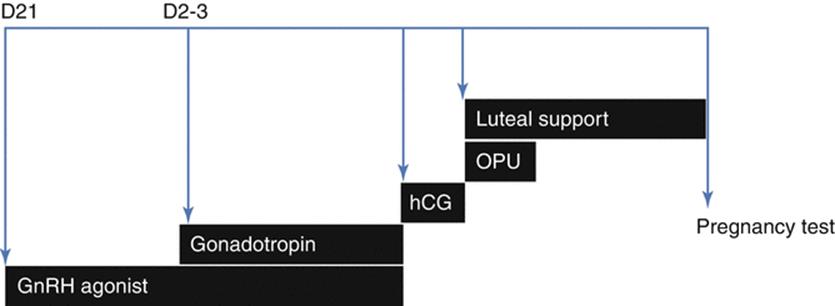
Fig. 5.1
GnRH agonist downregulation protocol
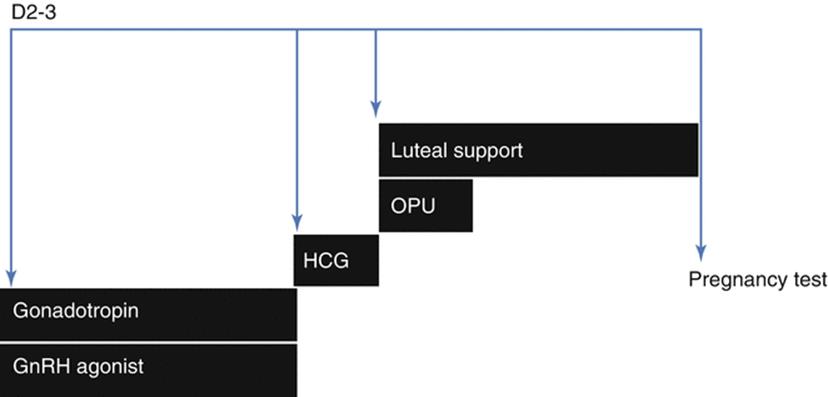
Fig. 5.2
Short flare GnRH agonist protocol
In the long protocol, a GnRH agonist depot preparation or daily injections are initiated during the mid-luteal phase of the preceding cycle. Today, this protocol, which aims at complete desensitization of the pituitary gland before starting stimulatory therapy, is still the most used worldwide for assisted reproductive techniques. Despite its effectiveness in preventing the premature LH surge and allowing strict cycle control, it has some disadvantages such as the following.
(a)
(b)
(c)
(d)
(e)
(f)
(g)
(h)
(i)
The GnRH agonist protocol may result in stable and low LH and progesterone (P) levels throughout the stimulation phase and may also cause suppression of endogenous FSH levels, leading to a follicular cohort of all small follicles at the initiation of FSH stimulation resulting in a synchronized follicular development. The advantages of this protocol are increased number of oocytes collected, additional pregnancy chances from cryopreserved embryos, and improvement in patient scheduling [7].
GnRH Antagonists
Antagonistic analogs of GnRH are derived from multiple amino acid substitutions at positions 1, 2, 3, 6, 8, and 10 in the decapeptide. These compounds have to be administered at high doses to result in the counteraction of endogenous GnRH activity. The first generation of GnRH analogs may cause anaphylactic reactions, due to stimulation of histamine release. The new generation compounds – Ganirelix and Cetrorelix – are free of such side effects. These analogs suppress gonadotropin (FSH, LH) secretion immediately and the levels of sex steroids decline. GnRH antagonists do not induce an initial increase of gonadotropins. Apart from their action to compete with GnRH for receptors on gonadotroph cell membranes, recent data indicate that prolonged treatment with GnRH antagonists leads to downregulation of GnRH receptors. GnRH antagonists act mainly through competition with native GnRH for the specific membrane receptors [3].
Three GnRH antagonist protocols have been described:
(a)
(b)
(c)
One of the most promising aspects of introducing GnRH antagonists into ovarian stimulation is the theoretical possibility of making this treatment less aggressive and much “softer” than an agonistic long protocol.
Based on review results of Felberbaum et al. [6], antagonist protocols have clear advantages, such as a shorter stimulation period, no sex steroid withdrawal symptoms, a lower rate of OHSS, and the possibility of finding more comfortable ways of ovarian stimulation. The pharmacological mode of action of GnRH antagonists is more physiological than that of GnRH agonists. GnRH antagonists allow immediate suppression of gonadotropins while preserving pituitary responsiveness to endogenous GnRH, which means enormous flexibility within therapeutic options. The GnRH antagonists may be given only when needed. The same publication suggested using GnRH antagonist protocol in selected patients, especially in poor responders [6].
In 2013, Depalo et al. [7] reported that the GnRH antagonist regimen is effective in preventing a premature rise of LH and therefore, results in a shorter and more cost-effective ovarian stimulation protocol compared to the long agonist protocol [7]. However, there is a difference in the synchronization of follicular recruitment and growth in the GnRH agonist and GnRH antagonist regimens, with better follicular growth and oocyte maturation seen with GnRH antagonist treatment [7, 8]. The main advantages of antagonist protocols are that it gives immediate, reversible suppression of gonadotropin secretion, which avoids the adverse effects related to the initial flare up and subsequent downregulation. The clinicians may initiate the IVF treatment in a normal menstrual cycle. Antagonist protocols result in endogenous inter-cycle FSH rise rather than FSH suppression, thus resulting in a significant reduction in the effective dosage and shorter treatment, than with the GnRH agonist. The main disadvantages of antagonist protocols are that it may cause high inter-cycle endogenous FSH concentrations, inducing secondary follicle recruitment and leading to asynchronous follicular development [7].
GnRH Antagonist versus GnRH Agonist Protocol in Good Responders
In a recent retrospective study, the outcome parameters of the patients anticipated to have a good response to stimulation, based upon baseline characteristics using either a GnRH agonist or antagonist protocol in their first IVF cycle were compared. The authors clearly reported that clinical pregnancy (43.6 % vs. 48.6 %) and live birth rates (34.9 % vs. 40.1 %) were similar in good responders utilizing either a GnRH agonist or antagonist during their first cycle of IVF [9].
In another prospective randomized study, the cycle outcomes of oral contraceptive (OC) pill pretreatment in recombinant FSH/GnRH-antagonist versus recombinant FSH/GnRH-agonist stimulation in IVF patients were reported. In both the protocols the patients had similar number of two pronuclei (2PN) oocytes, cryopreserved embryos, embryos transferred, implantation, and pregnancy rates [10].
The positive effect on reduction of OHSS rates in antagonist protocols was elucidated in a recent meta-analysis [11]. Based on 45 randomized controlled trials (RCTs) study results, the authors failed to reveal any statistically significant results in terms of ongoing pregnancy rates and live birth rates. However, the authors clearly reported that the use of antagonist compared with long GnRH agonist protocols was associated with a large reduction in OHSS [11].
The study questions whether a GnRH agonist and a GnRH antagonist protocol for the same patient undergoing IVF have different cycle outcomes was answered in a recent study [12]. In this retrospective study, the implantation rate and clinical pregnancy rate were significantly higher in the antagonist protocol (15.82 % and 30.26 %, respectively) than in the agonist protocol (5.26 % and 10.64 %, respectively). It was concluded that the GnRH antagonist protocol probably improved the outcome of pregnancy of older patients with a history of multiple failure of IVF-ET [12].
Recent meta-analysis summarized the study findings of RCTs [7, 8]. Based on these study results, the implantation rate, clinical pregnancy rate, and miscarriage rates were similar in the GnRH antagonist as well the GnRH agonist long protocol. However, a significantly higher number of oocytes and a higher proportion of mature MII oocytes were retrieved per patient randomized, in the GnRH agonist group compared to the GnRH antagonist group. Moreover, a significant relationship was observed between the patient’s age and the number of oocytes retrieved in the antagonist group, meaning that the GnRH antagonist allows a more natural recruitment of follicles in the follicular phase in an ovary that has not been suppressed, whereas a better synchronization of the follicular cohort is observed with the agonist treatment [7, 8].
GnRH Antagonist versus GnRH Agonist Protocol in Poor Responders
Mohamed et al. [13] compared the agonist flare-up and antagonist protocols in the management of poor responders to the standard long downregulation protocol in a retrospective study [13]. They found both the flare-up and the antagonist protocols significantly improved the ovarian response of known poor responders. However, a significantly higher cycle cancellation rate and less patients having embryo transfer in the antagonist group tipped the balance in favor of the flare-up protocol [13]. Another recent retrospective study compared the efficacy of four different protocols including GnRH agonist (long, short and mini-flare), and GnRH antagonist on pregnancy outcomes in poor responders. They suggested that the application of four different protocols in poor responder patients seem to have similar efficacy in improving clinical outcomes such as implantation, pregnancy and cancellation rates [14].
The first published report of a prospective, RCT, comparing a fixed, multi-dose GnRH antagonist protocol with a long GnRH agonist protocol in poor responders undergoing IVF concluded that a protocol including a GnRH antagonist appears at least as effective as one using a GnRH agonist in patients who are poor responders to a long agonist protocol, and may be easier or more convenient to administer. Both the protocols have similar implantation and pregnancy rates [15].
Another randomized prospective study focused on the advantageous affect of antagonist protocols on embryologic data. In this randomized prospective study, the authors found that the flare-up protocol appears to be more effective than the GnRH antagonist protocol in terms of mature oocytes retrieved, fertilization rate, and top quality embryos transferred in poor-responder patients. However, they also reported similar findings in both protocols in terms of implantation and pregnancy rates [16]. We also published similar study results in 2009 [17]. We clearly reported in our randomized prospective study that the microdose flare-up protocol seems to have a better outcome in poor responder patients, with a significantly higher mean number of mature oocytes retrieved and higher implantation rate [17].
Kahraman et al. [18] also compared the efficacy of the microdose GnRH agonist flare-up and multiple dose GnRH antagonist protocols in patients who had a poor response to a long luteal GnRH agonist protocol in a prospective randomized study. The authors concluded that the microdose GnRH agonist flare-up protocol and multiple dose GnRH antagonist protocol seem to have similar efficacy in improving treatment outcomes in poor responder patients [18].
A recent randomized prospective study compared the efficacy of GnRH antagonist protocol with GnRH agonist protocol in poor responders in 364 women. They concluded that long GnRH agonist and fixed GnRH antagonist protocols have comparable pregnancy rates per transfer (42 % vs. 33 %, respectively). The higher cancellation rate (22 % vs. 15 %, respectively) observed in the antagonist group suggests the long GnRH agonist protocol as the first choice for ovarian stimulation in these patients [19].
Recently, in view of the discrepancies about the potential advantages of GnRH antagonist ovarian stimulation protocols compared with the GnRH agonist protocols in poor ovarian responders undergoing IVF/ICSI, a meta-analysis of the published data was performed to compare the efficacy of GnRH antagonist versus GnRH agonist protocols for ovarian stimulation in IVF poor responders. A meta-analysis involving 566 IVF patients in the GnRH antagonist protocol group and 561 patients in the GnRH agonist protocol group was performed. The main conclusion of this study was a clear advantage was gained in the duration of stimulation with GnRH antagonist in poor ovarian responders undergoing IVF, although there were no statistical differences in the number of oocytes retrieved, the number of mature oocytes retrieved, the cycle cancellation rate, and clinical pregnancy rates between the GnRH antagonist and GnRH agonist protocols. However, the authors also addressed the fact that further controlled randomized prospective studies with larger sample sizes are needed [20].
References
1.
Hayden C. GnRH analogues: applications in assisted reproductive techniques. Eur J Endocrinol. 2008;159 Suppl 1:S17–25.CrossRefPubMed
2.
Schally AV. Luteinizing hormone-releasing hormone analogs: their impact on the control of tumorigenesis. Peptides. 1999;20(10):1247–62.CrossRefPubMed
3.
Ortmann O, Weiss JM, Diedrich K. Gonadotrophin-releasing hormone (GnRH) and GnRH agonists: mechanisms of action. Reprod Biomed Online. 2002;5 Suppl 1:1–7.CrossRefPubMed
4.
Ron-El R, Raziel A, Schachter M, et al. Induction of ovulation after gnRH antagonists. Hum Reprod Update. 2000;6(4):318–21.CrossRefPubMed
5.
Daya S, Maheshwari A, Siristatidis CS, et al. Gonadotropin releasing hormone agonist protocols for pituitary desensitization in in vitro fertilization and gamete intrafallopian transfer cycles. Cochrane Database Syst Rev. 2000;(2):CD001299.
6.
Felberbaum RE, Diedrich K. Gonadotrophin-releasing hormone antagonists: will they replace the agonists? Reprod Biomed Online. 2003;6(1):43–53.CrossRefPubMed
7.
Depalo R, Jayakrishan K, Garruti G, et al. GnRH agonist versus GnRH antagonist in in vitro fertilization and embryo transfer (IVF/ET). Reprod Biol Endocrinol. 2012;10:26.PubMedCentralCrossRefPubMed
8.
Depalo R, Lorusso F, Palmisano M, et al. Follicular growth and oocyte maturation in GnRH agonist and antagonist protocols for in vitro fertilisation and embryo transfer. Gynecol Endocrinol. 2009;25(5):328–34.CrossRefPubMed
9.
Johnston-MacAnanny EB, DiLuigi AJ, Engmann LL, et al. Selection of first in vitro fertilization cycle stimulation protocol for good prognosis patients: gonadotropin releasing hormone antagonist versus agonist protocols. J Reprod Med. 2011;56(1–2):12–6.PubMed
10.
Barmat LI, Chantilis SJ, Hurst BS, Dickey RP. A randomized prospective trial comparing gonadotropin-releasing hormone (GnRH) antagonist/recombinant follicle-stimulating hormone (rFSH) versus GnRH-agonist/rFSH in women pretreated with oral contraceptives before in vitro fertilization. Fertil Steril. 2005;83(2):321–30.CrossRefPubMed
11.
Al-Inany HG, Youssef MA, Aboulghar M, et al. Gonadotrophin-releasing hormone antagonists for assisted reproductive technology. Cochrane Database Syst Rev. 2011;(5):CD001750.
12.
Li Y, Li Y, Zhang H, et al. Comparison between a GnRH agonist and a GnRH antagonist protocol for the same patient undergoing IVF. J Huazhong Univ Sci Technolog Med Sci. 2008;28(5):618–20.CrossRefPubMed
13.
Mohamed KA, Davies WAR, Allsopp J, Lashen H. Agonist “flare-up” versus antagonist in the management of poor responders undergoing in vitro fertilization treatment. Fertil Steril. 2005;83(2):331–5.CrossRefPubMed
14.
Madani T, Ashrafi M, Yeganeh LM. Comparison of different stimulation protocols efficacy in poor responders undergoing IVF: a retrospective study. Gynecol Endocrinol. 2012;28(2):102–5.CrossRefPubMed
15.
Cheung LP, Lam P-M, Lok IH, et al. GnRH antagonist versus long GnRH agonist protocol in poor responders undergoing IVF: a randomized controlled trial. Hum Reprod. 2005;20(3):616–21.CrossRefPubMed
16.
Malmusi S, La Marca A, Giulini S, et al. Comparison of a gonadotropin-releasing hormone (GnRH) antagonist and GnRH agonist flare-up regimen in poor responders undergoing ovarian stimulation. Fertil Steril. 2005;84(2):402–6.CrossRefPubMed
17.
Demirol A, Gurgan T. Comparison of microdose flare-up and antagonist multiple-dose protocols for poor-responder patients: a randomized study. Fertil Steril. 2009;92(2):481–5.CrossRefPubMed
18.
Kahraman K, Berker B, Atabekoglu CS, et al. Microdose gonadotropin-releasing hormone agonist flare-up protocol versus multiple dose gonadotropin-releasing hormone antagonist protocol in poor responders undergoing intracytoplasmic sperm injection-embryo transfer cycle. Fertil Steril. 2009;91(6):2437–44.CrossRefPubMed
19.
Prapas Y, Petousis S, Dagklis T, et al. GnRH antagonist versus long GnRH agonist protocol in poor IVF responders: a randomized clinical trial. Eur J Obstet Gynecol Reprod Biol. 2013;166(1):43–6.CrossRefPubMed
20.
Pu D, Wu J, Liu J. Comparisons of GnRH antagonist versus GnRH agonist protocol in poor ovarian responders undergoing IVF. Hum Reprod. 2011;26(10):2742–9.CrossRefPubMed