
....................................
GM: Pam, we’ve talked a lot about individual dietary choices and their effect on human health. But there are also collective choices we make as a society that influence health in all kinds of ways, not least by directing, or misdirecting, the citizenry in making their individual choices. So let’s discuss public policy and propose some changes to the status quo.
PP: Well, public policy has to change because we simply cannot afford to keep spending as much as we spend on health care and expect to have either a vibrant economy or a balanced budget. It’s simply impossible. We spent $8,000 per person on health care services in 2009, the most of any country in the world by a long shot. Poor Norway limped along in second place at $5,000 per person. So we’re spending 60 percent more than the second most expensive health care system in the world.1 That’s insane, particularly for a country that ranks thirty-sixth in the world in longevity. If a company made laptops and it was spending 60 percent more for microprocessors and other parts than its competitors, and yet its laptops came in thirty-sixth in a test for durability, I don’t think that company would be in business very long.
GM: When I think of our health care system, I’m reminded of what my doctor said to me once. As I mentioned, he’s got a humble approach to his practice, which is why I return to him annually. He said, “I’m not interested in the practice of health care. I’m interested in the practice of medicine.” I asked him what the difference was. He told me that he sees health care as the system that doctors get caught up in: he has to see so many patients per hour, deal with the insurance companies, diagnose and treat according to guidelines, etc. He’s dismissive, to put it mildly, of the health care system. He’s passionate about the practice of medicine; medicine to him means a lot of talking and listening, getting to know his patients, and treating them as individual human beings. He happens to believe in colonoscopy screening, but when I turn it down annually, he hears me out and he’s fine with that.
PP: The problem is medical education. There are plenty of doctors who have the best of intentions, but they’ve never been schooled in nutrition. If they’re seeing patients with degenerative diseases and they’re not practicing nutrition, they’re not practicing medicine, period.
Doctors are taught to mitigate and treat symptoms. We need to set the bar higher in training health care professionals. Health care has to become outcome-oriented. We have to teach doctors that stopping the progression of diseases, and even reversing diseases, is an option.
GM: How do we do that?
PP: Be the first one to show up in your doctor’s office reversing disease with diet. Doctors were never taught in school that you can eat your way out of disease. However, be your doctor’s first patient who does, and maybe your doctor will take a fresh look at diet as an intervention tool. Until medical schools give doctors a proper education, patients may have to do it.
GM: And then there’s the education of the rest of us. The schools are key to getting children off to a healthy start in life, yet school nutrition guidelines are effectively written by agribusinesses through their shills in the U.S. Department of Agriculture (USDA). What can be done to help kids eat healthy lunches in schools?
PP: Well, first, of course, if you can pack a healthy lunch for your child that’s generally best, but that’s not an option for everyone. We need to concern ourselves with what’s offered in the cafeteria. The federal nutrition guidelines allow for meals that are 30 percent fat, which is a good way to promote obesity, and it’s been quite effective at doing just that.
GM: In fact, the problem is even worse than those obscene guidelines, because in 2005 only 30 percent of schools met the guidelines for maximum saturated fat allowed in school lunches.2 So first they set preposterously unhealthy guidelines and then find even those lax guidelines too onerous to meet, so they violate them with impunity. They’re making children obese and diabetic and sick in countless ways, and we know that obese children and adolescents often become obese adults. So the degree of failure here, both moral and nutritional, is stunning.
Representative Jared Polis of Colorado, a rare congressman who’s aware of these issues, introduced The Healthy School Meals Act of 2010, for which the Physicians Committee for Responsible Medicine (PCRM) is fighting the good fight. This would be only a first step, but a terrific first step, toward improving school nutrition. It would increase the availability of plant-based foods in schools, incentivize schools to provide plant-based options, such as plant milks, and remove the restrictions currently in place for non-dairy milks. Children would no longer have to bring in a note from their doctor explaining why they don’t choose to drink bovine lactation fluid. Unfortunately, the bill may not have a chance to be voted on until the Child Nutrition Act next comes up for renewal in 2015. But in the meantime, before the government acts, parents and even children have to take matters into their own hands.
PP: Right. One of the reasons why our own foundation’s focus is at the local level is that a great deal of authority has been taken away from the local school or school system, but not so much that a group of concerned parents, teachers, or students can’t make substantive changes in their local schools. If you want better lunches for your kid, you can start gathering a group of interested people who can begin to put pressure on the school system to set up a committee to get this done. You don’t want to focus on getting all the unhealthy foods, like cow’s milk, out of the school because that’s not likely to happen any time soon; instead, you want to focus on insisting that healthy alternatives be made available. A salad bar, at least one low-fat vegan option, and a plant milk should be offered every day. This would make life easier for the nutritionally aware parent who now won’t be forced to prepare a lunch every day, and it would expose all the children, whether their parents have a consciousness around these issues or not, to some healthy choices. People shouldn’t feel hopeless and powerless at the local level; that’s where the most immediate solutions are available.
GM: Let’s say there’s a high school kid who’s on the diet we recommend, and he would like to have new kinds of food choices in the cafeteria. What should he do?
PP: Let me tell you the story of a very exclusive private school here in Columbus. A group of students got together and sent a letter to the headmaster. They wrote something like this: “We get a great education here. We have unparalleled opportunities and we appreciate that. Our facilities are second to none.” And they went on with praise. And then they said, “But there’s one area in which we feel that the school has not paid much attention to—it’s not up to par with the rest of what goes on here—and that is the food that’s served in the cafeteria. We think that an educational institution that strives for excellence everywhere should pay as much attention to this issue as to academics.” It was a very well-crafted, polite letter; I was astounded that it came from high school students. After it stimulated some parents to get active on the issue, changes were made in the cafeteria. Now, that was in a private school. You can imagine that with tuition bills being as high as they are, private school administrators are likely to show responsiveness to the concerns of parents and students.
I have another example from a public school situation. I met a young woman whose mother had converted to a plant-based diet for health reasons. She got into it after her mom and discovered that there was nothing for her to eat at school. She started asking why. She spoke to the people who were running the cafeteria and was told, essentially, “That’s just the way things are.” She refused to accept that, so, as a sophomore in high school, she started a campaign that actually resulted in changes in the cafeteria. I think that kids can make a big difference because when kids initiate a campaign for healthy food, that immediately overcomes the argument that the advocates for the status quo constantly bring up, which is that kids won’t eat healthy food. Well, present a letter signed by two hundred kids saying, “We want healthy food,” and they can’t use that easy, thoughtless excuse anymore.
Let’s keep in mind, too, that high school is supposed to be about getting kids to think critically. So why not get them to think critically about something that’s critically important, like their health? We ought to be assigning kids comparative research on health issues. For example, give them the assignment to research the question, “Is cow’s milk good for you or bad for you?” Give them a dozen websites to visit, equally divided between those that do and do not advocate consumption of cow’s milk, and let the kids prepare their findings and offer their own opinions. They can weigh the opinions expressed by PCRM against those offered by the American Diabetes Association. I don’t think you’d find too much pushback on that idea. I don’t think a lot of parents are going to protest, “Forcing my kid to do research is a bad idea.” We can be considerably more adventurous in a high school classroom than in a grade school classroom, and we should be.
GM: So we should invite kids to actually think about their health?
PP: Absolutely. That’s going to pay dividends in untold ways. I have every confidence that high school students who research these issues will wind up, more often than not, making better choices for their health. I bet they will also wind up knowing more about nutrition than their doctors.
GM: Hospitals, like schools, are sometimes public and sometimes private institutions, but it seems to be the case that hospital food is almost universally atrocious.
PP: Hospitals are run by health care professionals; we have to train health care professionals about diet. If you or I walked down the halls of a hospital, we’d be appalled at the food served: meatloaf, eggs and bacon, greasy pancakes and butter, chicken and turkey, and macaroni and cheese served to people who’ve had heart attacks and strokes. Now, if someone came to the hospital for emphysema, they wouldn’t be offered cigarettes. However, if they come in for any number of medical conditions, they’re served the very foods that caused them. Yet doctor after doctor, nurse after nurse, and dietitian after dietitian walk down the halls of a hospital and see patients eating these meals that are counterproductive to their recovery. By doing nothing about it, they are essentially saying, “This is okay with me!”
GM: What would happen if doctors, nurses, and dietitians told hospital administrators, “We can’t feed people like this.”
PP: If enough of them spoke up, I believe that it would change overnight. In the meantime, patients need to complain and bring in healthy food from the outside. And if you’re bringing in food from the outside, I suggest you negotiate with the hospital to reduce the bill, since there’s no reason you should pay for food that, for your own good, you refuse to eat.
GM: I read an article recently about film director Duncan Roy, who was wrongly imprisoned in the Los Angeles Men’s Central Jail for a period of months, in which he said, “People in that jail are hungry, and nobody gives a damn.”3I don’t think prison food is something the general population cares a lot about, but it’s not hard to imagine that the facts, if reported, would be Dickensian. What could or should be done about prison food?
PP: Dr. Antonia Demas is a friend of mine who did a remarkably low-cost project in Miami at the Bay Point School, a residential school for violent male juvenile offenders. She recruited a group of kids and asked them to eat a plant-based diet, to participate in the preparation of the food, and to keep a journal while they were engaged in the project. And the kids started getting better grades, their health improved, their athleticism improved, and their behavior improved.4 She brought to one of our conferences excerpts from their journals with their names redacted. In the beginning of one of the journals, the writing was so bad you could hardly read or understand it. And then, thirty-five pages in, the kid’s writing is completely legible, the grammar has changed, the sentences are finished, the thoughts are clear, and the statements were amazing.
GM: Is the implication that the diet itself is improving clarity of mind?
PP: Oh, absolutely. This is explainable from a medical perspective because we know that the brain is a huge user of water, oxygen, and glucose. When you don’t eat well, it’s not just that you’re not fueling your body—you’re not fueling your brain. When people eat the food that their bodies are designed to eat, they think more clearly, they are able to participate in life better, and they make better decisions. I remember one kid wrote in his journal about how one of the benefits of this experience was that he would one day be able to make healthy food for his wife and his family. Now, for a juvenile offender to have positive thoughts like that toward women and family because he’s been exposed, in a caring way, to a diet that helps people care for themselves, speaks volumes.
I think a lot of people would perceive feeding prisoners a good diet as providing them with an undeserved luxury. Actually, I think the people who would benefit most would be society at large. The guards and the wardens would certainly have an easier time and we would return prisoners back to society as more productive people.
GM: I don’t see why even those who have a “tough love” attitude toward prisoners would object to feeding them very plain, simple, inexpensive foods like oatmeal, rice and beans, potatoes, corn, wheat, fruits, and vegetables. Prisoners certainly shouldn’t go hungry, so let’s feed them inexpensive, filling, starchy foods. None of the rich foods of royalty, like meat and fish and cheese. Why the hell would we feed meat and dairy, which require so much energy, water, and cost to produce, to people who have presumably committed crimes? Let’s put them on an inexpensive, low-fat, starch-based, plant-based diet; they’ll wind up being the healthiest population in the country. Shouldn’t this idea appeal to both conservatives and liberals? Let’s “punish” prisoners with cheap food that makes them healthy. And since they’re wards of the state, when they get healthy, that saves the taxpayers money.
PP: Meat and dairy, unfortunately, aren’t as expensive as they should be. That’s the result of another public policy—farm subsidies.
GM: And you’d favor ending them outright?
PP: Yeah, let’s get rid of them.
GM: I’d be fine with either of two outcomes. The first is the cleanest: get rid of all farm subsidies, as you say. Get government out of the business of picking the winners in agriculture—and it has effectively picked large-scale, animal agriculture interests—and turn it into a free market. Again, that’s an idea that should appeal to conservatives. I’d also be fine with subsidizing only crops raised organically and intended for human beings, not animals. Then at least our tax dollars would be helping farmers help the population get healthier, while incentivizing stewardship of the land.
PP: The reason why it’s best to get government out of this completely, and you and I may have some philosophical differences on this score, is that I don’t think that government generally solves problems; I think more often it creates them. Once you propose that we’re going to subsidize this instead of that, who’s going to decide what to subsidize? How is that decision going to get made in a way that isn’t effectively corrupt? We cannot afford to continue to grow government. We cannot afford to continue to keep throwing money at problems. We can’t just build another USDA down the street staffed with different people who subsidize different farm crops and magically find a way to pay for it. We’re done. I’m all for government simply getting out of that business.
GM: That would be more than fine with me. Another activity that perhaps the government should consider exiting is the business of issuing nutritional guidelines.
PP: Absolutely. USDA has screwed it up beyond recognition and it’s not a productive use of the agency’s time. We’ve already discussed the problems with industry and agriculture influencing the USDA, but in preparation for a class that I teach, I visited the websites of a number of other countries that issue dietary guidelines. I spoke in South Africa last year, so I went to the South African government’s website where it promotes dietary guidelines. I’ve looked at Australia and several different countries.
GM: Is any country doing a good job of it?
PP: No, and for very familiar reasons—they’re pressured by the same political influences from food and agricultural groups that we are here. If we can’t find a model government policy anywhere on the planet that manages to eliminate this level of influence and provide impartial information to the public, maybe we should just get the government out of the dietary recommendations business. It can’t be any worse than the status quo.
GM: Actually, I hope you’re right about that last point, but I wonder: As misguided as the current guidelines are, if there were no guidelines at all for school lunchrooms, would some states begin serving children meals that are 50 to 60 percent fat? In other words, are we better off with lousy guidelines that are the product of tacit corruption, or no guidelines at all? It’s a head-scratcher for me.
I think I’d favor retaining a role for government in issuing guidelines, but moving it from the USDA to the surgeon general’s office. And then all we’d have to do would be to get Dr. John McDougall or Dr. Neal Barnard appointed surgeon general and we’re good.
PP: If we could be guaranteed that these men or someone like them would be in that position, I’d be all for it. The problem is there are only a few doctors in the country who understand these issues and are capable, in my opinion, of doing the right thing. The likelihood that one of them would be appointed is not great. In fact, a few years ago, PCRM resolved to influence the appointment to the Dietary Guidelines Advisory Committee of some nutrition professionals with no ties to industry. PCRM submitted several highly qualified names; not one was appointed. Given its track record, we’re better off getting government out of it.
GM: The other guidelines that are crucial to consumers are the labeling laws that govern what is written on the packages of food we buy. Bold health claims are made about various types of foods, and the nutrition labels can be confusing. What should be done?
PP: The most important thing that we could do would meet opposition from food manufacturers, but it would be a simple law to draft and pass. The law would simply tell manufacturers of foods that the only thing they can do is put the ingredients on the label. In other words, a manufacturer can say it’s delicious and it smells great, but it can’t make any nutritional or health claims about the product. That would stop all this silly game-playing in which manufacturers take a stick of margarine that’s 100 percent fat, fortify it with plant sterols, and say it’s good for lowering cholesterol. The next thing I’d recommend doing would be to reduce the nutrition facts label to the basics: calories and calories from fat. That’s it.
GM: What about people who need to restrict sodium? Shouldn’t they know how much sodium is in a given food? Or, for the sugar-sensitive, how many grams of sugar are in food? Or cholesterol content?
PP: Sodium would be listed in the ingredients list, as would animal foods. We teach our members to pay attention only to the ingredients list and to avoid products with long lists of ingredients, many of which are not recognizable as food. It works.
GM: Medicare remains the most debated, the most complex, and certainly the most fiscally significant public health policy issue. It’s easy to imagine someone writing a scholarly tome exploring all the complexities of the program and analyzing in a thousand pages a raft of competing ideas on how to keep it afloat. Not so easy to imagine anyone actually reading that book. Meanwhile, journalists and policy wonks debate the issue endlessly, politicians rant and rave and posture, and nothing gets done. So, to save everyone a mountain of time and trouble, and to save the country from tens of trillions in increased deficit spending in the coming decades, I say that we try to solve the problem in a few minutes here.
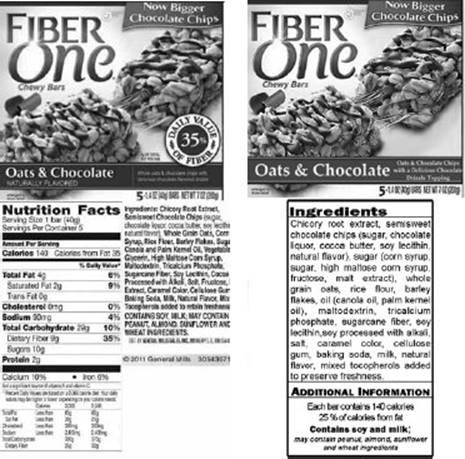
Labels should be simple and easy to read. The current, complicated label system costs a fortune as federal agencies are forced to spend time reviewing labels, policing manufacturers, and responding to lawsuits filed by manufacturers over claims that are denied. And consumers are still left with a label that few people pay attention to and many don’t know how to interpret.
On the left is the front and back of the package of a popular product. On the right is my proposed version. Since no health claims would be allowed if my rules were adopted, the front of the box would not mislead people into thinking that this product promotes good health because of its fiber content (the fiber is due to added fiber from chicory root, not because the ingredients are high in fiber), and the term “naturally flavored” would not be permitted.
“Nutrition Facts” charts would not appear on the back of the box, which would prevent misrepresentation about the amount of fiber. Sugars and oils would be grouped together, making it easier for consumers to see just how much of these ingredients are in the product.
With this simpler label, consumers would readily see that the front of the box shows essentially a picture of a candy bar, and the ingredients list is consistent with a candy bar. Some consumers would still buy it because it tastes good, but more would not consider it a health food.
PP: Happy to help.
GM: Medicare’s fiscal nightmare looms because of a combination of factors:
1. Demographics, with an aging generation of baby boomers (eighty million people will be on Medicare by 2040);
2. A sick and obese population of seniors made unhealthy by unhealthy food; and
3. A health care system geared toward incessant, expensive testing, often followed by expensive intervention.
As we know, high-tech medical intervention doesn’t always lead to better health outcomes, but it does always lead to higher costs; in the case of Medicare, those costs are borne by the taxpayers. The trend is unsustainable, to say the least.
I believe a decent society provides its senior citizens with an affordable, accessible system of medical care. I don’t want Americans to lose the Medicare entitlement. But it’s simply unsustainable on the present path. So here’s my suggestion: society should have a pact with its senior citizens. If you’ve paid into Medicare during your working life, we will take care of you in your retirement years. If you’re sick, Medicare will continue to cover your costs if you need to go to the doctor or the hospital. But an endless hunt for medical problems should not be part of that compact. Nor should most interventions consequent to that hunt. If you’re a senior citizen and you for some reason want a “preventive” colonoscopy or mammogram or stress test or angiogram or prostate-specific antigen test or vitamin D test or EKG or Dexa scan, it should be on your dime. If you are asymptomatic, but your preventive testing leads to an intervention (other than removal of a tumor or polyp), let that be on your dime, too. If we end Medicare as a discretionary testing benefit, we may save enough money to keep the program solvent for many more years. And I suspect it’ll save lives as well.
My parents had a very good friend who was about ninety years old. She went to a doctor complaining of chest pain, so the doctor proposed an angiogram. During the procedure, they nicked her aorta and she died a few days later. It’s unconscionable. They could have just put her on a low-fat, plant-based diet, but instead they killed her, and charged it to the taxpayers.
When my father, who at this point was a frail old man in his late eighties with Parkinson’s disease dementia, passed out at home, we made the mistake of calling 911. The medics took him to the hospital, where he remained for a week, ostensibly to combat his orthostatic hypotension. They ran every test on him imaginable. He was a frail, dying old man who didn’t even know what state he was in—when asked that question by his neurologist, I swear he said “confusion”—but the one thing he knew was that he wanted to get out of the hospital. They ran one test after another on him and billed the taxpayers $70,000 for it. They still didn’t stabilize his blood pressure, but they did give him a urinary tract infection from the catheter. I was wracked with guilt for putting him in the hospital. So the next time he passed out, we kept him home and took care of him until he came to. One thing I’m proud of is that we allowed him to die at home; he never saw a hospital again.
PP: The disturbing fact is that the overtesting and overtreating we’ve discussed before is especially targeted at the senior population. The situations you described with your family and family friend are not isolated incidents.
Neil Armstrong died as a result of complications of bypass surgery at the age of eighty-two. As I mentioned before, only a tiny fraction of bypass surgeries in the United States are medically warranted; the procedure is even less useful and more dangerous in people over the age of eighty.5 But after a routine stress test that Armstrong failed, he underwent a quadruple bypass. Although we’ll most likely never know the details of the conversation he had with his cardiologist, I would be willing to bet that the discussion did not include the recommendation to adopt a low-fat, plant-based diet or a recommendation to read Dr. Caldwell Esselstyn’s book, both far less expensive alternatives to bypass surgery. It would be hard to believe that Armstrong would have opted for bypass had he been informed properly of the risks and minimal benefits of the procedure and the potential benefits of plant-based nutrition.
GM: Pam, how would you save Medicare?
PP: The way to make Medicare sustainable is to stop paying for tests and procedures that have no basis in science. You mentioned before that society should take care of health care for its seniors. I agree. Here’s how we could do it in a way that would have a positive effect on all payers. We should incorporate the findings of independent research groups like Cochrane into the decision-making process. For example, Cochrane’s research, which is extensive, shows that mammograms are inadvisable for any group. For every woman saved, six women die unnecessarily. Neither Medicare nor any other entity should pay for mammograms. If you want a mammogram, you can pay for it yourself, but neither the government nor insurance companies should pay for those tests. Same with Dexa scans, PSA testing, colonoscopy, and other diagnostic tests. And the same would hold true for treatments. If Avastin does not add a single day of survival for breast cancer patients, it simply would not be reimbursable. You could pay for it yourself if you were convinced you wanted it.
Independent groups like Cochrane should be hired to conduct research on tests, drugs, and procedures to determine which are worthwhile. Congress and any bureaucracy susceptible to political influence should be kept out of the discussion. The National Institutes of Health at one point convened a panel that concluded that breast cancer screening should not be a blanket recommendation based on the evidence; Congress overrode the scientists and overturned the panel’s recommendations.6 This should be unacceptable.
If we develop a system that relies on evidence, instead of confining our discussion only to who should pay for any test or intervention that any doctor orders or any patient wants, we could contain costs, which would free up enough money to provide scientifically justified care to all seniors. Doctors and hospitals have a financial incentive to preserve the status quo, but we know that the status quo is terrible health outcomes at unsustainable cost.
GM: Are you optimistic that government will reform itself and make these kinds of changes happen?
PP: No, but I think we can educate the public one person at a time, until so many people have dropped out of the system that the system does not exist in its current form. The only workable solution to our Medicare problem and our larger health care cost problem is to reduce demand for health services. The ways to do that are to create a healthier and better-informed populace and to demand that science, not a profit-oriented medical establishment, determines what is worth paying for.
GM: Since we did such a good job of developing a plan for Medicare, let’s help balance the budget. We raise and kill more than ten billion land animals a year in America, and kill another fifty-three billion aquatic animals.7 If we were to tax this carnage at an average of only about a dollar per animal—considerably more for the large mammals and considerably less for the sardines—with the tax burden shared by the producers and the slaughterhouses and the commercial fisheries, that would generate about $60 billion per year for the Treasury. Some of that money could then be dedicated to remediating the environmental damage to the land and rivers brought on by animal agriculture. Of course, the argument would be made that such a tax on producers would be passed along to the consumer. To the extent that that’s true, it would only increase prices on foods that are making Americans sick, thereby discouraging their consumption, and leading to reduced medical costs, a further savings to the government, and a boost to the economy generally. So, while I don’t believe it’s on anyone’s radar, theoretically a slaughterhouse and fisheries tax would be a superb way to raise revenues for a government awash in red ink.
PP: I agree. Those who pollute the water supply and destroy the environment should be responsible for paying for it. And the price of animal products should have some bearing on the true cost of producing them, which includes this damage.
GM: New York City Mayor Michael Bloomberg has been in the news in the last few years, first banning trans fats from restaurants, then banning sodas and sugary drinks larger than sixteen ounces from restaurants, movie theaters, and street carts. Some are attacking the mayor for acting like Big Brother. What’s your opinion of his initiatives?
PP: We live in America, not China. I worry about who is going to make up the food police and what guidelines they are going to use. If we’re going to let Mayor Bloomberg decide the size of the soft drinks and whether or not trans fat is allowed … well, what if Mayor Bloomberg talks to Dr. Barry Sears, who tells him that baked potatoes are bad for you? Is that the next food we’re going to eliminate? The more government gets involved, the more messed up things get.
GM: I grant your logic, but all the same, I support the mayor’s actions. It might not be the most sensible or ideologically consistent way to improve public health, but when you’re in a crisis of the proportions that we face, I appreciate that at least somebody in a position of power is trying to do something. More than a dozen other state and local governments have emulated Mayor Bloomberg’s ban on trans fats, and it appears to have changed eating habits in NYC, at least slightly for the better.8 And while it seems silly to ban sugary drinks larger than sixteen ounces while allowing consumers to buy three eight-ounce sugary drinks, I’ll welcome it for the attention it brings to the issue.
PP: I’ll continue to disagree. Growing the problem, as in more regulation, does not make it better. As Albert Einstein once said, “You cannot solve a problem with the same thinking that created it.” A major contributor to our health care crisis is government; let’s get it out of the picture, instead of rearranging it.
GM: Personally, I wouldn’t object if Mayor Bloomberg were to really show some guts and tax cheeseburgers. They clearly cause even more damage to people’s health than giant soft drinks. In fact, I have a theory that Obama’s presidency was nearly destroyed by the cheeseburger.
PP: I’m also very anti-cheeseburger, but could you explain that one?
GM: Sure. When Obama first ran for president, I agreed with him on most of the issues, but I had one quibble: he kept eating cheeseburgers at his photo ops. Proof that he was a regular Joe, even if his name was Barack. Well, I certainly wasn’t going to let his dietary indiscretions keep me from supporting him, so I thought of it as a quibble without consequence. But it was indicative of his lack of understanding of health, and his tendency to conflate health with health insurance.
Imagine an Iraqi bureaucrat at the worst point in the insurgency in 2004, with car bombs exploding in markets all over Baghdad, and IEDs blowing up American Humvees. The bureaucrat surveys the carnage around him and has a “Eureka!” moment: “What this city needs is car insurance reform.”
That’s precisely how Obama has approached the atrocity that is the state of American health. Our real problem isn’t the large number of uninsured, lamentable as that fact may be. Our real problems are obesity, diabetes, heart disease, cancer, and all the other ailments that come from eating foods like the cheeseburger that our president is so delighted to chomp down on at photo ops. Obesity is so widespread that he apparently couldn’t find anyone to be surgeon general who wasn’t obese. So I realize now that what those cheeseburger photo ops really demonstrated is that the man knows nothing about health. And knowing nothing about health allowed him to believe that having health insurance is a matter of greater significance than having the real thing, health. The Affordable Care Act, his signature achievement, has nothing whatsoever to do with health.
PP: I want to say first of all that it’s not entirely his fault. There is a tendency for the market to pay attention to who’s paying for health care versus whether there might be a way to obviate the need for those services in the first place. He’s caught up in a system that emphasizes who’s going to pay, instead of whether there’s another way to provide care, so it’s not entirely his fault.
What is his fault is that, in spite of public sentiment against it, the bill passed anyway. It’s very difficult to manage any situation that involves significant change with zero buy-in from the public.
GM: As a Democrat, I agree with you.
PP: I don’t find many who don’t. This is not a partisan issue; this isn’t Republicans against Democrats; this is practicality setting in. It doesn’t matter if you’re Republican or Democrat; if you have a simple grasp of economics, you’ll understand that if a breast cancer patient diagnosed yesterday pays her first $175 health premium today and then sucks up $50,000 worth of care, you can’t have a whole lot of that going on before it becomes unsustainable. We can’t print money at the insurance companies. So this is a bad piece of legislation that will eventually have to be dismantled, at least in part.
In government, we have to be very careful of the law of unintended consequences. We need to think through all the things that will happen as a by-product of a new law, outcomes that were never intended. The more people, and especially businesspeople, understand the Affordable Care Act, the more they will object to it. When that happens, the federal government will have to make more exceptions to keep disaster from happening. And that’s where all these exceptions come in—
GM: Yeah, all these waivers to businesses to sidestep the law.
PP: Oh, they will have to keep doing it. I read a survey recently where this polling company called CEOs to say, “We’re not going to use your name, but if this law stands, will you drop your health insurance?” And some alarming percentage of CEOs said, “We wouldn’t be the first but we would be a fast second.” In other words, all we need is one large company to drop coverage and the dominoes will start to fall. I think that the government cannot afford to have a major player say, “We give up. We’re not going to provide insurance at our company anymore.” So they’ve granted all these waivers trying to keep the ship from sinking and they can’t keep doing that but then again they have no choice.
GM: It’s like getting special dispensations from the pope. It’s an absurd way to create national policy. And let’s not forget that while Chief Justice John Roberts upheld the mandate’s constitutionality as a tax, he also struck down the law’s enforcement provisions to effectively compel the states to expand the Medicaid program, the mechanism by which roughly 15 million more people were to obtain health insurance. So the law will not bring us anywhere near universal coverage, in spite of the mandate. I do approve of the law’s provisions for government-sponsored insurance (the preexisting condition insurance plan) for those who are refused coverage by private insurers, but that was a nice, simple provision that didn’t require a mandate. Unfortunately, it’s going to be replaced by the more complex exchanges in 2014.
The absurd mandate has been posited by almost every commentator in the media, with the notable exception of Lawrence O’Donnell, as the sine qua non of Obamacare. The truth is that it’s a sham and a mirage, a toothless response to the largely imaginary problem of people “gaming the system” by going to the emergency room for a cold. In fact, people don’t fail to buy health insurance because they want to “game the system”; they fail to buy it either because they can’t afford it or because they feel they don’t need it. There is no enforcement mechanism for the mandate. What happens if you don’t buy health insurance as mandated by the law? You get fined—$95 the first year, or 1 percent of your income. What happens if you don’t pay the fine? Nothing. There’s no penalty for not paying the fine. Here’s what the law says: “In the case of any failure by a taxpayer to timely pay any penalty imposed by this section, such taxpayer shall not be subject to any criminal prosecution or penalty with respect to such payer.” So if the mandate is a violation of constitutional freedoms, as some passionately argue, it’s only a symbolic one; in a very real, practical sense, it’s merely an invitation to break the law. That doesn’t strike me as wise policy.
PP: No, it’s not, but I’ll tell you what I think the take-home message is for anyone who is reading this book, regardless of her political convictions. Whether you are sick or healthy, whether you have health insurance or not, whether you are a Republican or a Democrat, the bottom line is the same. You have to take responsibility for your own health. You’ve got to get the information that you need to make informed choices about health care. It doesn’t really matter who’s going to pay for it; it doesn’t really matter whether Obamacare stands or doesn’t stand. If it got erased tomorrow, and we went back to the way it was two years ago, the person with coronary artery disease faces the same choice: he can either do what his doctors tell him, which is not medically warranted or scientifically supported, or he can take matters into his own hands and find his own solution. If you are perfectly healthy and you want to stay that way, you’re not going to stay that way listening to most of the authorities who you generally might seek out for advice about such things. You’ve got to drop out of the system and look for alternative options. And when I say alternative, I don’t mean “alternative medicine”; I mean alternatives to all traditional health care.
You can go visit doctors, do what you’re told, and keep eating what’s advertised on television and what’s served in fast-food joints and restaurants. Or you can drop out of all of that and take care of yourself. If enough people do that, we won’t have to worry about who’s paying for health care anymore because we’re going to get rid of so much of this health care cost that it’ll be a nonissue.
GM: I confronted Michael Moore on this recently at a public event in Los Angeles. Again, I’m a left-wing guy and I’ve admired several of his films, but not Sicko, because, as I told him, he doesn’t understand anything about health. His overriding issue is that fifty million Americans don’t have insurance coverage and he made the point that fifty thousand people died last year because they couldn’t afford medical care. Now if that’s true, it’s of course indefensible.
PP: It is, but more people died from too much medical intervention.
GM: I pointed that out to him. Probably at least five times as many people died because they had excessive and unnecessary and bad medical care. He didn’t have a response to that. He was sitting on the stage, all three hundred or so pounds of him, arguing that we should have Medicare for all. So in other words, people should be free to eat hot dogs and pizza and cheeseburgers and then force us to do unlimited medical testing on them and provide unlimited surgical interventions, with the government picking up the tab. That’s the progressive solution? What exactly is progressive about bankrupting the country so that Michael Moore can have as many angioplasties as his cardiologist recommends? What’s progressive about bankrupting government so that it won’t have any money to spend on education, clean energy, infrastructure, the environment, and all of the other things that Michael Moore and I believe in?
PP: Health care costs are going to strangle our economy if we don’t put a limit on them. What the government seems to want to do is make it limitless.
GM: Right. As a progressive, just as I don’t want my tax dollars wasted on a bloated defense budget, I don’t want my tax dollars paying for unnecessary angioplasties for bloated cheeseburger eaters. And I don’t want my tax dollars to continue subsidizing the animal agriculture interests that are producing those low-cost cheeseburgers that are killing Americans. Stop subsidizing animal agriculture and let’s see the real market cost of a cheeseburger, which may be fifteen dollars or more. Letting that cost rise to the market cost—something those free-market right-wingers should believe in—would do wonders for the state of American health.
PP: Here’s my suggestion for Michael Moore, if he would ever listen to me. Michael, before you produce any more documentaries on health, I’m going to charge you with getting healthy. Your objective is to get thin and healthy. Once you go through the process of trying to do so—and you may well have already tried—and you find out how impossible it is to do by going through traditional medical channels, then do it like Bill Clinton did and try this whole food, plant-based diet. Go outside the system to find the answers to your health issues. Do that, and then you’re going to produce a different kind of documentary, which will be well worth watching because you’ll have some credibility on the subject.
GM: Lawrence O’Donnell, who as I mentioned deserves kudos for highlighting the absurdity of the mandate, nonetheless appears to agree with Michael Moore that the best system of health care would be Medicare for all. I was fortunate to have the chance recently to have a little private informal exchange with O’Donnell on the subject of health. Now, let me preface this by saying that the last thing in the world that I would want to do would be to attack Lawrence O’Donnell, who is a national treasure and as eloquent a spokesman for progressive values as anyone alive. But, like Michael Moore and so many others on the left, he espouses ideas on public health policy that are reflexive expressions of an ideology that, despite its good intent, doesn’t question common assumptions that our society makes on human health, many of which are profoundly wrong.
So I was delighted to have the chance to express to O’Donnell my frustration with media coverage of Obamacare over the last three years. I thought I made my case effectively, and here is the gist of what I said:
The media keeps referring to Obamacare as health reform when it is merely health insurance reform that affects health barely at all. Its essential flaw is its focus on insurance payments instead of health. I asked, with rhetorical flourish, would you rather have good health insurance or good health? The real problem in this country isn’t the millions without health insurance; the real problems are obesity, diabetes, heart disease, and cancer. It’s the food, stupid! Studies have shown that access to medical care has minimal effect on health outcomes; indeed, I noted, the third-leading cause of death in America is medical care. (O’Donnell disputed that assertion but I would point him to an op-ed by Dr. Sanjay Gupta in the New York Times, in which he estimated two hundred thousand iatrogenic deaths annually, which puts death by medical care in third place, as I contended.9) The one thing that truly has demonstrable effect on health outcomes is the food we eat. If we were to stop subsidizing the meat and dairy industry with farm subsidies, allowing the price of a cheeseburger to skyrocket, that would do more to improve human health than Obamacare ever could. Somebody in the media needs to let another voice into the debate besides the usual detractors and supporters of Obamacare. We need a voice like Dr. McDougall’s that would make the case that we’ll never solve the problem unless we change the food.
And I rested my argument, rather proud of myself.
PP: Was he left speechless?
GM: Actually, no. There’s a reason Lawrence O’Donnell has risen as far as he has. He’s a very persuasive guy. He dismissed my arguments like he was swatting so many flies and then moved on to his next interlocutor. First, he said, give up on the fantasy that we’ll ever end farm subsidies. Second, he said, I simply was not allowing for human fallibility. Ice cream, he said, is delicious. He repeated that statement over and over, with increasing emphasis. “Ice cream is delicious. People will always eat ice cream because ice cream is DE-LIC-IOUS! That’s never going to change. Human beings are fallible and, being fallible, will always eat ice cream because ICE CREAM IS DE-LIC-IOUS!” I was wasting my breath with all my impossibly severe ideas about eating.
I walked away deflated. Here I thought I had made several powerful arguments for why we needed to change the debate about health in this country, and yet I had made a rookie error, failing to factor in the extraordinary deliciousness of ice cream. I didn’t know whether to keep fighting for the plant-based cause, or just chuck it all and head to Baskin-Robbins.
PP: Here’s what O’Donnell is not taking into account. The American public is not given the opportunity to make an informed decision. Your cholesterol is 220, so your doctor says, “You know, your cholesterol is getting up there. We’re going to need to put you on a statin drug.” So he puts you on Lipitor and your cholesterol comes down. You get this false sense of security that things are better because you were never really told the whole story about your cholesterol. That sense of security ends with a heart attack. Now let’s replay this conversation the way it should happen. You go to your doctor and your cholesterol is 220 and your doctor says, “Here are our choices. We can use Lipitor, and it’ll reduce your risk of dying of a heart attack by about 1.8 percent. I want to read to you the list of side effects of the drug very briefly; it’s just six or seven pages long. So you can take this drug, or I can show you how to eat a diet that will work faster than the drug and will reduce your risk of dying of a heart attack almost entirely. You’ll also reduce your risk of dying from cancer, diabetes, and other diseases. And there are no side effects. Now, which would you like to do? I can either write the prescription right now, or I can teach you how to eat this diet.”
I believe that most people, when presented with those alternatives, would at least take a look at this diet. I’ve worked with all kinds of people: blue-collar workers, white-collar workers, people who make $400,000 a year, people who make $20,000 a year. They don’t all jump at the chance to change their diet, but a heck of a lot of them want to do it when presented with that kind of information. I think the public should be insulted by the mind-set that presumes that it does not have the will or the intelligence to make a change for its own good. What Lawrence O’Donnell is basically saying is that people are so stupid and weak that we might as well not even tell them about the ideal human diet because they’d rather eat ice cream and lose their limbs to diabetes than make the effort to clean up their diet.
GM: I think he’s saying that people know that ice cream isn’t a health food, but they eat it anyway because they are fallible creatures.
PP: No, they don’t know. They’re misled a hundred different ways. They’re eating fat-free ice cream. They’re told that dairy products provide calcium to strengthen their bones. They’re told that chocolate is a superfood and that nuts are indispensable for brain function. And they’re taught that they can’t affect their health or their weight very much in any case because it’s all in the genes. They look to the Academy of Nutrition and Dietetics for dietary advice and they’re told that there’s room for everything, including ice cream, in a healthy diet. They think that because they buy extra virgin olive oil, fat-free dairy products, and imported organic cheese, they’re doing great. Lawrence O’Donnell was basically implying that 160 million Americans with degenerative disease are well aware that their current treatments don’t work and that they can instead eat themselves out of disease, but they’ve just chosen not to do so because they love ice cream. Well, that’s not been my experience. I find it unfathomable that people would care so little about themselves that, in spite of being well aware of how to regain their health, they just wouldn’t want to make the effort. I don’t believe that’s the case at all.
I’ll tell you what my experience has been, not with one or two people but with many thousands of people. When they understand the truth about what is making them sick, many act on it. They are willing to change their diets not just a little bit, but entirely. And the diet they adopt is full of foods that, to the palates they cultivate, are every bit as delicious as ice cream once was to them, when their palates responded only to sugar and fat. And, incidentally, once in a while on special occasions, they may still indulge in some delicious non-dairy ice cream. But they know that there’s no reason to ever again touch dairy or the foods that have made them fat and sick.
This is the way our public health crisis ends. The government isn’t going to do it. People have to do it. They have to take their health into their own hands. The job of the medical community is to give people the knowledge upon which they can act. If the medical community continues to fail in that responsibility, we in the plant-based foods movement will pick up the slack. We will get the word out in books, in films like Forks Over Knives, on the Internet, through educational ventures like The Wellness Forum, person-to-person, and in any other way we can. We will treat people with respect by giving them the knowledge upon which they will act to save their own lives and to save the country from a fiscal nightmare. I firmly believe that people can do this, and that’s not blind optimism on my part. I see it happen every day.
GM: Pam, it’s been a pleasure chatting with you, but I’ve got to go home and stay up late and type all of this up.
PP: Have a cup of coffee.