Ron M. Walls
Introduction
Definition
Rapid sequence intubation (RSI) is the administration, after preoxygenation, of a potent induction agent followed immediately by a rapidly acting neuromuscular blocking agent to induce unconsciousness and motor paralysis for tracheal intubation. The technique is predicated on the fact that the patient has not fasted before intubation and, therefore, is at risk for aspiration of gastric contents. The preoxygenation phase before drug administration permits a period of apnea to occur safely between the administration of the drugs and intubation of the trachea, therefore obviating the need for positive-pressure ventilation. In other words, the purpose of RSI is to render the patient unconscious and paralyzed and then to intubate the trachea without the use of bag-mask ventilation, which may cause gastric distention and increase the risk of aspiration. Sellick's maneuver (posterior pressure on the cricoid cartilage) has been widely recommended and used to occlude the esophagus and supposedly prevent passive regurgitation, but it has been shown to impair glottic visualization in some cases, and the evidence supporting its use is tenuous. In this edition of the manual, we have demoted Sellick's maneuver to “optional” status.
Rapid sequence intubation is the virtually simultaneous administration, after preoxygenation, of a potent sedative agent and a rapidly acting neuromuscular blocking agent to facilitate rapid tracheal intubation without interposed positive-pressure ventilation.
Indications and Contraindications
RSI is the cornerstone of emergency airway management. Other techniques, such as blind nasotracheal intubation or intubation using sedation with or without topical anesthesia, may be useful in certain patients presenting with a difficult airway (see Chapter 2). However, the superiority of RSI in terms of success rates, complication rates, and control of adverse effects makes it the procedure of choice for the majority of emergency department intubations. Contraindications to RSI are relative. Difficult intubation per se is not a contraindication to RSI; rather, it indicates to the physician that a careful preintubation assessment and plan are required (see Chapter 2 and Figs. 2-2 and 2-4). Other relative contraindications pertain more to the choice of individual agents for the intubation rather than to the use of a rapid sequence technique. These relative contraindications are discussed in various places throughout this text and within the discussions of the pharmacology of each agent.
Technique
RSI can be thought of as a series of discrete steps, referred to as the seven Ps. These are shown in Box 3-1.
BOX 3-1 The Seven Ps of Rapid Sequence Intubation
1. Preparation
2. Preoxygenation
3. Pretreatment
4. Paralysis with induction
5. Positioning
6. Placement with proof
7. Postintubation management
A. Preparation
Before initiating the sequence, the patient is thoroughly assessed for difficulty of intubation (see Chapters 2 and 7). Fallback plans in the event of failed intubation are established, and the necessary equipment is located. The patient is in an area of the emergency department that is organized and equipped for resuscitation. Cardiac monitoring, blood pressure monitoring, and pulse oximetry should be used in all cases. Continuous capnography provides additional valuable monitoring information, particularly after intubation. The patient has at least one, and preferably two, secure, well-functioning intravenous lines. Pharmacological agents are drawn up in properly labeled syringes. Vital equipment is tested. If a direct laryngoscope is to be used, the blade of choice is affixed to the laryngoscope handle and clicked into the “on” position to ensure that the light functions and is bright. If a video or fiberoptic laryngoscope is to be used, it is turned on, image quality is verified, and any necessary antifog solution is applied. The endotracheal tube (ETT) of the desired size is prepared, and the cuff tested for leaks. If difficult intubation is anticipated, a smaller tube (6.0 or 6.5 mm) should also be prepared. Selection and preparation of the tube, as well as the use of the intubating stylet and bougie, are discussed in Chapter 6. Throughout this preparatory phase, the patient should be receiving preoxygenation as described in the next section.
B. Preoxygenation
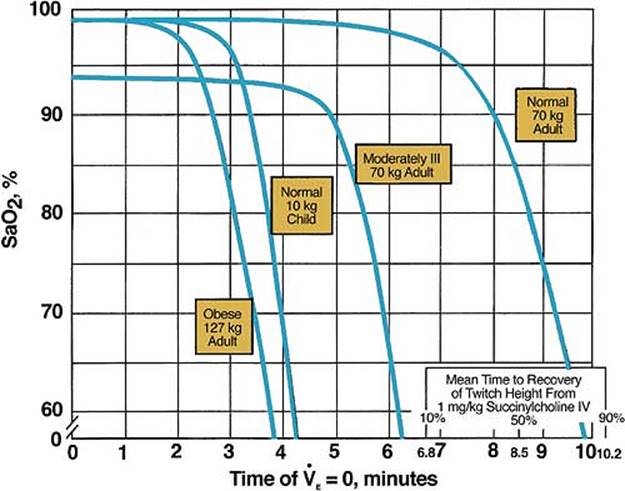
Preoxygenation is essential to the “no bagging” principle of RSI. Preoxygenation is the establishment of an oxygen reservoir within the lungs, blood, and body tissue to permit several minutes of apnea to occur without arterial oxygen desaturation. The principle reservoir is the functional residual capacity in the lungs, which is approximately 30 mL/kg. Administration of 100% oxygen for 3 minutes replaces this predominantly nitrogenous mixture of room air with oxygen, allowing several minutes of apnea time before hemoglobin saturation decreases to less than 90% (Fig. 3-1). Similar preoxygenation can be achieved much more rapidly by having the patient take eight vital capacity breaths (the greatest volume breaths the patient can take) while receiving 100% oxygen.
Time to desaturation varies, depending on particular patient attributes, with children, morbidly obese patients, and late-term pregnant women desaturating much more rapidly than an average healthy adult.
Note the bars indicating recovery from succinylcholine paralysis on the bottom right of Fig. 3-1. This demonstrates the fallacy of the oft-cited belief that a patient will quite likely recover sufficiently from succinylcholine-induced paralysis to breathe on his or her own before sustaining injury from hypoxemia, even if intubation and mechanical ventilation are both impossible. Although many patients will recover adequate neuromuscular function to breathe on their own before catastrophic desaturation, many others, including almost all children, will not, and even those who do are dependent on optimal preoxygenation before paralysis.
A healthy, fully preoxygenated 70-kg adult will maintain oxygen saturation over 90% for 8 minutes, whereas an obese (127-kg) adult will desaturate to 90% in less than 3 minutes. A 10-kg child will desaturate to 90% in less than 4 minutes. The time for desaturation from 90% to 0% is even more important and is much shorter. The healthy 70-kg adult desaturates from 90% to 0% in less than 120 seconds, and the small child does so in 45 seconds. A late-term pregnant woman is a high oxygen user and has an increased body mass, so she desaturates quickly in a manner analogous to that of the obese patient. Particular caution is required in this circumstance because both the obese patient and the pregnant woman are also difficult to intubate and to bag-mask ventilate.
The time to desaturate from 90% to 0% is dramatically less than the time to desaturate from 100% to 90%.
Most emergency departments do not use systems that are capable of delivering 100% oxygen. Typically, emergency department patients are preoxygenated using the “100% nonrebreather mask,” which delivers approximately 65% to 70% oxygen (see Chapter 5). In physiologically well patients in whom difficult intubation is not anticipated, this percentage is often sufficient and adequate preoxygenation is achieved. However, higher inspired fractions of oxygen are often desirable and can be delivered by active breathing through the demand valve of bag-mask systems equipped with a one-way exhalation valve, or by specially designed high-concentration oxygen delivery devices. Oxygen delivery is discussed in detail in Chapter 5. The use of pulse oximetry throughout intubation enables the physician to monitor the level of oxygen saturation, thus eliminating guesswork.
|
|
|
Figure 3-1 • Time to Desaturation for Various Patient Circumstances. Source: From Benumof J, Dagg R, Benumof R. Critical hemoglobin desaturation will occur before return to an unparalyzed state following 1 mg/kg intravenous succinylcholine. Anesthesiology 1997;87:979. |
The old recommendation that an intubator should hold his or her breath during the laryngoscopy to determine the maximal time that the patient should be without ventilation predated pulse oximetry and has no place in modern airway management.
C. Pretreatment
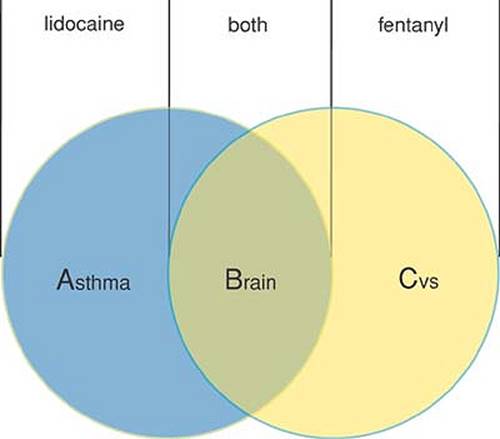
Pretreatment is the administration of drugs to mitigate adverse effects associated with the intubation or the patient's underlying comorbidities. These adverse effects include bronchospastic reactivity of the airways to the ETT in patients with reactive airways disease, the intracranial pressure (ICP) response to airway manipulation in patients with elevated ICP, and systemic release of sympathetic adrenergic amines (the reflex sympathetic response to laryngoscopy [RSRL]). We have revisited our former recommendation regarding use of a defasciculating dose of a competitive neuromuscular blocking agent in patients with elevated ICP who are receiving succinylcholine and, on the basis of available evidence, can no longer recommend this practice. Similarly, we no longer recommend the routine use of atropine before succinylcholine in small children. The pretreatment drugs are shown in Box 3-2 and discussed in detail in Chapter 17. Because there are three classes of patients for whom pretreatment is indicated, the mnemonic “ABC” can be used (Fig. 3-2): Asthma (representing reactive airways disease), Brain (representing elevated ICP), and Cardiovascular (representing those at risk from RSRL; i.e., patients with ischemic heart disease, vascular disease [especially cerebrovascular disease], hypertension, and vascular events, such as aortic dissection, intracranial hemorrhage, etc.). The two drugs, fentanyl and lidocaine, and their relationship to the ABC conditions can be represented in a Venn diagram (Fig. 3-2). The pretreatment agents, when indicated, are administered 3 minutes before the induction agents and succinylcholine.
D. Paralysis with induction
In this phase, a rapidly acting induction agent is given in a dose adequate to produce prompt loss of consciousness (see Chapter 18). Administration of the induction agent is immediately followed by the neuromuscular blocking agent, usually succinylcholine (see Chapter 19). Both medications are given by intravenous push. The concept of RSI does not involve the slow administration of the induction agent, nor does it involve a titration-to-end point approach. The sedative agent and dose should be selected with the intention of rapid intravenous administration of the drug. Although rapid administration of these induction agents can increase the likelihood and severity of side effects, especially hypotension, the entire technique is predicated on rapid loss of consciousness, rapid neuromuscular blockade, and a brief period of apnea without interposed assisted ventilation before intubation. Therefore, the induction agent is given as a rapid push followed immediately by a rapid push of the succinylcholine. Within a few seconds of the administration of the induction agent and succinylcholine, the patient will begin to lose consciousness and respirations will decline, and then cease.
|
|
|
Figure 3-2 • Pretreatment Agents for Rapid Sequence Intubation—the ABC Approach. CVS, cardiovascular system. |
E. Positioning
After 20 to 30 seconds, apnea virtually universally will be present. If succinylcholine has been used as the neuromuscular blocking agent, fasciculations will be observed during this time. The patient will become increasingly flaccid. The oxygen mask used for preoxygenation remains in place to prevent the patient from acquiring even a partial breath of room air. At this point, the patient is positioned optimally for intubation (see Chapter 6), with consideration for cervical spine immobilization in trauma. Sellick's maneuver, the application of firm pressure (see Chapter 6) on the cricoid cartilage to prevent passive regurgitation of gastric contents, was formerly widely recommended, but there is little evidence to support its use, and emerging evidence demonstrates that it can worsen laryngoscopic view and impair tube insertion over a bougie. Thus, it is considered optional. If used, Sellick's maneuver is initiated immediately on the observation that the patient is losing consciousness and maintained throughout the entire intubation sequence until the ETT has been correctly placed, the position verified, and the cuff inflated. If there is difficulty visualizing the glottis or inserting the ETT, Sellick's maneuver, if used, is discontinued, and external laryngeal manipulation or other maneuvers are used as indicated. Some patients, as discussed in Section 6 of this manual, will be sufficiently compromised that they require assisted ventilation to maintain oxygen saturations over 90% before, during, and after the intubation. Such patients, especially those with profound hypoxemia, should be bag-mask ventilated throughout the sequence to prevent worsening hypoxemia. In such cases, the application of Sellick's maneuver may minimize the volume of gases passed down the esophagus to the stomach, possibly decreasing the likelihood of regurgitation.
F. Placement with proof
Approximately 45 seconds after the administration of the succinylcholine, or 60 seconds if rocuronium is used, test the patient's jaw for flaccidity and intubate. Because of the minutes of safe apnea time permitted by the preoxygenation, the intubation can be performed gently and carefully with due attention to the patient's dentition and proper attention to technique to minimize the potential for trauma to the airway. The glottic aperture is visualized, and the ETT is placed. The stylet is removed, and the ETT cuff is inflated. Tube placement is confirmed as described in Chapter 6 to prove that the tube is correctly placed within the trachea. End-tidal carbon dioxide (CO2) detection is mandatory. A capnometer, such as a colorimetric end-tidal CO2detector, is sufficient for this purpose. Continuous capnography is recommended, however. Sellick's maneuver, if used, is then discontinued on the order of the intubator.
G. Postintubation management
After placement is confirmed, the ETT must be taped or tied in place. Mechanical ventilation should be initiated as described in Chapter 37. A chest radiograph should be obtained to assess pulmonary status and ensure that mainstem intubation has not occurred. Hypotension is common in the postintubation period and is often caused by diminished venous blood return as a result of the increased intrathoracic pressure that attends mechanical ventilation, exacerbated by the hemodynamic effects of the induction agent. Although this form of hypotension is often self-limited and responds to intravenous fluids, more ominous causes should be sought. Blood pressure should be measured, and if significant hypotension is present, the management steps in Table 3-1 should be undertaken.
BOX 3-2 Pretreatment Drugs for Rapid Sequence Intubation
|
Fentanyl |
When sympathetic responses should be blunted (increased intracranial pressure (ICP), aortic dissection, intracranial hemorrhage, ischemic heart disease) |
|
Lidocaine |
For reactive airways disease or increased ICP |
|
TABLE 3-1 Hypotension in the Postintubation Period |
|||||||||||||||
|
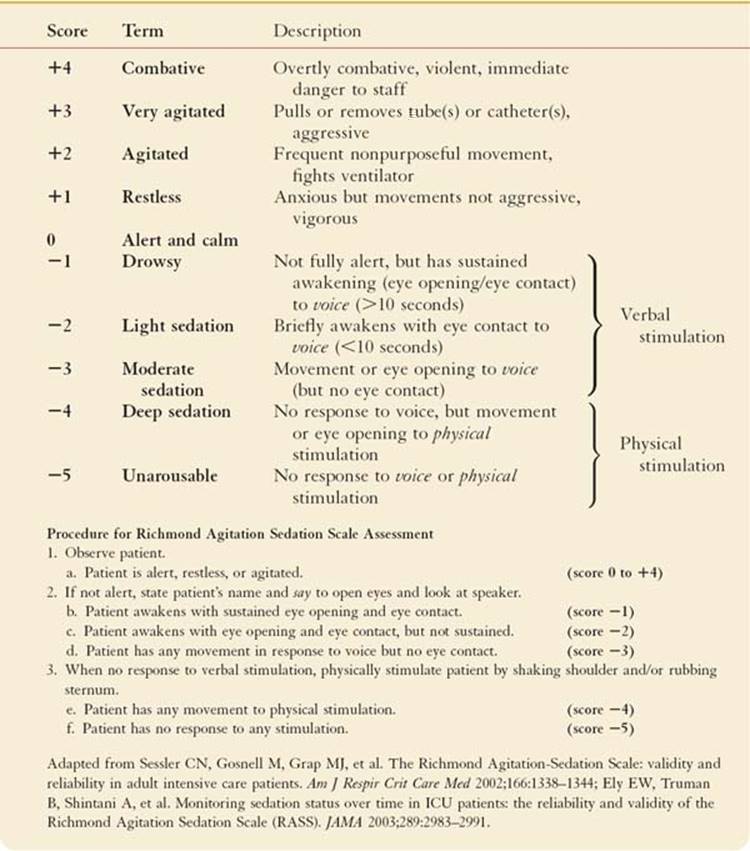
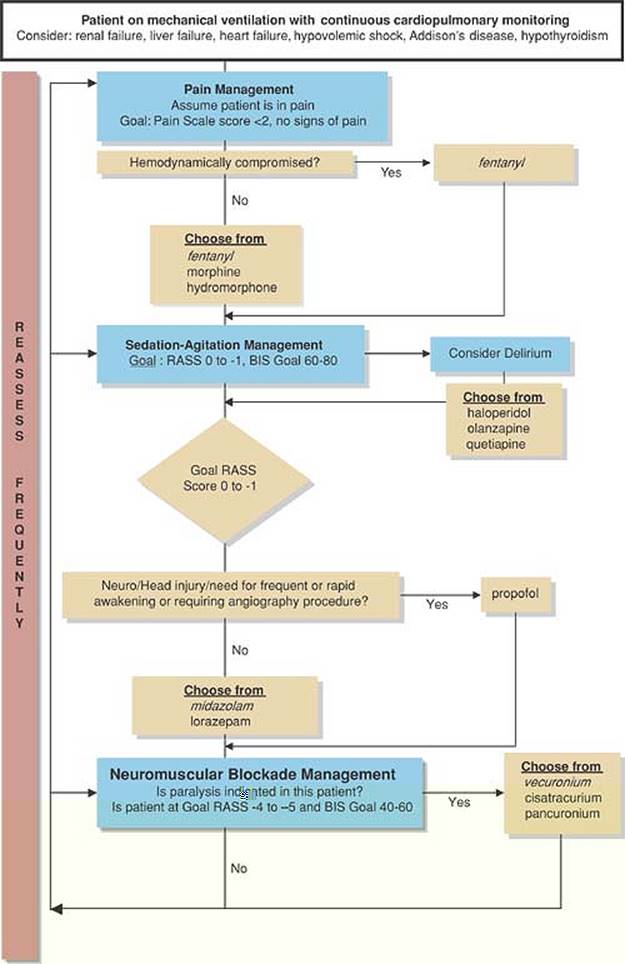
Long-term sedation is usually indicated. Recently, there is an increased focus on avoidance of paralysis, except when necessary, and use of a sedation scale, such as the Richmond Agitation Sedation Scale, to optimize patient comfort (Box 3-3). Sedation is administered to reach the desired sedation goal, and neuromuscular blockade is used only if the patient then requires it for management. This avoids the use of neuromuscular blockade to eliminate (and obscure) patient response, when the cause of the patient's agitation is inadequate sedation. A sample sedation protocol is shown in Fig. 3-3. Maintenance of intubation and mechanical ventilation require both sedation and analgesia, and these can be titrated to patient response (Fig. 3-3). A reasonable sedation starting point is lorazepam 0.05 mg/kg or midazolam 0.2 mg/kg, combined with an analgesic such as fentanyl 2 to 3 µg/kg, morphine 0.2 mg/kg, or hydromorphone (Dilaudid) 0.03 mg/kg. Fentanyl may be preferable because of its superior hemodynamic stability. When a neuromuscular blocking agent is required, a full paralytic dose should be used (e.g., vecuronium 0.1 mg/kg). Sedation and analgesia are difficult to titrate when the patient is paralyzed, and “topping up” doses should be administered regularly, before physiological stress (hypertension, tachycardia) is evident. For patients requiring serial examination, principally patients with neurological conditions, propofol by infusion is preferable, because it can be discontinued or decreased with rapid recovery of consciousness. Propofol infusion can be started at 25 to 50 mcg/kg/min and titrated. An initial bolus of 0.5 to 1 mg/kg may be given if rapid sedation is desired.
Timing the Steps of RSI
Successful RSI requires a detailed knowledge of the precise steps to be taken and also of the time required for each step to achieve its purpose. Preoxygenation requires at least 3 minutes for maximal effect. In hurried circumstances, eight vital capacity breaths (if possible) can accomplish equivalent preoxygenation in less than 30 seconds. It is recommended that pretreatment drugs be given 3 minutes before the administration of the sedative and neuromuscular blocking agent. The pharmacokinetics of the sedatives and neuromuscular blockers would suggest that a 45-second interval between administration of these agents and initiation of endotracheal intubation is optimal, extending to 60 seconds if rocuronium is used. Thus, the entire sequence of RSI can be described as a series of timed steps. For the purposes of discussion, time zero is the time at which the sedative agent and succinylcholine are pushed. The recommended sequence is shown in Table 3-2.
BOX 3-3 Richmond Agitation Sedation Scale
|
|
An example of RSI performed for a generally healthy 40-year-old, 80-kg patient is shown in Table 3-3. Other examples of RSI for particular patient conditions are in the corresponding sections throughout the text.
|
|
|
Figure 3-3 • Postintubation Management Protocol. See also Box 3-3 for description of the Richmond Agitation Sedation Scale. Source: The protocol, reproduced with permission, was developed for use at Brigham and Women's Hospital, Boston. |
|
Table 3.2 Rapid Sequence Intubation |
||||||||||||||||
|
Success Rates and Adverse Events
RSI has a very high success rate in the emergency department, approximately 99% in most modern series. The National Emergency Airway Registry (NEAR), an international multicenter study of more than 10,000 emergency department intubations, reported greater than 99% success for RSI when used on patients with medical emergencies and greather than 97% for trauma patients. RSI success rates are higher than those for other emergency airway management methods, and RSI is the main rescue technique when other methods, such as blind nasotracheal intubation, fail. The NEAR investigators classify events related to intubation as follows:
|
Table 3.3 Rapid Sequence Intubation for Healthy 80-kg Patient |
||||||||||||||||||
|
||||||||||||||||||
· Immediate complications, such as witnessed aspiration, broken teeth, airway trauma, undetected esophageal intubation
· Technical problems, such as mainstem intubation, cuff leak, recognized esophageal intubation
· Physiological alterations, such as pneumothorax, pneumomediastinum, cardiac arrest, dysrhythmia
This system allows witnessed complications to be identified and all adverse events to be captured, but avoids the incorrect attribution of various technical problems (e.g., recognized esophageal intubation or tube cuff failure) or physiological alterations (e.g., cardiac arrest in a patient who was in extremis before intubation was undertaken and which may or may not be attributable to the intubation) as complications. Overall, event rates are low in the NEAR studies; immediate complications are seen in approximately 3% of RSI patients. Hypotension and alterations in heart rate can result from the pharmacological agents used or from stimulation of the larynx with resultant reflexes. Other studies have reported consistent results. The most catastrophic complication of RSI is unrecognized esophageal intubation, which is rare in the emergency department, but occurs with alarming frequency in some prehospital studies. This situation underscores the importance of the confirmation of tube placement described in Chapter 6. It is incumbent on the person who administers neuromuscular blocking agents and potent sedatives to the patient to be able to establish an airway and maintain mechanical ventilation. This process may require a surgical airway as a final rescue for a failed oral intubation attempt (see Chapter 2 and Fig. 2-5). Aspiration of gastric contents can occur but is uncommon. Overall, the true complication rate of RSI in the emergency department is low and the success rate is exceedingly high, especially when one considers the serious nature of the illnesses for which patients are intubated, as well as the limited time and information available to the clinician performing the intubation.
“Accelerated” and “Immediate” RSI
When time is of the essence, the RSI sequence can be compressed so the steps are conducted much more rapidly than the standard RSI outlined previously.
1. Accelerated RSI
· Shorten preoxygenation to 30 seconds by using eight vital capacity breaths
· Shorten the pretreatment interval to 1 or 2 minutes from 3 minutes
2. Immediate RSI
· Preoxygenate with eight vital capacity breaths
· Eliminate pretreatment
Evidence
1. What is the optimal method for preoxygenation?: Standard preoxygenation has traditionally been achieved by 3 minutes of normal tidal volume breathing of 100% oxygen. Panditt et al. (1) showed that eight vital capacity breaths achieves similar preoxygenation to that of 3 minutes of normal tidal volume breathing and that both of these methods are superior to four vital capacity breaths. The time to desaturation of oxyhemoglobin to 95% is 5.2 minutes after eight vital capacity breaths versus 3.7 minutes after 3 minutes of tidal volume breathing versus 2.8 minutes after four vital capacity breaths (2,3). Preoxygenation of normal healthy patients can produce an average of 8 minutes of apnea time before desaturation to 90% occurs, but the times are much less (as little as 3 minutes) in patients with cardiovascular disease, obese patients, and small children (4). Sufficient recovery from succinylcholine paralysis cannot be relied on before desaturation occurs, even in properly preoxygenated healthy patients (4,5). Term pregnant women also desaturate more rapidly than nonpregnant women and desaturate to 95% in less than 3 minutes, compared with 4 minutes for nonpregnant controls. Preoxygenating in the upright position prolongs desaturation time in nonpregnant women to 5.5 minutes, but does not favorably affect term pregnant patients (6,7).
2. Evidence: Evidence regarding the use of pretreatment drugs, induction agents, and neuromuscular blocking agents are discussed in the Evidence sections of the relevant chapters.
3. Sellick's maneuver: A meta-analysis of the studies of Sellick's maneuver by Brimacombe and Berry (8) concluded that there is no hard evidence supporting its routine use during RSI, but the practice remains firmly entrenched. Sellick's maneuver may be applied improperly or not at all during a significant proportion of emergency department RSIs (9). Even when applied by experienced practitioners, Sellick's maneuver can increase peak inspiratory pressure and decrease tidal volume or even cause complete obstruction during bag-mask ventilation (10). Cricoid pressure appears to enhance the success rate of fiberoptic intubation, increasing rapid insertion success from 33% to more than 60% in one series (11). Properly applied, cricoid pressure tends to improve laryngoscopic view during conventional direct laryngoscopy, but it may interfere with both insertion of and ventilation through the laryngeal mask airway (12,13). Cricoid pressure is capable of moving the cervical spine approximately 5 mm in normal subjects, which suggests that it might present a hazard in patients with unstable cervical spine injuries; however, its use in patients with cervical spine injuries has never been assessed (14). A two-handed technique has been advocated, but it has never been shown to be superior to the one-handed technique in terms of prevention of aspiration and results in a worse laryngoscopic view (15).
4. Is RSI superior to intubation with sedation alone?: This is also discussed in the evidence sections for Chapters 2 and 19. Bozeman et al. (16) compared the use of etomidate alone to etomidate plus succinylcholine in a prehospital flight paramedic program and found that RSI outperformed etomidate-alone intubations by all measures of ease of intubation. An analysis of 200 prehospital intubations performed before and after institution of an RSI protocol found that intubation success increased from 73% before RSI was used to 96% with RSI (17). Li et al. (18) found similar improvement when RSI was introduced in the emergency department. The only direct comparison between RSI and blind nasotracheal intubation showed that higher success rates and more rapid intubation are achieved by RSI in poisoned patients (19). Dufour et al. (20) reported very high success and low complication rates in 219 patients undergoing RSI in a community hospital in Canada. Pediatric RSI has also been studied. A multicenter report of pediatric intubation by the NEAR investigators identified 156 pediatric intubations from among 1,288 total intubations, with 81% of pediatric intubations having been done using RSI (21). A study of 105 children younger than 10 years (average age, 3 years) who underwent RSI with etomidate as the induction agent showed stable hemodynamics and high success and safety profiles (22). Bair et al. (23) analyzed 207 (2.7%) failed intubations among 7,712 intubations in the NEAR project and found that the greatest proportion of rescue procedures (49%) involved the use of RSI to achieve intubation after failure of oral or nasotracheal intubation by non-RSI methods.
References
1. Pandit JJ, Duncan T, Robbins PA. Total oxygen uptake with two maximal breathing techniques and the tidal volume breathing technique: a physiologic study of preoxygenation. Anesthesiology 2003;99:841–846.
2. Baraka AS, Taha SK, Aouad MT, et al. Preoxygenation: comparison of maximal breathing and tidal volume breathing techniques. Anesthesiology 1999;91:612–616.
3. Ramez Salem M, Joseph NJ, Crystal GJ, et al. Preoxygenation: comparison of maximal breathing and tidal volume techniques. Anesthesiology 2000;92:1845–1847.
4. Benumof JL, Dagg R, Benumof R. Critical hemoglobin desaturation will occur before return to an unparalyzed state following 1 mg/kg intravenous succinylcholine. Anesthesiology 1997;87:979–982.
5. Hayes AH, Breslin DS, Mirakhur RK, et al. Frequency of haemoglobin desaturation with the use of succinylcholine during rapid sequence induction of anaesthesia. Acta Anaesthesiol Scand 2001;45:746–749.
6. Heier T, Feiner JR, Lin J, et al. Hemoglobin desaturation after succinylcholine-induced apnea: a study of the recovery of spontaneous ventilation in healthy volunteers. Anesthesiology 2001;94:754–759.
7. Baraka AS, Hanna MT, Jabbour SI, et al. Preoxygenation of pregnant and nonpregnant women in the head-up versus supine position. Anesth Analg 1992;75:757–759.
8. Brimacombe JR, Berry AM. Cricoid pressure. Can J Anaesth 1997;44:414–425.
9. Olsen JC, Gurr DE, Hughes M. Video analysis of emergency medicine residents performing rapid-sequence intubations. J Emerg Med 2000;18:469–472.
10. Allman KG. The effect of cricoid pressure application on airway patency. J Clin Anesth 1995;7:197–199.
11. Asai T, Murao K, Johmura S, et al. Effect of cricoid pressure on the ease of fibrescope-aided tracheal intubation. Anaesthesia 2002;57:909–913.
12. Vanner RG, Clarke P, Moore WJ, et al. The effect of cricoid pressure and neck support on the view at laryngoscopy. Anaesthesia 1997;52:896–900.
13. Aoyama K, Takenaka I, Sata T, et al. Cricoid pressure impedes positioning and ventilation through the laryngeal mask airway. Can J Anaesth 1996;43:1035–1040.
14. Gabbott DA. The effect of single-handed cricoid pressure on neck movement after applying manual in-line stabilization. Anaesthesia 1997;52:586–588.
15. Cook TM. Cricoid pressure: are two hands better than one? [comment]. Anaesthesia 1996;51:365–368.
16. Bozeman WP, Kleiner DM, Huggett V. Intubating conditions produced by etomidate alone vs. rapid sequence intubation in the prehospital aeromedical setting. Acad Emerg Med 2003;10:445–456.
17. Rose WD, Anderson LD, Edmond SA. Analysis of intubations: before and after establishment of a rapid sequence intubation protocol for air medical use. Air Med J 1994;13:475–478.
18. Li J, Murphy-Lavoie H, Bugas C, et al. Complications of emergency intubation with and without paralysis. Am J Emerg Med 1999;17:141–143.
19. Dronen SC, Merigian KS, Hedges JR, et al. A comparison of blind nasotracheal and succinylcholine-assisted intubation in the poisoned patient. Ann Emerg Med 1987;16:650–652.
20. Dufour DG, Larose DL, Clement SC. Rapid sequence intubation in the emergency department. J Emerg Med 1995;13:705–710.
21. Sagarin MJ, Chiang V, Sakles JC, et al. National Emergency Airway Registry (NEAR) investigators. Rapid sequence intubation for pediatric emergency airway management. Pediatr Emerg Care 2002;18:417–423.
22. Guldner G, Schultz J, Sexton P, et al. Etomidate for rapid-sequence intubation in young children: hemodynamic effects and adverse events. Acad Emerg Med 2003;10:134–139.
23. Bair AE, Filbin MR, Kulkarni RG, et al. The failed intubation attempt in the emergency department: analysis of prevalence, rescue techniques, and personnel. J Emerg Med 2002;23:131–140.