Tobias D. Barker
Robert E Schneider
Bag-mask ventilation is the cornerstone of airway management.
Although all airway skills are important, perhaps the most important skill, and one of the most difficult to perform correctly, is the ability to use a bag and mask to effectively oxygenate and ventilate a patient. Once mastered, however, confident bag-mask ventilation (BMV) reduces both the urgency to intubate and the anxiety that universally accompanies a failed attempt at laryngoscopy and intubation, especially if muscle relaxants have been used to facilitate intubation. In fact, competence with BMV is a prerequisite to using paralytic agents to secure the airway. A well-designed sequential approach to basic airway management is essential to the practice of emergency medicine physicians, critical care physicians, hospitalists, emergency medical services providers, and anesthesia practitioners.
Supplemental Oxygenation
There is a stepwise progression that must be understood and followed in administering oxygen to nonintubated, spontaneously breathing patients who cannot maintain acceptable oxygen saturation on room air. Many patients arrive to the emergency department with a nasal cannula connected to oxygen at 2 to 3 L/minute flow rate. If ineffective at maintaining adequate oxygen saturations, the nasal cannula should immediately be replaced with a nonrebreathing mask at 15 L of flow, so named because of the one-way valves incorporated into the mask to prevent the patient from entraining room air. There has been tremendous confusion in the past regarding the actual percentage of oxygen that can be successfully delivered through a nonrebreathing mask. For years, most physicians believed that a nonrebreather was capable of delivering upward of 95% oxygen. This belief was fueled by the original name of the mask, 100% nonrebreather mask, which is clearly misleading. Many well-conducted studies have subsequently shown that the maximum percentage of oxygen that can be delivered effectively is actually 70% to 75% because the mask does not effectively seal and prevent the entrainment of room air, and the reservoir is too small to provide a sufficient volume of oxygen to meet the large demand that occurs during inspiration. In common use, the nonrebreather probably provides oxygen at about 65%. Replacing the nasal cannula with a nonrebreathing mask and then observing changes in pulse oximetry readings over a 2 to 3 minute period allows one to quickly assess the efficacy of the nonrebreathing mask.
If the expected improvement in oxygenation does not occur, the nonrebreather should be removed and replaced with any one of several specific resuscitation bags and masks. Initially, the patient must be reassured that a tight-fitting mask will be placed on his or her face and encouraged to continue breathing spontaneously without any assistance from the care provider. Utmost attention must be directed to ensuring a tight mask seal. After 3 or 4 minutes, the patient's oxygenation should be reassessed, and if not improving, synchronous augmentation of the patient's inspiratory effort (500–700 cc tidal volume of oxygen with each spontaneous inspiration) should be undertaken. In a nontachypneic patient (less than 20 breaths/minute), this procedure is simply done. In a tachypneic patient (greater than 20 breaths/minute), synchronous augmentation will be quite difficult. Continued attempts at augmenting each inspiratory effort may result in asynchronous bagging, leading to insufflation of the patient's stomach and increased risk of vomiting or regurgitation of gastric contents. To combat this, an appropriate cadence of bagging must be selected to allow effective enhancement of every third or fourth inspiratory effort. This is fairly easy to do and allows the care provider time to be certain a good seal is achieved and maintained. If synchronous assist fails, continuous positive airway pressure or bilevel positive airway pressure may be helpful (see Chapter 38), or endotracheal intubation will be required.
Bag-Mask Ventilation
There is a paucity of literature that adequately describes effective BMV. It is not glamorous, most health care providers mistakenly think that they are proficient at it, and it is given little attention in most airway textbooks and courses. This makes BMV appear mundane as an airway management maneuver. However, one quickly realizes its importance, given the fact that effective bag-mask oxygenation and ventilation buys time as one works through the array of potential solutions in managing a difficult or failed airway. Simply stated, the ability to effectively oxygenate and ventilate a patient with a bag and mask leaves three failed attempts at laryngoscopy and intubation as the only pathway to a failed airway.
Successful BMV depends on a patent airway, an adequate mask seal, and proper ventilation. Creating an adequate mask seal requires an understanding of the design features of the mask, the anatomy of the patient's face, and the interrelationship between the two. A patent airway permits the delivery of appropriate tidal volumes without insufflating the stomach. Techniques used in producing a patent airway often include head extension, chin lift, and jaw thrust maneuvers. Proper ventilation must take into account not only giving the appropriate volume, but also giving it at the correct rate and with the appropriate amount of force.
The specific type of bag used in BMV is also important. Bags that minimize dead space, incorporate unidirectional airflow valves (e.g., duckbill inspiratory valves), and use one-way expiratory valves to prevent the entrainment of room air during inspiration will deliver 90% to 97% oxygen to spontaneously breathing or ventilated patients. This is in sharp distinction to improperly configured bags that provide high oxygen concentration during active bagging, but deliver only 30% oxygen during spontaneous patient breathing. This suboptimal oxygenation is due to the lack of a one-way expiratory valve on the bag, leading to entrainment of room air.
A typical mask consists of three main parts:
· A round 15-mm orifice that fits a standard 22-mm female connector on the bag portion of the assembly
· A hard shell, or body of the mask; this is often clear, to allow continuous visualization of the patient's mouth and nose so immediate intervention can be employed if the patient visibly regurgitates
· A circumferential cushion, or inflatable collar, which, when properly inflated, evenly distributes downward pressure onto the patient's face, promoting an effective mask seal
It is easier to establish an adequate mask seal if the mask is too large than if it is too small. In masks with inflatable collars, the collar must be inflated to the extent that it forms an adequate seal. An inadequate seal may indicate that air should be added to or removed from the mask empirically according to the operator's best judgment to maximize a facial seal.
Opening the Airway
The airway should be opened before placing the mask on the face. There are two maneuvers commonly used to open the airway. The head tilt, chin lift is the primary maneuver used in any patient in whom cervical spine injury is not a concern. In this technique, the clinician uses two hands to extend the patient's neck and open the airway. While one hand applies downward pressure to the patient's forehead, the tips of the index and middle finger of the second hand lift the mandible at the mentum, which lifts the tongue from the posterior pharynx. The jaw thrust maneuver also moves the tongue anteriorly with the mandible, minimizing its obstructing potential. An effective jaw thrust is achieved by forcibly and fully opening the mouth to “translate” the condyles of the mandible out of the temporomandibular joint, then pushing the mandible forward and maintaining a forward position with the help of the oral airway (Fig. 5-1). The jaw thrust is the safest first approach to opening the airway of a patient with a potential cervical spine injury because, properly performed, it can generally be accomplished without moving the neck. The reduced emphasis on the jaw thrust technique in the current advanced cardiac life support (ACLS) guidelines has to do with reducing the complexity of cardiopulmonary resuscitation for lay persons, rather than opposition to its use. Both the jaw thrust and head tilt, chin lift techniques have been shown in multiple studies to improve airway patency, and skilled airway managers should feel comfortable with either.
|
|
|
Figure 5-1 • Jaw thrust maneuver employing a two-hand technique. |
Airway Adjuncts
Once an open airway has been established, it must be maintained. Oropharyngeal and nasopharyngeal airways (Fig. 5-2A and B) devices are important adjuncts in achieving this goal. Both will prevent the tongue from occluding the airway and provide an open conduit for air to pass. Unless BMV is expected to be needed only transiently (e.g., while naloxone takes effect), an oropharyngeal airway (OPA) should be placed whenever BMV is required. The OPA may be supplemented by one, or even two, nasopharyngeal airways. Neither of these airway devices will protect the trachea from aspiration of secretions or gastric contents.
Positioning the Mask
With the mandible pulled forward, the mask is placed on the face and sealed. The mask should be placed on the patient's face detached from the bag. This is a simple, but often neglected, point. Leaving the bag and mask connected during initial placement makes the procedure awkward and clumsy. The nasal part of the mask should be opened and placed on the bridge of the nose. The body of the mask is then levered down onto the patient's face (Fig. 5-3), covering the nose and mouth, and is adjusted cephalad (superior) or caudad (inferior) to allow optimum positioning.
|
|
|
Figure 5-2 • A: The family of Guedel (bottom row) and Berman (top row) oropharyngeal airways. B: A Guedel oropharyngeal airway and a nasopharyngeal airway (also called a nasal trumpet). |
One must be cognizant at all times of the patient's orbits and resist any temptation to rest the ulnar surfaces of either wrist or the mask cushion on the orbits during BMV. This inadvertent compression may produce a profound vagal response and significantly reduce retinal blood flow.
Single-Hand Mask Hold
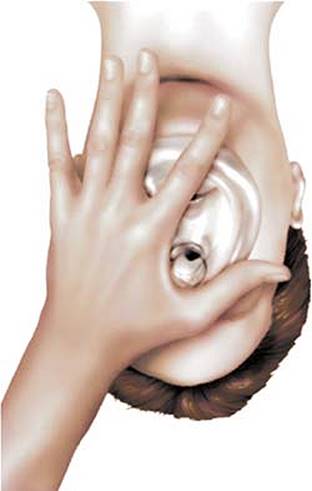
Ordinarily, the operator's nondominant hand is placed on the mask with the distal pads of the thumb and the index finger used to hold the mask in place, rocking it gently from side to side to achieve the best seal. The remaining fingers are used to pull the mandible up into the mask to keep the airway open. A common tendency, especially if any difficulty is encountered, is to pinch the body of the mask with the thumb and index finger pads. If this occurs, a mask leak may be produced or worsened if already present. If the operator's hand is large enough, the web space between the thumb and index finger may appose the mask connector, allowing the rest of the hand to fall comfortably onto the body of the mask at a 45-degree angle (Fig. 5-4); however, most people do not have hands this large, meaning that the index finger and thumb web space is a variable distance from the collar of the mask (Fig. 5-5). This hand position allows even distribution of downward pressure as the mask is gently sealed onto the patient's face. The long, ring, and little fingers should lie comfortably on the body of the mask, although their respective finger pads contact the mentum of the chin and body of the mandible and must be ready to pull the mandible into the mask (chin lift), if necessary (Fig. 5-6). Ordinarily, the tip of the long finger placed beneath the mentum is used to keep the mandible in a “thrusted position.” Several authors recommend placing the volar pad of the little finger posterior to the angle of the mandible to attempt a jaw thrust maneuver (Fig. 5-5). This method of producing a jaw thrust maneuver is extremely difficult to perform and maintain for any length of time, especially with small hands. Alternatively, the mandible can be kept forward by “hooking” the long finger under the mentum while the remaining fingers lie comfortably along the undersurface of the mandibular body (Fig. 5-7). It is important to be certain the volar pads elevate only on the bony parts of the mandible; pressure to the soft tissues of the neck may occlude the airway. When holding the mask with one's left hand, it may be necessary to gather the left cheek with the hypothenar eminence of the hand and compress it into the mask cushion while rocking the mask to the right to establish a more efficient mask seal.
|
|
|
Figure 5-3 • After opening the nasal portion of the mask, it is positioned on the face to incorporate the nares and mouth inside the body of the mask. |
|
|
|
Figure 5-4 • An effective single-handed mask seal can be achieved by placing the thumb/index finger web space against the mask connector at 45 degrees and gently pushing the mask onto the face with the web space, not the palm of the hand. This single-hand mask hold is best suited to individuals with large hands. |
Two-Hand Mask Hold
The two-hand mask hold is the most effective method of opening the airway while achieving and maintaining an adequate mask seal. It is the method of choice in an emergency situation when a one-handed mask hold is not producing adequate ventilation. The two-handed, two-person technique mandates that one operator's sole responsibility is to ensure proper mask placement on the patient's face by simultaneously using both hands to open the airway and achieve an effective mask seal. An assistant is needed to squeeze the bag, but the most experienced airway manager should be handling the mask seal.
Initially, the operator opens the airway and translates the mandible forward. Standing at the head of the patient, the long fingers of both hands are placed behind the angle of the mandible (Fig. 5-8). The mouth is then opened with the thumbs (Fig. 5-9) and the mandible pulled to a “thrusted” position (Fig. 5-1) in which the bottom teeth are now in front of the top teeth. The long fingers maintain the thrusted position while the mask is applied to the face as discussed previously.
The operator's hands may be placed on the mask in one of two ways. In the first method, the index finger and thumb distal phalanges of both hands are placed in apposition to one another along the inferior and superior ridges of the mask, respectively (Fig. 5-10). The volar pads of the remaining three fingers of each hand (long, ring, and little fingers) are fully abducted and used to capture the mandible and perform a simultaneous jaw thrust and chin lift maneuver, opening the airway and creating an optimum mask seal. In the second method, both thenar eminences can be positioned parallel to one another with the thumbs pointing caudad (inferior), executing gentle downward pressure to push the mask into the face to effect a seal (Fig. 5-11), while the long fingers, positioned behind the angles of the mandible, perform a jaw thrust maneuver (Fig. 5-8). This mask hold position is more comfortable and less prone to fatigue compared to that described previously.
|
|
|
Figure 5-5 • Single-hand mask hold for individuals with medium-size hands. |
|
|
|
Figure 5-6 • The Thumb and Index Finger Lie Passively on The Mask. The long, ring, and little finger volar pads capture the body of the mandible and mentum and perform a chin lift maneuver. |
|
|
|
Figure 5-7 • Single-hand mask hold for individuals with small hands. |
|
|
|
Figure 5-8 • Initial Position of Hands for a Two-hand Mask Hold. Note the tips of the long fingers behind the angle of the mandible. For this to occur, the wrists must be in an ulnar deviated position. |
|
|
|
Figure 5-9 • Mouth opening employing thumbs to depress the mandibular mentum with a rocking motion to open the mouth. |
|
|
|
Figure 5-10 • Conventionally Taught Position of Fingers for a Two-hand Mask Hold. Thumbs are cephalad (superiorly) and index fingers are caudad (inferiorly), leaving only three fingers to create and maintain jaw thrust and chin lift maneuver. This is not a comfortable position to maintain for any length of time. |
|
|
|
Figure 5-11 • Two-handed Mask Hold Technique: Emergency technique two-hand mask hold position:metacarpophalangeal joints of both thumbs appose the mask connector and thenar eminences to compress the mask into the face, allowing the other four fingers to create and maintain the jaw thrust position. This is a much more comfortable position for prolonged ventilation. |
In desperate situations, a single care provider employing a two-hand mask hold can achieve oxygenation and ventilation by squeezing the bag between his or her elbow and chest/lateral abdomen, or between his or her knees if on the floor while using both hands to optimize the mask seal until help can be recruited.
Ventilating the Patient
Once the airway is opened and an optimal mask seal obtained, the resuscitation bag is connected to the mask, and the patient is ventilated. When fully inflated, the standard adult resuscitation bag contains 1,500 cc of oxygen. This entire volume should not and cannot be delivered repeatedly without insufflating the stomach. The goal of effective oxygenation and ventilation is to deliver 10 to 12 reduced tidal volume breaths (500 cc) per minute without exceeding the proximal and distal esophageal sphincter opening pressures of approximately 25 cm of water. High upper airway peak inspiratory pressures result from short inspiratory times, large tidal volumes, incomplete airway opening, increased airway resistance, and decreased compliance. Several things can be done to minimize the potential for gastric inflation and its complications. Deliver each breath over 1 second, and deliver a tidal volume that is sufficient to produce a visible chest rise (500–600 mL). Do not, however, deliver more volume or use more force than is needed to produce visible chest rise. This goal of delivering smaller tidal volumes with each breath while avoiding rapid or forceful breaths is also reflected in the new ACLS guidelines.
|
|
|
Figure 5-12 • Proper application of Sellick's maneuver (cricoid pressure) involves the thumb and long finger properly positioned on the cricoid (not the thyroid) cartilage and applying posterior pressure to occlude the esophagus against the anterior surface of the C-6 vertebral body. Note that the index finger is free to apply external laryngeal manipulation. |
Sellick's Maneuver
While ventilating, performing a Sellick's maneuver correctly may reduce gastric insufflation. Until more definitive literature is published, we suggest it be applied if resources permit. Sellick's maneuver is performed by pressing the cricoid cartilage posteriorly, causing it to occlude the esophagus against the spinal column (Fig. 5-12). This requires an additional health care provider and should only be used if the patient is unresponsive. A common error is to apply pressure to the thyroid cartilage instead of the cricoid cartilage, causing airway occlusion.
Summary
BMV is a dynamic process. One must continually assess the adequacy of gas exchange that one is providing. Listening and feeling for areas of mask leak and observing the rise and fall of the chest are crucial to success. With the nondominant hand placed appropriately on the mask, a left-sided mask leak will be felt by the care provider's hypothenar eminence. An assistant may be required to evaluate the integrity of the seal on the right side of the mask and compress the right cheek into the mask cushion as needed. It may be necessary to rock the mask up or down or from side to side (pronation or supination) to achieve a better mask seal. It may also be necessary to frequently reperform the jaw thrust maneuver to re-establish airway patency because it is common for the mandible to slip back to its normal position during BMV. When squeezing the bag and delivering effective tidal volumes, the care provider should simultaneously feel resistance in the bag and observe rise and fall of the patient's chest. Other signs of adequate ventilation are improvement in oxygen saturation, the appearance of an appropriate waveform on a capnograph, and color change from purple to yellow on an end-tidal carbon dioxide (CO2) detector, provided the patient is generating CO2.
Occasionally, one may be able to deliver an inspiratory breath, but passive expiration fails to occur. This ordinarily occurs when the degree of jaw thrust is inadequate. Removal of the bag-mask unit from the face and re-creation of a jaw thrust will ordinarily permit expiration.
When initial BMV fails to establish or maintain adequate oxygen saturation, better bag and mask techniques must be used. If a single-hand mask hold is being used, one should immediately employ a two-handed, two-person technique and focus on the following options:
1. Is the mask seal optimal? If not, how can this be improved (e.g., applying KY jelly to a beard; placing unfolded gauze 4 × 4s fluffed and compressed inside the mouth along the buccal pouches [cheeks] to create a better mask seal; reinserting the patient's false teeth; gathering both cheeks inside the body of the mask; ensuring that the entire mouth and all airway adjuncts are within the body of the mask, not disrupting the seal) (Fig. 5-13)?
|
|
|
Figure 5-13 • Two nasal airways and an oral airway inserted and placed inside the body of the mask to ensure an effective mask seal. |
2. Are all upper airway adjuncts being properly used? The most common error is the failure to use oral and/or nasal airways. Oral or nasal airways should always be used when an unresponsive patient is being ventilated with a bag and mask; two nasal airways and an oral airway should be used in cases where persistent difficulty is encountered in delivering adequate ventilation and oxygenation (Fig. 5-13).
3. Does the jaw thrust maneuver need to be redone to more effectively open the airway?
4. Does a more experienced person need to be recruited to help optimize bag-mask technique?
Evidence
1. How much oxygen is the patient actually receiving with different oxygen delivery systems? Standard textbooks in respiratory therapy (1,2) and anesthesiology (3) describe oxygen delivery systems and the concentrations of oxygen that they characteristically deliver.
2. How can I determine whether a superior resuscitation bag is being used? Not all self-inflating ventilation bags deliver high concentrations of oxygen. Only those bags with duckbill inhalation valves, one-way exhalation valves, and small dead space can be expected to deliver inhaled concentrations of oxygen greater than 90% (4,5). Duckbill valve bags without one-way exhalation valves have been shown to deliver less than 40% oxygen (5).
3. What is the optimal technique to ventilate the patient during BMV? The primary goal is oxygenation without gastric inflation. This is best accomplished by focusing on avoiding high airway pressures during BMV (e.g., longer inspiratory times, smaller tidal volume, optimal airway opening) (6,7,8,9). The recommended tidal volume of 500 cc is best achieved by squeezing the bag with one hand rather than squeezing the bag against one's body (10).
4. Should Sellick's maneuver be performed during BMV? If the necessary personnel are available, it is possibly helpful to use this technique during BMV. Note that literature exists both supporting and questioning the utility of Sellick's maneuver. Proper application of cricoid pressure does appear to reduce the volume of air entering the stomach when BMV is performed with low to moderate pressures (11). There is also literature, however, indicating that this technique may not occlude the esophagus at all (12) or may impair ventilation by partially obstructing the upper airway (13). In addition, although not developed to be used as an adjunct to improve visualization during laryngoscopy, there are studies both supporting its ability to improve (14) and worsen (15) visualization of the airway during direct laryngoscopy.
References
1. Shapiro BA, Kacmarek RM, Cane RD, et al. Clinical application of respiratory care, 4th ed. St. Louis, MO: Mosby; 1991.
2. Kacmarek RM, Stoller JK, eds. Current respiratory care. Toronto, Ontario, Canada: BC Decker; 1988.
3. Vender JS, Clemency MV. Oxygen delivery systems, inhalation therapy and respiratory therapy. In: Benumof JL, ed. Airway management: principles and practice. St. Louis, MO: Mosby; 1996.
4. Cullen P. Self-inflating ventilation bags. Anaesth Intensive Care 2001;29:203.
5. Nimmagadda U, Salem MR, Joseph NJ, et al. Efficacy of preoxygenation with tidal volume breathing: comparison of breathing systems. Anesthesiology 2000;93:693–698.
6. American Heart Association. 2005 American Heart Association Guidelines for Cardiopulmonary Resuscitation and Emergency Cardiovascular Care. Circulation 2005;112(Suppl I):IV.
7. Uzun L, Ugur MB, Altunkaya H, et al. Effectiveness of the jaw-thrust maneuver in opening the airway: a flexible fiberoptic endoscopic study. ORL J Otorhinolaryngol Relat Spec 2005;67:39.
8. Guildner CW. Resuscitation—opening the airway. A comparative study of techniques for opening an airway obstructed by the tongue. JACEP 1976;5:588.
9. Davis K Jr, Johannigman JA, Johnson RC Jr, Branson RD. Lung compliance following cardiac arrest [published correction appears in Acad Emerg Med 1995;2:1115]. Acad Emerg Med 1995;2:874–878.
10. Wolcke B, Schneider T, Mauer D, et al. Ventilation volumes with different self-inflating bags with reference to the ERC guidelines for airway management: comparison of two compression techniques. Resuscitation 2000;47:175–178.
11. Petito SP, Russell WJ. The prevention of gastric inflation—a neglected benefit of cricoid pressure. Anaesth Intensive Care 1988;16:139.
12. Smith KJ, Dobranowski JD, Yip Gietal, et al. Cricoid pressure displaces the esophagus: an observational study using magnetic resonance imaging. Anesthesiology 2003;99:60–64.
13. Hartsilver EL, Vanner RG. Airway obstruction with cricoid pressure. Anaesthesia 2000;55:208.
14. Levitan RM, Kinkle WC, Levin WJ, et al. Laryngeal view during laryngoscopy: a randomized trial comparing cricoid pressure, backward-upward-rightward pressure, and bimanual laryngoscopy. Ann Emerg Med 2006;47:548–555.
15. Snider DD, Clarke D, Finucane BT. The “BURP” maneuver worsens the glottic view when applied in combination with cricoid pressure. Can J Anaesth 2005;52:100–104.