
Joshua Nogar
ASPIRIN AND SALICYLATES
EPIDEMIOLOGY
 In 2008, aspirin and salycilates (ASA) were involved in 20,000 toxic exposures and 48 deaths.
Many over-the-counter medications (eg, Pepto-Bismol, oil of wintergreen [methyl salicylate], liniments used in vaporizers) contain large amounts of salicylates, and ingestion or application of even small amounts can lead to inadvertent salicylate toxicity.
PATHOPHYSIOLOGY
Absorption of ASA may be delayed or erratic. Peak serum levels may be significantly delayed, but toxic levels are usually apparent within 6 hours. Peak levels from ingestion of enteric-coated or sustained-release aspirin have been reported up to 60 hours after ingestion.
ASA may form a gelatinous gastric mass, and large amounts of aspirin may remain in the stomach long after an overdose. In addition, aspirin has an inhibitory effect on gastric emptying. The result is a salicylate level that may vascilate before ultimately trending down.
At physiologic pH (7.40), essentially all salicylate molecules are ionized. A decrease in pH (acidosis) increases the proportion of nonionized salicylate. Nonionized salicylate molecules cross cell membranes, including the blood-brain barrier. Therefore, acidemia increases intracellular salicylate concentration.
Mortality from ASA toxicity correlates directly with brain salicylate concentration.
A urinary pH above 8.0 ionizes salicylate in the urine and impairs reabsorption across the urinary tubules, resulting in enhanced urinary elimination.
ASA toxicity causes respiratory alkalosis due to an elevated respiratory rate through a direct effect on the medullary respiratory center.
ASA toxicity causes uncoupling of oxidative phos-phorylation and inhibition of various Krebs’ cycle enzymes. This results in increased catabolism and elevated carbon dioxide and heat production, increased glycolysis and demand for glucose, and production of organic acids including lactate, pyruvate, and ketoac-ids, which contribute to the metabolic acidosis of salicylate poisoning.
Normoglycemia, hyperglycemia, or hypoglycemia may be seen. Hypoglycemia in brain cells may occur despite normal serum glucose levels.
Chronic administration of large doses of salicylates when the serum salicylate level is greater than 60 milligrams/dL results in hypoprothrombinemia and an elevated prothrombin time (PT).
CLINICAL FEATURES
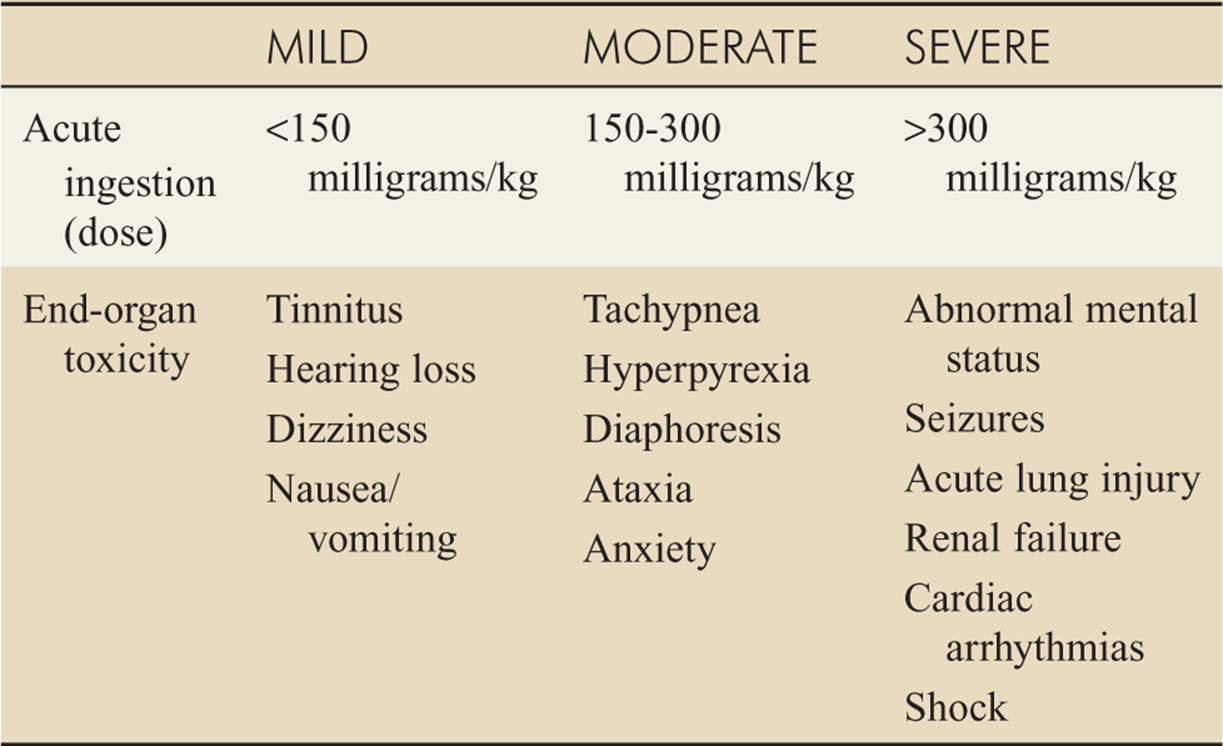
ASA toxicity is a clinical diagnosis made in conjunction with the patient’s acid–base status. The manifestations of salicylate toxicity depend on the dose, whether exposure is acute or chronic, and the patient’s age (Table 108-1).
ASA blood concentrations may correlate poorly with toxicity, and relying on drug levels as a measure of toxicity is the most common pitfall to avoid when managing ASA overdoses.
Acute ingestion of less than 150 milligrams/kg usually produces mild toxicity with nausea, vomiting, and gastrointestinal (GI) irritation.
Acute ingestion of 150 to 300 milligrams/kg usually results in moderate toxicity with vomiting, hyperventilation, sweating, and tinnitus. In adults, these findings often coincide with salicylate levels >30 milligrams/dL.
Toxicity from ingestion of more than 300 milligrams/kg is usually severe.
The pathognomonic acid–base disturbance of salicylate toxicity is increased anion gap metabolic acidosis, metabolic alkalosis (due to volume contraction), and respiratory alkalosis.
The most common clinical picture is combined respiratory alkalosis and increased anion gap metabolic acidosis, although a normal anion gap does not exclude salicylate toxicity in patients with an unknown ingestion. In addition, co-ingestion of sedative drugs may impair the respiratory drive and result in respiratory acidosis.
ASA toxicity can be misdiagnosed as sepsis, particularly in the elderly population (lactic acidosis, contraction metabolic acidosis, and respiratory alkalosis).
Uncommon manifestations of severe acute ASA toxicity include hyperthermia, neurologic dysfunction, renal failure, pulmonary edema, and acute respiratory distress syndrome (ARDS). Rarely, rhabdomyolysis, gastric perforation, and GI hemorrhage occur.
Fatality is more likely with advanced age. Unconsciousness, hyperthermia, severe acidosis, seizures, and dysrhythmias are also associated with increased mortality risk. Toxicity may present with hyperventilation, tremor, papilledema, agitation, paranoia, bizarre behavior, memory loss, confusion, and stupor.
Chronic ASA toxicity tends to develop at lower drug concentrations as compared to acute overdoses.
Patients taking carbonic anhydrase inhibitors (CAIs) to treat glaucoma are at increased risk for chronic salicylism. CAIs cause a metabolic acidosis, which increases the volume of distribution of salicylates, leading to increased central nervous system (CNS) salicylate levels and possible toxicity despite a “therapeutic” serum salicylate level.
In children, acute ASA overdoses generally present within a few hours of ingestion.
Children under 4 years of age tend to develop metabolic acidosis (pH <7.38), whereas children over 4 years usually have mixed acid–base disturbance as in adults.
In children, chronic salicylate toxicity is usually more serious than acute toxicity, and more likely to be lethal. Symptoms may take days to appear, and there may be an underlying illness that promts salicylate administration.
Hyperthermia indicates a worse prognosis. Renal failure is a severe complication. Pulmonary edema is rare in pediatric patients.
TABLE 108-1 Severity Grading of Salicylate Toxicity in Adults
DIAGNOSIS AND DIFFERENTIAL
Salicylate levels should be interpreted cautiously since severe toxicity may be present despite a “therapeutic” or declining level.
The use of the Done nomogram, which was developed to predict toxicity after acute ingestion within a known time frame, may be misleading and is no longer recommended.
Enteric-coated aspirin may be visible on plain radiographs; however, a negative radiograph does not exclude the ingestion.
The differential diagnosis of salicylate toxicity includes theophylline toxicity, caffeine overdose, acute iron poisoning, Reye’s syndrome, diabetic ketoacidosis, sepsis, and meningitis.
Chronic salicylism may be mistaken for an infectious process in an adult or child; it may present with hyperventilation, volume depletion, acidosis, marked hypokalemia, and CNS disturbances.
Chronic salicylism should be considered in any patient with unexplained nonfocal neurologic and behavioral abnormalities, especially with coexisting acid–base disturbance, tachypnea, dyspnea, or noncardiogenic pulmonary edema.
EMERGENCY DEPARTMENT CARE AND DISPOSITION
Emergent priorities remain airway, breathing, and circulation. Cardiac monitoring and an intravenous (IV) access should be instituted.
Administer activated charcoal 1 gram/kg to minimize absorption and hasten elimination. Multiple doses are probably not beneficial.
Whole-bowel irrigation may be effective when toxicity is due to sustained-release or enteric-coated aspirin.
Intravenous normal saline should be administered to patients with evidence of volume depletion. Except for the initial saline resuscitation, all subsequent fluids should contain at least 5% dextrose; if hypogly-cemia or neurologic symptoms are present, then administration of IV fluids with 10% dextrose should be considered.
After adequate urine output (1-2 mL/kg/h) is established, and if not contraindicated by initial electrolyte and renal function test results, potassium chloride 40 mEq/L should be added to the patient’s IV fluids.
Alkalinization of the serum and urine enhances ASA protein binding and urinary elimination.
Administer a bolus of 1 to 2 mEq/kg of sodium bicarbonate followed by 150 mEq (three ampules) of sodium bicarbonate added to a liter of D5W and infused at 1.5 to 2.0 times the patient’s maintenance rate; adjust the infusion to maintain urine pH above 7.5.
Severe ASA toxicity may result in significant volume depletion and metabolic abnormalities; during resuscitation frequent clinical evaluations as well as at hourly monitoring of urine pH, salicylate levels, electrolytes, glucose, and acid–base status is indicated.
Bicarbonate administration can exacerbate hypokalemia. Failure to maintain normokalemia can limit effective alkalinization.
Cardiac monitoring and an intravenous (IV) line should be instituted early, but airway management deserves special consideration in ASA-poisoned patients. A sudden drop in serum pH due to respiratory failure can precipitously worsen ASA toxicity. If intubation is required, ventilator settings should attempt to maximize minute ventilation. Respiratory acidosis occuring after a mechanical ventilator is set to “normal” rate/volume parameters can be a premor-bid event.
Consider hemodialysis for all cases with ASA levels in excess of 100 milligrams/dL, although no absolute threshold exists. Significant chronic toxicity requiring hemodialysis can occur at levels as low as 60 to 80 milligrams/dL. Also consider hemodialysis for clinical deterioration despite supportive care and alkalinization, renal insufficiency, severe acid–base disturbance, altered mental status, orARDS.
Check ASA levels every 2 hours until a peak is identified and then every 4 to 6 hours until the level is non-toxic. In severe ingestions, hourly levels correlated with clinical status are indicated.
Hemorrhage due to prolonged PT in chronic salicylism is rarely seen, but may be treated with fresh frozen plasma.
Treat dysrhythmias by correcting metabolic abnormalities and with standard ALS protocols.
With the exception of enteric-coated or sustained-release formulations, a patient may be discharged from the ED if there is progressive clinical improvement, no significant acid–base abnormality, and declinig serial ASA levels toward a therapeutic range.
With enteric-coated and sustained-release ASA, peak serum levels may not occur until 10 to 60 hours after ingestion, and observation is warrented.
In potentially large ingestions, admit the patient for at least 24 hours to assure declining serial salicylate levels and improving clinical status.
ACETAMINOPHEN
EPIDEMIOLOGY
Acetaminophen (APAP) is the most popular over-the-counter analgesic in the United States.
 In 2008, the American Association of Poison Control Centers received reports of approxamately 150,000 single-agent and combination-agent exposures to APAP.
PATHOPHYSIOLOGY
APAP is rapidly absorbed from the GI tract. In overdose, peak serum levels usually occur within 2 hours. However, delayed absorption may occur with APAP preparations containing propoxyphene or diphenhydramine and with “extended relief” preparations.
APAP is primarily metabolized by the liver, while a small percentage (<5%) undergoes direct renal elimination.
The majority of APAP is metabolized through sulfation and glucuronidation, but a small percentage of APAP is oxidized by cytochrome P450 to a toxic metabolite, N-acetyl-p-benzoquinoneimine (NAPQI). NAPQI is detoxified by hepatic glutathione to a nontoxic compound that undergoes renal elimination.
In APAP overdose, hepatic glucuronidation and sulfation are quickly saturated, and a higher percentage of APAP is metabolized by cytochrome P450 to NAPQI. When hepatic glutathione stores are depleted to less than 30% of normal, NAPQI accumulates, and hepatic toxicity ensues.
NAPQI causes hepatocellular injury, and typically produces centrilobular necrosis.
Patients with low glutathione stores (alcoholics and AIDS patients) and those with induced cytochrome P450 activity (alcoholics and individuals on anticonvulsant or antituberculosis drugs) are at greater risk of developing APAP toxicity.
N-acetylcysteine (NAC) is a specific antidote for APAP. Among other actions, NAC inhibits binding of NAPQI to hepatic proteins, may act as a glutathione precursor or substitute, and may directly reduce NAPQI back to APAP.
CLINICAL FEATURES
Acute APAP toxicity presents in four stages. During the first 24 hours, the patient may be asymptomatic or have nonspecific symptoms such as anorexia, nausea, vomiting, and malaise.
On days 2 and 3, nausea and vomiting may improve, but evidence of hepatotoxicity, such as right upper quadrant abdominal pain and tenderness with elevated transaminases and bilirubin, may be present.
On days 3 and 4, there may be progression to fulminant hepatic failure with lactic acidosis, coagulopathy, renal failure, and encephalopathy, as well as recurrent nausea and vomiting.
Those who survive hepatic failure will begin to recover over the next weeks with total resolution of hepatic dysfunction.
Massive APAP ingestion (4-hour APAP level >800 micrograms/mL) may be associated with acute onset of either coma or agitation and lactic acidosis.
DIAGNOSIS AND DIFFERENTIAL
APAP toxicity may occur with acute ingestion of more than 140 milligrams/kg or when more than 7.5 grams are ingested by an adult in a 24-hour period. The diagnosis of a significant ingestion depends on laboratory testing, since symptoms may initially be absent or nonspecific.
An APAP level should be measured in all patients presenting with any drug overdose since APAP is a common co-ingestant.
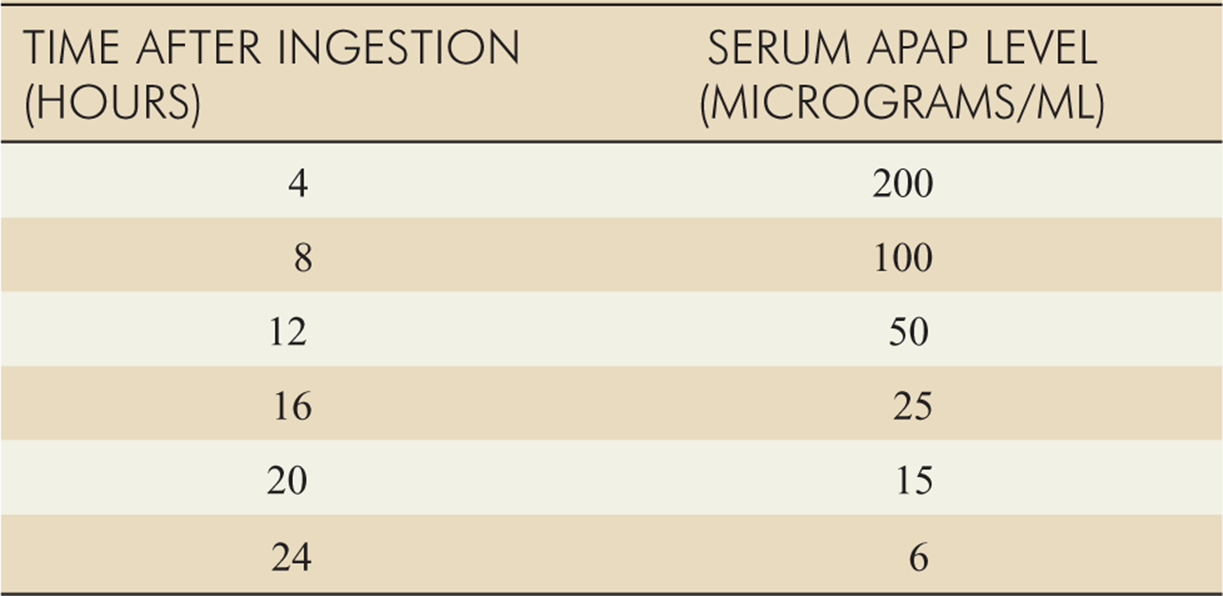
An APAP level, drawn as soon as possible within 4 to 24 hours of ingestion, will guide subsequent ED management. Serum levels above 150 micrograms/dL at 4 hours post ingestion are potentially toxic (see Table 108-2). After 24 hours, a detectable APAP level or the presence of elevated transaminases may predict toxicity.
TABLE 108-2 Potentially Toxic Serum APAP Levels in Acute Ingestion
When multiple ingestions have occurred over a period of time, assessment is problematic. Consultation with a toxicologist is warrented in these cases.
Clinical experience with extended relief ingestions is limited. If a 4- to 8-hour level is in the toxic range (Table 108-2), then therapy should be initiated. If the 4- to 8-hour level is elevated but below the toxicity cutoff, then a second level 4 to 6 hours later should be obtained and therapy initiated if the second level is in the toxic range.
Obtain additional laboratory studies, including a CBC, coagulation studies, renal function tests, liver function tests, electrolytes, and additional toxicologic studies for possible coingestion.
The differential diagnosis of APAP toxicity includes viral and alcoholic hepatitis, other drug- or toxin-induced hepatitides, and hepatobiliary disease.
Acute APAP poisoning can often be distinguished from other forms of hepatitis by its acute onset, rapid progression, and markedly elevated transaminase levels.
EMERGENCY DEPARTMENT CARE AND DISPOSITION
Emergent priorities remain airway, breathing, and circulation. Cardiac monitoring and an IV line should be instituted.
NAC is a specific antidote for APAP toxicity and can prevent toxicity if administered within 8 hours of ingestion, and significantly reduce hepatotoxicity if administered within 24 hours of ingestion. There may be benefit from NAC, even when administered after 24 hours.
Begin NAC therapy empirically if there is any delay in obtaining a serum APAP or in patients with toxic serum levels.
NAC is administered orally or by nasogastric tube as a 140 milligram/kg loading dose, followed by 70 milligrams/kg every 4 hours for 17 additional doses. It can be given IV as a 150 milligram/kg loading dose, followed by 50 milligrams/kg over the next 4 hours, and then 100 milligrams/kg over the next 16 hours.
NAC can be administered immediately after activated charcoal; there is no evidence that activated charcoal decreases its effectiveness.
NAC is safe in pregnancy.
Nausea and vomiting during NAC therapy may be reduced by diluting it in a beverage or with administration of antiemetics such as metoclopramide or ondansetron.
Treatment of fulminant hepatic failure includes NAC therapy, correction of coagulopathy and acidosis, treatment of cerebral edema, supportive measures for multiorgan system failure, and early referral to a liver transplant center.
Patients with nontoxic APAP levels below the toxic range (Table 108-2) can be discharged from the ED if there is no evidence of other drug ingestion or intent of self-harm.
NONSTEROIDAL ANTI-INFLAMMATORY DRUGS
EPIDEMIOLOGY
Morbidity due to nonsteroidal anti-inflammatory drug (NSAID) exposure is far more significant from therapeutic dosing than after overdoses. NSAID-related GI bleeding is estimated to cause 103,000 hospitalizations and 16,500 deaths annually in the United States. NSAIDs have also been implicated in a significant proportion of cases of drug-induced renal failure.
PATHOPHYSIOLOGY
NSAIDs inhibit the enzyme cyclooxygenase (COX), which produces prostaglandins from arachidonic acid. There are at least two forms of cyclooxygenase, COX-1 and COX-2. COX-1 is responsible for most of the adverse effects of NSAIDs.
There are three types of cyclooxygenase inhibitors: nonselective (which inhibit both COX-1 and COX-2), which comprise the majority of NSAIDs; partially selective (which preferentially inhibit COX-2 only at low doses), such as etodolac and meloxicam; and selective (which preferentially inhibit COX-2), including valdecoxib, rofecoxib, and celecoxib.
NSAIDs are rapidly absorbed from the GI tract. Most NSAIDs undergo at least partial hepatic metabolism before elimination in the urine or feces.
Plasma half-lives of NSAIDs range from 2 to 4 hours for ibuprofen, to approximately 15 hours for the new COX-2 inhibitors, and more than 50 hours for piroxicam and phenylbutazone.
Phenylbutazone and naproxen may displace warfarin from plasma proteins, resulting in elevated PT times. Phenylbutazone also decreases the elimination of warfarin. The selective COX-2 inhibitors have been reported to slightly elevate the PT at therapeutic doses.
Other NSAIDs do not interact in these ways with warfarin, but nonselective NSAID use is contraindicated with warfarin because NSAID platelet aggregation inhibition may significantly increase the risk of bleeding.
NSAIDs may decrease the effectiveness of anti-hypertensives, including diuretics, α-adrenergic blockers, angiotensin-converting enzyme inhibitors, and β-adrenergic blockers.
NSAIDs inhibit the renal clearance of lithium and methotrexate and may cause toxicity from these drugs.
CLINICAL FEATURES
Toxicity associated with therapeutic use of NSAIDs is more common than acute overdose. The most frequent problems are GI bleeding and renal insufficiency.
CNS effects such as headache, mental status changes, and aseptic meningitis may be seen. Seizures have been reported with large ingestions, especially of mefenamic acid.
Pulmonary manifestations such as bronchospasm and hypersensitivity pneumonitis can occur.
Hepatic dysfunction, especially in the elderly and in patients with autoimmune disease, is possible.
Inhibition of platelet aggregation may lead to bleeding. The COX-2 inhibitors (eg, rofecoxib, celecoxib) have less antiplatelet effect than conventional NSAIDs; the lack of platelet inhibition with COX-2 inhibitors may increase the risk of acute coronary syndrome or thromboembolic stroke in at-risk patients who were previously on conventional NSAIDs.
Bone marrow suppression, including aplastic anemia, has been reported.
NSAIDs account for approximately 10% of cutaneous drug reactions, ranging from benign rashes and phototoxic reactions to severe Stevens–Johnson syndrome and toxic epidermal necrolysis.
Fetal NSAID exposure may lead to premature closure of the ductus arteriosus, oligohydramnios, renal dysfunction, necrotizing enterocolitis, and CNS hemorrhage.
Acute NSAID overdose generally has low morbidity, and usually becomes clinically apparent within 4 hours of ingestion.
Abdominal pain, nausea, and vomiting may occur.
CNS manifestations include altered mental status, diplopia, nystagmus, headache, and rarely seizures. Hypotension and bradydysrhythmias have been reported.
Renal failure may occur and are often associated with serum electrolyte abnormalities and volume overload.
DIAGNOSIS AND DIFFERENTIAL
The manifestations of NSAID toxicity are nonspecific.
NSAID levels are not readily available and are not clinically useful in assessing toxicity.
Laboratory evaluation should include electrolytes, glucose, BUN/creatinine, liver function tests, and an APAP level.
EMERGENCY DEPARTMENT CARE AND DISPOSITION
Emergent priorities remain airway, breathing, and circulation. Cardiac monitoring and an IV line should be instituted.
Activated charcoal 1 gram/kg is indicated for GI decontamination when early overdoses are identified.
Volume resuscitation, correction of acid–base and electrolyte disorders, and standard treatment of other complications such as seizures, dysrhythmias, and renal failure should be performed as indicated.
Patients with asymptomatic NSAID ingestions may be safely discharged from the ED after screening for co-ingestants and a 4- to 6-hour observation period. In deliberate overdoses, a psychiatric consultation should be obtained prior to discharge.
For further reading in Tintinalli’s Emergency Medicine: A Comprehensive Study Guide, 7th ed., see Chapter 183, “Aspirin and Salicylates,” by Luke Yip; Chapter 184, “Acetaminophen,” by Oliver L. Hung and Lewis S. Nelson; and Chapter 185 “Nonsteroidal Anti-Inflammatory Drugs,” by Joseph G. Rella and Wallace A. Carter.