
Milan D. Nadkarni
EPIDEMIOLOGY
 In the pediatric population, fever is the most common chief complaint presenting to an emergency department and accounts for 30% of outpatient visits each year.
Meningitis risk decreases from about 1% in the first month of life to <0.1% later in infancy while the risk for pyelonephritis remains relatively constant among young girls with fever, and gradually decreases among boys over the first year of life.
Most studies of febrile infants ≤3 months old cite a bacteremia/sepsis incidence of 2% to 3%. The most common causes of bacteremia and meningitis in this age group are Escherichia coli, group B Streptococcus, and Listeria monocytogenes. Risk factors include premature delivery, ruptured amniotic membranes more than 24 hours prior to delivery, maternal GBS status, and intrapartum fever.
In older infants and children, Streptococcus pneu-moniae previously accounted for more than 90% of occult bacteremia with Neisseria meningitidis, group A Streptococcus, and Salmonella responsible for the remainder. Haemophilus influenzae type b was a significant cause of bacteremia, but has been nearly eliminated since vaccination against this organism began in the early 1990s.
Administration of the H. influenzae type b vaccine and the heptavalent pneumococcal conjugate vaccine have decreased the occult bacteremia rate of well-appearing, febrile children 3 to 36 months of age from approximately 2% to 3% to 0.5% to 0.7%.
PATHOPHYSIOLOGY
Fever is the result of the body’s thermostat being reset by exogenous pyrogens, such as bacteria, bacterial endotoxins, antigen–antibody complexes, and viruses, which stimulate the production of endogenous pyrogens.
Infants and young children are thought to be at increased risk for bacteremia due to their immature immune system. The likelihood of various organisms causing bacteremia is age dependent.
Neonates and young infants demonstrate decreased opsonin activity, decreased macrophage and neu-trophil function, and bone marrow exhaustion. Infants and children demonstrate a poor immunoglobulin G antibody response to encapsulated bacteria until 24 months of age.
CLINICAL FEATURES
In the neonate or infant <2 to 3 months of age, the threshold for concerning fever is 38°C (100.4°F); in infants and children 3 to 36 months old, the threshold is 39°C (102.2°F).
In general, higher temperatures are associated with a higher incidence of serious bacterial illness.
Immature development and immature immunity make reliable examination findings difficult. Persistent crying, inability to console, poor feeding, or temperature instability may be the only findings suggestive of a serious bacterial illness.
DIAGNOSIS AND MANAGEMENT BASED ON AGE
INFANTS UP TO 3 MONTHS OLD
History and physical examination are rarely helpful in diagnosing or excluding serious bacterial illness in this age group as symptoms are typically vague, and physical examination findings are unreliable: men-ingismus is present in <15% of bacterial meningitis; rales may not be appreciated in the absence of ability to generate negative inspiratory forces; and bacteremia can occur in the well-appearing infant.
A history of cough, tachypnea, or hypoxia (by pulse oximetry), however, should alert the examiner to a possible lower respiratory tract infection and prompt chest radiograph.
The safest course for 0- to 28-day-old infants is full sepsis testing, admission, and empiric antibiotic treatment.
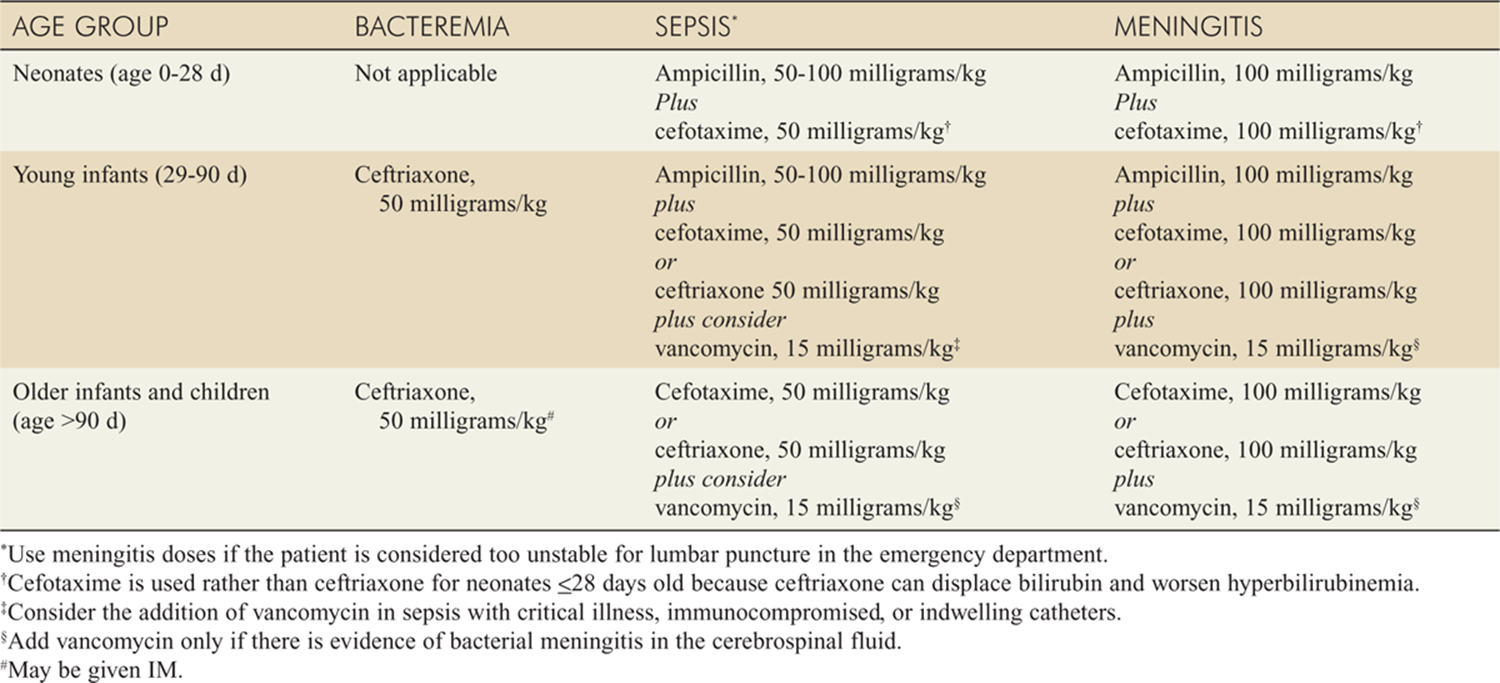
Antibiotic coverage in this age group includes ampi-cillin for L. monocytogenes (see Table 68-1) and either gentamycin or cefotaxime to cover E. coli. Sepsis testing includes complete blood count (CBC), blood culture, urinalysis (UA) and urine culture, chest radiograph, and lumbar puncture.
Criteria used to define infants at low risk for serious bacterial illness in the 31 to 90 days age group include well appearance without a history of prematurity or other comorbidity, and a normal urinalysis.
Infants with symptoms of lower respiratory tract disease, such as cough, grunting, physical findings such as tachypnea, rales, rhonchi, or low pulse oximeter readings, should have a chest radiograph.
The Boston, Philadelphia (which include normal CSF, UA, and CBC), and Rochester criteria (which includes normal UA and CBC) should only be applied if the child’s presentation warrants the sepsis testing listed above. Obtaining these laboratory tests should be reconsidered for infants in the 31 to 90 days age group because of the lower incidence of bacteremia due to screening and treatment for maternal GBS and declining rates of bacteremia.
All ill-appearing infants should receive parenteral antibiotic therapy (see Table 68-1) and be admitted to the hospital.
Management of well-appearing febrile low-risk infants remains a subject of significant debate. Infants older than 28 days at low risk may be managed conservatively as inpatients with ceftriaxone (see Table 68-1) pending cultures; as inpatients without antibiotics; as outpatients with ceftriaxone 50 milligrams/kg IM; or as outpatients without antibiotics. The key deciding factor should be the physician’s comfort level and the ability for close follow-up, typically within 12 hours. If antibiotics are administered (inpatient or outpatient), CSF and blood cultures should be obtained prior to administration of antibiotics.
Most community and academic emergency physicians perform a full septic workup in infants less than 4 weeks of age.
It is our recommendation to admit all well-appearing febrile infants less than 4 weeks of age. Empiric antibiotics or close observation can be discussed with the hospitalist.
Infants between the ages of 4 and 12 weeks may be considered for discharge provided a complete workup is negative.
Well-appearing febrile children between the ages of 29 and 90 days with an identifiable viral source of infection (eg, respiratory syncytial virus [RSV] or influenza) should have urinary tract infection (UTI) ruled out before being discharged from the emergency department, as UTI occurs in 2% to 4% of febrile infants with RSV.
Chest radiographs are obtained at the discretion of the clinician, but are not indicated for infants with clinical bronchiolitis or RSV that is otherwise uncomplicated.
Lumbar puncture in this group of children may be deferred in those who are well-appearing and test positive for a source of infection.
For febrile infants less than 3 months of age with an identifiable source of infection requiring antibiotic treatment (eg, otitis media or UTI) blood and CSF cultures should be obtained prior to administration of antibiotics.
TABLE 68-1 Initial Intravenous Antibiotic Dosages for Bacteremia, Sepsis, and Meningitis
INFANTS 3 TO 36 MONTHS OLD
Physical examination findings become more reliable with increasing age, though meningeal signs remain unreliable in the first year of life. Viral illnesses including pneumonia account for most febrile illnesses in this age group; patients with clinical findings suggesting pneumonia should have a chest radiograph.
UTI may present with fever and no other symptoms in this age group. UTI is a significant source of bacterial illness in females prior to toilet training, circumcised boys younger than 6 months of age and uncircum-cised boys under 1 year of age; these patients should have urinalysis and urine culture (by catheterization) if a source for the fever is not otherwise identified.
Unless there is an identifiable source of infection through history and physical examination, urinalysis/culture and/or chest radiograph may be the only two tests required for a workup on these febrile infants.
Infants in this age group who appear ill should receive a full septic workup including lumbar puncture and administration of antibiotics in a timely fashion (see Table 68-1).
OLDER FEBRILE CHILDREN
The risk for bacteremia in children older than 3 years is <0.2% since the introduction of Prevnar. CBC is no longer predictive of bacteremia and blood cultures are no longer recommended (more likely to yield false positive results) in immunized older children with fever.
Etiologies to consider in older febrile children include streptococcal pharyngitis, pneumonia, and Epstein–Barr virus infection. Testing is directed by clinical presentation.
EMERGENCY DEPARTMENT CARE AND DISPOSITION
The management of pneumonia is covered in Chapter 73; UTI is covered in Chapter 77; and infections of the ears, nose, and throat are covered in Chapter 70.
Table 68-1 lists specific antibiotic recommendations for conditions discussed in this chapter.
Although fever makes children uncomfortable, it is not harmful to children, though it does lower the seizure threshold. The physician can use several methods to reduce fever:
1. Remove excessive clothing and blankets to increase heat loss through radiation.
2. Administer acetaminophen 15 milligrams/kg PO/PR every 4 hours (maximum dose, 80 milligrams/kg in 24 hours).
3. Consider ibuprofen 10 milligrams/kg PO in children older than 1 year of age; the dose can be repeated every 6 hours (maximum of 40 milligrams/kg in 24 hours), and can be given concurrently with acetaminophen.
SEPSIS
EPIDEMIOLOGY
Sepsis is an infectious inflammatory syndrome with clinical evidence of infection that may include focal infections and meningitis. Multiorgan failure and death can rapidly develop. The clinical situations in which sepsis may develop or be suspected are quite varied and therefore the true incidence in children is not well described.
PATHOPHYSIOLOGY
The progression from bacteremia to sepsis begins with colonization with a bacterial pathogen (usually nasopharyngeal), and progresses to invasion of the blood by encapsulated organisms, the release of inflammatory mediators, and failure of host defenses.
Risk factors include impaired immunity, prematurity, recent invasive procedures, and indwelling foreign objects such as catheters, splenic function, congenital metabolic disease, and the presence of and obstruction to drainage of a body cavity.
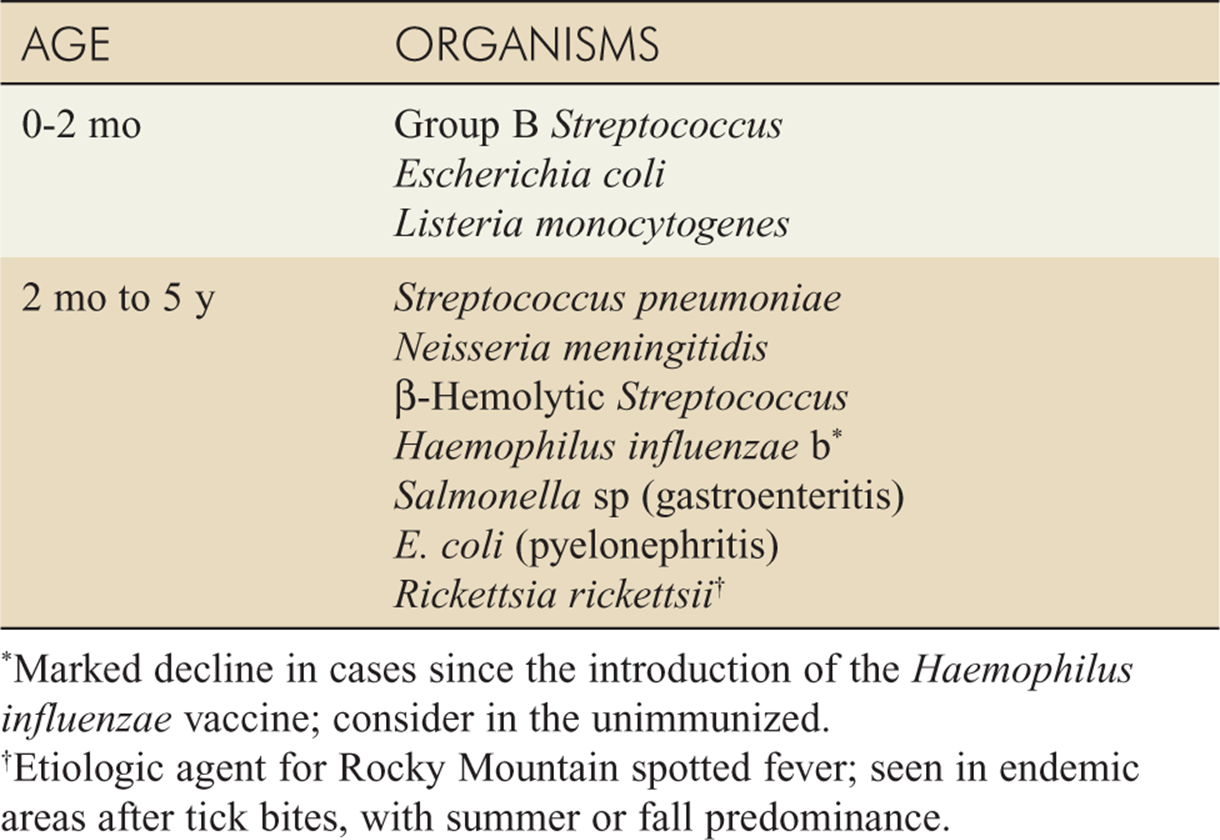
Age-dependent etiologies of sepsis are listed in Table 68-2.
TABLE 68-2 Common Organisms Causing Sepsis and Meningitis
CLINICAL FEATURES
Clinical signs may be vague and subtle in the young infant, and include lethargy, poor feeding, vomiting, irritability, or hypotonia.
Fever is common; however, very young infants with sepsis may be hypothermic. Tachypnea and tachycardia are usually present as a result of fever but also may be secondary to hypoxia and metabolic acidosis.
Sepsis can rapidly progress to shock manifest as prolonged capillary refill, decreased peripheral pulses, altered mental status, and decreased urinary output. Hypotension is usually a very late sign of septic shock in children and, and, in conjunction with respiratory failure and bradycardia, indicates a grave prognosis.
DIAGNOSIS AND DIFFERENTIAL
Diagnosis is based on clinical findings and confirmed by positive blood culture results.
Though international criteria for sepsis have been published, all infants who appear toxic should be considered septic. The laboratory evaluation of a child with presumed sepsis includes a CBC, blood culture, complete metabolic panel, catheterized urinalysis with culture and sensitivities, chest radiograph, lumbar puncture, and stool studies in the presence of diarrhea.
A serum glucose level should be performed on any critically ill child with altered mental status or cardi-orespiratory instability. Serum lactate may be useful for predicting severity of the clinical course, but rarely changes the emergency department management.
EMERGENCY DEPARTMENT CARE AND DISPOSITION
Administer high-flow oxygen, institute cardiac monitoring, and secure IV or IO access immediately. Endotracheal intubation should be performed in the presence of respiratory failure.
Treat shock with 20-mL/kg boluses of normal saline solution. Repeat boluses until vital signs, perfusion, and mental status and urine output improve, up to 100 mL/kg total volume.
Treat hypogly cemia with 4 to 5 mL/kg D10 in neonates and young infants and 2 mL/kg D25 in older infants and children.
Initiate antibiotic therapy promptly, as soon as IV access is achieved. Do not delay due to difficulty with procedures such as lumbar puncture. Empiric antibiotic choices are listed in Table 68-1.
Treat volume-refractory shock with dopamine 5 to 20 micrograms/kg/min or norepinephrine 0.1 to 0.2 micrograms/kg/min.
Consider the presence of drug-resistant organisms or immunoincompetence and infection with unusual or opportunistic organisms.
MENINGITIS
EPIDEMIOLOGY
Since the advent of the H. influenzae type b (Hib) vaccine, the epidemiology of pediatric meningitis in the United States has changed dramatically. In 1986, the median age for all patients with meningitis was 15 months; in 1995 the median age for meningitis was 25 years. Meningitis has shifted from being predominantly a disease of infants and young children to a disease predominantly of adults.
PATHOPHYSIOLOGY
Typically, meningitis is a complication of primary bacteremia. It is thought that the products of bacterial multiplication alter the permeability of the blood-brain barrier and extend the infection to the brain and surrounding cerebrospinal fluid spaces.
Less commonly, meningitis may result from hematog-enous spread from a distant primary focal infection, direct extension from adjacent infection, or following cribriform plate or sinus fracture.
The neurologic damage that sometimes follows meningitis is thought to result from direct inflammatory effects, brain edema, increased intracranial pressure, decreased cerebral blood flow, and vascular thrombosis.
Impaired splenic function and immunosuppression or immunodeficiency is associated with a relatively increased risk of meningitis.
Bacterial agents responsible for meningitis vary with age. Group B streptococci, E. coli, and L. mono-cytogenes predominate in neonates. Streptococcus pneumoniae and N. meningitidis are most common in older infants and children.
CLINICAL FEATURES
Meningitis may present with the subtle signs that accompany less serious infections, such as otitis media or sinusitis. Irritability, inconsolability, hypoto-nia, and lethargy are most common in infants.
Older children may complain of headache, photophobia, nausea, and vomiting and exhibit the classic signs of meningismus with complaints of neck pain and stiffness.
Occasionally, meningitis presents as a rapidly progressive, fulminant disease characterized by shock, seizures, or coma, or with febrile status epilepticus. In infants presenting with hypothermia a full septic workup should be initiated to rule out meningitis.
DIAGNOSIS AND DIFFERENTIAL
Diagnosis is made by lumbar puncture and analysis of the cerebrospinal fluid (CSF). The CSF should be examined for white blood cells, glucose, and protein and undergo Gram stain and culture.
Herpes encephalitis should be considered in the seizing neonate and any child with CSF pleocytosis.
In the presence of immunoincompetence, infections with opportunistic or unusual viral organisms should be considered.
Cranial computed tomography should be performed before lumbar puncture in the presence of focal neurologic signs or increased intracranial pressure.
EMERGENCY DEPARTMENT CARE AND DISPOSITION
Treatment should always begin with the ABCs and restoration of oxygenation and perfusion (see specific treatment recommendations under Sepsis, above).
Empiric antibiotic therapy is based on the patient’s age and listed in Table 68-1.
Antibiotics should not be deferred or delayed when meningitis is strongly suspected.
Strongly consider the addition of acyclovir 10 milligrams/kg/dose in neonates with seizures, or ill-appearing neonates and in neonates with vesicular lesions.
The role of steroids in the management of meningitis in children is controversial. If given, the dose should ideally be administered before antibiotics.
For any patient suspected of having meningitis for whom efforts at lumbar puncture fail, the patient should be admitted, hydrated, given meningitis doses of antibiotics, and blood and urine cultures obtained. Lumbar puncture may be successful after hydration.
POSITIVE BLOOD CULTURES
Recall all children with positive blood cultures.
In the case of positive S. pneumoniae cultures:
1. If the child is receiving appropriate antibiotics, is clinically well, and afebrile, the child should complete the course of therapy.
2. If afebrile and clinically well but not receiving antibiotics, opinions differ regarding the need for additional blood cultures and antibiotic therapy. Most physicians would treat this group of infants with antibiotics and repeat a blood culture 24 to 48 hours after initiation of antibiotics. These children can be managed on an outpatient basis.
3. The febrile child who appears ill should receive a complete sepsis evaluation (CBC, urinalysis, CSF indices, and blood, urine, and CSF cell count and cultures).
For the persistently febrile patient who is well appearing and has a normal evaluation, admission is usual, although empiric treatment with ceftriaxone and follow-up as an outpatient may be considered.
For any patient who is ill appearing, complete a sepsis evaluation and admit for parenteral antibiotics.
Children with cultures positive for N. meningitidis, methicillin-resistant Staphylococcus aureus or gram-negative organisms should be admitted for parenteral antibiotic therapy.
Children who are thought to be at risk for a serious bacterial illness and do not have reliable follow-up or the ability to return to the hospital should also be admitted for inpatient management.
For further reading in Tintinalli’s Emergency Medicine: A Comprehensive Study Guide, 7th ed., see Chapter 113, “Fever and Serious Bacterial Illness,” by Vincent J. Wang.