
Michael J. Halaska1 and Lukas Rob1
(1)
Department of Obstetrics and Gynaecology, 2nd Medical Faculty, Charles University, Prague, Czech Republic
Michael J. Halaska
Email: mhalaska@seznam.cz
Keywords
Cervical cancerPregnancyPregnancy preservationManagementChemotherapy during pregnancy
Introduction
Cervical cancer is one of the most common malignancies diagnosed in the pregnant population. Because of the anatomical proximity to the developing foetus, it is also one of the most challenging tasks facing the surgical oncologist. More detailed epidemiology can be found in Chap. 1.
During the past few decades, a large body of findings related to the prognosis of cervical cancer diagnosed during pregnancy has been described. Majority of the studies show that prognosis is not negatively influenced when the disease is diagnosed during pregnancy. During counselling, a patient’s gestational age at diagnosis, stage of the disease and the patient’s wishes regarding continuation of pregnancy are important factors that need to be taken into account when choosing an optimal treatment. Most probably we can consider pregnancy-preserving management in early-stage disease (FIGO stage IA–IB2) tumours without compromising the prognosis. Indeed, preservation of pregnancy in a patient with advanced disease would not be a reasonable treatment option. Further, if a patient wishes to have her fertility preserved despite the risks, her physician must contend with prognostic uncertainty.
Diagnostics and Staging
Most women diagnosed with cervical cancer during pregnancy have early-stage disease [1] which might be explained by regular gynaecological examinations offered during pregnancy, making early detection more likely. Symptoms are usually absent in stage IA disease, whereas postcoital bleeding or spotting occurs in 20 % of the cases and abnormal oncological cytology in 63 % with stage I cancer during pregnancy [2].
Colposcopic and cytologic examinations are more difficult to interpret during pregnancy because of the occurrence of physiological pregnancy changes of the tissue (e.g. increased cervical volume, increased vascularisation, stromal oedema and glandular hyperplasia), even though eversion of the cervix facilitates inspection. An experienced oncogynaecologist should always be involved in managing any suspicious cases. In case of colposcopic suspicion of microinvasion, a flat cone biopsy is recommended, preferably between the 13th and 20th week of pregnancy. The risks of bleeding and abortion are the lowest during this period of pregnancy [3]. In larger tumours, a biopsy without significant risks can be performed [4]. For imaging methods, ultrasound is preferred in that it poses minimal risks to the foetus but is more operator dependent than magnetic resonance imaging (MRI). Increased perfusion during pregnancy can make diagnostics more difficult. Use of MRI in pregnant women with cervical cancer has been described [5]. MRI imaging in six pregnant patients was not different from non-pregnant patients, although some pregnancy changes have been reported, including movement of the foetus and physiological hyperintensity of the cervix in pregnancy. The teratogenic effects of gadolinium have been found only in extremely high or repetitive doses though when necessary it could be used after the 1st trimester of pregnancy [6].
The most important prognostic factor in cervical cancer, in addition to the size of the tumour, is lymph node involvement. Several publications have described lymphadenectomy performed during pregnancy as either staging surgery alone or combined with cone biopsy or trachelectomy. Table 12.1 summarises published studies of such lymph node dissection procedures performed in pregnancy. Lymphadenectomy can be carried out through abdominal incision or, more frequently, using a less invasive laparoscopic (transperitoneal or retroperitoneal) approach. The lymphadenectomy can be safely performed during pregnancy between the 13th and 22nd week of gestation. From 56 published cases, the majority of patients underwent surgery before the 22nd week of gestation. A median of 17 (range 6–71) harvested lymph nodes were detected in these 56 cases. With increasing gestational age, the probability of retrieving a sufficient number of lymph nodes decreases. Thus, at higher gestational stages, this staging procedure cannot be oncologically reliable and should not be performed.
Table 12.1
Staging lymphadenectomy during pregnancy
|
Author |
Number |
Stage |
Surgery |
Gestational age |
Number of LNs |
Positive LNs |
Follow-up |
Follow-up |
|
Week |
% |
Month |
||||||
|
Stan (2005) [8] |
1 |
IB2 |
LS-TP |
16 |
72 |
0 |
NED |
48 |
|
Alouini (2008) [9] |
8 |
IB1-IIIA |
3× LS-TP, 5× LS-RP |
12–32 |
11–28 |
37.5 |
5× NED, 3× DOD |
8–103 |
|
Sioutas (2011) [10] |
1 |
IB1 |
Abdominal |
13 |
18 |
0 |
NED |
30 |
|
Sioutas (2011) [10] |
1 |
IA2 |
LS-TP |
12 |
28 |
0 |
NED |
27 |
|
Ferriaoli (2012) [11] |
1 |
IA2 |
LS-TP |
7 |
13 |
0 |
NED |
120 |
|
Ferriaoli (2012) [11] |
1 |
IA2 |
LS-TP |
13 |
30 |
0 |
NED |
240 |
|
Carillon (2011) [12] |
1 |
IB1 |
LS-TP |
13 |
NA |
0 |
NED |
12 |
|
Vercellino (2014) [7] |
32 |
IA1-IIA |
32× LS-TP |
6–25 |
6–57 |
16.7 |
NED |
17–164 |
LS-TP laparoscopic transperitoneal lymphadenectomy, LS-RP laparoscopic retroperitoneal lymphadenectomy, LNs lymph nodes, NED no evidence of disease, DOD died of disease
The issue of detection of sentinel lymph nodes is disputable. No case report has been published on a patient with foetus in utero as technetium is injected into the cervix, which is in the near proximity of the foetus. Patent blue is contraindicated because of the risk of an anaphylactic reaction. Use of indocyanine green could be a safe option. Concerning the above-mentioned facts, we distinguish between different management algorithms of cervical cancer in pregnancy based on the feasibility of lymphadenectomy, with 22nd–25th week of gestation (preferably the 22nd week) being determinative. Deciding which surgical technique to employ depends largely on the experience and preference of the surgeon. When laparotomy is used, a lower midline incision is preferred. Laparoscopy was found to have a comparable complication rate under certain conditions (e.g. operating time less than 90 min, a maximal pneumoperitoneum of 13 mmHg, open laparoscopic technique, skilled surgical team). Some authors have described the placement of laparoscopic ports based on gestation week at surgical procedure in order to avoid an injury of the uterus and to enable sufficient access to the retroperitoneal space [7].
Management of a Patient with Cervical Cancer Diagnosed During Pregnancy
After fully informed counselling, which should be made up of an obstetric evaluation of the patient, the presentation should include vaginal findings, pregnancy risk assessment, ultrasonographic datation of the gravidity and exclusion of foetal malformations or other disorders. It should also include a decision, and an exact treatment plan should be prepared by a team that should comprise an oncogynaecologist, perinatologist, neonatologist and oncologist (and eventually an anaesthesiologist, pathologist, radiodiagnostician), as well as the patient herself and her partner. Figure 12.1 provides an overview of the management of a pregnant patient with cervical cancer.
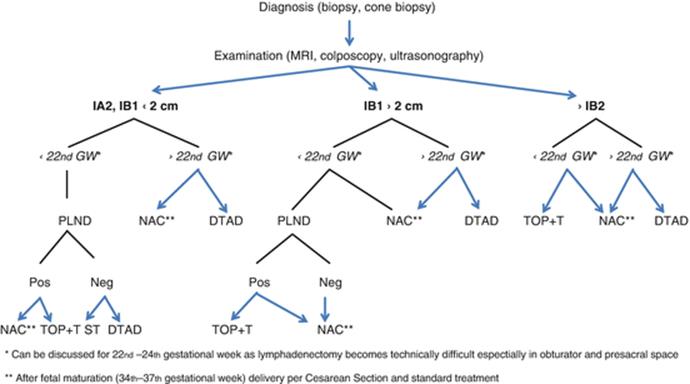
Fig. 12.1
Management of a cervical cancer patient diagnosed during pregnancy. PLND pelvic lymph node dissection, NAC neoadjuvant chemotherapy, TOP+T termination of pregnancy and standard treatment, STsimple trachelectomy, DTAD delayed treatment after delivery, GW gestational week of pregnancy, MRI magnetic resonance imaging
Non-preserving Management in Pregnancy
Some patients have an explicit wish not to preserve the pregnancy. Usually, they are represented by women who were diagnosed while planning an artificial abortion, advanced-stage disease patients or multiparous women who have concerns about their previous children. Because cervical cancer represents an obstacle to the surgical abortive procedure, the situation becomes immediately more complicated. In an operable disease, radical hysterectomy can be performed with the foetus in utero (during the 1st trimester) or after Caesarean section surgery to reduce the uterine volume (during the 2nd trimester). In advanced-stage disease when chemoradiotherapy is indicated, two alternative options are available. One is to start chemoradiotherapy with the foetus in utero, which usually leads to foetal demise within one month after exposure to radiotherapy. The option that is more frequently used today involves first performing an ureterotomy with evacuation of the foetus and then starting chemoradiotherapy within one week after termination. The advantages and disadvantages of performing Caesarean section prior to the initiation of radiotherapy need to be carefully weighed for each patient. Benefits include no need to recalculate the radiation field, no interruption of radiotherapy once started, lower number of obstetric complications (bleeding, disseminated intravascular coagulation) and reduced psychological distress for the patient. On the other hand, surgery involves several risks: formation of adhesions, which might increase the toxicity of radiotherapy; surgical site infection, possibly delaying the radiotherapy; and the risk of implantation metastasis.
Pregnancy-Preserving Management
The treatment of cervical cancer in pregnancy is still considered experimental, particularly in an advanced disease. Continuation of pregnancy should be offered to only highly motivated, carefully selected patients after informing them about the most current state of knowledge on the clinical issues under consideration. Based on the possibility to perform a staging lymphadenectomy (in early-stage tumours), the patients can be divided into groups diagnosed during the 22nd week and after the 22nd week of pregnancy.
Tumours Diagnosed Before the 22nd Gestational Week
For IA1 tumours, cone biopsy is a surgical procedure offering sufficient and relatively safe treatment in pregnancy. For more progressive tumours, staging lymphadenectomy should be performed first to identify high-risk tumours (i.e. tumours with positive lymph nodes). In node-positive cases, termination of pregnancy followed by standard treatment should be advocated.
For stage IA2 and IB1 tumours smaller than 2 cm in lymph node-negative patients and in younger women with early cervical cancer, a trachelectomy could be suitable. The standard procedures for fertility sparing in non-pregnant women in such cases are vaginal or abdominal radical trachelectomy. An overview of published cases in pregnancy (see Table 12.2) describes not only the technical difficulties (e.g. prolonged operative time associated with significant blood loss and an increase in infection rates) but also the loss of pregnancy in 6 out of 23 cases (26 %). Therefore, radical trachelectomy should not be recommended during pregnancy. Meanwhile, a number of recent studies in non-pregnant women have demonstrated that the risk of parametrial involvement in node-negative patients is less than 1 % for these stages (IA2 and IB1 ˂ 2 cm tumours), which justifies using simple trachelectomy (an oncologically safe procedure) and omitting radical parametrectomy [13]. The feasibility and safety of this technique have been reported elsewhere [14, 15].
Table 12.2
Cases of abdominal and vaginal radical trachelectomy performed during pregnancy
|
Author |
Stage |
Size |
Histologic type |
Surgery |
Surgery |
Delivery |
Outcome |
Patient outcome |
Follow-up |
|
mm |
Week |
Week |
|||||||
|
Ungar (2006) [17] |
IB1 |
NA |
Squamous cell |
ART + PLND |
7 |
AB |
Abortion at the 1st post-op day |
NED |
NA |
|
Ungar (2006) [17] |
IB1 |
NA |
Squamous cell |
ART + PLND |
8 |
AB |
Abortion at the 1st post-op day |
NED |
NA |
|
Ungar (2006) [17] |
IB1 |
NA |
Squamous cell |
ART + PLND |
9 |
38 |
0 |
NED |
20 |
|
Ungar (2006) [17] |
IB1 |
NA |
Squamous cell |
ART + PLND |
13 |
AB |
Abortion at the 16th post-op day |
NED |
NA |
|
Ungar (2006) [17] |
IA2 |
NA |
Squamous cell |
ART + PLND |
18 |
39 |
0 |
NED |
72 |
|
Mandic (2009) [18] |
IB1 |
4 |
Squamous cell |
ART + PLND |
19 |
36 |
5 h, blood loss 450 ml |
NED |
12 |
|
Abu-Rustum (2009) [19] |
IB1 |
12 |
Lympho-epithelial |
ART + PLND |
15 |
39 |
3.5 h, blood loss 1600 ml, left ureter lesion |
NA |
NA |
|
Enomoto (2011) [20] |
IB1 |
NA |
Squamous cell |
ART + PLND |
15 |
37 |
7.5 h, blood loss 960 ml |
NED |
6 |
|
Aoki (2014) [21] |
IB1 |
20 |
Squamous cell |
ART + PLND |
17 |
38 |
6.5 h, blood loss 2510 ml |
NED |
40 |
|
Karateke (2010) [22] |
IB2 |
50 |
Squamous cell |
ART + PLND |
22 |
AB |
4 h, abortion 4 h post-op |
NA |
NA |
|
Ferriaoli (2012) [11] |
IA2 |
4 |
Adenocarcinoma |
VRT + PLND |
5 |
35 |
0 |
NED |
120 |
|
Ferriaoli (2012) [11] |
IA2 |
10 |
Squamous cell |
VRT + PLND |
11 |
AB |
Abortion on the 7th post-op day |
NED |
240 |
|
Bravo (2012) [23] |
IB1 |
35 |
Squamous cell |
VRT + PLND |
11 |
36 |
0 |
NED |
160 |
|
Alouini (2008) [9] |
IB1 |
20 |
Squamous cell |
VRT + PLND |
12 |
AB |
Abortion on the 2nd post-op day |
NED |
132 |
|
Alouini (2008) [9] |
IB1 |
25 |
Adenocarcinoma |
VRT + PLND |
12 |
30 |
0 |
DOD |
18 |
|
Sioutas (2012) [10] |
IA2 |
3.6 |
Squamous cell |
VRT + PLND |
12 |
37 |
0 |
NED |
26 |
|
Sioutas (2010) [10] |
IB1 |
NA |
Adenocarcinoma |
VRT + PLND |
13 |
37 |
0 |
NED |
47 |
|
Sioutas (2011) [10] |
IB1 |
NA |
Adenocarcinoma |
VRT + PLND |
13 |
29 |
0 |
NED |
33 |
|
Iwami (2011) [24] |
IB1 |
NA |
Adenocarcinoma |
VRT + PLND |
16 |
37 |
0 |
NED |
14 |
|
Kolomainen (2013) [25] |
IB2 |
42 |
Adenocarcinoma |
VRT |
16 |
26 |
PROM 8 weeks after surgery, NEC |
NED |
184 |
|
van de Nieuwenhof (2008) [26] |
IB1 |
8 |
Squamous cell |
VRT + PLND |
18 |
36 |
6.5 h, blood loss 1550 ml |
NED |
9 |
|
Saso (2015) [27] |
IB1 |
4 |
Squamous cell |
VRT |
19 |
36 |
0 |
NED |
64 |
|
Ferriaoli (2012) [11] |
IB1 |
27 |
Adenocarcinoma |
VRT + PLND |
22 |
31 |
IVH on the 2nd post-op day |
DOD |
48 |
ART abdominal radical trachelectomy, VRT vaginal radical trachelectomy, PLND pelvic lymph node dissection, PALND para-aortic lymph node dissection, PROM premature rupture of membranes, ABabortion, NEC necrotising enterocolitis, IVH intraventricular haemorrhage, NED no evidence of disease, DOD died of disease, NA not available, POSTOP post-operative
Patients diagnosed with tumours in stage IB1 larger than 2 cm with negative lymph nodes are indicated for neoadjuvant chemotherapy (NACT) until reaching foetal maturity. Another option is to administer NACT without performing a lymphadenectomy, but which is then performed after delivery. With negative lymph nodes, some authors propose the delay of treatment until after delivery. A literature review included 76 stage IB1 cases of delayed treatment with a 95 % survival rate at a mean follow-up of 37.5 months [16]. The median delay was 16 weeks and no recurrences were reported for node-negative patients. If progression of disease were suspected through either clinical examination or MRI, termination of pregnancy or NACT should follow.
In patients with tumour stage IB2 and higher, the only option to preserve a current pregnancy would be to administer NACT. The therapeutic value of staging lymphadenectomy before the initiation of chemotherapy is unclear, but such information might be useful in further management of pregnancy preservation.
There is growing knowledge on the oncological safety of NACT administered during pregnancy. The major purpose of NACT is to stabilise the tumour and prevent its spread.
Tables 12.3 and 12.4 summarise data of 42 stage IB patients who received NACT in pregnancy. The chemotherapy regimens were based on platinum alone or in combination with paclitaxel, vincristine, 5-FU, cyclophosphamide or bleomycin. Chemotherapy was administered at a 3-week interval. Overall survival rate was 81.6 % (31/38) at a median follow-up of 24 (range 1–153) months. The survival rate was 88.9 % (16/18) in stage IB1 at a median follow-up of 14.5 months (one patient diagnosed with small cell cancer died). In stage IB2, the overall survival rate was 73.7 % (14/19) at a median follow-up of 27 months. These results need to be interpreted with caution because of the short follow-up time and because different chemotherapy regimens were included. Recently published guidelines on gynaecologic cancer treatment in pregnancy recommend a platinum-based chemotherapy (cisplatin 75 mg/m2), preferably with paclitaxel (175 mg/m2) at a 3-week interval [48]. An alternative to cisplatin is carboplatin (AUC 5-6), which has been shown to have a more favourable maternal toxicity profile. Data on the use of gemcitabine, vinorelbine and topotecan during pregnancy are very limited, and these agents should be avoided in pregnant patients. Alternative chemotherapeutic protocols are cisplatin 75 mg/m2 with ifosfamide 2 mg/m2 in patients with spinocellular carcinoma and cisplatin 75 mg/m2 with Adriamycin 35 mg/m2 in patients with adenocarcinoma given in a10-day regimen.
Table 12.3
Cases of neoadjuvant chemotherapy in stage IB1 tumours
|
Author |
Age |
GW |
Stage |
Histological type |
Grade |
Size |
Chemotherapy |
GW at delivery |
Patient outcome |
Follow-up |
|
mm |
Month |
|||||||||
|
Cardonick (2010) [28] |
NA |
NA |
IB1 |
NA |
NA |
NA |
P |
NA |
NA |
NA |
|
Cardonick (2010) [28] |
NA |
NA |
IB1 |
NA |
NA |
NA |
PV |
NA |
NA |
NA |
|
Favero (2010) [29] |
31 |
14 |
IB1 |
Squamous cell |
2 |
NA |
P |
32 |
NA |
NA |
|
Favero (2010) [29] |
29 |
18 |
IB1 |
Adenocarcinoma |
3 |
NA |
P |
34 |
NA |
NA |
|
Favero (2010) [29] |
31 |
18 |
IB1 |
Squamous cell |
3 |
NA |
P |
34 |
NED |
10 |
|
Favero (2010) [29] |
34 |
22 |
IB1 |
Squamous cell |
2 |
NA |
P |
36 |
NED |
5 |
|
Marnitz (2010) [30] |
35 |
15 |
IB1 |
Adenocarcinoma |
2 |
NA |
3× PT |
32 |
NED |
17 |
|
Marnitz (2010) [30] |
31 |
20 |
IB1 |
Squamous cell |
3 |
NA |
3× PT |
32 |
NED |
12 |
|
Marnitz (2010) [30] |
35 |
22 |
IB1 |
Squamous cell |
2 |
NA |
3× PT |
35 |
NED |
7 |
|
Marnitz (2010) [30] |
36 |
15 |
IB1 |
Squamous cell |
2 |
NA |
3× PT |
36 |
NED |
3 |
|
Marnitz (2010) [30] |
29 |
19 |
IB1 |
Adenocarcinoma |
3 |
NA |
3× PT |
33 |
NED |
3 |
|
Marnitz (2010) [30] |
35 |
19 |
IB1 |
Adenocarcinoma |
2 |
NA |
3× PT |
34 |
NED |
1 |
|
Giacalone (1996) [31] |
34 |
19 |
IB1 |
Squamous cell |
2 |
20 |
3× P |
32 |
NED |
12 |
|
Fruscio (2012) [32] |
34 |
26 |
IB1 |
Adenocarcinoma |
3 |
20 |
P |
36 |
NED |
43 |
|
Fruscio (2012) [32] |
37 |
8 |
IB1 |
Squamous cell |
3 |
20 |
P |
36 |
NED |
23 |
|
Ayhan (2012) [33] |
26 |
18 |
IB1 |
Clear cell |
NA |
20 |
3× P |
32 |
NED |
36 |
|
Caluwaerts (2006) [34] |
28 |
15 |
IB1 |
Squamous cell |
2 |
30 |
6×P |
32 |
NED |
10 |
|
Chun (2010) [35] |
27 |
25 |
IB1 |
Small cell |
NA |
30 |
3× PT |
35 |
DOD |
49 |
|
Fruscio (2012) [32] |
34 |
22 |
IB1 |
Squamous cell |
2 |
30 |
P |
36 |
NED |
65 |
|
Fruscio (2012) [32] |
39 |
20 |
IB1 |
Adenocarcinoma |
1 |
30 |
P |
36 |
NED |
41 |
|
de Lima (2013) [36] |
24 |
23 |
IB1 |
Adenocarcinoma |
NA |
32 |
2× P + Vin |
34 |
NED |
24 |
|
Kong (2014) [37] |
31 |
19 |
IB1 |
Adenocarcinoma |
2 |
32 |
3× PT |
33 |
NED |
96 |
P cisplatin, V vinblastine, Vin vincristine, T paclitaxel, DOD died of disease, NED no evidence of disease, AWD alive with disease, NA not available, GW gestational week
Table 12.4
Cases of neoadjuvant chemotherapy in stage IB2 tumours
|
Author |
Age |
GW |
Stage |
Histological type |
Grade |
Size |
Chemotherapy |
GW at delivery |
Patient outcome |
Follow-up |
|
mm |
Month |
|||||||||
|
Karam (2007) [38] |
28 |
23 |
IB2 |
Squamous cell |
3 |
40 |
7× P |
33 |
NED |
16 |
|
Li (2011) [39] |
36 |
27 |
IB2 |
Squamous cell |
3 |
42 |
2× PT |
33 |
NED |
21 |
|
Peculis (2014) [40] |
27 |
17 |
IB2 |
Squamous cell |
NA |
42 |
6× PA |
34 |
NED |
20 |
|
Rabaiotti (2010) [41] |
27 |
15 |
IB2 |
Squamous cell |
3 |
50 |
3× P |
32 |
DOD |
24 |
|
Chun (2010) [35] |
27 |
28 |
IB2 |
Squamous cell |
NA |
50 |
2× TC |
36 |
NED |
60 |
|
Li (2011) [39] |
39 |
29 |
IB2 |
Squamous cell |
NA |
50 |
2× PT |
33 |
NED |
13 |
|
Kong (2014) [37] |
38 |
18 |
IB2 |
Squamous cell |
NA |
50 |
3× PT |
35 |
NED |
36 |
|
Islam (2012) [42] |
37 |
10 |
IB2 |
Adenocarcinoma |
2 |
53 |
1× P |
34 |
NED |
36 |
|
Fruscio (2012) [32] |
37 |
18 |
IB2 |
Squamous cell |
3 |
60 |
P |
32 |
NED |
153 |
|
Fruscio (2012) [32] |
28 |
16 |
IB2 |
Squamous cell |
3 |
60 |
PT |
33 |
NED |
113 |
|
Fruscio (2012) [32] |
36 |
16 |
IB2 |
Squamous cell |
3 |
60 |
PT |
34 |
NED |
115 |
|
Fruscio (2012) [32] |
32 |
20 |
IB2 |
Squamous cell |
3 |
70 |
P |
35 |
DOD |
27 |
|
Fruscio (2012) [32] |
29 |
13 |
IB2 |
Squamous cell |
3 |
70 |
PV |
30 |
DOD |
27 |
|
Tewari (1997) [43] |
36 |
21 |
IB2 |
Squamous cell |
2 |
70 |
4× PV |
32 |
NED |
24 |
|
Smyth (2010) [44] |
26 |
23 |
IB2 |
Small cell |
NA |
94 |
3× A + CFA |
35 |
OT |
NA |
|
Lai (1997) [45] |
NA |
NA |
IB2 |
NA |
NA |
NA |
PVB |
NA |
DOD |
52 |
|
Lai (1997) [45] |
NA |
12 |
IB2 |
NA |
NA |
NA |
PVB |
NA |
DOD |
59 |
|
Lanowska (2011) [46] |
41 |
14 |
IB2 |
Squamous cell |
2 |
NA |
4× P |
31 |
NED |
1 |
|
Gambino (2011) [47] |
28 |
20 |
IB2 |
Squamous cell |
NA |
NA |
1× P |
22 |
NED |
24 |
|
Gambino (2011) [47] |
42 |
24 |
IB2 |
Squamous cell |
NA |
NA |
3× P |
36 |
NED |
36 |
P cisplatin, V vinblastine, B bleomycin, T paclitaxel, A doxorubicin, CFA cyclophosphamide, C carboplatin, DOD died of disease, NED no evidence of disease, OT ongoing treatment, NA not available
Tumours Diagnosed After the 22nd Gestational Week
As mentioned above, complete pelvic lymphadenectomy is difficult to perform beyond 22 weeks gestation; therefore, nodal status cannot be taken into account in the decision-making process. In stage IA2 and IB1 tumours smaller than 2 cm, one option is to delay treatment until foetal maturity is achieved and then discuss timing of delivery with a neonatologist. Another option is administration of NACT. For higher stages, NACT is the only means to preserve pregnancy and reach foetal maturity.
Mode of Delivery
Vaginal delivery is possible in patients with no evidence of residual tumours, especially after cone biopsy or trachelectomy. However, most patients should deliver via Caesarean section. Ripening of the cervix during spontaneous delivery that underwent surgery during pregnancy could be abnormal. Both episiotomy and laparotomy recurrences have been documented [43, 49]. Caesarean section allows the surgical team to combine surgery with radical hysterectomy. We recommend performing midline uterotomy to avoid getting too close to the cervix during surgery. The procedure, however, poses an increased risk of higher blood loss. If carried out by an experienced team, it could be performed as standard procedure. Figure 12.2 depicts a specimen of the uterus after Caesarean section combined with radical hysterectomy.
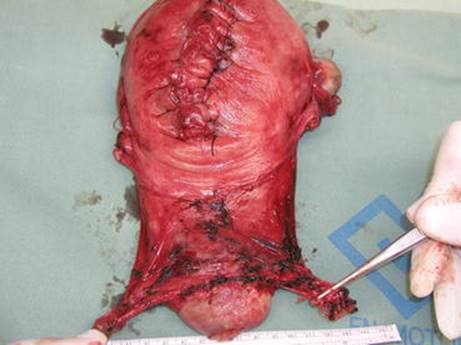
Fig. 12.2
Specimen of the uterus after Caesarean section combined with radical hysterectomy
Conclusion
Cervical cancer belongs to one of the most challenging cancer diseases when diagnosed during pregnancy. Pregnancy-preserving management should be considered as it seems that pregnancy does not negatively influence the prognosis of the patients, and moreover, majority of cases are diagnosed at the early stage of disease. Combination of conservative surgery and neoadjuvant chemotherapy offers interesting therapeutic options in the management of patients diagnosed with cervical cancer during pregnancy.
Financial Disclosure/Acknowledgments
M.J.H. declares financial support from SOTIO not related to the work presented.
References
1.
Manuel-limson GA, Ladines-Llave CA, Sotto LS, Manalo AM. Cancer of the cervix in pregnancy: a 31-year experience at the Philippine General Hospital. J Obstet Gynaecol Res. 1997;23(6):503–9.CrossRefPubMed
2.
Sood AK, Sorosky JI, Krogman S, Anderson B, Benda J, Buller RE. Surgical management of cervical cancer complicating pregnancy: a case-control study. Gynecol Oncol. 1996;63(3):294–8.CrossRefPubMed
3.
Robova H, Rob L, Pluta M, Kacirek J, Halaska Jr M, Strnad P, et al. Squamous intraepithelial lesion-microinvasive carcinoma of the cervix during pregnancy. Eur J Gynaecol Oncol. 2005;26(6):611–4.PubMed
4.
Economos K, Perez VN, Delke I, Collado ML, Tancer ML. Abnormal cervical cytology in pregnancy: a 17-year experience. Obstet Gynecol. 1993;81(6):915–8.PubMed
5.
Balleyguier C, Fournet C, Ben HW, Zareski E, Morice P, Haie-Meder C, et al. Management of cervical cancer detected during pregnancy: role of magnetic resonance imaging. Clin Imaging. 2013;37(1):70–6.CrossRefPubMed
6.
Okuda Y, Sagami F, Tirone P, Morisetti A, Bussi S, Masters RE. [Reproductive and developmental toxicity study of gadobenate dimeglumine formulation (E7155) (3)-Study of embryo-fetal toxicity in rabbits by intravenous administration]. J Toxicol Sci. 1999;24 Suppl 1:79–7.
7.
Vercellino GF, Koehler C, Erdemoglu E, Mangler M, Lanowska M, Malak AH, et al. Laparoscopic pelvic lymphadenectomy in 32 pregnant patients with cervical cancer: rationale, description of the technique, and outcome. Int J Gynecol Cancer. 2014;24(2):364–71.CrossRefPubMed
8.
Stan C, Megevand E, Irion O, Wang C, Bruchim I, Petignat P. Cervical cancer in pregnant women: laparoscopic evaluation before delaying treatment. Eur J Gynaecol Oncol. 2005;26(6):649–50.PubMed
9.
Alouini S, Rida K, Mathevet P. Cervical cancer complicating pregnancy: implications of laparoscopic lymphadenectomy. Gynecol Oncol. 2008;108(3):472–7.CrossRefPubMed
10.
Sioutas A, Schedvins K, Larson B, Gemzell-Danielsson K. Three cases of vaginal radical trachelectomy during pregnancy. Gynecol Oncol. 2011;121(2):420–1.CrossRefPubMed
11.
Ferraioli D, Buenerd A, Marchiole P, Constantini S, Venturini PL, Mathevet P. Early invasive cervical cancer during pregnancy: different therapeutic options to preserve fertility. Int J Gynecol Cancer. 2012;22(5):842–9.CrossRefPubMed
12.
Carillon MA, Emmanuelli V, Castelain B, Taieb S, Collinet P, Vinatier D, et al. [Management of pregnant women with advanced cervical cancer: about five cases observed in Lille from 2002 till 2009. Evaluation of practices referring to the new French recommendations of 2008]. J Gynecol Obstet Biol Reprod (Paris). 2011;40(6):514–21.CrossRef
13.
Rob L, Skapa P, Robova H. Fertility-sparing surgery in patients with cervical cancer. Lancet Oncol. 2011;12(2):192–200.CrossRefPubMed
14.
Ben-Arie A, Levy R, Lavie O, Edwards C, Kaplan A. Conservative treatment of stage IA2 squamous cell carcinoma of the cervix during pregnancy. Obstet Gynecol. 2004;104(5 Pt 2):1129–31.CrossRefPubMed
15.
van Calsteren K, Hanssens M, Moerman P, Orye G, Bielen D, Vergote I, et al. Successful conservative treatment of endocervical adenocarcinoma stage Ib1 diagnosed early in pregnancy. Acta Obstet Gynecol Scand. 2008;87(2):250–3.CrossRefPubMed
16.
Morice P, Uzan C, Gouy S, Verschraegen C, Haie-Meder C. Gynaecological cancers in pregnancy. Lancet. 2012;379(9815):558–69.CrossRefPubMed
17.
Ungar L, Smith JR, Palfalvi L, Del PG. Abdominal radical trachelectomy during pregnancy to preserve pregnancy and fertility. Obstet Gynecol. 2006;108(3 Pt 2):811–4.CrossRefPubMed
18.
Mandic A, Novakovic P, Nincic D, Zivaljevic M, Rajovic J. Radical abdominal trachelectomy in the 19th gestation week in patients with early invasive cervical carcinoma: case study and overview of literature. Am J Obstet Gynecol. 2009;201(2):e6–8.CrossRefPubMed
19.
Abu-Rustum NR, Tal MN, DeLair D, Shih K, Sonoda Y. Radical abdominal trachelectomy for stage IB1 cervical cancer at 15-week gestation. Gynecol Oncol. 2010;116(1):151–2.CrossRefPubMed
20.
Enomoto T, Yoshino K, Fujita M, Miyoshi Y, Ueda Y, Koyama S, et al. A successful case of abdominal radical trachelectomy for cervical cancer during pregnancy. Eur J Obstet Gynecol Reprod Biol. 2011;158(2):365–6.CrossRefPubMed
21.
Aoki Y, Inamine M, Ohishi S, Nagai Y, Masamoto H. Radical abdominal trachelectomy for IB1 cervical cancer at 17 weeks of gestation: a case report and literature review. Case Rep Obstet Gynecol. 2014;2014:926502.PubMedPubMedCentral
22.
Karateke A, Cam C, Celik C, Baykal B, Tug N, Ozbasli E, et al. Radical trachelectomy in late pregnancy: is it an option? Eur J Obstet Gynecol Reprod Biol. 2010;152(1):112–3.CrossRefPubMed
23.
Bravo E, Parry S, Alonso C, Rojas S. Radical vaginal trachelectomy and laparoscopic pelvic lymphadenectomy in IB1 cervical cancer during pregnancy. Gynecol Oncol Case Rep. 2012;2(3):78–9.CrossRefPubMedPubMedCentral
24.
Iwami N, Ishioka S, Endo T, Baba T, Nagasawa K, Takahashi M, et al. First case of vaginal radical trachelectomy in a pregnant Japanese woman. Int J Clin Oncol. 2011;16(6):737–40.CrossRefPubMed
25.
Kolomainen DF, Bradley RJ, Larsen-Disney P, Shepherd JH. Radical vaginal trachelectomy at 16 weeks’ gestation: a case report. Gynecol Oncol Case Rep. 2013;5:28–30.CrossRefPubMedPubMedCentral
26.
van de Nieuwenhof HP, van Ham MA, Lotgering FK, Massuger LF. First case of vaginal radical trachelectomy in a pregnant patient. Int J Gynecol Cancer. 2008;18(6):1381–5.CrossRefPubMed
27.
Saso S, Sawyer R, O’Neill NM, Tzafetas M, Sayasneh A, Hassan HA, et al. Trachelectomy during pregnancy: what has experience taught us? J Obstet Gynaecol Res. 2015;41(4):640–5.CrossRefPubMed
28.
Cardonick E, Usmani A, Ghaffar S. Perinatal outcomes of a pregnancy complicated by cancer, including neonatal follow-up after in utero exposure to chemotherapy: results of an international registry. Am J Clin Oncol. 2010;33(3):221–8.PubMed
29.
Favero G, Chiantera V, Oleszczuk A, Gallotta V, Hertel H, Herrmann J, et al. Invasive cervical cancer during pregnancy: laparoscopic nodal evaluation before oncologic treatment delay. Gynecol Oncol. 2010;118(2):123–7.CrossRefPubMed
30.
Marnitz S, Kohler C, Oppelt P, Schmittel A, Favero G, Hasenbein K, et al. Cisplatin application in pregnancy: first in vivo analysis of 7 patients. Oncology. 2010;79(1-2):72–7.CrossRefPubMed
31.
Giacalone PL, Laffargue F, Benos P, Rousseau O, Hedon B. Cis-platinum neoadjuvant chemotherapy in a pregnant woman with invasive carcinoma of the uterine cervix. Br J Obstet Gynaecol. 1996;103(9):932–4.CrossRefPubMed
32.
Fruscio R, Villa A, Chiari S, Vergani P, Ceppi L, Dell’Orto F, et al. Delivery delay with neoadjuvant chemotherapy for cervical cancer patients during pregnancy: a series of nine cases and literature review. Gynecol Oncol. 2012;126(2):192–7.CrossRefPubMed
33.
Ayhan A, Dursun P, Karakaya BK, Ozen O, Tarhan C. Neoadjuvant chemotherapy followed by cesarean radical hysterectomy in a triplet pregnancy complicated by clear cell carcinoma of the cervix: a case presentation and literature review. Int J Gynecol Cancer. 2012;22(7):1198–202.CrossRefPubMed
34.
Caluwaerts S, Van CK, Mertens L, Lagae L, Moerman P, Hanssens M, et al. Neoadjuvant chemotherapy followed by radical hysterectomy for invasive cervical cancer diagnosed during pregnancy: report of a case and review of the literature. Int J Gynecol Cancer. 2006;16(2):905–8.CrossRefPubMed
35.
Chun KC, Kim DY, Kim JH, Kim YM, Kim YT, Nam JH. Neoadjuvant chemotherapy with paclitaxel plus platinum followed by radical surgery in early cervical cancer during pregnancy: three case reports. Jpn J Clin Oncol. 2010;40(7):694–8.CrossRefPubMed
36.
de Lima CA, Barcelos AC, Paschoini MC, Silva JH, de Lima MA, Murta EF, et al. Conservative treatment of uterine cervical adenocarcinoma in pregnancy. Case Rep Obstet Gynecol. 2013;2013:692017.PubMedPubMedCentral
37.
Kong TW, Lee EJ, Lee Y, Chang SJ, Son JH, Ryu HS. Neoadjuvant and postoperative chemotherapy with paclitaxel plus cisplatin for the treatment of FIGO stage IB cervical cancer in pregnancy. Obstet Gynecol Sci. 2014;57(6):539–43.CrossRefPubMedPubMedCentral
38.
Karam A, Feldman N, Holschneider CH. Neoadjuvant cisplatin and radical cesarean hysterectomy for cervical cancer in pregnancy. Nat Clin Pract Oncol. 2007;4(6):375–80.CrossRefPubMed
39.
Li J, Wang LJ, Zhang BZ, Peng YP, Lin ZQ. Neoadjuvant chemotherapy with paclitaxel plus platinum for invasive cervical cancer in pregnancy: two case report and literature review. Arch Gynecol Obstet. 2011;284(3):779–83.CrossRefPubMed
40.
Peculis LD, Ius Y, Campion M, Friedlander M, Hacker N. Stage IB2 adenosquamous cervical cancer diagnosed at 19-weeks gestation. Aust N Z J Obstet Gynaecol. 2015;55(1):94–7.CrossRefPubMed
41.
Rabaiotti E, Sigismondi C, Montoli S, Mangili G, Candiani M, Vigano R. Management of locally advanced cervical cancer in pregnancy: a case report. Tumori. 2010;96(4):623–6.PubMed
42.
Islam S, Mukhopadhyay L, Howells R. Neo-adjuvant chemotherapy and radical surgery for stage 1B cervical cancer in pregnancy. J Obstet Gynaecol. 2012;32(2):191–2.CrossRefPubMed
43.
Tewari K, Cappuccini F, Gambino A, Kohler MF, Pecorelli S, Disaia PJ. Neoadjuvant chemotherapy in the treatment of locally advanced cervical carcinoma in pregnancy: a report of two cases and review of issues specific to the management of cervical carcinoma in pregnancy including planned delay of therapy. Cancer. 1998;82(8):1529–34.CrossRefPubMed
44.
Smyth EC, Korpanty G, McCaffrey JA, Mulligan N, Carney DN. Small-cell carcinoma of the cervix at 23 weeks gestation. J Clin Oncol. 2010;28(18):e295–7.CrossRefPubMed
45.
Lai CH, Hsueh S, Chang TC, Tseng CJ, Huang KG, Chou HH, et al. Prognostic factors in patients with bulky stage IB or IIA cervical carcinoma undergoing neoadjuvant chemotherapy and radical hysterectomy. Gynecol Oncol. 1997;64(3):456–62.CrossRefPubMed
46.
Lanowska M, Kohler C, Oppelt P, Schmittel A, Gottschalk E, Hasenbein K, et al. Addressing concerns about cisplatin application during pregnancy. J Perinat Med. 2011;39(3):279–85.CrossRefPubMed
47.
Gambino A, Gorio A, Carrara L, Agoni L, Franzini R, Lupi GP, et al. Cancer in pregnancy: maternal and fetal implications on decision-making. Eur J Gynaecol Oncol. 2011;32(1):40–5.PubMed
48.
Amant F, Halaska MJ, Fumagalli M, Dahl SK, Lok C, Van CK, et al. Gynecologic cancers in pregnancy: guidelines of a second international consensus meeting. Int J Gynecol Cancer. 2014;24(3):394–403.CrossRefPubMed
49.
Goldman NA, Goldberg GL. Late recurrence of squamous cell cervical cancer in an episiotomy site after vaginal delivery. Obstet Gynecol. 2003;101(5 Pt 2):1127–9.PubMed