
Kyle J. Van Arendonk
Elliott R. Haut
Presentation
A 35-year-old multisystem trauma victim presents after a high-speed motorcycle crash. After undergoing embolization for bleeding secondary to his open book pelvic fracture, he developed abdominal compartment syndrome requiring decompressive laparotomy. The operation revealed multiple liver lacerations and a small bowel perforation that was primarily repaired. Over the next several days, he experienced a significant systemic inflammatory response and multiple organ dysfunction syndrome requiring the use of vasopressors and mechanical ventilation.
Discussion
The above patient suffering from major multisystem trauma is a common scenario managed by the surgical critical care team. One of the many challenges facing the team is finding a way to provide nutrition through the long ICU course that invariably ensues. The first two issues that must be addressed are when to begin nutrition and via what route that nutrition should be provided.
Timing. The benefits of early enteral nutrition in the critically ill and injured patients have been well established. Ideally, enteral nutrition should be initiated within the first 24 to 48 hours following ICU admission. Early provision of enteral nutrition dampens the inflammatory response and is associated with lower mortality, decreased morbidity, and improved outcomes.
Enteral versus Parenteral. The enteral route is preferred over the parenteral route whenever possible because of both the benefits of enteral nutrition and the risks associated with parenteral nutrition. Enteral nutrition has been shown to stimulate the production of secretory IgA, preserve upper respiratory tract immunity, maintain the intestinal brush border, preserve gut-associated lymphoid tissue, and prevent the translocation of bacteria across the intestinal wall, all leading to a decrease in infectious complications in surgical ICU patients.
Enteral nutrition also avoids the many risks inherent to parenteral nutrition, including mechanical complications of central venous access placement (i.e., pneumothorax, hemothorax, arterial puncture, etc.), line sepsis, electrolyte disturbances, and liver dysfunction. With the use of parenteral nutrition, gut disuse leads to mucosal atrophy, bacterial overgrowth, diminished blood flow, and decreased gut immunity, all of which may lead to increased translocation of bacteria across the intestinal wall.
Enteral Nutrition
Routes for Enteral Nutrition: Enteral feeds can be provided through several routes. Gastric feeds can be provided via an orogastric or a nasogastric tube or via a gastrostomy tube, placed either surgically, endoscopically (percutaneous endoscopic gastrostomy [PEG] tube) or percutaneously via interventional radiology. Postpyloric feeds can be given via a nasoduodenal or a nasojejunal tube, a surgical jejunostomy tube, or a PEG tube with a jejunal extension (PEG-J).
Bedside placement of nasoduodenal tubes can be time-consuming and at times difficult. The critical care and surgical teams should plan ahead whenever possible and have a nasoduodenal tube placed intraoperatively under direct manipulation in patients undergoing laparotomy who are expected to need enteral nutrition access. When a nasoduodenal feeding tube is placed in the ICU, a two-step procedure should be utilized to avoid inadvertent bronchial placement and the potential complications that can result (Table 1 and Figure 1). In addition, taking the small amount of extra time to secure the tube to the nose (i.e., via a commercial device such as the AMT bridle™) after placement is confirmed can increase the likelihood that the enteral tube stays in position through periods of patient agitation and patient repositioning.
TABLE 1. Two-step Procedure for Nasoduodenal Feeding Tube Placement
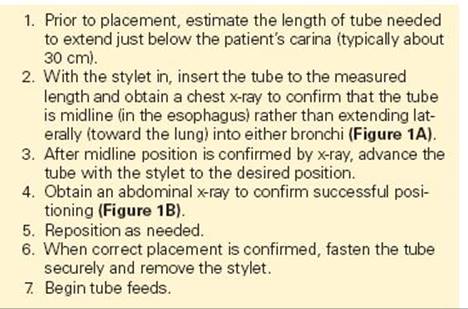

FIGURE 1 • Radiographs showing (A) initial insertion of the feeding tube into the distal esophagus to confirm midline positioning beyond the carina and (B) advancement of the feeding tube into a postpyloric position.
No evidence exists for a mortality benefit with postpyloric feeds rather than gastric feeds. Most studies have also failed to show a significant difference in the rate of ventilator-associated pneumonia with postpyloric feeds, although lower rates of regurgitation and aspiration have been seen. Given these concerns over the risk of aspiration with gastric feeds, some providers suggest that critically ill patients at high risk of aspiration should preferentially be fed via a postpyloric route, especially if showing signs of intolerance to gastric feeds. However, gastric feeds can still be used safely in the majority of patients.
Monitoring of Enteral Feeding: One way to monitor the tolerance of gastric feeds and possible risk of aspiration is to measure gastric residual volumes, which can be checked approximately every 6 hours and are considered acceptable when less than approximately 200 to 300 mL (exact values vary by institution). Repeated high gastric residuals should encourage the transition to postpyloric feeding, although repeatedly holding tube feeds when gastric residuals are high in the absence of any clinical signs of feeding intolerance is discouraged.
A common problem in the ICU patient receiving enteral feeds is the frequent stopping of enteral feeds for frequent, often daily, trips to the operating room or to diagnostic testing. Tube feeds at an hourly goal rate cannot provide full nutrition when they are routinely infusing for only a small portion of each 24-hour period. If these patients are already intubated or have a tracheostomy in place, the need for anesthesia induction for intubation is precluded and tube feeds can therefore safely be left running during these periods in order to maximize nutritional support. In the case of postpyloric feeding, the risk of aspiration even when induction of anesthesia is required is exceedingly low. Nutrition should therefore be continued during procedures or diagnostic testing whenever possible.
Enteral Nutrition in Specific Patient Population: Clinical scenarios do exist in which enteral nutrition must be avoided. For example, bowel perforation, bowel obstruction, and discontinuity of the gastrointestinal tract (i.e., damage control surgery) preclude enteral feeding. However, research is showing the number of these conditions is fewer than previously thought. In cases of acute pancreatitis, enterocutaneous fistulae, and the open abdomen, enteral nutrition now has been shown to be safe and even beneficial, in contrast to the historical teaching to avoid enteral feeds in these situations.
For acute pancreatitis, increasing evidence shows that early enteral nutrition improves outcomes. Gastric and jejunal feeds may even provide similar benefit, contrary to intuition that would suggest that gastric feeds would stimulate the pancreas and worsen the inflammatory response. For proximal enterocutaneous fistulae, enteral feeds can be provided distal to the fistula. For more distal fistulae, proximal enteral feeds can be given, and the length of small bowel present prior to the fistula will determine if enteral nutrition will be adequate. In these cases, as well as in cases of short gut syndrome, the addition of “supplemental” parenteral nutrition may be necessary.
Historically, enteral nutrition has also been delayed for several days until bowel function has returned (as marked by presence of bowel sounds, passage of flatus, etc.) after any gastrointestinal surgery. In the general ICU population, however, these signs are not necessarily reliable, and enteral nutrition should not be delayed based upon the lack of bowel sounds or passage of flatus and stool.
Finally, enteral nutrition should be avoided in patients with significant hemodynamic instability. In patients requiring vasopressor support or large-volume fluid or blood product resuscitation, enteral nutrition is typically withheld until the patient is more hemodynamically stable and fully resuscitated. Although ischemic bowl is a rare complication of enteral nutrition, theoretically enteral nutrition may require an increase in splanchnic blood flow requirement that cannot be supported in low cardiac output states. For this reason, hemodynamic instability has been considered a contraindication to early enteral feeding. However, enteral support is often provided to patients on stable low doses of vasopressors while watching carefully for any signs of intolerance.
Parenteral Nutrition
When early enteral nutrition is not possible, decision making depends on the patient’s nutritional status prior to admission to the ICU. No nutritional support is necessary for the first 7 days in previously healthy patients without evidence of malnutrition, after which parenteral nutrition should then be initiated. However, if patients have evidence of malnutrition prior to the episode of critical illness, parenteral nutrition should be initiated as soon as possible. Parenteral nutrition can be stopped once enteral nutrition has begun and is able to provide a majority of the patient’s energy requirements.
Parenteral nutrition can also be used to supplement enteral support in cases in which enteral support cannot meet a patient’s full caloric requirements after approximately 7 days. Maintaining at least a portion of patients’ nutritional support via the enteral route is important, as even “trickle” or “trophic” feeds (usually considered 10 to 30 mL/h) may be beneficial in maintaining the intestinal brush border and preventing mucosal atrophy.
Parenteral nutrition requires adequate venous access. Peripheral parenteral nutrition (PPN) is a lower osmolality solution that can safely be given through a peripheral vein, although it is rarely able to provide full nutritional support. PPN is often used as a bridge until full enteral support can be achieved or adequate venous access is obtained for central parenteral nutrition (CPN). CPN consists of a high osmolality solution that can provide full nutrition but must be given through a central venous line.
Several approaches can help decrease line sepsis when using parenteral nutrition. Lines should be placed in a standardized fashion using a checklist to ensure adherence to best practices for sterility. A peripherally inserted central catheter or a single lumen central line is preferred over the use of any multiple lumen catheters because of the lower risk of line sepsis. The subclavian vein is preferred (vs. internal jugular or femoral) given its lower rate of infection. The central line should be a new line inserted with a fresh stick rather than changed over a guide wire at a preexisting central line site. Ideally, the central line should be limited to provision of parenteral nutrition (“dedicated”) without any other use (i.e., blood draws or medication administration).
Presentation Continued
After a long course in the SICU, this patient was slowly weaning from mechanical ventilation. His prealbumin was measured to be 25 (normal range, 18 to 38). His nitrogen balance was calculated to be positive. A metabolic cart was completed, and his respiratory quotient (RQ) was 1.1. His tube feeds were adjusted appropriately. His glycemic control, initially maintained with an insulin drip, was converted to a subcutaneous regimen.
Calculating Nutritional Requirements
Energy requirements vary based on the clinical situation, but a general estimate is 25 to 30 kcal/kg/d. Higher energy requirements can be seen in patients with burns, sepsis, and multisystem trauma. Energy requirements can also be calculated using published predictive equations such as the Harris-Benedict equation (Table 2), which gives a measure of resting energy expenditure (REE) that can then be adjusted by an activity or a stress factor to calculate total daily energy expenditure (Table 3). Finally, indirect calorimetry can also be used. Indirect calorimetry uses a “metabolic cart” to measure the amount of oxygen consumed and carbon dioxide eliminated in order to calculate a patient’s actual (as opposed to predicted) REE. In order to maintain accuracy, indirect calorimetry is typically limited to patients who are on mechanical ventilation and who are at a relatively steady state.
TABLE 2. Useful Formulas

UUN = urine urea nitrogen
TABLE 3. Approximate Stress Factor Multipliers for REE

Carbohydrates, protein, and fat provide 4, 4, and 9 kcal/g, respectively. Ethanol provides 7 kcal/g. In clinical settings, dextrose, with 3.4 kcal/kg, should typically be used rather than carbohydrate in calculations. For parenteral nutrition, 10% and 20% lipid solutions contain 1.1 and 2 kcal/mL, respectively. In the ICU setting, infusions of propofol also provide significant calories that must be considered (1.1 kcal/mL) (Table 2). In general, approximately 60% of calories should come from carbohydrate, 25% to 30% from fat, and 10% to 15% from protein. Protein seems to be the nutrient most important for wound healing, immune function, and preventing the loss of lean body mass. Critically ill patients are therefore often given additional protein based upon either simple equations (estimating 1 to 2 g/kg/d of protein need) or by calculating their actual nitrogen balance (see example in Table 4).
TABLE 4. Sample Calculations

CPN = central parenteral nutrition
Monitoring Adequacy of Nutritional Support
The concept of nitrogen balance is based on the balance between anabolism and catabolism. Providing nutritional support to the critically ill patient is meant to shift this balance to the anabolic state so that the patient’s protein does not need to be utilized for gluconeogenesis (catabolism). The ideal state of positive nitrogen balance is then a greater intake of nitrogen than excretion of nitrogen, while a negative nitrogen balance is to be avoided. Nitrogen balance is calculated by subtracting total nitrogen losses (urine, stool, insensible losses) from nitrogen intake (Table 2). Nitrogen intake is calculated based on 6.25 g of protein containing 1 g of nitrogen, while nitrogen losses are estimated by measuring a 24-hour urine urea nitrogen (UUN) and adding an estimate of stool and insensible losses.
Adequacy of nutrition can also be estimated using the respiratory quotient (RQ), which is calculated via indirect calorimetry. The RQ is the ratio of carbon dioxide produced to oxygen consumed. Each of the major nutrients has a unique RQ: protein (RQ = 0.8), fat (RQ = 0.7), and carbohydrates (RQ = 1.0). Pure carbohydrate metabolism therefore has an RQ of 1.0, while pure fat oxidation has an RQ of 0.7. The ideal RQ on an individual patient is approximately 0.8. An RQ under 0.7 represents underfeeding with resulting lipolysis and ketosis. An RQ over 1.0 represents overfeeding (Table 2).
Reassessment of the adequacy of nutritional support in meeting requirements should be done at regular intervals. In addition to indirect calorimetry and the other methods mentioned, a number of laboratory values also serve as markers of adequate nutrition. Albumin and transferrin levels have half-lives of approximately 20 and 10 days and so do not serve as ideal markers of changes made in the short term. Prealbumin is a more useful marker with its shorter half-life of about 2 days. Retinol-binding protein is a relatively new marker with an even shorter half-life of about 12 hours. Unfortunately, however, each of these markers also reflects the acute phase response to critical illness and therefore may not accurately reflect nutritional status in the ICU setting.
Critically ill patients should have their glucose levels monitored closely. Strict glucose control, keeping glucose levels 80 to 110 mg/dL, was accepted as the standard of care after one large trial showed reduced sepsis, reduced ICU length of stay, and lower hospital mortality with strict control compared to “conventional” therapy (keeping glucose levels <200 mg/dL). However, more recently, another large trial has brought this practice into question after showing increased mortality in patients receiving strict glucose control compared to a more lenient approach (keeping glucose levels <180 mg/dL), thought to be due to a difference in episodes of hypoglycemia. Many institutions have now relaxed their goal for glucose control to approximately 100 to 150 mg/dL, although these targets may be different for specific patient populations (i.e., cardiac surgery) and change frequently with newly emerging research.
Overfeeding and Refeeding Syndrome
Overfeeding patients in the critical care setting should be avoided with the same vigilance that underfeeding is avoided. Overfeeding can cause harmful metabolic consequences, including hyperglycemia and hypertriglyceridemia. In addition, overfeeding can have deleterious effects on weaning from mechanical ventilation by burdening the patient with an extra load of carbon dioxide that must be expired. This diagnosis must be considered and ruled out in any patient who does not have another more obvious cause for failure to wean.
When initiating nutritional support in the critically ill, the critical care team must avoid the risk of refeeding syndrome. This condition typically occurs when the sudden introduction of nutrition in a relatively malnourished patient stimulates the release of insulin, causing phosphate, potassium and magnesium to shift intracellularly. The diagnosis is made when hypophosphatemia, hypokalemia, and hypomagnesemia are discovered after initiation of nutritional support in at-risk patients, such as those with prolonged malnutrition, excessive gastrointestinal losses, chronic alcohol abuse, metastatic cancer, and recent abdominal surgery, all of which lead to depletion of the above electrolytes. Refeeding syndrome can result in generalized muscle weakness and difficulty in weaning the patient from mechanical ventilation due to the depletion of ATP stores resulting from hypophosphatemia. The condition can be avoided by slowly reintroducing nutrition in patients at high risk of developing the syndrome.
Immunonutrition
More recently, the focus has shifted from nutritional support to nutritional therapy as a way to augment the immune system and dampen the systemic inflammatory response. In high-risk patients, immune-modulating enteral feeds containing supplements such as arginine, glutamine, omega-3 fatty acids and antioxidants such as selenium, vitamin C, and vitamin E have been studied. Additional research is needed regarding each of these individual additives, but immune-modulating formulas appear to have a variety of clinical benefits in the critically ill.
Case Conclusion
After weaning from mechanical ventilation, this patient was transferred from the ICU to the regular care floor. His tube feeds were continued while he regained swallowing function with the help of speech and language pathologists. He was able to support his nutrition with an oral diet before transfer to a rehabilitation facility.
Conclusion
The importance of appropriate nutritional support in the critically ill cannot be overemphasized. Failure to provide adequate nutrition has been shown to increase morbidity and mortality in the ICU. Appropriate nutritional support in the critically ill limits the inflammatory response and decreases the rate of ICU complications.
TAKE HOME POINTS
· Early nutrition is beneficial in critically ill patients.
· Enteral nutrition is preferable to parenteral nutrition whenever possible.
· Consider risks of gastric versus postpyloric feeding.
· Overfeeding should be avoided as much as underfeeding.
· Use objective data (i.e., laboratory values, nitrogen balance, and indirect calorimetry) to guide changes in nutritional support.
SUGGESTED READINGS
Al-Omran M, Albalawi ZH, Tashkandi MF, et al. Enteral versus parenteral nutrition for acute pancreatitis. Cochrane Database Syst Rev. 2010;(1):CD002837.
Finfer S, Chittock DR, Su SY, et al. Intensive versus conventional glucose control in critically ill patients. N Engl J Med. 2009;360(13):1283–1297.
Gramlich L, Kichian K, Pinilla J, et al. Does enteral nutrition compared to parenteral nutrition result in better outcomes in critically ill adult patients? A systematic review of the literature. Nutrition. 2004;20(10):843–848.
Marderstein EL, Simmons RL, Ochoa JB. Patient safety: effect of institutional protocols on adverse events related to feeding tube placement in the critically ill. J Am Coll Surg. 2004;199(1):39–47; discussion 47–50.
McClave SA, Martindale RG, Vanek VW, et al. Guidelines for the provision and assessment of nutrition support therapy in the adult critically ill patient: Society of Critical Care Medicine (SCCM) and American Society for Parenteral and Enteral Nutrition (A.S.P.E.N.). JPEN J Parenter Enteral Nutr. 2009;33(3):277–316.
Mehanna HM, Moledina J, Travis J. Refeeding syndrome: what it is, and how to prevent and treat it. BMJ. 2008;336(7659):1495–1498.
Ziegler TR. Parenteral nutrition in the critically ill patient. N Engl J Med. 2009;361(11):1088–1097.