
John B. Ammori
Ronald P. Dematteo
Presentation
A 68-year-old, otherwise healthy man presents with early satiety and vague upper abdominal pain, which became progressively worse over the past several months. His symptoms are unrelieved by proton pump inhibitors and have worsened in the past 2 weeks prompting him to see his primary physician. His past medical history is significant for hypertension and hyperlipidemia controlled with medications. His surgical history is unremarkable. Review of systems is negative for any other symptoms. Vital signs are normal. Physical examination reveals an upper abdominal mass, no associated jaundice, and no generalized lymphadenopathy. Contrast-enhanced CT scan of the abdomen and pelvis demonstrates a large, heterogeneous, partially necrotic left upper-quadrant mass inseparable from the gastric fundus (Figure 1). There is no radiographic evidence of metastatic disease.
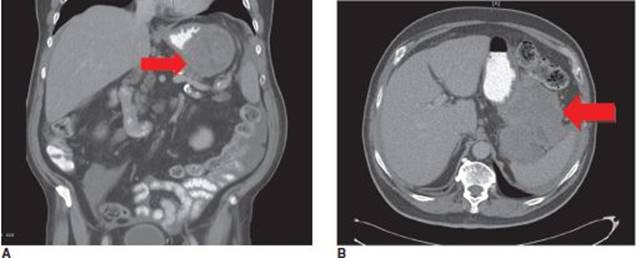
FIGURE 1 • CT scan demonstrating a large, heterogeneous, partially necrotic left upper-quadrant mass inseparable from the gastric fundus. Also note reactive perisplenic fluid.
Differential Diagnosis
The differential diagnosis of a gastric mass includes gastric adenocarcinoma, gastrointestinal stromal tumor (GIST), leiomyosarcoma, leiomyoma, gastric lymphoma, and neuroendocrine tumor. Given the large size of the mass, its exophytic nature, and lack of intraabdominal metastatic disease in this case, gastric adenocarcinoma and neuroendocrine tumor are unlikely to be the diagnosis. Gastric lymphoma is an unlikely diagnosis since there was no lymphadenopathy on clinical and radiologic examination. Leiomyomas are homogenous and usually well marginated, making this diagnosis unlikely in this case. The most likely diagnoses in a patient presenting with a large, necrotic exophytic gastric mass are GIST and leiomyosarcoma.
Workup
Esophagogastroduodenoscopy (EGD) demonstrates a submucosal mass in the gastric body. Biopsy of the mucosa overlying the mass revealed no pathologic abnormality. Endoscopic ultrasound (EUS) showed a large heterogeneous mass contiguous with the gastric wall without perigastric lymphadenopathy. Fine needle aspiration (FNA) biopsy showed spindle cells; immunohistochemistry was not performed.
As in this case, endoscopic biopsies are often unable to make diagnosis because the mass is submucosal. If the tumor has eroded into the gastric mucosa and caused bleeding, biopsy may yield a diagnosis. EUS is not mandatory in the workup of these tumors, but it can be useful in assessing the extent of disease is some cases. In a patient with a resectable tumor who is fit for surgery, FNA is not necessary. Biopsy of GIST may lead to complications, such as hemorrhage or tumor rupture, which may lead to tumor dissemination. FNA, or core needle biopsy, is useful for patients with the following indications: (1) metastatic or unresectable disease; (2) when neoadjuvant therapy is considered; or (3) if lymphoma is strongly suspected. Good quality cross-sectional imaging of the abdomen and pelvis is crucial to evaluate local and distant extent of disease. The typical imaging finding is a large, hypervascular, exophytic, heterogeneous mass, often with central necrosis. The liver and peritoneum are the most common metastasic sites and must be carefully evaluated.
Diagnosis and Treatment
Approximately 3,000 GISTs are diagnosed each year in the United States. The stomach is the most common primary site of GIST. Sixty percent of tumors arise from the stomach, while 30% arise in the small intestine. Less common sites include the duodenum and rectum, accounting for approximately 5% each.
The clinical presentation of GIST depends on both its size and location. Nearly 30% of GISTs are asymptomatic and discovered incidentally. Symptoms generally result from mass effect of these extraluminal masses. They are usually nonspecific symptoms such as nausea, emesis, early satiety, abdominal distension, or pain. The median size of GIST in symptomatic patients is approximately 9 cm compared with nearly 3 cm in asymptomatic patients. Patients may also present with microcytic anemia due to subclinical gastrointestinal bleeding into the gastrointestinal tract lumen. Some patients with GIST manifest significant bleeding due to erosion into the gastrointestinal tract or intraperitoneal tumor rupture.
GISTs have three histologic patterns: spindle cell type (70%), epitheloid cell type (20%), and mixed (10%). The definitive diagnosis of GIST is made by immunohistochemical expression of the KIT receptor tyrosine kinase (CD117 antigen). Approximately 95% of GISTs are positive for KIT expression. Approximately 80% of KIT-negative GISTs have a mutation in the platelet-derived growth factor receptor alpha (PDGFRA). The most frequent site of KIT mutation is exon 11 (70%), followed by exon 9 (10%), and exons 13 and 17 (rare). GISTs with an exon 9 mutation have a poorer clinical course compared to those with an exon 11 mutation.
Surgery is the mainstay of treatment for resectable GIST. The goal is a margin negative resection. Segmental resection of the organ from which the tumor originates is adequate. For example, if it is anatomically feasible, segmental gastric resection is appropriate as opposed to formal gastrectomy. When the tumor is adherent to contiguous organs, en bloc resection to attain negative surgical margins should be performed. There is no role for routine lymphadenectomy since metastases to lymph nodes are extremely rare. However, if regional lymph nodes are suspicious for metastatic disease, lymphadenectomy should be performed.
Imatinib is the mainstay of adjuvant therapy for GIST. Imatinib is a targeted tyrosine kinase inhibitor that competitively inhibits KIT. Approximately 60% of patients have a partial response and 25% have disease stability. Tumors with KIT exon 11 mutations are more sensitive to imatinib therapy than tumors with KIT exon 9 mutations, with approximately 75% achieving a partial response compared to 45%, respectively. Imatinib is first-line therapy for metastatic GIST. The role of adjuvant imatinib following complete resection has been studied in a randomized, phase III, double-blind, placebo-controlled multicenter trial. One-year recurrence-free survival was significantly improved in patients treated with adjuvant imatinib for 1 year after resection (98% vs. 83%, P < 0.001). The rate of recurrence increased 6 months following the completion of imatinib therapy. Trials are currently underway assessing longer courses of adjuvant therapy. Neoadjuvant imatinib should be considered in clinical situations in which downsizing of the tumor would assist in achieving negative resection margins, such as large tumors that may require adjacent organ resection. Preoperative therapy may also be beneficial for tumors in surgically difficult locations such as the gastroesophageal junction, duodenum, and rectum. The tumor is reassessed with cross-sectional imaging and surgery is often performed after 6 months of treatment.
CT scan can be used to assess response to imatinib. Tumors do not decrease substantially in size, but instead the tumor appearance changes from hypervascular to hypoattenuating, homogeneous, and cystic (Figure 2). Primary resistance to imatinib therapy is seen in 15% of tumors. Secondary resistance to imatinib often occurs after approximately 18 months of therapy, often due to additional mutations in the KIT gene. CT scan will demonstrate a new solid enhancing focus within a responding mass (Figure 2). Patients who develop resistance to imatinib may respond to second-line sunitinib therapy.

FIGURE 2 • CT imaging of imatinib response and secondary resistance. A: Characteristic hypoattenuating, homogeneous, and cystic appearance of tumor indicating response to imatinib. B: New solid enhancing foci (arrows) within a responding mass indicating secondary resistance to imatinib.
Liver and peritoneum are the most likely sites of metastatic disease. The three major factors predicting metastases following resection are primary site, size, and mitotic rate (Table 1). Standard treatment for metastatic disease is imatinib. There are three main indications for cytoreductive surgery in metastatic or recurrent GIST. These are (1) emergencies such as hemorrhage, bowel perforation, or obstruction; (2) resectable disease that is stable or responsive to imatinib; and (3) focal progression defined as the development of secondary drug resistance to imatinib in one or a few sites, while other sites of disease remain stable. In the latter case, one may consider resecting only the drug resistant tumors if complete resection is not possible. Cytoreductive surgery is generally not indicated for debulking unresectable progressive disease or diffuse progression defined as multiple sites of progressive disease.
TABLE 1. Risk Factors for Recurrence of GIST Based on Mitotic Rate, Tumor Size, and Site of Origin

HPFs, high power fields.
Adapted from Miettinen M, Lasota J. Gastrointestinal stromal tumors: pathology and prognosis at different sites. Semin Diagnostic Pathol. 2006;23:70.
Surgical Approach
Complete surgical resection with negative microscopic margins is the treatment of choice for resectable tumors without evidence of metastasis. Segmental resection of the stomach or small intestine is appropriate. Formal gastrectomy for wider clearance of uninvolved tissue is unnecessary. Since lymph node metastases are rare, lymphadenectomy is unnecessary unless there is clinical suspicion of lymph node involvement. GISTs are often exophytic from the stomach or small bowel and can typically be lifted away from adjacent organs. Tumors with pedunculated or limited attachment can often be resected with a gastric wedge. Tumors with broad-based attachment that cannot be resected with a wedge generally require partial gastrectomy, typically with a Billroth II gastrojejunal reconstruction. Large lesions near the gastroesophageal junction may require total gastrectomy with roux-en-y esophagojejunostomy. Some tumors can densely adhere to surrounding organs requiring en bloc resection in order to achieve complete resection. In general, one may approach surgical resection of GIST by either an open or a laparoscopic approach depending on technical concerns as well as surgeon preference and experience.
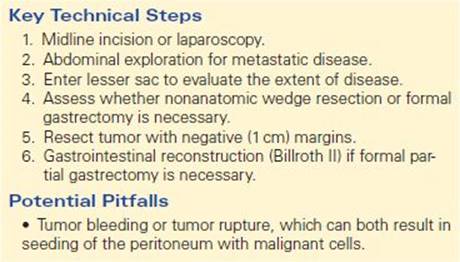
The key technical steps for resection of a gastric GIST are as follows (Table 2). The abdomen is explored, paying particular attention to the peritoneal surfaces and liver. The lesser sac is entered through the gastrocolic ligament. The tumor is identified. A partial gastrectomy is performed with 1-cm gross margins. This can usually be done with GIA stapling devices. Care should be taken to avoid narrowing the gastric lumen. If the tumor is located near the pylorus, incisura, or gastroesophageal junction, and a formal gastrectomy should be performed, as discussed above.
TABLE 2. Key Technical Steps and Potential Pitfalls
The patient in the case presented in this chapter underwent tumor resection using an open approach due to the large tumor size and the anticipated need for a complex resection. At laparotomy, initial exploration revealed no evidence of peritoneal or liver metastases. A large tumor arising from the greater curvature of the stomach was identified. It was densely adherent to the pancreatic tail and splenic hilum. A complete resection was achieved with an en bloc resection including wedge partial gastrectomy, splenectomy, and distal pancreatectomy.
Meticulous and careful intraoperative handling of GISTs is critical. These tumors are usually fragile with extensive necrosis or hemorrhage. If the pseudocapsule is torn, bleeding and tumor rupture may occur, increasing the risk of peritoneal recurrence.
Special Intraoperative Considerations
Metastatic disease may be discovered at exploration. If there is limited and resectable metastases, resection of all disease should be performed. This may require liver resection and resection of limited peritoneal disease.
Postoperative Management
As with all abdominal surgery, pain control, early ambulation and aggressive pulmonary toilet are crucial for postoperative recovery. Prophylaxis for deep venous thrombosis is achieved with sequential compression devices and/or subcutaneous heparin. Nasogastric tube decompression is at the discretion of the surgeon. Diet is advanced as the patient tolerates. Surgery-specific complications include postoperative surgical site infections, bleeding, and gastric leak. Surgical site infections are the most common complication, ranging from wound cellulitis to organ space infections. Postoperative bleeding is a rare complication that may occur early in the postoperative period. Gastric or enteric leak is rare and usually presents approximately 1 week postoperatively. These can often be controlled with percutaneous drainage and antibiotics, but reoperation is necessary for free intraperitoneal leaks. Long-term follow-up after full postoperative recovery includes history and physical as well as CT scan every 3 to 6 months for 3 to 5 years and annually thereafter. Patients with low-risk tumors can be managed with less frequent follow-up.
The patient in the case presented in this chapter recovered well without surgical complication. He is taking adjuvant imatinib and is without recurrence 9 months following surgery.
TAKE HOME POINTS
· GIST is the most common mesenchymal tumor of the gastrointestinal tract.
· Characterized by expression of the KIT receptor tyrosine kinase
· May present with nonspecific symptoms or with gastrointestinal hemorrhage
· Tumors are exophytic, and often necrotic and hemorrhagic. Endoscopy shows a submucosal mass, occasionally with an overlying ulcer.
· Surgery with negative margins is the mainstay of treatment for nonmetastatic GIST.
· Patients at high risk for recurrence should receive adjuvant imatinib for at least 1 year.
· Imatinib is the treatment of choice for metastatic GIST. Treatment should be continued until secondary resistance develops.
· Surgery plays a role in selected patients with resectable metastatic disease that is stable or responsive to imatinib and in selected patients with focal progression.
SUGGESTED READINGS
Dematteo RP, Ballman KV, Antonescu CR, et al. Adjuvant imatinib mesylate after resection of localised, primary gastrointestinal stromal tumour: a randomised, double-blind, placebo-controlled trial. Lancet. 2009;373:1097–1104.
Demetri GD, von Mehren M, Antonescu CR, et al. NCCN Task Force report: update on the management of patients with gastrointestinal stromal tumors. J Natl Compr Canc Netw. 2010;8(suppl 2):S1–S41; quiz S2–S4.
Gold JS, Gonen M, Gutierrez A, et al. Development and validation of a prognostic nomogram for recurrence-free survival after complete surgical resection of localised primary gastrointestinal stromal tumour: a retrospective analysis. Lancet Oncol. 2009;10:1045–1052.
Miettinen M, Lasota J. Gastrointestinal stromal tumors: pathology and prognosis at different sites. Semin Diagn Pathol. 2006;23:70–83.
van der Zwan SM, DeMatteo RP. Gastrointestinal stromal tumor: 5 years later. Cancer. 2005;104:1781–1788.
Zalinski S, Palavecino M, Abdalla EK. Hepatic resection for gastrointestinal stromal tumor liver metastases. Hematol Oncol Clin North Am. 2009;23:115–127, ix.