
Sajid A. Khan
Jeffrey B. Matthews
Presentation
A 43-year-old female presents with a 6-year history of progressively worsening upper abdominal pain, steatorrhea, and weight loss. She reports a history of chronic pancreatitis associated with heavy alcohol use in her 30s, although she has been abstinent for at least 2 years. Steatorrhea and weight loss have stabilized with encapsulated pancreatic enzyme therapy. Despite daily propoxyphene, her pain persists, interfering with work and other activities. She has insulin-dependent diabetes mellitus and smokes a half pack per day. There is no family history of pancreatic disease. She is thin but not cachectic, with no other significant physical findings.
Differential Diagnosis
Although the differential diagnosis for upper abdominal pain is broad, the chronic unrelenting nature of the pain, the presence of steatorrhea, and the association with heavy alcohol use narrows the diagnosis. The surgeon must consider disorders other than chronic pancreatitis that induce chronic pain, particularly those that often coexist with alcohol and tobacco abuse. These include peptic ulcer disease, hepatitis, and biliary tract disorders. Complications of chronic pancreatitis such as pseudocyst formation and pancreatic cancer must be considered. Symptoms secondary to duodenal or biliary obstruction due to chronic inflammation and fibrosis may occur. Chronic narcotic use may lead to dependency and drug-seeking behavior, as well as chronic constipation.
Workup
Chronic pancreatitis is an inflammatory disease characterized by progressive and irreversible destruction of gland parenchyma. Although excess alcohol consumption is the most common risk factor, chronic pancreatitis may also be associated with autoimmune disorders, pancreatic duct outflow obstruction due to traumatic stricture or pancreas divisum, and micronutrient deficiency (tropical pancreatitis). An estimated 20% to 30% of cases are hereditary or idiopathic. Hereditary pancreatitis is an autosomal dominant disorder often associated with germline mutations in the trypsinogen gene PRSS1 and is estimated to increase the risk 15-fold for developing pancreatic adenocarcinoma. An increasing number of cases of otherwise idiopathic chronic pancreatitis have been linked to genetic variants in the cystic fibrosis gene CFTR, the protease inhibitor SPINK1, and chymotrypsin C.
There are several prevailing theories for the cause of pain. In some cases, an obstructed main pancreatic duct by stricture or stone is thought to increase intraductal pressure, causing pain and upstream ductal dilatation. In the so-called large duct disease, operations that achieve ductal decompression may be indicated. In other cases, it is thought that repeated inflammatory insults damage intrapancreatic and retroperitoneal sensory nerve pathways. Inflammation and calcification are often most pronounced in the pancreatic head and uncinate process. Pancreatic resection of this dominant disease focus may remove the “motor” of chronic inflammation, interrupting nociceptive signaling.
The pain of chronic pancreatitis typically presents as recurrent acute exacerbations of moderate to severe pain interspersed with periods of relative quiescence, but some patients experience persistent severe pain that causes significant incapacitation. Understanding the individual pattern of pain and the extent of chronic disability is important to selection of therapy. Current and past use of alcohol and tobacco should be documented. Some patients report pain that is more postprandial than steady, associated with gaseous distention, and localized in the midabdomen rather than the back or epigastrium. This type of pain may occur without overt steatorrhea and may be improved by pancreatic enzyme supplementation. Medical therapy with analgesics should be documented, and psychosocial support assessed. Endocrine insufficiency often occurs late in the course of the disease, usually many years after exocrine insufficiency.
Visualization of organ morphology, ductal anatomy, and possible involvement of surrounding structures is essential. The most useful initial imaging study is a triphasic IV contrast-enhanced computed tomography (CT) with 2- to 3-mm slices. Key findings include areas of pancreatic ductal dilation, calcifications, focal areas of acute inflammation, dominant masses suspicious for neoplasia, dilation of the extrahepatic biliary tree, and complications such as pseudocyst or duodenal obstruction. This pancreas protocol CT may also show vascular complications such as splenic vein thrombosis.
Further detail of ductal anatomy may be visualized by endoscopic or magnetic resonance cholangiopancreatography (ERCP or MRCP) to identify main pancreatic duct strictures and intraductal stones, bile duct stricture, ductal communication with pseudocysts, and anatomic variations such as pancreas divisum. MRCP is generally preferred because it is noninvasive and avoids radiation exposure. Endoscopic ultrasound is useful to evaluate early disease and cystic lesions, and in tissue sampling for suspected neoplasia. In general, ERCP for diagnostic purposes should be avoided. Endotherapy may be selectively appropriate to achieve pancreatic or biliary decompression, dilate strictures, remove stones, or drain pseudocysts.
In the present patient, MRCP revealed a diffusely dilated main pancreatic duct with multiple intraluminal filling defects consistent with pancreatic duct stones (Figure 1).
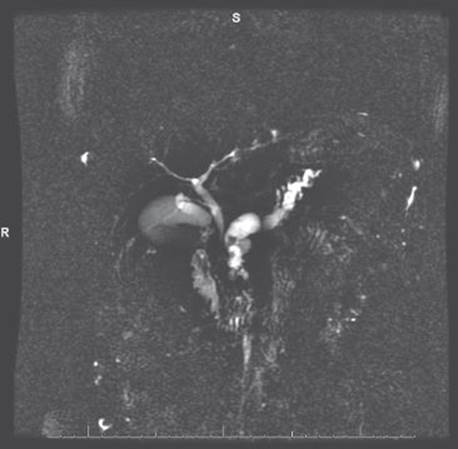
FIGURE 1 • MRCP showing dilation of main pancreatic duct.
Diagnosis and Treatment
The most common indication for surgery is intractable pain. However, surgery is occasionally indicated to address pseudocyst, pancreatic ascites, bile duct or duodenal obstruction, or suspicion of neoplasia. Because the true basis of pain is often uncertain and the natural history of chronic pancreatitis is unpredictable, patients should be counseled that surgery provides long-term complete relief of symptoms in only approximately 85% of patients.
An operative strategy that drains the pancreatic duct system or resects the dominant focus of inflammation is more effective than therapy directed at interrupting the neural pathways. Celiac ganglion blocks and video-assisted thoracic splanchnicectomy only provide temporary pain relief. Pain recurrence within 3 to 6 months is common with such procedures, and they are recommended only as a bridge to more definitive therapy.
The choice of operation should be tailored to the individual anatomic circumstances and the most likely source of pain. Wherever possible, pancreatic parenchyma should be preserved to limit loss of endocrine and exocrine function. Significant ductal dilation and a dominant inflammatory mass are the two most important anatomic features that dictate the best choice of operation. Other important factors include symptomatic biliary or duodenal obstruction, pseudocyst, and mesenteroportal/splenic vein thrombosis.
Surgical Approach
Lateral Roux-en-Y Pancreaticojejunostomy (Puestow-type Procedure)
This drainage procedure is ideal to relieve pain associated with a pancreatic duct dilated ≥10 mm (Table 1). A bilateral subcostal or midline laparotomy incision is used and the lesser sac is entered by separating the greater omentum from the transverse mesocolon. Adhesions between the posterior wall of the stomach and the chronically inflamed pancreas are taken down to widely expose the anterior surface of the pancreas. A generous Kocher maneuver to the level of the superior mesenteric vein (SMV) elevates and exposes the pancreatic head.
TABLE 1. Key Technical Steps and Potential Pitfalls
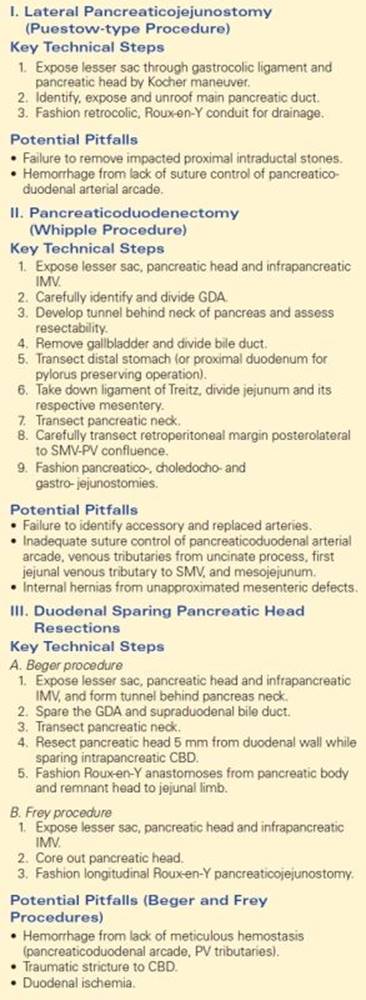
The main pancreatic ductal system is usually readily identifiable by palpation and an 18G needle (location confirmed when clear fluid is aspirated), although occasionally intraoperative ultrasound is useful. Cautery through the parenchyma overlying the needle widens initial access to the duct lumen, and then a right-angled clamp into the duct guides further unroofing, first toward the tail and then toward the ampulla. Intraductal stones are usually easily removed although occasionally they are deeply impacted within the head and uncinate process. It is not necessary to remove all stones provided that proximal drainage is achieved. The duct should be opened to within 2 cm of the tip of the tail. In the head of the gland, both the dorsal and ventral duct systems are unroofed to within 1 to 2 cm of the duodenal wall. This usually requires suture control of the anterior branches of the pancreaticoduodenal arterial arcade.
A Roux-en-Y conduit is used for drainage. The jejunum is divided 20 cm distal to the ligament of Treitz using a 3.8-mm gastrointestinal (GIA) stapler. The limb should be at least 50 cm, and a stapled or hand-sewn side-to-side enteroenterostomy is performed. The Roux limb is advanced through the mesocolon to the right of the middle colic vessels and usually oriented with its proximal (stapled) end toward the pancreatic tail, although the reverse orientation may be used depending upon mesenteric flexibility. An enterotomy slightly smaller than the length of the pancreatic duct is made on the antimesenteric aspect. A single-layer, continuous, side-to-side anastomosis is then fashioned using double-armed absorbable monofilament suture. The jejunal sutures are full thickness or seromuscular; the pancreatic sutures should reach the duct lumen where possible but otherwise should include generous portions of fibrotic pancreatic capsule (Figure 2).
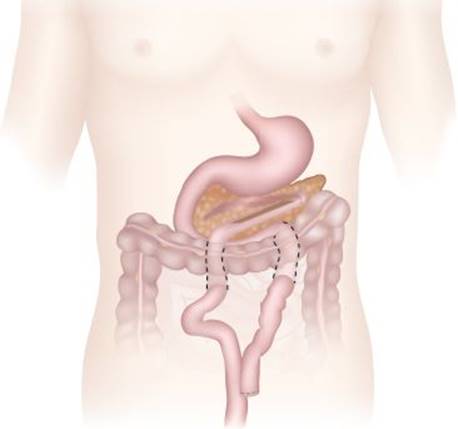
FIGURE 2 • A lateral Roux-en-Y retrocolic pancreaticojejunostomy.
Pancreaticoduodenectomy (Whipple Procedure)
Pancreaticoduodenectomy (PD) may be indicated in patients in whom inflammation and calcification are concentrated within the head and uncinate process (with or without upstream dilation of the main pancreatic duct), when there is a focal mass suspicious for neoplasm, or when there is biliary and/or duodenal obstruction. This procedure may include a distal gastrectomy (“classic” Whipple PD) or pyloric preservation (PPPD).
A midline or bilateral subcostal incision is used and a generous Kocher extended to mobilize the hepatic flexure. A cholecystectomy is performed, and the common bile duct is isolated at its insertion to the cystic duct. The gastroduodenal artery (GDA) is isolated and its identity confirmed by a persistent pulsation in the common hepatic artery after compression. An accessory or replaced right hepatic artery, if present, is usually palpable at the posterior aspect of the gastrohepatic ligament at the foramen of Winslow and should be preserved. The GDA is divided and underlying portal vein (PV) identified. A tunnel posterior to the neck of the pancreas is started. The lesser sac is entered via the gastrocolic ligament in an avascular plane, the right gastroepiploic vein is divided, and infrapancreatic SMV exposed. The tunnel behind the neck of the pancreas is completed, and a Penrose drain or umbilical tape is passed through it for traction. Once resectability has been assured, the bile duct is divided just proximal to the cystic duct insertion (if there is extrahepatic biliary dilation) or just distal to it (if there is not). The stomach is divided between two firings of a 4.8-mm GIA 60 stapler, starting from the greater curve near the junction of the right and left gastroepiploic arcades and ending at the lesser curve just proximal to the incisura angularis. The lesser omentum is divided, including the right gastric artery. The ligament of Treitz is taken down, the jejunum divided with a 3.8-mm GIA 60 stapler 20 cm distally, and the proximal mesojejunum and mesoduodenum are divided. The proximal jejunum is then advanced into the supracolic compartment by passing it posterior to the superior mesenteric vessels. Electrocautery divides the pancreatic neck between stay sutures. Resection is completed by carefully dividing small tributaries of the PV from the uncinate process and retroperitoneal tissues posteriorly.
The jejunum at the distal staple line is advanced through the transverse mesocolon to the right of the middle colic vessels. A number of acceptable techniques for pancreaticojejunostomy have been described, including a two-layered invaginating technique and a pancreatic duct-to-mucosa anastomosis with or without exteriorized transanastomotic stenting. Biliary–enteric continuity is restored by an end-to-side single layer interrupted or continuous anastomosis. Gastrojejunostomy is usually performed hand-sewn in two-layer fashion, with the afferent limb oriented toward the lesser curve.
Other Operations for Chronic Pancreatitis
PD carries significant postoperative morbidity and long-term digestive consequences even when performed by experienced surgeons. Duodenumsparing pancreatic head resection (DSPHR) may be a safe and effective alternative for some patients and is indeed the preferred approach in many European centers. The Beger procedure has been advocated for patients with an inflammatory pancreatic head mass. In this form of DSPHR, after a generous Kocher, a tunnel between the neck of the pancreas and the PV is developed as in a standard PD. However, the GDA and supraduodenal bile duct are spared. The neck is transected, the head retracted laterally, and tributaries to the PV controlled. The pancreatic head is resected 5 mm off the duodenal wall down to but sparing the intrapancreatic common bile duct. A Roux-en-Y pancreaticojejunostomy is fashioned to the left side of the pancreas (body and tail) and then tacked over the right-sided pancreatic head excavation. A modification of this approach (Berne variant) involves coring out the pancreatic head without formal transection of the neck. Patients with a dominant inflammatory focus in the pancreatic head and dilated main pancreatic duct may benefit from a Frey procedure that combines coring out of the pancreas head with longitudinal Roux-en-Y pancreaticojejunostomy.
Patients with hereditary chronic pancreatitis syndromes or who have failed previous operations may be candidates for total (or completion) pancreatectomy with or without autologous islet cell transplantation (AIT). AIT entails collagenase-based digestion of the resected pancreas followed by isolation of intact islets for infusion into the PV. This approach has been reported by several experienced centers, although indications and timing are somewhat controversial. Pain is durably relieved in approximately 70% of patients, and about 40% of patients will initially require no postoperative insulin therapy.
Outcomes of Operations for Chronic Pancreatitis
Comparison of surgical options for the treatment of chronic pancreatitis is hampered by the relative paucity of results from randomized, prospective clinical trials. Most reports include small numbers of patients, are nonrandomized, and are retrospective. There is no uniform method in reporting outcomes, and there is significant heterogeneity among patient populations and surgeon experience. Historically, PD has been viewed as the standard against which other procedures have been evaluated. In one review, PD was reported to achieve “pain relief” in 70% to 100% of patients. Comparison of various types of DSPHR to PD in several randomized trials has shown similar effectiveness with respect to pain relief, postoperative morbidity, new-onset postoperative diabetes, and quality of life. Comparisons between two variations of DSPHR (Beger vs. Frey procedures) have similarly shown no significant difference. Comparison between operative and endoscopic therapy for large duct chronic pancreatitis in randomized trials clearly indicates that surgical drainage is more effective than transampullary stenting and lithotripsy in terms of partial or complete pain relief and number of required procedures.
Postoperative Management
Postoperative management of patients with chronic pancreatitis should include attention to exacerbation of exocrine insufficiency (managed by pancreatic enzyme replacement therapy) and the development of endocrine insufficiency (initially managed by sliding scale insulin, and then adjusted with long-acting preparations as appropriate). Continued abstinence from alcohol and tobacco is important in prevention of symptomatic recurrence. Slow taper of narcotic analgesia is often required, and patients should be followed longitudinally for ongoing medical and psychosocial support.
Case Conclusion
The patient underwent Roux-en-Y lateral pancreaticojejunostomy for large duct disease without head predominance. She was discharged on postoperative day 5. She is currently 1 year from her operation, pain free, not requiring analgesics, and steatorrhea is controlled by pancreatic enzyme supplementation. She continues to be employed.
TAKE HOME POINTS
· Incapacitating pain is the most common reason for consideration of surgical therapy.
· IV contrast-enhanced CT should evaluate for pancreatic ductal dilation, dominant areas of inflammation and calcification, a focal mass suspicious for malignancy, and presence of complications such as pseudocyst or duodenal obstruction.
· Pancreatic duct anatomy and presence of areas of stricture or dilation should be delineated by MRCP or ERCP (if endotherapy or biopsy is indicated).
· The long-term goals for any of the operative approaches are pain relief and preservation of exocrine and endocrine function.
· The choice of operation should address anatomic abnormalities while preserving organ parenchyma, where possible.
· Treatment decisions should be tailored to individual clinical and anatomic circumstances as well as to the experience and preference of the surgeon.
SUGGESTED READINGS
Beger HG, Schlosser W, Friess HM, et al. Duodenum-preserving head resection in chronic pancreatitis changes the natural course of the disease. Ann Surg. 1999;230:512–523.
Cahen DL, Gouma DJ, Rauws EA, et al. Endoscopic versus surgical drainage of the pancreatic duct in chronic pancreatitis. N Engl J Med. 2007;356:676–684.
Diener MK, Rahbari NN, Fischer L, et al. Duodenum-preserving pancreatic head resection versus pancreaticoduodenectomy for surgical treatment of chronic pancreatitis. Ann Surg. 2008;247:950–961.
Schafer M, Mullhaupt B, Clavien P. Evidence-based pancreatic head resection for pancreatic cancer and chronic pancreatitis. Ann Surg. 2002;236:137–148.
Steer ML, Waxman I, Freedman S. Chronic pancreatitis. N Engl J Med. 1995;332:1482–1490.
Strate T, Taherpour Z, Bloechle C, et al. Long-term follow up of a randomized trial comparing the Beger and Frey procedures for patients suffering from chronic pancreatitis. Ann Surg. 2005;241:591–598.