
Scott E. Regenbogen
Presentation
A 53-year-old man presents to the emergency room with painless, bright red bleeding from the rectum. The bleeding is described as large volumes, occurring three times in the preceding 8 hours. His medical history includes hypertension and obesity. He takes a daily aspirin and occasional ibuprofen for back pain. He has never had a colonoscopy. He has no family history of colorectal cancer. His blood pressure is 90/55 and heart rate is 120 per minute. Abdominal exam is normal. There is blood in the rectal vault but no palpable mass.
Differential Diagnosis
Bright red rectal bleeding typically comes from the colon or the rectum, though in 10% to 15% of patients, brisk hematochezia results from upper gastrointestinal bleeding (UGIB), and another 10% to 15% originate in the small bowel. Diverticular hemorrhage is the most commonly identified source of major lower gastrointestinal bleeding (LGIB) in adults. Other common causes include inflammatory bowel disease and neoplasms, and in older adults, colonic angiodysplasia. In children and young adults, LGIB is most commonly caused by inflammatory bowel disease, Meckel’s diverticula, or benign polyps. Minor intermittent bleeding in any age group may be related to anorectal disease, such as hemorrhoids or fissures. Ischemic colitis should be considered in patients with atherosclerotic disease, dehydration, or other causes of restricted mesenteric perfusion.
Workup
After obtaining large-bore venous access, a sample for blood type and crossmatch is sent. In this patient, his hematocrit is 18%, and his coagulation studies are normal. Nasogastric tube aspirate is bilious, without blood. Anoscopy reveals small, nonbleeding hemorrhoids. He is admitted to the intensive care unit, and resuscitated with isotonic fluids and transfused with packed red blood cells. His blood pressure normalizes, and the bleeding seems to subside.
A bowel preparation is administered, and colonoscopy the following day reveals extensive diverticulosis (Figure 1) and dark blood in the descending and transverse colon. Later that evening, he has another large bloody bowel movement and becomes hypotensive. Again, his blood pressure improves after transfusion. Urgent mesenteric angiography is performed. There is evidence of atherosclerotic disease, but no active bleeding is identified (Figures 2Aand 2B).

FIGURE 1 • Colonoscopy in a patient with LGIB, revealing diverticulosis, but no source of active bleeding.

FIGURE 2 • Images from selective mesenteric angiogram revealing normal anatomy without evidence of active bleeding from the (A) superior mesenteric artery distribution and (B) inferior artery distribution.
Diagnosis and Treatment
Diverticular bleeding accounts for about half of acute LGIB hospitalizations in the United States, and an even greater share of cases among the elderly. Risk factors for bleeding among individuals with diverticulosis include systemic anticoagulation, hypertension, and use of nonsteroidal anti-inflammatory drugs or steroids. The bleeding can be massive and even life threatening, but it is often a diagnosis of exclusion, as the bleeding will cease spontaneously in 80% of cases, usually before the source can be identified. Recurrent bleeding will, however, occur in 15% to 30% of these patients.
Initial management is supportive, including close hemodynamic monitoring and, in appropriate cases, blood transfusion. Surgery is rarely required for management, except in cases with hemodynamic instability refractory to resuscitation and transfusion, or recurrent or ongoing bleeding that cannot be controlled by other means. When bleeding persists, all efforts should be made to localize the source, in an attempt to focus surgical resection and ensure that bleeding is indeed arising from the colon. A suggested algorithm for the evaluation of presumed diverticular LGIB is shown in Figure 3. Those with suspicion of UGIB (bloody nasogastric aspirate, history of peptic ulcer disease, recent NSAID use, cirrhosis, etc.) should undergo urgent upper endoscopy. Once an upper tract source has been excluded, the next test of choice may be either colonoscopy or angiography, depending on the patient’s condition, and institutional preference.

FIGURE 3 • A suggested algorithm for the evaluation and management of patients with acute LGIB presumed to be from bleeding colonic diverticula.
For patients with brisk ongoing bleeding, many advocate urgent angiography for localization and embolization. In some institutions, tagged red blood cell scan is used as a screening test, because of its higher sensitivity, to decide which patients will undergo angiography. If a bleeding source is found on angiography, selective therapeutic embolization is attempted. If successful, patients can undergo elective colonoscopy after the bleeding episode has resolved. Colon resection in this setting is not obligatory because <20% of embolization patients will develop mucosal ischemia in the devascularized colon. If bleeding cannot be controlled with embolization, the angiographer can leave a catheter in the bleeding vessel to facilitate localization at the time of surgery. In patients with recurrent intermittent bleeding and repeatedly negative angiograms, “provocative” angiography may be considered, using catheter-directed vasodilators, anticoagulants, or thrombolytics to reactivate a quiescent bleeding source. Provocative procedures should be performed only if urgent surgical intervention can be performed when needed.
Others advocate urgent colonoscopy for patients with ongoing bleeding, either with a “rapid-purge” bowel preparation with polyethylene glycol, or preparation by enema only. Rates of colonoscopy completion and of successful localization of bleeding in this setting vary widely in the literature. Some nonrandomized studies have suggested that urgent colonoscopy with endoscopic epinephrine injection, coagulation, and/or clipping reduces rates of rebleeding, as compared with delayed colonoscopy. The only randomized study on the topic (Green et al., 2005), however, found that urgent colonoscopy increased rates of localization, without reduction in mortality, length of stay, or need for surgical resection. In a hemodynamically stable patient, it is reasonable, therefore, to perform colonoscopy either promptly during the acute hospitalization, or electively after resolution of the bleeding episode. Regardless of timing, all patients with acute LGIB who have not had a recent complete colon evaluation should undergo colonoscopy to exclude neoplasm.
Despite all attempts, bleeding can be difficult to localize in patients with intermittent diverticular bleeding. Some patients may require surgery even in the absence of localization, due to repeated episodes of bleeding or acute hemodynamic instability. Because diverticulosis is most common in the sigmoid and descending colon, empiric left-sided resections were once advocated for such nonlocalized LGIB. However, segmental resection in the absence of a demonstrated source carries significantly greater risk of recurrent bleeding than total colectomy in this setting, and has fallen out of favor. Instead, when resection is required for unlocalized LGIB, total abdominal colectomy is recommended.
Presentation Continued
After angiography in our patient, his bleeding stops and the patient is transferred out of the intensive care unit. Two days later he has severe abdominal cramping, becomes hypotensive, and has a very large bloody bowel movement, associated with a 10% drop in hematocrit. Repeat angiography again fails to demonstrate a definite source of bleeding. He is persistently hypotensive, so with resuscitation ongoing, he is taken urgently to the operating room. Colonoscopy in the operating room reveals bright blood throughout the colon, but a discrete source cannot be identified.
Surgical Approach for Total Abdominal Colectomy
Patients with persistent unlocalized bleeding may require operation (Table 1). After adequate resuscitation and correction of coagulopathy, all efforts should again be made to localize bleeding in the operating room before undertaking resection. The patient should be positioned in the lithotomy or split-leg position to permit access to the anus for colonoscopy and/or anastomotic leak testing. Exploration and resection are typically performed through a midline laparotomy but, in a hemodynamically stable patient without prohibitive intra-abdominal adhesions, may be performed laparoscopically with or without hand assistance by surgeons with expertise in laparoscopic colon surgery. Trocar arrangements for total colectomy vary, but we favor the use of an umbilical trocar for the camera and dissecting ports in all four quadrants. When using a hand-assist technique, a hand port is placed in the suprapubic position, through a Pfannenstiel or a lower midline incision. The specimen can be extracted through the hand port incision, or through a suprapubic, periumbilical, or stoma incision, depending on approach and anatomy. On-table colonoscopy, ideally with carbon dioxide insufflation, can be used to evaluate the colon intraoperatively. A colonoscope passed orally can often traverse the entire small intestine if the bowel is manually reduced over the scope. Bimanual palpation and transillumination of the intestine can identify mass lesions. If no convincing source can be identified, but bleeding is absent proximal to the ileocecal valve, total abdominal colectomy is recommended.
TABLE 1. Key Technical Steps and Potential Pitfalls for Total Abdominal Colectomy
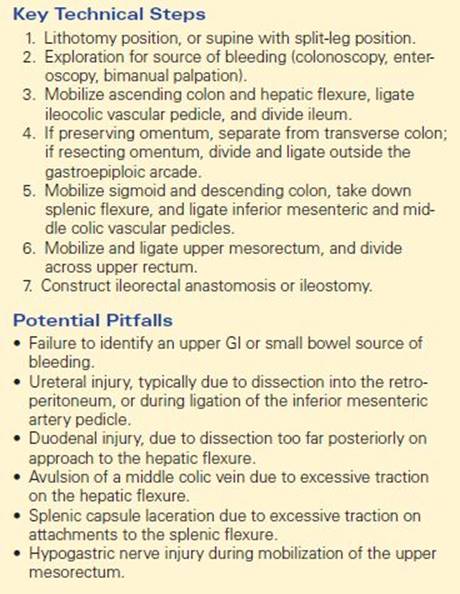
The colon is mobilized from the retroperitoneum by incision along the line of Toldt. On the right, the ureter and the gonadal vessels are identified and protected within the retroperitoneum, and the duodenum is swept posteriorly as dissection approaches the hepatic flexure. Care must be taken to avoid avulsing venous tributaries of the superior mesenteric vein as the flexure is elevated medially. The gastrocolic omentum can be preserved, by separating it from the transverse colon, or resected with the specimen by dividing it outside the gastroepiploic arcade. The transverse mesocolon is separated from the omentum, and then mobilized from the retroperitoneum through dissection in the lesser sac. At this point, division of the ileum and the ileocolic pedicle facilitates exposure for mobilization of the left and sigmoid colon. On the left, care is taken to avoid injury to the splenic capsule when taking down the flexure, and the ureter and the gonadal vessels must be identified and protected in the retroperitoneum during mobilization of the sigmoid colon and ligation of the inferior mesenteric artery pedicle. As dissection continues behind the upper rectum in the presacral space, the hypogastric nerves, which contribute to sexual function, are preserved by sweeping them down off the mesorectum. After ligating the remaining mesenteric vasculature, the bowel is divided across the upper rectum, either with a linear stapler or between bowel clamps, and the specimen is passed off the field. Intestinal continuity can be restored with an ileorectal anastomosis, or end ileostomy can be constructed and the rectal stump turned in and left closed.
Special Intraoperative Considerations
Because most LGIB is managed without surgery, those patients who require total abdominal colectomy in this setting typically will be either acutely unstable, or debilitated from protracted preoperative manipulations. In the presence of hemodynamic instability, malnutrition, major comorbidity, inflammatory disease of the terminal ileum or rectum, or poor anal sphincter function and fecal incontinence, ileorectal anastomosis should be avoided, and end ileostomy performed. Ileostomy and mucous fistula is also an option, but the divided rectum typically will not reach the abdominal wall, so the distal transection must occur above the rectosigmoid junction if mucous fistula is planned. The finding of an unexpected malignancy requires careful attention to an oncologically appropriate mesenteric lymphadenectomy. Other unexpected findings, such as inflammatory bowel disease, Meckel’s diverticulum, arterial–intestinal fistula, or others, would require alteration of the operative plan and a focus on the source of bleeding.
Postoperative Management
Because of the extensive abdominal dissection, postoperative ileus after total abdominal colectomy is common. Total parenteral nutrition is often required, because patients who require surgery for LGIB may have suffered through extensive preoperative workup with prolonged restriction of oral nutrition. Routine prophylaxis for deep venous thrombosis should be used. Postoperative antibiotics are not typically necessary. After return of bowel function, stool output may be liquid and high volume, and the use of bulking agents plus antidiarrheal medications such as loperamide or diphenoxylate/atropine is often required to avoid dehydration. After the initial recovery period, most patients will continue permanently with several stools per day. Patients with good preoperative anal sphincter function will typically not suffer major deterioration in their continence.
Anastomotic leak rates after ileorectal anastomosis range from 2% to 5%. Leak can present as fever, pain, ileus, diarrhea, tenesmus, urinary retention, or fistula. Depending on patient condition and the location, size, and spread of the leak, management might involve simple observation, percutaneous drainage, transanal repair, or reoperation with repair or resection of anastomosis and fecal diversion.
TAKE HOME POINTS
· Diverticular bleeding accounts for a majority of LGIB requiring hospitalization in adults.
· Diverticular bleeding is self-limited in 80% of cases, but 15% to 30% will have recurrent bleeding.
· Options for localization of LGIB include angiography, flexible endoscopy, capsule endoscopy, and nuclear scintigraphy.
· Indications for surgery in LGIB include recurrent refractory bleeding or hemodynamic instability.
· The operation of choice for unlocalized LGIB distal to the ileocecal valve is total abdominal colectomy, with ileorectal anastomosis or end ileostomy.
SUGGESTED READINGS
ASGE Standards of Practice Committee. An annotated algorithmic approach to acute lower gastrointestinal bleeding. Gastrointest Endosc. 2001;53:859–863.
ASGE Standards of Practice Committee. The role of endoscopy in the patient with lower-GI bleeding. Gastrointest Endosc. 2005;62:656–660.
Green BT, Rockey DC, Portwood G, et al. Urgent colonoscopy for evaluation and management of acute lower gastrointestinal hemorrhage: a randomized controlled trial. Am J Gastroenterol. 2005;100:2395–2402.
Hoedema RE, Luchtefeld MA. The management of lower gastrointestinal hemorrhage. Dis Colon Rectum. 2005;48:2010–2024.
Jensen DM, Machicado GA, Jutabha R, et al. Urgent colonoscopy for the diagnosis and treatment of severe diverticular hemorrhage. N Engl J Med. 2000;342:78–82.
Khanna A, Ognibene SJ, Koniaris LG. Embolization as firstline therapy for diverticulosis-related massive lower gastrointestinal bleeding: evidence from a meta-analysis. J Gastrointest Surg. 2005;9:343–352.