
Michael J. Rosen
Presentation
The patient is a 56-year-old obese (BMI 41 kg/m2) male with a past medical history of hypertension and non–insulin-dependent diabetes. Three years prior to this presentation, he underwent an elective sigmoid colectomy for multiply recurrent sigmoid diverticulitis. He developed a postoperative wound infection and his wound healed by secondary intention. Within 1 year, he noted a bulge along his incision that was becoming increasing uncomfortable. He was noted to have an incisional hernia and underwent elective repair. He was repaired in an open fashion with a 10- × 15-in piece of Composix mesh (Polypropylene and PTFE). He initially did well and was discharged on postoperative day 3. However, on his 2-week postoperative visit, he was noted to have erythema of the wound and purulent drainage. He was explored in the operating room, the wound was opened, the fascia appeared intact, and cultures revealed MRSA. He was placed on a negative pressure wound therapy for approximately 6 months and presents to you with a chronic draining sinus. An abdominal computerized tomography scan reveals fluid around the mesh. The patient reports generalized malaise, denies fevers, and has no erythema on exam. His laboratory evaluation is unremarkable.
Differential Diagnosis
This case presentation considers the workup of a patient with a chronic draining sinus after an open ventral hernia repair with prosthetic mesh. The differential diagnosis of a draining sinus after an open ventral hernia repair depends on the time of presentation. In the early postoperative period, multiple factors can lead to wound issues. Superficial surgical site infections are common and often are a result of skin flora contamination. Deep space infections involving the mesh in the early postoperative period are more concerning. While these are most often associated with prosthetic contamination with skin flora, potential bowel injury and missed enterotomy must be considered. Culture results revealing gram-negative or anaerobic bacteria should raise concern for the surgeon. Patients presenting with chronic draining sinuses many months after open ventral hernia repair often represent some form of an infected foreign body. Occasionally, these can be the result of a suture sinus abscess, and removal of the suture can be curative. Unfortunately, most often this involves contamination of the graft, signaling lack of incorporation, and will not resolve without surgical intervention. If patients present with a draining sinus long after their initial surgery, the possibility of mesh erosion into the viscera should be entertained. Careful evaluation for a fistula is imperative to guide preoperative planning.
Discussion
Abdominal wall reconstruction represents a broad spectrum of disease. Patients can range from those with a small umbilical hernia (<2cm) up to some of the most challenging reconstructive problems such as patients with massive hernias and an enterocutaneous fistula. The reconstructive surgeon dealing with the full spectrum of these problems must have multiple reconstructive techniques at hand. It is impossible for one procedure or one form of prosthetic to address all of the unique problems these patients can display. This chapter focuses on the complex spectrum of these scenarios. It is important to mention that there is no single definition of a “complex” ventral hernia. In fact, multiple factors can make a ventral hernia complex, and often recognizing these issues preoperatively can avoid potential postoperative morbidity. In general, ventral hernias become complex based on certain patient, defect, and surgical technique characteristics. Patient comorbidities linked to postoperative complications include obesity, smoking, COPD, immunosuppression, malnutrition, and diabetes. Optimization of each of these parameters preoperatively is important for ultimate success of the repair. Complex defect characteristics include the presence of contamination or infection (i.e., infected prosthetic material, enterocutaneous fistulas, or concomitant elective bowel surgery), large defects with substantial tissue loss, massive hernias with loss of abdominal domain (more viscera outside the abdominal cavity than within it), and multiply recurrent hernias with fixed noncompliant abdominal walls. Finally, at times the reconstructive techniques chosen by the surgeon can complicate the repair. For instance, a commonly performed procedure, component separation, typically involves elevation of large subcutaneous flaps that can be associated with wound morbidity of up to 40% in some series. In this chapter, I will address a common clinical scenario of a complex abdominal wall problem: infected prosthetic mesh.
Workup
The initial workup of any patient presenting with problem after surgery is to obtain all operative reports and determine exactly what was done before. It is important to identify what mesh was placed, and in what compartment in the abdominal wall. The management of an onlay mesh can be significantly different than an intraperitoneally placed mesh. Likewise, the composition of the mesh material can have implications in management. For example, macroporous mesh (polypropylene and polyester mesh) can often be salvaged with partial mesh excision. However, microporous mesh (ePTFE, Goretex) can almost never be salvaged and requires complete mesh excision. I obtain an abdominal computerized tomography scan for all patients with complex abdominal wall problems. This imaging test gives important information with regard to whether there is uncontrolled infection (i.e., undrained fluid collections), the size of the mesh, the layer of the abdominal wall where the mesh was placed, whether bowel is involved, and the extent of remaining uninvolved abdominal wall that can be used for eventual reconstruction.
It is never an emergency to remove an infected piece of prosthetic material from the abdominal wall. If there is extensive soft tissue inflammation/erythema, a course of antibiotics is warranted. If there are undrained fluid collections causing systemic inflammatory response, these should be drained surgically or by interventional radiology. Although it is not likely that this will cure the infection, these measures will reduce soft tissue inflammation and preserve these important structures for eventual abdominal wall reconstruction. Appropriate treatment of any skin breakdown is also important. Optimization of nutrition prior to formal abdominal wall reconstruction is paramount. In patients with a chronic nidus of infection it is often impossible to normalize their metabolic profile, but maximizing nutrition is important for a successful result. If a fistula is present, I rarely keep patients NPO unless they are high output and cannot control the effluent with an ostomy appliance.
Diagnosis and Treatment
In this patient, the timing of the early wound infection followed by a chronic draining sinus and the presence of MRSA suggests a deep surgical site infection involving the prosthetic. Given the fact that it is a PTFE-based mesh, complete surgical excision of the graft is warranted. In these situations, it is important to have clear goals between the surgeon and the patient as to what must be accomplished and what would be the ideal situation if possible. After 6 months of conservative therapy, it is not necessary to continue with any other nonoperative measures and the patient should be optimized for resection of the mesh as previously mentioned. The most important principle in managing infection of a prosthetic device regardless of its location, is complete resection of all foreign material whenever possible. Fortunately, in cases of infected microporous mesh, the graft is often not well incorporated and can be easily removed.
When planning the operation, the surgeon will be faced with several potential scenarios. Occasionally, the peritoneal cavity is not violated during resection of the mesh. In this case, I often will leave the wound open, allow it to heal by secondary intention, and perform my formal reconstruction 6 months to 1 year later in a clean field. Alternatively, if the peritoneal cavity is violated, the surgeon must stabilize the abdominal wall. Rapidly absorbable synthetic mesh (Vicryl or Dexon) are reasonable alternatives; however, they often result in very large defects to repair in the future. Single-staged reconstruction with biologic mesh is another alternative. There are multiple products available and it is beyond the scope of this chapter to evaluate these differences, but certain reconstructive principles remain constant. These materials do not function as an interposition graft to prevent hernias. They should be used with advanced reconstructive techniques such as a Rives-Stoppa or component separation to function as a reinforcement of a primary facial repair. When used accordingly they have reported successful reconstructions in up to 80% of contaminated single-staged repairs.
Surgical Approach
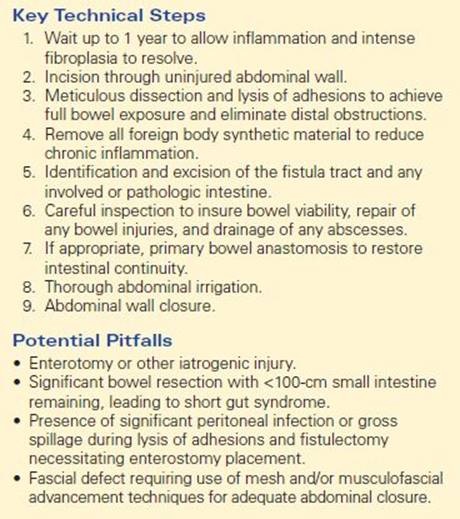
As described above, the principles of the operation are to perform complete excision of all prosthetic material. This often requires a full midline laparotomy to expose the entire abdominal wall to ensure complete mesh removal and definitive abdominal wall reconstruction if necessary. Key technical points of the reconstruction are described in Table 1.
TABLE 1. Key Technical Steps and Potential Pitfalls to Component Separation
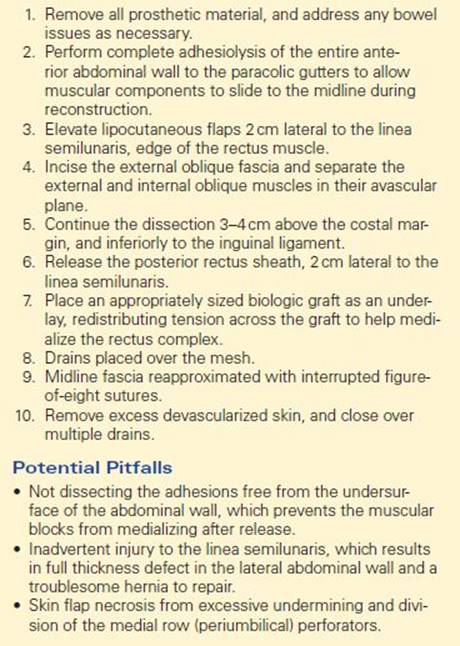
Component Separation
Begin by performing a complete laparotomy and removing all prosthetic material, and address any bowel issues as necessary. Perform a complete adhesiolysis of the entire anterior abdominal wall to the paracolic gutters. This will allow muscular components to mobilize toward the midline during reconstruction. Elevate lipocutaneous flaps 2 cm lateral to the linea semilunaris to the lateral edge of the rectus muscle. Take care to avoid the periumbilical perforators during this mobilization by leaving an “island” of subcutaneous tissue in the middle of the flap. This maneuver will prevent problems with abdominal wall ischemia (Table 1).
Incise the external oblique fascia just lateral to the rectus sheath and separate the external and internal oblique muscles in their avascular plane. Continue the dissection 3 to 4 cm above the costal margin, and inferiorly to the inguinal ligament. Release the posterior rectus sheath, 2 cm lateral to the linea semilunaris. Place an appropriately sized biologic graft as an underlay, redistributing tension across the graft to help medialize the rectus complex. Place closed suction drains over the mesh. Reapproximate the midline fascia with interrupted figure-of-eight sutures. Remove excess devascularized skin, and close in several layers.
Special Intraoperative Considerations
In certain cases of infected and contaminated abdominal wall reconstruction, the field will be grossly contaminated. It is imperative that appropriate bioburden reduction techniques are employed, including debridement of all devitalized tissue, and copious pulse lavage irrigation of the wound. If the wound cannot be grossly decontaminated, then reconstructive efforts should be postponed. The patients can be placed on dressings for several days and formal reconstruction performed after the wound has been decontaminated.
Postoperative Management
These reconstructive procedures performed in the setting of infection and contaminations are fraught with postoperative wound complications. Recognizing and managing these appropriately is important to eventual success of the operation. In cases of MRSA prosthetic infections, I feel there is often a biofilm present in the wound that cannot be eradicated. Therefore, I place these patients on suppressive antibiotic therapy for at least 6 months after removal of the graft (Bactrim SS QD). I also feel it is important to keep the drains in place in cases of biologic mesh utilization. Despite the term “mesh,” these are actually grafts that are often not perforated and therefore are prone to fluid buildup around the graft. This fluid will prevent incorporation and often contains collagenases that will degrade the graft. Therefore, I leave the drains in place for at least 2 weeks in most cases. These reconstructive procedures are also major surgical endeavors and epidurals can help pain management, and most patients should be observed in an intensive care unit setting for the immediate postoperative period.
TAKE HOME POINTS
· Set realistic expectations for the patients and the surgeons about what can actually be accomplished in one setting in these difficult problems.
· Remove all infected prosthetic material whenever possible.
· Single-staged reconstruction of infected and contaminated fields is reasonable in most patients, although it does not always have to be performed. Know when you are in a difficult situation and know when to bail out.
· Optimize patients preoperatively with adequate nutrition, infection control, and preservation of soft tissues.
· Do not wait forever to remove infected synthetic mesh. If the wound is not healed by 3 to 6 months, the prosthetic is almost always infected.
|
6 |
Enterocutaneous Fistula |
|
|
ERIC J. CULBERTSON and MICHAEL G. FRANZ |
Presentation
A 61-year-old man with a history of morbid obesity, hypertension, and hiatal hernia repair underwent ventral incisional hernia repair with synthetic mesh 2 years ago. That operation was complicated by infected mesh that was explanted 4 weeks ago. The patient presents now with a nonhealing abdominal wound that for the past few days is draining increasing amounts of foul-smelling fluid. He complains of pain at the wound site and skin irritation from the drainage, but denies fevers, chills, nausea or vomiting, and has a normal appetite and bowel movements. The patient is afebrile and vital signs are normal. He weighs 140 kg (BMI, 38.6). Mucous membranes are noted to be dry. Focused examination reveals a 12 × 12 cm open, granulating wound in the midabdomen with two sinus tracts from which is expressed a thin, foul-smelling, light brown fluid (Figure 1). There is significant abdominal wall laxity at the wound site.
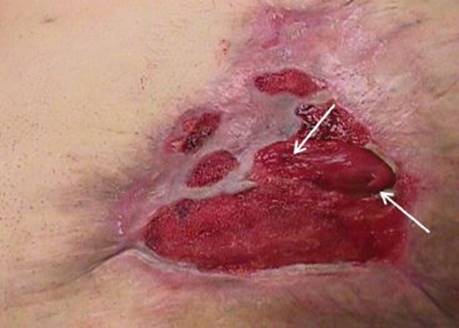
FIGURE 1 • Nonhealing surgical wound with two visible mucosal openings (white arrows).
Differential Diagnosis
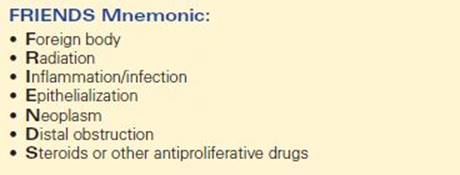
Postoperative abdominal wound drainage most often signifies the presence of infection, seroma, hematoma, or enterocutaneous fistula. Foul-smelling, purulent discharge in this patient most likely indicates a deep-space wound infection, including possible retained infected mesh, or a gastrointestinal fistula with drainage of bowel contents. The majority of enterocutaneous fistulas develop postoperatively (75% to 85%), following surgery for inflammatory bowel disease (IBD), cancer, or bowel obstruction (i.e., lysis of adhesions). Presentation is usually during the first 5 to 7 postoperative days. Enterocutaneous fistulas may also occur spontaneously (15% to 25%) as a result of radiation, malignancy, or a number of inflammatory conditions including IBD and diverticular disease. Other factors that contribute to fistula development or delay fistula healing include the presence of distal bowel obstruction, foreign body inflammation, infection, irradiated bowel, local malignancy, or antiproliferative drugs (Table 1).
TABLE 1. Factors Associated with Nonhealing Fistulas
Workup
History and physical examination can be diagnostic. Food or feculent drainage from the wound is diagnostic, as is visible intestinal mucosa. Serum laboratory studies are important to evaluate for signs of infection, electrolyte disturbances, and malnutrition.
The patient in our scenario has normal white blood cell and platelet counts and hemoglobin. Potassium and chloride are somewhat low at 3.4 and 95 mmol/L, respectively; the remainder of the electrolytes are normal, but BUN and creatinine are elevated at 32 and 1.5 mg/dL, respectively. Liver function tests are within normal limits but the albumin is low at 3.0 g/dL. The electrolyte and renal tests indicate that the patient is suffering the effects of fluid loss and dehydration and will need resuscitation. A low albumin suggests that the patient also may be malnourished despite his obesity.
A CT scan of the abdomen and pelvis is conducted to assess for intra-abdominal abscess or other source of deep-space infection. The CT scan will also evaluate for abscess or retained infected mesh and assess the source and anatomy of a possible fistula. The patient in our scenario has no evidence of abscess, infected mesh, inflammation, or wound infection on CT scan. However, there is a loop of bowel that is in close approximation to the skin surface, which may indicate the presence of an enterocutaneous fistula is identified (Figure 2A). A fistulogram, in which the external opening of the fistula tract is cannulated and injected with water-soluble contrast and evaluated by immediate and delayed radiographs, is subsequently performed. This is important to identify the source and location of the fistula and any possible intra-abdominal leakage, as well as to rule out the presence of a distal bowel obstruction, which may keep the fistula open and prevent future closure. In our patient, a fistulogram of the two wound tracts identifies an opening corresponding to an efferent limb of distal small bowel with contrast flowing easily past the ileocecal valve and filling the colon with no evidence of distal obstruction or intra-abdominal leakage (Figure 2B). The other external opening is identified as the afferent bowel limb, which also fills easily without leakage (image not shown).
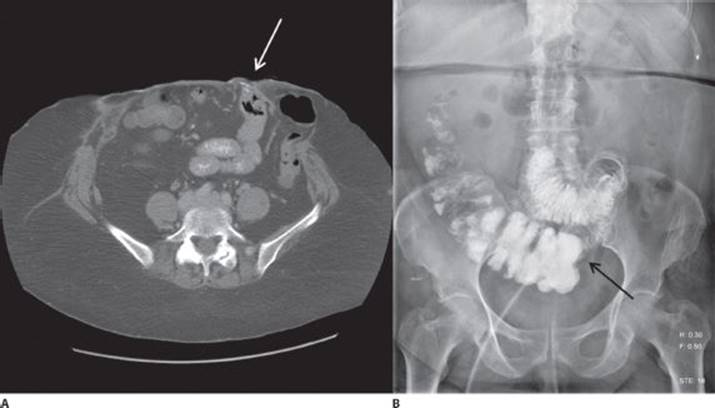
FIGURE 2 • A: CT scan demonstrating a loop of small intestine in close approximation to the skin surface constistent with a possible enterocutaneous fistula (white arrow). B: Fistulogram with contrast flowing past the ileocecal valve (black arrow) and filling the colon.
Diagnosis and Treatment
Based on the imaging studies, the patient in this scenario has an enterocutaneous fistula involving the distal small bowel with two openings corresponding to the afferent and efferent bowel limbs, without evidence of distal bowel obstruction or intra-abdominal leakage. Fistula formation is a dreaded surgical complication with mortality of 5% to 20%. Treatment initially beings with replacing fluid and electrolyte losses and controlling infection. Depending on the fistula location and the degree of fistula output, patients may present with profound fluid and electrolyte losses. In the patient in our scenario, lab results suggest that the patient is dehydrated and hypokalemic and hypochloremic from enteric fluid loss. Resuscitation is begun with intravenous normal saline supplemented with potassium chloride. Although this patient does not show signs of sepsis and no clear infection is seen on CT imaging, patients with fistulas often present with overt infection and sepsis and prompt administration of broad-spectrum antibiotic therapy along with resuscitation is warranted in these cases. Abscesses should be drained either percutaneously or surgically, and in some cases surgical bowel diversion may be necessary. Skin and soft tissue surrounding the injury must also be aggressively protected in anticipation of surgical correction, if necessary.
Once the patient is stabilized, and ongoing support established, attention can be turned to managing the fistula output and improving the patient’s nutritional status. Patients should be made NPO and parenteral nutrition given to minimize fistula output, restore ongoing fluid and electrolyte losses, and maintain caloric and protein goals to optimize the patient’s nutrition and wound-healing capability. Electrolytes and blood sugar should be followed closely and the parenteral nutrition adjusted accordingly. Proton pump inhibitors are given to reduce gastric secretions. Underlying disorders such as IBD should be controlled. Fistula output should be measured or estimated and recorded on a daily basis. The output is classified as either low (<500 mL/d) or high (>500 mL/d). High-output, gastric, duodenal, and ileal fistulas are associated with a lower rate of spontaneous closure, whereas low-output, esophageal, pancreatobiliary, jejunal, and colonic fistulas are more likely to close with conservative management alone. If fistula output remains low after an initial period of NPO status and parenteral nutrition, oral feedings may be attempted, especially for more distal fistulas, and should be adjusted to ensure minimal fistula output. In some cases enteral feedings alone may be possible, although most often parenteral nutrition is required in order to maintain optimal wound healing and readiness for potential surgery. In cases of persistent high fistula output in which it is difficult to maintain adequate fluid intake and electrolyte balance, subcutaneous somatostatin or an analog may be trialed. Somatostatin inhibits gastrointestinal tract secretions and increases intestinal water and electrolyte absorption, and may reduce high fistula output. Our patient is initially made NPO and started on parenteral nutrition. Fistula output remains well below 500 mL/d, and small amounts of supplemental oral liquids and soft foods are permitted for comfort.
Adequate wound care is important but can often be challenging and requires considerable patient education and outpatient management. Assistance of a specialized wound or enterostomal care team can often be helpful but is not always available. Skin barriers (powders, creams, foam, etc.) should be used to protect the skin from irritation. Low-output fistulas may be managed with frequent dressing changes, whereas high-output fistulas usually require an ostomy pouch or a similar device. Another management technique often employed with success is negative pressure wound therapy, which may improve nonsurgical fistula closure rates and manage or close fistulas in patients with contraindications to surgery.
For the patient in our scenario, we chose negative pressure therapy for initial management. A sponge is placed over the entire wound up to the skin edges. Holes are created through the sponge for each fistula opening and rubber catheters passed through. One catheter is advanced into the afferent bowel limb, and the other into the efferent limb. The sponge and catheters are then sealed with clear adhesive sheets and continuous suction applied. In this manner, the skin is protected, fistula output is well controlled and can be accurately recorded, and wound healing is promoted (Figure 3). In the case of a more proximal fistula, tube feedings can be given through a catheter in the efferent bowel limb.
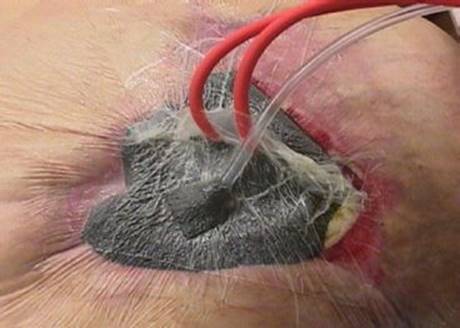
FIGURE 3 • Negative pressure wound therapy device in place on the fistula wound. The two red rubber catheters are placed in the afferent and efferent bowel limbs to control the effluent. The clear tubing applies a vacuum to the black sponge dressing to stabilize the abdominal wall and to promote wound healing. A nonadherent, nonocclusive dressing is placed deep into the wound to protect against further bowel injury. Compulsive wound examinations and adjustments to negative pressure therapy are required for safety and effectiveness.
In general, a conservative management approach should be taken for the initial 4 to 6 weeks to assess the possibility of spontaneous fistula closure, which occurs in as many as one-third of cases. After this time, fistulas are unlikely to heal on their own. Patients with small, superficial fistulas or those who are deemed not to be surgical candidates may be considered for fibrin glue treatment of the fistula site for potential closure. Surgical repair is delayed until at least 4 to 6 months, and sometimes up to a year from the time of the most recent abdominal operation to allow for bowel adhesions to soften and to optimize the patient’s infectious, nutritional, and wound status.
Surgical Approach
After careful consideration of the timing and patient optimization, surgical repair with the goal of restoring intestinal continuity may be considered (Table 2). Extensive discussion should be had with the patient regarding risks and expected outcomes. Although definitive repair at the initial operation is usually the goal, in many cases a temporary diverting enterostomy is needed to allow for adequate bowel and wound healing, and in some cases the fistula cannot be safely repaired necessitating permanent fistula or enterostomy. Consider marking potential stoma sites prior to surgery. Preoperatively, bowel preparation should be considered and appropriate antibiotic and deep venous thrombosis (DVT) prophylaxis should be given.
TABLE 2. Key Technical Steps and Potential Pitfalls to Enterocutaneous Fistula Repair
It is often advantageous to approach the peritoneum and intra-abdominal organs through a new incision, typically midline above or below previous scars, to minimize the risk of bowel injury due to adhesions to the abdominal wall at prior surgical sites. Meticulous dissection and lysis of adhesions is carried out to expose the peritoneal cavity. Selective adhesiolysis from the ligament of Treitz to the rectum is considered with the goal of preparing bowel for reconstruction and eliminating distal obstructions, and weighed against the risk of further intestinal injury due to injudicious dissection. Any sites of abscess should be drained and thoroughly irrigated. The fistula site is carefully isolated and separated from the abdominal wall (Figure 4A). The fistula tract is excised and segmental resection of any involved bowel is performed using clamps or a stapler with preservation of as much unaffected bowel as possible. Simple closure of the fistula site alone is associated with a high rate of recurrence. The entire bowel should be inspected along its length and any diseased (such as from IBD, diverticular disease, ischemia, etc.) segments resected. Every effort should be made to preserve at least 100 cm of small intestine to avoid short gut syndrome. If conditions are appropriate and contamination is minimal, bowel continuity can be restored with either a stapled or two-layer hand-sewn primary anastomosis under physiologic tension. Given the extensive adhesions that are often present in these cases, unplanned enterostomy may occur. These should be carefully repaired using absorbable suture and reinspected before abdominal closure to ensure bowel viability and adequate repair. After the fistula has been excised, bowel reanastomosed, other injuries repaired, and bowel reinspected, the abdomen is thoroughly irrigated. The abdominal wall is then closed beginning with the fascia using permanent or slowly absorbing suture. In cases of active wound or peritoneal infection or gross contamination, the skin should be left open and allowed to heal by secondary intention or a delayed-primary closure may be considered.
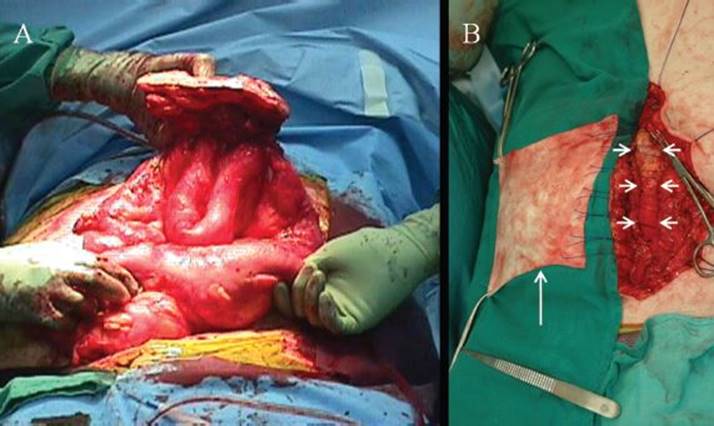
FIGURE 4 • Intraoperative view of an enterocutaneous fistula repair. A: After extensive lysis of adhesions, the fistula with involved bowel and abdominal wound are identified and separated from normal intestine and abdominal wall prior to excision. B: Human cadaveric dermis (single white arrow) is sutured into place with minimized bridging of a remaining fascial defect (white arrow heads) after fistula repair.
Special Intraoperative Considerations
If significant intra-abdominal infection is present, gross contamination occurs during the operation, underlying disease processes such as IBD or malignancy are inadequately controlled, or the patient has significant comorbidities, placement of a proximal diverting enterostomy may be necessary to allow distal anastomoses to adequately heal. Placement of a decompressive gastrostomy and feeding jejunostomy should be considered based on patient status and the magnitude of the operation. All patients with fistulas have associated fascial defects (hernias). If the fascial defects are small enough to be closed with minimal tension, the fascia is repaired primarily. Many hernias will require use of mesh, typically an absorbable synthetic mesh or a biologic mesh such as a dermal allograft or xenograft due to the greater risk of recurrent fistulization or mesh infection with permanent synthetic material (Figure 4B). In some cases, musculofascial advancement flaps, such as a components separation procedure, may also be necessary to allow adequate abdominal wall closure. Local cutaneous flaps or skin grafts may be needed to cover areas of extensive skin loss.
Postoperative Management
Ensuring adequate postoperative nutrition is essential for anastomotic and laparotomy wound healing. Parenteral nutrition, if used preoperatively, is continued until the patient is taking an adequate oral diet. Postoperative ileus may require several days to resolve and recovery is assisted with nasogastric tube decompression. Resumption and advancement of an oral diet may be slow, particularly in patients who have not eaten for weeks or months. Antibiotic coverage should be discontinued within 24 hours postoperatively unless there is suspected or documented infection to minimize the risk of antibiotic resistance. Any underlying conditions associated with the fistula formation, such as IBD, should be medically controlled. While in the hospital, the patient’s wound should be assessed regularly for signs of infection or fistula recurrence. If an open wound or ostomy is present, the patient should be educated in proper wound and/or stomal care prior to discharge or provided with home nurse visitation. Close outpatient follow-up with regular clinic visits until the wound is well healed is warranted. If a diverting enterostomy was placed at the time of repair, consideration for restoring bowel continuity will depend greatly on individual patient factors but should be delayed for at least 6 to 12 weeks, and longer if possible, to allow the wound to heal, assure that fistulization does not recur, treat inciting disease processes (IBD, malignancy, etc.), and allow adhesions to soften.
Case Conclusion
Our patient is deemed an appropriate surgical candidate following 6 months of negative pressure wound management and parenteral nutrition with oral supplementation. The abdomen was entered through a fresh incision superior to the previous incisions and wound site, extensive adhesiolysis was performed, the bowel was mobilized, and the fistula tract and the involved abdominal wall were excised (Figure 4A). No abscesses or peritoneal contamination were identified and primary anastomosis of the remaining healthy bowel ends after removal of pathologic segments was performed without complication. A residual fascial defect was repaired using human cadaveric dermis (Figure 4B). Parenteral nutrition was continued in the initial postoperative period. The patient was started on a clear liquid diet on postoperative day 6, advanced to soft foods the following day, and parenteral nutrition was discontinued. At the time of most recent follow-up, 1 year after fistula repair, the incision has healed well without signs of fistula recurrence or significant abdominal wall laxity.
TAKE HOME POINTS
· Identify and treat sepsis, dehydration, electrolyte imbalances, and malnutrition, which are frequently seen in these patients.
· Radiologic evaluation with CT imaging and fistulogram aids in identifying potential sources of infection, intestinal obstruction, and delineating the fistula anatomy.
· Parenteral nutrition and NPO status are implemented initially. If the fistula is located distally and output is low, oral feedings may be considered.
· Wound care is rigorous and focused on controlling fistula output, protecting the surrounding skin and soft tissues and promoting wound healing.
· Up to one-third of fistulas will close with nonoperative management. Fistulas that do not close within 4 to 6 weeks are unlikely to do so.
· Fistula repair is delayed for at least 4 to 6 months and up to a year to allow bowel adhesions to soften, treat any underlying disease, and optimize the patient’s infectious, nutritional, and wound status.
· Postoperatively, nutritional status should be maintained, and the patient should be followed closely for signs of infection or refistulization until wounds are fully healed.
SUGGESTED READINGS
Berry SM, Fischer JE. Classification and pathophysiology of enterocutaneous fistulas. Surg Clin North Am. 1996;76: 1009–1018.
Draus JM Jr, Huss SA, Harty NJ, et al. Enterocutaneous fistula: are treatments improving? Surgery. 2006;140:570–576; discussion 576–578.
Evenson AR, Fischer JE. Current management of enterocutaneous fistula. J Gastrointest Surg. 2006;10:455–464.
Gunn LA, Follmar KE, Wong MS, et al. Management of enterocutaneous fistulas using negative-pressure dressings. Ann Plast Surg. 2006;57:621–625.
Martinez JL, Luque-de-Leon E, Mier J, et al. Systematic management of postoperative enterocutaneous fistulas: factors related to outcomes. World J Surg. 2008;32: 436–443; discussion 444.
Schecter WP, Hirshberg A, Chang DS, et al. Enteric fistulas: principles of management. J Am Coll Surg. 2009; 209:484–491.
Torres AJ, Landa JI, Moreno-Azcoita M, et al. Somatostatin in the management of gastrointestinal fistulas. A multicenter trial. Arch Surg. 1992;127:97–99; discussion 100.
Visschers RG, Olde Damink SW, Winkens B, et al. Treatment strategies in 135 consecutive patients with enterocutaneous fistulas. World J Surg. 2008;32:445–453.
Wainstein DE, Fernandez E, Gonzalez D, et al. Treatment of high-output enterocutaneous fistulas with a vacuum-compaction device. A ten-year experience. World J Surg. 2008;32:430–435.