
Terry L. Buchmiller
Presentation
A 3-year-old previously healthy girl presents to her pediatrician with a right upper abdominal fullness discovered yesterday by her mother during bathing. She has seemed a bit more tired than usual after playing and has been eating less at mealtimes for 1 week. There have been no fevers, recent travel, and no other family members are ill.
On physical examination, she is listless, though well hydrated and afebrile. She has no scleral icterus and no adenopathy. Her lungs are clear to auscultation. A firm, nonmobile mass is palpated in the RUQ just under the costal margin. It is not tender but moves with respiration. Her abdomen is otherwise soft and nondistended, and she has no peritoneal signs.
Differential Diagnosis
The differential diagnosis of an right upper quadrant (RUQ) abdominal mass in a pediatric patient is broad and includes hydronephrosis, nephroblastoma (Wilms tumor), liver masses and tumors, choledochal cysts, intestinal duplication cysts, and retroperitoneal tumors. Liver masses include hemangiomas, focal nodular hyperplasia, and liver tumors, both benign and malignant. The most common malignant tumor in young children is the hepatoblastoma. Hepatocellular carcinoma more commonly seen in those over 5 years. Liver sarcomas, rhabdoid tumors, immature teratomas and choriocarcinomas are more uncommon.
Workup
Evaluation of a potential abdominal mass in children may include plain films to detect calcifications, displacement of the stomach or the intestine, and assessment of the bowel gas pattern. As these findings will likely be nonspecific, further imaging includes an abdominal ultrasound to narrow the differential diagnosis and ascertain organ involvement as well as characteristics of the mass. An abdominal CT with intravenous and oral contrast can further define vascular involvement and assess lymphadenopathy. MRI may ultimately be an important adjunct in hepatic lesions in determining tumor relationship to biliary anatomy and the hepatic vasculature. A chest x-ray or a CT should be obtained to rule out metastatic disease. Laboratory evaluation should include a CBC, electrolytes, serum transaminases, AFP, β-HCG, and a urinalysis. Serum AFP is produced in the fetal liver and yolk sac and declines to adult levels after age 6 months. Elevated AFP occurs in 90% of patients presenting with hepatoblastoma and can be used as an adjunct to assess response to treatment and disease recurrence.
Presentation Continued
CBC and electrolytes were normal. Her ultrasound showed normal kidneys without hydronephrosis and a solid mass measuring 4 × 4.5 cm confined to the right hepatic lobe with mildly increased vascular flow. An abdominal CT with contrast confirmed this solitary hepatic mass and showed no vascular impingement or invasion. There was no obvious adenopathy. The following day, the β-HCG returned at 1(normal, < 6 mIU/mL) while the AFP was significantly elevated at >50,000 (normal, 1 to 15 ng/mL).
Diagnosis and Treatment
Based on the workup demonstrating a large solid hepatic mass in a toddler with a markedly elevated AFP, the single leading diagnosis is hepatoblastoma. Hepatoblastoma is the most common malignant hepatic tumor in children <3 years of age, and complete surgical resection offers the best chance for cure. However, approximately 20% of children with hepatoblastoma have metastatic disease at presentation. Hepatoblastomas are epithelial-based lesions that are either predominantly fetal (well differentiated), embryonal (immature/poorly differentiated), mixed epithelial/mesenchymal, or anaplastic. A chest CT should be obtained to exclude pulmonary metastases. Evaluation by both a pediatric surgeon and a pediatric oncologist are warranted, and assessment for inclusion in clinical trials is encouraged.
Imaging is scrutinized to assess for primary tumor resection. If there is metastatic disease and/or obvious unresectability, then the tumor should be biopsied and neoadjuvant chemotherapy initiated. Restaging after chemotherapy will reassess for later resection. In select cases of bilobar disease in the absence of metastasis, primary liver transplantation may be considered.
Presentation Continued
The chest CT was negative and all abdominal imaging suggested the solitary tumor being contained in the right hepatic lobe. Therefore, the patient is a candidate for a formal right hepatic lobectomy.
Surgical Approach
Although preoperative imaging may suggest respectability, only surgical exploration is confirmatory. Nonanatomic liver resections are typically avoided because of a higher rate of incomplete resection and local relapse.
Operative steps include careful preparation with the placement of several large bore intravenous lines (preferably in the upper extremity), an arterial line, and a urinary catheter as blood loss should be anticipated. An epidural catheter for postoperative pain management should be considered. Blood products including packed RBCs, FFP, and platelets should be available. Positioning should allow the surgeon access to the neck, chest, abdomen, and groins.
A right subcostal incision is used to evaluate the tumor location and extent. The abdomen is explored for any regional or metastatic disease not detected on preoperative imaging studies. Suspicious extrahepatic lesions should be biopsied and sent for frozen section prior to resection. If the lesion is deemed resectable, an appropriate anatomic hepatic lobectomy or trisegmentectomy is undertaken.
The liver is completely mobilized by dividing the triangular ligament and attachments to the bare area, allowing anterior displacement of the liver and access to the retrohepatic vena cava. Attachments to the right adrenal and small branches to the IVC are divided. The IVC is mobilized and the resection plane assessed for vascular invasion. The hepatic veins are palpated to assure clearance from the tumor. Intraoperative ultrasound may be useful in completing the vascular assessment.
The porta hepatis is dissected and the appropriate branches of the hepatic artery, portal vein, and bile duct are isolated. Assuring resectability after complete vascular assessment, the respective portal structures are now ligated. After vascular ligation, a demarcation line is evident and the parenchyma is now divided. Anatomic liver resection is undertaken proceeding from the portal structures, up the retrohepatic cava, toward the hepatic veins. Many different techniques and instruments for parenchymal division exist subject to surgeon experience and preference. Small vascular branches and bile ductules within the liver substance are ligated as encountered. The hepatic veins should be approached by dissection within the liver substance. Once the hepatic vein(s) are ligated, the final parenchymal attachments are divided completing specimen resection.
The raw surface of the remaining liver is closely scruntinized and small bile leaks or vessels are ligated. The omentum may be placed over this raw surface in older children. Drain(s) are left.
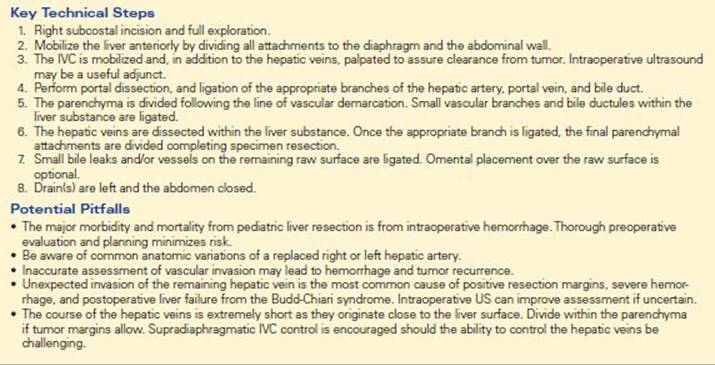
The major morbidity and mortality with hepatic tumor resection is from intraoperative hemorrhage. Potential pitfalls include inaccurate assessment of vascular invasion leading to hemorrhage and tumor recurrence. Variations in vascular anatomy are common as the right hepatic artery arises from the superior mesenteric artery and the left hepatic artery from the left gastric artery in 15% each, respectively (Table 1).
TABLE 1. Key Technical Steps and Potential Pitfalls to Hepatic Lobectomy
Special Intraoperative Considerations
Should tumor be suspected at the resection margin, intraoperative frozen section should be performed as complete resection is desired. Knowledge of hepatic segmental anatomy will assist in resection options.
Presentation Continued
The patient’s right hepatic lobectomy was performed with a 150-mL blood loss and no transfusion requirement. Gross tumor resection was achieved and no suspicious extrahepatic lesions were encountered. She was extubated at the termination of the operation and taken to the ICU for management.
Postoperative Management
Most children readily adapt to major hepatic resection with compensatory hypertrophy. Postoperative hepatic insufficiency is manifest by hypoglycemia, hypoalbuminemia, and hypoprothrombinemia and requires meticulous surveillance. However, neonates remain a susceptible population. Intravenous fluids should contain 10% dextrose, and supplemental albumin and Vitamin K are provided as needed the first week. Close attention to vital signs, urine output, and hemoglobin levels assures no occult postoperative bleeding. Oral feeding may be resumed when the ileus resolves, typically within 2 to 3 days. When the patient is tolerating a regular diet, the abdominal drain can be removed when it is low volume and free from bile. Chemotherapy is usually initiated after several weeks to allow for hepatic regeneration and recovery.
Case Conclusion
Her recovery was uneventful and she maintained normal serum glucose levels. She was transferred to the floor where her ileus resolved on POD 3. Her nasogastric tube was removed, and her diet advanced. Her drain output was <30 mL of serous fluid and was removed on POD 6. She was discharged home on oral narcotics. Her final pathology returned as pure fetal-type hepatoblastoma with clear tumor margins. She is being closely observed without chemotherapy and monitored for tumor recurrence with serum AFP and imaging. A >85% cure rate is anticipated.
TAKE HOME POINTS
· More than 70% of all pediatric liver tumors are malignant, accounting for 1% of all pediatric malignancies. Hepatoblastoma is the third most common abdominal malignancy following neuroblastoma and Wilms tumor.
· Hepatoblastoma presents between ages 6 months to 3 years and can be associated with the Beckwith-Weidemann syndrome, familial adenomatous polyposis, hemihypertrophy, and a low birth weight. Serum AFP is elevated in 90%. Children with associated conditions should be considered for tumor screening with serum AFP and US to increase the likelihood of earlier detection.
· Multiple tumor staging systems exist that guide treatment. Approximately 20% have metastatic disease at presentation with lung, brain, and/or bone marrow involvement. Only one-third to one-half of children diagnosed with hepatoblastoma have tumors amenable to primary resection.
· Diagnostic imaging with US, CT, and MRI is used and to assess resection. Chest CT is most commonly used to rule out pulmonary metastasis.
· Complete surgical resection remains the ultimate goal as the only effective cure.
· Several chemotherapeutic regimens exist that are based on cisplatin. Although most patients receive postoperative chemotherapy, it may be avoided in those with completely resected tumors with pure fetal histology. Radiation therapy has a very limited role.
· Preoperative chemotherapy may shrink bulky tumors making them more amenable to complete resection.
· The best survival rate approaches 95% in those with stage I disease (complete resection) with pure fetal histology. Overall survival rates are 75%.
· Children with unresectable tumors in the absence of metastasis may be strongly considered for liver transplantation. Transplantation is ultimately utilized in 6% of patients with hepatoblastoma and may be combined with neoadjuvant chemotherapy.
SUGGESTED READING
Essentials of pediatric surgery. In: Rowe M et al., eds. Liver Tumors. St Louis, MO: Mosby-Year Book, 1995:278–290.