
Jeremy Goverman, MD, FACS and Shawn P. Fagan, MD, FACS
A 50-year-old, 75-kg, male is brought into the emergency department by EMS. He was found ambulating at the scene of a house fire approximately 2 hours prior. He is noted to have circumferential third-degree burns to his entire right and left upper extremities as well as his entire head and neck. In the emergency department he is alert and oriented, and complains of a dry mouth.
1. What is the first step in assessing this patient?
2. How large is this patient’s burn?
3. According to the Parkland formula, how much fluid will this patient need during the first 8 hours? Next 16 hours? What is the initial intravenous fluid rate?
4. Should this patient be transferred to an American Burn Association–verified Burn Center?
5. Why is it important to know if a burn is circumferential? What procedure would you perform?
BURNS
Answers
1. As with every trauma, begin with ATLS protocol and assessment of ABCs. In this case the patient will require intubation for airway protection. Given the size (>20%) and location of the burn, the patient will require large-volume resuscitation and will likely develop significant facial and airway edema. Elective intubation prior to the development of airway edema is common practice for larger burns.
2. The rule of 9’s allows for a simplified approach to calculate total body surface area (TBSA) for a burn (Figure 21-1). The Lund and Browder method (which utilizes a chart) is commonly used for estimation of burn size in children.
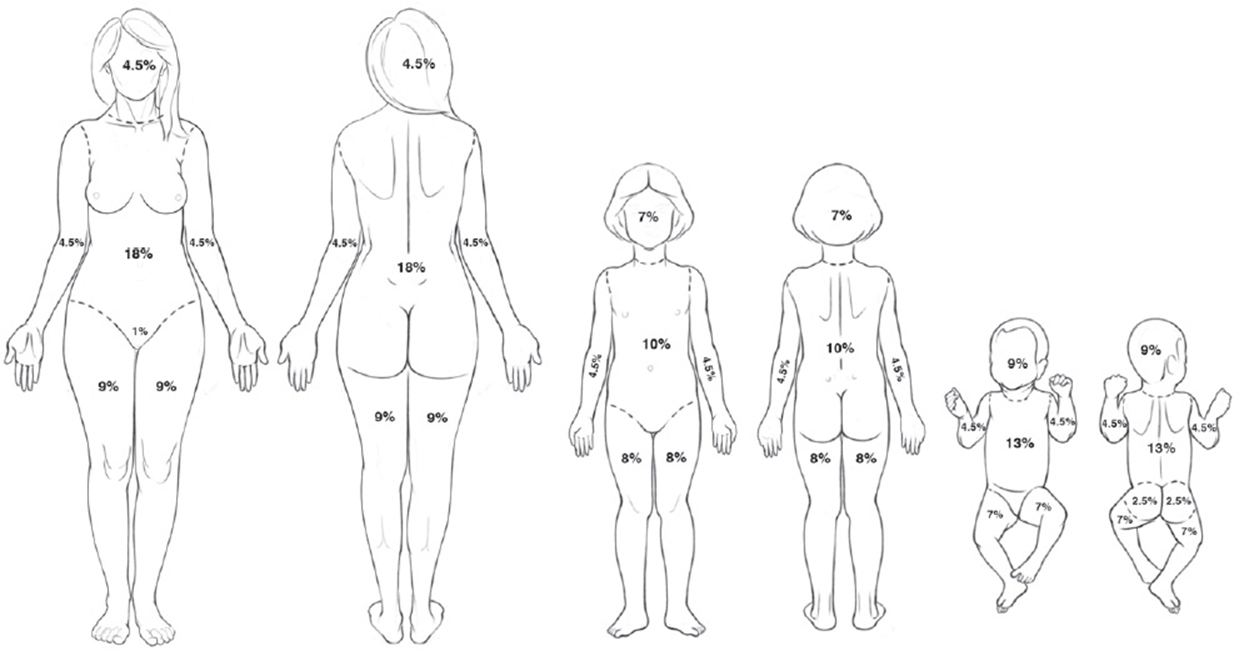
Figure 21-1. The rule of 9’s. (Reproduced with permission from Kaufman MS, Stead LG, Stead SM, et al. First Aid for the Surgery Clerkship. 2nd ed. New York: McGraw-Hill; 2009:299 [Figure 18-1].)
In the case above, each upper extremity is 9, head is 9, neck is 1 = 28% TBSA.
3. The Parkland formula is a formula used for the initial fluid resuscitation of a burn patient with >20% TBSA. It estimates the overall fluid total as 4 mL × % TBSA × weight (kg). Half of this volume is to be administered in the first 8 hours post burn, while the second half of this volume is to be administered over the next 16 hours.
The Parkland formula should only serve as a guide to resuscitation. Global (ie, lactate, base deficit, pH) and regional (ie, urine output, mental status) parameters of perfusion should be followed and trended in order to fine-tune the resuscitation volumes. Typically crystalloid is used for the first 8 hours and varying quantities of colloid (ie, albumin) are added in according to patient needs and surgeon preference. As resuscitation volumes approach and exceed 6 cm3/% TBSA/kg, the incidence of compartment syndromes and intra-abdominal hypertension increases. In such cases, the addition of colloid may allow for slightly less overall fluid administration.
In this case 4 mL × 28% third-degree burn × 75 kg = 8400 cm3. This is the total fluid to be given over 24 hours (4200 cm3/first 8 hours, 4200 cm3/next 16 hours). Since the patient presented 2 hours post injury, the first 4200 cm3 should be given over 6 hours. IVF rates would be 700 cm3/h (first 6 hours), and 262.5 cm3/h (second 16 hours).
4. Yes; because this second-degree burn involves the face, this patient should be transferred to a burn center. According to the American Burn Association the following 10 items require transfer to a burn center:
1. Partial thickness burns greater than 10% TBSA.
2. Burns that involve the face, hands, feet, genitalia, perineum, or major joints.
3. Third-degree burns in any age group.
4. Electrical burns, including lightning injury.
5. Chemical burns.
6. Inhalation injury.
7. Burn injury in patients with preexisting medical disorders that could complicate management, prolong recovery, or affect mortality.
8. Any patient with burns and concomitant trauma (such as fractures) in which the burn injury poses the greatest risk of morbidity or mortality. In such cases, if the trauma poses the greater immediate risk, the patient may be initially stabilized in a trauma center before being transferred to a burn unit. Physician judgment will be necessary in such situations and should be in concert with the regional medical control plan and triage protocols.
9. Burned children in hospitals without qualified personnel or equipment for the care of children.
10. Burn injury in patients who will require special social, emotional, or rehabilitative intervention.
5. Escharotomy: A circumferential second- or third-degree burn, on extremities or digits, has the potential to compromise circulation. A significant burn on the anterior torso has the potential to compromise ventilation. Prompt attention to such burns can prevent serious complications. The appropriate anatomic sites for escharotomies vary; however, a proper escharotomy should extend into normal skin on either end of the incision and penetrate through the dermis up to the subcutaneous tissue. The ultimate goal is decompression, while at the same time minimizing exposure of, or damage to, neurovascular structures. When possible, escharotomies should be located at the sites of standard fasciotomy incisions. This facilitates evaluation and treatment of compartment syndrome, which may accompany a massive fluid resuscitation.
TIPS TO REMEMBER
 Rule of 9’s: head 9%, each upper extremity 9%, each lower extremity 18%, anterior chest + abdomen 18%, and back 18%.
First-degree burns are not included in TBSA calculations.
<20% TBSA does not require large-volume resuscitation (ie, Parkland formula).
Parkland formula = 4 mL × % TBSA × weight/kg; give one half in the first 8 hours post injury.
Burn depth often progresses over the first 24 hours post burn.
Massive fluid resuscitation has the potential to cause secondary compartment syndrome, that is, orbital, abdominal, extremity. Treatments include increasing colloid as fluid, lateral canthotomy, paralysis, abdominal decompression, and escharotomy/fasciotomy.
COMPREHENSION QUESTIONS
1. A 33-year-old man is noted to have first-degree burns to his entire left leg, third-degree burns to his entire right leg, as well as second- and third-degree burns to his entire anterior chest and abdomen. Which of the following statements is false?
A. He may require escharotomies to his chest.
B. He will require large-volume resuscitation (ie, Parkland formula).
C. He has a 54% TBSA burn.
D. He fulfills the ABA criteria for transfer to a burn center.
2. A 20-year-old female is seen in the emergency department after scalding herself with hot soup. She is noted to have blistering of her anterior thigh with involvement of her genitals. Which of the following is most likely true?
A. She has an 18% TBSA burn.
B. She may require large-volume resuscitation (ie, Parkland formula).
C. She fulfills the ABA criteria for transfer to a burn center.
D. She should be resuscitated with albumin.
3. A 50-year-old male electrical worker was involved in a high-voltage electrical injury at approximately 8 AM. He was intubated in the field by EMS and transferred to the local emergency department where he was given 4 L of lactated Ringer’s solution and quickly transferred to a regional verified burn center. The patient arrived to the burn center at 1 PM and is noted to have a 40% TBSA burn. He is 100 kg. What should his initial fluid rate on arrival to the burn center be?
A. 1000 cm3/h
B. 1333 cm3/h
C. 800 cm3/h
D. 500 cm3/h
Answers
1. C. Only second- and third-degree burns are included in calculations of TBSA. Leg (18%) + anterior chest (9%) + anterior abdomen (9%) = 36% TBSA.
2. C. Burns that involve the genitalia, perineum, face, hands, or feet fulfill criteria for burn center transfer.
3. B. Total fluid requirement first 24 hours = 4 (40 × 100) = 16,000 cm3. Therefore, 8 L (one half the total resuscitation volume) must be given in the first 8 hours. The patient has already received 4 L in the first 5 hours; therefore, he requires an additional 4 L over the next 3 hours: 1.33 L/h.
SUGGESTED READING
Herndon D. Total Burn Care. 4th ed. Philadelphia, PA: Elsevier, Inc; 2012.