
Xavier Jimenez, MD and
Shamim H. Nejad, MD
Mr. Downey is a 35-year-old gentleman with a history of heroin dependence, alcohol abuse, and cocaine abuse, transferred from the county jail and admitted for observation after deliberately ingesting a razor blade in order to prevent being transferred to prison. He had a similar episode two months prior to this admission in which the razor blade was removed via EGD in the emergency room. On this presentation, however, he declined an EGD, demanding instead that he be operated upon. As there was no indication of an acute abdomen, he was instead admitted for observation with the plan for him to pass the razor blade on his own, and to surgically intervene only if he developed signs of peritonitis or perforation. In the emergency department, all vitals and laboratory results are unremarkable. The patient’s last use of heroin, alcohol, and cocaine was approximately six months ago, prior to his incarceration.
On admission, the patient is accompanied by two guards and is shackled at all times. On the floor he begins demanding clonazepam for the treatment of his anxiety disorder and hydromorphone intravenously for acute pain complaints. His affect ranges from irritable to angry to bouts of tearfulness. He intermittently swears at nursing staff as well as at you and your senior resident. Whenever his requests are denied or perceived to not be met, he begins to kick his bedside stand, yell, or bang his head on the bed or the floor until he is restrained by his guards and hospital security. On the second hospital day, an abdominal KUB shows the presence of not only the razor blade but also two batteries that the patient apparently ingested from the television remote in his room. When asked why he ingested the batteries, the patient again states his fear of returning to jail and his strong desire to avoid going back to prison “at all costs.” He then blames the surgical team for not treating his pain and anxiety causing him to “act out,” and threatens that if “no one listens” to him, he will do it again.
1. What diagnoses might this patient have that would explain this behavior?
2. What communication techniques would you use in approaching this patient?
DIFFICULT PATIENTS
All patients bring aspects of themselves into clinical encounters—and so do you. A distinction can be made between healthy or adaptive traits and dysfunctional or maladaptive traits. Adaptive traits include sound judgment, adequate frustration tolerance, delayed gratification, an ability to cooperate, and emotional control, whereas Mr. Downey exhibits a number of maladaptive traits. He experiences emotion dysregulation, moving quickly from irritability to anger to sadness. He also shows low frustration tolerance and an inability to delay gratification, as evidenced by his outbursts when not given what he requests. In addition, he overtly attacks and devalues members of the clinical team, with little, if any, regard for their concerns. His history of polysubstance dependence and requests for numerous medications also suggest generally poor coping mechanisms for managing stress or pain. Globally, Mr. Downey lacks impulse control, sound judgment, and insight into his maladaptive traits.
Clinicians also carry aspects of their own identities and personalities into clinical encounters, and at times they can feel strong emotional reactions to their patients. This is particularly the case in difficult patients, especially those who devalue others or malinger symptoms. As such, Mr. Downey likely inspires negative feelings in clinicians involved with him, including discomfort, fear, anxiety, or anger. This can lead to avoidance or neglect of the patient by the clinician, contributing further to the patient’s emotional and behavioral outbursts, which in turn leads to ever-more clinician resentment. In an effort to break this cycle, it is important to identify these reactions, and to discuss them openly with team members and supervisors.
Psychiatry can be consulted to assist in management with difficult patients. For instance, certain symptoms may be amenable to pharmacological management. Mr. Downey exhibits a labile mood and poor impulse control, suggesting the possible role for a dopamine antagonist if his outbursts cannot be otherwise managed. In the event of severe agitation or violence, patients may benefit from a dopa-mine antagonist as needed for behavioral control. This may reduce the incidence of agitation and violence along with decreasing the need for physical restraints. Benzodiazepines may need to be used in conjunction with dopamine antagonists to control extrapyramidal side effects and to potentiate the antipsychotic’s effect, but must be used with caution in any patient with a history of substance abuse, as Mr. Downey has. Ultimately, very close or constant observation may be necessary in order to prevent further ingestion of items that will prolong his stay. This is particularly important as a patient improves medically and surgically as disposition out of a structured setting, such as a hospital, causes some patients to regress psychologically with resulting behavioral dysregulation. Other indications for consulting psychiatry include instances in which a patient may lack the capacity to accept or refuse treatments based on poor judgment or insight, as well as general breakdowns in communication or cooperation with the treatment team.
Answers
1. It is important to rule out any conditions (medical and psychiatric) that contribute to maladaptive expressions or behaviors. This includes mood disorders (eg, bipolar illness), anxiety disorders (eg, PTSD), psychotic disorders, delirium, factitious disorder, malingering, or substance-induced states. When traits appear in the absence of other conditions and are pervasive, fixed, and severely maladaptive, it is important to seriously consider a personality disorder, although generally it requires a longitudinal history of this behavior before labeling a difficult patient with this kind of diagnosis. Personality disorders must be diagnosed with caution, as once a patient is labeled as such, it may make it difficult for the surgical team to treat the patient objectively without their own emotions interfering. Table 54-1 describes the various personality disorders. Mr. Downey has normal laboratory values and vitals, has not recently used mood-altering substances, is otherwise physically healthy, and has been admitted in the past for similar reasons. He very well might, therefore, have a personality disorder. However, he is clearly attempting to obtain secondary gain (remaining out of prison) by his behavior, and so malingering would be high on the differential list in this case too.
Table 54-1. Personality Disorder Diagnoses
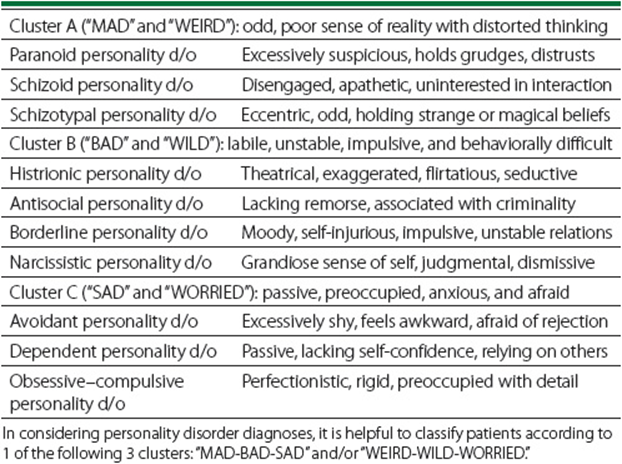
Given his maladaptive traits (lack of remorse for others, poor impulse control, emotional dysregulation, limited coping, etc), a history of incarceration, and the deliberate creation of medical problems with specific aims, Mr. Downey most likely is demonstrating malingering. He may also fit within Cluster “B” pathology and may fit the diagnosis of antisocial personality disorder.
2. Communicating with Mr. Downey may be difficult, but there are general techniques that can be used. First and foremost, a united, clear, and consistent message must be utilized when communicating with all difficult patients. Although most common in borderline personality disorder, all patients are capable of unintentionally splitting treatment teams so as to cause disagreements and difficulties that lead to disrupted care and poor outcomes. In addition, it is paramount that certain boundaries be clearly defined and maintained with all patients utilizing maladaptive traits.
A common technique equally useful for difficult, demanding, hostile, or dependent patients is scheduling specific, time-limited sessions that are entirely and solely treatment based (eg, seeing hospitalized patients twice at 8 AMand 1 PM daily for 15 minutes each, going over very specific treatment agendas). Informing the patient of the schedule up front and then enforcing it is crucial. One will need to cater the content of these sessions depending on the person’s traits. For example, obsessive–compulsive personalities often dwell on details and minutiae; it may be helpful to enlist them in keeping track of their own recovery (vital signs, labs, medication regimen) while keeping them informed when small fluctuations and insignificant changes are not to be worried about to minimize anxiety.
Considerable anxiety, worry, and stress related to medical conditions, immobility, loss of function, or pain are each very real experiences. Empathizing with such an experience can be challenging due to a patient’s toxic demeanor and attitude but also very powerful in creating an alliance. The principal mechanism of empathy is validation or acknowledgment of a patient’s concerns. Empathy is a direct recognition of what the patient is experiencing and reflection of it back in a clear, simple, and nonjudgmental language. In Mr. Downey’s example, one might recognize his concerns and confirm them with empathic statements (eg, “It must be terrifying to think about going to prison.”) rather than with less empathic questions (eg, “What are you so worried about?”). Additionally, one may attempt to normalizeconcerns expressed by a patient (“Your reaction to a prison sentence is natural.”), paving the road to a shared understanding. A patient who is validated in this manner may sense genuine concern and engage in a more cooperative dialogue, leading to shared clinical goals. Finally, depending on the patient’s values, it is important to identify others who may assist in enhancing communication, including but not limited to family members, friends, intimate partners, social work, or clergy. In some instances, consultation with a psychiatric service may be indicated.
TIPS TO REMEMBER
 Personality disorders are organized in clusters according to general attributes (mnemonics of “BAD-MAD-SAD” and “WEIRD-WILD-WORRIED”).
Psychiatric consultation can assist in the management of difficult patients, especially in cases of severe aggression, behavioral outbursts, breakdowns in communication, or poor judgment suggesting a lack of decision-making capacity. It should be said, however, that simply disagreeing with the surgical team does not mean a patient lacks decision-making capacity!
Empathic validation and normalization packaged in statements (rather than questions) can increase the therapeutic alliance when working with difficult patients.
Splitting should be reduced with unified and consistent messages. Specific and focused sessions can be useful when working with hostile, demanding, or dependent patients.
Awareness of clinician feelings and reactions to difficult patients can prevent worsening in communication and cooperation with such patients.
COMPREHENSION QUESTIONS
1. Mr. J is a 44-year-old man who requires imminent below-the-knee amputation. He refuses on numerous accounts, reporting doctors cannot be trusted and that he generally shuns medical advice. On exam, he is oriented to time and space, reveals a flattened affect, and communicates various inaccurate thoughts, including that the infection will heal on its own. He wishes to be discharged. What is the next course of action?
A. Respect his autonomy and discharge the patient with oral antibiotics.
B. Consult psychiatry to evaluate for a psychotic disorder and capacity for decision making.
C. Override the patient’s autonomy and operate emergently.
D. Treat empirically with antipsychotic medications.
2. A 31-year-old woman is admitted to the ICU for close observation after reportedly ingesting an entire bottle of acetaminophen as well as causing self-inflicted burns to her arms with her gas stove. These occurred in a fit of rage after her boyfriend of three months announced he would leave her. Her psychiatric history includes brief trials with antidepressants but no current treatment. She has seen literally dozens of psychiatrists. She has been admitted to psychiatric services over a dozen times since the age of 18, but she denies any serious suicide attempts. She was diagnosed with a personality disorder at age 19. Which of the following best characterizes this patient’s recurrent behaviors?
A. Paranoid personality disorder
B. Antisocial personality disorder
C. Borderline personality disorder
D. Dependent personality disorder
3. Mrs. K, a 56-year-old retired nurse with no significant medical history, is sent to the ED by her outpatient surgeon who performed an unremarkable elective hernia repair three weeks prior. Postoperatively, she has healed poorly with numerous bouts of fever, night sweats, and fatigue. She has not responded to trials of antibiotics, and her surgeon is perplexed. On admission, blood cultures are drawn, revealing a gram-negative bacteremia. Her surgical site is erythematous and grossly infected. She is given IV antibiotics, but after numerous days in the hospital, a nursing assistant witnesses Ms. K rubbing something vigorously into her wound site. On confrontation she breaks down but cannot explain her behavior and is very ashamed. She begins to describe numerous difficulties at home, including a tumultuous divorce, an unruly son who was recently arrested, and chronic financial struggles including potential bankruptcy. Which of the following statements would you use in approaching Mrs. K at this point?
A. “Why are you infecting yourself?”
B. “It makes perfect sense that you are overwhelmed.”
C. “Maybe you don’t need to be in the hospital.”
D. “You don’t seem to want to be better.”
Answers
1. B. Mr. J is refusing a presumably lifesaving intervention, and it is important to establish whether he has the capacity to refuse treatment. It is unclear at this point if he is simply uneducated about his disease, is afraid of doctors because he or a family member has had a bad experience in the past, has a psychotic illness, or is under the influence of a substance. Clarification of diagnosis, decision capacity, and whether dopamine antagonist medication is indicated may result from consultation with a psychiatrist. Although patient autonomy is an important value to uphold, discharging this patient prematurely may cause significant harm or even death.
2. C. This patient exhibits mood dysregulation, intense interpersonal relationships, impulsivity, a history of self-injury, and suicidal behavior in the absence of other psychiatric or medical explanations. She has had a long history or psychiatric contact and psychiatric hospitalizations since age 18, giving one a very longitudinal history, and she tells you she has been diagnosed with a personality disorder. The maladaptive traits discussed here are present in Cluster B (“BAD AND WILD”) personality disorders, with borderline personality disorder being the most likely diagnosis.
3. B. Patients with suspicious symptoms (in this case, symptoms of a likely factitious disorder) can become very defensive when confronted, and may continue problematic behaviors if not empathically validated at some level. Mrs. K would benefit from normalization of her feelings, but not of her behavior. Gentle confrontation of her emotional difficulties can pave the way for a therapeutic alliance. Psychiatry consultation should be obtained on most suspected cases and perhaps a referral to social work for psychosocial support would be helpful.