
Mayank Mohan Agarwal1 and Yogesh R. Barapatre1
(1)
Department of Urology, Postgraduate Institute of Medical Education and Research, Level II, B Block, Nehru Hospital, PGIMER, Sector 12, Chandigarh, 160012, India
Mayank Mohan Agarwal
Email: drmayank.22@gmail.com
Abstract
Symptom of urinary incontinence is the presentation of several abnormalities in the function of lower urinary tract (LUT) and the etiologies are varied. Similarly, pelvic organ prolapse (POP) can give rise to various LUT symptoms most commonly urgency and difficulty in voiding, and it can mask stress urinary incontinence. The initial management of mild/moderate incontinence and small degree of POP is conservative, incorporating pelvic floor muscle training, behavioural modification and medications. Urodynamics (UDS), in broad sense, is required during initial evaluation in the form of bladder diary (urolog) and measurement of postvoid urinary volume with or without uroflowmetry. Invasive multichannel UDS is required when the initial treatment fails and more insight is required into pathophysiological basis of the symptomatology. The armamentarium of multichannel UDS includes cystometry, pressure-flow study, urethral pressure profilometry with or without electromyography, and fluoroscopic surveillance (video-UDS). The best study would be decided by the physician based on the urodynamic question(s). The interpretation of urodynamic investigation is best done in real-time during the investigation or immediately after it; therefore, the treating physician/team member should be directly involved in the study. Indications of various urodynamic tests, current armamentarium of multichannel UDS, its strength and limitations in current understanding are discussed in the chapter.
Women with pelvic floor disorders present with a myriad of symptomatology. It may range from stress urinary incontinence and pelvic organ prolapse (POP), urgency with or without incontinence, to voiding/defecatory dysfunction or pelvic pain/dyspareunia. Initial evaluation is almost entirely clinical, i.e. a detailed history and thorough clinical examination; an ultrasound of kidney–ureter–bladder–pelvis may be added (in my clinical practice, rather liberally) considering it an ‘extension of clinical examination’. Urodynamic assessment starts at this stage only in the form of bladder diary or the urolog.
It must be understood at this point that urodynamic study (UDS) must not be performed for every patient with the goal of achieving a definitive diagnosis in one test. Initial treatment for any incontinence in women is behavioural, physical, and medical after non-invasive evaluation as described above. Invasive urodynamic evaluation, in other words a definitive urodynamic diagnosis, is needed only when it would make a difference in the management.
Urolog
The Urolog, is an extremely helpful, non-invasive tool to document the patient’s drinking habits and voiding patterns over a finite period of time. Often, it is the sole metric to initiate treatment. At the most basic level, a voiding diary is just what it sounds like: a schedule for going to the bathroom. For a 24- to 48-h period the patient records all fluid intakes, and measures and records all urine output, including frequency and episodes of leakage. These data are beneficial to the physician because they clarify home voiding patterns, particularly in the elderly. They are often useful to patients as well because they provide a focus on the problem (feedback) and can serve as a baseline for treatment interventions such as behavioural training, bladder training, and pharmacologic management. This type of diary answers a lot of questions about bladder health and patterns, and creates a baseline picture of bladder control. A prototype of bladder diary used at our institute is given in Fig. 2.1.

Fig. 2.1
Bladder diary prototype. (Courtesy of Postgraduate Institute of Medical Education and Research, Chandigarh, India.)
The following information can be readily interpreted from a comprehensive urolog:
(a)
(b)
(c)
(d)
The problem of a comprehensive bladder diary is patient-compliance. The following simpler modifications are often clinically used:
(a)
(b)
Diary duration may be an important factor in terms of the reliability/representativeness of symptoms; longer diary duration is known to provide less variable diary data. Thus, a 7-day diary would be more reliable than a 3-day. The most appropriate duration of the test has not been established. Whatever the duration, it would be preferable to have diary of a weekday and a weekend to evaluate for a ‘psychogenic voiding pattern’. Further details on various patterns on the urolog would be redundant here and can be found in appropriate text books.
Uroflowmetry
Uroflowmetry is defined as a measurement of rate of urine flow over time. It is easy to perform, non-invasive and requires little time and preparation. It is reflection of the final result of the act of voiding and therefore influenced by a number of variables. These include effectiveness of detrusor contractions, completeness of sphincteric relaxation, patency of urethra and, in females, adequate support of pelvic organs. It is very useful in selecting patients presenting with voiding dysfunction for more complex urodynamic testing. It also provides an objective way of determining response to treatment of certain diseases, e.g. flow after sling surgery. Since women are poor historians as far as LUTS are concerned, it is prudent to screen with uroflowmetry before undertaking invasive procedure for any pelvic floor dysfunction, whether incontinence or prolapse.
Various types of uroflowmeters are available for measurement of uroflow, viz gravimetric, rotating disc, electronic dipstick, and integral trap magnetic type. Whatever type, it is important to conform to certain standardization requirements. The International Continence Society (ICS) technical report [1] recommends a range of at least 0–50 mL/s for Qmax, 0–1,000 mL for voided volume, maximum time constant of 0.75 s, and an accuracy of +5 % relative to full scale. Uroflowmeter can be, rather preferably, set up in a toilet where tension-free, conducive environment with adequate privacy can be arranged for a hassle-free void.
Normal Uroflow Curve
The flow curve is characteristically a bell-shaped curve (Fig. 2.2) whose Qmax is achieved within initial 1/3rd of total voiding time. The relevant quantitative parameters obtained from the free flow curve are Qmax, Qave (= voided volume/flow time), flow time, voided volume, and postvoid residual urine (ultrasound).
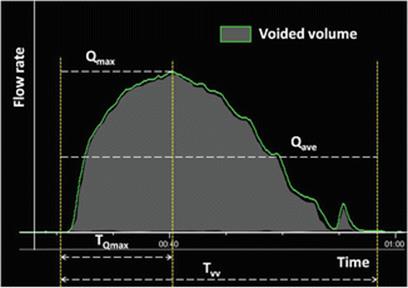
Fig. 2.2
A typical normal flow curve showing various measurements
Flow rate is affected by many factors, including volume, psychological inhibition, age, race, and abdominal straining. Volume is the single most important determinant of flow rates; therefore, it is imperative to mention volume with Qmax for correct interpretation. Flow–volume nomograms (Fig. 2.3) and volume normalized flow rates (cQ) are two ways to aid in interpretation [2, 3]. Since flow and volume share a quadratic relation, cQ = Q (max or average)/√bladder volume (voided volume + postvoid residue). This value is considered to be a constant for a given individual for a given condition of outlet over wide range of volumes. We found the following values [median (interquartile range)] in Indian population.
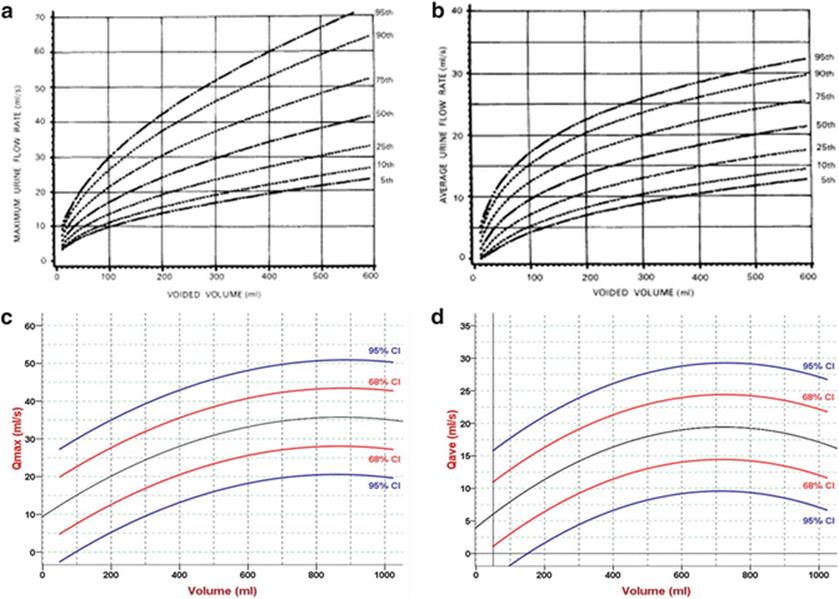
Fig. 2.3
Flow–volume nomograms for women: (a, b) liverpool nomograms for Caucasian women, and (c, d) PGIMER nomograms for Indian women. (From Barapatre Y, Agarwal MM, Singh SK, et al. Uroflowmetry in healthy women: development and validation of flow–volume and corrected flow–age nomograms. Neurourol Urodyanm 2009; 28(8): 1003–9, with permission.)
cQmax = 1.39 (1.14 − 1.66)
cQave = 0.79 (0.62 − 0.96)
We found this concept to be useful in our clinical practice akin to body mass index.
Uroflow Curve Patterns
Various abnormal flow patterns have been described (Fig. 2.4):
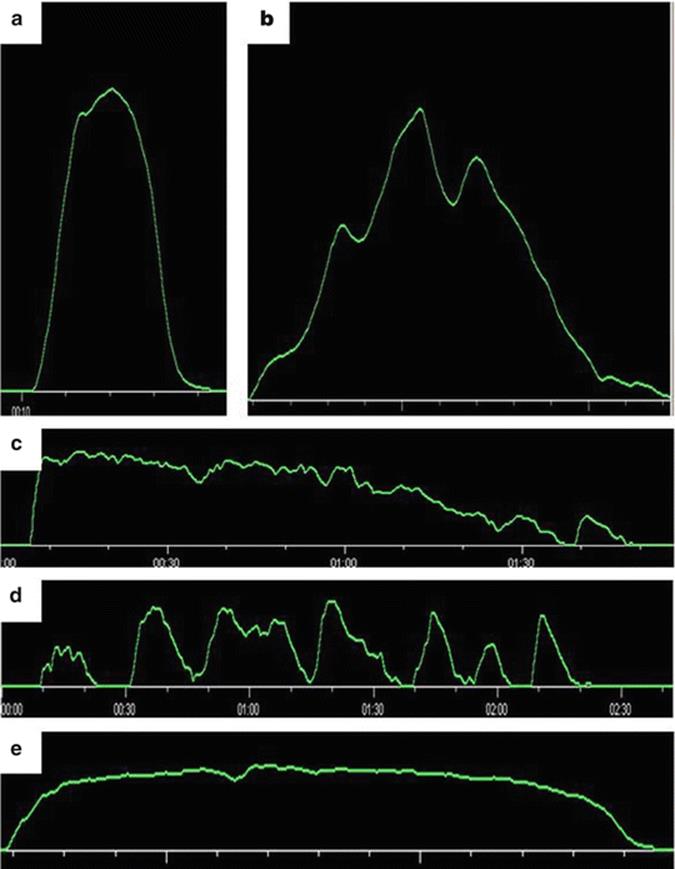
Fig. 2.4
(a) A peaked pattern of hypervoider; (b) a stattaco pattern; (c) compressive obstruction; (d) straining pattern; (e) constrictive obstruction
· Supervoid/hypervoid: a peaked curve, high Qmax with short voiding time. Often seen in patients with bladder overactivity
· Compressive obstruction: Qmax is reached early in the flow and then a prolonged tail continues
· Constrictive obstruction: a box-shaped plateau curve
· Intermittent curve: straining pattern
In the presence of abnormal flow pattern with normal urethral calibration, usually invasive UDS will be the next logical step.
Multichannel Urodynamics (UDS)
Uroflowmetry is the final outcome of function of bladder and status of urethral resistance. Therefore, it cannot differentiate between detrusor underactivity and bladder outlet obstruction. If further information is needed for management, invasive multichannel UDS would be required. It comprises pressure-flow analysis and urethral pressure profilometry (UPP) with or without fluoroscopic surveillance (video-urodynamics [VUDS]). The key component for pressure-measurement is a pressure transducer which converts mechanical energy into electrical signals.
For urodynamic apparatus, technical recommendations of the Working Party of Urodynamic Equipment of the ICS have been published [1] and are available on its website (www.icsoffice.org). Briefly, the transducer requirements are as follows:
· Pressure range—0–300 cmH2O
· A sensitivity drift with temperature—less than 0.1 %/°C
· Linearity and hysteresis deviation—equal or less than ±1 % over pressure range 0–100 cmH2O
· Should be able to sustain an overload pressure of 1,500–5,000 cmH2O. The calibration should not change >1 % once overload pressure is removed
· A zero offset signal (a small electrical output from transducer in the presence of zero pressure) should not change >0.1 cmH2O/°C with temperature
Multichannel UDS is always an embarrassing investigation for patients, since the woman’s private parts are exposed and touched. Therefore, no stone should be left unturned to put the woman at ease, so that she will tolerate the investigator ‘staring’ at her introitus. Privacy should be respected at all times.
As discussed above, UDS is required for further classification and quantification of cause of LUTS in patients presenting with incontinence and POP when it would make a difference in the management. A UDS is generally not warranted when presentation is purely prolapse symptoms, i.e. ‘something coming out’ with or without dragging in pelvis getting relieved on repositioning the prolapse. Similarly, it may possibly be omitted before midurethral sling surgery in a woman in menstrual age group presenting with pure stress urinary incontinence of moderate degree, and urethral hypermobility is demonstrable on clinical examination. However, scientific societies lack consensus on this aspect.
Nevertheless, it would be preferable to undertake a UDS before surgical intervention in the following circumstances in women:
· Severe stress incontinence, previous pelvic radiation, previous anti-incontinence surgery.
· Overactive bladder symptoms, with or without incontinence, with or without stress incontinence symptoms.
· Voiding difficulty associated with incontinence or POP.
· POP associated with LUTS, including in-continence.
· Poorly definable or variable symptoms.
· Associated with diseases which can affect the function of LUT/pelvic floor, e.g. diabetes mellitus, Parkinson’s disease, cerebrovascular accident, and prolapsed intervertebral disc.
Various experts have suggested routine use of UDS before any anti-incontinence surgery, be it sling surgery for SUI or onabotulinum toxin A/sacral neuromodulation for urge incontinence. It not only provides useful information for understanding the condition of LUT and planning of treatment, but also helps in more informed counselling and prognostication. A significant minority of women presenting with ‘pure SUI’ actually have detrusor overactivity and urethral relaxation type voiding pattern (without significant detectable detrusor contraction) which may become unmasked after surgery (Fig. 2.5). Similarly, performing UDS in case of POP, both before and after reduction of POP before surgery may provide clue to occult stress incontinence and provide functional correlate to improvement (or not) in clinical symptomatology.
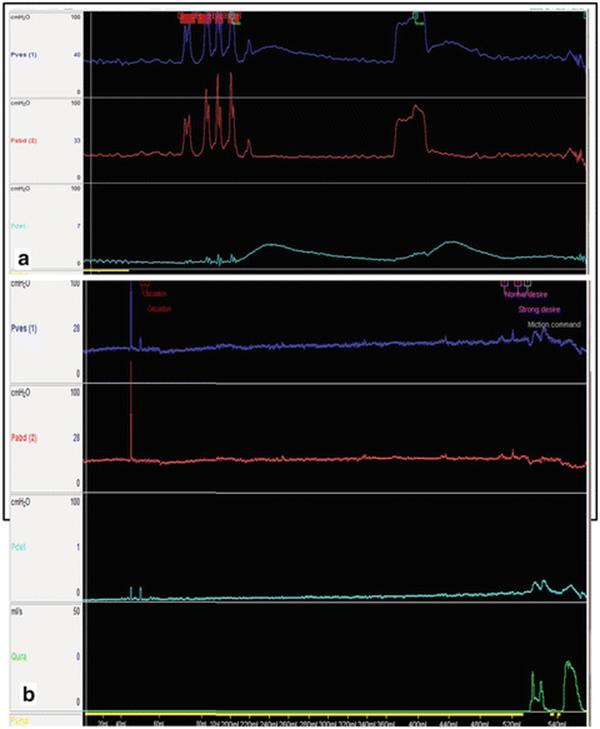
Fig. 2.5
(a) Stress-induced detrusor overactivity in a woman presenting with pure SUI symptoms; (b) urethral relaxation type voiding pattern without significant rise in detrusor pressure during voiding in a woman with severe SUI without urethral hypermobility
Advantages of UDS evaluation in women with incontinence:
· Description of detrusor activity during filling.
· Determination of bladder compliance.
· Confirmation of incontinence and its cause.
· Assessment of detrusor voiding function.
· Assessment of degree of sphincter weakness.
· Assessment of pelvic floor function.
· Assessment of urethral function.
Various classification systems exist for LUT dysfunction. Out of these, the ICS and expanded functional classifications provide the most reasonable platforms for understanding the pathophysiology of LUT dysfunction in a given patient and planning/prognosticating its treatment-outcome. A classification scheme used at our institute adopted from the ICS is presented in Table 2.1.
Table 2.1
Urodynamic description based on International Continence Society classification
|
Storage phase |
Voiding phase |
|
|
1. Bladder function |
1. Bladder function |
|
|
(a) Detrusor activity: normal/overactive (neurogenic/non-neurogenic) |
(a) Detrusor activity: normal/underactive/acontractile |
|
|
2. Urethral function |
||
|
(a) Normal/abnormal |
||
|
(b) Bladder sensation: normal/hypersensitive/hyposensitive/absent |
(b) Location of obstruction—from bladder neck |
|
|
(c) Degree of obstruction—Blaivas’ criteria, AG no. (?), DAMPF (?), Pura—Pves (max) |
||
|
(c) Bladder capacity: normal/high/low |
||
|
(d) Bladder compliance: normal/high/low |
||
|
2. Urethral function |
||
|
(a) Closure mechanism: normal/incompetent |
||
|
(b) Maximum urethral closure pressure |
||
|
(c) Urethral profile length |
||
|
(d) Leak point pressures (ALPP/DLPP) |
Cystometry: Filling and Voiding (Pressure-Flow Analysis)
A free uroflowmetry should be done before UDS as described above since it would be required for a combined interpretation. Patient should be seated comfortably on the urodynamic chair. Multipurpose UDS chairs are available some of which are also radiolucent and can be electromechanically made into various positions/heights (Fig. 2.6). The patient is placed in reclining position which helps placement of catheters and electrodes. Alternatively, if a sophisticated chair is not available, placement of catheters and filling cystometry can be performed in supine position on a couch. Subsequently, she can be shifted to the micturitional chair for a voiding phase. Of course, this method is more cumbersome. During voiding the patient may be asked to be in sitting or squatting position (whichever is her preferred voiding position), the urethral meatus should be clearly visible and a light source like torch should be available for assessment of urinary leak. The latter is very important and we believe that it is more sensitive than a fluoroscopic contrast assessment of leakage. Three types of measurement systems (catheter-transducer) are available, i.e. fluid infusion system, air-charged system and catheter-mounted microtip-transducer. Of these, the former is most widely available system.
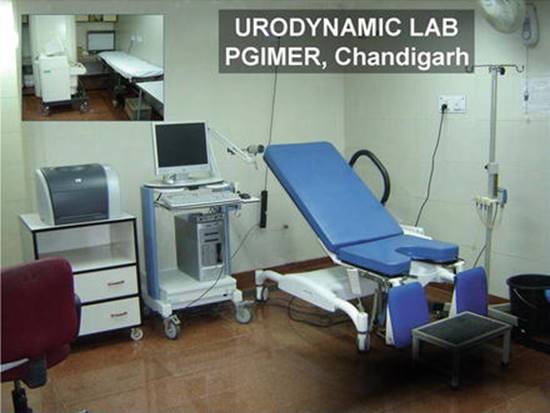
Fig. 2.6
Urodynamic suite at our institution showing the Sonesta Stille radiolucent urodynamic chair, the Solar Silver® urodynamic apparatus (MMS International, the Netherlands) and (inset) ultrasound machine
A 6Fr double-lumen cystometry catheter is placed in the bladder and taped to the skin. Balloon rectal catheter (5–8Fr) is then placed; care is taken to place the balloon above anorectal junction without any kink in the tubing (Fig. 2.7a, b). The catheters are then attached to respective pressure transducers kept at the level of superior border of the pubic symphysis. After flushing out air from the catheter-transducer system, the transducers are zeroed to the atmosphere before starting the study. Surface Electromyography (EMG) electrodes (preferably button electrodes) are placed in the perianal region.
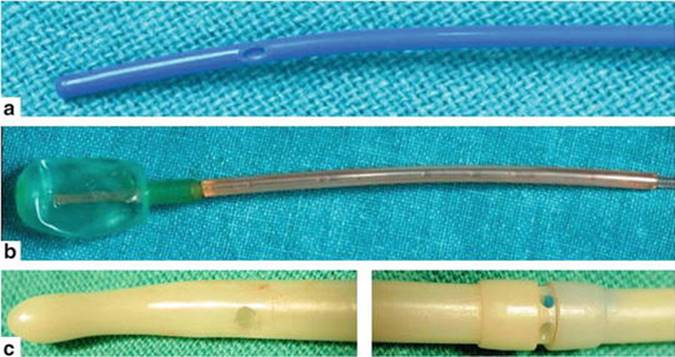
Fig. 2.7
Fluid perfusion urodynamic catheters, (a) a 6Fr double lumen cystometry catheter; (b) an 8Fr single lumen perforated balloon rectal catheter with inserter; (c) a 7Fr triple lumen urethral pressure profilometry (UPP) catheter
The common filling medium is sterile normal saline (0.9 % w/v). Alternatively, a diluted iodinated contrast medium is used if video-fluoroscopic surveillance is needed. It is important to calibrate the uroflowmeter to the density of the fluid used. Ideally, the fluid should be warmed to body temperature to avoid artefacts due to bladder irritation at cold temperature. The filling is started at physiological rate which has been defined as 1/4th of the body weight or less. Alternatively, a moderate fill rate (~50 mL/min) or ~10 % of functional bladder capacity (from bladder diary) can be used. Often, the first filling cycle may show artefacts due to rapid filling; therefore, it is prudent to repeat a filling-voiding cycle at the same sitting. To further allay anxiety and to develop a repo with the patient a light conversation should continue throughout the procedure and the following sensations are marked—first sensation, first desire, normal desire, strong desire, urgency (if felt), and maximum cystometric capacity (Fig. 2.8). Any leakage associated with urgency/detrusor overactivity is marked.
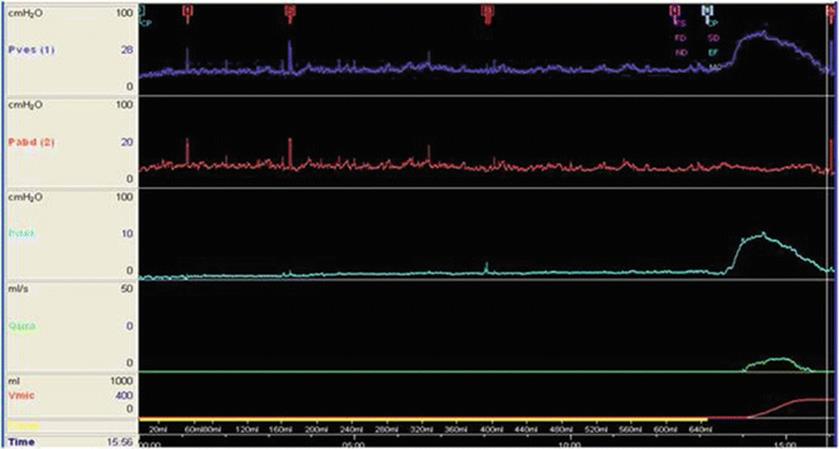
Fig. 2.8
Irregular baseline of Pves and Pabd indicates continuous conversation between doctor and patient during the study. Cough response during filling and at the end of the study suggests good equivalence between Pabd/Pves
The following measurements are relevant in cystometry from the point of view of urinary incontinence:
Detrusor Overactivity
It is a urodynamic observation characterized by involuntary detrusor contractions of any amplitude during the filling phase which may be spontaneous or provoked. It can be provoked by rapid filling, use of cooled or acidic filling medium and hand wash. The term ‘detrusor overactivity’ replaces the previous term ‘detrusor instability’ as well as its definition of at least 15 cmH2O amplitude. Detrusor overactivity is of two types as follows (Fig. 2.9):
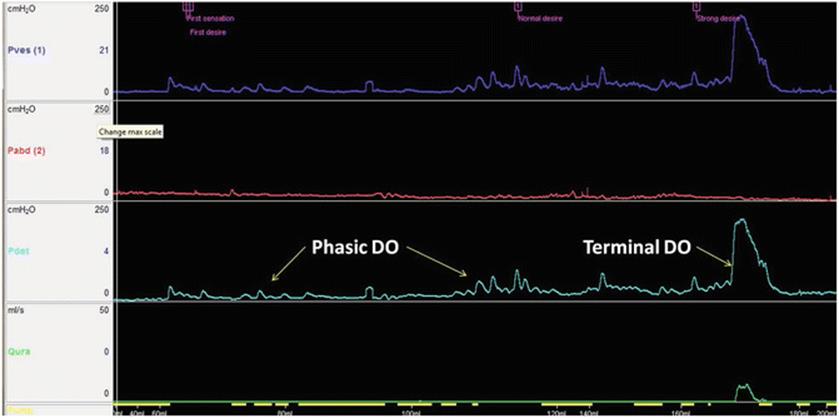
Fig. 2.9
A filling phase multichannel UDS graph showing phasic as well as terminal DO in a patient with urge incontinence and obstructive voiding
1.
2.
It is not only important to be able to diagnose DO but also to quantify it. There have been efforts to develop indices of severity taking into account summation of all DO amplitudes or area under curve as a function of cystometric capacity (e.g. ∑Pdet/MCC or PdetAUC/MCC). However, unfortunately, none of these concepts have been standardized.
Abdominal Leak Point Pressure
Similar to maximum urethral closure pressure (MUCP), abdominal leak point pressure (ALPP) is a measure of obstructive quality of urethra in storage phase. It is defined as the intravesical pressure at which urine leakage occurs due to increased abdominal pressure in the absence of a detrusor contraction. A value <60 cmH2O is considered indicative of intrinsic sphincteric deficiency. It is measured at bladder volumes 150–250 mL, preferably in upright position. It can be measured by either graded cough or progressive Valsalva manoeuvre (Fig. 2.10).
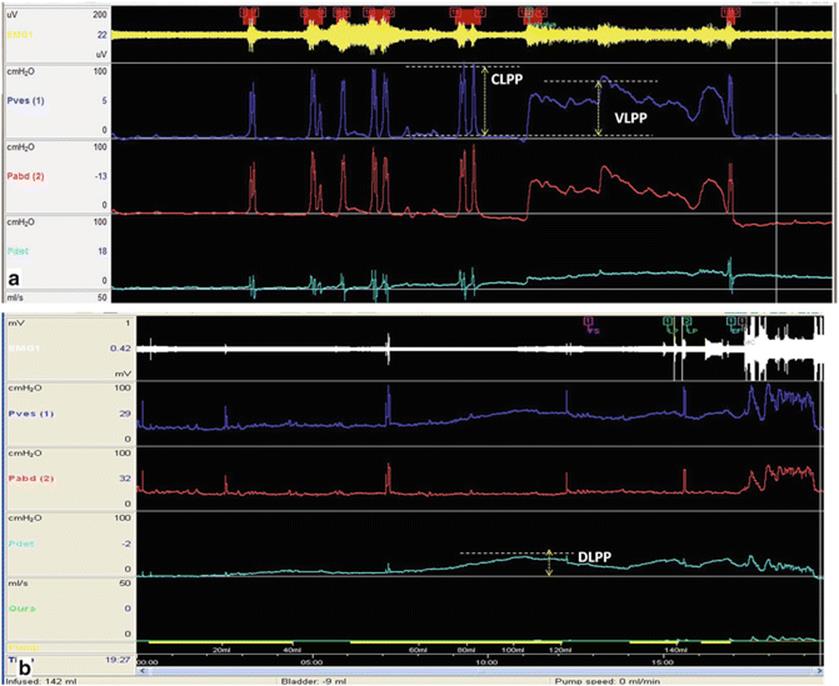
Fig. 2.10
Leak point pressure measurement. (a) Abdominal leak point pressures in a patient with stress urinary incontinence—difference in CLPP and VLPP is notable; (b) Detrusor leak point pressure in a patient with voiding dysfunction after repair of complex vesicovaginal fistula—this patient presented with bilateral hydroureteronephrosis with thick-walled bladder, which can be explained by high DLPP. Compliance in this patient had an active component suggested by a drop in Pdet on stopping flow
The latter is considered more representative for a couple of reasons, firstly there is no significant reflex pelvic floor contraction during this manoeuvre (unlike cough) and secondly the pressure rise is more controlled and graded and therefore more accurately measurable. It is based on the assumption that the 6–8Fr catheter present in the urethra does not change the measurements significantly or change the urethral disposition during stress. Although the technical aspects of measurements of ALPP have not been evaluated comprehensively, the ALPP value correlate reasonably with MUCP and in fact correlate more closely to the presence of ISD compared to the latter. During measurement, the leak is observed either directly at the meatus or using fluoroscopy; we prefer the former method. It has been found that ALPP and MUCP when considered together are more predictive of ISD from the perspective of surgical results [4].
In case the investigator is not able to demonstrate the leakage with stress manoeuvre (the urodynamic stress incontinence; USI), there are various ways to demonstrate the same.
(a)
(b)
(c)
Bladder Compliance
It indicates the status of accommodation function of the bladder. Normally the bladder should ‘accommodate’ the urine/filling fluid without much rise in Pdet (<10 cmH2O) over filling volume 300–500 mL. Therefore, the compliance, defined as maximal cystometry capacity/end fill Pdet (considering it zero at zero volume) normally ranges from 30 to 50 mL/cmH2O. A compliance less than 12.5 mL/cmH2O is considered risk factor for damage to upper urinary tracts. Sphincteric urinary incontinence in women having poor compliance (e.g. pelvic radiation, neurogenic bladder) is a kind of ‘safety valve’ and therefore, it is of paramount importance to improve compliance before any anti-incontinence procedure. Compliance has two components, passive (interstitial tissue and collagen) and active (detrusor); only the latter component is sensitive to pharmacological interventions. Urodynamically, the two components of the compliance can be differentiated by stopping the filling for about 2 min and watching for decrease in Pdet (and hence improvement in compliance) (Fig. 2.10b).
Detrusor leak point pressure (DLPP) is a measure of implication of poor compliance on upper tract drainage into bladder. Pioneered by Dr J McGuire in children with meningomyelocoele, it is defined as detrusor pressure in the absence of an active detrusor contraction at which urinary leakage occurs (Fig. 2.10b). DLPP >40 cmH2O is associated with upper tract damage.
Voiding Phase
After completion of filling and stress phases as described above, the patient is asked to void into uroflowmeter with the catheter in situ. Some women would be habitual to void with variable amount of abdominal straining; however, the patient is encouraged to relax during voiding and avoid straining at all cost. This is to avoid artefacts during the study and correctly measure the contribution of active detrusor contraction for voiding. This is important since a low Pdet during voiding (PdetQmax <12 cmH2O) has been associated with increased incidence of voiding dysfunction after midurethral sling procedures for incontinence (Fig. 2.5b).
Diagnosis of bladder outlet obstruction in women is not as straightforward as in men since definitions lack standardization. Concept of bladder outlet obstruction index and Abrams-Griffiths nomogram are not applicable in women. Various criteria have been laid down, as follows:
(a)
(b)
(c)
(d)
Urethral Pressure Profilometry
This UDS is indicated when the clinician is interested in knowing the function of urethra. Similar to cystometry, urethrometry, or the UPP is performed both during storage and voiding phase. During storage, it is performed during rest as well as stress manoeuvres.
A triple lumen 7Fr UPP catheter is placed in bladder, connected to appropriate transducers and fixed to an automated motor-driven puller. The catheter has three apertures, the one close to the tip for cystometry, one of the two proximal ones for urethrometry and third for fluid infusion (Fig. 2.7c).
Resting UPP
After 50–100 mL filling, the filling rate is decreased to 2–6 mL/min and puller is started to pull the UPP catheter at a predefined fixed rate (we typically keep at 2 mm/s). Once the urethral pressure aperture reaches functional bladder neck, the Pura graph shows an uprising pattern whereas the Pves continues to be at the baseline. In this way the pressure along the whole of the urethra is recorded.
Maximum Urethral Closure Pressure
Urethral closure pressure (Pclo) is defined as the urethral pressure over and above vesical pressure (Pclo = Pura − Pves) (Fig. 2.12). Understandably, it indicates the urethral resistance during storage and its maximum value (i.e. MUCP) indicates the occlusive quality of the urethra. Normally, it ranges from 40 to 60 cmH2O; a value of less than 20–30 cmH2O is often defined as intrinsic sphincter deficiency and is associated with poorer surgical outcomes, particularly with suspension procedures.
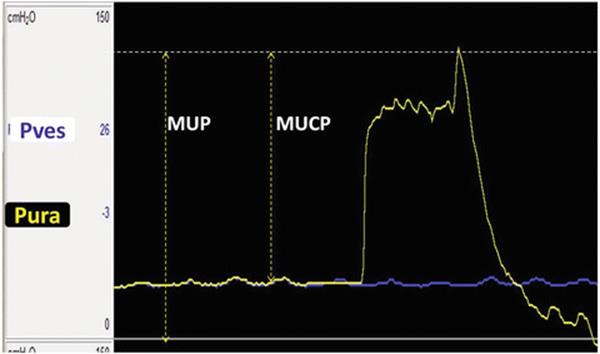
Fig. 2.12
A resting urethral pressure profilometry of a woman showing calculation of maximum urethral closure pressure
Urethral Relaxation Incontinence
This is measured during resting UPP cycle. Previously known as ‘urethral instability’ it is an uncommon phenomenon, sometimes detected in women presenting with large volume urinary leakage without prior warning/urgency. It is defined as a fall of Pura >15 cmH2O during filling without concomitant rise in abdominal pressure or detrusor overactivity. Alternatively, maximum urethral pressure variation ratio of 33 % or more (∆MUPX100/highest MUP) is considered indicative of this condition. It is not clear whether or not it is a variant of a prematurely activated micturition reflex, in which the rise in detrusor pressure due to an involuntary contraction is too small to see. According to the ICS, it is better to give a full description if symptoms are seen in association with a decrease in urethral pressure during cystometry.
Stress UPP
Once the static profile is taken, at approximately 150–250 mL of filling the catheter is pulled just below the midurethra detected by a point just past the MUCP (vide infra). Stress manoeuvre is performed by cough or Valsalva (blowing in a balloon is simple technique) for calculation of pressure transmission ratio and ALPP.
Pressure Transmission Ratio
This is measured in stress UPP cycle. In a normally continent woman with supported urethra, transmission of abdominal pressure to urethra is equal or greater than that to bladder in order to maintain continence. The PTR is defined as ratio of rise in Pura to rise in Pves during cough (PTR = ∆PuraX100/∆Pves). Care should be taken that during this measurement, the patient should not leak, since a fluid-bridge thus formed would transmit Pves directly giving false negative result. As discussed above, normally it should be ≥100 %. A value less than 100 % in an incontinent woman is indicative of urethral hypermobility (Fig. 2.13).
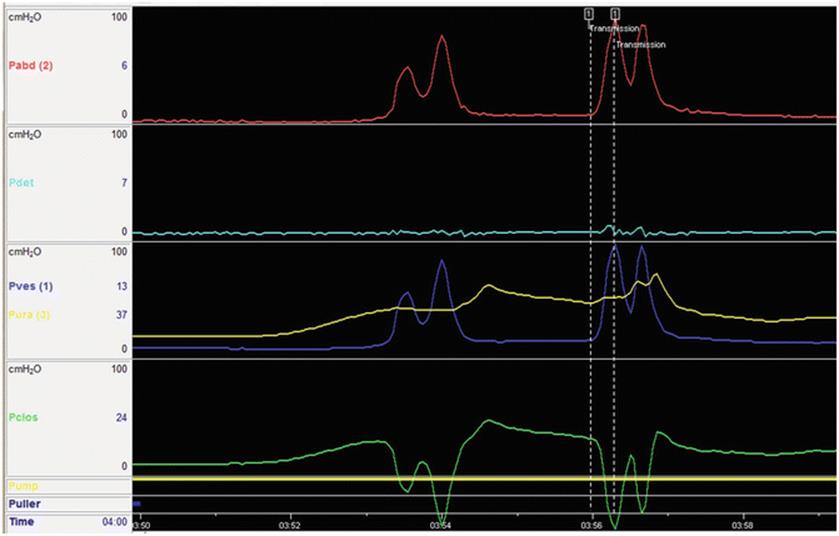
Fig. 2.13
Stress UPP graph showing measurement of pressure transmission ratio (PTR). Two points are taken, one at the start of cough and another at the peak (broken white lines). Difference in Pura as a percentage of Pves is PTR
Bump et al. [9] found a PTR cut-off of 90 % to have a sensitivity and normal predictive value to be 97 %. Unfortunately, it has remained an orphan concept and its clinical relevance has not been evaluated in details.
ALPP
Another, possibly more accurate method is employing the ‘fluid bridge’ principle of UPP (vide infra). In this, the urethral aperture of the UPP catheter is placed just distal to midurethra. The patient performs Valsalva manoeuvre or graded cough and deflections are observed in the Pves, Pabd as well as Pura graphs. As soon as there is leakage, a fluid bridge is formed and the vesical pressures are transmitted to the urethral aperture. This point is recorded and corresponding Pves is marked as ALPP (Fig. 2.14).
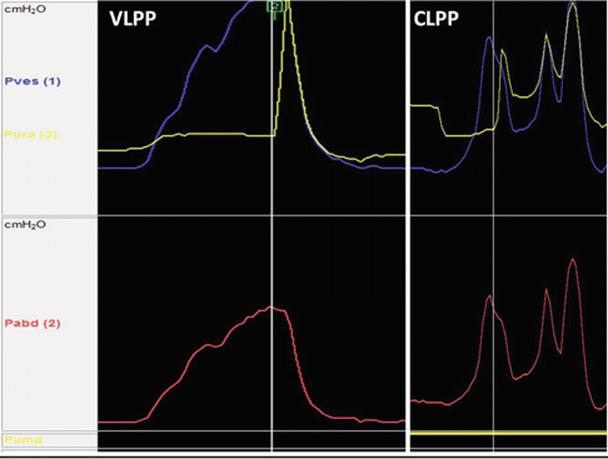
Fig. 2.14
Stress UPP graph showing measurement of abdominal leak point pressures. ALPP (CLPP and VLPP) is defined as Pves at a point (solid vertical white line) where Pura shows a sudden rise indicative of formation of fluid-bridge (i.e. leakage)
Voiding UPP
In the absence of standard criteria for diagnosis of bladder outlet obstruction, we have found micturitional UPP with or without fluoroscopic surveillance are quite helpful in diagnosis and localization of BOO. MUPP is performed as follows:
Once the static and stress (if indicated) have been performed, the UPP catheter is pulled back to the bladder neck, marked by elevation of Pura over Pves and kept there. The filling CMG is resumed in standard fashion. Once voiding phase is started and micturition is initiated, the puller is given command to pull at a fixed rate (2 mm/s) so that the urethral pressure orifice negotiates the urethra recording the urethral pressures all along, in real time. Normally, there should be no pressure gradient in any part of urethra (i.e. Pclo → 0) except for a minor dip in Pura at the level of urethral meatus. Any pressure gradient >5 cmH2O is diagnostic of BOO and the point at which this happens marks the most proximal level of obstruction (Fig. 2.15).
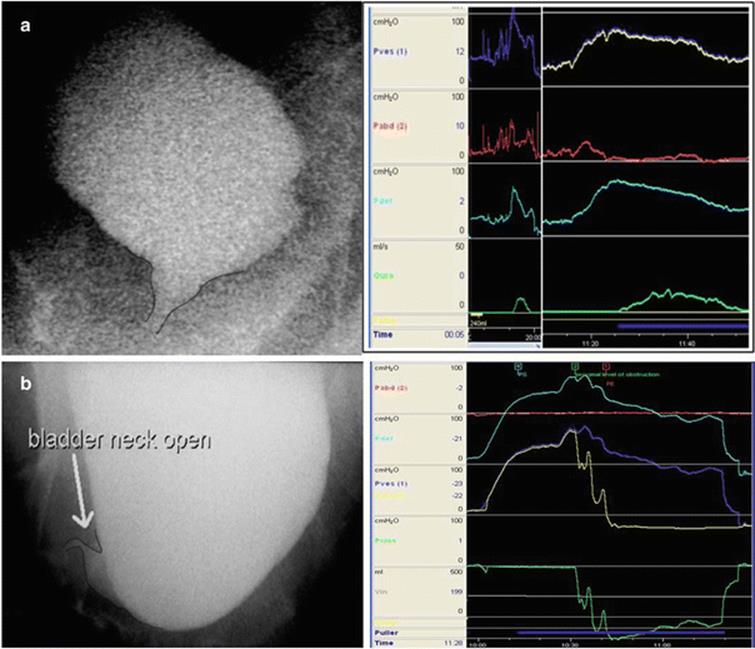
Fig. 2.15
Micturitional UPP (a) patient with obstructive nephropathy with incontinence—high pressure-low flow voiding pattern indicative of BOO; however, MUPP did not show any obstruction (no Pura-Pves gradient) confirmed on fluoroscopy; (b) patient with stage II cystocoele with voiding dysfunction showing high pressure-low flow voiding pattern indicative of BOO. It was localized by the MUPP (Pura-Pves gradient starting at midurethra) confirmed on fluoroscopy
Electromyography
The measurement of electrical activity of pelvic floor muscles is performed to study the behaviour of the muscles during micturitional cycle (storage + voiding). In the evaluation of incontinence and voiding dysfunction in women, EMG activity is helpful in indicating neurological intactness of the LUT and pelvic floor. It can be measured using needle, luminal or surface electrodes. Needle electrodes are inserted directly into the muscle in question (external urethral sphincter) and hence most accurate. However, in non-neurological conditions, this would be too invasive and painful for the information sought. Most of the information can be gathered by measuring activity of anal sphincter or puborectalis since these are easily accessible using surface and luminal electrodes, respectively (Fig. 2.16).
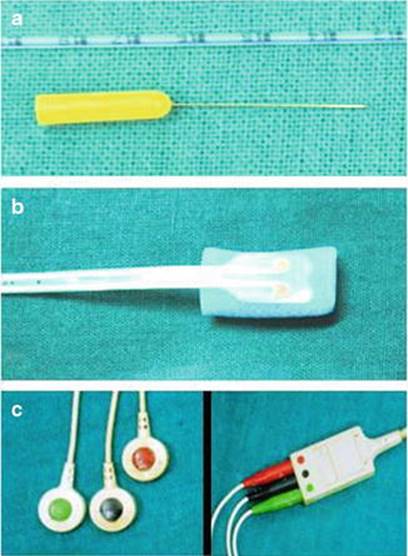
Fig. 2.16
Electromyography electrodes: (a) concentric needle electrode, (b) vaginal sponge electrode, (c) surface electrodes
We most frequently use perineal surface electrodes since these are totally non-invasive and offer maximum patient-compliance. The electrodes are placed on either side of anus as close as possible. At this location, fat is minimal even in obese patients and superficial part of external anal sphincter is adjacent. Neutral electrode is placed close to the other two electrodes in perineum. The EMG patterns in neurologically intact individuals are detailed in (Fig. 2.17).
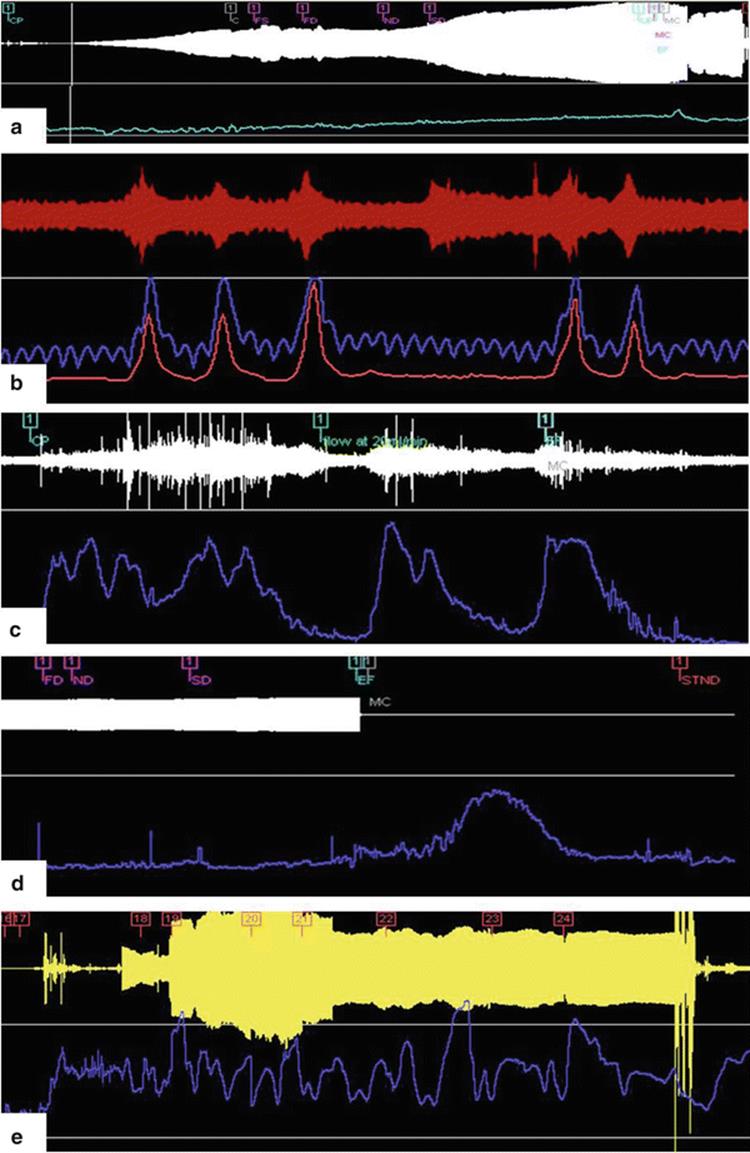
Fig. 2.17
(a) Progressively increasing EMG activity during storage phase; (b) cough response of pelvic floor activity; (c) reflex increase in EMG activity with detrusor overactivity; (d) EMG activity becomes silent just before detrusor contraction during voiding phase; (e) increased EMG activity of pelvic floor with abdominal straining during attempt to void. Blue linesrepresent Pves
Since, surface electrodes measure sum of pelvic floor activity, there are certain limitations, i.e. noise is more and amplitude of change in muscle activity is less, compared to an invasive needle electrode. It may be difficult to differentiate detrusor sphincter dyssynergia from increased pelvic floor activity from straining.
Ambulatory UDS
The foremost indication of invasive UDS in a patient undergoing surgery for SUI is to be able to demonstrate the so-called USI, i.e. demonstration of leakage with increased abdominal pressure without any detrusor activity. In some cases, USI is not demonstrable in office UDS despite a suggestive history. Therefore, in keeping with the urodynamic principle ‘the investigation should be able to explain/corroborate with patient’s symptoms’, an ambulatory, or natural fill, UDS is indicated.
It utilizes air-charged catheters or microtip transducer-catheters for measurement of pressures. The catheters are connected to a small portable machine (Fig. 2.18) which the patient can hang conveniently. Three cycles are recorded:
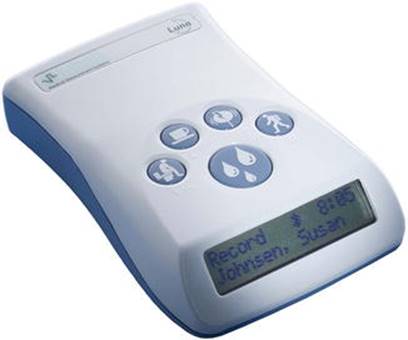
Fig. 2.18
LUNA ambulatory urodynamics apparatus. (Courtesy of MMS International, the Netherlands.)
(a)
(b)
(c)
Patient is asked to mark events or accidents during recording phase (e.g. leak, urgency, or pain). The recorded data is downloaded on a desktop for interpretation.
Ambulatory UDS has revealed various surprises:
(a)
(b)
(c)
If after AUDS no incontinence can be demonstrated, then the patient should be told that surgery would not be wise when the cause of incontinence remains to be defined.
Video-Urodynamics
VUDS is considered gold standard for diagnosis of various voiding dysfunctions. It helps in delineating bladder outline and capacity, vesicoureteral reflux, position of bladder neck at rest, stress and during voiding, inspection of leakage during stress manoeuvre, the presence and location of BOO as well as status of anterior vaginal wall support.
Despite the benefit, there are certain disadvantages and limitations. It involves an expensive and elaborate setup which may not be practicable everywhere and it is associated with radiation hazard. Moreover, delineation of bladder outlet may not be clear at times due to positioning. In our setup, we perform UPP as described earlier which is conclusive in most circumstances. Whenever fluoroscopic surveillance is required, we perform a cystourethrogram separately in our high power fluoroscopy and radiography suite.
To summarize, simple non-invasive urodynamic investigations, e.g. urolog and uroflowmetry are essential part of initial management of patients with pelvic floor dysfunction, and may even be sufficient in many individuals undergoing invasive treatment. Multichannel UDS should be used judiciously for its invasiveness, cost, and inconvenience. It is best interpreted in real-time during the test; therefore, it is preferably performed in front of the treating team member. Whatever UDS investigation, it is of paramount importance to have clear urodynamic questions to be answered with each investigation and it must always be interpreted in clinical perspective; ultimately, it is the patients who need treatment and not the investigation!
References
1.
Rowan D, James ED, Kramer AEJL, Sterling AM, Suhel PF. Urodynamic equipment: technical aspects. J Med Eng Technol. 1987;11:57–64.PubMedCrossRef
2.
Haylen BT, Ashby D, Sutherst JR, Frazer MI, West CR. Maximum and average urine flow rates in normal male and female populations- The Liverpool nomograms. Br J Urol. 1989;64:30–8.PubMedCrossRef
3.
Barapatre Y, Agarwal MM, Singh SK, Sharma SK, Mavuduru RM, Mete UK, et al. Uroflowmetry in healthy women: development and validation of flow—volume and corrected flow—age nomograms. Neurourol Urodyanm. 2009;28(8):1003–9.CrossRef
4.
Kilicarslan H, Gokce G, Ayan S, Guvenal T, Kaya K, Gultekin EY. Predictors of outcome after in situ anterior vaginal wall sling surgery. Int Urogynol J. 2003;14:339–41.CrossRef
5.
Massey JA, Abrams PH. Obstructed voiding in the female. Br J Urol. 1988;61:36–9.PubMedCrossRef
6.
Defreitas GA, Zimmern PE, Lemack GE, Shariat SF. Refining diagnosis of anatomic female bladder outlet obstruction: comparison of pressure-flow study parameters in clinically obstructed women with those of normal controls. Urology. 2004;64:675–9.PubMedCrossRef
7.
Blaivas JG, Groutz A. Bladder Outlet obstruction nomogram for women with lower urinary tract symptomatology. Neurourol Urodyn. 2000;19(5):554–64.
8.
Schaefer W, Clarkson B, Griffiths D, Tadic S, Resnick N. The urodynamics of voiding function in females: grading of bladder outflow conditions on a continuous scale. J Urol. 2011;185(4S):e682–3.CrossRef
9.
Bump RC, Copeland Jr WE, Hurt WG, Fantl JA. Dynamic urethral pressure/profilometry pressure transmission ratio determinations in stress incontinent and stress-continent subjects. Am J Obs Gyn. 1988;159:749–55.CrossRef