
Oussama El Yazami Adli1 and Jacques Corcos1
(1)
Department of Urology, McGill University, Jewish General Hospital, 3755 Côte Sainte-Catherine Road, Montreal, QC, Canada, H3T 1E2
Jacques Corcos
Email: jcorcos@uro.jgh.mcgill.ca
Abstract
Female stress urinary incontinence (SUI), defined as involuntary leakage on effort, exertion, sneezing, or coughing (Urology, 61(1):37–49, 2003), is a prevalent condition with significant impact on patient quality of life (QoL). About 18.3 million American women suffered from urinary incontinence in 2010, and almost 50 % of them reported SUI as the primary or sole symptom, with a financial burden of over US $12 billion a year (Curr Urol Rep, 12(5):370–6, 2011; Obstet Gynecol, 114(6):1278–83, 2009). This number is expected to increase substantially as the population ages. Worldwide, the prevalence of female SUI ranges from 5 to 61 %, and its incidence is estimated to be 4–11 % per year (Int Urogynecol J, 22(2):127–35, 2011; Incontinence: Fourth International Consultation on Incontinence, Paris, France, Health Publications Ltd., 2009, 35–112). Tension-free vaginal tape (TVT®; Gynecare, Ethicon, Somerville, NJ, USA) was the first retropubic midurethral synthetic sling (Int Urogynecol J, 7(2):81–6, 1996) proposed to address defective suburethral support, hypothesized to be responsible for the development of stress incontinence. Since then, the procedure has changed the perspective of SUI treatment and has become standard of care. It has several advantages, including a mini-invasive vaginal approach, short operation time, and hospital stay, combined with excellent short- and long-term results.
Female stress urinary incontinence (SUI), defined as involuntary leakage on effort, exertion, sneezing, or coughing [1], is a prevalent condition with significant impact on patient quality of life (QoL). About 18.3 million American women suffered from urinary incontinence in 2010, and almost 50 % of them reported SUI as the primary or sole symptom, with a financial burden of over US $12 billion a year [2, 3]. This number is expected to increase substantially as the population ages. Worldwide, the prevalence of female SUI ranges from 5 to 61 %, and its incidence is estimated to be 4–11 % per year [4, 5].
Tension-free vaginal tape (TVT®; Gynecare, Ethicon, Somerville, NJ, USA) was the first retropubic midurethral synthetic sling (MUSS) [6] proposed to address defective suburethral support, hypothesized to be responsible for the development of stress incontinence. Since then, the procedure has changed the perspective of SUI treatment and has become standard of care. It has several advantages, including a mini-invasive vaginal approach, short operation time, and hospital stay, combined with excellent short- and long-term results.
Development of the TVT Procedure
The retropubic MUSS procedure was first based on the work of Petros and Ulmsten [7] describing the “integral theory” as the basis of female urinary continence during sudden increases in intra-abdominal pressure through the vaginal connective tissue and/or pelvic ligamentous support. In 1994, the “hammock theory” of DeLancey postulated the role of two elements, the sphincter and urethral support [8]. The supportive hammock under the urethra provides a firm backstop against which it is compressed during heightened abdominal pressure, preventing urine leakage.
Retropubic MUSSs (Fig. 3.1) reinforce urethral support at the level of the pubourethral ligaments. Sling placement at the midurethra enables dynamic urethral kinking when abdominal pressure is amplified and provides continence without affecting the bladder neck. This has been well-demonstrated in sonographic and dynamic magnetic resonance imaging studies [9, 10].
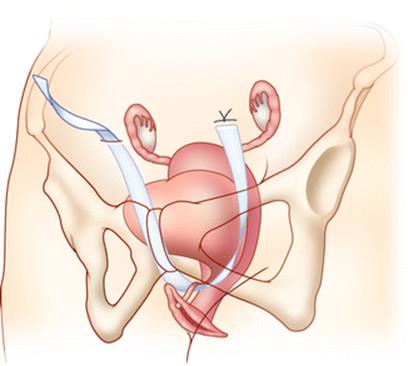
Fig. 3.1
Position of the retropubic tension-free vaginal tape
In its original description, the procedure involved sling positioning in a retrograde manner (bottom-to-top). Since then, several modifications have been made regarding trocar passage and sling composition.
Based on animal and clinical studies [11–14], most commercially available MUSSs nowadays are made from type I, macroporous, monofilament, uncoated mesh that is believed to be resistant to infection and inflammation (Table 3.1). Interestingly, in a randomized controlled trial (RCT) on 100 female SUI patients, Rechberger et al. [15] reported similar cure and complication rates with both monofilament and multifilament meshes up to 18 months, but published no long-term data.
Table 3.1
Commercially available retropubic slings
|
Brand |
Approach |
Material |
|
TVT® (Gynecare, Ethicon, Somerville, NJ, USA) |
Retrograde |
Monofilament |
|
Advantage® (Boston Scientific Corporation, Natick, MA, USA) |
Retrograde |
Monofilament |
|
SPARC® (American Medical Systems, Minnetonka, MN, USA) |
Antegrade |
Monofilament |
|
Lynx® (Boston Scientific) |
Antegrade |
Monofilament |
|
Anterior intravaginal slingplasty (Tyco Healthcare LP, Norwalk, CT, USA) |
Retrograde |
Multifilament |
Surgical Procedure
We first describe a surgical technique inspired by the original bottom-to-top procedure, with some minor changes. The top-to-bottom approach is addressed thereafter.
The TVT® kit consists of two curved needles attached to a 1.1 × 40 cm polypropylene mesh sling sheathed in plastic, with a detachable handle to facilitate retropubic passage of the needles and a guide to rigidify the Foley catheter.
Although the original method emphasized the use of local anesthesia, most procedures are now performed under spinal or general anesthesia. Patients are placed in the dorsal supine lithotomy position, prepped and draped in a sterile manner. Perioperative broad spectrum antibiotics are administered, and appropriate anti-embolism precautions are taken, depending on hospital policy. An 18-Fr Foley catheter is placed in the urethra.
Local anesthetics are infiltrated vaginally (10 cc on the side of the urethra up to the urogenital diaphragm and 5 cc under the vaginal mucosa) prior to incision if the procedure is to be performed under local anesthesia. Anesthetics (20 cc) are injected in the suprapubic area as well as on each side of the planned skin incision site.
A 1.5-cm midline vaginal incision is made, starting 0.5 cm from the external meatus of the urethra. Blunt dissection with Metzembaum scissors is undertaken in the paraurethral area between the vaginal mucosa and the pubocervical, orienting towards the symphysis pubis. Special care must be taken to coagulate or compress any bleeding. Dissection is advanced as far as the subsymphysial space with scissors or finger through the incision.
The guide is placed in the Foley catheter which is tented towards the ipsilateral side of trocar passage to mobilize the bladder neck and proximal urethra away from the trocar path. The needle is secured to the handle, then placed within the paraurethral tunnel with the needle tip between the surgeon’s index finger in the vagina and the lower rim of the pubic ramus. Slow, controlled pressure is needed to bring the needle, oriented along the previously dissected path, through the urogenital diaphragm, the space of retzius and the rectus abdominal fascia, in close contact with the pubic bone, targeting the skin mark about 1 cm from midline above the pubis (Fig. 3.2a, b). The skin is then breached with a scalpel, and the needle is externalized. The same procedure is followed on the other side. At this point, cystoscopy is undertaken to ensure bladder integrity.
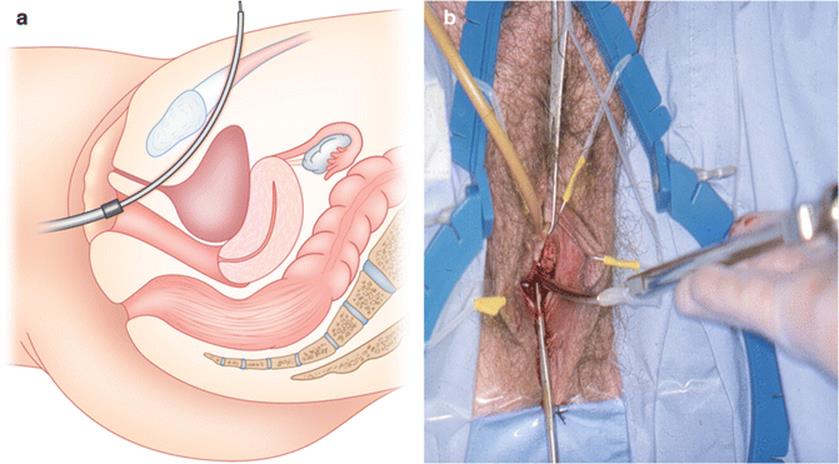
Fig. 3.2
Passage of the trocar in bottom-to-top fashion. (a) Schematic view of the path of passage from the vaginal incision through the urogenital diaphragm, the space of retzius, and the rectus abdominal fascia in close contact with the pubic bone and (b) perioperative view
The sling is positioned suburethrally by pulling on the threads and adjusted. The bladder is filled with 250–300 cc of saline, and a cough test is performed. The tape is tightened accordingly, until only a drop of saline is at the meatus. The Metzembaum scissors are then placed between the urethra and the tape to avoid over-adjustment, and the plastic sheet is removed. The tips of the sling are sectioned at the level of the skin and retracted from the cutaneous plane. Hemostasis is verified, and the vaginal incision is sutured. A vaginal gauze pad is left in the vagina for 24 h.
In the top-to-bottom approach, the suprapubic arc sling kit (SPARC® American Medical Systems, Minnetonka, MN, USA) contains two needles that are smaller than TVT® trocars. Prepubic incisions are first made 1 cm from midline on each side above the pubis, and the needles are passed from there onto the surgeon’s finger placed within the periurethral dissection. The mesh is attached to the needles by sliding dilating connectors and withdrawn from the prepubic incisions. It is tensioned similar to the bottom-to-top approach.
Results
Efficacy
TVT is the best studied and documented procedure among MUSSs. Table 3.2 summarizes the long-term outcome data. Cure rates up to 11.5 years are reported to be up to 90 % and are in the same order as those reported in initial, early trials [6], indicating effective maintenance over the years.
Table 3.2
Results of retropubic midurethral slings in the literature
|
Authors |
Number of patients |
Mean age at surgery |
Recruitment criteria |
Length of follow-up |
Testing |
Results |
Notes |
|
Nilsson et al. [16] |
85 |
57 |
Primary SUI |
5 years |
Urodynamics |
84.7 % cured |
|
|
QoL evaluation |
10.6 % improved |
||||||
|
4.7 % failed |
|||||||
|
Rezapour and Ulmsten [17] |
49 |
66 |
Stress incontinence and ISD |
4 years |
Urodynamics QoL evaluation |
74 % cured |
Failing patients were over 70 years old with severe ISD |
|
12 % improved |
|||||||
|
14 % failed |
|||||||
|
Reich et al. [18] |
108 |
63 |
Unselected group |
7 years |
Urodynamics |
Objective cure rate: 89.8 % |
Urge incontinence is the main reason for dissatisfaction after surgery |
|
QoL evaluation |
Subjective cure rate: 82 % |
||||||
|
13 % improved |
|||||||
|
4.6 % failed |
|||||||
|
Liapis et al. [19] |
65 |
58.1 |
SUI with stage 1 cystocele |
7 years |
Urodynamics |
Cure rate: 80 % |
|
|
Failure rate: 13.5 % |
|||||||
|
Song et al. [20] |
306 |
50.7 |
SUI |
7 years |
Urodynamics QoL evaluation |
Cure rate: 84.6 % |
23.2 % had complications at 1-month follow-up after surgery |
|
Groutz et al. [21] |
52 |
62.4 |
Urodynamically confirmed SUI |
10 years |
Questionnaire |
Subjective cure rate: 65 % |
54 % of patients had concomitant UUI |
|
Improvement: 12 % |
|||||||
|
Failure rate: 23 % |
|||||||
|
Serati et al. [22] |
58 |
58 |
SUI without ISD or POP |
10 years |
Urodynamics |
Objective cure rate: 93.1 % |
|
|
Subjective cure rate: 89.7 % |
|||||||
|
Abdul-Rahman et al. [23] |
12 |
53.3 |
Neuropathic bladder dysfunction and SUI |
10 years |
Urodynamics (incontinence impact questionnaire) |
7 patients cured |
2 patients lost to follow-up at 10 years were continent at 5 years |
|
2 patients improved |
|||||||
|
1 failed |
|||||||
|
Olsson et al. [24] |
128 |
54.4 |
SUI |
11.5 years |
Stress test, 23-h pad test, questionnaire |
Objective cure rate: 84 % |
|
|
Subjective cure rate: 77 % |
|||||||
|
18 % improved |
|||||||
|
Nilsson et al. [25] |
– |
69 |
SUI |
11 years |
Urodynamics QoL evaluation |
Objective cure rate: 90 % |
|
|
Subjective cure rate: 77 % |
Comparison Between Retropubic MUSSs According to the Tape Placement Approach
Few RCTs comparing TVT® with other retropubic MUSSs have been published. Comparison of different bottom-to-top slings has revealed no significant differences [26]. Andonian et al. [27] randomized 41 patients with SUI to either SPARC® or TVT® but did not find statistically significant differences in terms of cure rates and complications at 1-year follow-up. Lord et al. [28] and Tseng et al. [29] reported a higher cure rate and fewer short-term complications with the bottom-to-top compared to the top-to-bottom approach. Meta-analysis by Novara et al. [30] led to the conclusion that the bottom-to-top procedure was more efficacious than the top-to-bottom mode, and similar results were published recently by Ogah et al. [31]. The long-term follow-up data of Heidler et al. [32] seem to endorse this conclusion.
TVT Versus Other Procedures for the Treatment of Incontinence
Meta-analyses of available RCTs suggest that retropubic MUSSs outperform Bursh colposuspension in terms of postoperative cure rates, but colposuspension is associated with fewer perioperative complications, shorter indwelling catheter duration and less long-term voiding dysfunction [30, 33, 34]. Similar success rates have been reported for both TVT® and fascial pubovaginal slings.
Comparison of retropubic and transobturator approaches reveals that both have globally similar postoperative outcomes. Sung et al. [35] and Long et al. [36] did not discern statistically significant differences in subjective cure or improvement rates, but the objective cure rate seemed to favor retropubic MUSS (88 % vs. 84 % for the transobturator approach) [31]. On the other hand, the transobturator route is linked with lower peri- and postoperative complication rates as well as shorter surgery time but with more frequent postoperative groin pain.
Minimally invasive, synthetic suburethral slings appear to be as effective as retropubic MUSSs in the short-term but with fewer postoperative complications (shorter operation time, less postoperative voiding dysfunction, and de novo urgency). However, quality of the evidence is insufficient because available trials and long-term data are lacking [31].
Complications
Perioperative and postoperative complications after retropubic MUSSs are rare. Table 3.3 summarizes the complication rate with the TVT® procedure. The risk of intraoperative complications is not related to patient age, body mass index (BMI), or parity, but may be due to surgeon experience and previous prolapse or incontinence surgery [39, 40]. Long-term follow-up data do not disclose any signs of rejection or adverse tissue reactions to the polypropylene tape.
Table 3.3
Complication rates with the TVT procedure
|
Authors |
Number of patients |
Bladder injury |
Bleeding |
Voiding difficulties |
De novo urgency |
Hematoma |
Urinary tract infections |
Sling erosion/extrusion |
Notes |
|
Tamussino et al. [37] |
2,795 |
2.70 % |
2.30 % |
Not reported |
Not reported |
0.67 % |
17.0 % |
Not reported |
41 % of patients had concomitant surgery |
|
Kuuva and Nilsson [38] |
1,455 |
3.80 % |
1.90 % |
7.60 % |
0.20 % |
1.90 % |
4.1 % |
Not reported |
|
|
Olsson et al. [24] |
124 |
2.7 |
2.7 |
12.1 % |
21.2 |
– |
7.2 % |
0 |
|
|
Kristensen et al. [39] |
788 |
6.6 % |
0.6 % |
56 % |
Not reported |
0.8 % |
3.1 % |
Not reported |
|
|
Pushkar et al. [40] |
207 |
5.4 % |
Not reported |
5.9 % |
8 % |
9.1 % |
Not reported |
0.5 % |
|
|
Tincello et al. [41] |
437 |
2.1 % |
1 % |
2.1 % |
3 % |
2 % |
1.9 % |
1.5 % |
1-year data |
|
Lleberia-Juanos et al. [42] |
243 |
6.2 % |
1.6 % |
13.2 % |
24.7 % |
Not reported |
4.5 % |
4.1 % |
|
|
Serati et al. [22] |
63 |
2 cases |
0 |
0 |
18.9 % |
Not reported |
Not reported |
Not reported |
10-year data |
Perioperative Complications
The bladder injury rate seems to be consistent in different series. Insufficient surgeon experience, previous incontinence, and pelvic surgery are independent risk factors for trocar injury [39], which should be promptly recognized on perioperative cystoscopy for correct application needle reinsertion. There is no need for primary closure or longer than usual bladder drainage, so that healing can take place without sequelae. Urethral injury is rare (less than 1 %) and should be repaired immediately [43].
Bowel injury is a rare complication that may occur during trocar passage in patients with a previous history of abdominal or pelvic surgery [44].
The incidence of vascular injury, estimated to be 2.7–6 % with the TVT® procedure, is due to lack of direct pelvic vascular structure visualization during trocar passage. The risk can be minimized (but not entirely eliminated) by a good operating technique. Bleeding can be managed by vaginal packing or compression of the anterior vaginal wall directly against the symphysis pubis. Persistent bleeding indicates major vessel injury and warrants retropubic exploration.
Postoperative Complications
Voiding dysfunction may present as complete urinary retention, persistently elevated post-void residual (PVR) or bothersome and poorly characterized lower urinary tract symptoms with variable incidence, depending on its definition [45]. It may occur despite standard perioperative use of scissors contact to provide a space between the tape and the urethra. Preoperative voiding difficulties and concomitant prolapse surgery are independent risk factors for postoperative voiding problems [46]. In case of complete, immediate postoperative urinary retention, re-intervention within 48 h is strongly advocated to release tension. This procedure is easily performed under local anesthesia compared to delayed sling mobilization (after 3–4 days) which can prove to be extremely difficult. The options for patients with initially high PVR include long-term clean intermittent catheterization, suprapubic catheterization, and alpha-blocker pharmacotherapy. Insufficient improvement after 1 month should prompt transvaginal sling excision or urethrolysis, acknowledging the significant risk of recurrent SUI symptoms [45].
De novo urgency, with or without incontinence episodes, is a significant problem after all types of incontinence surgery. The incidence rate after retropubic MUSSs ranges from 4 to 33 % [34, 47–49], and the symptoms are reported to be as bothersome as preoperative SUI [50]. The origin of de novo urgency and its mechanism are unclear. Risk factors include old age, parity, history of cesarean section and recurrent urinary tract infections (UTI), elevated detrusor pressure over 15 cmH2O during the filling phase, and maximal detrusor pressure (Pdetmax) of less than 28 cmH2O during the voiding phase on preoperative cystometry [51]. Antimuscarinics in this particular type of symptomatic DO seem to be less efficient in this than in idiopathic overactive bladder syndrome [34]. Urethrolysis with sling resection remains an option in the presence of obstruction.
The incidence of vaginal extrusion and urinary tract erosion is reported to be around 2 %. Interestingly, Nilsson et al. [25] did not encounter any cases of tape extrusion/erosion on 11-year patient follow-up. Extrusion may be related to poor surgical technique, infection, or physical properties of the implanted material [45]. Large extrusions should be managed by excision and removal of the extruded sling segment, but simple observation could be an option for nonsexually active patients with small extrusions. On the other hand, urinary tract erosion is confirmed by endoscopy and must be managed operatively by scissors or laser transection of the intraluminal portion of the sling or by an open technique.
The incidence of other complications, such as dyspareunia, is poorly documented, but must warn of possible sling extrusion. Surgical site infections are rare and occur mostly with multifilament meshes.
Special Considerations
Mixed Urinary Incontinence
Mixed urinary incontinence is defined as the involuntary loss of urine associated with the sensation of urgency and also with exertion, sneezing, or coughing [1]. Up to 80 % of patients diagnosed with SUI report mixed symptoms [49], and these women may be difficult to manage with conservative measures alone.
Several studies have described retropubic MUSS outcomes in patients, showing overall improvement of both stress and urge components [52–54]. Paick et al. [55] reported an overall cure rate of 81.9 % at mean follow-up of 10.9 months, and multivariate analysis disclosed that failure to cure urgency urinary incontinence was related to low maximum urethral closure pressure (MUCP) and the presence of uninhibited DO. Resolution of urodynamic DO after the retropubic MUSS procedure has been noted in 23–40 % of patients [56, 57]. Objective and subjective cure rates are encouraging in women with a predominant stress component and in those with equal urgency and stress incontinence than in subjects with predominant urgency [58]. In a systemic review of the published data, Jain et al. [59] found good cure rates of the stress component (85–97 %) and lower (30–85 %) and declining cure rates of urgency incontinence over time.
Intrinsic Sphincter Deficiency
Intrinsic sphincter deficiency (ISD), defined by objective urodynamic measurements of urethral function as MUCP of 20 cmH2O or less, or Valsalva leak point pressure (VLPP) lower than 60 cmH2O [60, 61], is associated with poor surgical outcome after urethral suspension procedures [62]. We strongly support the statement that, to a certain degree, ISD is always coupled with SUI.
Most studies of retropubic MUSSs excluded or contained small numbers of patients with ISD. Thus, fewer series are available for analysis. Overall, the retropubic approach is effective in treating SUI and ISD, although the cure rates are slightly lower than those of SUI without ISD. Rodriguez et al. [63] did not detect a significant impact of various VLPP values on TVT outcomes. Rezapour et al. [64], who reported 4-year follow-up of TVT in ISD patients, obtained objective and subjective cure rates of 74 % and improvement in 12 % of patients, which are lower than the cure rates of SUI without ISD. Multivariate analysis of several observational studies failed to demonstrate ISD as an independent risk factor for surgical failure. Some authors suggested that the coexistence of poor urethral mobility and ISD may be associated with a higher surgical failure rate [65]. The failure rate with retropubic MUSSs remains lower than with transobturator slings, as seen in two large, comparative, retrospective, and randomized controlled studies [66, 67]. Proper explanations remain unclear.
Recurrent SUI
Recurrent SUI may be related to the underlying mechanism in SUI (ISD) or inappropriate intraoperative tape adjustment. Management of these situations can be difficult. Clinical guidelines from the Society of Obstetricians and Gynaecologists of Canada call for conservative measures as the first-line modality in recurrent SUI [68]. However, such conclusions are mainly extrapolated from studies of primary SUI. Surgical options include bulking agents, abdominal urethropexy, artificial urinary sphincter (AUS), and repeat MUSSs. The success rate with bulking agents tends to decrease over time. The failure rate of Bursh colposuspension is 55 % in patients with recurrent ISD without urethral hypermobility. The cure rates of AUS in properly selected patients are reported to be 76–89 % [69–72].
Secondary retropubic MUSSs are associated with significant cure rates after retropubic or transobturator synthetic sling placement. Objective and subjective cure rates in retrospective and prospective studies varied between 77.4 % and 62 % after median follow-up of 19 and 40 months, respectively [73–75]. It is noteworthy that all these studies exclusively or predominantly recruited patients with ISD. The repeat retropubic approach is significantly more successful than the repeat transobturator procedure (71 % vs. 48 %) with no increase in the incidence of complications compared to primary surgery, except for de novo urgency (30 % vs. 14 %, p < 0.001).
Concomitant Pelvic Organ Orolapse Surgery
The TVT procedure is more easily undertaken with a vaginal Pelvic Organ Orolapse (POP) approach than with abdominal surgery. The sequence of MUSS placement depends on POP procedure, but the tape should be adjusted after its completion [76].
Despite limited follow-up in most published studies, the objective cure rate of urinary incontinence is between 84 and 94 % [77–80]. The question of whether or not to perform a TVT procedure for occult SUI at the time of prolapse surgery was addressed by Liang et al. [81] who reported a significantly higher rate of postoperative stress incontinence in women who did not undergo TVT® vs. those who did (64 % vs. 10 %). In a Cochrane database review, Maher et al. [82] concluded that the addition of TVT to prolapse repair may reduce the incidence of postoperative urinary incontinence (relative risk 5.5, 95 % confidence interval 1.32–22.32), but needs to be balanced against possible differences in adverse effects.
Retropubic MUSS in Obese (BMI >30) and Elderly (>65-Year-Old) Women
Several small studies have evaluated the outcomes of retropubic MUSS procedures in overweight and obese patients. Killingsworth et al. [83] reported no differences in improvement or complication rates between normal, overweight (BMI 25–29.9), and obese patients at 12-month follow-up. In another retrospective investigation, obesity did not appear to influence the rate of bladder injury or urinary retention after TVT® procedure [84]. On the other hand, in a study with median 5.7-year follow-up, Hellberg et al. [85] noted a decrease in the subjective cure rate between women with BMI less than 25 and those above 35 (81.2 % vs. 52.1 %). However, these obese patients were significantly older and more often suffered from diabetes mellitus and chronic bronchitis. There was no increase in the complication rate between patient groups, depending on the BMI.
As for age, older women are more prone to ISD and mixed urinary incontinence than younger women [86]. The retropubic MUSS procedure is associated with decreased cure rates in elderly patients. Jun et al. [87] observed a decline of cure and improvement rates in elderly patients (over 65 years old) vs. younger patients at median 48.8-month follow-up (66.7 % vs. 80.2 % and 3.3 % vs. 4.7 %). Hellberg et al. [85] compared patients older than 75 years with younger subjects. Older women more frequently had mixed urinary incontinence with inferior subjective cure rates than their younger counterparts (55.7 % vs. 79.7 %), and a higher failure rate for the stress component over urgency symptoms. Adjustment for previous vaginal repair, incontinence surgery, and history of recurrent UTI did not alter the lower odds ratios for cure in these women.
Conclusion
Retropubic MUSSs represent standard care in female SUI. The procedure has the advantage of minimally invasive surgery (short operation time, ambulatory surgery) with excellent objective and subjective cure rates in all groups of patients on long-term follow-up. The complication rate is low, provided the procedure is performed in a standardized manner.
References
1.
Abrams P, Cardozo L, Fall M, Griffiths D, Rosier P, Ulmsten U, Van Kerrebroeck P, Victor A, Wein A, Standardisation Sub-committee of the International Continence Society. The standardisation of terminology in lower urinary tract function: report from the Standardisation Sub-committee of the International Continence Society. Urology. 2003;61(1):37–49.CrossRef
2.
Reynolds WS, Dmochowski RR, Penson DF. Epidemiology of stress urinary incontinence in women. Curr Urol Rep. 2011;12(5):370–6.CrossRef
3.
Wu JM, Hundley AF, Fulton RG, Myers ER. Forecasting the prevalence of pelvic floor disorders in U.S. women: 2010 to 2050. Obstet Gynecol. 2009;114(6):1278–83.CrossRef
4.
Walker GJ, Gunasekera P. Pelvic organ prolapse and incontinence in developing countries: review of prevalence and risk factors. Int Urogynecol J. 2011;22(2):127–35. Epub 2010 Jul 9.CrossRef
5.
Milsom I, Altman D, Lapitan MC, Nelson R, Sillen U, Thom DH. Epidemiology of urinary (UI) and faecal (FI) incontinence and pelvic organ prolapse (POP). In: Abrams P, Cardozo L, Khoury S, Wein AJ, editors. Incontinence: 4th international consultation on incontinence. Paris, France: Health Publications Ltd.; 2009. p. 35–112.
6.
Ulmsten U, Henriksson L, Johnson P, Varhos G. An ambulatory surgical procedure under local anesthesia for treatment of female urinary incontinence. Int Urogynecol J. 1996;7(2):81–6; discussion 85–6.CrossRef
7.
Petros PE, Ulmsten UI. An integral theory of female urinary incontinence. Experimental and clinical considerations. Acta Obstet Gynecol Scand Suppl. 1990;153:7–31.CrossRef
8.
DeLancey JO. Structural support of the urethra as it relates to stress urinary incontinence: the hammock hypothesis. Am J Obstet Gynecol. 1994;170(6):1713–20; discussion 1720–3.CrossRef
9.
Atherton MJ, Stanton SL. A comparison of bladder neck movement and elevation after tension-free vaginal tape and colposuspension. BJOG. 2000;107(11):1366–70.CrossRef
10.
Rinne K, Kainulainen S, Aukee S, Heinonen S, Nilsson CG. Dynamic MRI confirms support of the mid-urethra by TVT and TVT-O surgery for stress incontinence. Acta Obstet Gynecol Scand. 2011;90(6):629–35.CrossRef
11.
Slack M, Sandhu JS, Staskin DR, Grant RC. In vivo comparison of suburethral sling materials. Int Urogynecol J Pelvic Floor Dysfunct. 2006;17(2):106–10. Epub 2005 Jul 2.CrossRef
12.
Meschia M, Pifarotti P, Bernasconi F, Magatti F, Viganò R, Bertozzi R, Barbacini P. Tension-free vaginal tape (TVT) and intravaginal slingplasty (IVS) for stress urinary incontinence: a multicenter randomized trial. Am J Obstet Gynecol. 2006;195(5):1338–42.CrossRef
13.
Domingo S, Alamá P, Ruiz N, Perales A, Pellicer A. Diagnosis, management and prognosis of vaginal erosion after transobturator suburethral tape procedure using a nonwoven thermally bonded polypropylene mesh. J Urol. 2005;173(5):1627–30.CrossRef
14.
Prien-Larsen JC, Hemmingsen L. Long-term outcomes of TVT and IVS operations for treatment of female stress urinary incontinence: monofilament vs. multifilament polypropylene tape. Int Urogynecol J Pelvic Floor Dysfunct. 2009;20(6):703–9.CrossRef
15.
Rechberger T, Rzeźniczuk K, Skorupski P, Adamiak A, Tomaszewski J, Baranowski W, Jakowicki JA. A randomized comparison between monofilament and multifilament tapes for stress incontinence surgery. Int Urogynecol J Pelvic Floor Dysfunct. 2003;14(6):432–6.CrossRef
16.
Nilsson CG, Kuuva N, Falconer C. Long-term results of the tension-free vaginal tape (TVT) procedure for surgical treatment of female stress urinary incontinence. Int Urogynecol J Pelvic Floor Dysfunct. 2001;12 Suppl 2:S5–8.CrossRef
17.
Rezapour M, Ulmsten U. Tension-free vaginal tape (TVT) in women with recurrent stress urinary incontinence—a long-term follow up. Int Urogynecol J Pelvic Floor Dysfunct. 2001;12 Suppl 2:S9–11.CrossRef
18.
Reich A, Kohorst F, Kreienberg R, Flock F. Long-term results of the tension-free vaginal tape procedure in an unselected group: a 7-year follow-up study. Urology. 2011;78(4):774–7.CrossRef
19.
Liapis A, Bakas P, Creatsas G. Long-term efficacy of tension-free vaginal tape in the management of stress urinary incontinence in women: efficacy at 5- and 7-year follow-up. Int Urogynecol J Pelvic Floor Dysfunct. 2008;19(11):1509–12.CrossRef
20.
Song PH, Kim YD, Kim HT, Lim HS, Hyun CH, Seo JH, Yoo ES, Park CH, Jung HC, Gomelsky A. The 7-year outcome of the tension-free vaginal tape procedure for treating female stress urinary incontinence. BJU Int. 2009;104(8):1113–7.CrossRef
21.
Groutz A, Rosen G, Cohen A, Gold R, Lessing JB, Gordon D. Ten-year subjective outcome results of the retropubic tension-free vaginal tape for treatment of stress urinary incontinence. J Minim Invasive Gynecol. 2011;18(6):726–9.CrossRef
22.
Serati M, Ghezzi F, Cattoni E, Braga A, Siesto G, Torella M, Cromi A, Vitobello D, Salvatore S. Tension-free vaginal tape for the treatment of urodynamic stress incontinence: efficacy and adverse effects at 10-year follow-up. Eur Urol. 2012;61(5):939–46.CrossRef
23.
Abdul-Rahman A, Attar KH, Hamid R, Shah PJ. Long-term outcome of tension-free vaginal tape for treating stress incontinence in women with neuropathic bladders. BJU Int. 2010;106(6):827–30.CrossRef
24.
Olsson I, Abrahamsson AK, Kroon UB. Long-term efficacy of the tension-free vaginal tape procedure for the treatment of urinary incontinence: a retrospective follow-up 11.5 years post-operatively. Int Urogynecol J. 2010;21(6):679–83.CrossRef
25.
Nilsson CG, Palva K, Rezapour M, Falconer C. Eleven years prospective follow-up of the tension-free vaginal tape procedure for treatment of stress urinary incontinence. Int Urogynecol J Pelvic Floor Dysfunct. 2008;19(8):1043–7.CrossRef
26.
Lim YN, Dwyer P, Muller R, Rosamilia A, Lee J, Stav K. Do the Advantage slings work as well as the tension-free vaginal tapes? Int Urogynecol J. 2010;21(9):1157–62.CrossRef
27.
Andonian S, Chen T, St-Denis B, Corcos J. Randomized clinical trial comparing suprapubic arch sling (SPARC) and tension-free vaginal tape (TVT): one-year results. Eur Urol. 2005;47(4):537–41.CrossRef
28.
Lord HE, Taylor JD, Finn JC, Tsokos N, Jeffery JT, Atherton MJ, Evans SF, Bremner AP, Elder GO, Holman CD. A randomized controlled equivalence trial of short-term complications and efficacy of tension-free vaginal tape and suprapubic urethral support sling for treating stress incontinence. BJU Int. 2006;98(2):367–76.CrossRef
29.
Tseng LH, Wang AC, Lin YH, Li SJ, Ko YJ. Randomized comparison of the suprapubic arc sling procedure vs tension-free vaginal taping for stress incontinent women. Int Urogynecol J Pelvic Floor Dysfunct. 2005;16(3):230–5.CrossRef
30.
Novara G, Ficarra V, Boscolo-Berto R, Secco S, Cavalleri S, Artibani W. Tension-free midurethral slings in the treatment of female stress urinary incontinence: a systematic review and meta-analysis of randomized controlled trials of effectiveness. Eur Urol. 2007;52(3):663–78.CrossRef
31.
Ogah J, Cody DJ, Rogerson L. Minimally invasive synthetic suburethral sling operations for stress urinary incontinence in women: a short version Cochrane review. Neurourol Urodyn. 2011;30(3):284–91.CrossRef
32.
Heidler S, Ofner-Kopeinig P, Puchwein E, Pummer K, Primus G. The suprapubic arch sling procedure for treatment of stress urinary incontinence: a 5-year retrospective study. Eur Urol. 2010;57(5):897–901.CrossRef
33.
Rehman H, Bezerra CC, Bruschini H, Cody JD. Traditional suburethral sling operations for urinary incontinence in women. Cochrane Database Syst Rev. 2011;(1):CD001754.
34.
Novara G, Galfano A, Boscolo-Berto R, Secco S, Cavalleri S, Ficarra V, Artibani W. Complication rates of tension-free midurethral slings in the treatment of female stress urinary incontinence: a systematic review and meta-analysis of randomized controlled trials comparing tension-free midurethral tapes to other surgical procedures and different devices. Eur Urol. 2008;53(2):288–308.CrossRef
35.
Sung VW, Schleinitz MD, Rardin CR, Ward RM, Myers DL. Comparison of retropubic vs transobturator approach to midurethral slings: a systematic review and meta-analysis. Am J Obstet Gynecol. 2007;197(1):3–11.PubMedCentralCrossRef
36.
Long CY, Hsu CS, Wu MP, Liu CM, Wang TN, Tsai EM. Comparison of tension-free vaginal tape and transobturator tape procedure for the treatment of stress urinary incontinence. Curr Opin Obstet Gynecol. 2009;21(4):342–7.CrossRef
37.
Tamussino KF, Hanzal E, Kölle D, Ralph G, Riss PA, Austrian Urogynecology Working Group. Tension-free vaginal tape operation: results of the Austrian registry. Obstet Gynecol. 2001;98(5 Pt 1):732–6.CrossRef
38.
Kuuva N, Nilsson CG. A nationwide analysis of complications associated with the tension-free vaginal tape (TVT) procedure. Acta Obstet Gynecol Scand. 2002;81(1):72–7.CrossRef
39.
Kristensen I, Eldoma M, Williamson T, Wood S, Mainprize T, Ross S. Complications of the tension-free vaginal tape procedure for stress urinary incontinence. Int Urogynecol J. 2010;21(11):1353–7.CrossRef
40.
Pushkar DY, Godunov BN, Gvozdev M, Kasyan GR. Complications of mid-urethral slings for treatment of stress urinary incontinence. Int J Gynaecol Obstet. 2011;113(1):54–7.CrossRef
41.
Tincello DG, Botha T, Grier D, Jones P, Subramanian D, Urquhart C, Kirkemo A, Khandwala S, TVT Worldwide Registry Investigators. The TVT Worldwide Observational Registry for Long-Term Data: safety and efficacy of suburethral sling insertion approaches for stress urinary incontinence in women. J Urol. 2011;186(6):2310–5.CrossRef
42.
Lleberia-Juanós J, Bataller-Sánchez E, Pubill-Soler J, Mestre-Costa M, Ribot-Luna L, Vizcaíno MA. De novo urgency after tension-free vaginal tape versus transobturator tape procedure for stress urinary incontinence. Eur J Obstet Gynecol Reprod Biol. 2011;155(2):229–32.CrossRef
43.
Morton HC, Hilton P. Urethral injury associated with minimally invasive mid-urethral sling procedures for the treatment of stress urinary incontinence: a case series and systematic literature search. BJOG. 2009;116(8):1120–6.CrossRef
44.
Rooney KE, Cholhan HJ. Bowel perforation during retropubic sling procedure. Obstet Gynecol. 2010;115(2 Pt 2):429–31.CrossRef
45.
Gilchrist AS, Rovner ES. Managing complications of slings. Curr Opin Urol. 2011;21(4):291–6.CrossRef
46.
Vervest HA, Bisseling TM, Heintz AP, Schraffordt Koops SE. The prevalence of voiding difficulty after TVT, its impact on quality of life, and related risk factors. Int Urogynecol J Pelvic Floor Dysfunct. 2007;18(2):173–82.CrossRef
47.
Debodinance P, Delporte P, Engrand JB, Boulogne M. Tension-free vaginal tape (TVT) in the treatment of urinary stress incontinence: 3 years experience involving 256 operations. Eur J Obstet Gynecol Reprod Biol. 2002;105(1):49–58.CrossRef
48.
Ustün Y, Engin-Ustün Y, Güngör M, Tezcan S. Tension-free vaginal tape compared with laparoscopic Burch urethropexy. J Am Assoc Gynecol Laparosc. 2003;10(3):386–9.CrossRef
49.
Ward KL, Hilton P, UK and Ireland TVT Trial Group. A prospective multicenter randomized trial of tension-free vaginal tape and colposuspension for primary urodynamic stress incontinence: two-year follow-up. Am J Obstet Gynecol. 2004;190(2):324–31.CrossRef
50.
Holmgren C, Nilsson S, Lanner L, Hellberg D. Frequency of de novo urgency in 463 women who had undergone the tension-free vaginal tape (TVT) procedure for genuine stress urinary incontinence—a long-term follow-up. Eur J Obstet Gynecol Reprod Biol. 2007;132(1):121–5.CrossRef
51.
Alperin M, Abrahams-Gessel S, Wakamatsu MM. Development of de novo urge incontinence in women post sling: the role of preoperative urodynamics in assessing the risk. Neurourol Urodyn. 2008;27(5):407–11.CrossRef
52.
Athanasiou S, et al. Mixed urinary incontinence/TVT or TVT-O. Oral presentation at the 34th Annual IUGA Meeting. Int Uroynecol J. 2009;20 Suppl 2:S218.
53.
Sinha D, Blackwell A, Moran PA. Outcome measures after TVT for mixed urinary incontinence. Int Urogynecol J Pelvic Floor Dysfunct. 2008;19(7):927–31.CrossRef
54.
Duckett JR, Basu M. The predictive value of preoperative pressure-flow studies in the resolution of detrusor overactivity and overactive bladder after tension-free vaginal tape insertion. BJU Int. 2007;99(6):1439–42.CrossRef
55.
Paick JS, Oh SJ, Kim SW, Ku JH. Tension-free vaginal tape, suprapubic arc sling, and transobturator tape in the treatment of mixed urinary incontinence in women. Int Urogynecol J Pelvic Floor Dysfunct. 2008;19(1):123–9.CrossRef
56.
Botros SM, Miller JJ, Goldberg RP, Gandhi S, Akl M, Beaumont JL, Sand PK. Detrusor overactivity and urge urinary incontinence following transobturator versus midurethral slings. Neurourol Urodyn. 2007;26(1):42–5.CrossRef
57.
Choe JH, Choo MS, Lee KS. The impact of tension-free vaginal tape on overactive bladder symptoms in women with stress urinary incontinence: significance of detrusor overactivity. J Urol. 2008;179(1):214–9.CrossRef
58.
Kulseng-Hanssen S, Husby H, Schiøtz HA. Follow-up of TVT operations in 1,113 women with mixed urinary incontinence at 7 and 38 months. Int Urogynecol J Pelvic Floor Dysfunct. 2008;19(3):391–6.CrossRef
59.
Jain P, Jirschele K, Botros SM, Latthe PM. Effectiveness of midurethral slings in mixed urinary incontinence: a systematic review and meta-analysis. Int Urogynecol J. 2011;22(8):923–32.CrossRef
60.
Sand PK, Bowen LW, Panganiban R, Ostergard DR. The low pressure urethra as a factor in failed retropubic urethropexy. Obstet Gynecol. 1987;69(3 Pt 1):399–402.
61.
McGuire EJ, Fitzpatrick CC, Wan J, Bloom D, Sanvordenker J, Ritchey M, Gormley EA. Clinical assessment of urethral sphincter function. J Urol. 1993;150(5 Pt 1):1452–4.
62.
Lim YN, Dwyer PL. Effectiveness of midurethral slings in intrinsic sphincteric-related stress urinary incontinence. Curr Opin Obstet Gynecol. 2009;21(5):428–33.CrossRef
63.
Rodríguez LV, de Almeida F, Dorey F, Raz S. Does Valsalva leak point pressure predict outcome after the distal urethral polypropylene sling? Role of urodynamics in the sling era. J Urol. 2004;172(1):210–4.CrossRef
64.
Rezapour M, Falconer C, Ulmsten U. Tension-Free vaginal tape (TVT) in stress incontinent women with intrinsic sphincter deficiency (ISD)—a long-term follow-up. Int Urogynecol J Pelvic Floor Dysfunct. 2001;12 Suppl 2:S12–4.CrossRef
65.
Liapis A, Bakas P, Salamalekis E, Botsis D, Creatsas G. Tension-free vaginal tape (TVT) in women with low urethral closure pressure. Eur J Obstet Gynecol Reprod Biol. 2004;116(1):67–70.CrossRef
66.
Jeon MJ, Jung HJ, Chung SM, Kim SK, Bai SW. Comparison of the treatment outcome of pubovaginal sling, tension-free vaginal tape, and transobturator tape for stress urinary incontinence with intrinsic sphincter deficiency. Am J Obstet Gynecol. 2008;199(1):76.e1–4.
67.
Schierlitz L, Dwyer PL, Rosamilia A, Murray C, Thomas E, De Souza A, Lim YN, Hiscock R. Effectiveness of tension-free vaginal tape compared with transobturator tape in women with stress urinary incontinence and intrinsic sphincter deficiency: a randomized controlled trial. Obstet Gynecol. 2008;112(6):1253–61.CrossRef
68.
Lovatsis D, Easton W, Wilkie D, Society of Obstetricians and Gynaecologists of Canada Urogynaecology Committee. Guidelines for the evaluation and treatment of recurrent urinary incontinence following pelvic floor surgery. J Obstet Gynaecol Can. 2010;32(9):893–904.
69.
Walsh CA. Recurrent stress urinary incontinence after synthetic mid-urethral sling procedures. Curr Opin Obstet Gynecol. 2011;23(5):355–61.
70.
Gorton E, Stanton S, Monga A, Wiskind AK, Lentz GM, Bland DR. Periurethral collagen injection: a long-term follow-up study. BJU Int. 1999;84(9):966–71.CrossRef
71.
Amaye-Obu FA, Drutz HP. Surgical management of recurrent stress urinary incontinence: a 12-year experience. Am J Obstet Gynecol. 1999;181(6):1296–307.CrossRef
72.
Costa P, Mottet N, Rabut B, Thuret R, Ben Naoum K, Wagner L. The use of an artificial urinary sphincter in women with type III incontinence and a negative Marshall test. J Urol. 2001;165(4):1172–6.CrossRef
73.
Lee KS, Doo CK, Han DH, Jung BJ, Han JY, Choo MS. Outcomes following repeat mid urethral synthetic sling after failure of the initial sling procedure: rediscovery of the tension-free vaginal tape procedure. J Urol. 2007;178(4 Pt 1):1370–4; discussion 1374.CrossRef
74.
Moore RD, Gamble K, Miklos JR. Tension-free vaginal tape sling for recurrent stress incontinence after transobturator tape sling failure. Int Urogynecol J Pelvic Floor Dysfunct. 2007;18(3):309–13.CrossRef
75.
Stav K, Dwyer PL, Rosamilia A, Schierlitz L, Lim YN, Chao F, De Souza A, Thomas E, Murray C, Conway C, Lee J. Repeat synthetic mid urethral sling procedure for women with recurrent stress urinary incontinence. J Urol. 2010;183(1):241–6.CrossRef
76.
Lo TS. Tension-free vaginal tape procedures in women with stress urinary incontinence with and without co-existing genital prolapse. Curr Opin Obstet Gynecol. 2004;16(5):399–404.CrossRef
77.
Jomaa M. Combined tension-free vaginal tape and prolapse repair under local anaesthesia in patients with symptoms of both urinary incontinence and prolapse. Gynecol Obstet Invest. 2001;51(3):184–6.CrossRef
78.
Partoll LM. Efficacy of tension-free vaginal tape with other pelvic reconstructive surgery. Am J Obstet Gynecol. 2002;186(6):1292–5; discussion 1295–8.CrossRef
79.
Lo TS, Chang TC, Chao AS, Chou HH, Tseng LH, Liang CC. Tension-free vaginal tape procedure on genuine stress incontinent women with coexisting genital prolapse. Acta Obstet Gynecol Scand. 2003;82(11):1049–53.CrossRef
80.
Groutz A, Gold R, Pauzner D, Lessing JB, Gordon D. Tension-free vaginal tape (TVT) for the treatment of occult stress urinary incontinence in women undergoing prolapse repair: a prospective study of 100 consecutive cases. Neurourol Urodyn. 2004;23(7):632–5.CrossRef
81.
Liang CC, Chang YL, Chang SD, Lo TS, Soong YK. Pessary test to predict postoperative urinary incontinence in women undergoing hysterectomy for prolapse. Obstet Gynecol. 2004;104(4):795–800.CrossRef
82.
Maher C, Baessler K, Glazener CM, Adams EJ, Hagen S. Surgical management of pelvic organ prolapse in women: a short version Cochrane review. Neurourol Urodyn. 2008;27(1):3–12.CrossRef
83.
Killingsworth LB, Wheeler 2nd TL, Burgio KL, Martirosian TE, Redden DT, Richter HE. One-year outcomes of tension-free vaginal tape (TVT) mid-urethral slings in overweight and obese women. Int Urogynecol J Pelvic Floor Dysfunct. 2009;20(9):1103–8.PubMedCentralCrossRef
84.
Revicky V, Mukhopadhyay S, de Boer F, Morris EP. Obesity and the incidence of bladder injury and urinary retention following tension-free vaginal tape procedure: retrospective cohort study. Obstet Gynecol Int. 2011;2011:746393.PubMedCentralCrossRef
85.
Hellberg D, Holmgren C, Lanner L, Nilsson S. The very obese woman and the very old woman: tension-free vaginal tape for the treatment of stress urinary incontinence. Int Urogynecol J Pelvic Floor Dysfunct. 2007;18(4):423–9.CrossRef
86.
Milsom I, Ekelund P, Molander U, Arvidsson L, Areskoug B. The influence of age, parity, oral contraception, hysterectomy and menopause on the prevalence of urinary incontinence in women. J Urol. 1993;149(6):1459–62.
87.
Jun KK, Oh SM, Choo GY, Park HK, Paick SH, Lho YS, Kim HG. Long-term clinical outcomes of the tension-free vaginal tape procedure for the treatment of stress urinary incontinence in elderly women over 65. Korean J Urol. 2012;53(3):184–8.PubMedCentralCrossRef