
PART 4 Philosophy: The Yoga Sutra
Chapter III: On Powers


III.1 Concentration is fixing the mind to a place.
The five outer limbs (bahirangas) have been explained. Now we go on to the inner limbs (antarangas). The sixth limb, concentration (dharana), is defined as confining the mind to a point in space. Patanjali uses the term chitta again here for mind, which encompasses intellect (buddhi), ego (ahamkara), and mind (manas). Vyasa explains that concentration is exercised by fixing the mind on an external or internal object. Internal objects are the lotuses (chakras), chiefly the navel center, the heart center, the third eye, and the crown of the head. The tip of the nose and tip of the tongue are also mentioned.
Concentration is focused as well on the inner sound or heart sound (anahata nada), which features strongly in the Hatha Yoga Pradipika. Binding the mind to the light in the heart lotus (jyoti) has been mentioned already in sutra I.36, and a clarifying effect is ascribed to it.
External objects that are suitable for concentration are those that belong to the category of sacred objects. Typically this would be the image of one’s chosen deity or something similar. The object must be sattvic in quality, as rajasic objects would agitate the mind and tamasic objects stupefy it. Only sattvic objects fill the mind with effulgent wisdom.
Western observers have often misunderstood India due to its many deities. But the deities are only expressions of the one infinite consciousness (Brahman). They are meditation and concentration devices, and in that context are called saguna brahman or Brahman with form. If Brahman is worshiped directly without image, then it is called nirguna brahman, the formless. There is no conflict between the two, only a lack of understanding. Kabir has said that saguna and nirguna are one.
Concentration now means that the modifications or fluctuations of the mind are kept in that chosen place. For instance, if a thought having as its object the light in the heart is brought to an end, it is then replaced by another thought of the same kind. If one thinks continuously of the light in the heart, that practice is called concentration.
If the original thought is replaced involuntarily by thoughts concerning completely different objects, this is not concentration. Some sources say that concentration is achieved only once it can be held for one and a half hours. If in our vinyasa practice we keep the mind bound to the breath, which is a sacred object (the Brahma Sutra says breath is the Brahman), then this is concentration practice.

III.2 If in that place of dharana there is an uninterrupted flow of awareness toward the object, then this is meditation (dhyana).
There are many concepts about meditation. The word is often used in the sense of thinking about something. If I am thinking about something, I might be approaching an object from different angles or I might be thinking about aspects that do not represent the object as a whole anymore. This all still comes under the yogic heading of dharana, which includes deliberating or reflecting on an object, and it usually creates a beta brain-wave pattern.
If, through focusing, I prevent any other object than the one chosen from entering my mind, this creates the brain-wave pattern of concentration, the beta pattern.
In meditation the mind relaxes and switches to an alpha pattern, which brings a deeper communion with the object, but it is only called dhyana if there is an uninterrupted flow of awareness toward the chosen object. In yogic meditation we are in asana and pranayama, with the senses withdrawn and the mind concentrated. If we then add the continuous awareness of an object that is not present indharana (concentration), then it is called dhyana. In dharana there is a stop-and-go process that we constantly have to kick-start by dodging the distractions. In meditation there is uninterrupted flow toward the object, which means that the connection with the object is not interrupted anymore.
The use of the term “object” is another source of misunderstanding, as it is often taken to mean a thing. But the object is only what we are focusing on — for example the breath in asana. One of the ultimate objects of meditation is shunyata — emptiness, the great void — which is an aspect of Brahman. In yoga, void is regarded as one of the most difficult “objects” to focus on. The mind has the tendency always to attach itself to the next thought arising, and if it has a choice between void and thought it usually chooses thought. Therefore emptiness is not a good meditation object for beginners. Otherwise we’ll be sitting and thinking, then remembering void, thinking then remembering void — which is something in between pratyahara and dharana, but not dhyana.
Shankara describes the difference between dharana and dhyana thus: “Whereas dharana is touched by other ideas imagined about the object, even though the mind has been settled on that object alone — if made on the sun, its orbit and extreme brilliance are also the object of the concentration, for the mind is functioning on the location as a pure mental process — not so with dhyana, for there it is only the stream of a single idea, untouched by any other idea of different kind.”1

III.3 If in that meditation the object only shines forth without being modified by the mind at all, that is samadhi.
This is a simple working definition, which defines only objectless (samprajnata) samadhi. The sutra in fact is almost identical with I.41, which defines samapatti, the state of mind during objectlesssamadhi. There the purified mind is likened to a clear crystal that is capable of faithfully reflecting whatever it is placed on. The three inner limbs are as follows:
6 dharana: The mind thinks about one object and avoids other thoughts; awareness of the object is still interrupted.
7 dhyana: There is a continuous flow of awareness toward the same object.
8 samadhi: There is utter stillness and no more movement in the mind. Only the object shines. The mind as we know it has seemingly ceased to exist. Therefore the object can be exactly replicated and we can gain complete knowledge of it.
The usual activity of the mind is to download sensory input relating to an object and then to compare it with all the data it has stored in the past. It then produces the most likely interpretation of what it believes the object to be. For example, the senses report a loud roar to the mind and mind says, “Train approaching fast — step back.” This is typical of how the mind works. It always analyzes the impact an object has on us — Does it threaten our survival? Can we gain from it? and so on. The mind is never interested in the object-as-such. Since the mind is analyzing superficial fast-changing appearances, it cannot perceive the underlying deep reality of an object — pure unmodified object-ness or such-ness.
When, now in samadhi, the mind waves have subsided, consciousness/self can directly experience the object on which our meditation (dhyana) is based. In fact only then, when we do not look anymore through the distorting glasses of our mind, can an object be directly experienced. This is the true meaning of direct experience. If we see an object through our senses and then the information passes through the various filters of our mentation, we can hardly call this direct, but rather relayed experience. Direct experience of the deep reality of an object, its suchness, can only be had in the mystical experience, when the modifying mentation ceases.
The activity of the mind is beautifully shown in the Buddhist story of an elephant being presented to four blind men for identification. The first grasps the trunk and believes the elephant to be a tube; the second takes hold of the ear and believes it to be a sheet of paper; the third gets hold of the leg and believes the animal to be a tree trunk; and the last apprehends the tail and takes the elephant to be a brush. In a similar way our mind sees only part of an object due to our inner blindness, whereas the intrinsic nature of the object is hidden from our view. This process is called misapprehension. By placing layers on layers of misapprehension, it believes it comes closer to the truth. While this might be a great method for acquiring day-to-day skills, if we want to find out about the true nature of things we need to use comprehension instead of apprehension. Comprehension occurs where the ripples of the surface of the mind have subsided and it is so still that consciousness can get an undistorted view of the object.
Vijnanabhikshu affirms in his commentary Yogavarttika that the definition of samadhi given here is only pertaining to samadhi “connected with some place” and “will not cover samadhi which is not limited (by some place).”2 The latter is of course seedless or supercognitive samadhi, in which all objects are removed and “Mahamudra (consciousness) rests on nought,” as Tilopa says.3 Then we recognize ourselves as consciousness.

III.4 If the three are practiced together it is called samyama.
If dharana, dhyana, and objective samadhi are practiced simultaneously on the very same object, this process is called samyama. Whereas objectless samadhi is a technique that eventually culminates in reaching permanent self-knowledge, samyama is a method for obtaining complete knowledge of something external. This does not happen in objectless samadhi, because in that state the mind is at rest.
Samyama is based on objective (samprajnata) samadhi. Objectless samadhi cannot be combined with dharana and dhyana, as they rely on objects. Objectless samadhi relies on the subject, which can arise only once the objects vanish. The mere definition of samyama means that the samadhi involved can only be samprajnata samadhi — samadhi with consciousness of an object.
To get to objective samadhi we apply dharana, dhyana, and samadhi sequentially; in samyama they need to be applied simultaneously. This is much more difficult than sequential application. Usually the trace of egoity left in dharana prevents samadhi.

III.5 From mastery of samyama shines the light of knowledge (prajna).
Vyasa adds that the more one becomes established in it, the stronger the light of knowledge shines. There is a gradual mastery in this difficult technique, which is the very technique by which the rishis gained all their knowledge. They did not study for a lifetime like scientists, nor did they perfect a particular art, but they first attained self-knowledge and then downloaded all that was to be known about their subject of interest, whether it was medicine, astrology, astronomy, yoga, grammar, law, or whatever.
Thus, at the dawn of time, humanity started out on the highest possible level. Then, because we lost ourselves, knowledge of the world became more and more broken up and scattered until we reached our present state in Kali Yuga (the age of darkness). Prajna, which we can translate as knowledge or insight, is the property of the intellect (buddhi) after it has been made sattvic. It is a state prior to discriminative knowledge (viveka khyateh) and features prominently in the Yoga Sutra. The seven stages in which prajna arises are set out in sutra II.27.
The reason why samyama is practiced is that it makes the intellect sattvic and therefore fitted for discriminative knowledge. This knowledge arises in the intellect, not in consciousness, the intellect being the seat of intelligence.
The difference between intellect and consciousness is as follows. Consciousness is forever free and aware. Everything exists in it already. Nothing can arise in it; otherwise it would be mutable. The intellect, however, can be aware or unaware of an object. If we suddenly attain discriminative knowledge, whereas we were ignorant before, by definition this means that this knowledge arose in the fluctuating intellect. The intellect, having gained discriminative knowledge, disconnects from consciousness. That state then is called independence (kaivalya), in which the erroneously superimposed identity of intellect and consciousness is erased and the correct knowledge of freedom of consciousness is cognized.

III.6 Samyama is applied in stages.
Samyama is a difficult technique. For this reason the practitioner needs to start with a simple gross object such as a lotus flower. Later, only complex gross objects such as the universe are chosen. Only if gross objects are completely mastered does one switch to subtle objects, which are the subtle essence of the elements — the chakras, the mind, the senses, and so on.
Vyasa points out that, if the higher application is already mastered through the grace of the Supreme Being, one should not go back and engage in the lower form, for example by reading people’s minds. There is great responsibility in such powers, but all too often people degrade themselves by using them to manipulate others. Vyasa refers here to sutra II.45, according to which the perfection of samadhi is obtained by devotion to the Supreme Being. Such a person, says Vyasa, should not go back to techniqueing, but rather stay in their high view.
Shankara calls telepathy a petty stage compared to atman realization.4 Ishvara pranidhana, devotion to the Supreme Being, is here taken as a short cut, a view strongly emphasized in the Bhagavad Gita. If that short cut has been taken, then one should not retrogress by going back to methods whose aims have already been achieved.
Vijnanabhikshu uses the analogy of an archer who first trains to pierce big (gross) and then tiny (subtle) objects.5 It is in a similar way that the yogi has to proceed with samyama.

III.7 These three limbs are the inner ones compared to the prior ones [those covered in chapter II].
Yama, niyama, asana, pranayama, and pratyahara are the outer limbs because they involve us from the mind outward. Called preparatory yoga by some commentators, the outer limbs are not an end in themselves.
Vyasa says the last three limbs are the direct means to samadhi, and Vijnanabhikshu elaborates by commenting that the first five limbs are therefore the indirect means to samadhi. According to him, any outward action must be given up at some point, because it is an obstacle to samadhi.6 He then quotes a passage from the Yoga Vashishta, according to which, just as the flight of a bird in the sky requires the use of both wings, similarly the highest place is obtained by both knowledge and action. Equating knowledge with the inner limbs and action with the outer limbs, he says the quotation “only suggests, in a general way, the combined practice of both as means and the end. They are not intended as accomplishing liberation together.”7
Shankara is even clearer. Commenting on Vyasa’s reference to the inner limbs as the direct means, he says, “He wishes to show that even though the previous ones [outer limbs] may not have been perfected, effort should be made at these three.”8 This means that, even if we have not perfected asana, we should make an attempt at the last three limbs, because only these limbs can lead to liberation. From the evidence of shastra (scripture), it appears that the ancient masters and authorities accepted asana only as a preparation for true yoga. A life confined to asana practice appears wasted in the light of shastra.
There is a modern, predominantly Western, concept that reduces yoga to asana practice. Asana is an integral part of yoga, especially for beginners. To reduce yoga to this one limb, however, does it an injustice.

III.8 Yet dharana, dhyana, and samadhi are outer limbs compared to seedless samadhi.
This sutra affirms what Patanjali previously said about samprajnata samadhi, which is samadhi with seed (of new embodiment). Samadhi with seed rests on an external object (such as the intellect) and therefore the individual retains its boundaries and conscious identity. It can be used to gain knowledge about the world (in samyama) but it still leaves seeds of new karma and future lives because we do not leave our boundaries and become one with the ocean of existence.
This happens only in seedless (nirbija) samadhi, where no trace or seed of egoity is left. It is also referred to as asamprajnata samadhi, or superconscious samadhi, because we leave our conscious identity and become one with superconsciousness (Brahman).
Seedless samadhi is an utterly useless experience. It cannot be used in samyama to become more knowledgeable and powerful. And the chances are that, after you experience it, you’ll be even less interested in your advantages over others. After you have seen the atman in you as the atman in everyone, it becomes somewhat less interesting to be better, greater, or more intelligent than fellow human beings.
Samyama and samprajnata samadhi, in which we still participate in the game of gain and loss, are nothing but preparations for seedless samadhi.
Why are they called preparations or external actions compared to seedless samadhi? “On account of its appearance on the cessation of the trio.”9
This means that seedless or objectless samadhi cannot be achieved or produced; it happens from the cessation or letting go of the others (dharana, dhyana, and objective samadhi). We cannot achieve or practice objectless samadhi; we can only abide in it. Shankara states, in his Brahma Sutra Commentary, “Liberation is the state of identity with Brahman, and hence it is not to be achieved through purification. Besides, nobody can show any mode whereby liberation can be associated with action. Accordingly, apart from knowledge alone, there cannot be the slightest touch of action here.”10
No human or superhuman effort can reveal the splendor of infinite consciousness. It is only the cessation of that very effort that makes us recognize that the very presence we are looking for is eternally there in our heart. It cannot be grasped or confined; it will come when we utterly cease to run after it, by grace. We then realize, as the Samkhya Karika states, “No one therefore, is bound; no one released, likewise no one transmigrates [incarnates].”11
It is consciousness — us — that is never bound, never released and never incarnates. It is only due to ignorance that we believe ourselves to be bound. Objectless samadhi is nothing but coming home, coming home to ourselves. This can happen only if we surrender and cease action. It happens through cessation of the inner limbs, which cease after the outer limbs cease.
Why then do we practice in the first place? Vedanta, like Zen Buddhism, suggests surrendering right on the spot. This is the absolute approach, in which the entire distance toward truth is covered in one step. Any technique here is seen as a lie veiling the truth that we are the truth already. For someone who cannot understand this high view, who cannot take this one step, systems like Yoga, Tibetan Buddhism, and Tantra operate within relative truth and approach absolute truth in several small steps.
It is not a logical approach, since you cannot manifest Brahman. It is always here. But yoga does not deal with Brahman. Brahman is not Patanjali’s concern. His concern is our ignorance. If we can reduce ignorance we will eventually see Brahman.
But yoga is not necessary to realize the absolute truth. One who has no ignorance can realize truth in one step simply by ceasing to identify with what is impermanent, such as the mind. Vijnanabhikshu affirms this when he says, “As they [dharana, dhyana, samadhi] are indirect causes [they] are not necessary [directly] to achieve asamprajnata.”12 Shankara goes even further by saying, “Yoga can be effected even without going through the five-fold means [outer limbs], from the mere accomplishment of the triad of concentration, meditation and samadhi.”13
He also suggests that “mastery of posture [is] not, in the case of distracted people, productive of yoga. Getting rid of the defects, and samadhi — these two will certainly produce it, and nothing else will.”14

III.9 When the subconscious imprint (samskara) of mental fluctuation is replaced with an imprint of cessation [of mental activity], then there is a moment of cessation of mental activity, which is known as transformation (parinama) toward cessation (nirodha).
We know now that consciousness is forever free and unchangeable. So why should we practice if we can’t change anyway? And why should we practice, since we are free already?
The fact is that the majority of people can get nothing out of the information that they are free already. Most of us hear that and then just keep suffering. Another reason the information is unhelpful is that, though we are immutable consciousness, we experience constant change and identify with it. For those who cannot spontaneously abide in consciousness, Patanjali presents the psychology of change (parinama). Every negative subconscious imprint (samskara) is here replaced by a positive subconscious imprint. In this way — slowly, step-by-step — we can transform our personality. Even if we started as a vicious, homicidal thug, we can transform ourselves into a sage, as the yogi Milarepa has demonstrated.15
There are some modern forms of therapy in which the content of the subconscious is replaced in a similar fashion to the processes of Patanjali’s yoga. The difference between those approaches and yoga is that, in the latter, the question of which imprints are wanted is clearly defined. The choice is not left to the client. The discouraged subconscious imprints are those of mental noise; the encouraged ones are those of mental stillness.
Patanjali gives hope to those who have listened to and understood the lofty discourses of nondualistic teachers but have experienced no positive changes as a result. To those downtrodden ones Patanjali extends his helping hand: “If we slowly change our personality (vasana) from ignorant (avidya) to wise (prajna) we will eventually see the light of knowledge (jnana) even if we weren’t able to do so initially.”
In this way, yoga is a very forgiving, down-to-earth approach that takes into account the human condition and allows us to progress at our own rate. However big our failures and however deep our despondency initially, we just keep going, knowing that no effort we make is ever lost.16 Even if we cannot see the light of knowledge now because our mind is clogged up, change (parinama) is possible. The change or transformation toward stillness happens by replacing the subconscious impressions of mental clutter by those of stillness.
There is no mental fluctuation without its subconscious impression. This needs to be deeply understood. It means that our mind will eternally just keep going as long as we let it run wild. If that impression of mental noise is, however, overpowered by a stronger impression of cessation of mental activity, there is a moment of silence in the mind. In that moment we get a glimpse of our true nature as consciousness.
The same happens if we have a near-death experience. The mind is overpowered by a much stronger samskara and is arrested for a moment. For many people who have had this experience, it has triggered a spiritual quest. In the short time that the mind is arrested, one can experience jnana, the knowledge of the self. Even if the experience comes to an end, the memory remains, and that is often enough to start the search for what is real, what does not change in the face of death.

III.10 The mind stays calm through repeatedly applying imprints (samskara) of cessation of its activity.
As an imprint of stillness can give us a moment of calm, so can continued calm be achieved by repeated input of the same or similar subconscious imprints. One such method is the use of mantra. To repeat a mantra is to repeat the same subconscious imprint of peace. Again, to meditate on the breath is nothing but placing repeated imprints of calmness. Even to meditate at a certain time of the day or special place means to instill a certain habit that assists the mind to calm down.
Every state of mind has the tendency to call for its repetition. If we are in a state of calmness for one hour, this in itself will set a tendency for the future. If we then get agitated, aggressive, or depressed, this also will call for repetition due to the imprints it leaves. If we constantly put in place imprints of calmness, the mind will slowly let go of its agitation and dullness and become calm.
In placing samskaras, one needs to be careful not to wrestle with one’s own mind, since that is nothing but agitation, which will make the mind angry. Rather we have to invite it gently into stillness. If an attempt is made to subdue a raging bull, it will get even angrier; if, however, it is led onto a green pasture, with no red rags around, it will calm down.
In order to keep the mind calm, one has to supply a steady stream of imprints of stillness. That is what many meditation techniques do.

III.11 If the scattering of the mind is replaced by one-pointedness, then this is called the samadhi transformation (parinama) of the mind.
Patanjali again uses the term parinama, this time in the context of samadhi. Samadhi parinama or samadhi transformation of the mind denotes the condition that makes the mind fit for samadhi. Thesamadhi referred to here is objective samadhi. Transformation toward objectless samadhi is referred to as nirodha parinama.
Vyasa explains that scatteredness is typical of the mind. After all, it has the tendency to attach itself to the next arising object. But, he continues, one-pointedness is another characteristic of the very same mind. Patanjali will affirm this later in sutra IV.23, where he says that the mind is colored by whatever it is directed to, whether this be the seer or the seen.
Due to the manifoldness of the seen, directing the mind toward the seen results in scattering. If it is directed toward the seer it will become one-pointed, due to the uniformity of the seer. This change of quality is a capacity of the mind and not of the seer, which is immutable.
If, then, the mind turns away from the seen and toward the seer, it thus becomes fit for samadhi. This process is called samadhi transformation. It is achieved unconsciously through the mere passing of time or consciously through negation or turning away from the seen. If, in our quest to become free, we become disappointed over and over again by the inability of external stimuli to provide lasting happiness, we will eventually turn away from them to find the kingdom within. This process of unconscious samadhi transformation is considered to take approximately thirty trillion incarnations per being.
Alternatively, we may consciously negate all objects we are drawn to, which will shorten this time to as little as one life span, as some sources claim. In some cases it may happen in an instant, but traditional authorities hasten to explain that those rare individuals have put in their work in previous incarnations.
The technique of negation works like this. When we sit and meditate and the mind turns, for example, to the accumulation of wealth, we say to ourselves that wealth is transitory and can be lost in an instant. Even if we are prudent, the world could plunge into a global economic crisis, or the country in which we live could be destroyed by war. Therefore it would be unwise to rely for happiness on the accumulation of wealth.
The mind may then suggest making the pursuit of sensual pleasure our quest. To this we say that the body will age and become diseased, and then others may not be interested in experiencing sensual pleasure with us. It is therefore not wise to rely for happiness on the availability of sensual pleasure.
The mind may then turn to friendship and relationships with others as a possible goal. We reject this by pointing out that all those others are transitory and will die, which will leave us alone and disappointed unless we die first. Relationships are transitory. We therefore should not rely on them for happiness. We also need to consider that this attitude would destroy our relationships because we are coming from need. Interest in another just because of their capacity to fulfill one’s needs is usage and not relationship.
The mind may then suggest making the body healthy and fit so that it will resist the effects of time. We reject this by pointing out that, however much we care for this body, it is subject to death. It is transitory. If we rely on transitory objects for happiness we will be disappointed.
In this way we negate and reject all suggestions of the mind one by one, since they are all transitory. Eventually, the mind will turn to the only permanent support, which is the seer. This is samadhitransformation of the mind.
When working with this process, one shouldn’t be discouraged by frequent setbacks. According to Vijnanabhikshu, “There cannot be a total eradication of distraction all at once, nor can there be the achievement of one-pointedness all at once, but only gradually, moment by moment.”17

III.12 If there is similarity of that idea that arises to the one that subsides, this is called one-pointedness (ekagrata) transformation of the mind.
If we have come to the point that, during meditation, an arising thought wave has a similarity to the previous one, the mind is transforming to one-pointedness. The word used by Patanjali to describe the relationship between the two thought waves is tulya, which can be translated as “similar,” “of the same kind,” or “equal.” If we are meditating on, let us say, the light in the heart, and every newly arising thought wave is roughly equal to the previous one, this is one-pointed mind.
The state of transformation described here is a more modest achievement than the two previous ones, samadhi parinama and nirodha parinama. It is quite common for yoga masters to start their description with the more advanced states. Since they live from a position of knowledge (jnana), they describe first what is close to them, the truth. Only then do they describe the states applying to beginners.
The process described here is called converting mind into intellect. Let us recall that mind (manas) is that form of thinking that jumps from one subject to another like a monkey from branch to branch. Mind deals with future or past, which is why it never stops. There are endless possibilities of what the future could bring, and all of them supply fuel to the mind.
Intellect, on the contrary, tends to think about the present. It thinks about one theme until complete comprehension is achieved. To make the mind a yogic tool, we need to convert it into intellect.Dharana exercises are used until the thought process can stay with the chosen object. The mind is then called one-pointed (ekagra). The transformation toward this state is called one-pointedness transformation (ekagrata parinama) of the mind.

III.13 By this have also been described the transformations of characteristic (dharma), manifestation, and condition pertaining to elements and sense organs.
So far Patanjali has applied his model of three transformations to the mind (chitta) only. Now he says the same is valid for the gross (elements) and the subtle (senses). In other words, the transformation of the qualities (gunas) of one’s mind follows the same laws as the transformation of the gross and subtle world. This explains why yogis who are in control of their minds can control their surroundings as well. By applying the laws of transformation of mind one can transform the world also. This is how the powers (siddhis) are produced.
Patanjali talks of transformation pertaining to three aspects: those of characteristic, of manifestation, and of condition. If we look at the mind, transformation of characteristic would be, for example, if the mind changes from single-pointed to suspended (nirodha). In nirodha the characteristic of the mind has changed so much that we could refer to it now as no-mind.
Change of manifestation would be whether the mind rests in the present on the one hand or in the past and future on the other. If the mind rests in the present moment, samadhi transformation of the mind has taken place.
The third category, transformation of condition, relates to what types of fluctuations arise and what types of imprints (samskaras) and conditioning (vasana) exist in the mind. A case of change of condition would be, for example, when the samskaras of focus become strong while the samskaras of scattering become weak. Here the mind does not change its fundamental characteristic, nor does it change its time mode (manifestation), but within those parameters it changes its ability to focus on one meditation object. In the previous sutra this was called converting mind into intellect.
Not only the mind but also all objects undergo these three types of transformation. Since the mind is an object too, it undergoes the same transformation. Only consciousness (purusha), which is the sole non-object, does not undergo transformation, since it is eternal and immutable.
Gross objects are made up of the gross elements ether, air, fire, water, and earth. The most fundamental type of transformation they undergo is change of characteristic, meaning that after the change has taken place the object is still there, but it has changed its characteristic so much that we cannot recognize it anymore as the object.
Let us choose the human body as an example. When a person dies we usually either bury the body or cremate it. If buried, the body will break down through the process of decay. The main part will transform into ammonia and will be processed through the nitrogen cycle into nitrates and phosphates, which are plant fertilizers. Most of the body will reappear above ground as plant matter. Similarly, if we cremate the body, apart from the minerals, which are left behind in the form of ash, the rest of the body is transformed into a gaseous state. Most of these gases will be returned to earth via rain or filtered out of the air by plants via photosynthesis. In both cases we have a change of characteristic of the object. All the atoms, molecules, and energy that made up the object are retained, but they take on a completely new form. We would say today one object is transformed into others.
The second type of transformation, change of manifestation, is also sometimes called change of temporal character. It is important here to understand that yoga says objects are real. Nothing that is real can ever become unreal and nothing unreal can ever become real. If for example we build a house, and after a hundred years it is destroyed by an earthquake, then yoga says the house was real all the time; otherwise we could never have built it. It changes only its manifestation. Before we built it, the house was unmanifest — in its seed state or potential state. In this state we can receive a vision of it, a vision that can be manifested. The potential state is also called future state. It means this object can manifest in the future. When we build the house it becomes manifest or it moves into the present state. Once it is destroyed it has changed to the residue or past state. Every object that was once manifested leaves a residue in the world. We might remember the house; photos or plans of it might remain.
We can easily understand this pattern when we look at the discovery of America by Christopher Columbus. He had no idea that it was there, but if it hadn’t been real he could never have discovered it. Similarly, discoveries of physical laws by physicists can only be made if something real is there.
It is not that we create the laws — we only discover them; they are revealed to us. We have not, for example, created electricity or magnetism. If they hadn’t been real all the time we could not have discovered them. Or let us say their discovery would have been a mere concept. As a mere concept, however, it would not have allowed us to use electricity for lighting.
There are indigenous cultures where children are not unconsciously conceived but where one of the parents will go off and dream the child from the seed state into the manifest state. We can recognize here the humble realization that it is not the parents that produce a human: they merely provide the body. The purpose of the dreaming is to find a human being that agrees to be born at this particular time into this particular family. This way we achieved a much more harmonious family life in the past. Interesting here is the ignorance of Western culture, which holds the belief that a human being has its beginning at conception.
There are objects in yoga that are called unreal. They cannot become manifest because they do not exist in the seed state either. They are either conceptualizations, meaning mere words with no objects attached, like the rabbit’s horn, the sky flower, or the castle in the sky, or they are illusions like the snake that actually is a rope. These objects are unreal or nonobjects, and therefore cannot become real.
The third type of transformation, change of condition, occurs while an object retains its characteristic and state of manifestation. If we look at the human body we would say it is first young, then mature, and then old. Most structures in the manifest world, like empires, governments, churches, religions, societies, and companies, go through a cycle of three phases — the establishment phase, the consolidation phase, and the dissolution phase.
Through all of these phases the object is still recognizable as the same object, but its appearance may change significantly.

III.14 That essence, which is always there in the past, future, and present, is called the object-as-such.
If we practice deep meditation or samyama on an object, we will look through its state of manifestation and observe its essence. Since the essence is unchanged whether the object is in the past, present, or future state, or in other words whether it is in the potential, manifest, or residue state, it is called the object-as-such. This object-as-such also does not change when the object changes from young to old. The object-as-such can be likened to the blueprint of an object. Without it no object can manifest.
There is an important difference here between Yoga and Samkhya on the one hand and Vedanta and Buddhism on the other. In Vedanta, the world of objects is seen as a mirage superimposed on consciousness. In Buddhism objects exist only as momentary notions in the mind. In both systems of thought there are no objects independent of mind: they are created entirely through the misapprehensions of the observer.
Yoga is radically different. The world and objects are seen as real. There is a clear distinction between real objects and conceptualizations such as the sky flower that are based only on words. Not only that, but yoga assigns an eternal aspect to objects, called their essence, which is completely independent of the observer. It is important for the yogi to perceive the object-as-such, or the such-ness of an object, because from perceiving real objects outside ourselves comes discriminative knowledge, the knowledge according to which we are different from the objects. From that eventually comes kaivalya, complete independence from the world of objects.
That yoga attests to the reality of the world is very interesting for a Western audience. Everyone who has been to India realizes that a certain “The world does not matter” attitude abounds. When I was traveling there in the mid-1980s I often had to line up for several hours at a train ticket counter. People brought foldable chairs and wrapped lunches, and everyone was fairly content in the queue. The idea was that, if we have thirty trillion incarnations to live through, why not spend a hundred of them in front of the ticket counter. If all objects are only mirages superimposed on consciousness, then the ticket counter is really only consciousness and this place is as good as any other to be.
On another occasion I was swimming in a large lake in India a few hundred yards out when a crowd gathered at the shore and watched quietly. When I returned to the shore, I asked the spectators what was so interesting about a swimming Westerner. A young man told me they were just watching to see whether Mandjula would come and get me. It turned out that Mandjula was a very large crocodile that, according to him, had already eaten twelve people. When I asked why nobody had called out to get me back to the shore, his reply was that whether I was eaten or not was my fate, and interception couldn’t change it. Or, if they had intervened, I would only walk into the fangs of a hungry tiger behind the next tree.
I do not want to belittle this view. It is very powerful and definitely has its advantages. However it leads to a certain apathy in Indian society, a belief that it is not really worth changing things. It has its origin in the doctrine of Advaita Vedanta that the world does not matter because it is not real. Shankara himself suggests in Vivekachudamani that one should look at the world with the same indifference with which one looks at the droppings of a crow.
It is probably not completely fair to say the world does not matter in the Indian view, but there is a huge difference between the Indian way of happily enduring malfunctions of society that make absolutely no sense and the Western way of frantically changing everything that doesn’t work (and often things that do work). Western society made a decision a long time ago that the world was to be looked at as real. On the other hand, however, we denied the existence of consciousness as being completely independent from matter.
Every young Westerner who studies Eastern mysticism should think clearly whether we want to go all the way and adopt a philosophy that denies the reality of the world. And then, if we have made up our minds, we should do that consciously, knowing what it means with all its cultural repercussions and not just unconsciously as a package deal.
Yoga beautifully combines both views, as both world and consciousness are seen as real. It seems to be far easier to reconcile it with our society’s values than is the extreme idealistic view of Vedanta.

III.15 The differentiation of transformation is caused by differentiation in sequence.
Why is it that Patanjali does not, like most teachers, just talk uniformly of change but subdivides change into three categories?
The answer is that in deep meditation different sequences of change can be recognized. From these sequences three different forms of change can be inferred. Vyasa explains that when dust gets turned into a lump of clay, then into an earthen pot, the pot will eventually break and the piece will disintegrate to dust again. The essence in this sequence is clay, which changes its characteristic in each step.
If we look at the pot as the essence, then, as the pot gets formed from clay, it moves from its potential state into the manifest state. When it breaks, it moves from the manifest into the residue state, which also means it moves from the present into the past, which is the second type of change.
The third type of change is when characteristic and manifestation do not change. Nevertheless after years of use we see that the past changes. It might look worn or cracks might appear.
According to Vyasa the observation of these sequences leads to the conclusion that objects are different from their characteristics, manifestations, and states. In other words if objects were only appearances superimposed on consciousness or momentary notions in the mind, such sequences could not be observed. Understanding the three changes in objects will lead to understanding of the changes of mind. This will help us to change the mind in the direction we want.

III.16 From samyama on the three types of transformation comes knowledge of past and future.
Patanjali starts a series of aphorisms that list the different types of supernormal powers. Having described the term parinama (transformation) and its three mental types (suspension, samadhi, and one-pointedness) and material types (characteristic, manifestation, and condition), he has defined that their differences are inferred from sequence. Sequence is nothing but succession in time. By practicing the combined form of dharana, dhyana, and samadhi on the governing aspect of transformation, which is succession in time, we get knowledge of time itself and what it seems to hide: past and future.
May I point out here that we are dealing the whole time with the relative world of mind and matter, which occur in time as do transformation and sequence. All of them occur in the absolute world of consciousness, which is timeless. If samyama is done now on the characteristic, time aspect, and condition of a particular object, the past and future of that object can be known. Samyama reveals not only the essence of the object — the object-as-such — but also when and how it changes.
Samyama on the change of characteristic of an object reveals what kind of object it was before and into what it will transform after it ceases to exist in this form.
Samyama on the change of manifestation of an object will reveal when it becomes manifest and when it will change into the residue state, which means when it becomes past.
Samyama on the change of condition of an object reveals its aging process, which also means how long it has existed in its present form and how long it will continue to exist in this form.
We have to remember, though, that no such knowledge leads to freedom. From the point of view of true yoga, exercizing such powers is a petty achievement. Vijnanabhikshu points out in his sub-commentary to the Yoga Sutra that the “respective samyama are to be practised only by those yogis who desire those respective powers, whereas those who desire strongly only liberation should practisesamyama only on the difference between the intellect and purusha (consciousness).”18

III.17 There is always a mix-up between a word, the object referred to, and the concept behind the word. If samyama is done on all three consecutively, one can understand the communication of all beings.
In daily use we forget that there is a difference between a word and the object it describes. We become aware of it when we meet somebody, usually from a different culture, who uses the same word to describe a different object, or uses a different word to describe the same object.
Vyasa explains that words are made up of letters of the alphabet. Individual letters, or letters that are spoken without being connected, do not refer to an object as a word does. A word is a combination of letters placed in a certain sequence. The meaning of a word grows out of convention. If the letters are uttered in a certain sequence, the intellect recognizes them as a word that is different from the individual letters, which have no meaning.
If the intellect recognizes a certain sequence of letters and connects them to a certain object, which is arrived at by convention, then the word appears as real. In reality, it is only a sequence of letters connected to an object, nothing else. The word “chair” will never become the chair; it is only ever a sequence of five letters. It has meaning only as long as we agree to which object it refers. A sequence of letters might change the object that it refers to when our convention and custom change. For example, nowadays one cannot anymore use the term “wicked” to scold a child, since the word now connotes something admirable.
Another fact that we have to take into consideration is that we may use the same word to describe roughly the same object, but we have a very different idea of the object. Let us take, for example, two people talking about the jealousy of their partners. One of them may be flattered, taking jealousy as a proof of the true love of the partner; the other may take it as a lack of trust, and in the end a lack of love, since the partner seems to be acting from fear of loss. The two people will find it difficult to communicate about jealousy. Although they use the term to refer to the same phenomenon, they have a completely different concept of it.
We connect ideas to words due to subconscious imprints (samskaras) that have been formed in the past and left a trace in our memory. Since we each have a different past, and therefore have collected a nonidentical cocktail of samskaras, our ideas related to words are different.
If one does samyama on a word, the object behind the word, and the idea behind the word of a particular living being consecutively, then one understands or knows the way of utterance or the mode of communication of that being. If one looks closely at it, there is no great mystery. The reason why we do not always understand each other is that we often use different codes in our expression.
If our codes overlap, some communication is possible.

If our codes do not overlap, communication is not possible.

Perfect understanding would be possible only if the codes were identical.

The reason why our codes are not identical is that we are conditioned by the past and communicate on the basis of this conditioning. Since we have a different past and hence a different conditioning, our communication code will also be different.
In samyama the yogi suspends his or her past conditioning, as was explained in sutra I.41. Like a crystal, the mind in samapatti reflects faithfully everything that it is directed toward. In other words, it duplicates what it perceives rather than produces a simulation of it.

This is possible because the yogi is in charge of his or her mentation, and not the other way around. By faithfully replicating the code of the examined being and comparing it with the object it refers to, the yogi will understand the communication modes and patterns of that being. Let us remember that only the mind in samapatti, which is the state of mind in samadhi relying on an object (samprajnata samadhi), is capable of truthfully reflecting an object. The mind of the average person is not capable of doing so, since it is likely to be clouded by the past.
In samyama, the yogi now compares the truthfully and directly experienced object with the code that the person uses. In this way the erratic nature of the communication pattern of that particular person can be experienced and therefore understood. In other words, the yogi can, in samyama, experience the difference between the object-in-itself and the way it is communicated by that being. With that knowledge, the language of that being can be understood. This makes this samyama nothing but a code-breaking device.
Vachaspati Mishra says that “the cries of all living beings, tame and wild animals, creeping things, birds and the rest, even the un-phenomenalised speech amongst them and the intended objects (denoted by those cries) and the presented ideas of them”19 can be understood. The ability to speak in tongues (the Apostles of Jesus) and the ability to communicate with animals (St. Francis of Assisi) have been reported from many cultures. Here is a scientific approach to it.

III.18 Through direct perception of subconscious imprints (samskaras) knowledge of previous births is obtained.
Vijnanabhikshu suggests the addition of “through samyama” to this sutra, since a direct perception of samskaras by the senses is not possible. From the viewpoint of higher yoga the power mentioned here is very unimportant. It does not matter what got us up to here. Important is what will get us from here to freedom.
This leads us to the question of why, if the siddhis are so unimportant, they are given so much space in the Yoga Sutra. Patanjali describes the siddhis because their manifestation instills trust and conviction that the yogic method works. There is also an important historical and mythological reason for their inclusion. If we look in the epics (Itihasa) and Puranas, yoga was popular as a method to gain powers. If Patanjali had ignored the powers, he would have placed his philosophy in a vacuum that would have isolated it from what yoga was, according to public perception. We can see the third chapter of the Yoga Sutra as an attempt by Patanjali to harness India’s magician subculture and turn it toward higher yoga by showing that these powers, if used properly, can lead to freedom.
But if we really understand yogic philosophy we know that the powers are a trap, because they can lead to egoic attachment. To get his point across, Patanjali first proves that he is a master of those powers and only then does he reject them.
To understand the present sutra we must first remember that there are three types of karma, which are all recorded or stored in the form of subconscious imprints.
The three types are:
• Karma that we accumulate now, which will determine who we will be in the future (future karma).
• Karma that we have accumulated in the past, which is awaiting its fruition in the karmic storehouse (residue karma).
• Karma that we have accumulated in the past, which is fructifying right now and has produced this embodiment (fruition karma).
The present sutra is concerned only with knowledge of previous lives. The first type of karma (future) is accumulated now and therefore has not contributed to this embodiment. The second type ofkarma (residue) is the storehouse. Since it has not contributed subconscious imprints to our present embodiment, we cannot know about it. The last type of karma is called fruition. It is the karma that has been accumulated in the past and has created our present body.
Since the subconscious imprints related to this karma have formed our present body and mind, they are located in our present subconscious right now.
If we practice samyama on these imprints, we can know the situations that produced them. By deep meditation on any object, its cause and origin can be cognized. A yogi with a pure (sattvika) intellect, and capable of samyama for extended periods, can uncover anything hidden in her or his subconscious or in somebody else’s subconscious for that reason. We know for example that Gautama Buddha had knowledge of future births. Also Krishna says to Arjuna, “Both of us had many lives in this world. The difference is that I know all of them. You do not know.”
All these imprints may spontaneously surface in deep insight, as in case of the Buddha.
We have to ask ourselves, however, why we would produce such a memory consciously. The significance of our past lives is on a par with that of the 6 o’clock soap opera on television. Their only value consists in entertainment. Our past lives are gone; we can’t change them anymore. What we can change is now. If we exercise what the Rishi Vasishta calls “true self-effort,” we can change and create our destiny. Our future is to become real, and to break free into the natural state. Right now we are slaves to our minds, which linger in the past. Entertaining ourselves with the past will increase that tendency.

III.19 By doing samyama on some-body’s ideas or thoughts, his or her whole mentation can be known.
If we do samyama on someone’s thought or idea, the entire mentation that produced that thought can be comprehended. The concept used here is that the microcosm is reflected in the macrocosm and vice versa. A thought or idea is always colored by the personality or conditioning (vasana) that produced it. By practicing samyama on a thought, the thought-producing matrix — the conditioning that produced the thought — is comprehended. Using that understanding, we can then know how this particular personality is going to modify any other sensory input that is presented to it. In other words we can anticipate the person’s thoughts, an act referred to in colloquial language as “reading” somebody’s thoughts.
The Rishi Vyasa practiced this technique himself on many occasions. In the Mahabharata we read that one of Vyasa’s grandsons, the virtuous Yudishthira, lived with his brothers in exile in the forest. Still not satisfied with what he had achieved in confining Yudishthira to the woods, Vyasa’s other grandson, the evil Duryodhana, went after Yudishthira and the brothers with his army to kill them. The Rishi Vyasa read his thoughts and suddenly appeared before Duryodhana to talk him out of his wretched undertaking. It is important here to note that Vyasa did not use his power for his own benefit, but rather he interfered because somebody else was threatened. Reading somebody’s mind to gain personal advantage is not permitted for the yogi, since it comes under the heading of “greed.”

III.20 The object on which the thought was based is not revealed by this samyama.
Let us go back to our example in the previous sutra. Vyasa practiced samyama on a thought of Duryodhana. From this samyama he understood the matrix that produced the thought, Duryodhana’s mind. From this he came to know all of Duryodhana’s thoughts. In our example, Duryodhana’s mind-set consisted mainly of hatred for Yudishthira, and from that Vyasa knew that Duryodhana was preoccupied with how to kill him.
In the present sutra Patanjali says that, when we practice samyama and read somebody’s mind, we will find out everything about him or her, but nothing about the object they thought about. By Vyasa’ssamyama he came to know Duryodhana’s thoughts. But the object around which the thoughts circled, in our case Yudishthira, couldn’t be known by such samyama.
This is important to understand. The purpose of samyama is to gain objective knowledge. The mind (chitta) of another person distorts an object through its own modifications (vrtti). By samyama on this distorted image, we can learn about the potency of that particular mind to distort the truth. But a true representation of the underlying object cannot be gained by looking at it through someone else’s eyes.
This applies also in daily life. We cannot know a person by what others say about him or her. We cannot comprehend the taste of salt or sugar by hearing about it. If we have never seen the ocean, we cannot understand it through the descriptions of others. We cannot have the mystical experience merely by listening to the words of a great master (unless we have had the experience ourselves but did not understand its significance). The experience itself is not contained in another’s words. We need to have the experience ourselves to be free.

III.21 By practicing samyama on the form of the body, its capacity to be seen is suspended. This happens by intercepting the light that travels from the body to the eye of the observer.
To understand this mechanism we need to look into the Samkhya system, which is the philosophy underlying the Yoga Sutra. All of our past thoughts and emotions (samskaras) densify into conditioning (vasana). All of our past vasanas (or a dominant combination thereof) densify into the subtle body (linga). At death the linga then manifests a new gross body (sthula sharira), which supplies us with experiences of pleasure and pain until eventually self-knowledge is produced. This manifestation happens through the subtle elements (tanmatras), which have the capacity to project themselves out into gross elements (mahabhutas). Each subtle element has associated with it a subtle sense. Thus, the element of form is related to the sense of seeing, the element of sound is connected to the sense of hearing.
The subtle elements (tanmatras) and the senses (indriyas), which are advanced meditation objects, are well known to the yogi from the practice of samapatti. In samapatti one chooses first gross and then increasingly subtle objects. When the yogi now practices samyama on the subtle elements of form (rupa), he can intercept its projection into the gross element of fire. (Remember that the linga or subtle body manifested the gross body.) The gross body is still there, but it can’t reflect any light that could be perceived by the eye of the observer. The visual perception of an object depends on its ability to reflect the rays of light that hit its surface. In our case the surface is removed and the light will travel straight through the body.
In a similar way, says Vyasa, the perception of the other senses is avoided. For example, by practicing samyama on the subtle element of sound, we can avoid being heard. Needless to say, to execute this power we first need to be able to perceive the subtle elements (tanmatras) in super-reflective samapatti (sutra I.44). After that we need to gain the ability to add dharana and dhyana without falling out of our deep objective samadhi.
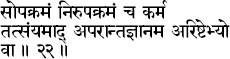
III.22 The fruition of karma is either imminent or postponed. By practicing samyama on karma or from observing omens, the time of death can be known.
When death is experienced without prior liberation, a new body needs to be manifested to provide more experience of pleasure and pain. This will happen eternally until the purpose of life, called freedom (kaivalya) or liberation (moksha), is achieved.
The new incarnation is determined by the strongest impression prevalent in the karmic storehouse (karmashaya). All related samskaras will collaborate with that particular dominant impression to manifest a new life. All karma in the storehouse is postponed or slow fructifying. From the moment it becomes active by participating in producing a body, it becomes immanent or fast fructifying. For example, from our perspective today the karma that has manifested our present body is in fruition whereas what is dormant in the storehouse is in residue (slow fructifying).
Similarly, in our life now we constantly produce new karma, unless we are in spontaneous suspension of breath (kevala kumbhaka) or samadhi, have gained jnana, are experiencing intense devotion to the Supreme Being (bhakti), or are in some similar state. In all of those states no new karma is created, because we are in truth or abide in consciousness. The new karma that we constantly produce can again be imminent or postponed, depending on the intensity of the act that has produced it. We know from the example of great masters such as Vishvamitra and Vasishta that by practicing with fervor one can break free in one lifetime. But it is true also that acts performed with great viciousness may manifest immediate results. So we are told that when the proud King Nahusha humiliated the Rishi Agastya he was turned into a snake on the spot. Acts performed with a mellower attitude will produce karma that accumulates in the karmic storehouse and comes to fruition slowly, in a future life.
By practicing samyama on karma, one can identify which elements of one’s karma are imminent or fast and which postponed or slow. By isolating all of one’s immanent karma, one can identify which part contributes to one’s death, and thus the time of death can be known. In this context we need to understand that fast-fructifying karma provides the fuel for the body. When this fuel runs out the end of the body is nigh.
The other way by which death can be foreseen is by observing omens. The Mahabharata says for example that, in his thirty-sixth year of rule, Emperor Yudishthira saw bad omens. He enthroned his crown prince, Parikshit, stepped down, and awaited the death of Krishna, which marked the beginning of Kali Yuga, and afterward his own death.
Vyasa says in his commentary that omens are of three kinds: personal, impersonal, and divine. Personal omens are when one closes with one’s fingers the apertures of the body, such as the eyes and ears, and does not perceive signs of life such as light and sound. Impersonal omens are visitations by other beings that function as messengers of death. A divine omen is the sudden appearance of a heavenly being or deity. From these various omens the time of approaching death can be ascertained.

III.23 By doing samyama on friend-liness, compassion, and joy, one acquires their powers.
This sutra is connected to sutra I.33. There Patanjali suggested that we should be friendly to the happy and compassionate to the downtrodden, experience joy on meeting the virtuous and be indifferent on encountering the vicious. By practicing samyama on the first three sentiments, so Vyasa says, unfailing energy results. Indifference, according to him, is not fit to be the object of samyama. It is not a sentiment itself, but, as Vijnanabhikshu explains, the absence of a sentiment, like friendliness for example. Since it is only a negation of other feelings, no samyama on it is possible and no powers can arise out of it.
The powers that arise from samyama on the other three sentiments are to be permanently established in them whatever the circumstance. Vachaspati Mishra says that “the yogi gets the power to make everybody happy and he delivers living beings from pain.”20
Why is unfailing energy a result of this samyama? Yoga considers that we have an endless energy reservoir at the base of the spine in the form of the serpent power kundalini. The extent to which this energy is blocked depends on our conditioning, which in turn determines which chakras are open and which are blocked. The samyama under discussion makes us free from our conditioning, which is nothing but the degree to which we are limited by past hurt. The samyama makes us independent because we do not react, in the three cases Patanjali outlined, according to previous conditioning. This enables us to access all our energy resources.

III.24 By samyama on any form of strength, such as the strength of an elephant, this strength can be gained.
Vyasa elaborates that by practicing samyama on Vainateya we will gain his strength. He believes this strength to be more desirable than an elephant’s, which is understandable since Vainateya ate an entire elephant when he was hungry. Who is Vainateya?
“Vainateya” means son of Vinata. It is said in the Garuda Purana that, a long time before man appeared on earth, gods and demons fought for supremacy. The gods eventually won by getting hold ofsoma, the nectar of immortality.
The leader of the gods was the powerful Indra, who at times could be very egotistical, proud, and cruel. One day he humiliated a group of tiny, ancient spirits called the Valakhilyas. They approached the Rishi Kashyappa for help in teaching the god a lesson and let all of their power (tapas) enter into him. Kashyappa then went and procreated with his wife Vinata.
After five hundred years Vinata gave birth to a son who was invincible. His name was Garuda, the king of the eagles. Garuda was so big that when he spread his wings they would cover the sky and shake the fourteen worlds. He could not be killed because he did not have a mortal body, it being a manifestation of the vibratory pattern of the Gayatri mantra, the most sacred of all mantras. Garuda, against the resistance of all the gods, forced his way into heaven, fought and defeated Indra, and took from him the soma, the nectar of immortality. This power of Garuda, explains Vyasa, we can get from doing samyama on it.
A similar method is employed today in NLP (neurolinguistic programming). NLP suggests that, if you want to excel in a particular subject, you choose a particular individual who has mastered it and duplicate their experience. If for example you desire to be a composer, you might go and duplicate J. S. Bach’s experience. Duplication addresses such aspects as how he felt, how he worked, what his ideas of himself were. In other words you do a meditation on Bach-ness. The concept of duplication is the closest that somebody with a fluctuating mind can get to samyama. Duplication means attempting to create in your mind an exact duplicate of your chosen object. Somewhere within that object is the power you are looking for, in this case the genius of J. S. Bach. The success of duplication is limited to exactly the amount by which your thought waves are fluctuating when you perform the duplication. These in turn are, of course, dependent on the extent to which you are a slave to your past conditioning.
Samyama works in a similar way, with the difference that the yogi, having made the mind single-pointed (ekagra) in objective (samprajnata) samadhi, can download J. S. Bach–ness without being limited by existing conditioning.
Any method for accumulating power, be it samyama, NLP, or hypnotherapy, must be questioned from the aspect of liberation (kaivalya). In kaivalya we go beyond gain and loss, since we become one with the matrix (consciousness) that supports all phenomena. The powers are phenomena, albeit very fancy ones. Phenomena are transitory and therefore cannot lead us to freedom. Why desire transitory phenomena when we can attain to that mystery — consciousness — that alone is eternal?

III.25 Through directing the luminous light of higher perception onto objects, whether they are subtle, hidden, or distant, one knows them.
This sutra describes the siddhi (power) that can arise from the practice mentioned in sutra I.36. There it was suggested that we focus on the effulgent or luminous light in the heart to clear the mind.
The master Vijnanabhikshu explains in his Yoga varttika that this is an indirect siddhi, which does not happen by doing samyama on an object that is subtle, hidden, or distant. Rather, the samyama is done on the intellect (buddhi) itself, which has been made sattvic through the prescribed meditation technique. Through the samyama there is revealed the effulgent light of the intellect, which is now a manifestation of the pure sattva guna. Directed at any object, this shining light reveals it.
This explanation might sound somewhat complicated, but it is exactly what happens. The mechanism can be seen at work in the discourses of many great masters such as J. Krishnamurti. Whatever was placed before him, his intellect appeared to dissect it in a millisecond. The audience can come to the erroneous belief that such masters are all knowing. It is not that they are all knowing; it is the laserlike quality of their sattvic intellect, revealing subtle, hidden, and distant objects, that makes them appear that way.

III.26 From samyama on the sun comes knowledge of the whole cosmos.
The Rishi Vyasa gives a beautiful description over several pages of the view of the subtle world region, seen through samyama. They are primarily spaces inhabited by beings according to their level of awareness resulting from previous actions. The description can be taken from any direct translation of the Yoga Bhasya (commentary), and it must not concern us here. Suffice it to say that the subcommentators Shankara, Vachaspati Mishra, and Vijnanabhikshu confirm the order of the world spaces as seen by Vyasa.
Most commentators of the twentieth century have erroneously taken this sutra to refer to the sun in the sky. If we were to do samyama on the star “sun” then we would learn all about its orbit, its luminosity, its history, its chemistry, and the like, but not about the world.
Many sutras are expressed in a cryptic way to fool the uninitiated. They were designed as a guide for teachers, along which they could develop their teaching. On reciting a sutra, a vast amount ofpreviously studied material would come to the teacher’s mind. In this way no major theme was forgotten. Today students and scholars alike speculate about the meaning of those sutras without undergoing the necessary traditional yogic training beforehand. “Yogic training” in this context means to learn from somebody who has studied the scriptures, has practiced the methods, has had the experiences, and can communicate the content. The many misunderstandings of the Yoga Sutra published today come about because such training has not been undertaken.
The key to understanding the present sutra is to know what it is that we have to practice samyama on to gain knowledge of all world spaces. Vyasa says, “on the door of the sun,” which does not get us much further, but we know it cannot be the sun in the sky — that would give us knowledge only of gross world spaces and not subtle ones.
Vachaspati Mishra gives a more precise description in his Tattva-Vaisharadi: “Upon the door of the sun means upon the tube of Sushumna.”21 The sushumna is the axis and center of the subtle universe, the microcosm. It fulfills the same function as Mount Meru (Kailash) in the macrocosm. As one of the tenets of mysticism says, “As above so below; as within so without.” By practicing samyama on the center of this subtle universe, we get to know its entire expanse. Hariharananda Aranya agrees that the solar entrance is identical with the sushumna entrance. In particular he says that an effulgent ray of light going up from the heart is to be used for this samyama.
Vijnanabhikshu, too, says that the solar gate refers to the entrance to the region of Brahman,22 Brahmarandhra, the gate of Brahman, being another word for the upper end of sushumna. If the life force exits the shushumna here at the point of death, one does not return into this world to manifest a new body but becomes one with infinite consciousness or “enters the regions of Brahman.”

III.27 Through samyama on the moon, knowledge of the arrangements of the stars is known.
Neither Vyasa nor any of the historical subcommentators explains this sutra any further. H. Aranya takes “moon” here as meaning lunar entrance, just as “sun” meant solar entrance. When self-knowledge has been obtained, the prana will leave through the sun-gate or gate of Brahman at the conclusion of one’s life. Having failed to obtain self-knowledge, the life force will exit through the lunar passage, which Aranya equates with the sense openings such as the eyes. The sense organs are apertures through which we apprehend the world, or gross world spaces. As the sun sheds its light on the moon, and it is only through this light that the moon is known, so is the light of consciousness, which shines through the solar passage, reflected onto the lunar passage, the senses. Only through the light of consciousness can our senses perceive.
By samyama on the moon gate (the senses), everything that is known through the senses — even the most remote objects such as the stars — can be known. This samyama makes the senses more proficient in collecting sensory input from faraway objects such as distant solar systems.

III.28 Through samyama on the pole star the movements of the stars are known.
This samyama should be practiced straight after the previous one, Vyasa says. He adds that if samyama were made on the celestial vehicles, sometimes translated as “astral chariots,” everything would be known about them. Shankara understands this to refer to astrological knowledge, which is knowledge of how conjunctions and oppositions of planetary objects influence the good and bad fortune of living beings.
H. Aranya understands this as the actual movements of the stars in the sky, which can be perceived if one looks steadfastly at the pole star for a long time. Vyasa takes the sutra to refer to both astronomical and astrological knowledge.

III.29 From samyama on the navel chakra, medical knowledge is derived.
Vyasa adds that such things as the three doshas (vata, kapha, and pitta) and the seven dhatus (skin, blood, flesh, fat, bone, marrow, and semen) are cognized. Those are ayurvedic terms, Ayurveda being the ancient Indian system of medicine.
In the traditional chant dedicated to Patanjali, he is credited with being the author of yoga, grammar, and medicine. The Charaka Samhita, one of the main treatises on medicine, is ascribed to him.
In this sutra Patanjali describes how he obtained his understanding of medicine — not by decades of research but simply by practicing samyama on the center of the body. In this way all systems of the body are comprehended. Vijnanabhikshu explains that the navel is chosen for this samyama, since the limbs and organs of a fetus grow out of the bulb of the navel (where it is connected to the mother) as a banana plant grows out of the bulb of its root.
The bulb (kanda) is an intricate detail of subtle anatomy. It is said to be the point of termination of all 72,000 nadis. The Rishi Vasishta points out that the navel constitutes the middle part of the kanda, from which the chakras originate.23 An asana called Kandasana is designed to stimulate kanda by pressing both heels into the abdomen.

III.30 Samyama on the cavity of the throat brings cessation of hunger and thirst.
According to Western medicine, metabolic activity, and with it decreases and increases in hunger, is directed by the thyroid gland, which is situated in the throat. When thyroid activity is high, one will be hungry and metabolize fast. People with an active thyroid gland often eat a lot and yet do not put on weight. Those with low thyroid activity experience minimal hunger but, since the body metabolizes slowly, they put on weight even if they eat little. The samyama on the right location will switch off any experience of hunger and thirst.
This samyama would have incredible commercial applications, since it is the ultimate slimness “pill.” Unfortunately Patanjali is not specific, and Vijnanabhikshu says the exact method can only be learned from “special yoga shastra” or from a guru who teaches it.

III.31 Samyama on the kurma nadi leads to complete steadiness.
The kurma nadi is a particular energy channel. Vyasa says this samyama leads to the motionlessness of a snake or lizard, in other words motionlessness of the body. Vijnanabhikshu and H. Aranya, however, take this sutra to be referring to the motionless mind, and Aranya takes kurma nadi to mean bronchial tube. The calming of the breathing mechanism will, according to his exposition, make the body motionless. This will lead to the mind becoming motionless.
Vijnanabhikshu says this samyama will lead to a steady state of mind. He interprets kurma nadi (tortoise channel) to mean the heart lotus, since it is formed by a collection of nerves “in the shape of a tortoise.”24 This could be right. His interpretation would lead to the reading of the sutra as “Samyama on the external form of the heart lotus leads to steadiness of the mind.” In linking the heart and the mind, this would anticipate sutra III.34, in which Patanjali says understanding of the mind is gained from samyama on the heart.

III.32 By practicing samyama on the effulgence in the head, the siddhas can be seen.
Some beings, in their quest for freedom and their consequent effort to map possible paths for others, did not just merge into infinite consciousness upon liberation, but consciously manifested again and created a large body of teachings over several manifestations. The Rishi Vyasa’s ability to “appear” or “disappear” is often mentioned in the Mahabharata. In a similar way Patanjali reappeared in the form of Charaka to give teachings on medicine, while Patanjali himself is seen as a manifestation of the serpent of infinity. The masters of the Advaita lineage — Gaudapada, Govinda, Shankara — are seen as a reappearance of the masters of the yoga lineage.
Accomplished masters who can project appearances at will are called siddhas in India. Here Patanjali suggests getting the darshana or view of such beings. In the Puranas (a category of scriptures) many stories are related where the practice of a yogi was greatly accelerated by getting the darshana and the instruction of a siddha. The method for getting such an audience, according to Patanjali, is to do samyama on the light in the head.
Vachaspati Mishra explains that the light in the head here means sushumna but doesn’t elaborate. This light arises when kundalini rises through sushumna and then creates effulgence at its upper end, which is the gate of Brahman inside the head. The samyama on this light will lead to the view of celestials. Stories are told, for example, that at the enlightenment of Gautama Buddha, at the death of Milarepa, and during the discourses of Yajnavalkya to Gargi and of Vasishta to Rama, the sky was full of siddhas and celestial beings.

III.33 Otherwise everything will be known from the rising glow of illumination.
Vyasa explains that this rising glow is the anticipation of discriminative knowledge, which will make us free or deliver us. Vijnanabhikshu declared earlier that all the previously described samyamas are to be done only by those who desire the powers they make available. To all of those who desire only liberation, the samyama on the difference between intellect and consciousness is sufficient. In this present sutra Patanjali states that all those powers will automatically come at the dawn of self-knowledge. We cannot help but be reminded of the attempted seduction of Jesus Christ by the Prince of Darkness in the desert. Gautama Buddha had the same experience under the bodhi tree when Mara tried to seduce him.
The powers are traps that might seduce an immature practitioner. They are attempts of the ego to attach itself yet again to appearance and claim it as its own. Just before self-knowledge is attained, pure intelligence is cognized and then rejected as not being the true self. In this cognition of pure intelligence, all powers of this world are contained. If we hold on to pure intelligence and use it for our own satisfaction, we can have all the power of this world. This moment is represented in the stories of Jesus and Buddha by the devil and Mara appearing and offering them all the world’s empires.
The devil and Mara are metaphors for the ego. The ego knows that when one step further is taken and the self is seen, the ego will be rendered powerless forever. In mysticism this is called the destruction of the ego, which again is only a metaphor. The ego now plays the last drawcard that it has, which is its identification with the last object that appears before the sun of self-knowledge rises. This last object is pure intelligence (buddhi).
The ego promises us that, if we sustain identification and declare this intelligence as ours, we can own the entire world. That is true. Pure intelligence, once freed from the shackles of tamas and rajas, will be able to penetrate any object. But it comes at a price. If we sustain identification, self-knowledge and therefore freedom are obstructed. It is only through the surrendering of all identification that what is intangible (consciousness) can be realized.
The following footnote is offered to those who want to understand the fine differences in Indian schools of thought. Shankara says, in his sub-commentary Vivarana, “When the yogi makes samyama on the self (atman) . . . ”25 This quote identifies the author as a Vedantin, which is indeed what Shankara is. Patanjali, who follows Kapila’s school of Samkhya, defines samyama as a combined effort ofdharana dhyana, and samprajnata samadhi (sutra III.4). Samprajnata samadhi is samadhi that relies for its arising on an object (such as the intellect) and is therefore called “samadhi with object.”Samprajnata samadhi excludes the atman, which is not an object but the subject. If we sustain samadhi on atman (consciousness) then this is “samadhi beyond object” (asamprajnata or nirbija samadhi). According to Patanjali, nirbija samadhi cannot be combined with dharana and dhyana, since both these methods imply the sustenance of ego. For a Vedantin like Shankara this poses no problem, since all appearances, including the ego, are seen only as mirages superimposed on the one true reality, consciousness.

III.34 Through samyama on the heart, understanding of the mind (chitta) is gained.
In this sutra Patanjali explains how he himself gained knowledge of yoga. According to him, yoga is the discipline of stilling the fluctuations of the mind (sutra I.2). In this definition, yoga is declared a discipline that deals mainly with the mind, it being the main obstacle that prevents us from abiding in consciousness. Students who do not experience the mind as an obstacle can go on to study the science of consciousness (Vedanta) directly. The Vedanta is explained in the Brahma Sutra, which starts with “athato brahmajijnasa,” meaning “Now then inquiry into consciousness.”
The term athato implies that in order to undertake this inquiry certain requirements need to be fulfilled beforehand. The principal requirements are that cognition needs to be free from error and the fluctuations of the mind (chitta) need to be predominantly sattvic. If this is not the case, we are not ready for the science of consciousness and should study the science of the mind first, which is yoga. For students who cannot meditate on consciousness directly, yoga provides the opportunity to become free.
Patanjali displays in his Yoga Sutra such complete understanding of mind that all subsequent masters accepted him as the authority for yoga. How did he get such a complete understanding, such comprehension of the matter? He did so through mastery of samyama.
Before Patanjali there were masters such as Hiranyagarbha who wrote treatises on yoga, but Patanjali’s replaced theirs. The method of samyama was possibly not as refined before Patanjali.
The understanding of the mind (chitta), and with it the understanding of yoga, is gained by samyama on the heart. The Maitri Upanishad states that, when the fuel of the senses is withheld, the mind is reabsorbed into the heart. It is reabsorbed into the heart because it was projected out of the heart in the first place. The heart is the source of the mind. That is why samyama on the heart is required if we want to understand mind.
The Chandogya Upanishad says, “Inside of the city of Brahman there is a house with nine doors. Inside this house there is a small shrine in the shape of a lotus flower [the heart].” On this lotus thesamyama is to be made. Vijnanabhikshu confirms that, by the practice of samyama on that abode called the heart, there is direct perception (knowledge) of the mind.26 The location that is understood here is obviously not the gross structure but the heart lotus in the form of the anahata, which is also called the center or the central channel.

III.35 Experience that serves the purpose of another is defined as the erroneous commingling of intellect and consciousness, which are really completely distinct. Through samyama on that which exists for its own purpose some knowledge concerning purusha can be obtained.
This is a difficult but highly rewarding sutra, once it is properly understood. The Sanskrit term used here for intellect is sattva. Through practice, study, and detachment, the common intellect has to be freed from all stupor (tamas) and frenzy (rajas). Only the intellect that has been made sattvic is a fitting tool for liberation. According to Samkhya, intellect in the form of pure sattva is the first evolute to arise out of nature (prakrti). This makes the sattvika form the natural form of the intellect. However, due to evolution, which in yoga is viewed as degeneration from the pristine, original, and natural state, it has been soiled and stained. Once the intellect has been returned to its original state, we can meditate on the difference between intellect and consciousness. This meditation eventually will lead to liberation.
The term “experience” now needs to be defined. The Sanskrit word used is bhoga, which can also be translated as “enjoyment” or “consumption.” The Mundaka Upanishad relates the story of two birds that sit on the same tree of life. One is enjoying or “eating” the fruits of the tree, the fruits of pleasure and pain. This bird is the conceptual, phenomenal, or egoic self, sometimes called jiva in Indian thought. The other bird just silently looks on and witnesses. This is the true self or consciousness, usually called atman or purusha. The first bird, through eating the fruit of pleasure and pain, falls into despair and ignorance. On turning around, however, and recognizing the glory of its friend, the true self, the first bird becomes free.
The conceptual or phenomenal self believes that it can own, accumulate, and consume phenomena, a process that is called bhoga or experience. The true self or consciousness is only silent awareness or witnessing. This state is true yoga or freedom. Bhoga and yoga are opposed. Either we believe in the game of gain and loss, the illusion that we can accumulate or lose phenomena, which is called experience, or we are forever free. The student of yoga who has experienced the whole breadth of human emotion now, in her or his thirst, asks for an experience (bhoga) of yoga and consciousness. But consciousness is beyond experience, since experience by definition is impermanent and fluctuating. Consciousness, however, is eternal and immutable; it is beyond experience and must be realized. Realization leads to freedom from thirst for experience. No experience can quench this thirst. On the contrary, experience always creates new thirst for new experience.
The sutra explains that experience exists for the purpose of the seer, as Patanjali states. This is why the seer is called “deep reality,” the reality that cannot be reduced to a deeper layer. That which exists only for its own purpose is, according to the Samkhya Karika, the purusha (consciousness). If consciousness did not exist for itself but for another, we would have to propose a yet deeper layer of reality underneath consciousness. This is not possible, since consciousness is already the formless absolute.
What is it exactly, then, that we have to do samyama on in order to get an idea of the self? Let us recall that samyama includes objective samadhi, which according to Patanjali’s definition cannot be directed at purusha. This is affirmed by H. Aranya, who says, “Purusha by himself cannot be the object of samyama.”27 The samyama here is done on the image or concept of purusha that the intellect has developed. “By samyama on the form of knowledge of purusha, a knowledge regarding the real purusha is acquired.”28 Now we understand why only the sattvika intellect is suitable for such inquiry. The intellect distorted by tamas and rajas could never come to right knowledge. Vyasa says in his commentary that practicing samyama on the idea or conception of consciousness leads to insight (prajna), which has purusha as its object.
Why is that important? Is not insight (prajna) still only a property of the intellect?
As we know from sutra II.27, insight is sevenfold and is the pre-stage and prerequisite for discrimi native knowledge (viveka khyateh). Discriminative knowledge is the medicine that cures the disease-conditioned existence, which has been caused by ignorance (avidya), and returns us to the healthy state, which is freedom (kaivalya).
Discriminative knowledge now does arise in the intellect. How is that possible? Does not liberation mean to abide in consciousness? One either does have or does not have discriminative knowledge, which makes it changeable. When something previously unknown comes to our awareness, it arises in the intellect. Consciousness, however, is forever aware and unchangeable.
Discriminative knowledge is nothing but the final stage of the awakening of intelligence. Once it is obtained, the illusion that the intellect forms a functional unity with consciousness is destroyed. The conceptual bond with consciousness is severed and consciousness then shines in its own glory. This happens without consciousness going through any mutation whatsoever. Only through isolation from the staining intellect are the independence and aloneness of the consciousness realized. The insight (prajna) obtained through the samyama described in this sutra is a pre-stage to it.

III.36 From that arise illumination, supernormal hearing, supernormal touch, supernormal sight, supernormal smell, and supernormal taste.
“From that” means from the samyama previously described. This is another clear indicator that the previous sutra was not talking about self-knowledge. Such powers do not arise out of self-knowledge. They are in fact an obstacle to self-knowledge, because the ego or I-am-ness attaches itself to the powers and claims them as its own. Any such form of identification will, however, stop one from becoming one with the ocean of infinite consciousness.
How do these powers (siddhis) arise? The first one, illumination (pratibha), has been described already in sutra III.33. It is a quality of the intellect that arises prior to discriminative knowledge (viveka khyateh). The other five are supernormal developments of the five senses. Let us recall that in Samkhya the senses and the five gross elements are projected out from the five subtle elements (tanmatras). The tanmatras can be looked on as subtle essences of the senses and gross elements. In a similar fashion the ahamkara or ego can be looked on as the subtle essence of the world as we know it, and cosmic intellect can be understood as the subtle essence of ego.
When the yogi has attained the stage of sattvic intellect and practiced the samyamas mentioned in the previous sutras, one perceives the subtle essence directly. For example, instead of seeing, one sees divine light — which is seeing-as-such — and with it all that is to be seen. Instead of hearing, one hears divine sound and with it all that is to be heard.
Vyasa explains that all things subtle, hidden, remote, past, and future are perceived, and many mythological stories are related of people obtaining those powers. When the blind king Drtharashtra looked over the battlefield Kurukshetra, on which all his sons and relatives had assembled to kill each other, his charioteer Sanjaya was given the celestial ear so that he could report all occurrences to the blind king. With his newfound ability he was able to hear all that was said on the battlefield and relay it to Drtharashtra.
Another example is the celestial eye that Arjuna obtains when he asks Krishna to reveal his cosmic form (Vishvarupa), to behold the Lord containing all universes in him. The next sutra will explain further.

III.37 All these are powers for the fluctuating mind, but they are obstacles for samadhi.
Vyasa explains that the superpowers hinder one from realizing the highest truth, which is the self-in-itself. All the powers are still just fluctuations of the mind, which prevent us from realizing the glory of the self.
To be able to see into the past and future might look very powerful to the fluctuating mind, offering a great opportunity to obtain advantage over others, but seen from consciousness it is absolutely insignificant. Time is a phenomenon that occurs in chitta (mind), which is achit, unconscious. Chit (consciousness) witnesses all time modes simultaneously and knows everything presented to it.
All phenomena, whether past, present, or future, are identical in their purpose. They are supplied only for us to realize ourselves as infinite, pure consciousness. The powers, however, because they are seen as extraordinary by the fluctuating mind, invite us to cling to them, and so prevent us from entering into seedless samadhi.
Vachaspati Mishra says, “Occasionally a man acquires those perfections, and thinks because of the power of these, that he has effected his purpose, and so might cease the samyama.”29 There are in fact many stories related of practitioners who acquired such powers and then fell from grace by pursuing them instead of the realization of consciousness. One might, for example, be a beggar in the waking state and a billionaire in dreams, and on acquiring powers one might set one’s sights on becoming a billionaire in the waking state as well. All these states, however, beggar and billionaire, waking and dreaming, are only transitory appearances arising to the eternal awareness of consciousness. If we “own” them, whatever they are, seedless samadhi cannot arise. For this reason all these states are an obstacle to samadhi.

III.38 Through loosening the cause of bondage and by knowing how the mind moves, one’s mind can enter another body.
The cause of bondage is ignorance. From ignorance are produced afflictions (kleshas), affliction-based actions, new karma, and more negative subconscious imprints (samskaras). Altogether they produce more ignorance (avidya). Avidya and all the related impurities are gradually removed, first by Kriya Yoga (yoga of action) and then by Ashtanga Yoga (eight-limbed yoga). This process is also referred to as loosening the cause of bondage.
Knowing how the mind moves is achieved by samyama on the heart. Vyasa explains that the bonds brought into being by previous actions become weak when yogic power increases. The bond between body and mind exists only because of subconscious imprints. Once those are removed, which is accomplished by objective samadhi, the yogi can withdraw his mind from one body and project it into another.
An interesting story relates how the great Shankara did exactly that. Some Western scholars and Vedantins have put significant effort into portraying Shankara exclusively as either a philosopher or a Vedantin, but from his treatises and his biography we can see that he was a great yoga master as well. He traveled the entire length and width of India by foot twice in an attempt to restore the correct understanding of the Upanishads, and in the course of his travels he defeated, in learned dispute, many scholars of rival schools.
One of his prominent victims was the famed ritualist Mandana Mishra. Shankara did battle with Mishra for a whole month until Mishra conceded defeat, which meant he had to become Shankara’s disciple. At this point Mandana Mishra’s wife Bharati stepped in, she being a great scholar in her own right, and persuaded Shankara that his defeat of Mandana was not complete until he had defeated her as well. Upon accepting the challenge, however, the surprised Shankara found that the subject of the renewed debate was to be kama shastra, treatises teaching sexual pleasure. He realized that, having been a monk from boyhood, he was ill-equipped to face the challenge, and asked for the debate to be adjourned for a month.
Shankara had heard that in a nearby kingdom the king had just died and was to be cremated that day. He instructed his disciples to take care of his unconscious body while he was gone; then, through the method described in our sutra, he withdrew his mind from his body and projected it into the body of the dead king. The body became animated by Shankara’s prana shakti, just as his own body became lifeless. For a whole month Shankara “studied,” in the body of the king and with the king’s wives, all that a monk usually does not get to study. The theory behind it, as you might have guessed, is that since he did not use his own body, he did not suffer any “pollution.” After fulfilling his mission, he returned to his body and defeated Mandana’s wife in debate using his newly acquired knowledge.
The story is omitted from some but not all accounts of Shankaracharya’s life. Some orthodox hardcore Vedantins feared it could put some confusing ideas into the minds of devotees. Its interest to us is that there is historical evidence the great Shankara successfully practiced Patanjali’s technique.

III.39 Through mastering the udana current, one stays untouched by water, mud, and thorns, and at death one rises up.
There are five principal vital airs. Vyasa describes them thus: Prana extends from the nose to the heart. Samana distributes food and goes up to the navel. Apana is a downward current that goes from the navel to the feet. Vyana pervades the entire body. Udana is an upward current that extends from the feet up to the head. Altogether they are known as prana.
By mastering the upward current, udana, lightness is achieved. This lightness expresses itself in two ways. One is that the yogi, when traveling over mud, water, or thorns, which would normally lead to immersion or entanglement, now remains in non-contact. In other words the yogi hovers above the terrain. The second manifestation is related to the endpoint of the udana current, which isbrahmarandhra,30 the upper end of sushumna. Through mastery of the udana, at death one exits the body through brahmarandhra. The exit point is related to the type of embodiment one will encounter in one’s next life. Vyasa states that the method enables one to die at will.31 This claim reconciles with accounts of masters who consciously left their bodies once their work was completed.
This rising at death is also exercised through the Phowa meditation, which is one of the Six Yogas of Naropa. The Tibetan Karma Kagyu School, which used to center around Mount Kailash, practices Naropa’s yogas. Ramamohan Brahmacharya, who was living at Mount Kailash, taught some of these techniques, such as Tummo (yoga of inner fire), to Shri T. Krishnamacharya.

III.40 By mastering the samana current, effulgence is acquired.
As described in the previous sutra by Vyasa, the samana current is responsible for distributing food and is located at the navel. In other words, samana fans and supports agni, the digestive fire. Agnicannot be controlled directly, but through samana it can be directed.
The sutra says this can be taken to such an extreme that the yogi’s body shines. There are reports of yogis using their bodies as torches in the dark forest. This is again related to Naropa’s six yogas, in this instance to Tummo, the yoga of inner fire. In one case the fire is used to create light, in the other to create heat. In Tummo, which is taught in Tibet, the yogi learns to melt ice to a diameter of several yards around the body.

III.41 Through samyama on the relationship between space and the sense of hearing one gains the divine ear.
The divine or celestial ear was considered under sutra III.36. There it is said to derive from samyama on the image of consciousness (purusha) arising in a sattvic intellect. Here we have a similar but slightly different method for arriving at the same goal.
According to yoga, space is the medium in which sound waves travel. In Samkhya, space (akasha) is the gross element (mahabhuta) that develops, together with the hearing sense, out of the subtle element (tanmatra) of sound. In other words, space and hearing depend on the subtle element of sound that is its origin. If we do samyama on the relationship of two objects (in this case space and hearing), we will recognize their common source. In our case the samyama on hearing and space will lead to the revelation of the subtle element of sound. Once the subtle element is cognized, the divine ear can be developed.

III.42 Through samyama on the relationship between space and the body or by samapatti on objects that have a quality of lightness, such as a cotton fiber, traveling through space is possible.
What is the relationship between space and the body? The body consists of four elements, but these four elements depend for their manifestation on space. No manifestation is possible without space. Vyasa writes that the relationship between the two is that space pervades the body. Through samyama on this relationship, the ability to place the body in space at will is gained.
All objects are made up of vibratory patterns. In yoga we call those patterns “sound,” even if the vibrations are not audible to the human ear. According to H. Aranya, the samyama is done on the unstruck sound (anahata nada) that pervades the body.32 The unstruck sound means of course an inaudible sound. Akasha being the medium through which sound travels, the unraveling of the sound or vibration pattern of the body leads to the ability to place the body in space wherever one wishes.
A similar effect can be gained by meditating on objects that have the property of lightness. This effect is used today in NLP (neurolinguistic programming). If one wants to attain the performance of, let us say, a certain athlete, one focuses completely on that athlete, and in that way duplicates his or her entire experience. The main reason somebody is able to perform a certain action is that they have associated this ability with their sense-of-I (ahamkara). It is a well-known fact that a belief that one will succeed in whatever one undertakes has the tendency to manifest that very result. This tendency is greatly enhanced by hypnosis, which can change unconscious beliefs about oneself. Samyama is even more effective, as one consciously replaces undesirable subconscious imprints (samskaras) with desirable ones.

III.43 The “Great Bodiless” is a method that functions outside of the gross body and beyond imagination. Through its application the veil over brightness is destroyed.
This is an advanced meditation technique. Westerners have a concept of meditation that is often strongly influenced by Buddhist Vipassana meditation and Japanese Zazen. The main technique in those forms of meditation is to be alert and to simply watch what happens, whether it is the breath, mental activity, or physical sensation. We have to let go of this concept if we want to understand meditation according to the Yoga Sutra.
Like Tibetan Buddhism and Tantra, Ashtanga Yoga proposes a much more elaborate system of meditation that is claimed to show results much faster, depending on our starting point. The Vijnana Bhairava, a collection of 112 meditation techniques, suggests looking at one’s daily life as if it were a dream and to act in one’s dreams as if one were awake. The purpose of the method is to realize that both states are not reality in itself but can be reduced to a third state, which is deep reality or consciousness.
Then we find in the Six Yogas of Naropa a technique called Illusory Body Yoga. In the instructions we read the following: “Within the crude and karmic human body lies the pure essence of the Buddha body concealed by men’s clingings and confusions. Through the practice of the Illusory Body Yoga samadhi, these clingings and confusions will gradually be cleared away. . . . As a result the samsaricpranas, nadis and bindus are purified.”33 It is in this context that our sutra has to be understood. The three systems of Tantrism, Ashtanga Yoga, and Tibetan Buddhism all employ methods that are occult, magical, alchemistic, shamanic, and transformatory. In this regard they are similar to each other and differ from the more rational and intellectual systems — Vedanta, Samkhya, Theravada Buddhism, and Zen Buddhism. We will understand now that a Tibetan Buddhist or an Indian tantric will be able to relate to the following description, whereas a Vedanta swami or a Sri Lanka Buddhist will discard it as abracadabra.
The sutra describes a method called mahavideha — “the Great Bodiless” — according to which we project our mind out of the body and imagine ourselves to be somewhere else. If this is achieved but we still perceive our gross body, then it is called imagined (kalpita). If we are completely established in our projected body and have become independent of the gross body, then it is called unimagined (akalpita) or actual. The kalpita is practiced first and leads then to the akalpita. Once it is perfected it is called the Great Bodiless.
As with Illusory Body Yoga, we project a body created by our imagination. And as with the Vijnana Bhairava, we hypothetically accept something as real that we know to be unreal (our dreams). This is done to reduce attachment to and identification with our gross body and the waking state. The attachment consists of ego (ahamkara). It is the belief that “I am the body” that prevents us from realizing ourselves as consciousness.
Vyasa explains that the practice reduces the afflictions, karma, and their threefold fruition. It is also said to eliminate tamas (stupor) and rajas (frenzy), which cover the sattva (intelligence) in the mind. In this way, as the Buddhist text explained, the “clingings and confusions” are reduced and the “pranas, nadis, and bindus are purified.”

III.44 The elements can be described in terms of five attributes, which are grossness, essential nature, subtleness, inherence, and purpose. Ifsamyama is done on the five attributes successively, then mastery of the elements is obtained.
The literature of the subcommentaries on this sutra is quite extensive. It is surprising to see such precise and in-depth analysis of nature and experience developed by the ancient sages of India. It is especially interesting then to look at contemporary man’s beliefs that he has invented science and thinking and that our ancestors were barbarians.
The five attributes that describe the elements are:
• Grossness: What we can perceive with the senses, such as the shape of an object or whether it is sound, light, or water.
• Essential nature: For example, liquidity of water, obstruction of earth, gaseousness of air, and so on.
• Subtleness: An element’s subtle essence (tanmatra). The tanmatra of a particular element is the subtlest form in which that element can still be perceived. It is perceived in samadhi and can be reduced only to ego (ahamkara) and intellect (buddhi). In that form, however, it is not related anymore to a particular element, which is why it is said that the tanmatra is the essence of the element.
• Inherence: The combination of the qualities (gunas) sattva, rajas, and tamas present in an element. Every element has a particular makeup of gunas, which can be known in deep meditation.
• Purpose: What an element is here for — namely, to provide first the opportunity for experience and second, when there has been sufficient experience of pleasure and pain, liberation.
The meditation technique suggested here consists of a successive penetration of deeper and deeper levels of elements until we reach their core. If we take water, for example, samyama is done first on its external form, which is water. Then samyama is done on its essential nature, which is liquidity. The next samyama is practiced on the ap-tanmatra, which is the subtle essence of water, perceivable only insamadhi. The fourth samadhi is done on the combination of gunas that constitute water, which is in this case a much higher level of rajas than tamas since water is very mobile and can engulf other objects. The last samyama is the most important. One perceives that the object does not exist for itself, but its purpose is to bring forth consciousness and quality of awareness (which is experience), and then its ability to know itself (which is liberation).
The sutra finally says that mastery of the elements can be gained from that samyama. To master the elements means to fulfill their purpose, which is to realize what they are here for.

III.45 From that samyama come the eight siddhis, which are not obstructed by the characteristics of the element.
The eight siddhis are:
• to become minute
• to become light
• to become large
• to reach far into the distance
• to be able to penetrate substances
• to make manifest whatever one chooses
• to be able to control appearances
• to be able to fulfill all one’s desires (omnipotence).
These eight siddhis are said not to be obstructed by the elements. Indeed, the last three embrace manipulation of the elements at will. But, says Vyasa, the yogi will not or cannot use this power to change anything in this world. This is because the order of the elements in this world is willed so by the one who has been perfected right from the beginning. That perfected being is, of course, the Supreme Being. In other words, although the powers are not obstructed through the elements, they are obstructed by the order established by the Supreme Being.

III.46 Perfection of the body is beauty, strength, grace, and adamantine solidity.
Instead of commenting, Vyasa repeats the sutra by saying that perfection of the body consists of loveliness, radiance, unsurpassed strength, and adamantine hardness. Shankara and H. Aranya refuse altogether to comment on Vyasa, while Vachaspati Mishra and Vijnanabhikshu merely repeat Vyasa’s words — which are virtually a repetition of Patanjali’s! We are looking here at the only one of 195 sutras on which none of the authoritative commentators wishes to comment.
The reason for their silence is that the body is seen as crystallized ego. When we make the body perfect, we make nothing but the ego perfect. The cause of freedom is to let go the identification with ego and body. They are silent because they want to avoid leading the student onto the wrong track — the search for perfection of the body.

III.47 From samyama on the process of knowing, the essential attribute, the ego, inherence, and purpose comes mastery of the senses.
The sutra is related to sutra III.44, but this time with the process of knowing or process of perception as the object.
• The first samyama is done on the process of knowing, which we may exemplify by consideration of the visual sense. Rays of light are reflected by an object, then collected by the eye, passed on to the mind, and compared to previous data collected about such objects. The process of knowing involves the presentation of an object, a sense organ such as an eye or ear, and the mind to recognize the object.
• The essential attribute is the intellect/intelligence. According to Vyasa, it is the nature of intelligence to illuminate whatever is presented. Miraculously, we could add. It is called the essential attribute because, without this essence of shedding light on objects, no knowing is possible. Intelligence is like light, like a torch in the darkness. Once it is switched off, even if objects, eyes, and mind are still present, seeing is not possible.
• The ego is the agent that owns the perception. Whereas the intelligence is pure knowing, the ego says it is I who knows; I perceive this object. Without this owner, perception is there, but there is nobody who perceives.
• The inherence is that which is inherent in all aspects covered so far. The process of knowing, the intellect, and the ego are all formed by the three gunas of prakrti: rajas, tamas, and sattva. The inherence therefore is the gunas.
• As in sutra III.44, the last samyama is done on the purpose. Here it is the purpose of perception, but it is identical with the purpose in III.44 nevertheless. The purpose of the world is to be seen. The purpose of perception is seeing. Both are there for the intellect to deduce the existence of the subject, the consciousness. From that, eventually the seer abides or rests in the true self, which is consciousness. This state, then, is freedom (kaivalya).
Mastery of the senses is a reversal of the process of projecting oneself outward. The normal process is to project oneself out through intelligence, ego, and the process of knowing, and eventually to identify oneself with objects such as house, car, social status, or one’s ability to conquer yoga postures. This process is also called evolution.
Opposed to this is involution, which leads from normalcy to the natural state. The natural state is not projecting ourselves out through the process of knowing but knowing ourselves as consciousness. Mastery of the senses in this context means accepting that permanent freedom and bliss are found only within, and therefore not letting the senses reach out and grasp the objects of desire.

III.48 From that [mastery of the senses] comes the ability to move the body with the speed of the mind, independence from the body, and mastery over the cause of manifestation.
To move the body with the speed of the mind means to be wherever one projects oneself. Ancient masters such as Vyasa have demonstrated the method.
Independence from the body is the ability to perform actions that would normally require a body but not resort to one. This means to project a mind and from that projected mind a body is manifested. This will be discussed further in sutra IV.4.
The cause of manifestation is nature (prakrti). But identification with that manifestation starts only because we observe it without self-knowledge, without self-remembrance. By giving up the erroneous belief (through samyama) that we are the world, prakrti ceases to manifest (at least as far as we are concerned: she will still manifest for others). This is mastery over the cause of manifestation. Mastery is not the manipulation of creation at one’s whim, because that would imply one has an agenda in this world. Any need to manipulate this world reflects an erroneous owning of phenomena, which stems from lack of self-knowledge.

III.49 From knowing the difference between intellect and consciousness comes sovereignty over all states of being and omniscience.
This is one of the key sutras of the third chapter. Everything heard so far aims at purifying and empowering the intellect. Finally, the intellect has been made purely sattvic or a pure manifestation of sattva guna, which is wisdom and intelligence. In such an intellect eventually arises the knowledge that the quality of awareness, the observer, is not located within it, but is a separate and deeper layer (or entity). The main difference between the two is that the intellect is fluctuating: it may be or may not be aware of an object. The consciousness, however, is eternally and unchangingly pure, quality-less awareness.
From knowing the difference between intellect and consciousness come supremacy and omniscience.
Omniscience is knowing everything that is to be known. Once one lets go of identification with the intellect, one can rest in true nature as consciousness. Once one rests in consciousness, the world is known. This is due to the fact that the world arises only through the onlooking of consciousness and for the purpose of consciousness realizing itself. In other words the intrinsic nature of all phenomena is only to provide knowledge for consciousness. Once this knowledge is gained, the intrinsic nature of all phenomena is understood.
The same fact accounts for the sovereignty of all states of being. All states of being, from suffering the greatest torment to being the most powerful ruler in the world, are identical in the regard that the experiencer identifies with the content of the experiences, the phenomena. This makes the experiencer impermanent, since all phenomena fluctuate. It is also said that all such beings go from death to death. Since they do not attain self-knowledge with this death, but still identify with the body, future deaths (and lives) have to be provided until the truth is seen.
Superior to all these states of being is that state in which one knows oneself as the eternal indestructible consciousness. In this state one separates at death from the body as a ripe fruit from the vine. Since consciousness is permanent, such a person is said to be immortal. Immortality in yoga is a bodiless state. All that is born must die, since birth carries the seed of death. To be immortal therefore means not to be born again.

III.50 Through supreme detachment toward even sovereignty and omniscience, the seeds of future karma are destroyed, which results in freedom (kaivalya).
The state of sovereignty described in the previous sutra has to be surrendered in order to become free. If we hold on to the powers, the ego will arise and say it is I who is powerful. This union with the transitory will plunge us back into conditioned existence. All powers and all knowledge are transitory because the intellect itself is impermanent.
Vyasa explains how this supreme detachment (vairagya) comes about. The yogi realizes that discriminative knowledge did arise in the intellect and is a property of it. Since the intellect is therefore fluctuating and mutable, it is nothing but a manifestation of the gunas. Patanjali expresses this by calling the intellect sattva, which is nothing but the name of one of the three gunas. The yogi knows that the gunas started to manifest the world only due to our ignorance. In this way discriminative knowledge can be seen as the final link in a long chain that started with ignorance (avidya).
Once this is understood, the yogi realizes that consciousness is eternal, immutable, and forever free, it being completely untouched by the presence or absence of discriminative knowledge or intellect. From this realization comes complete detachment from the intellect, which severs the illusory link between consciousness and conditioned existence.
Along with detachment from the intellect comes the dissolution of any sense of agency, the illusion that we are the doer. There follows the destruction of the seeds of future karma and rebirth. From this destruction of all shackles and bonds arises the state of cosmic consciousness or kaivalya.

III.51 The invitations of celestial beings should cause neither pride nor attachment, since that would again cause undesirable consequences.
According to Vyasa there are four types of yogis. The first type is practicing, and for them the light is just dawning (sutra I.36). The second type has achieved super-reflective (nirvichara) samapatti, and therefore receives truth-bearing knowledge (sutra 1.48). The third type has mastered the elements and senses but is still practicing (sutras III.44 and III.47), while the fourth has gone beyond practice and is approaching liberation.
Of these four types, the first is of no interest to celestial beings and the third and fourth are out of their reach. According to Vyasa the second type will, however, arouse their attention. They will try to seduce him by offering physical immortality, the services of compliant nymphs, satyrs, spacecraft, and wish-fulfilling trees as well as clairvoyance and clairaudience. Furthermore, one will be promised meetings with the great masters, be given an adamantine body and so on. All those, so the celestials will say, one has rightfully earned through one’s practice. The problem is that, on accepting such invitations, pride and attachment to the new-found acquisitions will develop. These will quickly consume the merit of one’s practice and plunge one again into ignorance and darkness.
One needs to realize that those celestials are in the claws of death due to their own attachment to pleasure. The yogi needs to detach from these invitations to gain freedom.

III.52 From samyama on the moment and its sequence comes knowledge born of discrimination.
A moment (kshana) is defined as the ultimate particle of time, as the atom is the ultimate particle of matter, according to Vyasa. He offers a second definition, which is the time taken by an atom to travel from one point in space to the adjacent point.
If we observe a continuous flow of such moments, this is called krama, sequence or succession of moment. Such a sequence is not, however, an accumulation of moments. In truth, one moment turns into the next moment and again into the next. We only ever observe one moment. Concepts such as an hour or a day give us the idea of time, but in fact there is no time. Time is only a construct of the mind, which is incapable of understanding momentariness. Nobody has ever seen future or past, as there is only ever the present. The mind develops concepts of future and past to understand why it cannot perceive certain objects.
It claims they have disappeared into an elusive past or will appear from an even more elusive future. Everything exists in all directions simultaneously. Phenomena become manifest and return to their potential state in this very moment. Nothing has ever happened in the past or future. Because our mentation cannot understand that everything is happening in the present, it develops the concept of time. But time exists only in the mind. It is its technique to organize phenomena one after the other because it does not comprehend the world.
People who have had near-death experiences have reported that they saw their life flashing past in one instant. This happens because the mind suspends at death. Then we rest in consciousness until it transforms again. From the viewpoint of consciousness our entire life happens simultaneously in a moment.
When we take a moment and look back we find there is something in us that was always there and has never changed. It appeared ancient when we were young, somewhat unabated by our youth. In old age this same aspect of ourselves suddenly feels young, timeless, and completely untouched by what is called the course of time. This aspect of ours is the true self, the consciousness. It has no past and no future. It is there simultaneously at our birth, in our youth, during our mature years, and at death. In the same way, a river is simultaneously at its source, in the mountains, in the plains, and at its mouth. It’s not that the river spends time to get from source to mouth: it is there in all places simultaneously.
In the same way the consciousness spends no time to get from birth to death. Everything happens in a moment.
When we pass from one moment into the next this is called sequence. A sequence of moments, according to Vyasa, does not amount to time, as there is only ever the present moment. Individual moments differ from each other, though, since all aggregates of prakrti are in constant flux.
If samyama is done on the moment and its succession, knowledge born of discrimination arises. This is due to the fact that this samyama will highlight anything that fluctuates. Whatever fluctuates is a product of prakrti and therefore not us — not purusha (consciousness), our true nature. In this samyama whatever is permanent will stand out from anything that is transitory. Discrimination comes about in this way.

III.53 From that, two objects that are identical in type, characteristic, and position in space can be distinguished.
In the sequence of moments it has passed through, every object has undergone a different history of mutation from any other object, even if that other object has the same function and even is in the same place. From the samyama on succession of moments such difference can be cognized.
The sutra says that a yogi can distinguish even two objects that are absolutely identical. If we place two identical objects — let us say two coins of the same denomination — before a blindfolded yogi and then exchange the position of the objects, the yogi can distinguish which of the objects has been in which position beforehand.
This is possible because, although the objects appear superficially identical, they have undergone a different history of change — for example object A was first in location 1 and then in location 2, whereas object B was first in location 2 and then in location 1.

III.54 Discriminative knowledge enables one to cross over. It is all-comprehensive and it is beyond time.
That which enables one to cross over (the ocean of conditioned existence) has to arise in every single practitioner. It cannot be gathered from a teacher’s instruction. For this reason the three stages of contemplation are always mentioned.
• Shravanna — listening to a teacher who is expounding the truth according to scripture. (It is important that a teacher does not make up his or her own truth, but that it reconciles with the teachings of literally hundreds of generations of masters.)
• Manana — reflecting and contemplating on the truth. Doubt is encouraged. Ask the teacher if you are not convinced. Don’t be satisfied with belief. Only when you have absolute conviction can the next step happen.
• Nidhidhyasana — realizing and permanently abiding in the truth.
Only with this last step has the truth become ours; mere listening or reading is not enough.
“All-comprehensive” means that nothing is hidden from this knowledge. “Discriminative knowledge” means to be aware of that which is different, the consciousness. Once this awareness is there, one knows everything that arises to consciousness. Since there is no other entity to which phenomena arise but consciousness, everything that arises is known — all-comprehensiveness.
“It is beyond time” means that this knowledge does not arise in time. It is a knowledge that discriminates between the phenomena and the container in which they arise. Time is only another phenomenon arising in this container. All phenomena arise simultaneously with this awareness. Discriminative knowledge is beyond manas (mind) and can only be gained by buddhi (intellect).

III.55 When the intellect has been made as pure as consciousness is already, liberation results.
This sutra points out the importance of the intellect. The consciousness plays no part in liberation since it is forever free and inactive. This is also stated in the Samkhya Karika. The consciousness (purusha) can never be bound, because it is forever free and therefore it cannot be liberated. Similarly the Karika says that the consciousness sits back like a spectator and only sees. It is prakrti that in a selfless way provides liberation (and bondage). This selfless role of prakrti led to the concept of the mother goddess Shakti in the later tantric philosophy, where the consciousness is identified with Shiva.
The purity of the consciousness consists in its unstainability through the phenomena that are projected onto it. The mind is impure because it is stainable by phenomena like afflictions (kleshas), ignorance (avidya), and actions (karmas). These phenomena leave imprints (samskaras), which force us to act according to previously acquired conditioning. The mind is therefore unfree and the consciousness free.
Patanjali here again uses the term sattva for intellect. It means that through the practice of yoga all traces of tamas (stupor) and rajas (agitation) have been removed, and we have reached a state of pure intelligence. In this state all misapprehensions are replaced by correct knowledge or truth (rta).
Because we now perceive things as they really are, no more afflictions can develop and no future karma can accumulate. It is only in this state that the intellect can comprehend the nature of consciousness, and all attachment and identification with the aspects of prakrti are given up. The self now rests in itself.
1. T. Leggett, Shankara on the Yoga Sutras, p. 283.
2. Yogavarttika of Vijnanabhikshu, vol. 3, trans. T. S. Rukmani, Munshiram Manoharlal, New Delhi, 1998, p. 6.
3. G. C. C. Chang, trans., Teachings and Practice of Tibetan Tantra, p. 25.
4. T. Leggett, Shankara on the Yoga Sutra, p. 285.
5. Yogavarttika of Vijnanabhikshu, vol. 3, trans. T. S. Rukmani, p. 9.
6. Ibid., p. 12.
7. Ibid.
8. T. Leggett, Shankara on the Yoga Sutras, p. 286.
9. Yogasutra of Patanjali, trans. and comm. B. Baba, Motilal Banarsidass, Delhi, 1976, p. 68.
10. Brahma Sutra Bhasya of Sri Sankaracarya, trans. Sw. Gambhirananda, Advaita Ashrama, Kolkata, 1965, p. 34.
11. G.J. Larson, Classical Samkhya, 2nd rev. ed., Motilal Banarsidass, Delhi, 1979, p. 274.
12. Yogavarttika of Vijnanabhikshu, vol. 3, trans. T. S. Rukmani, p. 14.
13. T. Leggett, Shankara on the Yoga Sutra, p. 287.
14. Ibid.
15. W. Y. Evans-Wentz, ed., Tibet’s Great Yogi Milarepa, 2nd ed., Munshiram Manoharlal, Delhi, 2000.
16. Bhagavad Gita VI.41–42.
17. Yogavarttika of Vijnanabhikshu, vol.3, trans. T. S. Rukmani, p. 19.
18. Yogavarttika of Vijnanabhikshu, vol.3, trans. T. S. Rukmani, p. 73.
19. J. H. Woods, trans., The Yoga System of Patanjali, p. 246.
20. J.H. Woods, trans., The Yoga System of Patanjali, p. 253.
21. J. H. Woods, trans., The Yoga System of Patanjali, p. 259.
22. Yogavarttika of Vijnanabhikshu, vol. 3, trans. T. S. Rukmani, p. 123.
23. Sw. Digambarji, ed. and comm., Vasishta Samhita, Kaivalyadhama, Lonavla, 1984, p. 20.
24. Yogavarttika of Vijnanabhikshu, vol. 3, trans. T. S. Rukmani, p. 127.
25. T. Leggett, Shankara on the Yoga Sutras, p. 336.
26. Yogavarttika of Vijnanabhikshu, vol. 3, trans. T. S. Rukmani, p. 130.
27. H. Aranya, Yoga Philosophy of Patanjali with Bhasvati, p. 312.
28. Ibid., p. 311.
29. J. H. Woods, trans., The Yoga System of Patanjali, p. 266.
30. Yogavarttika of Vijnanabhikshu, vol. 3, trans. T. S. Rukmani, p. 151.
31. H. Aranya, Yoga Philosophy of Patanjali with Bhasvati, p. 315.
32. H. Aranya, Yoga Philosophy of Patanjali, p. 318.
33. G. C. C. Chang, trans., Teachings and Practice of Tibetan Tantra, p. 87.