The cavity of the thorax is completely filled laterally by the lungs, each lying in its pleural cavity. The space between the pleural cavities occupying the centre of the thoracic cavity is the mediastinum. It contains the heart and great blood vessels, oesophagus, trachea and its bifurcation, thymus, thoracic duct, lymph nodes, phrenic and vagus nerves. The loose connective tissue between these structures connects freely with that of the neck. Mediastinitis may complicate infections in the neck.
Divisions of the mediastinum
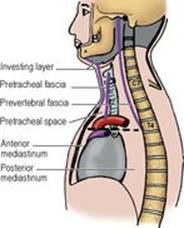
There is a plane of division to which the whole topography of the mediastinum can be related, namely a plane passing horizontally through the sternal angle (of Louis), i.e. the manubriosternal joint (Fig. 4.9). From the second costal cartilages, this plane passes backwards to the lower border of T4 vertebra. Above, between it and the thoracic inlet, lies the superior mediastinum. Below the plane, the inferior mediastinum is divided into three compartments by the fibrous pericardium: a part in front, the anterior mediastinum; a part behind, the posterior mediastinum; and the middle mediastinum in between containing the pericardium and heart together with the adjoining parts of the great vessels and the lung roots. The anterior and posterior mediastina are in direct continuity with the superior mediastinum; their separation from it is purely descriptive, not anatomical. The plane passes through the bifurcation of the trachea, the concavity of the arch of the aorta, and just above the bifurcation of the pulmonary trunk. On the plane the azygos vein enters the superior vena cava, and the thoracic duct reaches the left side of the oesophagus in its passage upwards from the abdomen. Also lying in the plane are the ligamentum arteriosum, with the left recurrent laryngeal nerve recurving below it, tracheobronchial lymph nodes, and the superficial and deep parts of the cardiac plexus.
|
|
|
Figure 4.9 Divisions of the mediastinum, showing the continuity with the tissue spaces of the neck. The superior mediastinum is above the interrupted line passing from the sternal angle to the lower border of T4 vertebra. The anterior mediastinum is continuous through the superior mediastinum with the pretracheal space of the neck, up to the hyoid bone. The posterior mediastinum is continuous with the retropharyngeal and paratracheal space of the neck, up to the base of the skull. The pharynx and oesophagus are not depicted. |
The prevertebral and pretracheal fasciae extend from the neck into the superior mediastinum. The former fuses with the anterior longitudinal ligament over T4 vertebra; the latter blends with the pericardium over the front upper part of the heart. Thus, neck infection in front of the pretracheal fascia is directed into the anterior mediastinum, while infection behind the pre-vertebral fascia is imprisoned in the superior mediastinum in front of the vertebral bodies (Fig. 4.9). From elsewhere in the neck infection may extend through the superior into the posterior mediastinum.