The posterior mediastinum is the space posterior to the pericardium and to the domed upper surface of the diaphragm. It is continuous directly, via the posterior part of the superior mediastinum, with the tissue spaces behind the pretracheal fascia and in front of the prevertebral fascia in the neck. It is bounded posteriorly by thoracic vertebrae 5 to 12 and anteriorly by the pericardium and the sloping fibres of the diaphragm (Fig. 4.9). It contains the oesophagus, thoracic aorta, azygos, hemiazygos and accessory hemiazygos veins, thoracic duct and lymph nodes.
Thoracic (descending) aorta
This large arterial trunk commences at the lower border of T4 vertebra, where the arch of the aorta ends (Fig. 4.13). At first to the left of the midline, the vessel slants gradually to the midline and leaves the posterior mediastinum at the level of T12 vertebra by passing behind the diaphragm between the crura (i.e. behind the median arcuate ligament). It gives off nine pairs of posterior intercostal arteries (see p. 183), a pair of subcostal arteries (see p. 276), bronchial arteries (see p. 216), oesophageal vessels (see below) and a few small pericardial and phrenic branches.
Oesophagus
This muscular tube begins at the lower border of the cricoid cartilage (at the level of C6 vertebra), passes through the diaphragm at the level of T10 vertebra and ends in the abdomen at the cardiac orifice of the stomach at the level of T11 vertebra. It is 25cm long.
The cervical portion of the oesophagus (see p. 341) commences in the midline in front of the prevertebral fascia, then inclines slightly to the left of the midline, enters the thoracic inlet and passes downwards through the superior mediastinum. At the level of T5 vertebra the oesophagus returns to the midline, but at T7 it deviates again to the left and curves forward to pass in front of the descending thoracic aorta and pierce the diaphragm 2.5cm to the left of the midline (a thumb's breadth from the side of the sternum), at the level of the seventh left costal cartilage. Here fibres from the right crus of the diaphragm sweep around the oesophageal opening in a sling-like loop (see p. 185). The intra-abdominal part of the oesophagus (see p. 248) varies in length according to the tone of its muscle and the degree of distension of the stomach; it averages 1 to 2cm.
In the superior mediastinum the oesophagus is crossed by the arch of the aorta on its left side, and the vena azygos on its right (Figs 4.12 and 4.13). Throughout its length the trachea is a direct anterior relation of the oesophagus. Just below the bifurcation of the trachea, in the posterior mediastinum, it is crossed anteriorly by the left main bronchus and the right pulmonary artery (Fig. 4.29). Below that the pericardium (separating it from the left atrium) and the posterior sloping fibres of the diaphragm are in front of the oesophagus. The thoracic duct is posterior to the oesophagus, at first to its right, then ascending directly behind it and lying to its left in the superior mediastinum. On a more posterior plane, the hemiazygos, accessory hemiazygos and right posterior (aortic) intercostal arteries cross the midline behind the oesophagus. The mediastinal pleura touches the oesophagus on both sides, and there is a pocket of right pleura behind the oesophagus and in front of the azygos vein and vertebral column.
Constrictions.The narrowest part of the oesophagus is its commencement at the cricopharyngeal sphincter (see p. 384), 15cm from the incisor teeth. Other sites where slight constrictions may be expected are where it is crossed by the aortic arch, 22cm, by the left principal bronchus, 27cm, and where it passes through the opening in the diaphragm, 38cm from the incisor teeth. Although the left atrium is in front of the lower part below the left bronchus, it is only when enlarged that the atrium causes an indentation in the oesophagus.
Blood supply
The upper oesophagus is supplied by the inferior thyroid arteries, the middle portion by oesophageal branches from the aorta and by the bronchial arteries, and the lower part by the oesophageal branches of the left gastric artery. Venous return from the upper part is to the brachiocephalic veins, from the middle part to the azygos system of veins, and from the lower reaches by oesophageal tributaries of the left gastric vein, which empties into the portal vein. Thus there exists, in the lower part of the oesophagus, an anastomosis between portal and systemic venous systems. This anastomosis lies level with the central tendon (T8 vertebra) well above the oesophageal hiatus in the diaphragm. In cases of portal obstruction varicosities of these veins occur and their rupture may give rise to serious or fatal haemorrhage.
Lymph drainage
Lymph channels from the cervical oesophagus drain to deep cervical nodes, from the thoracic oesophagus to the tracheobronchial and posterior mediastinal nodes, and from the abdominal part to left gastric and coeliac nodes. However, within the oesophageal walls there are lymphatic channels which enable lymph to pass for long distances within the viscus so that drainage from any given area does not strictly follow the above pattern.
Nerve supply
The upper part of the oesophagus is supplied by the recurrent laryngeal nerves and by sympathetic fibres from cell bodies in the middle cervical ganglia running in on the inferior thyroid arteries. The middle and lower parts receive fibres from the thoracic sympathetic trunks and greater splanchnic nerves, while the parasympathetic supply is from the vagus nerves which form a plexus on the surface of the oesophagus. Over the last few centimetres of the thoracic oesophagus the anterior and posterior vagal trunks (see p. 250) form from this plexus. The anterior trunk contains predominantly left vagal fibres and the posterior mainly right fibres, but both trunks have fibres from both vagi.
The motor supply is from the vagus, from cell bodies in the nucleus ambiguous for the upper striated muscle part, and from the dorsal motor nucleus with relay in plexuses in the wall for the lower visceral muscle part. The glands receive secretomotor fibres from the vagus. Pain fibres appear to run with both the vagal and the vasomotor sympathetic supply. As with cardiac pain, oesophageal pain can be referred to the neck, arm and thoracic wall.
Structure
The muscular wall of the oesophagus consists of an inner circular and an outer longitudinal layer, which are of skeletal muscle in the upper part and smooth muscle in the lower part. There is no sharp line of demarcation between these two areas and there is considerable overlap of the two types of muscle in the middle part. The skeletal muscle provides rapid contraction so that the bolus is quickly passed well into the oesophaus, and the larynx may safely open to resume breathing. The thicker longitudinal layer forms a continuous outer coat except at the top, where two tendinous bands ascend within the lower border of the inferior constrictor of the pharynx (see Fig. 6.41, p. 390) and get attached to the midline ridge on the back of the lamina of the cricoid cartilage (see Fig. 6.47, p. 394). The circular muscle of the oesophagus reaches higher than the longitudinal muscle to be continuous with the cricopharyngeus muscle (see p. 384). Except for the short intra-abdominal segment, there is no serous covering of the tube. The mucous membrane is thick and in the collapsed state thrown into longitudinal folds. There is a thick muscularis mucosae. The surface epithelium of the mucous membrane is non-keratinized stratified squamous. This is replaced by columnar epithelium at the gastro-oesophageal junction, but the change may not take place strictly at the cardiac orifice and columnar epithelium may line the lowermost oesophagus. But an oesophagus that has the squamocolumnar junction 3cm or more above the gastro-oesophageal junction is abnormal (Barrett's oesophagus), metaplastic change in response to reflux from the stomach being the most likely cause. In the submucosa are mucous glands that are rather sparse and found for the most part at the upper and lower ends of the tube. Although there is no anatomical thickening of muscle at the lower end of the oesophagus, there is a zone of high pressure (lower oesophageal sphincter) approximately 3cm in length, which helps to prevent reflux of stomach contents but relaxes during swallowing.
Surgical approach
The cervical part of the oesophagus is approached usually from the left side of the neck by opening up the interval between the trachea and the carotid sheath. In the thorax, a long length of oesophagus is readily accessible on the right side in front of the vertebral column, after transecting the azygos arch (Fig. 4.12). The posterior intercostal vessels and thoracic duct are at risk when mobilizing the oesophagus posteriorly. The lower part is more easily approached from the left side, above the diaphragm (Fig. 4.13) in the interval between the pericardium in front and the aorta behind. The gastro-oesophageal junction may be approached through the abdomen (see p. 248) and maximal access to the lower oesophagus and stomach is obtained via a thoracoabdominal incision with division of the diaphragm (see p. 189).
Lymphatic drainage of the thorax
The superficial lymphatics of the thoracic wall drain mainly to axillary nodes. Lymph vessels close to the sternum pass between the costal cartilages to parasternal nodes and a few lymphatics from the pectoral region ascend across the clavicle to inferior deep cervical nodes. Lymphatic drainage from the deeper tissues of the thoracic wall goes to intrathoracic lymph nodes.
Parasternal (internal thoracic) nodes are situated at the anterior ends of the upper five intercostal spaces, along the internal thoracic artery. Their efferents drain to the bronchomediastinal lymph trunks. They may become involved in cancer of the breast.
Intercostal nodes lie at the posterior ends of the intercostal spaces. Efferents from upper intercostal nodes pass to the thoracic duct or right lymphatic duct. Lower nodes of both sides drain downwards to the cisterna chyli in the abdomen.
Diaphragmatic nodes are on the thoracic side of the diaphragm in anterior, lateral and posterior groups. In addition to draining the diaphragm, the lateral nodes on the right receive lymph from the liver. Efferents from diaphragmatic nodes pass to parasternal and posterior mediastinal nodes.
Posterior mediastinal nodes are situated behind the pericardium on the oesophagus and descending aorta. They receive afferents from the oesophagus, pericardium and diaphragm. Their efferents pass mainly to the thoracic duct.
Tracheobronchial nodes drain the lungs and the heart. Superior tracheobronchial nodes lie on both sides in the angles between the trachea and the main bronchi, while inferior tracheobronchial (subcarinal or carinal) nodes are in the angle between the bronchi.
Paratracheal nodes lie on the front and sides of the trachea. They receive afferent lymphatics from the tracheobronchial nodes and their efferents pass to the bronchomediastinal lymph trunks.
Brachiocephalic nodes are in the superior mediastinum anterior to the brachiocephalic veins. They drain the thyroid, thymus, pericardium and heart. Their efferents join with those of the paratracheal and parasternal nodes to form the bronchomediastinal lymph trunks. The right trunk drains to the right lymphatic duct and the left to the thoracic duct, or they may each open directly into the junction of the internal jugular and subclavian veins on their respective sides.
Thoracic duct
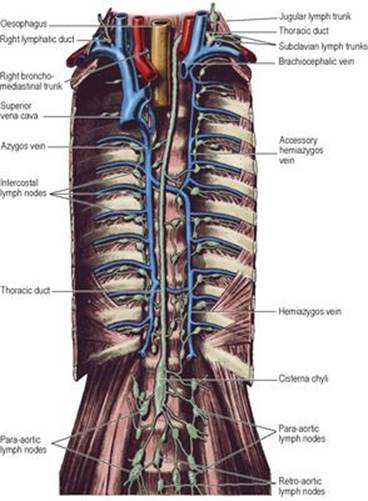
The thoracic duct commences at the upper end of the cisterna chyli (Fig. 4.27 and see p. 278), on a level with the body of T12 vertebra between the aorta and the azygos vein. It passes upwards, with these structures, between the crura of the diaphragm and comes to lie against the right side of the oesophagus. At the level of T5 vertebra it inclines to the left and passes behind the oesophagus. In the superior mediastinum it lies to the left of the oesophagus on a posterior plane. As the duct ascends in the thorax it lies anterior to the right aortic intercostal arteries and the terminal parts of the hemiazygos and accessory hemiazygos veins. Passing vertically upwards in the superior mediastinum it lies posterior to the arch of the aorta and the left subclavian artery. At the root of the neck it arches forwards and to the left, behind the carotid sheath and its contents, crossing over the dome of the pleura and the left subclavian artery to enter the point of confluence of the left internal jugular and subclavian veins (Fig. 4.10). It may divide into two or three separate branches, all of which open at the angle between these two veins. The thoracic duct has several valves.
|
|
|
Figure 4.27 Azygos system of veins and thoracic duct on the posterior wall of the thorax. The hemiazygos vein is shown draining into the azygos vein at a lower level than usual. A confluence of lymph trunks is more often seen than a cistern. |
Carrying all the lymph from the lower half of the body, the duct receives in its course through the thorax lymph from the posterior mediastinal and left intercostal nodes, and from the left bronchomediastinal trunk. In the neck it receives the left jugular and subclavian lymph trunks and thus finally comes to drain all the lymph of the body except that from the right upper limb and the right halves of the thorax and the head and neck.
The right lymphatic duct, much smaller than the thoracic duct, drains the right intercostal nodes and the right bronchomediastinal trunk. It may receive the right jugular and subclavian lymph trunks before it opens into the commencement of the right brachiocephalic vein, or they may remain separate and open independently into the jugulosubclavian junction.
Azygos system of veins
The thoracic wall and upper lumbar region are drained by the posterior intercostal and lumbar veins into the azygos system of veins.
Azygos vein
The azygos vein is usually formed by the union of the ascending lumbar vein with the subcostal vein of the right side. The vessel goes through the aortic opening of the diaphragm under shelter of the right crus, lateral to the thoracic duct, and passes upwards lying on the sides of the vertebral bodies, on a plane posterior to that of the oesophagus. At the level of T4 vertebra the azygos vein arches forwards over the hilum of the right lung and ends in the superior vena cava (Fig. 4.12). It receives the lower eight posterior intercostal veins and at its convexity the superior intercostal vein of the right side. It receives the bronchial veins from the right lung, pericardial veins and some veins from the middle third of the oesophagus. The two hemiazygos veins usually join it at the levels of T7 and 8 vertebrae.
Hemiazygos veins
These two veins lie longitudinally on the left side of the bodies of the thoracic vertebrae. They may communicate with each other, but characteristically drain separately from their adjoining ends behind the oesophagus into the azygos vein (Fig. 4.27). They receive the left lower eight posterior intercostal veins, four each. The inferior vein, the hemiazygos vein, is formed in the abdomen by the union of the left ascending lumbar and subcostal vein (and often communicates with the left renal vein). It passes up through the left crus of the diaphragm and receives veins from the lower oesophagus. The superior vein is the accessory hemiazygos vein; it receives the bronchial veins from the left lung.
Thoracic sympathetic trunk
The thoracic part of the sympathetic trunk (Figs 4.12 and 4.13) lies posterior to the costovertebral pleura and is hence not a content of the posterior mediastinum. It contains about 12 ganglia, most of which lie anterior to the heads of ribs. The first thoracic ganglion is frequently fused with the inferior cervical ganglion, forming the cervicothoracic (stellate) ganglion, and lies anterior to the neck of the first rib. The lowest three ganglia lie lateral to the corresponding vertebral bodies. Each ganglion receives a preganglionic white ramus from the anterior ramus of its corresponding spinal nerve. After relay in the ganglion a postganglionic grey ramus returns to each thoracic nerve, usually medial to the white ramus. Postganglionic sympathetic fibres also pass to the cardiac and pulmonary plexuses, trachea, oesophagus, thoracic aorta and its branches.
The splanchnic nerves, three in number, come from the lower eight ganglia and consist mainly of preganglionic fibres. The lowest, or least splanchnic nerve leaves the twelfth ganglion; the lesser splanchnic nerve comes from the tenth and eleventh ganglia. The greater splanchnic nerve is formed by branches from the fifth to the ninth ganglia. Each pierces the crus of its own side. Their abdominal course and distribution are described on page 281.
The thoracic trunk continues downwards into the abdomen by passing behind the medial arcuate ligament of the diaphragm.
Upper thoracic ganglionectomy
Interruption of the sympathetic outflow to the upper limb from the upper thoracic ganglia (see Fig. 1.14, p. 20) is used in the treatment of Raynaud's syndrome and palmar hyperhidrosis. This can be effected through a cervical approach at the root of the neck, or by an axillary transthoracic route through the third intercostal space, or by a minimal access procedure through a thoracoscope. The cervical approach requires division of the suprapleural membrane and separation of the pleura from the heads and necks of the ribs. In transthoracic approaches the pleural cavity is entered and the costovertebral pleura is then divided to expose the sympathetic chain that lies behind it. The sympathetic chain is interrupted below the third ganglion and the rami communicantes of the second and third ganglia are divided, or these ganglia are removed with the intervening chain. The first thoracic ganglion is preserved intact to avoid the occurrence of Horner's syndrome.