Liver
The liver, the largest gland in the body, weighs approximately 1500g and receives about 1500mL of blood per minute. The wedge-shaped organ (Figs 5.32 and 5.33) occupies most of the right hypochondrium and epigastrium. It has two surfaces, diaphragmatic and visceral. The diaphragmatic surface is boldly convex, moulded to the undersurface of the diaphragm, and is descriptively subdivided into anterior, superior, posterior and right surfaces which merge into one another without any clear demarcations. A sharp inferior border separates the right and anterior surfaces from the visceral surface, which slopes upwards and backwards from here to merge with the posterior surface. Most main vessels and ducts enter or leave at the porta hepatis which is on the visceral surface, but the hepatic veins emerge from the posterior surface.
From the diaphragmatic and visceral surfaces peritoneal folds pass respectively to the diaphragm and to the stomach; these persist from the ventral mesogastrium into which the developing liver grows (Fig. 5.17).
The inferior border is notched by the ligamentum teres which lies in the free lower margin of the falciform ligament (see p. 234). From here the attachment of the falciform ligament ascends on the anterior surface to reach the superior surface where a reduplication of the left leaf forms the left triangular ligament (Fig. 5.32A). The right leaf of the falciform ligament passes to the right, in front of the inferior vena cava, and becomes the upper layer of the coronary ligament.
When the posterior and visceral surfaces are viewed together (Fig. 5.32B), an H-shaped pattern of structures is seen. Centrally lies the porta hepatis (the hilum of the liver), the cross-piece of the H. The right limb of the H is made by the inferior vena cava (on the posterior surface) and the gallbladder (inferior surface), while the left limb is made by the continuity of the fissures for the ligamentum venosum and ligamentum teres. The vena cava lies in a deep groove or sometimes a tunnel, on the convexity of the posterior surface. To the right of the vena cava is the triangular bare area, with the vena cava as its base and with sides formed by the superior and inferior layers of the coronary ligament. The apex where these two layers meet is the small right triangular ligament. From the inferior layer, the line of peritoneal attachment passes in front of the inferior vena cava, and thence up along its left side to the summit of the liver. Here it meets the diverging right leaf of the falciform ligament (Fig. 5.32B). The two peritoneal layers are attached to the bottom of a deep groove that runs to the left from the inferior vena cava and lodges the ligamentum venosum. This fissure and the contained ligament turn at a right angle and run downwards on the posterior surface to the left end of the porta hepatis, outlining a rectangular area of the liver, the caudate lobe, between the fissures. The two layers of the lesser omentum are attached to the bottom of the fissure along the left margin of the caudate lobe. Due to the depth of the fissure, which passes obliquely into the substance of the liver, the caudate lobe is partly separated from the rest of the liver and has an anterior surface that forms the posterior wall of the fissure. The caudate lobe thus lies behind the right part of the lesser omentum, as a content of the lesser sac. A narrow caudate process extends to the right between the porta hepatis and the inferior vena cava (Fig. 5.32B).
At the porta hepatis the two layers of the lesser omentum deviate to the right to enclose the right and left hepatic ducts and the right and left branches of the hepatic artery and portal vein. They lie in the order vein–artery–duct (VAD) with the ducts in front and thereby more accessible in surgery. Also present in the porta are several lymph nodes and the nerves of the liver.
The gallbladder lies in a shallow fossa on the downsloping visceral surface, with its cystic duct close to the right end of the porta hepatis. Its neck is highest, its fundus lowest, frequently projecting below the inferior border. The quadrate lobe lies between the gallbladder and the fissure for the ligamentum teres.
The bare area is in contact with the diaphragm and the right suprarenal gland. The visceral surface is related, with peritoneum intervening, to the stomach, duodenum, hepatic flexure of the colon and right kidney, and these organs may leave impressions on the liver surface. To the right of the gastric impression a slight bulge, the omental tuberosity, is in contact with the lesser omentum, which separates it from a similar eminence on the body of the pancreas. The oesophagus makes a shallow impression on the posterior surface of the liver.
The liver is suspended by the hepatic veins and the inferior vena cava. The hepatic veins are entirely intrahepatic and enter the vena cava while it is clasped in the deep groove on the posterior surface. The visceral surface rests on the underlying viscera, particularly the stomach and hepatic flexure of the colon. The left triangular ligament needs to be divided surgically, before the left lobe of the liver can be retracted to the right, to expose the abdominal oesophagus and upper part of stomach.
Surface marking
The upper margin of the liver is approximately level with the xiphisternal joint, arching slightly upwards on each side. On the left it reaches the fifth intercostal space 7–8cm from the midline, and on the right to the fifth rib, curving down to the right border which extends from ribs 7 to 11 in the midaxillary line. The inferior border is along a line joining the right lower and upper left extremities; some of it thus lies approximately level with the right costal margin, while centrally it crosses behind the upper abdominal wall between the costal margins about a hand's breadth below the xiphisternal joint.
Lobes
The liver was customarily divided by anatomists into a larger right and a smaller left lobe utilizing the line of attachment of the falciform ligament anteriorly and the fissures for the ligamentum teres and ligamentum venosum on the visceral surface. The caudate lobe, lying between the inferior vena cava and the fissure for the ligamentum venosum, and the quadrate lobe, lying between the gallbladder fossa and the fissure for the ligamentum teres, were consequently considered to be part of the right lobe. This subdivision of the liver is not in accordance with the arrangement of the vascular and biliary channels within the liver. The functional division of the liver into right and left halves is along an oblique plane that runs through the centre of the bed of the gallbladder and the groove for the inferior vena cava. The middle hepatic vein lies in this plane and is a useful landmark in radiological and ultrasonographic investigations.
Segments
On the basis of blood supply and biliary drainage, there are four main hepatic sectors (also called sections): left lateral; left medial; right medial; and right lateral. The left lateral sector lies to the left of the attachment of the falciform ligament and the grooves for the ligamentum teres and ligamentum venosum. The left medial sector lies between this demarcating line and the planes of the gallbladder and inferior vena cava. The line of division between the right medial and right lateral sectors has no external marking; it runs in an oblique direction posteriorly and medially from the middle of the front of the right lobe towards the vena caval groove, and the right hepatic vein lies in this plane. These four sectors are further subdivided into eight segments, which are customarily numbered using Roman numerals (Fig. 5.34); the International Hepato-Pancreatico-Biliary Association has, however, recommended the use of Arabic numerals.
Segment I is the caudate lobe of the liver. Despite lying to the left of the plane between the two functional lobes of the liver, the caudate lobe is an autonomous segment receiving blood from right and left branches of the hepatic artery and portal vein, draining bile into right and left hepatic ducts and having independent venous drainage into the inferior vena cava. The left lateral sector contains segment II posteriorly and segment III anteriorly, with the left hepatic vein being between them. Segment IV is recognized on the visceral surface as the quadrate lobe. Segments V and VI are the inferior segments of the right medial and right lateral sectors respectively. Segments VII and VIII are the superior segments of the right lateral and right medial sectors respectively. When the visceral surface of the liver is viewed from below (Fig. 5.33), the hepatic segments appear to be arranged in an approximately anticlockwise direction around the porta hepatis. Further segmental subdivision partitions segment IV into IVa (superior) and IVb (inferior) segments, the latter coinciding more accurately with the quadrate lobe. Similarly the caudate lobe (segment I) is subdivided into right and left parts and the caudate process.
Blood supply
The liver receives blood from two sources. Arterial (oxygenated) blood is furnished by the hepatic artery, which divides into right and left branches in the porta hepatis. The right branch of the hepatic artery normally passes behind the common hepatic duct and in the liver divides into medial and lateral sectoral branches; the left branch likewise divides into medial and lateral sectoral branches. Sometimes the common hepatic artery arises from the superior mesenteric artery or the aorta (instead of the coeliac trunk), in which case it usually runs behind the portal vein. The right hepatic artery may arise from the superior mesenteric artery (15%), and the left hepatic artery from the left gastric artery (20%) as aberrant or accessory arteries; i.e. they may replace the normal branches or exist in addition to them.
Venous blood is carried to the liver by the portal vein (see p. 266) which divides in the porta hepatis into right and left branches which in turn give sectoral branches like the arteries; this portal blood is laden with the products of digestion which have been absorbed from the alimentary canal, and which are metabolized by the liver cells.
Compression of the hepatic artery and portal vein, just below the porta hepatis, between an index finger passed through the epiploic foramen of Winslow and a thumb on the anterior surface of the right free edge of the lesser omentum (Pringle's manoeuvre) significantly diminishes the inflow of blood to the liver and is a useful procedure in the surgical management of trauma to the liver.
There is no communication between right and left halves of the liver; indeed, even within each half the arteries are end arteries (hence infarction of the liver). Although infarction may illustrate this point, in the presence of disease there are often enough anastomoses with phrenic vessels (e.g. across the bare area) to provide a collateral circulation that is sufficient to allow ligation of the hepatic artery, a procedure that has been used to induce metastases to regress without compromising normal liver tissue (though with less success than was hoped).
The venous return differs in that it shows a mixing of right and left halves of the liver. Three main hepatic veins (Fig. 5.34) drain into the inferior vena cava. A middle vein runs in the plane between right and left halves and receives from each. Further laterally lie a right and left vein; the middle vein frequently joins the left very near the vena cava. All the veins have no extrahepatic course and enter the vena cava just below the central tendon of the diaphragm. Several small accessory hepatic veins enter the vena cava below the main veins, including a separate vein from the caudate lobe. There is some anastomosis between portal venous channels in the liver and the azygos system of veins above the diaphragm across the bare area of the liver.
|
|
|
Figure 5.34 Main hepatic veins and approximate positions of surgical segments, indicated by Roman numerals (posterior segments are in brackets). See text for explanation. |
Lymph drainage
The lymphatics of the liver drain into three or four nodes that lie in the porta hepatis (hepatic nodes). These nodes also receive the lymphatics of the gallbladder. They drain downwards alongside the hepatic artery to pyloric nodes as well as directly to coeliac nodes. Lymphatics from the bare area of the liver communicate with extraperitoneal lymphatics which perforate the diaphragm and drain to nodes in the posterior mediastinum. Similar communications exist along the left triangular and falciform ligaments from the adjacent liver surfaces.
Nerve supply
The nerve supply of the liver is derived from both the sympathetic and vagus, the former by way of the coeliac ganglia, whence nerves run with the vessels in the free edge of the lesser omentum and enter the porta hepatis. Vagal fibres from the hepatic branch of the anterior vagal trunk reach the porta hepatis via the lesser omentum.
Structure
The classic description of liver morphology is centred on the hepatic lobule, a region of liver tissue of something like pinhead size and hexagonal shape, with a central vein and plates or cords of hepatocytes, separated by vascular spaces or sinusoids radiating from the vein to the periphery of the lobule. At the corners of the lobules are the portal triads consisting of small branches of the hepatic artery and portal vein and bile ductules. In the human liver, however, such a classical lobule is not usually present. The arrangement is that of a polygonal territory with a portal triad at the centre and tributaries of the hepatic veins at the boundary. This is termed a portal lobule and corresponds to sections of at least three ‘classic’ lobules.
The sinusoids intervening between the cords of hepatocytes are lined by endothelial cells which show frequent intercellular spaces and fenestrations. These allow plasma (but not blood cells) to leave the sinusoids and enter the perisinusoidal spaces between the endothelium and hepatocytes, so that exchange of materials can take place between plasma and liver cells. Many of the endothelial lining cells are capable of phagocytic activity, constituting the Kupffer cells of the reticuloendothelial system. Bile manufactured by hepatocytes first enters the biliary canaliculi which are situated between apposing sides of adjacent hepatocytes. Collectively the canaliculi form a meshwork which drains into the bile ductules of the portal triads, and these in turn unite to form the larger intrahepatic ducts.
The liver is enclosed in a thin capsule of connective tissue from which sheaths pass into the liver at the porta hepatis, surrounding the branches of the hepatic artery, portal vein and bile ducts. Inside the liver smaller branches of these vascular and biliary channels run within connective tissue trabeculae, termed portal canals.
Development
The liver develops by proliferation of cells from the blind ends of a Y-shaped diverticulum which grows from the foregut into the septum transversum. The cranial part of the septum transversum becomes the pericardium and diaphragm. The caudal part becomes the ventral mesogastrium (Fig. 5.17), and it is into this that the liver grows (see p. 239).
The original diverticulum from the endoderm of the foregut (Fig. 5.40A–C) becomes the bile duct; its Y-shaped bifurcation produces the right and left hepatic ducts. A blind diverticulum from the bile duct becomes the cystic duct and gallbladder. The hepatic ducts divide and redivide to become the interlobular and intralobular bile ductules. Hepatic circulation in the fetus is referred to on page 31.
Biopsy, resection and transplantation
Needle biopsy of the liver is carried out through the right eighth or ninth intercostal space in the midaxillary line; the needle path is below the level of the lung but traverses the costodiaphragmatic recess of the pleura before going through the diaphragm and crossing the peritoneal cavity to enter the liver. The needle must not penetrate more than 6cm from the skin to avoid entering the inferior vena cava. A misplaced needle could damage the kidney, colon or pancreas, and pneumothorax is another possible complication. When the liver lesion is malignant, needle biopsy can lead to the seeding of cancer cells along the needle track.
A right (hemi) hepatectomy involves dividing liver tissue along a line from the left of the gallbladder to the right edge of the inferior vena cava, ligating vessels and ducts along the way, so that segments V–VIII and the gallbladder can be removed. The middle and left hepatic veins are preserved. For left (hemi) hepatectomy, segments II–IV together with most of the caudate lobe are removed. The gallbladder may be removed or left intact, and the line of resection at the back is level with the left edge of the vena cava. The right and usually the middle hepatic veins are preserved. In more extensive procedures left hepatectomy is combined with removal of segments V and VIII, or right hepatectomy is combined with the removal of segment IV. Alternatively, the more restricted removal of segments is carried out when pathological involvement of the liver is limited.
In liver transplantation the patient's liver is removed, usually with the attached segment of the inferior vena cava, utilizing a venovenous bypass between the portal vein and left femoral vein to the left axillary vein. The suprahepatic inferior vena cava of the donor liver is sutured to the patient's, followed by the infrahepatic caval anastomosis and thereafter the portal vein anastomosis. The venous clamps are released in the same sequence and venovenous bypass interrupted. The hepatic artery anastomosis is made and biliary tract continuity established by end-to-end common bile duct anastomosis, or by anastomosing the donor bile duct to the recipient's jejunum. Particularly in children, in whom it may not be possible to use a venovenous shunt, preservation of the patient's inferior vena cava may be necessary. The donor liver is then attached to the recipient's inferior vena cava by a ‘piggy-back’ technique.
Biliary tract
The extrahepatic biliary tract consists of the three hepatic ducts (right, left and common), the gallbladder and cystic duct, and the bile duct. The right and left hepatic ducts exit from the liver and join to form the common hepatic duct near the right end of the porta hepatis. In a surgical sense, it is only the confluence of the hepatic ducts which is accessible without dissection into the liver substance. But prior to its emergence from the liver, the left hepatic duct may run along the base of the quadrate lobe only partly surrounded by the liver substance. The common hepatic duct so formed passes down between the two peritoneal layers at the free edge of the lesser omentum. The common hepatic duct is soon joined on its right side at an acute angle by the cystic duct from the gallbladder, to form the bile duct (Fig. 5.35A). When the liver is retracted at operation the ducts are seen to descend below the liver, but at rest they lie in loose contact with the porta hepatis.
Gallbladder
The gallbladder stores and concentrates the bile secreted by the liver. It is a globular or pear-shaped viscus (Fig. 5.33) with a capacity of about 50mL, and consists of three parts: fundus; body; and neck. It lies in the gallbladder fossa on the visceral surface of the right lobe of the liver, adjacent to the quadrate lobe.
Its bulbous blind end, the fundus, usually projects a little beyond the sharp lower border of the liver and touches the parietal peritoneum of the anterior abdominal wall at the tip of the ninth costal cartilage, where the transpyloric plane crosses the right costal margin, at the lateral border of the right rectus sheath (Fig. 5.1). This is the surface marking for the fundus and the area of abdominal tenderness in gallbladder disease. (The fundus of the normal gallbladder is not palpable but may become so if distended by biliary tract obstruction.) The fundus lies on the commencement of the transverse colon, just to the left of the hepatic flexure. The body passes backwards and upwards towards the right end of the porta hepatis and is in contact with the first part of the duodenum. The upper end of the body narrows into the neck which, when the liver is in its normal position (not retracted upwards), lies at a higher level than the fundus. The neck continues into the cystic duct, which is 2 to 3cm long and 2 to 3mm in diameter. It runs backwards, downwards and to the left to join the common hepatic duct, usually in front of the right hepatic artery and its cystic branch (but variations are common). The wall of the neck where it joins the cystic duct may show a small diverticulum (Hartmann's pouch). This is not a feature of the normal gallbladder and is always associated with a pathological condition; it may be the site of impaction of a gallstone.
The fundus and body of the gallbladder are usually firmly bound to the undersurface of the liver by connective tissue; small cystic veins pass from the gallbladder into the liver substance. Small bile ducts may also pass from the liver to the gallbladder, and if undetected they may drain bile into the peritoneal cavity after cholecystectomy. The peritoneum covering the liver passes smoothly over the gallbladder. Occasionally the gallbladder hangs free on a narrow ‘mesentery’ from the undersurface of the liver. Rarely the gallbladder may be embedded within the liver. Very rarely the gallbladder may be absent.
The gallbladder varies in size and shape. In rare cases it is duplicated with single or double cystic ducts. It may be septate with the lumen divided into two chambers. The fundus may be folded in the manner of a Phrygian cap; this is the most common congenital abnormality.
Blood supply
The cystic artery is usually a branch of the right hepatic. It runs across the triangle formed by the liver, common hepatic duct and cystic duct (Calot's triangle), to reach the gallbladder. Variations in the origin of the artery are common. It may arise from the main trunk of the hepatic artery, from the left branch of that vessel or from the gastroduodenal artery, and in either case may pass in front of the cystic and bile ducts.
Venous return is by multiple small veins in the gallbladder bed into the substance of the liver and so into the hepatic veins. One or more cystic veins may be present but these are uncommon; they run from the neck of the gallbladder into the right branch of the portal vein. Cystic veins do not accompany the cystic artery.
Lymph drainage
Lymphatic channels from the gallbladder drain to nodes in the porta hepatis, to the cystic node (in Calot's triangle at the junction of the common hepatic and cystic ducts), and to a node situated at the anterior boundary of the epiploic foramen. From these nodes lymph passes to the coeliac group of preaortic nodes.
Structure
The gallbladder is a fibromuscular sac which, histologically, shows a surprisingly small amount of smooth muscle in its wall. Its mucous membrane is a lax areolar tissue lined with a simple columnar epithelium. It is projected into folds which produce a honeycomb appearance in the body of the gallbladder, but are arranged in a more or less spiral manner in the neck and cystic duct (the ‘spiral valve’ of Heister). The epithelial cells actively absorb water and solutes from the bile and concentrate it. Mucus is secreted by the columnar epithelium but there are no goblet cells, and mucus-secreting glands are present only in the neck.
Common hepatic duct
The right and left hepatic ducts emerge from the porta hepatis and unite near its right margin in a Y-shaped manner to form the common hepatic duct. This is joined, usually after about 3cm, by the cystic duct to form the bile duct. The right branch of the hepatic artery normally passes behind the common hepatic duct but may run in front of it. The site of union of the cystic and common hepatic ducts is usually on the right side of the common hepatic duct about 1 to 2cm above the duodenum, but sometimes the cystic duct runs parallel to and on the right of the hepatic duct for a variable distance before uniting with it, and it may also spiral round behind the hepatic duct before joining it on its left side. Rarely the cystic duct may be absent and the gallbladder drains directly into the common hepatic duct. Another anomaly is an accessory right hepatic duct which may open into the common hepatic duct, cystic duct or gallbladder. All these possibilities must be borne in mind during cholecystectomy and other operations on the biliary tract.
Bile duct
The bile duct (formerly called the common bile duct) is about 6 to 8cm long and its normal diameter does not exceed 8mm. It is best described in three parts or thirds. The upper (supraduodenal) third lies in the free edge of the lesser omentum (Fig. 5.35) in the most accessible position for surgery—in front of the portal vein and to the right of the hepatic artery, where the lesser omentum forms the anterior boundary of the epiploic foramen. The middle (retroduodenal) third runs behind the first part of the duodenum (Fig. 5.26) and slopes down to the right, away from the almost vertical portal vein which now lies to the left of the duct with the gastroduodenal artery. The inferior vena cava is behind the duct. The lower (paraduodenal) third slopes further to the right in a groove on the back of the head of the pancreas (it may even be embedded in a tunnel of pancreatic tissue) and in front of the right renal vein. Neoplasms of the head of the pancreas may obstruct the duct here. It joins the pancreatic duct (Fig. 5.40D) at an angle of about 60° at the hepatopancreatic ampulla (of Vater). The ampulla and the ends of the two ducts are each surrounded by sphincteric muscle, the whole constituting the ampullary sphincter (of Oddi). Sometimes the muscle fibres surrounding the ampulla and the pancreatic duct are absent, leaving only the bile duct sphincter. When all three are present the arrangement allows for independent control of flow from bile and pancreatic ducts. The ampulla itself opens into the posteromedial wall of the second part of the duodenum at the major duodenal papilla, which is situated 10cm from the pylorus.
Blood supply of the biliary tract
The extrahepatic biliary tract receives small branches from the cystic and right hepatic arteries and the posterior branch of the superior pancreaticoduodenal artery; they form anastomotic channels on the duct. Small veins from the biliary tract drain to the portal vein or enter the liver.
Nerve supply of the biliary tract
Parasympathetic fibres, mainly from the hepatic branch of the anterior vagal trunk, stimulate contraction of the gallbladder and relax the ampullary sphincter, and sympathetic fibres from cell bodies in the coeliac ganglia (with preganglionic cells in the lateral horn of spinal cord segments T7–9) inhibit contraction, but the hormonal control of gallbladder activity (by CCK from neuroendocrine cells of the upper small intestine) is much more important than the neural. Afferent fibres including those subserving pain (e.g. from a duct distended by an impacted gallstone) mostly run with right-sided sympathetic fibres and reach spinal cord segments T7–9, but some from the gallbladder may run in the right phrenic nerve (C3–5), through connections between this nerve and the coeliac plexus. Any afferent vagal fibres are probably concerned with reflex activities, not pain. Biliary tract pain is usually felt in the right hypochondrium and epigastrium, and may radiate round to the back in the infrascapular region, in the area of distribution of spinal nerves T7–9. The phrenic nerve supply explains the occasional referral of pain to the right shoulder region.
Imaging of the biliary tract
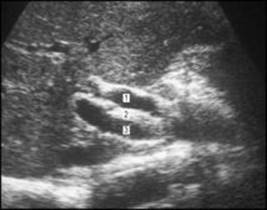
The gallbladder and biliary ducts can be demonstrated by ultrasound (Fig. 5.36), and this technique has largely replaced the visualization of these structures by radiography after the administration of radio-opaque substances which are excreted by the liver into bile. Under direct vision through an endoscope, a catheter can be inserted into the hepatopancreatic ampulla and radio-opaque contrast medium injected, resulting in the radiographic delineation of the bile and pancreatic ducts (endoscopic retrograde cholangiopancreatography). These ducts can now also be demonstrated by the non-invasive technique of magnetic resonance imaging (Fig. 5.37).
|
|
|
Figure 5.36 Ultrasound image of normal structures at porta hepatis: 1, common bile duct; 2, hepatic artery; 3, portal vein. Provided by Dr D. J. Lomas, Addenbrooke's Hospital, Cambridge. |
|
|
|
Figure 5.37 Magnetic resonance cholangiopancreaticogram. Coronal view showing normal intra and extrahepatic bile ducts and main pancreatic duct. Fluid in these channels and in the alimentary tract enables their visualization without the use of contrast medium by this non-invasive technique. Provided by Dr D. J. Lomas, Addenbrooke's Hospital, Cambridge.) |
Portal vein
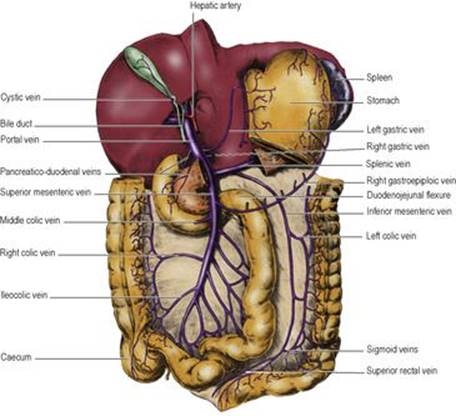
The portal vein is the upward continuation of the superior mesenteric vein, which changes its name to portal after it has received the splenic vein behind the neck of the pancreas (Fig. 5.38). It lies in front of the inferior vena cava, as it lies behind the pancreas and the first part of the duodenum but loses contact with the inferior vena cava by entering between the two layers of the lesser omentum. It runs almost vertically upwards in the free edge, where the lesser omentum forms the anterior boundary of the epiploic foramen, lying behind the bile duct and the hepatic artery (Fig. 5.35), and reaches the porta hepatis. Here it divides into a right and left branch which enter the respective halves of the liver.
|
|
|
Figure 5.38 Portal vein and its tributaries. |
The portal vein receives the right and left gastric veins and the superior pancreaticoduodenal vein. The cystic vein or veins, when present, join the right branch of the portal vein, and the paraumbilical veins running with the ligamentum teres join the left branch. The ligamentum itself (the obliterated remains of the left umbilical vein) is often not completely fibrosed even in adults (50%), and can then be cannulated at the umbilicus, providing access to the portal venous system.
The portal vein is about 8cm long. Although demonstrable during fetal life and a short postnatal period, thereafter no valves are present in the portal vein or its tributaries.
The five sites of portal/systemic anastomosis are considered with the appropriate territories: lower end of the oesophagus (see p. 208), upper end of the anal canal (see p. 315), bare area of the liver (see p. 262), periumbilical region (see p. 179) and retroperitoneal areas (see p. 258). In portal hypertension 80% of portal blood may be shunted into the collateral channels so that only 20% reaches the liver; however, the opening up of the collaterals does not decrease the level of hypertension.