The adult female breast or mammary gland lies in the subcutaneous tissue (superficial fascia) of the anterior thoracic wall. Despite individual variations in size, the extent of the base of the breast is fairly constant: from the sternal edge to near the midaxillary line, and from the second to the sixth ribs. It overlies pectoralis major, overlapping onto serratus anterior and onto a small part of the rectus sheath and external oblique muscle. A small part of the upper outer quadrant may be prolonged towards the axilla. This extension (the axillary tail) usually lies in the subcutaneous fat; rarely it may penetrate the deep fascia of the axillary floor and lie adjacent to axillary lymph nodes.
Some 15–20 lactiferous ducts, each draining a lobe of the breast, converge in a radial direction to open individually on the tip of the nipple, the projection just below the centre of the breast which is surrounded by an area of pigmented skin, the areola. Each lactiferous duct has a dilated sinus at its terminal portion in the nipple. Smooth muscle cells are present in the nipple and their contraction causes erection of the nipple. Large sebaceous glands, sweat glands and other areolar glands are present in the skin of the areola. The areolar glands form small elevations (tubercles of Montgomery), particularly when they enlarge during pregnancy.
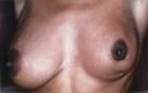
Behind the breast the superficial fascia (the upward continuation of the membranous layer of superficial abdominal fascia of Scarpa) is condensed to form a posterior capsule. Strands of fibrous tissue (forming the suspensory ligaments of Cooper) connect the dermis of the overlying skin to the ducts of the breast and to this fascia. They help to maintain the protuberance of the young breast; with the atrophy of age they allow the breast to become pendulous, and when contracted by the fibrosis associated with certain carcinomas of the breast they cause dimpling of the overlying skin (Fig. 2.19). They also cause pitting of the oedematous skin that results from malignant involvement of dermal lymphatics (an appearance often referred to as peau d'orange). Between the capsule and the fascia over pectoralis major is the loose connective tissue of the retromammary space.
|
|
|
Figure 2.19 Dimpling of the skin below the areola of the left breast due to contraction of the suspensory ligaments of Cooper. This physical sign is often enhanced by raising the arms. |
The male breast resembles the rudimentary female breast and has no lobules or alveoli. The small nipple and areola lie over the fourth intercostal space.
Blood supply
This is derived mainly from the lateral thoracic artery by branches that curl around the border of pectoralis major and by other branches that pierce the muscle. The internal thoracic artery also sends branches through the intercostal spaces beside the sternum; those of the second and third spaces are the largest. Similar but small perforating branches arise from the posterior intercostal arteries. The pectoral branch of the thoracoacromial artery supplies the upper part of the breast. The various supplying vessels form an anastomosing network. From a circumareolar venous plexus and from glandular tissue venous drainage is mainly by deep veins that run with the main arteries to internal thoracic and axillary veins. Some drainage to posterior intercostal veins provides an important link to the internal vertebral venous plexus veins (see p. 428) and hence a pathway for metastatic spread to bone.
Lymph drainage
A subareolar plexus of lymphatics communicates with lymphatics within the breast. Around 75% of the lymphatic drainage of the breast passes to axillary lymph nodes, mainly to the anterior nodes, some to the posterior nodes; direct drainage to central or apical nodes is possible. Much of the rest of the lymphatic drainage, originating particularly from the medial part of the breasts, is to parasternal nodes along the internal thoracic artery. A few lymphatics follow the intercostal arteries and drain to posterior intercostal nodes. Occasionally, some lymph from the breast may drain into one or two infraclavicular nodes in the deltopectoral groove or into small inconstant interpectoral nodes between pectoralis major and minor. The superficial lymphatics of the breast have connections with those of the opposite breast and the anterior abdominal wall, from the extraperitoneal tissues of which there is drainage through the diaphragm to posterior mediastinal nodes. Direct drainage from the breast to inferior deep cervical (supraclavicular) nodes is possible. These minor pathways tend to convey lymph from the breast only when the major channels are obstructed by malignant disease.
Development and structure
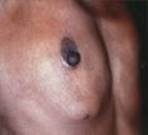
The breast is a modified sweat gland and begins to develop as early as the fourth week as a downgrowth from a thickened mammary ridge (milk line) of ectoderm along a line from the axilla to the inguinal region. Supernumerary nipples or even glands proper may form at lower levels on this line (Fig. 2.20).
|
|
|
Figure 2.20 Supernumerary breast and nipple in the left inframammary region. |
Lobule formation occurs only in the female breast and does so after puberty. Each lactiferous duct is connected to a tree-like system of ducts and lobules, intermingled and enclosed by connective tissue to form a lobe of the gland. The resting (non-lactating) breast, however, consists mostly of fibrous and fatty tissue; variations in size are due to variations in fat content, not glandular tissue which is very sparse. During pregnancy alveoli bud off from the smaller ducts and the organ usually enlarges significantly, and more so in preparation for lactation. When lactation ceases there is involution of secretory tissue. After menopause progressive atrophy of lobes and ducts takes place.