The cranial end of the neural tube (see p. 23) becomes dilated into vesicles and its walls thicken by proliferation of cells; the cerebral hemispheres, brainstem and cerebellum are so developed. More caudally the neural tube enlarges in a simple manner by proliferation of cells, to form the spinal cord. In all regions these proliferating cells arrange themselves regularly in functional groups. Despite the apparent random arrangement of the nuclei in the brainstem, there is a logical pattern to their positions which can be correlated with the rather simpler disposition of cell groups in the spinal cord that results from this development.
Spinal cord
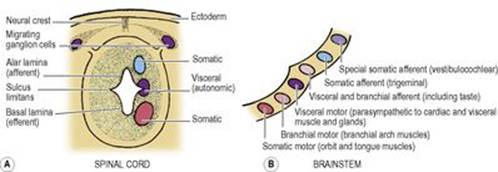
The central canal, relatively very large at first, is not rounded in cross-section, but is projected laterally into a groove on the inner wall of the spinal cord, as the sulcus limitans (Fig. 7.33A). The developing nerve cells of the spinal cord form thickenings dorsal and ventral to the sulcus, the alar lamina and basal lamina respectively. The alar lamina contains sensory (afferent) cells and the basal lamina contains motor (efferent) cells. In each lamina the cells are of two kinds; near the sulcus limitans lie the autonomic (visceral) cells, while further away lie the body wall and limb (somatic) cells.
|
|
|
Figure 7.33 Cell groups of the spinal cord and brainstem: A in the developing spinal cord, where motor cells are ventral and sensory cells dorsal with autonomic cells in between; B in the brainstem (floor of the fourth ventricle) which resembles an ‘opened out’ spinal cord, with motor cells now lying medially and sensory cells laterally with autonomic cells in between. |
Brainstem
A similar arrangement holds in the brainstem as in the spinal cord. But here a third type of cell appears in each lamina, namely the branchial afferent and efferent cells of cranial nerves supplying the derivatives of the branchial arches (see p. 24). These branchial cells theoretically lie between the autonomic and somatic cells of each lamina. They are the central cell stations of the nerves of the pharyngeal arches (trigeminal, facial, glossopharyngeal and vagus). The branchial group or column is also known as the special visceral group, and the visceral as the general visceral group.
In the fourth ventricle the central canal is opened out, and basal and alar laminae lie roughly in the same plane; the dorsal afferent and ventral efferent cells thus become lateral and medial respectively (Fig. 7.33B). The order of the cell groups is similar, but migration of certain cell groups (neurobiotaxis) in the developing brainstem alters, in places, the relatively simple basic arrangement.
Motor nuclei of the brainstem
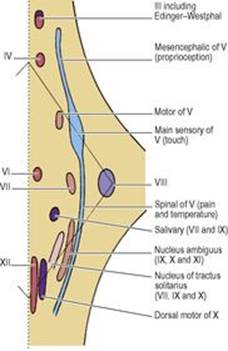
The motor nuclei are arranged according to the type of muscle they supply (Fig. 7.34). The ordinary skeletal muscle of the head (somatic muscle) consists of the muscles of the orbit and the muscles of the tongue. In line with the anterior horn cells of the spinal cord, the brainstem nuclei supplying these muscles (oculomotor, trochlear, abducent and hypoglossal) lie near the midline ventral to the ‘central canal’ (i.e. ventral to the aqueduct or floor of the fourth ventricle as the case may be).
|
|
|
Figure 7.34 Sites of cranial nerve nuclei in the right half of the brainstem as seen from the dorsal aspect. See text for the correlation between the information in this diagram with that in Figure 7.33B. |
Developed from the region of the embryonic pharynx are the striated muscles of mastication, of the face, and of the pharynx and larynx. Their motor nuclei (branchial) lie slightly more laterally: the motor nucleus of the trigeminal nerve, the facial nucleus and the nucleus ambiguus (for the glossopharyngeal and vagus nerves and the cranial part of the accessory nerve).
The general visceral efferent, parasympathetic motor, nuclei are represented by the accessory oculomotor (Edinger–Westphal) nucleus, the salivary nucleus (whose secretomotor fibres join the nervus intermedius part of the facial nerve and the glossopharyngeal nerve), and the dorsal motor nucleus of the vagus (for cardiac muscle and the smooth muscle of the alimentary tract). These nuclei migrate medially.
Afferent nuclei of the brainstem
These follow the general plan outlined above, and from medial to lateral form visceral, branchial and somatic afferent groups (the reverse order of the motor efferent columns). But unlike the motor groups, which consist of interrupted columns forming individual nuclei, each of these afferent ‘columns’ consists of a single nuclear mass (Fig. 7.34). The general visceral and branchial (special visceral) afferent cell groups merge as the nucleus of the tractus solitarius, which receives not only taste fibres from the facial, glossopharyngeal and vagus nerves but also afferents from the heart, lungs and other viscera from the vagus nerve. The somatic afferent column is represented by the sensory nuclei of the trigeminal nerve, really one elongated nucleus extending throughout the brainstem to the upper spinal cord. The brainstem has a fourth column of sensory nuclei that has no counterpart in the spinal cord; these are the cochlear and vestibular nuclei of the vestibulocochlear nerve, and they form a special somatic afferent group lying farthest laterally.