How do humans run? Is running just a faster version of walking? Is there a proper running form? Can I improve my running form? These are questions that many runners ask running experts, be they MDs, PhDs, running coaches, or fellow runners with more experience. The answers to these questions are complicated, but ultimately answerable, with a little knowledge of exercise science.
This chapter explains the hows of running. Ultimately, an explanation of the gait cycle is worthy of doctoral study by researchers studying the biomechanics of running. The overview presented here provides runners with a basic understanding of the anatomy involved, the biomechanics that engage and disengage the anatomy, and the kinesthetic results that occur from initiating the running motion. The drills included in this chapter are designed to aid the runner in perfecting the running form by fine-tuning the gait cycle.
Running Gait Cycle
Running can be understood by using an analysis of the gait cycle. Unlike walking, which is defined by having both feet simultaneously in contact with the ground during a cycle, running is characterized by having both feet off the ground during a cycle (a cycle is defined as the period between when one foot makes initial contact with the ground until the same foot reconnects with the ground). The two phases of the gait cycle are the stance, or support, phase and the swing phase. When one leg is in the stance phase, the other is in the swing phase.
The stance phase is marked by the foot’s initial contact with the ground (foot strike), midstance through toe-off and takeoff. This phase has been measured at approximately 40 percent of the gait cycle; however, for elite distance runners and sprinters it represents considerably less of the total phase. The swing phase begins with the float, which morphs into the forward swing or swing reversal, and finishes with the landing or absorption, which begins the next cycle. In the illustration (figure 3.1), the right leg is in the stance phase (making contact with the ground), and the left leg is in the swing phase, preparing to make contact with the ground.

Figure 3.1 The gait cycle: (a) initial contact, (b) stance phase, (c) takeoff, and (d) forward swing phase. -
Stance Phase
The quadriceps group, specifically the rectus femoris, is heavily active before initial contact. Once contact is made, the muscles, tendons, bones, and joints of the foot and lower leg function to dissipate the impact of the landing. Specifically, as described in chapter 9, three related but separate foot movements occur. The subtalar joint inverts and everts, the midfoot abducts or adducts, and the forefoot dorsiflexes and plantarflexes. Ideally, through this interaction of the anatomy of the lower leg, a small amount of pronation, the inward collapsing of the rear foot, occurs. This pronation helps dissipate the shock of the landing by spreading the impact over the full surface of the foot at midstance. An underpronated foot at midstance is less prepared to cushion the impact of landing because only the lateral aspect of the foot is in contact with the ground. This type of biomechanics can lead to chronically tight Achilles tendons, posterior calf strains, lateral knee pain, and iliotibial band tightness (all covered in chapter 10). Conversely, an overpronated foot at midstance can result in tibia pain, anterior calf injuries, and medial-side knee pain because of the internal rotation of the tibia. Neither extreme, a high rigid arch that underpronates or supinates or a low hypermobile arch, is ideal. Mild to moderate pronation is normal and very effective at combating impact stress.
Swing Phase
After the initial contact and midstance positioning, the hamstrings and hip flexors, the quadriceps, and the muscles of the calf (gastrocnemius and soleus) work in conjunction to allow a proper takeoff. While one leg is moving through its gait cycle, the other leg is preparing to begin a cycle of its own. Having already contacted the ground, this leg begins its forward motion as a result of the forward rotation of the pelvis and the concurrent hip flexion caused by the psoas muscles. As the leg passes through the forward swing phase, the hamstrings lengthen, limiting the forward extension of the lower leg, which had been extended by the quadriceps. The lower leg and foot begin to descend to the running surface as the torso accelerates, creating a vertical line from head to toe upon impact.
Note that two cycles, one by each leg, are happening simultaneously. As one foot takes off the ground to begin its swing phase, the other leg is preparing to begin its stance phase. The dynamic nature of the running movement makes isolating the anatomy involved difficult because, unlike in walking, potential energy (the energy stored within a physical system) and kinetic energy (the energy of a body resulting from its motion) are simultaneous. Essentially, the anatomy involved in running is constantly turned on both as agonists, muscles that are prime movers, and antagonists, muscles with opposing or stabilizing motion. In walking, the muscles are either one or the other during the gait cycle.
The role of the core during the stance phase is identical to its role in the swing phase, providing stability for the upper body, which allows the pelvis to twist and rotate in its normal manner. Because the gait cycle is defined by each leg moving through the stance or swing phase simultaneously, stabilizing the pelvis so it can function appropriately is an important task. A more lengthy discussion of the core is found in chapter 7, but suffice it to say that an unstable core could potentially lead to injury because of the gait cycle being negatively impacted.
The arms also function to stabilize and balance, but in a slightly different way. Each arm counterbalances the opposite leg, so when the right leg swings forward, the left arms swings, and vice versa. Also, the arms counterbalance each other, keeping the torso stable and in good position and ensuring that arm carriage is forward and back, not side to side in a swaying motion. Poor arm carriage ultimately costs the runner both by hindering running efficiency (stride length is shortened as a result of the legs “following” the swaying arms and rocking slightly) and running economy (poor form requires a dramatic increase in energy consumption).
Given the explanation that the gait cycle can be understood as each leg performing a cycle simultaneously, and that the same anatomy (i.e., muscles, tendons, and joints) are performing multiple functions simultaneously, it is reasonable to assume that a breakdown, or failure, in the kinetic chain is likely. This breakdown usually occurs because of inherent biomechanical imbalances that are exacerbated by the dynamic repetition of the running motion. For example, the quadriceps group and the hamstrings group are both involved in the landing phase of the gait cycle. The quadriceps group serves to extend the leg and the hamstrings limit flexion at the knee. Because the quadriceps group is dramatically stronger, the hamstrings must be able to work at their optimal capacity for the movement to be fluid. If the hamstrings group is weakened or inflexible, an imbalance exists that will ultimately lead to an injury. This is just an obvious example of the injury potential of anatomical imbalances. To counteract this scenario and others, this book offers a comprehensive strength-training regimen. The exercises are geared to complement each other by developing both the agonist and antagonist muscles as well as strengthening joints.
ABC Running Drills
Other than with strength training, how can running form and performance be improved? Because running has a neuromuscular component, running form can be improved through form drills that coordinate the movements of the involved anatomy. The drills, developed by coach Gerard Mach in the 1950s, are simple to perform and cause little impact stress to the body. Essentially, the drills, commonly referred to as the ABCs of running, isolate the phases of the gait cycle: knee lift, upper leg motion, and pushoff. By isolating each phase and slowing the movement, the drills, when properly performed, aid the runner’s kinesthetic sense, promote neuromuscular response, and emphasize strength development. A properly performed drill should lead to proper running form because the former becomes the latter, just at a faster velocity. Originally these drills were designed for sprinters, but they can be used by all runners. Drills should be performed once or twice a week and can be completed in 15 minutes. Focus on proper form.
A Motion
The A motion (figure 3.2; the movement can be performed while walking or more dynamically as the A skip or A run) is propelled by the hip flexors and quadriceps. Knee flexion occurs, and the pelvis is rotated forward. The arm carriage is simple and used to balance the action of the lower body as opposed to propelling it. The arm opposite to the raised leg is bent 90 degrees at the elbow, and it swings forward and back like a pendulum, the shoulder joint acting as a fulcrum. The opposite arm is also moving simultaneously in the opposite direction. Both hands should be held loosely at the wrist joints and should not be raised above shoulder level. The emphasis is on driving down the swing leg, which initiates the knee lift of the other leg.

Figure 3.2 (a) A motion 1, (b) A motion 2, and (c) A motion 3.
B Motion
The B motion (figure 3.3) is dependent on the quadriceps to extend the leg and the hamstrings to drive the leg groundward, preparing for the impact phase. In order, the quadriceps extend the leg from the position of the A motion to potential full extension, and then the hamstrings group acts to forcefully drive the lower leg and foot to the ground. During running the tibialis anterior dorsiflexes the ankle, which positions the foot for the appropriate heel landing; however, while performing the B motion, dorsiflexion should be minimized so that the foot lands closer to midstance. This allows for less impact solely on the heel, and because the biomechanics of the foot are not involved as in running, it does not promote any forefoot injuries.

Figure 3.3 (a) B motion 1, (b) B motion 2, and (c) B motion 3.
C Motion
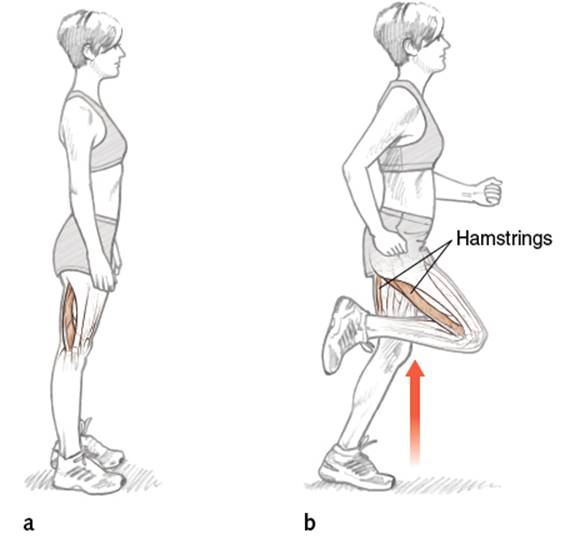
The final phase of the running gait cycle is dominated by the hamstrings. Upon impact, the hamstrings continue to contract, not to limit the extension of the leg but to pull the foot upward, under the glutes, to begin another cycle. The emphasis of this exercise (figure 3.4) is to pull the foot up, directly under the buttocks, shortening the arc and the length of time performing the phase so that another stride can be commenced. This exercise is performed rapidly, in staccato-like bursts. The arms are swinging quickly, mimicking the faster movement of the legs, and the hands come a little higher and closer to the body than in either the A or B motions. A more pronounced forward lean of the torso, similar to the body position while sprinting, helps to facilitate this motion.