
Craig R. Asher and Cesar Augusto Bonilla Isaza
INTRODUCTION TO PHYSICAL EXAMINATION
Over the years, the bedside skills of the cardiologist have diminished, due in part to the readily available access to echocardiography. However, the cardiology boards expect a high level of understanding of physical diagnosis. Most of the testing of physical diagnosis is indirect. Many of the questions are structured with a brief history and physical exam that provide clues about the diagnosis or answer. Often these are subtle hints that will not be appreciated by the unprepared. This chapter provides many of the pearls of physical diagnosis that are important for taking the boards.
INSPECTION
Basic principles (these descriptors may correlate with specific diagnoses):
 General appearance: Distress, diaphoresis, tachypnea, cyanosis, pallor
Posture: Orthopnea, platypnea/orthodeoxia (dyspnea and O2 desaturation in the upright position such as seen in patients with patent foramen ovale (PFO) and atrial septal defect (ASD) with R-to-L shunt), trepopnea (dyspnea lying on one side but not the other such as with large pleural effusions)
Stature: Tall (Marfan syndrome, Acromegaly), short (Turner and Noonan syndrome, Down syndrome), dwarfism (Ellis–van Creveld syndrome associated with ASD)
Nutritional status: Obese (sleep apnea, metabolic syndrome), cachexia (end-stage systolic heart failure, chronic disease, malignancy), athletic or muscular (anabolic steroid use)
Abnormal movements: Chorea (Sydenham chorea as seen with rheumatic fever), ataxia (Friedrich ataxia associated with hypertrophic cardiomyopathy [HCM] or tertiary syphilis associated with aortic aneurysms), head bobbing (aortic regurgitation [AR] or tricuspid regurgitation [TR]), Cheyne–Stokes respirations
See Table 2.1 for additional associated conditions and specific diseases found with various skin, head and neck, eye, chest and abdomen, extremity findings.
TABLE
2.1 Physical Examination Findings with Associated Conditions and Disease States

ARTERIAL PULSE
Basic Principles
Described by upstroke, magnitude, and contour
Composed of percussion (ejection, mid to later portion) and tidal waves (reflected wave from periphery, midlater portion)
Graded 0 to 4. Grade 0 is absent; Grade 1 is barely palpable; Grade 2 is easily palpable; Grade 3 is normal; and Grade 4 is bounding.
Normal pulse pressure approximately 30 to 40 mm Hg (systolic minus diastolic blood pressure)
Anacrotic notch is present at the systolic upstroke in the arterial pulse (ascending limb).
Dicrotic notch is present in the diastolic downstroke in the arterial pulse (descending limb) at aortic valve closure.
Disease States
See Figure 2.1.

FIGURE 2.1 Carotid pulse findings in normal and disease states. A: The normal carotid pulse. There is a rapid ascending and descending limb. The descending limb is slower than the ascending limb and has a dicrotic notch that occurs during aortic valve closure. The dicrotic notch is generally not palpable on examination. B: Hyperdynamic pulse. There is a rapid, high volume ascending and descending limb. C: Parvus/tardus pulse with anacrotic notch refers to a small-amplitude pulse with a delayed systolic peak associated with AS. The anacrotic notch on the ascending limb may be appreciated on examination. D: Pulsus alternans is the beat-to-beat variation in the arterial pulse amplitude that is seen with left ventricular dysfunction and low stroke volume. E: Pulsus bisferiens is characterized by two systolic peaks during systole. The amplitude of the pulse is high. The initial peak is due to the ejection or percussion wave, and the second peak is due to a reflected or tidal wave in the periphery. This type of pulse is most often seen with isolated AR or combined AR and stenosis. F: Dicrotic pulse is another form of double-peaked pulse where the dicrotic notch is present in diastole just after S2. The dicrotic pulse usually occurs in patients with hypotension due to low CO or low SVR. G: Spike and dome pulse is another form of double-peaked pulse that occurs with HOCM. There is an initial delayed systolic peak followed by a lower-amplitude systolic peak.
Pulsus Alternans
Alternating beat to beat strong and weak pulsations in sinus rhythm
Reflects myocardial dysfunction due to alterations in preload, afterload, and contractility with each beat
Pulsus Paradoxus
Exaggeration of normal inspiratory fall of systolic blood pressure (SBP) > 10 mm Hg
Causes include cardiac tamponade, chronic lung disease/acute asthma, pulmonary embolism (PE), right ventricular infarction, congestive heart failure, tension pneumothorax, pregnancy, obesity, and rarely constrictive pericarditis (only effusive form)
Major mechanisms include (a)  venous return to the right heart during inspiration with shift of the septum to the left resulting in
  left ventricle (LV) stroke volume and therefore SBP and (b) pulmonary venous reservoir with inspiration resulting in left-sided filling (lower pulmonary vein to left ventricular gradient).
Cardiac tamponade may occur without pulsus paradoxus due to loss of interventricular dependence with high LV enddiastolic pressure (AR or LV dysfunction), ASD (volume of shunted blood exceeds volume of blood between inspiration and expiration), or right ventricular hypertrophy (RVH) and pulmonary hypertension (PH).
The paradox is that heart sounds can be heard during inspiration, while the pulse weakens and may not be palpable.
Reversed pulsus paradoxus may occur with HCM or in mechanically ventilated patients.
Double-Peaked Pulse
amplitude pulse with two systolic peaks
Results from accentuated percussion wave and tidal wave
Most common cause is severe AR (bisferiens) with or without aortic stenosis (AS), though may also occur with hypertrophic obstructive cardiomyopathy (HOCM, bifid or “spike and dome”)and hyperdynamic states (patent ductus arteriosus [PDA], arteriovenous malformations).
Pulsus Tardus and Parvus
Tardus (slow upstroke) and parvus (low amplitude)
Caused by AS, though may be absent even in the setting of severe AS in elderly with noncompliant carotid vessels
Associated with an anacrotic pulse
Anacrotic Pulse
Notch on the upstroke of the carotid pulse (anacrotic notch) may be palpable.
Two distinct waves can be seen (slow initial upstroke and delayed peak, which is close to S2).
Present in AS
Dicrotic Pulse
Accentuated upstroke with second peak after dicrotic notch in diastole (after S2)
Second peak in diastole differentiates the dicrotic pulse from a bisferiens pulse.
Occurs in patients with low cardiac output (CO) and high systemic vascular resistance (SVR) or high CO and low SVR (in both cases the systolic pressure is low)
Other miscellaneous signs/findings related to arterial pulse include the following:
Osler Sign
Obliteration of brachial pulse by BP cuff with sustained palpable and rigid radial artery
Invasive BP measurements may not correlate with cuff pressures and pseudohypertension may be present.
Due to atherosclerotic, calcified blood vessels
Pulse Deficit
Difference in the heart rate by direct cardiac auscultation and the distal arterial pulse rate when in atrial fibrillation (AF)
Due to short diastoles with short RR interval, the contraction may not be strong enough to generate enough stroke volume to the periphery and thus the peripheral pulse may underestimate the heart rate.
Radial-to-Femoral Delay
Generally radial and femoral pulse occur at nearly the same time (femoral slightly earlier).
Due to obstruction of arterial flow due to coarctation, the femoral pulse may be delayed.
Confirmed by in lower-extremity pressure compared to upper-extremity pressure in the supine position
Asymmetric right greater than left pulses and pressures:
Supravalvular AS: The pool of blood is directed toward the right side of the aorta in greater proportion than to the left (due to the Coanda effect) resulting in a disparity in pulses and pressures, including inequality of carotid pulses.
Pressure/Pulse Difference in Two Arms (>10 mm Hg Systolic)
Due to obstruction involving the aorta, innominate and subclavian arteries due to the following etiologies: congenital, arteriosclerosis, embolism, arteritis, dissection, postsurgical (subclavian flap repair for coarctation) or external obstruction (thoracic outlet syndrome).
Historical signs of severe AR due to high stroke volume detected by pulse abnormalities include the following:
Hill Sign
Extreme augmentation of systolic BP in the femoral artery compared with the brachial artery (>40 mm Hg)
Seen with severe AR
Results from a summation of waves traveling distally in the aorta
Mayen Sign
in diastolic BP with arm elevation of >15 mm Hg
Traube Sign “Pistol shot”
Loud systolic sound heard over the femoral artery
Corrigan Pulse: “Water-Hammer” Pulse
Large-amplitude upstroke and collapse of the carotid artery pulse due to high CO and low resistance
Duroziez Sign
Systolic and diastolic bruit heard over the femoral artery with gentle compression
JUGULAR VENOUS PULSE
Basic Principles
Pressure and waveforms should be evaluated.
Adjust level of head/torso until pulsations optimally visualized. Generally around 45 degrees.
Internal jugular preferable to external jugular and right internal jugular preferable to left
Jugular venous pulse (JVP)  with inspiration in normal patients
Jugular Venous Pressure
Measured as the vertical height above the sternal angle or angle of Louis (junction of manubrium and sternum), which is considered to be 5 cm above the right atrium (RA) in all positions
9-cm H2O is considered elevated.
Conversion: 1.36 cm H2O = 1 mm Hg
Abdominojugular reflux (previously referred to as the hepatojugular) can be performed to confirm or determine elevated venous pressure. Application of pressure >10 to 30 seconds over the right upper quadrant (RUQ) results in sustained elevation of jugular pressure ≥4 cm above the sternal angle for >10 seconds following release of pressure. Straining (Valsalva maneuver) must be avoided since it will cause a false reading.
 A wave: RA filling durig RA systole
C wave: Upward motion tricuspid valve in systole / carotid artery deflection
X descent: RA relaxation (during RV systole)
V wave: RA filling during RV systole
Y descent: Fall in RA pressure when tricuspid valve opens (RV diastolic filling)
Jugular Venous Waveforms
See Figure 2.2.

FIGURE 2.2 Internal jugular pulsations in normal individuals and during AF. The physiology attributed to each wave is noted. Typically, there are two positive waves (“a” and “v” waves) and two negative waves (“x” and “y” descents) in normal individuals. The “a” wave is lost with AF. The “c” wave is not appreciable on physical examination. RA, right atrium; RV, right ventricle.
Disease States
See Figure 2.3.

FIGURE 2.3 Internal jugular pulsations during various disease states. A: Large “v” or “cv” wave characteristic of TR along with a rapid “y” descent. B: Large “a” wave as seen with obstruction to right ventricular filling with TS. The “y” descent is slow when TS is present. A large “a” wave without a prominent “y” descent may occur with RVH or PH. C: Cannon “a” waves are present with AV dissociation and describe the presence of intermittent prominent “a” waves that occur during contraction against a closed AV valve during ventricular systole. It should not be confused with a prominent “v” wave. D:Loss or blunting of the “y” descent is an important feature of cardiac tamponade that corresponds with impairment of diastolic filling. E: A prominent “x” and “y” descent is present with either constrictive pericarditis or restrictive cardiomyopathy. The rapid “y” descent is a marker of early rapid filling due to an abnormality of compliance that is seen with both of these conditions. F: The “x” descent and “y” descent with an ASD are equal in amplitude.
AF—loss of “a” wave resulting in just one major positive wave
Complete heart block or atrioventricular (AV) dissociation— cannon “a” wave due to contraction against a closed tricuspid valve
Tricuspid stenosis (TS), RVH, PH, severe left ventricular hypertrophy (LVH)—giant “a” waves
Severe TR—large “v” wave and rapid “y” descent
ASD -prominent and equal “a” and “v” waves
Constrictive pericarditis—prominent “y” descent (predominant filling during early diastole) and sometimes prominent “x” descent giving “w” shape waveform along with elevated jugular venous pressure and Kussmaul sign
Restrictive cardiomyopathy—prominent “x” and “y” descent may also be present similar to constrictive pericarditis.
Cardiac tamponade—prominent “x” wave and loss of the “y” descent representing loss of filling in diastole along with elevated jugular venous pressure
Superior vena cava (SVC) obstruction—elevated but nonpulsatile JVP
Other Miscellaneous Signs/Findings
Kussmaul sign—paradoxical rise in JVP during inspiration due to increased resistance of RA filling during inspiration. The opposite of the normal fall in JVP with inspiration.
Classical finding in constrictive pericarditis. May also occur with RV infarct, severe TR or TS, PE, and restrictive cardiomyopathy but is absent with cardiac tamponade except for the effusive constrictive form.
PRECORDIAL MOTION
Basic Principles
The normal apex moves toward the chest wall in early systole and is best palpated in the fourth or the fifth left intercostal space just medial to the midclavicular line.
It is 1 to 2 cm in size and lasts less than one-third of systole.
The apical pulsation is not always the point of maximal impulse (PMI) (e.g., in rheumatic mitral stenosis (MS), the PMI may be produced by the right ventricle).
Hypertrophy
LVH results in an apical impulse that is sustained and not diffuse.
RVH or PH results in a left parasternal heave or lift that is sustained and not diffuse.
Dilation
LV enlargement results in a diffuse, laterally displaced apical impulse.
RV enlargement results in a diffuse impulse occurring in the parasternal region.
Disease States
LV aneurysms may produce diffuse outward bulging and a rocking effect.
Constrictive pericarditis may be characterized by systolic retraction of the chest instead of outward motion (Broadbent sign).
Hyperactive precordium occurs in volume overload (severe aortic and mitral regurgitation [MR], large left-to-right shunt).
HCM causes a double systolic outward motion. This is due to a palpable “a” wave (increased atrial filling) and sustained outward movement of the apex. In some patients, there are two systolic motions as well as the motion during atrial systole resulting in a triple apical impulse.
FIRST HEART SOUND
Basic Principles
Ventricular systole begins with closure of the mitral (first) and tricuspid (second) valves.
S1 is best heard with the diaphragm of the stethoscope at the apex for the mitral and the left sternal border for the tricuspid valve.
Opening sounds of the mitral and tricuspid valves are pathologic sounds.
Intensity
Mitral closure is generally louder than tricuspid closure.
S1 is generally louder than S2 at the apex and the left sternal border and softer than S2 at the left and the right second interspaces.
S1 (particularly M1) is  with:
with:
Short PR interval (due to wide separation of leaflets at onset of ventricular systole)
MS with mobile leaflets
Hyperdynamic LV function or transvalvular flow due to shunts ( force of leaflet closure)
TS or ASD (T1 )
S1 is with:
Long PR interval (leaflets close together at onset of ventricular systole)
MS with immobile or calcified leaflets
Severe AR (due to mitral preclosure from the jet hitting the mitral valve and high left ventricular end diastolic pressure [LVEDP])
MR due to prolapse or flail (poor coaptation of leaflets)
Severe LV dysfunction with poor CO ( force of leaflet closure)
S1 is variable with:
Atrial fibrillation
Complete heart block and AV dissociation
Splitting
Split S1 must be differentiated from an S4 gallop heard best at the apex with the bell of the stethoscope and an ejection sound (ES) (pulmonic or aortic) heard at the base of the heart.
Persistent splitting:
Late T1 closure due to severe TS, ASD or right bundle branch block (RBBB)
Late T1 closure due to Ebstein anomaly (S2 also split) with associated multiple systolic and diastolic clicks “sail-like sounds”
Early M1 closure due to LV preexcitation
Reverse splitting (rare):
Late M1 closure due to severe MS (usually associated with TR), left bundle branch block (LBBB), RV pacing
SECOND HEART SOUND
Basic Principles
Ventricular systole ends with closure of the aortic (first) and pulmonic (second) valves.
S2 closure sounds are heard best with the diaphragm of the stethoscope in the second left and right intercostal spaces near the sternum.
Intensity
Aortic closure heard best at the second right intercostal space adjacent to the sternum is generally louder than pulmonic closure heard best at the second left intercostal space adjacent to the sternum.
 S2 (A2) is with hypertension (HTN), dilated aorta.
S2 (A2) is  with AS.
S2 (P2) is with pulmonary HTN, dilated pulmonary artery (PA).
S2 (P2) is with pulmonary stenosis (PS).
Single S2
A2 is absent with severe AS.
P2 is absent with chronic obstructive pulmonary disease (COPD) and obesity (inaudible sound due respiratory noise) or PS, pulmonary atresia, right ventricular outflow tract (RVOT) obstruction, and Tetralogy of Fallot.
A2-P2 occur together with aging due to decreased inspiratory delay of P2.
Splitting
Normally A2 and P2 separate during inspiration and come together during expiration (physiologic splitting) (Fig. 2.4). This occurs due to pulmonary vascular impedance and relatively longer RV ejection period relative to LV ejection period.

FIGURE 2.4 Illustration of normal S2 (physiologic) splitting and pathologic S2 splitting (persistent, fixed, paradoxical) with the changes that occur as a result of the respiratory cycle. With normal physiologic splitting, P2 closure occurs later than A2 closure during inspiration with associated increased preload and a longer right ventricular ejection period. During expiration, a single S2 sound is heard. With persistent splitting, A2 and P2 are heard throughout the respiratory cycle but separated by a wider distance during inspiration. This is due either to a delay in the closure of P2 or an early closure of A2. Fixed splitting may occur with hemodynamically significant ASDs and describes the equal and persistent separation of A2 and P2 during the respiratory cycle. Paradoxical splitting is the opposite of normal splitting (P2 precedes A2) during expiration, and a single sound is heard during inspiration. This is due to either a delay in A2 closure or an early P2 closure.
Splitting of the S2 may be physiologic or pathologic.
Pathologic splitting:
a. Fixed splitting—wide and persistent splitting that remains unchanged throughout the respiratory cycle
Conditions—ASD (~70% secundum ASD when hemodynamically significant), RV failure (most common cause in adults), PS, Partial anomalous pulmonary venous return (usually with sinus venosus ASD), ventricular septal defect (VSD) with left-to-right shunt (A2 closure is early)
b. Persistent splitting—splitting occurs with both inspiration and expiration but is not fixed with a further widening occurring with inspiration.
Conditions:
1. P2 delayed—RBBB, pulmonary HTN, RV dysfunction, PS, dilated PA
2. A2 early—severe MR, VSD, Wolf–Parkinson–White (WPW) (LV pre-excitation)
c. Paradoxical splitting—the normal sequence of A2 followed by P2 closure is reversed so that so that with expiration P2 precedes A2 and with inspiration the sounds come together.
Conditions:
1. A2 delayed—LBBB or RV pacing, AS, LV dysfunction, HCM, Dilated aorta or Ischemia
2. P2 early—WPW (RV preexcitation)
THIRD HEART SOUND
Basic Principles
Physiologic sound in young adults though may disappear with standing. Almost all adults lose S3 after 40 years old.
It is normal during the third trimester of pregnancy.
Best heard with light pressure of the bell of stethoscope (low frequency) in the left lateral decubitus position at the apex
Right-sided S3 can be heard at left sternal border and may with inspiration.
Most commonly heard in conditions of high flow across an AV valves
S3 follows an opening snap (OS) and pericardial knock (PK) in timing.
S3 corresponds with the “y” descent of the central venous or atrial waveform or the Doppler E wave on an echocardiogram.
An S3 is not expected with severe MS.
FOURTH HEART SOUND
Basic Principles
S4 is usually pathologic (atrial gallop).
S4 is heard best with the bell of the stethoscope and occurs just before S1, after the P wave on the EKG and is equivalent to the Doppler A wave on an echocardiogram.
A left-sided S4 is heard best in the left lateral decubitus position at the apex during expiration and a right-sided S4 is heard at the left sternal border to midsternum best with inspiration.
Common pathologic states associated with a left-sided S4 include—AS, HTN, HCM, and Ischemic heart disease. A right-sided S4 is heard with PH and PS.
S4 gallop is not heard with AF.
When S3 and S4 are heard simultaneously such as may occur with tachycardia and prolonged PR intervals, a “summation gallop” (SG) is present.
A quadruple rhythm with a distinct S3 and S4 may be heard with tachycardia.
EXTRA HEART SOUNDS
Diastole
See Figure 2.5.

FIGURE 2.5 The relative timing of heart sounds heard during diastole is shown. The earliest sound audible is an OS. A TP related to atrial tumors such as an atrial myxoma occurs at the same time as an OS. A PK present with constrictive pericarditis occurs later than an OS but slightly earlier than an S3gallop. The PK can be distinguished from an S3 since it is louder and higher pitched. An S4 occurs before the onset of ventricular systole. Sometimes with rapid heart rates, there is a fusion of S3 and S4 to create an SG.
Opening Snap
Pathologic sound generated by abrupt movement of the body of the mitral leaflets in early diastole due to MS or tricuspid stenosis (TS)
OS is a high-pitched sound best heard medial to the apex with the diaphragm of the stethoscope.
If the valve is not mobile or MR is present, an OS may not occur.
An interval of <70 milliseconds is consistent with severe MS. However, this interval is affected by other factors such as left atrial and left ventricular pressure and compliance.
S2–OS interval may not be useful with rapid heart rates or with AS, AR, or MR.
A tumor plop (TP) has about the same timing as an OS.
A right-sided OS is best heard at the left sternal border and varies with respiration.
Other Diastolic Heart Sounds
A tumor “plop” occurs at about the same time as an OS. It is due to the movement of a tumor such as a myxoma into the atrium during diastole.
A PK is best heard with the diaphragm of the stethoscope at the apex and may vary with respiration. It is due to the rapid early left ventricular filling that occurs with constrictive pericarditis.
Systole
See Figure 2.6.

FIGURE 2.6 The relative timing of heart sounds heard during systole is shown. An ES is the earliest systolic sound audible and is heard just after S1 but occurs before the carotid pulsation. Nonejection clicks are usually midsystolic or late systolic and are most commonly caused by MVP. MC, midsystolic click; LC, late systolic click.
Ejection Sounds
ES occur in early systole following valve opening.
ES occur before the upstroke of the carotid artery pulsation.
ES are high pitched and heard best with the diaphragm.
An aortic ES occurs most often with opening of a bicuspid aortic valve and may be heard at the sternum, LSB, or apex. It may also be heard with a dilated aorta.
A pulmonic ES may be heard with PS. It will during expiration and during inspiration (the only right-sided sound that with inspiration). It may also be heard with a dilated PA.
With increasing severity of PS, the time between S1 and the ES shortens.
With severe PS, S1 and the ES may fuse (and therefore ES is not audible).
Nonejection Clicks
Predominantly due to mitral valve prolapse (MVP) with myxomatous mitral valve
Clicks due to MVP are due to tensing of the chordae during systole.
Clicks are best heard with the diaphragm at the apex in mid to late systole.
Other uncommon causes include atrial septal aneurysms, mobile tumors, HCM, and nonmyxomatous mitral valve disease.
Clicks may be single or multiple and may vary over time.
Maneuvers that LV volume or afterload move the click closer to S1 and maneuvers that LV volume or afterload move the click away from S1 (Fig. 2.7).
When the click is closer to S1, the murmur becomes longer and may be louder.

FIGURE 2.7 The systolic click-murmur associated with MVP. The click is dynamic in timing dependent on loading conditions. The murmur is a regurgitant type though not holosystolic starting after the systolic click. With an increase in preload and afterload with squatting, the click occurs later in systole (away from S1) and the murmur is shortened. The intensity of the murmur is variable depending on the relative increase in afterload. With an increase in afterload with handgrips, the click occurs later in systole but the murmur may intensify depending on the relative increase in afterload. With maneuvers that decrease preload or afterload such as the Valsalva maneuver (phase 2) or standing the click moves closer to S1 and the murmur is longer in duration and may be more intense.
Pericardial Friction Rubs
Pericardial rubs are high-pitched, dynamic, and scratchy sounds.
They are best heard with the patient leaning forward (or on elbows and knees) following forced held expiration or deep held inspiration.
Three components may be heard, (a) atrial systole, (b) ventricular systole, and (c) rapid ventricular filling.
Generally only one or two components will be heard. When one component is heard, it is generally the systolic component that can be confused with systolic murmurs.
The presence of a pericardial rub does not correlate well with the volume of pericardial effusion. Pericardial rubs may occur with large pericardial effusions (several mechanisms contribute to generating the sound).
A mediastinal crunch (Hamman sign) is due to air in the pericardium or mediastinum (as may occur after cardiac surgery) and may be associated with subcutaneous emphysema.
Pleural rubs are accentuated during inspiration.
Prosthetic Heart Sounds
The intensity of the opening and closing sounds varies according to the type and design of the prosthetic valve.
With ball-cage valves (Starr–Edwards), the opening click (OC) is louder than the closing click (CC) for both aortic and mitral prostheses.
With bileaflet or tilting disc valves, the CC is louder than the OC for both aortic and mitral prostheses.
A decrease in the intensity of the OC or CC or a change in the relative intensity of the clicks for a given prosthesis should be considered abnormal.
With aortic valve prostheses, any decrescendo AR murmurs should be considered abnormal.
With mitral valve prostheses, any holosystolic MR murmurs should be considered abnormal.
Pacemaker Sounds
High-frequency click sound heard in patients with either endocardial or epicardial pacemakers thought due to stimulation of skeletal muscle contraction (intercostal or pectoral muscles)
A pacemaker sound is a presystolic click occurring immediately after the pacemaker stimulus and therefore may be confused with an atrial gallop or a loud S1 sound.
HEART MURMURS
Basic Principles
Heart murmurs are due to turbulence of blood flow either due to structural abnormalities or increased blood flow velocity.
Heart murmurs are characterized in many ways including (1) timing (systolic, diastolic, or continuous) and (2) clinical significance (benign or pathologic).
Systolic murmurs may be further classified based on timing of onset and termination as holosystolic, midsystolic, early systolic, and late systolic.
Diastolic murmurs may be further classified based on timing of onset as early diastolic, middiastolic, and late diastolic.
Heart murmurs are also described based on location heard, shape (e.g., crescendo-decrescendo, plateau), intensity (I–VI), pitch or frequency (e.g., high-pitched sounds like AR due to high-pressure gradient versus low-pitched sounds like MS due to low-pressure gradients), quality (e.g., musical, harsh), radiation, accompanying sounds, and response to maneuvers.
Systolic murmurs are further characterized as (1) ejection and (2) regurgitant.
Ejection systolic murmurs are diamond shaped, low or medium frequency, begin after S1 and end before S2, and increase in intensity after a long cycle length or PVC.
Regurgitant systolic murmurs are often holosystolic, high frequency, begin with S1 and or extend to and touch S2, and do not change in intensity after a long cycle length or PVC.
Ejection murmurs usually result from blood flow through a semilunar valve and regurgitant murmurs result from blood flow through an atrioventricular valve or a ventricular defect.
SYSTOLIC MURMURS
Systolic Murmurs: Ejection Type
See Figures 2.8 and 2.9.

FIGURE 2.8 The systolic ejection murmurs due to AS and pulmonic stenosis (PS). The severity of stenosis is associated with the time to peak and the duration of the murmur as well as the associated findings. With severe AS, an S4 gallop and paradoxical S2 splitting may be present. With severe PS, a right-sided S4 gallop and persistent S2 splitting may be present. With congenital AS and PS, an ES may come before the murmur. With increasing severity of PS and AS, the corresponding P2 and A2 component of the second heart sound gets fainter.

FIGURE 2.9 Systolic ejection murmurs due to HOCM and ASD. The murmur of HCM has a crescendo-decrescendo pattern. In some patients, LVOT obstruction resulting from systolic anterior motion of the mitral leaflet causes MR. This second systolic murmur is difficult to distinguish from the ejection-type sound. It has the qualities of a regurgitant murmur extending to the S2 sound and extending to axilla. The murmur of an ASD typically is due to an ejection pulmonary outflow sound related to increased stroke volume. There also may be a diastolic rumble across the tricuspid valve related to increased flow entering the right ventricle.
1. Aortic valvular stenosis:
Location: heard best with the diaphragm at the aortic area
Description: mainly harsh, medium pitch with a crescendo/decrescendo configuration. In elderly, there is a high-pitched musical murmur that may be heard radiating to the apex (Gallavardin murmur). This may mimic an MR murmur.
Radiation: into the neck and great vessels though it may be toward the apex in elderly, but not beyond the apex
Intensity: related to stroke volume and severity and therefore may or may not reflect the severity of stenosis (e.g., mild AS with high stroke volume may be loud whereas severe AS with low stroke volume may be soft)
Severity: severe AS is characterized based on an in ejection time (longer duration and delayed peaking).
Maneuvers: AS murmur may following Valsalva and post PVC.
Associated findings:
– Prominent “a” waves ( RV compliance because of septal hypertrophy—Bernheim effect)
– “Parvus (reduced) and tardus (slow)” carotid upstroke with anacrotic pulse. Not always present in the elderly with stiff vessels.
– Thrill over the carotid pulse (shudder)
– Precordial thrill
– Apical impulse is sustained, nondisplaced.
– Early ES heard with congenital stenosis
– A2 intensity or absent with severe AS
– Second heart sound is single (P2) or may be paradoxically split.
– Palpable and audible S4
– Reduced pulse pressure
Variations: Congenital supravalvular AS is heard best at the first or the second right interspace and is associated with radiation toward the right carotid artery with relatively left-sided pulses. A2 may be increased with this form of AS (Table 2.2).
2. Aortic sclerosis:
Location: right upper sternal border, heard best with the diaphragm
Description: soft
Radiation: does not radiate widely
Intensity and Severity: related to flow, early peaking
Associated findings: no associated findings of AS, normal S2, and no radiation to the carotids
3. Hypertrophic cardiomyopathy:
Location: left ventricular outflow tract (LVOT) obstruction murmur is heard best along the mid and the lower left sternal edges.
Description: harsh
Radiation: LVOT obstruction murmur may be widely transmitted, although not usually heard at the neck.
Intensity and Severity: related to the degree of obstruction
Maneuvers: hemodynamic changes that affect LV volume, contractility, and vascular resistance help differentiate HOCM from AS:
– Standing AS and HOCM
– Valsalva (straining phase) the murmur of HOCM and or does not change the murmur of AS
– Amyl nitrite the murmur of HOCM and AS.
– Post PVC, the murmur of HOCM and AS is .
Associated findings:
– “a” wave (Bernheim effect)
– Murmur of MR occurring in midlate systole may be present due to systolic anterior motion of the mitral valve.
– Murmur of RVOT obstruction may be present at the left upper sternal border in rare circumstances.
– Brisk carotid upstrokes sometimes bifid, “spike and dome.” If carotid upstroke is reduced, contemplate an alternative diagnosis.
– Sustained LV apical impulse, double or triple thrust
– S2 paradoxical split
– S4 gallop
4. Pulmonic stenosis:
Location: heard best in the pulmonary area
Description: harsh, medium pitch, crescendo/decrescendo
Radiation: directed to the left shoulder, back, lung fields, and neck
Intensity: depends on stroke volume and severity
Severity: characterized by the duration of murmur and time to peak
Maneuvers: The murmur with inspiration.
Associated findings:
– “a” wave
– Sustained sternal lift or heave
– Normal S1 followed by ejection click (EC) that may not be present in dysplastic leaflets
– Absent or P2
– Widely persistent split S2
– Early pulmonic ES that with inspiration
– Right-sided S4 (atrial gallop with inspiration)
– Murmur of TR
– Elevated JVP
5. Innocent murmur in children: (Still murmur):
Location: left lower sternal border or apex
Description: low-medium frequency, vibratory or buzzing, short midsystolic
Radiation: usually none
Intensity and Severity: related to stroke volume but usually soft
Maneuvers: may change in intensity or disappear with different positions, such as standing
6. Innocent murmur in children to young adults: (Pulmonary ejection murmur):
Location: pulmonary area
Description: high frequency, early to midsystolic crescendo-decrescendo
Radiation: usually none
Intensity and Severity: related to stroke volume but usually soft
TABLE
2.2 Distinguishing Features between Left Heart Obstructive Conditions

Systolic Murmurs: Regurgitant Type
See Figure 2.10.

FIGURE 2.10 Regurgitant-type murmurs. The timing of the murmurs is shown with most regurgitant murmurs, MR, TR, and VSD extending from S1 to S2. However, some regurgitant murmurs are not holosystolic. Examples include acute severe MR where there is rapid equalization of the left atrial and ventricular pressures resulting in an early systolic murmur, the click murmur of MVP and ischemic MR associated with papillary muscle dysfunction.
1. Mitral regurgitation:
Location: usually heard best with the diaphragm at the apex
Description: blowing, high pitched
Radiation: typically into the left axilla unlike with AS
Intensity and Severity: variable related to BP, loading conditions, mechanism and acuity
Maneuvers: may with expiration and during isometric handgrip
Variations:
– MR due to posterior prolapse may be anteriorly directed toward the left sternal border and neck
– MR may not be holosystolic, following a click it may be mid or late systolic and it may be early systolic with acute MR (rapid equalization of pressures)
Associated findings:
– Laterally displaced apical impulse
– S1
– Mid to late systolic click, and late systolic murmur in patients with MVP
– S3
– S2 (P2) may be when PH occurs.
2. Tricuspid regurgitation:
Location: heard best along the lower sternal border but also along right sternal border
Description: blowing, high pitched
Radiation: to the right side, not beyond the axilla as with MR
Intensity: may with inspiration (Carvallo sign), though sometimes even severe TR is not loud and may not with inspiration (RV failure when RV volume does not change)
Severity: may not be related to intensity though always with elevated JVP
Variations—if RV is severely dilated occupying the left precordium, then TR may be heard toward the apex.
Associated findings:
– Left parasternal lift (due to RV hypertrophy)
– Elevated JVP with large “v” or “cv” wave with rapid “y” descent with obliterated “x” descent.
– Right-sided S3
– Diastolic rumble at the left sternal border, narrow split S2, and P2 if it is due to PH
– Pulsatile liver
– Right heart failure signs
3. Ventricular septal defect:
Location: around the lower sternum
Description: harsh and high pitched
Radiation: toward the sternum and not to the axilla
Intensity: generally loud but depends on the size of the shunt
Severity: usually accompanying thrill though the intensity of the murmur is not proportional to the degree of shunt (a loud, restrictive murmur is generally small, and a soft non-restrictive murmur is generally a large shunt)
Maneuvers: does not with inspiration as does TR
Variations:
– Depends of the relative compliance of the LV/aorta and RV/PA—may be early systolic when PH is present
– If heard best in the first and second left intercostal spaces and radiating to the left clavicle, suspect supracristal defect or PDA.
Associated findings:
– Thrill
– A2 is usually normal.
– P2 is normal or .
– A diastolic rumble may be present due to increased flow across the mitral valve.
DIASTOLIC MURMURS
See Figures 2.11 and 2.12.
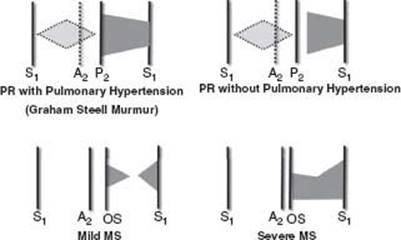
FIGURE 2.11 Diastolic murmurs. The diastolic decrescendo PR murmur associated with PH is called the Graham Steell murmur. The murmur follows a loud P2 sound. In contrast, the PR murmur unrelated to PH starts after the P2 sound. The murmur of MS usually occurs after a loud S1 and may be decreased in intensity prior to presystolic accentuation due to atrial contraction. The severity of MS is determined largely by the duration of the S2–OS interval and the duration of the murmur.

FIGURE 2.12 Diastolic murmurs of AR. The murmur of chronic AR is a decrescendo murmur beginning after S2. There often is an associated loud systolic ejection murmur due to high stroke volume. The murmur of acute severe AR is decrescendo in configuration but is brief in duration due to rapid equalization between aortic diastolic and left ventricular diastolic pressure. The systolic ejection murmur in acute severe AR is generally less intense compared to chronic AR since the stroke volume is not able to increase acutely. The Austin Flint murmur is a diastolic flow murmur that occurs in patients with AR and mimics the diastolic rumble of MS. It begins after an S3 gallop. Associated sounds (OS, S1 intensity) and maneuvers aid to differentiate an Austin Flint murmur from an MS murmur.
1. Mitral stenosis:
Location: localized around the apex, heard best in left lateral decubitus position
Description: low-pitched diastolic rumble heard best with the bell and crescendo in late diastole
Radiation: none
Severity: related to duration of the murmur, not to the intensity. A2–OS interval related to severity.
Maneuvers: with amyl nitrite and exercise due to tachycardia
Variations: early to mid diastolic rumble may be heard without stenosis due to flow (i.e., large VSD, PDA)
Associated findings:
– S1 may be if pliable leaflets.
– OS present with OS to A2 interval
– P2 and left parasternal lift if PH
– AF is common
– TR or MR murmurs may be present.
– TS murmur may be present.
– Elevated JVP with large “v” waves may be present with pulmonary HTN and associated TR.
2. Aortic regurgitation:
Location: left or right sternal border
Description: blowing, high-pitched decrescendo, heard best with the diaphragm, begins with A2 and heard best sitting, leaning forward in expiration
Radiation: if heard best with radiation to the right sternal border, suspect aortic root disease, and if heard best with radiation to the left sternal border or apex, suspect leaflet abnormalities.
Intensity: related to the severity and acuity of the lesion dependent on the difference between the aortic and the LV diastolic pressure gradient
Severity: in chronic AR, the duration of the murmur is associated with severity. In acute AR, a brief and soft early diastolic murmur may be present. The associated findings are important in determining severity.
Variations: leaflet perforation may cause a “cooing” or musical sound.
Associated findings:
– Aortic systolic ejection murmur
– Austin Flint murmur—a low-pitched rumbling apical diastolic murmur with presystolic accentuation that may mimic MS
– Soft S1 (premature closure).
– Paradoxically split S2
– S3
– Laterally displaced hyperdynamic apical impulse
– Wide pulse pressure with diastolic pressure
– Large volume pulses
– Bisferiens carotid pulse
– Multiple peripheral signs may be present including those discussed in the arterial pulse section.
– Diastolic MR may occur due to annular dilation.
3. Pulmonic regurgitation:
Location: pulmonary area
Description: high pitched and blowing, early diastolic decrescendo and generally brief beginning with P2 if due to PH (Graham Steell) and lower pitched in the absence of PH beginning after P2
Radiation: very localized
Intensity: with inspiration
Severity: “to-and-fro” murmur with severe PR and associated findings
Maneuvers: the murmur gets louder with inspiration.
Associated findings:
– Loud P2
– Persistent split S2
– Elevated JVP with a prominent “a” wave that may be masked by a large “v” wave if TR is also present
– TR murmur
– Parasternal lift due to RVH may be present.
4. Tricuspid stenosis:
Location: localized at the lower left sternal border or xiphoid area and best heard in the right lateral decubitus position
Character: not as low pitched as MS
Radiation: none
Intensity: with inspiration
Severity: related to the associated findings
Variations: a short, early to mid diastolic rumble may be heard without stenosis due to flow such as with an ASD.
Associated findings:
– Large “a” wave and slow “y” descent
– Tricuspid OS may be heard.
– Splitting of S1 and loud S1/T1 may occur.
– Right heart failure signs may occur.
CONTINUOUS HEART SOUNDS
They start in systole and encompass part or all of the systole and must extend through S2 into diastole without discontinuation.
Usually continuous murmurs peak near to or at S2 but are not required to encompass all of systole and diastole.
A holosystolic and holodiastolic murmur (“to and fro”) together is not a continuous murmur since it does not go through the second heart sound.
Continuous murmurs occur because of a continuous gradient between chambers or vascular structures (aorta–PA, artery–artery, artery–vein, vein–vein), during both systole and diastole.
Benign continuous sounds include a venous hum and mammary souffle.
A venous hum is heard mostly in children in the right supraclavicular area. It may have a “humming” quality. The intensity is variable depending on position (loudest sitting and with the head rotated contralaterally) and may be diminished by compression.
A mammary souffle is present in late pregnancy or during lactation. It may be primarily systolic heard in the third to fourth interspace on either or both sides. It may be abolished by compression.
Pathologic continuous murmurs include PDA, coronary fistula, pulmonary arteriovenous fistulas, and coarctation of the aorta.
Continuous murmurs radiated to the back are usually pathologic, and coarctation of the aorta, and pulmonary A-V fistulas should be suspected in first instance; rarely, the murmur of PDA is heard in the back.
Patent Ductus Arteriosus
See Figure 2.13.

FIGURE 2.13 PDA murmur. The murmur of a PDA is a continuous murmur characterized by an increasing intensity in systole, extension through the S2 sound, and then decreasing in diastole. Engulfing the S2 heart sound is essential to distinguish a continuous murmur from a “to-and-fro” murmur. As the PA pressure goes up, the diastolic component of the murmur shortens and may disappear. With further increases in PA pressure, the systolic component diminishes and may also disappear. When Eisenmenger syndrome occurs with a right-to-left shunt, the continuous murmur will be altered and a short systolic murmur is all that remains.
Heard best in the left second interspace near the sternum with radiation to the left clavicle
Harsh, loud, machinery-like quality, sometimes associated with a thrill
with peak intensity around S2 and then gradually wanes and may not encompass all of diastole
When PH develops, the diastolic portion gets shorter and softer. With severe pulmonary systolic HTN, the systolic component may also diminish and be absent.
With large left to right shunt, an apical diastolic rumble may be heard.
Associated findings:
Differential cyanosis when right to left shunting occurs (upper extremities with normal oxygenation and lower extremities with cyanosis)
Tachycardia
Bounding peripheral pulses and wide pulse pressure
Apical impulse displaced, diffuse
DYNAMIC AUSCULTATION
See Figures 2.14 and 2.15.

FIGURE 2.14 An algorithm demonstrating the effect of various maneuvers on systolic murmurs. TR, tricuspid regurgitation; PS, pulmonary stenosis; MVP/MR, mitral valve prolapse/mitral regurgitation; HOCM, hypertrophic obstructive cardiomyopathy; MR, mitral regurgitation; AS, aortic stenosis; VSD, ventricular septal defect. *The effect of squatting on AS may be variable (decreased, no change, or even increased) depending on the relative alteration of preload and afterload.

FIGURE 2.15 An algorithm demonstrating the effect of various maneuvers on diastolic murmurs. AR, aortic regurgitation; PR, pulmonary regurgitation; MS mitral stenosis; TS, tricuspid stenosis.
Respiration
In general, right-sided murmurs and sounds with inspiration and left-sided murmurs and sounds .
Exceptions include
The ES of PS with inspiration.
The click of MVP moves closer to S1 and the murmur may be longer and accentuated with inspiration.
Valsalva
Obtained by performing an inspiration followed by forced exhalation against a closed glottis
Phase II during straining is detected at the bedside—there is a in venous return and BP and reflex tachycardia.
The opposite happens during phase IV where an in stroke volume results in an in BP, and a in HR. This phase has no utility in clinical practice but may lead to a diagnostic error (the overshoot).
During the strain phase, the only murmurs that are those of HOCM and the MR murmur associated with MVP gets longer and may in intensity.
Right-sided murmurs return to baseline levels within 2 to 3 beats after the Valsalva release.
Hemodynamic Maneuvers
Raising legs while supine augments venous return and augments most right-sided heart sounds (after a few beats) and left-sided heart sounds (after 4 to 6 beats). The murmur of HOCM is .
Squatting results in venous return and systemic resistance. Most right- and left-sided murmurs such as AR, MR, and VSD. The murmur of HOCM is .
Hand grips BP and HR. AS murmur is unchanged or may , most other left-sided murmurs. The HOCM murmur and click and murmur of MVP are delayed and usually in intensity.
Pharmacologic Agents
Amyl nitrite results in marked transient preload and afterload (BP) reduction and subsequent in heart rate.
This maneuver is best for distinguishing:
1) AS () versus MR ()
2) MS () versus Austin Flint ()
3) MVP click murmur gets longer.
Innocent systolic murmurs are .
The intensity of the murmur of AR .
Post PVC
The murmurs of HCM, AS, and PS .
2There is no change in the murmurs of MR and TR.
The carotid upstroke in AS, and , or remains unchanged in the HCM.
The pulse pressure with HCM (Brockenbrough phenomenon) and that of AS .
TYPICAL FINDINGS OF SPECIFIC MEDICAL CONDITIONS
Acute Myocardial Infarction
Bradycardia or tachycardia
Normotensive or hypotensive
S1 soft (associated with MR)
S2 paradoxically split
S3 gallop
S4 gallop ( LV compliance during ischemia)
Late systolic murmur (crescendo) of MR (such as due to papillary muscle dysfunction)
Early systolic murmur (decrescendo) of acute severe MR (such as papillary muscle rupture)
RV Infarction
JVP with “a” and “v” wave
Kussmaul sign
Hypotension
Right-sided S3 or S4 gallop ( with inspiration)
Systolic murmur of TR
Clear lungs
Dilated Cardiomyopathy
JVP with “a” and “v” wave
Low pulse amplitude, narrow pulse pressure, and pulsus alternans
Diffuse apical impulse displaced laterally and downward
S2 paradoxically split (often due to LBBB)
S2 (P2) with pulmonary HTN.
S4, S3, or SG with tachycardia
MR or TR murmurs
Restrictive CM
Macroglossia, purpura, bruising (amyloidosis)
Cachexia
Tachycardia
Hypotension (including orthostatic hypotension)
JVP with rapid “x” and “y” descent
Kussmaul sign
Narrow pulse pressure with decreased pulse amplitude
S3 gallop (less common S4 gallop)
MR or TR murmurs
Right heart failure signs (hepatosplenomegaly, pulsatile liver, ascites, edema)
Cardiac Tamponade
Hypotension (and signs of hypoperfusion)
Tachycardia
Pulsus paradoxus
Elevated JVP with prominent “x” descent and reduced or absent “y” descent
Quiet heart sounds
Beck triad: ( JVP, quiet heart sounds, and hypotension)
Ewart sign with dullness to percussion and bronchial lung sounds on the left side below the left scapula (due to compression of the left lower lobe by a large pericardial effusion)
Pulmonary rales
Constrictive Pericarditis
JVP with rapid “x” and “y” descent (Friedreich sign)
Kussmaul sign
Apical impulse may not be palpable.
Systolic retraction of the apical impulse (Broadbent sign)
Quiet heart sounds
Pericardial knock
Right heart failure signs (hepatosplenomegaly, pulsatile liver, ascites, edema)
Pulsus paradoxus may be present with effusive-constrictive pericarditis.
MR or TR murmurs
Pulmonary Hypertension
Elevated JVP with prominent “a” waves
Left parasternal systolic lift
Loud P2 (may be palpable)
S2 persistently split
Right-sided S4 or S3 gallop
Pulmonic ES
Pulmonic regurgitation (Graham Steell murmur)
TR murmur
Right heart failure signs (hepatosplenomegaly, pulsatile liver, ascites, edema)
Type A Aortic Dissection
Normotensive, hypertensive, or hypotensive
Unequal upper-extremity BP
Unequal or absent pulses
New high-pitched diastolic decrescendo murmur (short duration and may be soft)
Systolic ejection murmur (associated with severe AR and stroke volume)
S3 gallop
Pericardial rub (if rupture into pericardial sac)
Shock or cardiac tamponade
Absence of peripheral signs seen with chronic AR
Neurologic findings (including Horner syndrome and stroke)
Atrial Septal Defect
Elevated JVP with equal size “a” and “v” waves
RV systolic heave
Palpable pulsation of the PA
P2
S2 fixed split
Midsystolic ejection murmur (increased flow across the pulmonary outflow tract)
Early low-pitched diastolic rumble (due to flow across the tricuspid valve)
MR can be heard with an ostium primum ASD (with associated mitral valve cleft)
Association with the Holt–Oram syndrome (upper limb deformities)
Ventricular Septal Defect
Normal or intensity S2
Persistent split S2
S3 gallop
Diastolic rumble (due to flow across the mitral valve)
Regurgitant holosystolic high-pitched murmur heard best along the left side of the sternum
Palpable thrill
With a supracristal VSD, the murmur is associated with AR.
With a muscular VSD, the murmur may be decrescendo in shape (the defect becomes smaller as the muscle contracts).
Expected “Normal” Findings during Pregnancy
Tachycardia
Normotensive with a tendency toward diastolic BP
Mildly or normal JVP with prominent “a” and “v” waves
Brisk carotid upstrokes
Laterally displace apical impulse
S1 and S2/P2
Splitting of S1
Persistent splitting of S2
S3 gallop
Grade 1 to 2 ejection murmur (due to blood flow through the pulmonary outflow tract)
Peripheral edema
Venous hum
Mammary souffle
SUGGESTED READINGS
Bates B. The heart, pressures and pulses. In: Bates B, ed. A Guide to Physical Examination. 3rd ed. Philadelphia: Lippincott; 1983.
Braunwald E, Perloff JK. Physical examination of the heart and circulation. In: Braunwald E, ed. Braunwald’s Heart Disease: A Textbook of Cardiovascular Medicine. 7th ed. Philadelphia: Elsevier Saunders; 2005.
Carabello BA, Crawford FA. Valvular heart disease. N Engl J Med. 1997;337:32.
Chatterjee K. Physical examination. In: Topol EJ, ed. Textbook of Cardiovascular Medicine. 3rd ed. Philadelphia: Lippincott Williams and Wilkins; 2007.
Criley JM, Criley DG, Zalace C. The Physiological Origins of Heart Sounds and Murmurs. Philadelphia: Lippincott Williams and Wilkins; 1997.
Heger JW, Niemann JT, Criley JM. Cardiology. 5th ed. Philadelphia: Lippincott Williams and Wilkins; 2004.
Hurst JW. The examination of the heart: the importance of initial screening. Emory Univ J Med. July-September 1991;135.
QUESTIONS AND ANSWERS
Questions
1. A 20-year-old man is referred for a cardiology consult due to an episode of nonexertional syncope associated with palpitations (his mother who is a nurse took his apical pulse and it was >200 bpm and irregular during the event). An electrocardiogram is reported as abnormal but not available. An echocardiogram was normal. Which of the following examinations suggests a cause for syncope in this patient?
a. Normal S1 and physiologic split S2
b. Normal S1 and persistent split S2
c. Physiologic split S1 and normal S2
d. Normal S1 and fixed split S2
2. A 31-year-old woman is 6 months pregnant. She has no significant medical or cardiac history. Her pregnancy has been uncomplicated except that now she is experiencing dyspnea with exertion. Which of the following examinations would be considered pathologic?
a. Normal S1 and S2 with a 2/6 early systolic ejection murmur and 1/6 diastolic rumble. No extra sounds.
b. Normal S1 and S2 with a S3 gallop
c. Normal S1 and S2. No extra sounds. Continuous murmur heard under the left breast.
d. Normal S1 and decreased S2. An ejection sound (ES) decreases with inspiration.
3. A 25-year-old woman has a history of congenital heart disease. She was recommended to have a “corrective interventional procedure” several years earlier due to a continuous murmur, but she did not do it because she felt well. She now has developed the onset of dyspnea with a moderate level of exertion. Which of the following examinations would you expect to be present?
a. Normal S1, soft S2/P2, and continuous systolic and diastolic murmur
b. Normal S1, normal S2/P2, and continuous systolic murmur but short diastolic murmur
c. Normal S1 and loud S2/P2 with predominant systolic murmur. Pink hands and blue feet.
d. Normal S1 and S2 with only a diastolic murmur. Pink hands and blue feet.
4. A 32-year-old woman has just returned from a year in India. She has a sore throat, fever, rash, arthralgias and is dyspneic. On examination, there is a soft S1 and loud S2. There is an S3 gallop. She has 2 murmurs, a 3/6 apical holosystolic regurgitant systolic murmur and a 2/6 apical, short mid-diastolic rumble. What is the most likely explanation for her symptoms?
a. Pulmonary stenosis (PS) and pulmonary regurgitation (PR)
b. Aortic stenosis (AS) and aortic regurgitation (AR)
c. Tricuspid stenosis (TS) and regurgitation
d. Mitral stenosis (MS) and mitral regurgitation (MR)
5. A 26-year-old woman is referred to cardiology clinic. She was told she had MVP 10 years earlier. A 2/6 regurgitant murmur is heard at the LSB with an associated midsystolic click. What is expected to happen when the patient changes from a standing to squatting position?
a. The click moves toward S2 and the murmur decreases.
b. The click moves toward S2 and the murmur intensifies.
c. The click moves toward S1 and the murmur decreases.
d. The click moves toward S1 and the murmur intensifies.
6. A 70-year-old man is seen in the hospital for preoperative cardiac clearance prior to hip surgery that is planned for today. Prior to falling and injuring his hip, he had no symptoms with >4 METS exertion. On examination, the intern hears a systolic murmur that is 3/6 in intensity. He is concerned that the patient has AS and would like to cancel the surgery and obtain an echocardiogram. Which of the following findings is not consistent with AS?
a. Following a PVC, the intensity of the murmur is unchanged.
b. The murmur starts after S1 and ends before S2.
c. The murmur is intensified after a long cycle length in atrial fibrillation (AF).
d. The murmur is typically crescendo/decrescendo in shape.
7. A 70-year-old man is day # 3 post inferior MI. He develops sudden hypotension. On examination, S1 is decreased, S2 (P2) is increased. There is a decrescendo systolic murmur that begins with S1 and ends in midsystole. There is a thrill along the left sternal border. What is the most likely diagnosis?
a. Severe TR.
b. Systolic anterior motion of the mitral valve with LVOT obstruction
c. Pseudoaneurysm
d. Ischemic MR
8. A 68-year-old man presents for evaluation of right heart failure. He has a history of coronary artery bypass graft (CABG) 10 years previously. He developed dyspnea with minimal exertion, orthopnea, palpitations, and lower-extremity edema in the past year. On examination, the jugular venous pressure is elevated to 15 cm H2O with a prominent “x” descent and a “y” descent that is blunted. Kussmaul sign is absent and pulsus paradoxus is present. The heart sounds are soft. A PK is absent. Which of the following conditions is suspected?
a. Restrictive cardiomyopathy
b. “Classical” form constrictive pericarditis
c. Effusive-constrictive pericarditis
9. A 47-year-old woman presents with dyspnea on exertion and episodes or presyncope. She has a history of rheumatic MS requiring a bioprosthetic MVR 10 years previously. On examination, JVP is 12 cm H2O. S1 is normal and S2 is persistently split and accentuated. There is an early, long duration 3/6 blowing diastolic decrescendo murmur and a 2/6 early peaking SEM at the left upper sternal border. With expiration, both murmurs decrease in severity. What is the most likely diagnosis?
a. Pulmonary regurgitation and stenosis
b. PR with pulmonary hypertension (PH)
c. AR and stenosis
c. Prosthetic mitral valve stenosis
10. A 32-year-old man has a history of a heart murmur since childhood. He is asymptomatic but was told he could not play sports as a child. On examination, there are equal pulses. S1 and S2 are normal without a split. There is a 3/6 SEM. There is no ES. There is a 2/6 diastolic decrescendo murmur. Following a PVC, the murmur increased in intensity as did the pulse pressure. Which is the correct diagnosis for this patient?
a. Subvalvular AS due to a subaortic membrane
b. Supravalvular AS
c. Hypertrophic cardiomyopathy
d. Bicuspid AS
Answers
1. Answer B: The patient has Wolf–Parkinson–White (WPW) syndrome with associated rapid AF that led to nonexertional syncope. With a manifest accessory pathway, left and right-sided WPW may be detected on auscultation due to abnormalities in the splitting of the second heart sound (S2). With a left-sided pathway, the A2 component of S2 would occur early since the atrioventricular (AV) node is bypassed and electrical activation of the left heart and therefore completion of ejection would lead to an earlier A2 closure sound. In expiration, A2 and P2 would be separated, and in inspiration, the separation would be increased. This is referred to as persistent splitting of S2. When a right-sided pathway is present, the P2 component of S2 occurs early during expiration (P2 before A2) with a single sound during inspiration. This is referred to as paradoxical splitting of S2. Physiologic splitting of S1 or S2 may be a normal variant and not associated with electrical or structural heart disease. A fixed split S2 may be associated with a hemodynamically significant ASD, though this would not be an expected cause of syncope.
2. Answer D: The physiologic changes during pregnancy including increased HR, stroke volume and decreased systemic and pulmonary vascular resistance lead to expected variations from normal on cardiac physical examination. The intensity of the first heart sound (S1) and S2 may be increased and splitting of S1 and S2 may occur. An S3 is common as is an early peaking, short systolic ejection murmur (≤2/6 intensity). These findings are all related to increased total volume and cardiac output (CO). Similarly, some women will have a very soft diastolic flow murmur related to increased flow across the AV valves. This may be physiologic if there are no other associated abnormal sounds (e.g., an opening snap [OS] of MS). Continuous murmurs such as a venous hum or mammary souffle may be heard. All other sounds including (1) reduced intensity S1 or S2, (2) paradoxical or fixed S2 splitting, (3) ≥3/6 systolic ejection murmur especially if mid or late peaking and long in duration, (4) ≥2/6 regurgitant murmur, (5) continuous heart sounds other than the mammary souffle and venous hum, (6) S4gallop, or (7) ESs or extra sounds are considered pathologic. In this patient, a decreased S2 sound and an ES that decreases with inspiration is consistent with PS. The other examples are acceptable in a normal pregnant woman.
3. Answer B: The clinical history and answers are consistent with a patent ductus arteriosus (PDA). Each choice suggests a different size of the shunt and level of pulmonary vascular resistance relative to systemic vascular resistance (SVR). See Fig. 2.13. Choice (A) is consistent with a small hemodynamically insignificant PDA characterized by a systolic and diastolic component that envelope the second heart sound. Choice (B) is consistent with at least a moderate-sized PDA with associated elevation of PA pressure. This results in shortening of the diastolic component of the murmur as the systemic and pulmonary vascular resistances in diastole begin to equalize. Remember that a continuous murmur is defined primarily by its extension through the second heart sounds and is not required to extend throughout all of systole and diastole. Choice (C) is consistent with a right-to-left shunt due to PH and resultant Eisenmenger physiology. In the setting of a PDA and Eisenmenger physiology, the upper extremities remain well oxygenated and pink since they do not receive shunted blood whereas the lower extremities do not—and therefore are blue. Choice (D) is an unlikely examination for a PDA.
4. Answer D: The history and clinical findings suggest acute rheumatic fever, which is manifest as a pancarditis. The endocardial lesion is an active valvulitis that most commonly involves the mitral valve followed by the aortic valve in frequency. In the acute phase of mitral valvulitis due to rheumatic fever, there is both a functional MS and regurgitation due to inflammation of the leaflets. The diastolic murmur is known as the Carey Coombs murmur and distinguishable from chronic rheumatic MS due to the absence of an OS, loud S1, and presystolic accentuation of the diastolic murmur. The associated MR may be severe. Aortic valve involvement is manifest as AR. The examination described is most consistent with a predominant MR murmur with mild functional MS.
5. Answer A: The mitral valve click and associated mitral regurgitant murmur is dynamically affected by changes in preload and afterload. Since the leaflets and chordae are redundant and elongated, there is effectively a mismatch between the leaflets and the left ventricular cavity size. When the cavity is smaller (as with decreased preload or afterload), the leaflets prolapse earlier in systole. This results in the mitral click moving closer to S1; therefore, the duration and intensity of the regurgitant murmur are increased. In contrast, when the cavity is larger (as with increased preload or afterload), the leaflets prolapse later in systole. This results in the mitral click moving away from S1 and closer to S2; therefore, the duration and intensity of the regurgitant murmur are decreased (see Fig. 2.7).
6. Answer A: Distinguishing between a systolic regurgitant and an ejection-type murmur is important to characterize the etiology of a murmur. Regurgitant murmurs result from abnormalities of the atrioventricular valves and shunts (MR and TR, ventricular septal defect [VSD]). Ejection murmurs result from abnormalities of flow through the semilunar valves or outflow tract (aortic and PS, HOCM). Regurgitant murmurs typically start with S1 or at least extend to S2, or both. They are typically high pitched and do not increase with a long diastole of AF or post PVCs since the relative gradient between the upstream and the downstream chambers do not change significantly. Ejection-type murmurs typically start after S1 and end before S2 and are generally medium pitched and crescendo/decrescendo in shape. With a long diastole of AF or post PVC, ejection murmurs increase in intensity.
7. Answer D: Acute ischemic MR following myocardial infarction may be due to organic or functional etiologies. The timing and intensity of the murmur are related in part to the mechanism and the severity as well as loading conditions. In the setting of organic MR due to papillary muscle rupture, the murmur is typically early systolic and then fades in later systole. This occurs because of rapid equalization of the left atrial and ventricular pressures in systole. In contrast, the functional etiologies of MR including papillary muscle dysfunction tend to occur later in systole.
8. Answer C: Constrictive pericarditis should be suspected in any patient with prior coronary artery bypass graft (CABG) and signs or symptoms of right heart failure especially if left ventricular function is preserved. The clinical findings in the patient are most notable for elevated JVP with a blunted “y” descent and pulsus paradoxus. The presence of a blunted “y” descent and pulsus paradoxus is not typical of classical form of constrictive pericarditis where there is typically a prominent “x” and “y” descent and the presence of Kussmaul sign. However, this constellation of findings is present with the effusive form of constrictive pericarditis. Effusive-constrictive pericarditis is due to an elastic pericardial visceral restraint with a tense pericardial effusion resulting in the clinical and hemodynamic features consistent with cardiac tamponade that subsequently revert to that of constrictive pericarditis following pericardiocentesis. Most patients with effusive-constrictive pericarditis ultimately require pericardiectomy. A PK is not expected in effusive-constrictive pericarditis and Kussmaul sign is generally absent.
9. Answer B: The patient has a Graham Steell murmur that is due to PR in the setting of PH. (See Fig. 2.11.) It is usually the result of longstanding MS. It differs from the findings seen with PR unrelated to PH where S2 is not accentuated and the murmur is not heard immediately after S2. Intensification of the murmur with inspiration and reduction of the murmur with expiration characterize this as a right-sided murmur, thus excluding AR and prosthetic MS. PS is a rare finding in rheumatic heart disease and would be associated with a reduced S2.
10. Answer A: The patient has a subaortic membrane resulting in subvalvular AS and AR. Subvalvular membranes are usually due to fibrinous membranes or tunnels that result in fixed stenosis. Several mechanisms lead to associated AR including the effects of a jet lesion on the aortic leaflets and retraction of the leaflets due to the membrane. Supravalvular AS is rarely associated with AR and typically has unequal pulses with right > left due to the streaming of the flow jet along the right side of the aorta. Bicuspid valvular AS is unlikely since the S2sound is preserved and there is no ejection click (EC). Finally, with HCM, the murmur post PVC is increased due to decreased preload resulting in increased systolic anterior motion of the mitral valve and increased obstruction. In addition, the pulse pressure (difference in pressure between the systolic and diastolic blood pressure) post PVC with HCM is decreased. With all other forms of AS (valvular, subvalvular, and supravalvular), the pulse pressure post PVC is usually increased.