
STUDY HINTS
Although Mendel did not know about the events that occur in a dividing cell, his laws of segregation and independent assortment are really descriptions of chromosome behavior during meiosis. Segregationsimply refers to the fact that the two homologous chromosomes separate to opposite sides of the cell (that is, they segregate) after synapsis in the first meiotic division. Independent assortment reflects the fact that the orientation of one pair of homologous chromosomes at the equatorial plate in cell division is independent of the orientation of other pairs; that is, alignment of chromosomes occurs randomly relative to one another.
The secret to solving Mendelian genetics questions is to recognize that there is a pattern hidden within the superficial confusion of facts with which you are presented. The first important step is to have a clear understanding of mitosis and meiosis. Then you must have a thorough working knowledge of the terminology. Beginning students commonly confuse phenotype and genotype, or gene and allele. Genotype is the genetic makeup (such as Aa), whereas phenotype is the expression of the genotype interacting with its environment (such as brown versus black fur). Different genes code for totally different protein products (such as a pigment enzyme versus blood membrane protein), whereas alleles are the different forms that a specific gene can have (such as normal enzyme A versus the lower-activity form of the same enzyme a). A list of Important Terms is given at the end of this section, and definitions can be found in the Glossary. We recommend that you use this list of terms as a study aid to test your own ability to define terms. Set up flash cards for difficult terms. Remember that beginning to study a new science is not very different from beginning to learn a foreign language.
Perhaps the most frequent problem that students have in Mendelian genetics is understanding the implications of segregation. As can be seen from meiosis, each parent transmits only one allele of each gene to an offspring. If the parent is homozygous, each gamete will be identical for that gene, but if the parent is heterozygous, two different gamete types will be produced, each of equal frequency. For a dihybrid (for example, AaBb), a single allele of each gene must be included in each gamete. If you use a Punnett square to summarize the outcomes of a cross, be sure to double-check that the gametes you list are the correct products of segregation.
The other common difficulty is extracting the appropriate information from a written problem. This takes practice, but there is a logical sequence to follow that might help make the process more routine. First, determine the mode of inheritance. Which trait is dominant, and which is recessive? This may be given, but if not, simply look to see which is expressed in the phenotype of an individual that has inherited both alleles.
Second, define symbols, using a capital letter or letters for the dominant trait and a lowercase letter for the recessive. Then assign genotypes based upon the phenotypes for each individual. Here it is extremely important to distinguish between what you “know” and what you “hypothesize” to be the genotype of an individual. If the individuals homozygous or described as true-breeding or inbred, the genotype can be assigned unambiguously. On the other hand, if the ancestry of offspring phenotypes is unavailable or inconclusive, an individual with a dominant phenotype may only be “known” to carry at least one dominant allele. Do not exceed what you are certain of. Simply represent the second allele by a dash to indicate the fact that it might be either dominant or recessive (i.e., A – could be either AA or Aa).
Next, ask what types of gametes each parent can produce, and summarize the combinations in a Punnett square. Once you have gained some practice, you should then begin to interpret the outcomes on the basis of probabilities.
Finally, reread the question to be certain that you are answering what it has asked. It is often at this point that the correct work can yield the wrong answer if you give genotypic ratios, for example, and the problem asked for phenotypic ratios.
Always remember that solving Mendelian genetics problems is just like working a series of puzzles, using a very precise vocabulary. Characteristics, such as the shape of watermelons and the hair color of guinea pigs, can make questions look very different, but their inheritance patterns generally follow the same set of fairly simple rules.
IMPORTANT TERMS
Allele
Continuous variation
Dihybrid
Discontinuous characters
Dominant
Gene
Genome
Genotype
Heterozygous
Homozygous
Independent assortment
Monohybrid
Pedigree
Phenotype
Recessive
Segregation
Testcross
PROBLEM SET 4
1. In humans, assume that the presence of dimples is a dominant trait. Suppose that in one family both parents have dimples, but their daughter does not. Their son does have dimples. What are the genotypes of the four people in this family?
link to answer
2. In humans, assume that having attached earlobes is recessive to having free earlobes. A woman and her husband both have free earlobes, although each happens to have a father with attached earlobes. Is it possible for this woman and man to have a child with attached earlobes? Please explain by indicating the genotypes of the parents and child.
link to answer
3. In the garden pea, tall is dominant to short and red flower color is dominant to white. These genes assort independently. Pure-breeding tall red plants are crossed with pure-breeding short white plants, and the F1 are crossed with each other to produce an F2. What proportion of F2 plants have the same genotype as the F1 plants?
link to answer
4. John bought a pair of black mice from his friend Steve. Steve did not know anything about their pedigree, except that at least one great-grandparent mouse had had brown fur. John discovered that in his first litter of 10 baby mice, 2 had brown fur. What can be concluded about the inheritance of hair pigmentation and the genotypes of his 2 black parent mice?
link to answer
5. In humans and chimpanzees, the ability to taste phenylthiocarbamide (PTC) is dominant to inability to taste it. The cell of a heterozygote at anaphase I of meiosis would have how many T and how many talleles? at metaphase of mitosis? at metaphase II of meiosis? It will help you answer questions like this if you sketch the cells yourself.
link to answer
6. The characters dumpy wing (dp), brown eye color (bw), hairy body (h), ebony body color (e), shortened wing veins (ve), and eyeless (ey) in Drosophila are all produced by recessive alleles. Assuming that these loci are not closely linked, how many different kinds of gametes will be produced by a fly having the genotype Dp dp bw bw Hh EE Ve ve ey ey?
link to answer
7. A normal woman whose father is an albino wishes to marry a phenotypically normal man whose mother was albino. She would like to know her chance of having an albino child. Knowing that in this case albinism is caused by a recessive autosomal gene, what should she be told?
link to answer
8. Chinchilla coat color in mice is due to a recessive allele (cch) and the normally pigmented coat, called agouti, is due to the dominant allele. Mice heterozygous for chinchilla coat color are mated to homozygous chinchilla (cch / cch) mice, and the resulting progeny include both agouti and chinchilla phenotypes. If one takes one of the agouti progeny and mates it to one of its chinchilla sibs, the expected genotypic ratio among their offspring is
(a) 3:1,
(b) 1:1,
(c) 9:3:3:1,
(d) 1:2:1,
(e) none of the above.
link to answer
9. In a cross of AaBbccDd to AabbCCDD, the frequency with which we would expect to obtain progeny of the genotype AABbCcDd is
(a) 1/128,
(b) 1/64,
(c) 1/32,
(d) 1/16,
(e) 1/8,
(f) none of the above.
link to answer
10. In a cross of AaBbCcDd to AabbCcDD, the proportion of progeny that show all four dominant traits is
(a) 81/256,
(b) 27/64,
(c) 54/64,
(d) 27/256,
(e) 27/32,
(f) 9/32,
(g) 3/32,
(h) none of the above.
link to answer
11. If the hypothetical autosomal dominant gene N is necessary for the production of pigment required for normal vision and the autosomal dominant gene S results in blindness because of the disorganization of neuronal synapses in the eye, what proportion of the progeny produced by the cross Nnss × nnSs will be blind?
link to answer
12. Assume that straight hair (S), golden brown fur (G), and hairy ears (H) are dominant to curly hair, dark brown fur, and hairless ears, respectively. All three loci assort independently. In a cross of Ss Gg HHwith SS Gg Hh, how many different phenotypes will be found among the progeny?
link to answer
13. In the cross indicated in problem 12 involving straight hair, golden brown fur, and hairy ears:
(a) What proportion of the offspring would have straight hair, dark brown fur, and hairy ears?
link to answer
(b) What proportion of the offspring would be expected to have the genotype SS GG Hh?
link to answer
(c) What proportion would be expected to be the genotype Ss Gg hh?
link to answer
link to answer
14. Referring again to the cross involving straight hair, golden brown fur, and hairy ears, how many different genotypes will be found among the progeny?
link to answer
15. Hygienic behavior in honeybees is determined by two recessive alleles. Those homozygous for one of these recessives will uncap the brood cells of the developing bees killed by an infection of American foulbrood bacteria. Those homozygous for the other recessive will remove the dead bee and clean the cell, thus removing the source of further infection. Both of these independently assorting loci must be homozygous recessive for hygienic behavior to occur. A testcross of dihybrid non-hygienic honeybees will produce what proportion of colonies that can successfully resist an infection of American foulbrood? Although it doesn’t really affect the answer of this problem, you should be aware that the male bee is haploid.
link to answer
16. Which of the following alternatives is/are correct? For two pairs of alleles, Aa and Bb, it is theoretically possible to have
(a) segregation without independent assortment,
(b) independent assortment without segregation.
link to answer
17. Assume that curly hair (s) in rabbits is recessive to straight hair (S). In a cross of Ss to Ss, the probability of obtaining exactly 3,000 straight-haired and 1,000 curly haired progeny in a sample of 4,000 offspring is
(a) 100 percent,
(b) very high but not quite 100 percent,
(c) small.
link to answer
18. Assume that a diploid organism has seven pairs of chromosomes. If the organism is heterozygous at only one locus on each of these seven pairs of chromosomes (Aa, Bb, . . ., Gg), independent assortment will permit the production of how many genetically different gametes?
(a) 7,
(b) 14,
(c) 16,
(d) 28,
(e) 49,
(f) 128.
link to answer
19. If the organism in problem 18 reproduces by self-fertilization, the number of different genotypes expected among the progeny of this septa hybrid is
(a) 14,
(b) 21,
(c) 49,
(d) 128,
(e) 256,
(f) 512,
(g) 2,187,
(h) 4,374,
(i) none of the above.
link to answer
20. If all the genes indicated in problems 18 and 19 were showing complete dominance, how many different phenotypes would the self-fertilized individual be able to produce?
link to answer
21. Cystic fibrosis is inherited as an autosomal recessive trait. Assume that it is possible to identify a heterozygote through a molecular genetic test (we will explore ways of doing this in a later chapter). Suppose that a man whose brother had cystic fibrosis is married and wishes to have children. The result of a skin test indicates that he is a carrier. Although there is no history of cystic fibrosis in his wife’s family, her skin test result also shows that she is a carrier. This couple then has three children who do not show any of the characteristics of this condition. What are the chances that their fourth child will have cystic fibrosis?
link to answer
22. A testcross of a trihybrid (AaBbCc) with complete dominance, independent assortment, and no gene interactions will give which genotypic ratio?
(a) 1:1:1:1,
(b) 9:3:3:1,
(c) 1:1:1:1:1:1:1:1,
(d) 27:9:9:9:3:3:3:1.
Which will be its phenotypic ratio?
link to answer
23. A cross is made of AaBb×AaBb. The A and B loci assort independently. The progeny of this dihybrid cross are then allowed to fertilize themselves. The proportion of the progeny that show segregation for the A locus (that is, produce A– and aa progeny) is
(a) 1/2,
(b) 9/16,
(c) 3/16,
(d) 1/16,
(e) none of the above.
link to answer
24. In a cross of AaBbccDd × AaBbCcDD, with independent assortment for all loci, the fraction of progeny that are homozygous for all four loci is
(a) 3/4,
(b) 1/3,
(c) 1/2,
(d) 1/4,
(e) 1/8,
(f) 1/16,
(g) 1/32.
link to answer
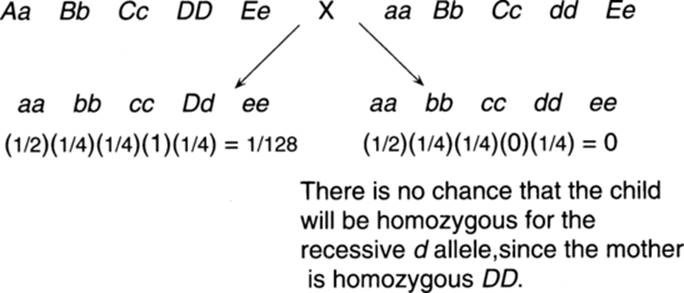
25. If an individual with the genotype AaBbCcDDEe is mated to an individual with the genotype aaBbCcddEe, what proportion of the offspring would be aabbccDdee? What proportion would be aabbccddee?
link to answer
26. Two guinea pigs are known to be heterozygous for a dominant mutation that causes them to have kinked tails. The breeder would like to establish a truebreeding kinked-tail line. She first gives away all of the normal-tailed guinea pigs that are born from that pair. What proportion of the remaining pups are homozygous for the kinked-tail allele?
link to answer
27. Let us assume that two genes affect pod development in strains of beans you are studying. Long pods (L) is dominant to short pods (l), and round seeds (R) is dominant to wrinkled seeds (r). In the progeny produced from one cross, you find the following types and proportions of plants: 3/8 long and round, 3/8 long and wrinkled, 1/8 short and round, 1/8 short and wrinkled. What are the phenotypes and genotypes of the parent plants?
link to answer
28. In humans, atopic allergic disease, also called ragweed hay fever, is dependent on a dominant gene A, and a dominant gene H determines a neurological disorder called Huntington disease. The normal genes are a and h, respectively. Assume a man who is Aahh marries a woman who is aaHh. These genes are on non-homologous chromosomes.
(a) What proportion of their children will have both atopic allergic disease and Huntington disease?
link to answer
(b) If these two genes were linked, would your answer be different?
link to answer
(c) Assume the two genes were on the same chromosome and a son from this marriage has both the Huntington and atopic allergic genes. Assuming no recombination and a genetically normal wife, what proportion of the son’s children would have both the dominant Huntington and atopic allergic genes?
link to answer
link to answer
29. In humans, the ability to flute (roll) one’s tongue is a dominant allele F, to the inability to flute the tongue, f. A student who cannot flute his tongue has a nephew who cannot flute his tongue; however, the nephew’s mother (the student’s sister) can flute her tongue. What are the genotypes of the student, nephew, and the nephew’s mother? What do we know about the student’s parents? Would the presence of two brothers and another sister who were unable to flute their tongue give more information on the student’s parents?
link to answer
30. A normal allele for skeletal development, sk, has an allele, Sk, that causes death in the homozygous condition. In the heterozygous condition the person is missing one joint from each finger, a condition called brachydactyly. What is the phenotypic ratio of the offspring of two parents with brachydactyly?
(a) 1 normal : 2 brachydactyly;
(b) 1 SkSk : 2 Sksk : 1 sksk,
(c) 1 brachydactyly : 2 normal;
(d) 1 normal : 1 brachydactyly;
(e) none of these is correct.
link to answer
31. A type of blindness called aniridia is caused by a dominant gene, A. Normal sight is found in those who are homozygous for the recessive allele, a. Another gene for hair color has two alleles showing incomplete dominance: DD = black, D′D′ = blond, and DD′ = brown hair. These two genes segregate independently of each other. Two individuals who are blind (both have a sighted parent) and have brown hair want to know what proportion of their offspring would be blind and have brown hair.
(a) 1/16;
(b) 2/16 (=1/8);
(c) 4/16 (= 1/4);
(d) 6/16 (= 3/8);
(e) 9/16.
link to answer
ANSWERS TO PROBLEM SET 4
1. The two parents both have dimples and must therefore have at least one dominant allele for dimples. Let us define the dominant as D and the recessive as d. Their daughter is homozygous recessive (dd) for this trait. This means that she received a recessive allele (d) from each parent, and the parents must therefore both be heterozygotes (Dd). The son has inherited at least one dominant allele from a parent, but it is not possible to tell whether he is homozygous or heterozygous for this trait. We shall simply represent his known genotype as D– to indicate that we do not have the evidence to establish the second allele.
2. Since both the woman and her husband had a parent with the recessive trait, they must both be heterozygotes. If we denote the traits as F for free earlobes and f for attached earlobes, the parents are Ff and the child with attached earlobes would be ff. The probability of having such a child is 1/4.
3. The F1 plants of a cross between two homozygotes will be heterozygous for both genes. Let’s define T as the dominant allele for tall plants, t as the recessive allele for short plants, R as the dominant allele for red flowers, and ras the recessive allele for white flowers. When these Tt Rr dihybrid F1 plants are crossed, nine different genotypes will be produced. Since the genes segregate independently, we can calculate the probability of a dihybrid being formed in the F2 by looking at the genes one at a time. When Tt is crossed to Tt, there is 1/2 chance that the progeny will be Tt. Similarly, there is a 1/2 chance that the progeny will be Rr. The probability of being both Tt and Rr is the product of the independent probabilities. Thus, 1/4 of the F2 offspring will be dihybrid like the F1.
4. Although the mice John bought from Steve showed the dominant trait, they must have both been heterozygous for coat color (which is consistent with there being a homozygous recessive individual in an earlier generation). Two out of 10 is near 1/4, the theoretical expectation from a monohybrid cross. You can therefore conclude that one segregating locus affects coat color in this pedigree and that black is dominant to brown. If we let B be the black allele and b be the brown allele, the parents John bought were both Bb. It is useful to note that the ratio of different kinds of offspring can be compared to theoretical ratios and then predict (hypothesize) what the parent genotypes must have been. That is simply going the opposite direction from the typical thought pathway of using parent genotypes to predict offspring types.
5. At anaphase I of meiosis, segregation would be under way but not yet complete. Thus there would be a total of two T and two t alleles (remember that DNA replication has duplicated each chromosome in the preceding interphase). At metaphase of mitosis, the same would be true. There would be a total of two T and two t alleles. At metaphase II of meiosis, however, either two T or two t would be present, since segregation has occurred but cell division has not yet been completed. The resulting cells would include only a single T or a single t allele each.
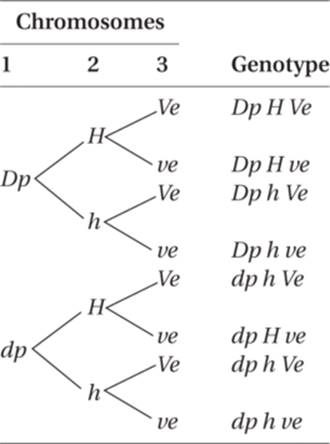
6. If the loci are not closely linked, then all combinations of alleles are possible. All gametes will carry bw, E, and ey, since the flies are homozygous for these alleles. The gametes will be segregating for all the others. The number of different kinds of gametes = 2n, where n is the number of segregating loci. In this example, 23 = 8. The gametes are shown in the accompanying figure.
7. The man and the woman are both heterozygous for the recessive albino allele. Since albinism is relatively rare in the population, we can assume that their phenotypically normal parents are homozygous AA. There is, therefore, a probability that 1/4 of their children will be homozygous (phenotypically albino). In other words, there is a 1/4 probability that any one of their children will be albino.
8.
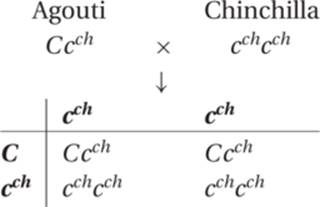
(b) The parents are Ccch and cchcch. Since a heterozygous chinchilla mouse carries the dominant C allele, in addition to cch, the progeny consist of half with normal pigmentation (Ccch) and half with chinchilla color. The cross of the normal F1 mice to chinchilla mice is therefore Ccch to cchcch and the expected genotypic ratio is half Ccch and half cchcch or 1:1. If wording in a problem like this confuses you, it is useful to write out the symbol and make your own pedigree:
9.
(d) Taking each gene separately, the probability of getting AA from a cross of Aa to Aa is 1/4; the probability of getting Bb from a cross of Bb to bb is 1/2; the probability of getting Cc from a cross of cc to CCis 1; and the probability of getting Dd from a cross of Dd to DD is 1/2. Assuming independent assortment for all four loci, the probability of getting AABbCcDd is the product of the independent probabilities, or 1/4 · 1/2 · 1 · 1/2 = 1/16. The same answer could be obtained in a more visual way by identifying the combinations as in the answer to problem 6.
10.
(f) Taking each gene separately, the probability of getting A – (that is, at least one A allele) from a cross of Aa to Aa is 3/4; the probability of getting B – from a cross of Bb to bb is 1/2; the probability of getting C – from a cross of Cc to Cc is 3/4; the probability of getting D – from a cross of Dd to DD is 1. Assuming independent assortment for all four loci, the probability of inheriting all four dominants is 3/4 · 1/2 · 3/4 · 1 = 9/32. Again, the combinations could be identified and counted as in problem 6.
11. Assuming independent assortment, the gametes formed by the two parents and the progeny produced are
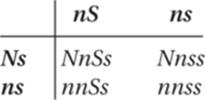
If the absence of pigment (nn) results in blindness and if neural problems result from the S allele, then any individual that is nn and/or S – will be blind. From the Punnett square, we can see that only 1/4 will have vision (Nnss); therefore, the answer is that 3/4 will be blind.
12. Since all genes are segregating independently, we can consider them one at a time. From the Ss × SS part of the cross, all offspring will inherit an S allele from the second parent and, thus, have straight hair. From Gg × Ggthere will be a 3:1 ratio of golden brown fur to dark brown fur. Finally, from HH × Hh, all will inherit the H allele from the first parent and have hairy ears. There are, therefore, only two different phenotypes: straight, golden, hairy and straight, dark, hairy.
13.
(a) As described in the answer to question 12, the only variation in phenotype is in the golden brown versus dark brown fur. We can, therefore, use the 3:1 ratio of golden brown to dark brown, and the proportion of offspring with dark brown fur would be 1/4. The genotype of the indicated offspring would be S– gg H–, where the dash indicates the second allele could either be dominant or recessive.
(b) 1/2 × 1/4 × 1/2 = 1/16.
(c) None (1/2 × 1/2 × 0), since the offspring could not be homozygous for the recessive.
14. Again, taking the genes one at a time, Ss × SS yields two genotypes, Gg × Gg yields three (GG, Gg, and gg), and HH × hh yields two. In total there will be 2 × 3 × 2 = 12 different genotypes. You can use a branching diagram like the one we used earlier to show all possible combinations of genotypes.
15. Let us designate the uncapping genotype as uu and the removing genotype as rr. The heterozygous nonhygienic worker bees are then UuRr, and the hygienic males to which they are crossed are ur(honeybee males are haploid, but the answer would be the same if you treated them as typical diploids). The gametes and progeny phenotypes are
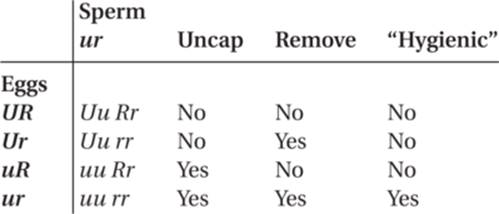
Thus 1/4 of the colonies will be able to resist the infection.
16. By definition, alleles segregate from each other at meiosis. Independent assortment is the name given to the situation in which the segregation of one pair of alleles is independent of the segregation of a second pair of alleles. If the two genes are linked and thus not assorting independently, they will each still be segregating. Since independent assortment is really independent segregation, answer (a) is correct.
17. The answer is (c), small. Theoretical ratios are rarely obtained exactly, even with large numbers. If you flip a coin two times, for example, the theoretical ratio of one head and one tall is expected only half of the time (you expect two heads one-fourth of the time and two tails one-fourth of the time). The results from coin tossing, or rabbit breeding, usually assume a normal distribution with the theoretical ratios as the mean and with deviations in both directions. The exact theoretical ratios here (3,000:1,000) would occur only rarely. It would be analogous to someone’s telling you that he or she had flipped a coin 4,000 times and had come up with exactly 2,000 heads and 2,000 tails. Although this is the theoretical value, you would be very dubious of the claim, and rightly so.
18.
(f) With one locus or one pair of chromosomes (e.g., Aa), two genetically different gametes (A and a) are expected. With two loci or two pairs of chromosomes (e.g., Aa and Bb), four genetically different gametes (AB, Ab, aB, and ab) are expected. With three loci or three pairs of chromosomes, eight genetically different gametes are possible. This series can be represented by the expression 2n, where the number 2 stands for the two alternatives at each locus and n is the number of loci or pairs of independently segregating chromosomes. In this case, the number of different gametes is 27, or 128. Be careful in applying a formula like this. Don’t just count genes; look at the genotype carefully and count only the heterozygous (segregating) genes.
19.
(g) This is a variant of problem 18. Instead of two possible gametic alternatives at each locus, we are dealing with possible genotypes at each locus. In all cases, the number is 3 (e.g., AA, Aa, and aa), so the number of different genotypes is 37 or 2,187.
20. Since there are only two phenotypes produced by each gene, then the possible phenotypes would be 2n or 27, the same number as gametes found in problem 18, 128.
21. Let us define the normal condition as C and the recessive cystic fibrosis as c. Both parents are carriers, Cc. Each of their children therefore has a 1/4 chance of having cystic fibrosis. It makes no difference how many previous children have been normal. The probabilities remain the same, since no previous events affect which eggs and sperm will fuse at fertilization.
22.
(c) The trihybrid will produce 2n = 23 = 8 different kinds of gametes, where n is the number of heterozygous loci. A testcross is a cross to a homozygous recessive, in which each type of gamete can be identified in the phenotype of the progeny. The genotypic ratio will be 1:1:1:1:1:1:1:1. The phenotypic ratio will be the same, since here each genotype produces a different phenotype.
23.
(a) Since the question asks only for the A locus, we can disregard the B locus. The cross is then, essentially, Aa × Aa, and the progeny are 1/4 AA, 1/2 Aa, and 1/4 aa. If these are allowed to self-fertilize, only the Aa (1/2 of the progeny) will show segregation, producing 3/4 A– and 1/4 aa individuals. The AA will produce only AA, and aa will produce only aa. They will, therefore, not show segregation, although of course segregation of chromosomes will still be occurring in these individuals.
24.
(f) Homozygosity can be due to having either two dominant or two recessive alleles (e.g., Aa × Aa will produce 1/4 AA, 1/2 Aa, and 1/4 aa or 1/2 homozygous and 1/2 heterozygous individuals). In this problem, we determine the fraction of progeny that are homozygous for each locus. Then, since they are assorting independently, we multiply the individual probabilities to get the probability for homozygosity at all four loci. As in the preceding problems, one could also work out the combinations and tally them, but applying probability expectations is more direct.
For the A locus, Aa × Aa, the probability is 1/2, as just stated.
For the B locus, Bb × Bb, the probability is 1/2.
For the C locus, cc × Cc, the probability is 1/2 (1/2 Cc:1/2 cc).
For the D locus, Dd × DD, the probability is 1/2 (1/2 DD: 1/2 Dd).
So, the overall probability is 1/2 · 1/2 · 1/2 · 1/2 = 1/16.
25. Taking the loci one at a time and assuming independent assortment, we have (1/2)(1/4)(1/4)(1)(1/4) = 1/128 and (1/2)(1/4)(1/4)(0)(1/4) = 0.
26. If we let K represent the dominant kinked-tail allele and k the recessive normal-tail allele, the cross of two heterozygous guinea pigs will be Kk × Kk. This will initially yield a 1:2:1 ratio of KK:Kk:kkprogeny. The breeder, however, gives away all of the normal-tail (kk) guinea pigs. This leaves a 1:2 ratio of homozygous to heterozygous kinked-tail babies. Thus 1/3 will be homozygous for kinked-tails.
27. The parent strains have long and round seeds (LI Rr) and long and wrinkled seeds (LI rr). The first thing you realize from the offspring is that they do not fit a 9:3:3:1 ratio, so it is not a simple dihybrid cross. Probably the most straightforward approach is to analyze each trait separately. Looking only at pod size, there is a 3:1 ratio of long to short. A 3:1 ratio is the expected outcome of a monohybrid, so you can presume that the parents are LI × LI. Next, looking only at the seed shape, there are equal numbers of round and wrinkled seeds. A 1:1 ratio is the expected outcome of a cross of a heterozygote to a homozygous recessive, Rr × rr.
28.
(a) 1/4. There is a 1/2 chance of A being given by the father and 1/2 of H coming from the mother.
(b) No, because the linkage is trans, that is, the atopic gene A is linked to a normal Huntington gene h and the normal atopic gene a is linked to the Huntington disease gene H, so there is still a 1/2 chance of Huntington disease and a 1/2 chance of atopic allergy.
(c) None. Without the possibility of recombination, the son would produce either a H or A h gametes. Only recombination would produce a gamete that contained both H and A alleles.
29. The genotype of the student and nephew are homozygous ff, while the sister’s genotype is heterozygous Ff. We know both parents are at least carriers for the nonfluting allele, but we cannot determine their genotypes with certainty. The presence of three more siblings who cannot flute their tongue does not give us more definitive information. Both Ff × ff and Ff × ff fit the data. Remember these are ratios, not actual numbers, we are expecting, and although the proportion of ff, from a Ff × ff cross is higher, each child is an independent event and there are not enough children to separate statistically a 1:1 ratio from a 3:1 ratio.
30.
(a) 1 normal : 2 brachydactyly. Answer (b) is the genotypic ratio, but since the genotype SkSk is lethal, this kind of individual would not show up in a phenotypic ratio of offspring.
31.
(d) 6/16 = 3/8. The proportion of individuals who would be blind is 3/4. The proportion who would be expected to have brown hair is 1/2. Using the product rule, 1/2 × 3/4 = 3/8.
CROSSWORD PUZZLE 4
Basic Mendelian Genetics
Across
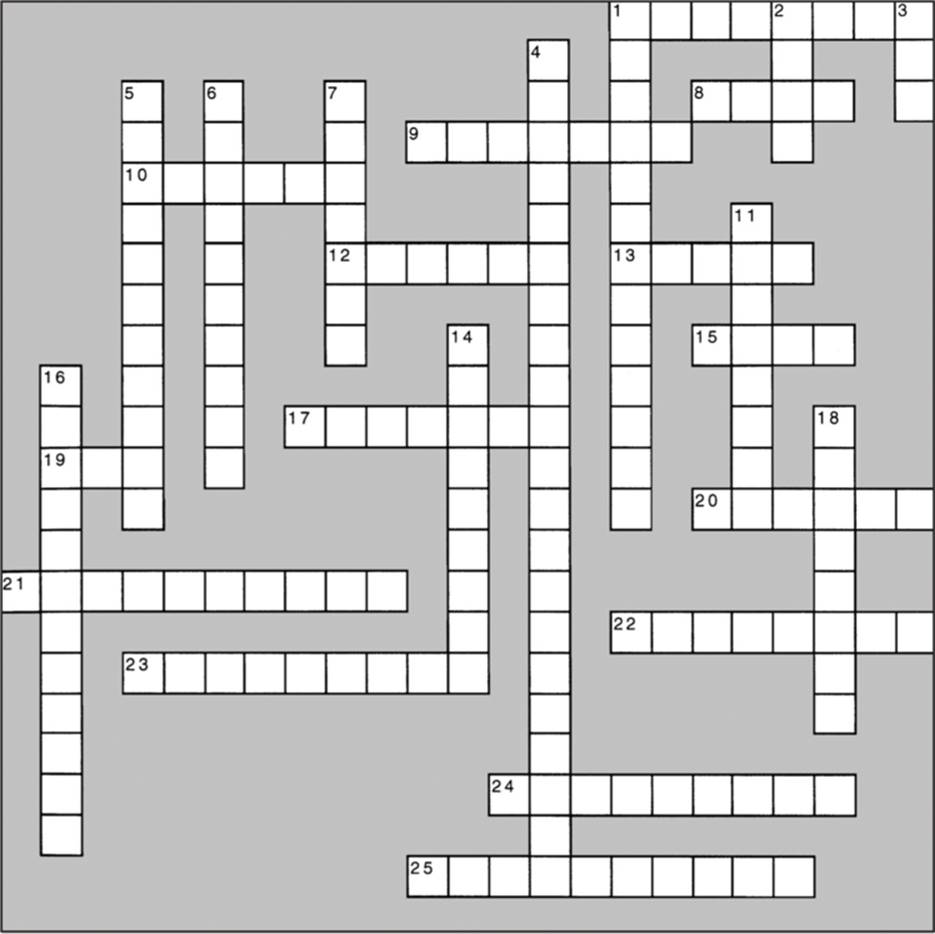
1. Allele that expresses itself in the heterozygote
8. Nucleotide sequence that codes for an RNA sequence
9. Probability of two independent events occurring together is simply the __ of their individual probabilities
10. Total genetic makeup of an organism
12. Alternative form of a gene
13. Number of genotypes produced in a simple monohybrid cross
15. Number of phenotypes expected in a dihybrid cross
17. Individual has the genotype AaBbCcDDGg, with no linkage. How many different kinds of gametes can this individual produce?
19. How many genotypes will be produced by the cross AABb × aabb?
20. Man responsible for the law of segregation
21. Zygote that has the same allele on the two homologous chromosomes
22. Genetic cross between two individuals that are heterozygous for two different genes
23. Describes an allele that does not express itself in the heterozygote
24. Cross between a homozygous recessive individual and an individual showing a dominant trait
25. Variation that cannot be divided into a few distinct categories
Down
1. Phenotypic variation that can be divided into distinct categories
2. Number of genotypes expected in a dihybrid cross
3. Number of phenotypes produced in a simple monohybrid cross
4. Random combination of alleles of two or more genes caused by being unlinked (on different chromosomes)
5. Term for alleles separating from each other during formation of gametes
6. Genetic crow between two heterozygous individuals in which only one locus is examined
7. Cross between the individuals AABb and aabb will produce a phenotypic ratio in which __ of the offspring will be Aabb
11. Actual genetic makeup of the organism at a specific locus
14. What is expressed; the result of the genotype interacting with the environment
16. Describes an individual who has two alleles at a given locus
18. Diagram that shows relationships among members of a family over one or more generations