
STUDY HINTS
A human pedigree is a shorthand way of showing the relationships in a family in which a genetic trait is segregating. The analysis of pedigrees is one of the most direct ways we have to determine the mode of transmission for human inherited conditions. It is not always possible to reach a definitive solution, however, because of small family sizes and the limited information available about most family histories. Sometimes several explanations are possible, but one may be better (that is, more probable) than another. Here we shall show some of the symbols commonly used in pedigrees and outline some simple rules that should help you in analyzing pedigrees. Generations are given Roman numerals; individuals are numbered from left to right within each generation.

Although one cannot make experimental matings to investigate the inheritance of a human trait, one can use the pattern of its transmission in a pedigree to make predictions about the mode of inheritance. First, it is important to recognize that most traits tend to fall into certain limited categories: dominant or recessive, autosomal or X-linked, and completely penetrant or incompletely penetrant. The initial step is therefore to try to classify an unknown trait in terms of these categories, recognizing that a single pedigree may not provide sufficient information to do this unambiguously.
Start by determining whether the trait is dominant or recessive. The following rules are designed to help you ask some useful questions about each pedigree you analyze. In the absence of evidence to the contrary, when evaluating a pedigree of a rare condition assume that individuals marrying into the pedigree are homozygous normal.
I. Dominance relationships: A dominant trait is the easiest to recognize, so begin by evaluating the pedigree for its fit to the predictions for dominant inheritance. If it does not fit these, then it is a recessive trait or shows some complex aspect, such as incomplete penetrance.
A. Dominant traits
1. Reversing the typical Mendelian logic, remember that a dominant trait will not occur in an individual unless it also appears in at least one of the parents (exceptions include a new mutation or incomplete penetrance).
2. A fully dominant trait will not skip generations. It will therefore often appear to be relatively common in a pedigree.
3. Unaffected sibs will have only unaffected offspring.
B. Recessive traits
1. In a marriage of two affected individuals, all of the offspring will be affected.
2. Recessive conditions are frequently found in pedigrees that include marriage between close relatives (a consanguineous mating).
3. A recessive trait commonly skips one or more generations because it is masked in heterozygotes.
II. Linkage relationships: Look first for evidence of sex-linkage. Remember that a single pedigree may not provide enough information to make an unambiguous classification.
A. Sex-linked inheritance
1. A sex-linked trait can never be passed from a father to his son, since the father’s X is passed to daughters and the Y does not carry typical coding genes. Therefore a single example of father-to-son transmission is sufficient proof that the trait is not sex-linked.
2. If the trait is recessive, all sons of a female who expresses the trait will also be affected.
3. If recessive, the trait will occur most frequently in males.
4. If the trait is dominant, it will be expected to occur slightly more often in females.
B. Autosomal inheritance
1. An autosomal trait can be passed from a father to his son.
2. Especially for a recessive autosomal trait, approximately the same number of males and females will be affected.
More complex relationships: Although the rules just listed will help you to analyze simple Mendelian conditions in a human pedigree, you should always remember that many situations can complicate the observed transmission patterns and gene expression. Incomplete penetrance, sex-limited expression (for example, testicular feminization, which can appear only in males), new mutation, two different loci that affect the same trait, adoption, mistaken parentage, and promiscuous mating can confuse the interpretation of a pedigree. In addition, the Y chromosome may be associated with the inheritance of some factors such as molecular polymorphisms. Such markers are called holandric, but there are few, if any, morphological traits that have definitely been traced to the Y chromosome.
IMPORTANT TERMS
Consanguinity
Holandric
Pedigree
Penetrance
Proband
Propositus (male)
Proposita (female)
PROBLEM SET 7
In the following pedigree diagrams, the generations and individuals within a generation are not numbered. This test of your ability to identify the appropriate individuals by numbering the pedigree properly is part of each problem. All pedigrees are fictitious. Any resemblance to a family living or dead is purely coincidental.
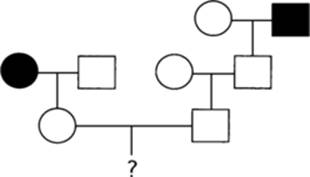
1. This pedigree is for the autosomal dominant trait achondroplasia, a rare form of dwarfism. Assuming complete penetrance, the probability that III-1 and III-2 will have an affected child is
(a) zero,
(b) 1/4,
(c) 1/2,
(d) 1/16,
(e) 1/8,
(f) 1/32,
(g) none of the above.
link to answer
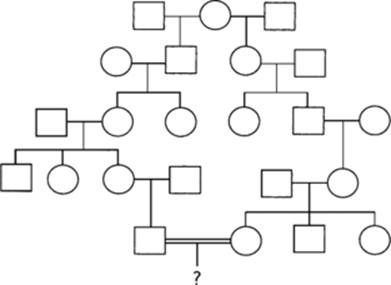
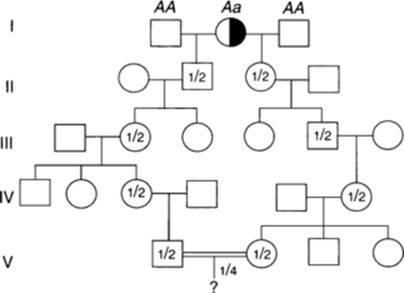
2. Todd and Sara (V-1 and V-2) wish to wed but are unaware that they share a common great-great-grandmother (I-2), who was heterozygous for a very rare autosomal recessive disease. The probability that their first child will be affected is
(a) 1/16,
(b) 1/64,
(c) 1/256,
(d) 1/1,024,
(e) 1/4,096,
(f) none of the above.
link to answer
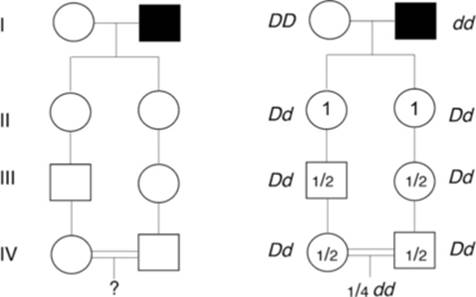
3. Two phenotypically normal people marry. Unknown to them, they have a common great-grandfather who suffered from a rare disorder (1 in 30,000 affected in the general population) that is inherited as an autosomal recessive trait (dd). Assume that the people marrying into this pedigree are all DD, that there has been no earlier consanguinity, and that no affected (dd) individuals have occurred. What is the probability that the first child of this couple (a baby girl) will be affected? Draw the pedigree.
link to answer
4. Laura and Michael (II-S and II-6) meet while attending a lecture concerning a rare human metabolic disease that is inherited as an autosomal recessive trait. They both have a sib who has this disease. They fall in love but are apprehensive about having children, since they know that the chance their first child will be affected is
(a) 1/2,
(b) 1/4,
(c) 1/8,
(d) 1/9,
(e) 1/10,
(f) 1/16,
(g) 1/32,
(h) none of the above.

link to answer
5. Consider the following pedigree.
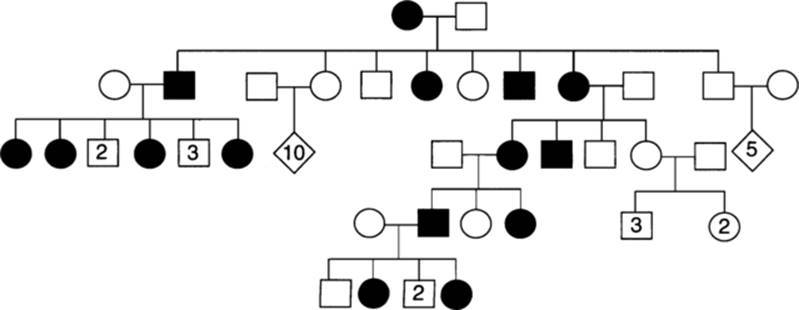
(a) What pattern of transmission is most consistent with this pedigree?
(1) autosomal recessive, (2) autosomal dominant, (3) X-linked recessive, (4) X-linked dominant.
link to answer
(b) If individual V-2 marries a normal individual, and if the condition has a pene-trance of 85 percent, what is the probability that their second child will express the trait?
link to answer
(c) On the third line, what does the diamond with a 10 in the middle mean?
link to answer
link to answer
6. The accompanying pedigree is for a trait with 100 percent penetrance. The trait is not necessarily uncommon in the population, but individual I-1 is homozygous normal.
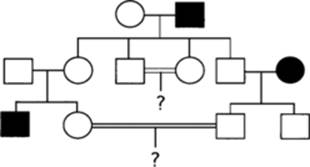
(a) What is the probable mode of inheritance?
link to answer
(b) What is the probability that the child of the brother-sister mating between II-3 and II-4 will show the trait phenotypically?
link to answer
(c) What is the probability that a child of the first-cousin marriage (III-2 and III-3) will carry the gene for the trait?
link to answer
link to answer
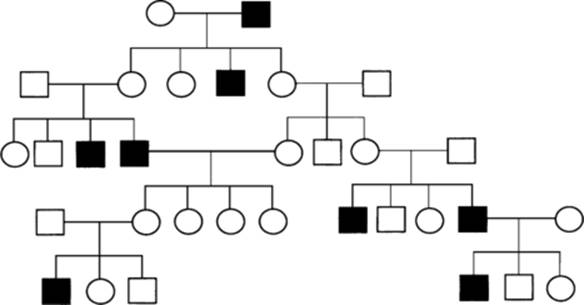
7. What kind of inheritance pattern is illustrated in this pedigree? Please name one or more specific traits that might fit this pattern of transmission and expression.
link to answer
8. Consider the following pedigree of a trait having 100 percent penetrance.
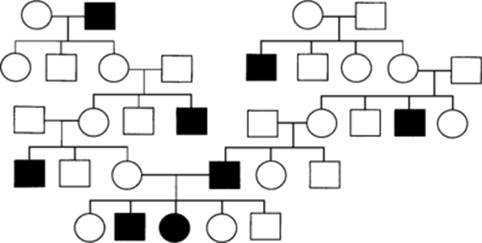
(a) The probable mode of inheritance of this trait is (1) X-linked dominant, (2) X-linked recessive, (3) autosomal recessive, (4) autosomal dominant.
link to answer
(b) If individual V-2 marries a homozygous normal person, what is the probability that their first child will be a carrier?
link to answer
link to answer
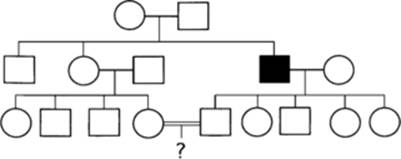
9. This pedigree is for a rare autosomal recessive trait. The probability that a child of III-4 and III-5 will manifest the phenotype for this trait is
(a) 1/2,
(b) 1/4,
(c) 1/8,
(d) 1/12,
(e) 1/16,
(f) 1/32,
(g) 1/64,
(h) none of the above.
link to answer
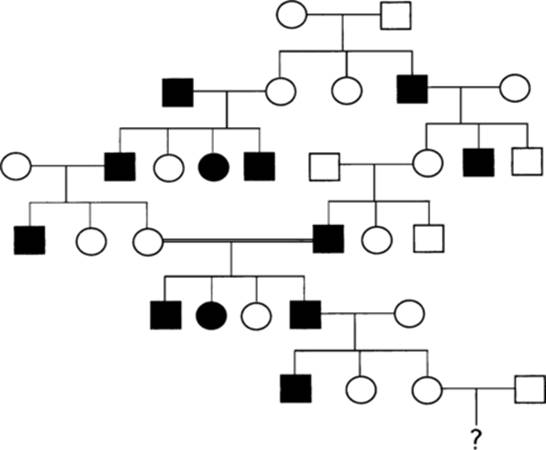
10. What kind of inheritance pattern is illustrated in this hypothetical pedigree? What is the probability that the offspring shown as a question mark will express the trait if it is a male child? What is the probability if it is a female child?
link to answer
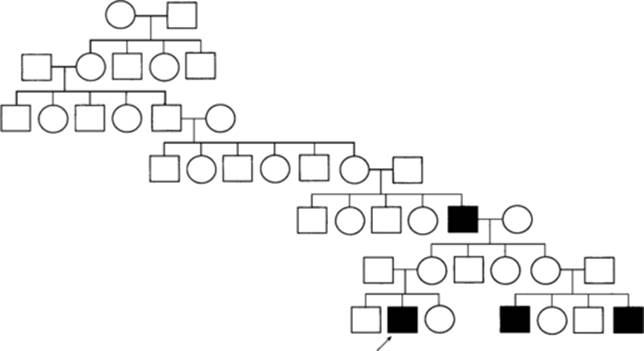
11. What can you tell the propositus about the inheritance of the trait he is exhibiting? How would you explain the entry of the gene into the pedigree?
link to answer
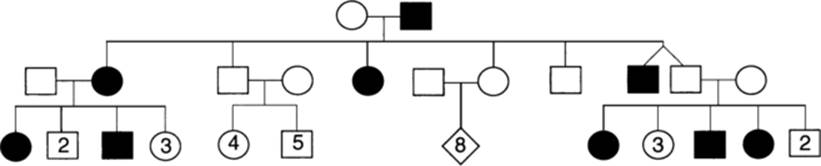
12. Shown is a pedigree for polydactyly in humans. What is the mode of inheritance for polydactyly, and what specific clues does the pedigree provide to support your hypothesis?
link to answer
13.
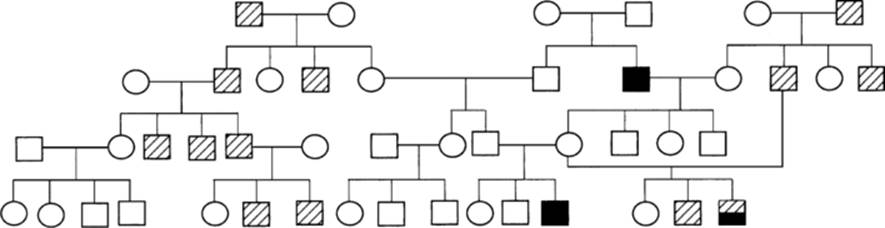
This pedigree shows the inheritance of two traits. One, marked with diagonal lines, is the inheritance of a DNA marker; and the other, marked as a solid black symbol, is for total color blindness where an affected individual sees objects only in shades of white, gray, and black.
(a) Since two traits are segregating in the same pedigree, would we classify the genetic expression as pleiotropic? Why or why not?
link to answer
(b) What is the inheritance pattern shown by each trait?
link to answer
(c) If male IV-16 were to marry female IV-5, what is the probability that their first child would have the DNA marker?
link to answer
(d) What is the probability that the first son will be totally color-blind?
link to answer
(e) What is the probability that the first child will both be color-blind and carry the DNA marker?
link to answer
link to answer
14. Consider the following pedigree.
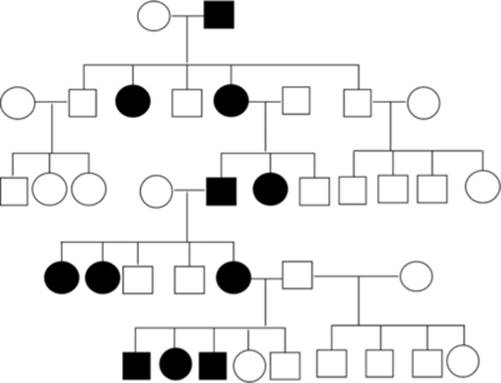
(a) What pattern of transmission is most consistent with this pedigree? (1) autosomal recessive, (2) autosomal dominant, (3) X-linked recessive, (4) X-linked dominant.
link to answer
(b) If individual V-3 marries a normal individual, and if the condition is known to have 100 percent penetrance, what is the probability that they will have a son expressing the trait? What is the probability they will have a daughter expressing the trait?
link to answer
link to answer
15. Consider the following pedigree.
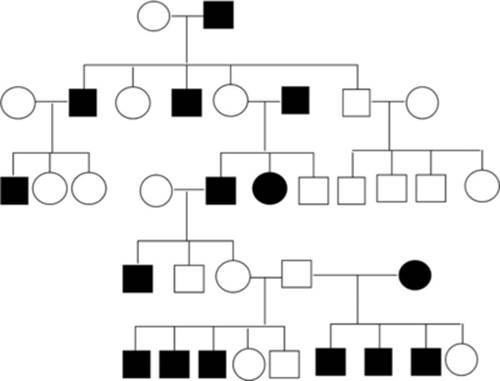
(a) What pattern of transmission is most consistent with this pedigree? (1) autosomal sex-influenced, (2) autosomal sex-limited, (3) autosomal dominant, (4) X-linked dominant, (5) X-linked recessive.
link to answer
(b) If individual V-2 marries a normal individual whose father expresses the condition, what is the probability that they will have a daughter who expresses the condition? A son who expresses the condition?
link to answer
link to answer
16. The following pedigree was obtained by examining a molecular marker.

(a) What pattern of transmission is most consistent with this pedigree? Explain.
link to answer
(b) If individual II-4 were to marry a female whose brothers all expressed the marker, what is the probability that they would have a male child who expressed the marker? What is the probability a female child would express the marker?
link to answer
link to answer
ANSWERS TO PROBLEM SET 7
1.
(a) Since the trait is inherited as a rare, completely penetrant dominant condition, we can assume that the affected people in this pedigree are heterozygous for the mutant allele. If the children in generation III had inherited the condition, they would express it. It then follows that the probability of an affected child’s occurring in generation IV is zero.
2.
(d) We must first determine the probability that Todd and Sara are both carriers (Aa). Because of the rare nature of the disease, we can assume that all people marrying into the pedigree are AA. The marriages in generation I are therefore AA males with the Aa female. Probabilities are traced in the pedigree, where the half-filled circle in generation I indicates heterozygosity. Tracing descendants II-2 and II-3 indicate that each has a 1/2 probability of carrying the recessive allele (1/2 of the offspring from a cross AA × Aa will be Aa). Since at each generation the person marrying into the pedigree will be AA, the probability the recessive allele will be retained in the line will be halved in each generation. If Todd and Sara are both Aa, the probability of having an aa child is 1/4. Thus the total probability of the gene’s traversing all generations and the parents’ having an aa child is
(1/2·1/2·1/2·1/2·1/2·1/2·1/2·1/2)·1/4 = 1/1,1024
3. For simplicity’s sake, only the people in the direct line from the dd common great-grandparent are shown in the pedigree we have drawn. Their sexes are arbitrary, since the trait is autosomal, and we are making up the pedigree. Since the great-grandfather is dd, all of his children in generation II will be heterozygous. For each subsequent generation, the probability that the d allele will be transmitted is 1/2. So the probability that it is transmitted to generation IV is 1 · 1/2 · 1/2 = 1/4 for each of the parents. The probability that both of the parents are Dd is therefore 1/4 · 1/4 = 1/16. The probability that the first child of IV-1 and IV-2 (regardless of sex) will be dd is 1/16 · 1/4 = 1/64.
4.
(d) Since the trait is an autosomal recessive one, both sets of parents in generation I must be Aa. That is the only way they could produce affected children without themselves showing the trait. The expected progeny for such a cross are 1/4 AA + 1/2 Aa + 1/4 aa. That is, 3/4 are phenotypically normal, and 1/4 are affected. Since Laura and Michael are phenotypically normal, we can exclude the probability that they are aa. They are either AA or Aa, with a 1/3 chance of their being AA and a 2/3 chance that they are Aa. Thus the probability that they both are carriers is 2/3 · 2/3 = 4/9. Multiplying this by 1/4 (the probability that the heterozygotes will have an affected child), we get an overall probability of 4/36 = 1/9.
5.
(a) The pattern of transmission appears to be X-linked dominant. Every affected individual has an affected parent, and normal parents have only normal progeny. The trait appears to be X-linked, because the female offspring of affected males are all affected, but no sons are affected. Affected females produce both affected sons and affected daughters.
(b) Female V-2 will transmit the mutant allele to both male and female offspring with a probability of .5. Whether it is the first, second, third, or a later child makes no difference. The probability that it will be expressed in a carrier is .85. Thus the overall probability that it will be both inherited and expressed is .50 · .85 = 0.425.
(c) The diamond signifies 10 phenotypically normal children whose sex is either unknown or irrelevant to the interpretation of the pedigree.
6.
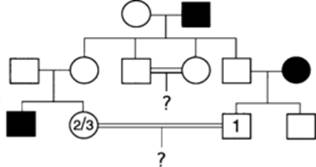
(a) Since the trait is 100 percent penetrant, it cannot be dominant, because III-1 is affected but has phenotypically normal parents. If it is a sex-linked recessive trait, then the III-3 and III-4 males should be affected, since their mother is homozygous recessive and would transmit the trait to all her sons. But since they are normal, the trait must be inherited as an autosomal recessive. The parents in generation 1 are AA female and aa male.
(b) Both II-3 and II-4 are heterozygous Aa. The probability of having an affected child is therefore 1/4.
(c) Since III-1 is affected, the parents (II-1 and II-2) are both heterozygous. This is a situation in which an individual marrying into the pedigree is a carrier, as often happens when the trait is not particularly rare. Since 3/4 of the offspring from a mating of two heterozygotes would be phenotypically normal (1/3 being AA and 2/3 being Aa), the probability that III-2 is a carrier is 2/3. Individual III-3 must be a carrier. His father was Aa, and his mother was aa, but he is not aa (he had 1/2 chance of being Aa and 1/2 of being aa). The probability that both III-2 and III-3 will be carriers is therefore 2/3 · 1 = 2/3. The probability that an affected child’s being produced from a mating of two heterozygotes is 1/4. Thus the answer to this question is 2/3 · 1/4 = 1/6.
7. Since this trait skips generations and is expressed in males, one might jump to the conclusion that it is a sex-linked (X-linked) recessive character. But it is always important to see whether the evidence is consistent with your initial hypothesis. A sex-linked trait will never be passed from a father to his son. But that happens twice in this pedigree: I-2 passing the trait to male II-4, and IV-9 passing it to male V-4. So it must be an autosomal dominant trait. The alternative, an autosomal recessive, is highly unlikely, since it would need to be so common in the population that all individuals marrying into the pedigree carry a recessive mutation allowing some of their offspring to be homozygous. Now, what autosomal traits might have an expression that is limited to males? Examples of sex-limited traits in males include those affecting secondary sexual characters like beard growth, breast size, and voice changes. Indeed, autosomal genes affecting any process or structure that is limited to one or the other sex could potentially fit this pattern. Examples in females include milk quality and quantity in dairy cattle and hydrometrocolpos, a condition in humans in which fluid accumulates in the uterus and vagina (A. P. Mange and E. J. Mange, Genetics: Human Aspects, second edition [Sunderland, MA: Sinauer Associates, 1990]).
8.

(a) The answer is (2): The mode of inheritance is sex-linked recessive. It is recessive because affected individuals do not necessarily have an affected parent (remember, 100 percent penetrance). It is sex-linked because all but one of the affected individuals is a male, apparently coming from a carrier Aa mother. The affected female, V-3, is a homozygote produced from merging two branches of the pedigree. Her mother was Aa and her father hemizygous a/Y.
(b) A carrier for a sex-linked recessive trait can only be a female (a male would always show such a trait). In this case the mating would be between an affected male (a/Y) and a normal female. All the daughters would inherit the father’s X chromosome with the a allele, but none of the sons would. Thus there is 1/2 chance that a child will be a carrier, since there is 1/2 chance that it will be a girl.
9.
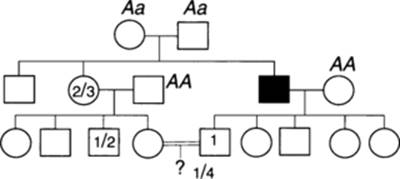
(d) 1/2 Since II-4 is affected (aa), we can conclude that both his parents are Aa. Since the trait is rare, we can assume that his wife is AA and that all his children will therefore be Aa. Each of the phenotypically normal children of I-1 and I-2 has a 1/3 chance of being AA and a 2/3 chance of being Aa. If II-2 is a heterozygote, the daughter (III-4) has a 1/2 chance of inheriting the a allele. If II-2 has a 2/3 chance of being Aa and she is married to an AA man, the overall probability that III-4 is heterozygous is 2/3 · 1/2 = 1/3. The overall probability of having an affected child is 1/3 (probability of III-4 being Aa) · 1 (the probability of III-5 being Aa) · 1/4 (probability of two carriers having an affected child) = 1/12.
10. This trait is autosomal, because it is passed from fathers to sons and so cannot be sex-linked. It is not a sex-limited trait, because females can be affected, although at a much lower rate than males. Furthermore, the females can inherit the trait from fathers and pass it on to sons but not show it themselves, unless they are homozygous (such as females III-4 and V-2). Thus, the trait is dominant in males and recessive in females. Expression is sex-influenced. Examples of human sex-influenced traits that are more commonly expressed in males include male pattern baldness, and pyloric stenosis. Thus, if it is male, the child has (1/2)(1/2) = 1/4 chance of being affected. A daughter could not be homozygous, so the probability is zero. Examples in females include congenital hip dysplasia, osteoporosis, and some autoimmune diseases such as lupus.
11. The trait looks most like a sex-linked recessive. It could have entered the pedigree through a female carrier, III-6. It might also have entered through a I-1 carrier female, but if so, it was passed down to IV-6 without affecting any of the eight males in generation II, III, and IV (including III-5, who would have to be nonpenetrant). Since half of them would have been expected to show the trait, this source is less likely. The best hypothesis is that it was brought in by III-6. Another comparatively unlikely explanation is that it originated as a mutation of A to a in the germ line of IV-6 or of III-5. Since mutation is a rare event, this explanation is used only if all others are less likely or otherwise excluded. One might test our hypothesis (III-6 carrier female) by tracing the pedigree of her family to see whether one can confirm the possibility of her being Aa.
12. It looks like an autosomal dominant trait with incomplete penetrance. Dominance is indicated by its frequency and by the fact that in all but one sibship the affected people have an affected parent. In that exception (the offspring of II-10), their father is a monozygotic twin with a polydactylous brother. The twins therefore both carried the dominant gene for polydactyly, but it is nonpenetrant in II-10. Its autosomal nature is indicated by the fact that the affected male, I-2, has an affected son. If the trait were X-linked, you would not expect an affected son, since the father’s X chromosome goes only to his daughters. Similarly, you would not expect a normal daughter unless, of course, it were nonpenetrant in her. In summary, the pattern of expression is consistent with the expectations of an autosomal dominant trait. The discordant monozygotic twins and the fact that a normal II-10 male produces affected children indicate less than 100 percent penetrance.
13.
(a) Pleiotropy is defined as two or more traits that are due to the same genetic change. Here there are clearly two different genetic factors segregating, so genetic expression would not be classified as pleiotropic.
(b) The DNA marker is passed from a father to all of his sons, and never from father to daughter. The only chromosome that shows that pattern of transmission is the Y, so the DNA marker could be considered a holandric trait. Total color blindness, on the other hand, is not passed to sons but can be transmitted through a daughter to grandsons. Total color blindness, like the more familiar “red–green color blindness” is X-linked.
(c) Male IV-16 is totally color-blind and carries the Y chromosome DNA marker. Female IV-5 has normal color vision and, although her father carried the Y chromosome marker, she could not have inherited it (or “she” would be a “he”). The probability that their first child will have the DNA marker is 1/2, since all sons will inherit the Y from the father and there is a 1/2 chance that the child will be a son.
(d) Since color blindness is a sex-linked recessive, it will not be passed to the son from the father. The probability is, therefore, zero. You might also note that the probability that a daughter will be color-blind is also zero, since it is a recessive trait and would be heterozygous, not homozygous, in any daughters. All daughters would be heterozygous carriers.
(e) To be both color-blind and a carrier of the DNA marker is not possible in this marriage. As noted in part d, no children will be color-blind though, from part c, half will have the Y-linked DNA marker.
14.
(a) The pattern of transmission is X-linked dominant, answer (4). See answer 5(a) for a comparable situation.
(b) None of the sons would express the trait, because a sex-linked trait can be passed only to daughters by a male parent. All of the daughters would have the condition, as they would all receive one of their X chromosomes from their father.
15.
(a) The pattern of transmission would fit an autosomal sex-influenced gene, dominant in males and recessive in females, answer (1). Males may receive a copy of the affected allele from either parent and need only one copy to express the condition. Females appear to be able to carry the trait as heterozygotes without expression, and only when the pedigree suggests a possible transmission from both parents is a female found who expresses the condition.
(b) None. A daughter would have to receive the gene from both parents in order to express the condition. The male would express the trait if he had even one copy of the gene.
16.
(a) The pattern fits holandric transmission. The marker segregates with father-to-son transmission and is, therefore, on the Y chromosome.
(b) One hundred percent of the male children would have the marker inherited from their affected father. None of the daughters would have the marker. Since the gene is on the Y chromosome, the wife’s genotype and parental lineage are not relevant to the answer.