
Sandeep Karunakaran1
(1)
IVF & Reproductive Medcine, ART Centre, Indian Naval Hospital Asvini, Opposite RC Church, N M Road, Colaba, Mumbai, Maharashtra, 400005, India
Sandeep Karunakaran
Email: sandeep_kk@yahoo.com
Email: sandeep.kk.ivf@gmail.com
Abstract
It is possible that the result of stimulation does not end in oocyte retrieval. One of the causes of non-retrieval of oocytes after an apparent normal stimulation cycle is Empty Follicle Syndrome (EFS). It is diagnosed after ruling out the other possible causes that could lead to non-retrieval of oocytes. EFS can be classified as genuine (GEFS) and false (FEFS). It is a highly stressful situation for both the couple undergoing the treatment and the clinical team. Hence, it is necessary to take steps to prevent it and apply a step-by-step formula to minimize it or its occurrence. EFS is a definite entity, and the clinicians would definitely see the cases of the same in the clinical practice.
Keywords
Empty Follicle SyndromeGenuine Empty Follicle SyndromeFalse Empty Follicle SyndromeOvarian dysfunctionOocyte donation
26.1 Introduction
It is not always that the stimulation protocol of an IVF cycle ends up in a favourable result. At times, it is possible that the result of stimulation does not end in oocyte retrieval. One of the causes of non-retrieval of oocytes after an apparent normal stimulation cycle is ‘Empty Follicle Syndrome.’ It is diagnosed after ruling out the other possible causes that could lead to non-retrieval of oocytes.
The condition of EFS was first described by Coulam et al. in 1986 in a report of five IVF cycles in four patients in whom no oocytes were found in follicular aspirate totaling 30 [1]. The term ‘Empty Follicle Syndrome’ was then coined. This condition could be very stressful both for the couple as well as the clinical staff and at times lead to unplanned and unforeseen situations [2]. The mechanism for EFS still remains unexplained, though many theories have been put forward for it, ranging from pharmacological problems [3–5] to human error [5–8].
There are two types of EFS that exist. In the first, it is the level of beta HCG which is sub-optimal (cause being human error or pharmaceutical reasons) that leads to failure of oocyte retrieval. The other type of EFS is failure to retrieve oocytes despite having achieved optimal levels of beta HCG. Accordingly, EFS can be classified as genuine (GEFS) and false (FEFS), which may offer a better explanation of the condition.
26.2 Definition
26.2.1 Genuine EFS (GEFS)
Genuine EFS can be defined as failure of retrieval of oocytes from mature ovarian follicles after controlled ovarian hyperstimulation for IVF after apparently normal follicular development and steroidogenesis in the presence of optimal beta HCG level on the day of oocyte retrieval.
26.2.2 False EFS (FEFS)
False EFS can be defined as failure of retrieval of oocytes in the presence of sub-optimal beta HCG levels due to an error either in the administration or the bioavailability of beta HCG on the day of oocyte retrieval. This is more commonly encountered than genuine EFS
26.3 Incidence
The incidence of Empty Follicle Syndrome is said to be 0.2 to 5 %, but most of this would fall in the false EFS group.
26.4 Pathophysiology
Many hypotheses propose the possible aetiology for GEFS as a dysfunction in the follicular genesis that causes early oocyte atresia. The hormonal response in the GEFS is apparently normal [9]. It is also postulated that some of these patients may require longer exposure to HCG levels for the detachment of oocyte cumulus complexes from the follicular wall [6]. Onalan et al. [10] challenged the above hypothesis wherein they used a rescue protocol and were able to retrieve oocytes later in the same cycle. This meant that most GEFS were actually FEFS in nature.
Advanced ovarian ageing, granulosa cell dysfunction and altered metabolism in older women have all been proposed as theories to explain EFS [10, 11]. Others have also proposed genetic factors that could be responsible for EFS [10, 11]. However, the first cause should always be kept as low bioavailability of the administered HCG due to either a pharmacological problem or human error [8]. In conclusion, there exists substantial uncertainty surrounding the mechanism and aetiology of EFS.
26.5 Factors Inducing EFS
The following factors have to be studied before labelling a case as GEFS or FEFS:
· Quality of ovarian stimulation
· Technical aspects of oocyte retrieval
· Use of HCG in ovarian maturation
· Shortfalls in administration of HCG
· Interval between HCG administration and oocyte retrieval
· Ovarian dysfunction
· Altered steroidogenesis
26.5.1 Quality of Ovarian Stimulation
Many factors influence the overall quality of ovarian stimulation and directly affect the outcome in terms of oocyte retrieval. Choice of gonadotropin is the foremost factor that affects this quality; recombinant gonadotropin (FSH and LH) is definitely advantageous over urinary preparation because of its higher purity, decreased batch-to-batch variability and highly specific bioactivity [12].
Higher pregnancy rates were achieved using recombinant FSH than urinary FSH in a meta-analysis conducted by Daya et al. [13]. A study by Balasch and colleagues demonstrated better follicular dynamics and oocyte maturity when recombinant FSH was used as compared to urinary preparations [14].
Monitoring during ovarian stimulation also plays an important role in successful oocyte retrieval. The backbone of follicular monitoring still remains trans-vaginal sonography (TVS). Plasma oestradiol is also set to play an important role, as its levels are directly proportional to follicular size. Both trans-vaginal sonography and plasma oestradiol can predict cycle outcomes [15].
The size of the leading follicle when HCG is administered plays an important role in successful retrieval. As a thumb rule, HCG is given when the leading follicle is around 18cm in diameter. Early or late administration of HCG may result in non-retrieval of oocytes.
26.5.2 Technical Aspects of Oocyte Retrieval
There could be many technical problems that account for unsuccessful oocyte retrieval. Low pressures in the tubings, leakage of pressure, poor-quality disposables and improper assistance during the retrieval procedures may also add to the problem of EFS.
However, technical aspects might not be able to explain EFS single handedly [16].
26.5.3 Use of HCG in Ovarian Maturation
HCG has been used as a substitute to mimic the LH surge that stimulates the final follicular maturation. The use of HCG has been a standard in COH protocols. Poor bioactivity in commercially available HCG preparations could be a leading cause of EFS [3]. Different commercially available HCG preparations have been shown to have different bioactivity. Besides even in the same commercial preparation, there could exist a significant batch-to-batch bioactivity.
EFS has long been claimed ‘pharmaceutical industry syndrome’ resulting from problems in the manufacture of HCG. This, however, does not satisfactorily explain the solitary incidence of EFS rather than as opposed to a clustered appearance in case of defective drug. Moreover, an unsuccessful oocyte retrieval can be corrected by a rescue dose (second dose) of HCG from the same batch.
26.5.4 Shortfalls in Administration of HCG
HCG administration in an IVF cycle has a pivotal role. Low dosages can lead to poor retrieval rates due to faulty late maturation of the oocyte. Wrong timing can prove fatal in an IVF cycle. Inappropriate dosage may also result in EFS. At times, the patient may also use the wrong route of drug administration. Proper counselling of the patients could minimize these difficulties.
26.5.5 Interval Between HCG Administration and Oocyte Retrieval
Time interval between HCG administration and oocyte retrieval has a remarkable influence on the outcome of the oocyte retrieval in the cycle. Mansour et al. [17] conducted a study on patients undergoing ICSI; he divided the patients into three groups wherein oocyte retrieval was performed 35, 36 and 37 h after HCG administration. He proved that metaphase 2 oocytes were significantly lower in the 35-h group compared with the 36-h group. However, the 36–37 h groups did not show significant difference. The fertilization rates were similar in both the groups. There have been varying results in other similar studies that were performed. Early retrieval has always yielded significantly fewer and more immature oocytes. Hence, the time gap between HCG and oocyte retrieval may contribute to the development of EFS in some cases.
26.5.6 Ovarian Dysfunction
Many authors have suggested ovarian dysfunction as a factor contributing to a failure to obtain oocytes after controlled ovarian hyperstimulation. One of the leading studies conducted by Ben-Shlomo et al. [18] proved that history of poor response to ovarian stimulation had a correlation with poor oocyte retrieval. Advanced stage of ovarian ageing may also contribute to incidence of EFS. Le Sala et al. [16], Zreik et al. [19] and Penarubbia et al. [20] have all suggested EFS as a cause of infertility possibly due to impaired maturation and disrupted growth of oocyte. The failure to retrieve oocytes may be a result of ovarian ageing and altered follicular genesis.
26.5.7 Altered Steroidogenesis
Altered steroidogenesis has been postulated as one of the theories of EFS. The steroid prolife of follicular fluid from a patient of EFS was characterized by increased oestradiol:progesterone ratio and increased follicular concentrate of androstenidione. Non-fertilizable oocytes have also shown a similar composition of steroids in its follicular fluid [10].
Greb et al. [21] conducted a similar study of EFS in perimenopausal patients and arrived at the same conclusion.
Literature also gives studies that are in contrast with the above. The authors, however, regard EFS as a one-time affair rather than a repetitive phenomenon.
26.6 Treatment Options and Clinical Implications
Even though a rare phenomenon, EFS is definitely seen more than once in the life cycle of an infertility specialist. The emotional pressure/stress can be tremendous on both the patient and the treating clinical staff.
26.6.1 Protocol for Management of EFS
The following steps can be taken to avert/minimize this situation (Fig. 26.1).
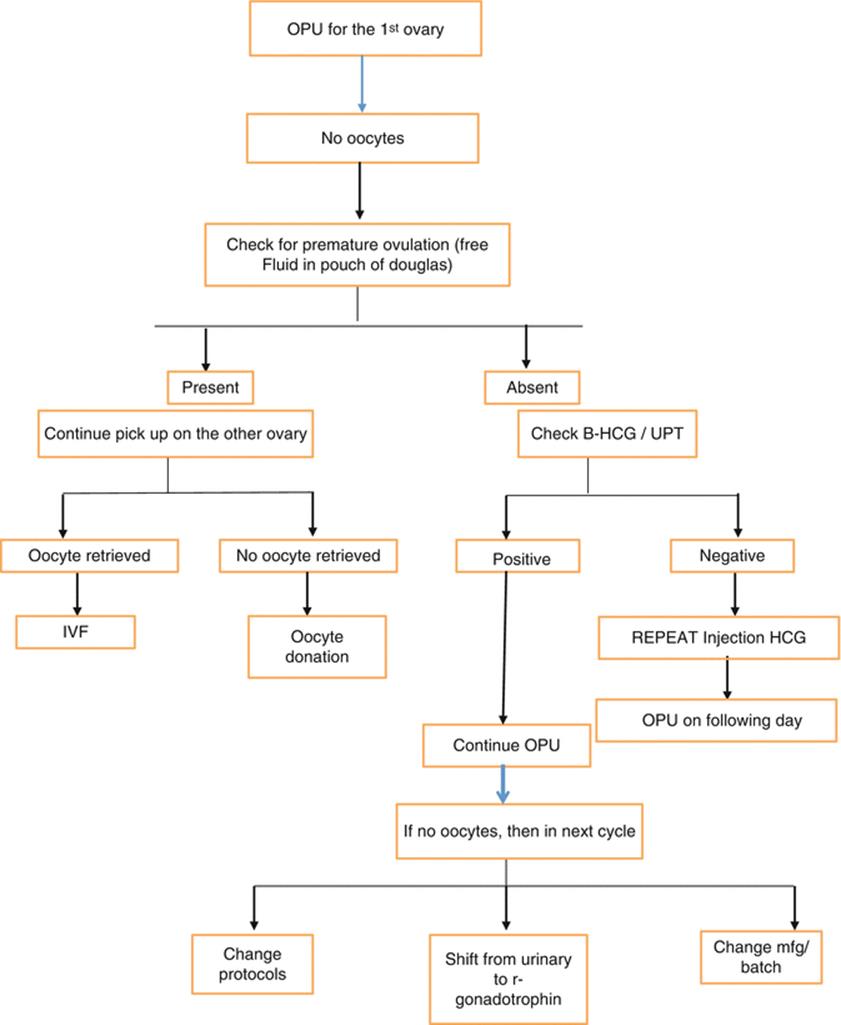
Fig. 26.1
Management of empty follicular syndrome
· Step 1: If it is noticed that there is no oocyte in the first ovary, it is prudent to pause the oocyte retrieval and check for any technical problems.
· Step 2: If technical problems have been ruled out, the clinician should try to look for premature ovulation, which is evident by presence of fluid in the pouch of Douglas. The clinician can proceed to retrieve the follicular fluid from the other ovary, but the chance of finding an oocyte is minimal. The patient could be counselled for oocyte donation cycle, and if willing, the embryo transfer can be done.
· Step 3: If there is no free fluid in the pouch of Douglas, one should proceed to do urine pregnancy test or check levels of beta HCG in serum. Serum levels might take time, and hence the more practical approach would be to do a urine pregnancy test.
· Step 4: If the urine test shows negative result or serum beta HCG is low, then the patient should be administered rescue dose of HCG and plan to proceed with the completion of procedure after 24 h.
· Step 5: If the urine test is positive or the serum beta HCG levels are normal, then the procedure should be completed in the same sitting. The chances of finding oocytes in the other ovary are minimal. Remedial action in such a case is to proceed to an oocyte donation or change protocols in the next ovarian stimulation cycle.
The following steps would be taken in the next cycle:
1.
2.
3.
4.
· Step 6: In case of genuine EFS, oocyte donation remains the only option.
26.6.2 R-HCG—A Novel Entrant
r-HCG has been an important part in the science of assisted reproduction. Recombinant product has highest purity, increased bioavailability and decreased batch-to-batch variation. With these qualities, r-HCG would go a long way in eliminating the variations caused due to urinary derived HCG and hence may help us eliminate EFS. There have been reports of successful outcome in cases of previous failures with urinary HCG.
26.6.3 Role of Oocyte Donation
Oocyte donation remains the only hope of treatment in cases of genuine EFS. The couple should be counselled for the same especially after repeated failures. Needless to say, the donor and the recipient should be matched, and the donation should be carried out according to the rules of the land.
26.7 Conclusion
EFS is a definite entity, and the clinicians would definitely see the cases of the same in the clinical practice. It is a highly stressful situation for both the couple undergoing the treatment and the clinical team, and hence it is necessary to take steps to prevent it and apply step-by-step formula to minimize it or its occurrence.
Even though EFS has been reported in both natural and unnatural cycles, it is very unlikely that it reoccurs. However, a history of recurrent EFS makes it mandatory to change treatment protocols to prevent it. Due to multiple aetiologies and confounding theories towards development, the definitive treatment of EFS still remains an enigma. Appropriate monitoring, tailoring of drugs and their dosages, managing the time gap interval between HCG dosage and oocyte retrieval and avoiding technical mishaps go a long way in preventing this repetitive situation. Further work and research is needed to identify, diagnose and treat these patients to manage and prevent the EFS and carve a successful path to achieve parenthood.
References
1.
Coulam CB, Bustillo M, Schulman JD. Empty follicle syndrome. Fertil Steril. 1986;46(6):1153–5.PubMed
2.
Driscoll GL, Tyler JP, Knight DC, Cooke S, Kime L, Clark L, Bernstein J. Failure to collect oocytes in assisted reproductive technology: a retrospective study. Hum Reprod. 1998;13(1):84–7.CrossRefPubMed
3.
Zegers-Hochschild F, Fernandez E, Machenna A, Fabres C, Alteiri E, Lopez T. The empty follicle syndrome: a pharmaceutical industry syndrome. Hum Reprod. 1995;10(9):2262–5.CrossRefPubMed
4.
Ndukwe G, Thornton S, Fishel S, Dowell K, Aloum M, Green S. ‘Curing’ empty follicle syndrome. Hum Reprod. 1997;12(1):21–3.CrossRefPubMed
5.
Ubaldi F, Zsolt N, Janssenwillen C, Smitz J, Van Steirteghem A, Devroey P. Ovulation by repeated hCG in ‘empty follicle syndrome’ yields a twin clinical pregnancy. Hum Reprod. 1997;12(3):454–6.CrossRefPubMed
6.
Meniru GI, Craft IL. Evidence from a salvaged treatment cycle supports an aetiology for the empty follicle syndrome that is related to terminal follicular developmental events. Hum Reprod. 1997;12(11):2385–7.CrossRefPubMed
7.
Quintans CJ, Donaldson MJ, Blanco LA, Pasqualini RS. Empty follicle syndrome due to human errors: its occurrence in an in-vitro fertilization programme. Hum Reprod. 1998;13(10):2703–5.CrossRefPubMed
8.
Papier S, Lipowicz R, De Vincentiis S, Nodar F, Olmeda SB, Acosta A. Pregnancy obtained by the transfer of frozen-thawed embryos originating from a rescued empty follicle syndrome cycle. Fertil Steril. 2000;74(3):603–4.CrossRefPubMed
9.
Onalan G, Pabuccu R, Onlan R, Ceylaner S, Selam B. Empty follicle syndrome in two sisters with three cycles: case report. Hum Reprod. 2003;18(9):1864–7.CrossRefPubMed
10.
Tsuiki A, Rose BI, Hung TT. Steroid profiles of follicular fluids from a patient with the empty follicle syndrome. Fertil Steril. 1988;49(1):104–7.PubMed
11.
Vujisic S, Stipoljev F, Bauman R, Dmitrovic R, Jezek D. Pericentric inversion of chromosome 2 in a patient with the empty follicle syndrome. Hum Reprod. 2005;20(9):2552–5.CrossRefPubMed
12.
Loumaye E, Campbell R, Salat-Baroux J. Human follicle-stimulating hormone produced by recombinant DNA technology: a review for clinicians. Hum Reprod Update. 1995;1(2):188–99.CrossRefPubMed
13.
Daya S. Updated meta-analysis of recombinant follicle- stimulating hormone (FSH) versus urinary FSH for ovarian stimulation in assisted reproduction. Fertil Steril. 2002;77(4):711–4.CrossRefPubMed
14.
Balasch J, Fábregues F, Creus M, Peñarrubia J, Vidal E, Carmona F, et al. Follicular development and hormonal levels following highly purified or recombinant follicle-stimulating hormone administration in ovulatory women undergoing ovarian stimulation after pituitary suppression for in vitro fertilization: implications for implantation potential. J Assist Reprod Genet. 2000;17(1):20–7.PubMedCentralCrossRefPubMed
15.
Hugues JN, Cedrin-Durnerin I. Endocrine characteristics of ART cycles. In: Gardner DK, Weissman A, Howles CM, et al., editors. Textbook of assisted reproductive techniques: laboratory and clinical perspectives. London: Martin Dunitz; 2001. p. 459–72.
16.
La Sala GB, Ghirardini G, Cantarelli M, Dotti C, Cavalieri S, Torelli MG. Recurrent empty follicle syndrome. Hum Reprod. 1991;6(5):651–2.PubMed
17.
Mansour RT, Aboulghar MA, Serour GI. Study of the optimum time for human chorionic gonadotropin-ovum pickup interval in vitro fertilization. J Assist Reprod Genet. 1994;11(9):478–81.CrossRefPubMed
18.
Ben-Shlomo I, Schiff E, Levran D, Ben-Rafael Z, Mashiach S, Dor J. Failure of oocyte retrieval during in vitro fertilization: a sporadic event rather than a syndrome. Fertil Steril. 1991;55(2):324–7.PubMed
19.
Zreik TG, Garcia-Velasco JA, Vergara TM, Arici A, Olive D, Jones EE. Empty follicle syndrome: evidence for recurrence. Hum Reprod. 2000;15(5):999–1002.CrossRefPubMed
20.
Peñarubbia J, Balasch J, Fábregues F, Creus M, Cívico S, Vanrell JA. Recurrent empty follicle syndrome successfully treated with recombinant human chorionic gonadotrophin. Hum Reprod. 1999;14(7):1703–6.CrossRef
21.
Greb R, van Uem JF, Bauer T. Empty follicle syndrome in perimenopausal patients. Fertil Steril. 1993;59(5):1141–2.PubMed