
Fessy Louis Thalakottoor1
(1)
Department of Reproductive Medicine, CIMAR Fertility Centre, Thalakottoor House, Bismi Gardens, 2nd Avenue, Marottichuvadu, Edappally, Cochin, Kerala, 682 024, India
Fessy Louis Thalakottoor
Email: fessylouis@gmail.com
Abstract
Controlled ovarian stimulation (COH) is a necessary prerequisite for the success of in vitro fertilization (IVF). Gonadotropins play a pivotal role in ovulation. Follicle-stimulating hormone (FSH) and luteinizing hormones (LH) are the main gonadotropins. Gonadotropins are inactive orally and, therefore, must be given parenterally. In routine ovulation induction, the goal is to promote the growth and development of a single mature follicle. But in controlled ovarian hyperstimulation, the aim is to obtain around 10–15 follicles so that we can select the best embryos formed, and the excess can be cryopreserved, but OHSS must not occur. There are different regimens for gonadotropins like fixed dose regime, step-up protocol, step-down protocol, chronic low-dose step-up regime, sequential regime, and combined therapy with other drugs like clomiphene citrate and tamoxifen. In controlled ovarian hyperstimulation (COH) with GnRh agonist, there is long protocol with GnRH agonist that is starting in the midluteal phase and gonadotropin treatment starting following menstruation. In short or flare-up protocol, GnRH agonist is started in the early follicular phase (day 2 of menses), and gonadotropins are started on the same day or on the following day (day 2/3). In the GnRH-antagonist protocol, the gonadotropins are started on day 2 of the cycle, and GnRH antagonist is added in the mid-follicular phase to prevent the premature LH surge. Even though long protocol is considered the ‘gold standard’ in IVF cycles, in future the use of antagonist for pituitary suppression and agonist for ovulation trigger would eliminate OHSS making ART protocols simpler and patient friendly.
Keywords
GonadotropinsControlled ovarian hyperstimulationFollicle-stimulating hormoneLuteinizing hormoneStep-up protocolStep-down protocolGnRh agonistLong protocolShort or flare-up protocolGnRH antagonistOvarian hyperstimulation syndrome
7.1 Introduction
Controlled ovarian stimulation (COH) is a necessary prerequisite for the success of in vitro fertilization (IVF), because it enables the recruitment of multiple healthy fertilizable oocytes. The ovarian stimulation protocol most commonly used in the past 20 years was the GnRH-agonist “long protocol.” Pituitary desensitization with GnRH analogues and urinary or recombinant gonadotropins is used to promote multifollicular growth [1]. Ovarian stimulation with FSH is a central component of the success of assisted reproduction technologies. Using daily injections of recombinant human FSH (r-FSH), FSH concentrations are maintained above the threshold for single follicle development for several days, allowing multiple follicles to mature and, consequently, multiple oocytes to be retrieved [2].
In the early ages of human in vitro fertilization (IVF), some of the women subjected to several days of gonadotropin treatments could not reach oocyte retrieval because of an unpredicted rise in luteinizing hormone (LH), which could lead to premature luteinization, asynchrony of oocytes maturation, and follicle maturation arrest [3]. This was accompanied by ovulation before oocyte pickup or by retrieval of postmature oocytes that were incapable of fertilization [4]. GnRH agonists were introduced in ovarian stimulation for IVF to inhibit the premature surge of LH. However, their use is not without disadvantages. The GnRH-agonist long protocol needs at least 2 weeks for desensitization with relatively high costs due to the increased requirement of gonadotropin injections. The inhibition of a premature LH surge by GnRH agonists requires at least 7 days, as it is accompanied by an initial stimulation of GnRH receptors before gonadotropin desensitization is achieved. On the other hand, GnRH antagonists compete directly with endogenous GnRH for receptor binding and therefore rapidly suppress the secretion of gonadotropins and steroid hormones [5].
7.2 Gonadotropins
Gonadotropins also exist naturally in the body, playing a pivotal role in ovulation. Gonadotropins are hormones synthesized and released by the anterior pituitary and act on the gonads (testes and ovaries) to promote production of sex hormones and stimulate production of either sperm or ova. Follicle-stimulating hormone (FSH) and luteinizing hormones (LH) are the main gonadotropins. Human chorionic gonadotropin is a gonadotropin that is only produced during pregnancy by the placenta. The effects of gonadotropins differ in males and females. Gonadotropins are used in fertility treatment to produce mature follicles and ovulation induction, in women. Gonadotropin production is controlled by gonadotropin-releasing hormone, which is released by the hypothalamus. Gonadotropins are clinically used to stimulate ovulation. They are administered by injection only. They contain follicle-stimulating hormone (FSH), luteinizing hormone (LH), or a combination of the two. There are two basic types of gonadotropins, recombinant gonadotropins and urinary-extracted gonadotropins (which include human menopausal gonadotropins (hMG), purified FSH, and highly purified FSH). Recombinant gonadotropins are created in a laboratory using recombinant DNA technology, while urinary-extracted gonadotropins are extracted and purified from the urine of postmenopausal women.
Gonadotropins are inactive orally and, therefore, must be given parenterally; the heavy protein content of the urinary preparation requires intramuscular injections. For over 30 years, the only preparation used for gonadotropin treatment consisted of human menopausal gonadotropins, a preparation of gonadotropins extracted from the urine of postmenopausal women. The commercial preparations available are with either 75 units of FSH and 75 units of LH per ampoule or in an ampoule with twice the amount, 150 units of each gonadotropin. A more purified urinary preparation of FSH became available by removing most of the LH in the urinary product. This product still requires intramuscular injection. A more highly purified form is available that can be administered subcutaneously. Recombinant FSH is now produced in Chinese hamster ovary cells transfected with the human FSH subunit genes. Recombinant FSH is homogeneous and free of contamination by proteins (characteristic of menopausal gonadotropins from urinary extracts), and this allows simpler subcutaneous administration [6].
Indications for gonadotropin usage are:
1.
2.
3.
4.
7.2.1 Different Regimes for Gonadotropin Therapy
Exogenous FSH stimulates proliferation of granulosa cells and follicular growth. In routine ovulation induction, the goal is to promote the growth and development of a single mature follicle. But in controlled ovarian hyperstimulation, the aim is to obtain around 10–15 follicles so that we can select the best embryos formed, and the excess can be cryopreserved, but OHSS must not occur.
7.2.1.1 Fixed Dose Regime
A constant daily dose of 75–150 IU of gonadotropins is started from day 2 or day 3. Monitoring USG and E2 levels guides as to till when the injections are continued. In the fixed dose regimen, the gonadotropin dose is kept constant throughout the stimulation. If the optimal starting dose has been determined, this protocol is simple to follow and results in good outcomes.
7.2.1.2 Individually Adjusted Regimes
There are regimes that are individually adjusted as guided by the TVS follicular scan and serum E2 levels.
Step-Up Protocol
This protocol is designed to maintain FSH levels at the minimum dosage required early in the cycle, when multiple follicular recruitment is most likely to occur (Fig. 7.1). It is typically begun with 75–150 IU of hMG or FSH on day 2 or 3 of the cycle and continued with that dose for 5–7 days. If the follicular and estradiol response are deemed inadequate, the dose is increased by 37.5–75 IU for another 5–7 days at which point the patient returns for monitoring. If necessary, another 37.5 IU incremental increase can be used until an appropriate response occurs. This protocol is rarely used in our practice as a first-line therapy and reserved for patients who hyperstimulate with conventional low-dose regimen. The main problem with this protocol is that the stimulation gets prolonged into many days, and both the patient and the doctor can get impatient [8].
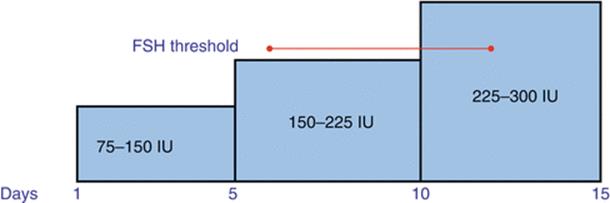
Fig. 7.1
Conventional step-up protocol
Step-Down Protocol
This regimen attempts to reproduce the normal physiological negative feedback of FSH where the development of a dominant follicle results in the rising of mid-follicular estradiol concentrations and the suppression of FSH levels and nondominant follicles become atretic (Fig. 7.2). One such regimen begins with 150 IU on day 2 or 3 of menses, which is continued for 2 or 3 days and then reduced to 75 IU for another 3 days, after which the patient undergoes follicular monitoring and serum estradiol measurement. If follicles >10 mm are observed on TVS, the dose is decreased in decedents in two steps. The last dose is then continued till the day of the hCG injection. The step-down regimen is intended to reduce the incidence of OHSS, but the long half-life of gonadotropin preparations makes it difficult to judge the proper dosage for maintenance of a lead follicle without risk of OHSS [9].
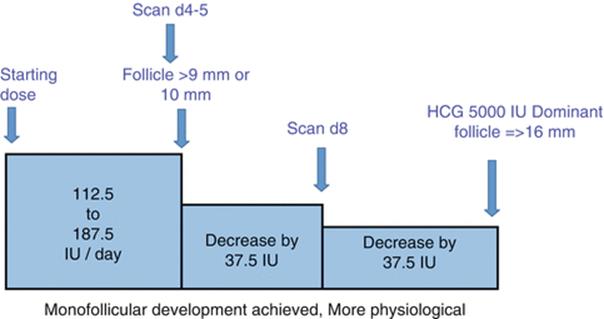
Fig. 7.2
Step-down protocol
Chronic Low-Dose Step-Up Regime
The principle behind this regimen is to find the “threshold” level of FSH which will lead to the development of a single preovulatory follicle (Fig. 7.3). This regime was proposed mainly by the ESHRE and ASRM joint consensus Thessaloniki group to prevent the OHSS. The key feature of this regimen is the low starting dose (37.5–75 units/day) of drug and a stepwise increase in subsequent doses, if necessary with the aim of achieving the development of a single dominant follicle rather than the development of many large follicles, so as to avoid the complications of OHSS and multiple pregnancy. Serum E2 levels are measured and USG is performed on day 7. If Serum E2 is >200 pg/ml or follicle size is above 10 mm, the same dose is continued. Otherwise, if the parameters are less than the above described, the daily dose is increased by an increment of 37.5 units every week, till the serum E2 level rises adequately [10].
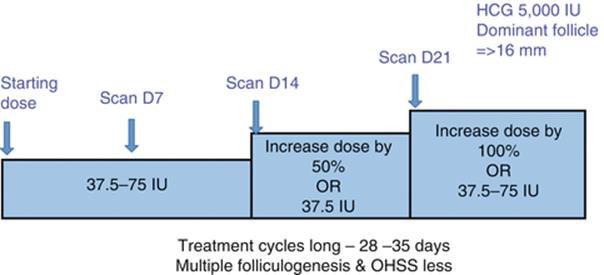
Fig. 7.3
Chronic low-dose step-up protocol
Sequential Regime
The principle for using the sequential protocol is that FSH dependence of leading follicle decreases as follicle grows (Fig. 7.4). The decrease in FSH threshold contributes to the escape of the leading follicle from atresia when FSH concentrations start to decrease due to negative feedback of rising E2. Start stimulation with low (37.5–75 IU/day) FSH dose, which is increased by 50 % or 37.5 IU after 14 days if no ovarian response. Thereafter, any further FSH increment is made by 37.5–75 IU at weekly intervals to a maximum of 225 IU/day. Once dominant follicle emerges and reaches a diameter of 14 mm, the dose is reduced by 50 %.
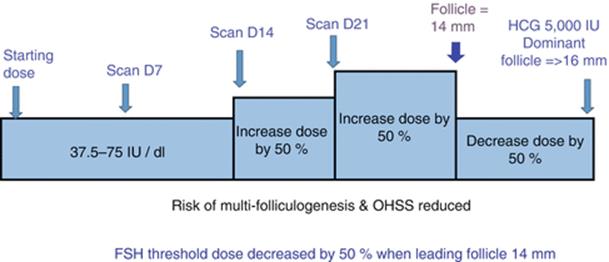
Fig. 7.4
Sequential protocol
7.2.1.3 Combined Therapy with Other Drugs
Clomiphene citrate or tamoxifen with gonadotropins: CC 100 mg or tamoxifen 20 mg is administered from day 2 to day 6, and injectable FSH/hMG 75/150 units is given on days 7, 8, and 9. Transvaginal sonography is done from day 10 onward, and in case the follicle growth or number is inadequate, additional FSH/hMG injections are administered. The combination of clomiphene and gonadotropin was explored in order to minimize the amount and the cost of gonadotropin alone. This method may decrease the amount of gonadotropin required by approximately 50 %; however, the same risks of multiple pregnancy and hyperstimulation can be expected. This reduced requirement for gonadotropin is found only in those patients who demonstrate a positive withdrawal bleeding following progestin medication or who have spontaneous menses [11].
7.3 Controlled Ovarian Hyperstimulation
Controlled ovarian hyperstimulation (COH) is a principal step of IVF therapy. The first IVF baby was born during a natural (unstimulated) IVF cycle. However, it was soon recognized that the success rate of IVF in natural cycles was low, primarily due to the low number of oocytes retrieved. Ovarian stimulation using urinary gonadotropins was adopted to deal with this problem, resulting in a significant increase in both the number of eggs retrieved and the success rate of IVF. With the increasing use of stimulation in IVF cycles, various problems were recognized. Premature luteinization and failure of synchronous follicular recruitment due to early dominant follicle selection were the two main problems resulting in reduced success rates. Also, ovulation could occur at any time of the day necessitating intensive monitoring and oocyte retrieval at inconvenient times of the day.
7.3.1 GnRh-Agonist Protocols
Several different GnRH agonists, buserelin, leuprorelin, nafarelin, and triptorelin, are routinely used in ART. The preparations differ in their potency and route of administration. Nafarelin and buserelin are available as a nasal spray, which needs to be given two to six times a day, while buserelin, leuprorelin, and triptorelin are given as subcutaneous injections once a day. With the intranasal route, the absorption of the GnRH agonist fluctuates resulting in an unpredictable response. Nevertheless, in most patients it is sufficient to prevent the spontaneous LH surge. Single injection of GnRh-agonist depot preparations is being tested with good results [12].
7.3.1.1 Long Protocol
Gonadotropin-releasing hormone agonists (GnRHa) were demonstrated to result in pituitary desensitization and successfully dealt with these problems, becoming the next major breakthrough in IVF treatment. In the late 1980s, gonadotropin-releasing hormone agonists (GnRH agonists) were introduced as a means of downregulating the pituitary to prevent premature ovulation, which in the past had necessitated canceling approximately 15 % of IVF cycles prior to egg retrieval. Since their introduction, pregnancy rates have increased because of the opportunity to retrieve cycles that would have been lost to early ovulation and because of the increase in the number of oocytes obtained in GnRH-agonist cycles [13].
The long protocol is the oldest and still the most commonly used regimen for ovarian stimulation. Most commonly, the GnRH agonist is started in the midluteal phase, and gonadotropin treatment is started following menstruation. The downregulating effects of GnRH agonists, as opposed to the stimulatory effects of GnRH, are related to the frequency of administration and the prolonged occupation of GnRH receptors by the agonists. GnRH agonist is being administered daily subcutaneously or by depot preparation. Criteria for downregulation to complete and start stimulation after getting menstruation are estradiol (E2) levels below 180 pmol/L, luteinizing hormone (LH) below 2 IU/L, and P4 below 2 nmol/L. Ultrasonography is used prior to initiation of gonadotropin treatment to rule out the presence of an ovarian cyst larger than 15 mm. Ovarian cysts form in approximately 10 % of women when the GnRH agonist is started in the midluteal phase, but these cysts almost always regress spontaneously in 1–3 weeks. Gonadotropin treatment is postponed until the cysts disappear or decrease to less than 15 mm in size. GnRH-agonist administration is continued for the duration of gonadotropin treatment (Fig. 7.5) [14].

Fig. 7.5
GnRH-agonist long protocol. OR oocyte retrieval,ET embryo transfer
Once downregulation is achieved, gonadotropins are administered to stimulate follicular growth with the GnRH agonist being continued at a lower dose. The initial dose of gonadotropin is usually 150–300 IU/daily, except in young women or those with polycystic ovarian disease where a lower dose (75–150 IU/daily) is appropriate. Intramuscular injections of urinary menopausal gonadotropins containing both FSH and LH were the mainstays of treatment until the development of a urinary gonadotropin that contained primarily FSH. Still newer, highly purified urinary FSH products introduced the advantage of being effective with subcutaneous administration. Recombinant FSH also allows subcutaneous administration. The hMG/FSH dose is subsequently adjusted according to follicular growth, as monitored by serum E2 levels and/or transvaginal ultrasonography. Human chorionic gonadotropin (hCG), either urinary or recombinant, is given once the follicular cohort consists of at least two follicles more than 18 mm in diameter. Oocyte retrieval follows 35–36 h later.
This protocol provides excellent cycle control making it the protocol of choice for first-time patients as well as for those with previous normal response. The main disadvantages of the long protocol are uncertainty of pregnancy at the start of GnRH-agonist treatment, longer duration of treatment, greater consumption of gonadotropins, and higher cost. In GnRH-agonist step-down regimen study by Olivennes et al. using leuprolide 0.1 mg/day, s.c., from day 21 and reducing it to 0.05 mg/day on stimulation, the cancelation rate remained high, and the pregnancy rate was relatively low [15].
Another study of the same step-down fashion of leuprolide (from 0.1 to 0.05 mg/day) showed higher number of oocytes and improved pregnancy rates [16]. In a Cochrane review, a single-dose depot of GnRH-agonist preparation (leuprolide 3.75 mg) was administered on day 21 of a previous cycle. It was observed that there was no evidence for differences between the long protocols using depot or daily GnRH agonist for IVF cycles. The use of depot GnRH agonist was associated with increased requirements for gonadotropins and a longer time for ovarian stimulation [17].
7.3.1.2 Short or Flare-Up Protocol
The administration of a GnRH agonist to a woman who has menstrual function will initially produce a stimulatory response, known as the “flare.” The magnitude of the flare response depends upon when in the cycle the agonist is administered. In the short protocol, the administration of GnRH agonist is started in the early follicular phase (day 2 of menses), and gonadotropins are started on the same day or on the following day (day 2/3). The monitoring, timing of hCG injection, and oocyte retrieval are for the long protocol. This protocol tries to derive benefit from an initial “flare-up” response due to endogenous FSH release from the pituitary gland that usually occurs in the first few days of GnRH-agonist administration. As there is no preceding pituitary suppression, this protocol results in a better response than the long protocol. However, the most important disadvantage is the high progesterone level during the early follicular phase, likely caused by the rescue of the preceding corpus luteum. Studies have confirmed a lower pregnancy rate using this protocol compared to the long protocol. Hence, in practice it is used only in patients with poor ovarian reserve or those with a previous poor response in the long protocol cycle (Fig. 7.6) [18, 19].
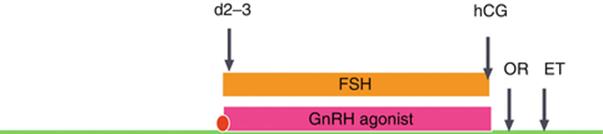
Fig. 7.6
GnRH-agonist short or flare protocol. FSH follicle stimulating hormone, OR oocyte retrieval, ET embryo transfer
7.3.2 GnRH-Antagonist Protocols
Although GnRH-agonist treatment is very effective, it has several pitfalls. There is an initial stimulation of GnRH receptors before pituitary desensitization is achieved. Hence, 7–14 days are required for adequate downregulation, menopausal symptoms are not unusual, and, unless a depot preparation is used, daily injections or multiple daily intranasal administrations are required for 2–4 weeks. In contrast, GnRH antagonists, being competitive inhibitors of endogenous GnRH due to their receptor binding property, rapidly inhibit secretion of gonadotropin and steroid hormones with a reduction of FSH and LH secretion within 8 h after administration, a potential advantage over GnRH agonists. In the GnRH-antagonist protocol, the gonadotropins are started on day 2 of the cycle, and GnRH antagonist is added in the mid-follicular phase to prevent the premature LH surge (Fig. 7.7) [20, 21].
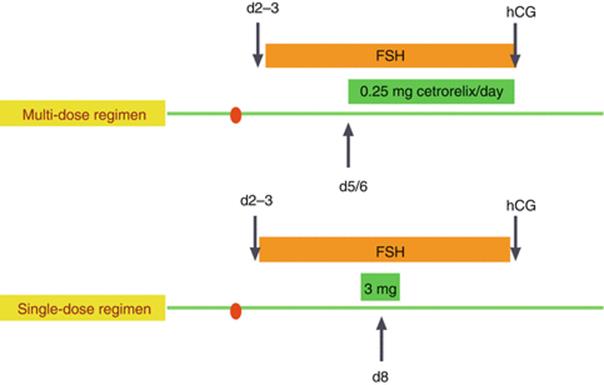
Fig. 7.7
GnRH-antagonist protocol. FSH follicle stimulating hormone
Two different compounds, cetrorelix and ganirelix, are available and are equally efficacious. Gonadotropin-releasing hormone antagonists are typically initiated either in a flexible protocol when the lead follicle is 14 mm in mean diameter or in a fixed protocol on stimulation days 5–6. They can be used in two different protocols, the single- and multiple-dose protocol. The multiple-dose GnRH-antagonist protocol involves the daily subcutaneous injections of 0.25 mg of either cetrorelix or ganirelix from day 5 or 6 of stimulation (the fixed start) until administration of human chorionic gonadotropin (hCG). The single-dose protocol involves a single subcutaneous injection of 3 mg GnRH antagonist on day 7 or 8 of stimulation. This single dose provides 4 days of pituitary suppression. If the patient needs more days of stimulation, the daily 0.25 mg of GnRH-antagonist injections are required until the hCG trigger. The monitoring, criteria for hCG administration, and oocyte retrieval are similar to the agonist protocols [22].
The treatment cycle is significantly shorter with GnRH antagonist than with GnRH-agonist treatment. GnRH antagonists are associated with simpler stimulation protocols, lower gonadotropin requirements, reduced costs, shorter duration of injectable drug treatment, absence of vasomotor symptoms, less risk of inadvertent administration during early pregnancy, avoidance of ovarian cyst formation, a significantly smaller dose of gonadotropin, and shorter intervals between successive cycles [23, 24]. Despite an initial trend toward a lower pregnancy rate with GnRH antagonists compared with agonists in a number of early randomized controlled studies, a recent meta-analysis found no significant difference in the probability of live birth rates with the use of either a GnRH-agonist or GnRH-antagonist protocol [25, 26]. As an effective alternative to hCG-induced ovulation, GnRH agonists induce a sustained release of LH (and FSH) from the pituitary that effectively induces oocyte maturation and ovulation in antagonist cycle.
Another possible advantage of antagonist cycle is that we can use GnRH agonist for trigger in comparison with hCG. GnRH-agonist triggering, however, results in a shorter endogenous LH surge that leads to a defective corpus luteum formation and an inadequate luteal phase. The profound luteolysis observed after GnRH-agonist triggering in contrast to the prolonged luteotropic effect often seen after triggering with hCG has been shown to almost completely eliminate the risk of OHSS in high responders. When we use standard luteal phase support after GnRH-agonist trigger, there is inadequate luteal phase, and it results in lower conception and higher miscarriage rates [27–29].
7.4 Protocol for Poor Responders
This group of women has the poorest prognosis for COH results and IVF pregnancy outcome. The definition of poor responder has differed widely in the literature and has included the woman’s age, basal hormonal status (high FSH), previous cancelation, and/or a poor response in a previous cycle with less than five oocytes retrieved and/or a peak serum E2 level 500 pg/mL. In most of the studies, poor responders were identified as patients with one or more of the following characteristics: high basal cycle day 3 FSH (10 mIU/mL) or E2 levels (90 pg/mL), advanced age (37 years), low ovarian volume, reduced number of antral follicles, and/or previous cancelation due to inadequate folliculogenesis (fewer than four dominant follicles after 6 days of gonadotropin stimulation) [30].
There is no one pituitary downregulation protocol that is best suited for all poor responders. Traditional GnRH-agonist flare and long luteal phase protocols do not appear to be advantageous. In poor responders we can try either a stop GnRH-agonist protocol or a micro-flare GnRH-agonist or a GnRH-antagonist protocol. Reduction of GnRH-agonist doses, “stop” protocols, and microdose GnRH-agonist flare regimes all appear to improve outcomes, although the proportional benefit of one approach over another has not been convincingly established. GnRH antagonists improve outcome in poor responders, although, in general, pregnancy rates appear to be lower in comparison with microdose GnRH-agonist flare regimens [31].
7.5 Protocol for Hyper Responders
The management of women who are at risk of developing an exaggerated response to COH represents a formidable challenge. An important consideration is the prevention of OHSS. Women with polycystic ovaries on ultrasound, even in the absence of other clinical features of PCOS, are at greater risk of developing OHSS. The incidence of OHSS has been reported to be as high as 30 % in this patient population. Other known risk factors for OHSS include young age, lean body weight, and a history of OHSS. In women undergoing COH treatment, high gonadotropin doses, high absolute levels (greater than 3,000 pg/ml), and rapidly rising E2 levels also represent risk factors for the development of OHSS [32].
Strategies for the prevention of OHSS include identifying patients at risk, individualization of COH protocols, and judicious use of gonadotropins. In this context, the aim of the COH is to decrease ovarian response, ideally to develop 5–15 follicles, while maintaining an E2 level of less than 3,000 pg/ml. Two effective COH protocols for high responders are the oral contraceptive pill GnRH-agonist dual suppression protocol and the GnRH-antagonist protocol. Antagonist protocol further gives us the option of substituting hCG trigger with a leuprolide acetate trigger which reduces the incidence of OHSS [33].
7.6 Recent Advance: Recombinant FSH-CTP in IVF
The β subunit of hCG is different from gonadotropic hormones as it has a C-terminal peptide extension which is responsible for reduced clearance resulting in major enhancement of in vivo bioavailability. Daily injections of FSH have to be given as it has a short half-life. Genes containing the sequence coding the C-terminal peptide (CTP) of hCG are fused with β subunit of FSH creating an FSH which is long acting with a half-life of 95 h eliminating the need for daily injections. Early follicular phase administration of FSH-CTP avoids the need for daily injections as a single injection enables follicular growth over a period of 7 days. Maximum serum levels are obtained after 36–48 h. A second injection 7 days later may cause hyperstimulation. Hence, daily doses of recombinant FSH are given thereafter. It is given as a single subcutaneous injection of 180 μg recombinant FSH-CTP on day 3 followed by daily injections of recombinant FSH 150 IU from day 10 onward combined with GnRH antagonist 0.25 mg subcutaneously to prevent premature surge of LH [34]. The pharmacokinetics of corifollitropin alfa and r-FSH are quite different, but their induced pharmacodynamic effects at the dosages used are similar [35]. It is recommended that patients should be treated with the appropriate dose of corifollitropin alfa according to their body weight as a lower dose does not result in milder stimulation and a higher dose does not result in an improved ovarian response. Two strengths of corifollitropin are available (for patients ≤60 kg and >60 kg). Compared with a daily dose of 200 IU of r-FSH, 150 μg of corifollitropin is equivalent in safety and pregnancy outcomes in women using an antagonist protocol.
In normal responder patients undergoing ovarian stimulation with GnRH antagonist co-treatment for IVF, ongoing pregnancy rates of 38.9 % for the corifollitropin alfa group and 38.1 % for r-FSH were achieved showing similar results for the number of embryos transferred. Median duration of stimulation was equal (9 days) and incidence of (moderate/severe) ovarian hyperstimulation syndrome was the same (4.1 and 2.7 %, respectively) [36]. Fertilization rates were high, ranging from 66 to 68 %. Corifollitropin alfa was generally well tolerated, with a tolerability profile similar to that of r-FSH. There were no clinically relevant differences in pregnancy complications and the incidence of infant adverse events between the two drugs [37].
A recent Cochrane review analyzed four RCTs with a total of 2,335 participants [38]. Overall live birth rate (OR 0.92) or OHSS (OR 1.12) was similar between the long-acting FSH and daily dose FSH. Women who received lower doses (60–120 μg) of long-acting FSH compared to daily FSH had lower live birth rates (OR 0.60). However, with medium dose of long-acting FSH, clinical pregnancy rate, ongoing pregnancy rate, multiple pregnancy rate, miscarriage rate, and ectopic pregnancy rate were similar to daily dose of FSH. The review concluded that the use of a medium dose of long-acting FSH is a safe treatment option and equally effective compared to daily FSH. It is a well tolerated and more convenient treatment option to induce multiple follicular growth prior to assisted reproduction. Its use for hyper or poor responders requires further research before a conclusion can be drawn.
Conclusion
The long protocol is considered the ‘gold standard’ in IVF cycles, in future the use of antagonist for pituitary suppression and agonist for ovulation trigger would eliminate OHSS making ART protocols simpler and patient friendly. GnRh-agonist long downregulation protocols produce more oocytes as well as embryos, but there is always the risk of OHSS. Also this protocol requires longer time for downregulation and large number of gonadotropin injections, which is a cause for concern to the patients, both physically and financially. Even though antagonists are better in this respect, the pregnancy rate is compromised in many studies, particularly in younger age group. With the soft protocols, which utilize antagonist for downregulation, even though oocyte recovery rate is low and does not allow embryo cryopreservation, the pregnancy rate is satisfactory, with least chance of OHSS.
Fine-tuning of COH can be performed presently with the available battery of hormonal preparations and adjuvant therapies. It is now very clear that the “one-size-fits-all” approach may no longer exist. The availability of new markers of ovarian reserve, the improvement in methodology for their measurement, and the huge amount of clinical data have supported the view that individualization in IVF is the way forward. In addition, new developments in the horizon may bring novel alternatives including more bioactive gonadotropin agonists and antagonists with effects of variable duration.
References
1.
Penzias AS. Improving results with assisted reproductive technologies: individualized patient-tailored strategies for ovulation induction. Reprod Biomed Online. 2004;9(1):43–66.CrossRefPubMed
2.
Baird DT. A model for follicular selection and ovulation: lessons from superovulation. J Steroid Biochem. 1987;27(1–3):15–23.CrossRefPubMed
3.
Loumaye E. The control of endogenous secretion of LH by gonadotrophin-releasing hormone agonists during ovarian hyperstimulation for in-vitro fertilization and embryo transfer. Hum Reprod. 1990;5(4):357–76.PubMed
4.
Lejeune B, Degueldre M, Camus M, Vekemans M, Opsomer L, Leroy F. In vitro fertilization and embryo transfer as related to endogenous luteinizing hormone rise or human chorionic gonadotropin administration. Fertil Steril. 1986;45(3):377–83.PubMed
5.
Al-Inany H, Aboulghar M. GnRH antagonist in assisted reproduction: a Cochrane review. Hum Reprod. 2002;17(4):874–5.CrossRefPubMed
6.
Germond M, Dessole S, Senn A, Loumaye E, Howles C, Beltrami V. Successful in-vitro fertilisation and embryo transfer after treatment with recombinant FSH. Lancet. 1992;339(8802):1170.CrossRefPubMed
7.
Practice Committee of the American Society for Reproductive Medicine. Current evaluation of amenorrhoea. Fertil Steril. 2006;86(5 Suppl 1):S148–55.
8.
Brown JB. Pituitary control of ovarian function – concepts derived from gonadotropin therapy. Aust N Z J Obstet Gynaecol. 1978;18(1):46–54.CrossRefPubMed
9.
Hugues JN, Cédrin-Durnerin I, Avril C, Bulwa S, Hervé F, Uzan M. Sequential step-up and step-down dose regimen: an alternative method for ovulation induction with follicle-stimulating hormone in polycystic ovarian syndrome. Hum Reprod. 1996;11(12):2581–4.CrossRefPubMed
10.
Thessaloniki ESHRE/ASRM-Sponsored PCOS Consensus Workshop Group. Consensus on infertility treatment related to polycystic ovary syndrome. Fertil Steril. 2008;89(3):505–22.CrossRef
11.
March CM, Tredway DR, Mishell Jr DR. Effect of clomiphene citrate upon amount and duration of human menopausal gonadotropin therapy. Am J Obstet Gynecol. 1976;125(5):699–704.PubMed
12.
Wong JM, Forrest KA, Snabes MC, Zhao SZ, Gersh GE, Kennedy SH. Efficacy of nafarelin in assisted reproductive technology: a meta-analysis. Hum Reprod Update. 2001;7(1):92–101.CrossRefPubMed
13.
Hughes EG, Fedorkow DM, Daya S, Sagle MA, Van de Koppel P, Collins JA. The routine use of gonadotropin-releasing hormone agonists prior to in vitro fertilization and gamete intrafallopian transfer: a meta-analysis of randomized controlled trials. Fertil Steril. 1992;58(5):888–96.PubMed
14.
Speroff L, Glass RH, Kase NG. Clinical gynecologic endocrinology and infertility. 6th ed. Baltimore: Lippincott Williams & Wilkins; 1999.
15.
Olivennes F, Righini C, Fanchin R, Torrisi C, Hazout A, Glissant M, et al. A protocol using a low dose of gonadotrophin-releasing hormone agonist might be the best protocol for patients with high follicle-stimulating hormone concentrations on day 3. Hum Reprod. 1996;11(6):1169–72.CrossRefPubMed
16.
Feldberg D, Farhi J, Ashkenazi J, Dicker D, Shalev J, Ben-Rafael Z. Minidose gonadotropin-releasing hormone agonist is the treatment of choice in poor responders with high follicle-stimulating hormone levels. Fertil Steril. 1994;62(2):343–6.PubMed
17.
Albuquerque LE, Saconato H, Maciel MC, Baracat EC, Freitas V. Depot versus daily administration of GnRH agonist protocols for pituitary desensitization in assisted reproduction cycles: a Cochrane review. Hum Reprod. 2003;18(10):2008–17.CrossRefPubMed
18.
Howles CM, Macnamee MC, Edwards RG. Short term use of an LHRH agonist to treat poor responders entering an in-vitro fertilization programme. Hum Reprod. 1987;2(8):655–6.PubMed
19.
Marcus SF, Brinsden PR, Macnamee M, Rainsbury PA, Elder KT, Edwards RG. Comparative trial between an ultra-short and long protocol of luteinizing hormone-releasing hormone agonist for ovarian stimulation in in-vitro fertilization. Hum Reprod. 1993;8(2):238–43.PubMed
20.
Halmos G, Schally AV. Changes in subcellular distribution of pituitary receptors for luteinizing hormone-releasing hormone (LH-RH) after treatment with the LH-RH antagonist cetrorelix. Proc Natl Acad Sci U S A. 2002;99(2):961–5.PubMedCentralCrossRefPubMed
21.
Kovacs M, Schally AV, Csernus B, Rekasi Z. Luteinizing hormone-releasing hormone (LH-RH) antagonist Cetrorelix down-regulates the mRNA expression of pituitary receptors for LH-RH by counteracting the stimulatory effect of endogenous LH-RH. Proc Natl Acad Sci U S A. 2001;98(4):1829–34.PubMedCentralCrossRefPubMed
22.
Copperman AB, Benadiva C. Optimal usage of the GnRH antagonists: a review of the literature. Reprod Biol Endocrinol. 2013;11:20.PubMedCentralCrossRefPubMed
23.
Al-Inany HG, Abou-Setta AM, Aboulghar M. Gonadotrophin-releasing hormone antagonists for assisted conception. Cochrane Database Syst Rev. 2006;(3):CD001750.
24.
Mahutte NG, Arici A. Role of gonadotropin-releasing hormone antagonists in poor responders. Fertil Steril. 2007;87(2):241–9.CrossRefPubMed
25.
Kolibianakis EM, Collins J, Tarlatzis BC, Devroey P, Diedrich K, Griesinger G. Among patients treated for IVF with gonadotrophins and GnRH analogues, is the probability of live birth dependent on the type of analogue used? A systematic review and meta-analysis. Hum Reprod Update. 2006;12(6):651–71.CrossRefPubMed
26.
Tur-Kaspa I, Ezcurra D. GnRH antagonist, cetrorelix, for pituitary suppression in modern, patient-friendly assisted reproductive technology. Expert Opin Drug Metab Toxicol. 2009;5(10):1323–36.CrossRefPubMed
27.
Devroey P, Aboulghar M, Garcia-Velasco J, Griesinger G, Humaidan P, Kolibianakis E, et al. Improving the patient’s experience of IVF/ICSI: a proposal for an ovarian stimulation protocol with GnRH antagonist co-treatment. Hum Reprod. 2009;24(4):764–74.CrossRefPubMed
28.
Humaidan P, Kol S, Papanikolaou EG; Copenhagen GnRH Agonist Triggering Workshop Group. GnRH agonist for triggering of final oocyte maturation: time for a change of practice? Hum Reprod Update. 2011;17(4):510–24.
29.
Kolibianakis EM, Schultze-Mosgau A, Schroer A, van Steirteghem A, Devroey P, Diedrich K, Griesinger G. A lower ongoing pregnancy rate can be expected when GnRH agonist is used for triggering final oocyte maturation instead of HCG in patients undergoing IVF with GnRH antagonists. Hum Reprod. 2005;20(10):2887–92.CrossRefPubMed
30.
Arslan M, Bocca S, Mirkin S, Barroso G, Stadtmauer L, Oehninger S. Controlled ovarian hyperstimulation protocols for in vitro fertilization: two decades of experience after the birth of Elizabeth Carr. Fertil Steril. 2005;84(3):555–69.CrossRefPubMed
31.
Badawy A, Wageah A, El Gharib M, Osman EE. Strategies for pituitary down-regulation to optimize IVF/ICSI outcome in poor ovarian responders. J Reprod Infertil. 2012;13(3):124–30.PubMedCentralPubMed
32.
Engmann L, Maconochie N, Sladkevicius P, Bekir J, Campbell S, Tan SL. The outcome of in-vitro fertilization treatment in women with sonographic evidence of polycystic ovarian morphology. Hum Reprod. 1999;14(1):167–71.CrossRefPubMed
33.
Itskovitz-Eldor J, Kol S, Mannaerts B. Use of a single bolus of GnRH agonist triptorelin to trigger ovulation after GnRH antagonist ganirelix treatment in women undergoing ovarian stimulation for assisted reproduction, with special reference to the prevention of ovarian hyperstimulation syndrome: preliminary report: short communication. Hum Reprod. 2000;15(9):1965–8.CrossRefPubMed
34.
Balen AH, Mulders AG, Fauser BC, Schoot BC, Renier MA, Devroey P, et al. Pharmacodynamics of a single low dose of long-acting recombinant follicle-stimulating hormone (FSH-carboxy terminal peptide, corifollitropin alfa) in women with World Health Organization group II anovulatory infertility. J Clin Endocrinol Metab. 2004;89(12):6297–304.CrossRefPubMed
35.
Fauser BC, Alper MM, Ledger W, Schoolcraft WB, Zandvliet A, Mannaerts BM; Engage Investigators. Pharmacokinetics and follicular dynamics of corifollitropin alfa versus recombinant FSH during ovarian stimulation for IVF. Reprod Biomed Online. 2010;21(5):593–601.
36.
Croxtall JD, McKeage K. Corifollitropin alfa: a review of its use in controlled ovarian stimulation for assisted reproduction. BioDrugs. 2011;25(4):243–54.CrossRefPubMed
37.
Rombauts L, Talmor A. Corifollitropin alfa for female infertility. Expert Opin Biol Ther. 2012;12(1):107–12.CrossRefPubMed
38.
Pouwer AW, Farquhar C, Kremer JA. Long-acting FSH versus daily FSH for women undergoing assisted reproduction. Cochrane Database Syst Rev. 2012;(6):CD009577.