
Elisabetta Costantini
List of Abbreviations
FSD Female sexual dysfunctions
MUS Mid-urethral sling
SUI Stress urinary incontinence
TOT Trans-obturator tape
TVT Tension-free vaginal tape
UI Urinary incontinence
Over the last 3 decades, more than 500 studies have been published in the field of urinary incontinence and sexual function. The reason for this increasing interest is that, traditionally, outcome studies in urogynecology focused on anatomic and functional changes after surgery and they neglected quality of life issues. The new condition-specific health-related quality of life instruments have improved our ability to assess the impact of pelvic floor surgery more fully, and the concept of patientcentered care has led us to focus on the patient’s perspective or expectations. Furthermore since the World Health Organization declared female sexuality a basic human right [1], sexual well-being is recognized as an important aspect of women’s health, and sexual dysfunctions can lessen or worsen quality of life.
Many studies reported that sexual problems are more prevalent in patients with pelvic floor dysfunctions demonstrating that stress urinary incontinence (SUI), overactive bladder, and in general lower urinary tract symptoms impact negatively on all sexual function domains.
Urinary incontinence (UI) is a common condition affecting 12-46 % of the adult female population [2]. This condition is associated with a significant worsening of the quality of life aspects, influencing social, physical, psychological, occupational, and sexual behaviors [2, 3]. Sexual dysfunction has been reported in up to 45 % of female incontinent patients with coital incontinence reported in 11 % of the women attending a urogynecological unit [4]. The reasons for the increased sexual function impairment in women with urinary incontinence may be due to both direct and indirect effects. Stress urinary incontinence (SUI) may affect sexual desire, lubrication, orgasm, and sexual satisfaction; irritation of vulvovaginal region associated with chronic urine leakage usually leads to dyspareunia. Also, patients may fear urine leakage during engaging in any sexual activity which may indirectly contribute to decreased sexual interest and lower sexual self-esteem [5]. So the link between female sexual dysfunctions (FSDs) and urinary incontinence is well demonstrated, and incontinence impacts upon different sexual domains, desire, pain, and orgasm, causing loss of self-confidence, difficulties in relating to the other sex, and even abandonment of sexual intercourse. In this scenario, assuming that urinary leakage contributes to sexual dysfunction, it is reasonable to presume that an operation designed to recover continence should also improve sexual function.
Today, minimally invasive anti-incontinence procedures (Fig. 8.1) such as a tension- free vaginal tape (TVT), a polypropylene mesh placed at the mid-urethra and anchored through the retropubic space, or a mid-urethral trans-obturator tape (TOT), inserted in a horizontal plane underneath the middle urethra between the two obturator foramen, are currently offered as the best approach to SUI and in the majority of the cases replaced other traditional procedure, such as a Burch colposuspension [6].
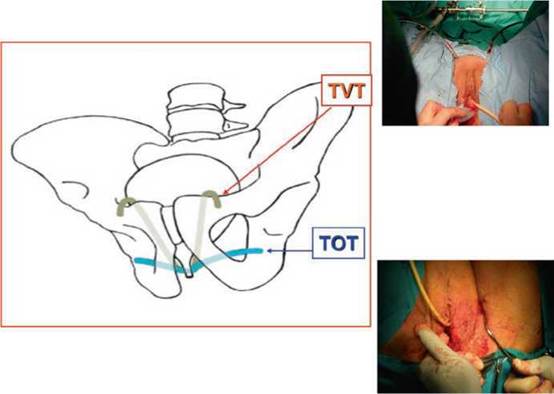
Fig. 8.1 Tension-free vaginal tape (retropubic position of the mesh) and tran-obturator tape (tran- obturator position of the mesh
Only recently the impact of mid-urethral slings (MUSs) on female sexual function has been reported with controversial results [7-11]. The majority of the studies focused on curing the incontinence rather than the impact of these procedures on sexual function so that the effects of MUS procedures on women’s sexual lives remain still uncertain. Some studies reported improved function after TVT and TOT procedures [10, 12, 13], but others reported deterioration or no change in symptoms. Study design including varying age, hormonal status, comorbidities, heterogeneity of coexistence of pelvic organ prolapses, difference evaluation criteria on success, and retrospective design of studies have been shown to account for these variable results [14].
The urethrovaginal space plays an important role in female arousal and sensation of orgasm [15], so the insertion of the sling may disrupt the anatomy of this space and modify the innervations of the anterior vaginal wall which leads to dyspareunia and anorgasmia. In addition, it was suggested that TOT and TOT-like procedures may injure the pudendal nerve branches and alter the somatosensitive pathway of the vulva causing sexual dysfunctions de novo. However, such neuroanatomic pathway was not definitely confirmed [16]. On the other hand [17], vaginal surgery for SUI may cause vaginal narrowing, scarring and reduction of the anterior vaginal wall elasticity, reduction of blood supply to the erectile tissue of the clitoris, tape erosion (which cause dyspareunia and partner discomfort), decreased genital sensation and vaginal lubrication, as well as persistent urine leakage during intercourse [16, 18]. All these factors, as confirmed by different authors [11, 19], are however the results of technique failure, and they are not always related to the surgical technique itself [20]. In fact some well-conducted studies demonstrated an increase in desire, arousal, lubrication, orgasm, and satisfaction [11, 21] in female incontinent patients after MUSs as demonstrated in a group of women who filled the Female Sexual Function Questionnaire before and after surgery (Fig. 8.2) [11]. After anti-incontinence procedures the patients improved their quality of sexual life, restored libido, increased sexual self-confidence, and in some cases restored sexual life in those women who avoided and abandoned sexual life for the incontinence problems. It is important in this view to underline that the majority of the studies included only patients who were sexually active and excluded those for whom medical and/or psychological factors have precluded any sexual relationship. Including patients not sexually active, it is possible to recognize a group of women with a restored sexual life with the number of sexually active women increasing from 59 to 71 % after MUS [11]. So following MUS placement, sexual function improves, and a relevant percentage of nonsexually active women renews sexual activity because of MUS. The development of any sexual problem after MUS surgery is probably because of anatomical reasons, such as an incorrect positioning of the sling, and/or an abnormal scar formation, and/or exposure of the mesh or de novo symptoms such as the de novo storage symptoms.

Fig. 8.2 When the total score and all sub-scores in the FSFI questionnaire were compared, a significant improvement in sexual function was found after MUS
In conclusion, female sexual dysfunction is a difficult and complex issue, and it is clear that urinary incontinence negatively impacts sexual function. The multidimensional aspects of female sexuality are often difficult to standardize, and we cannot forget the partner’s role. After anti-incontinence surgery, the results on sexual function depend on different factors, and generally the studies are not able to give us a clear answer because they did not focus on the different aspect of female sexuality and they did not correlate technique failures and complications with the female sexual dysfunctions. In the attempt to summarize, we can recognize three different groups of patients (Fig. 8.3): (1) women with Hypoactive Sexual Desire Disorders or women with no partner, who do not wish to have or to restore sexual activity, and in this case surgery has no impact on sexuality. (2) women with incontinence-related female sexual dysfunctions who restored or improved sexual activity after MUS if incontinence is resolved; and (3) women with surgery-related persistent or de novo female sexual disorders after MUS which were often related to a complication such as a mesh exposure or a mesh retraction or to a dissatisfactory outcome. In this group FSDs persist or compare de novo.

Fig. 8.3 Results on sexuality after MUS depend on 3 different situations due to woman’s characteristics
References
1. World Health Organization. Sexual health: working definitions. 2002. Available at: http:// www.who.International/reproductive-health/gender/sexual_health.html.
2. Thankar R. Review of current status of female sexual dysfunction evaluation in urogynecol- ogy. Int Urogynecol J Pelvic Floor Dysfunct. 2009;20 Suppl 1:S27-31.
3. Pauls RN, Segal JL, Silva WA, Kleeman SD, Karram MM. Sexual function in patients presenting to a urogynecology practice. Int Urogynecol J Pelvic Floor Dysfunct. 2006;17:576-80.
4. Liang CC, Tseng LH, Lo TS, Lin YH, Lin JR, Chang SD. Sexual function following outside-in transobturator midurethral sling procedures: a prospective study. Int Urogynecol J. 2012;23:1693-8.
5. Witek A, Drosdzol-Cop A, Nowosielski K, Solecka A, Mikus K. Long-term impact of surgical repair for stress urinary incontinence on female sexual functions, distress and behaviours. J Clin Nurs. 2012;22:1591-8.
6. Novara G, Artibani W, Barber MD, Chapple CR, Costantini E, Ficarra V, Hilton P, Nilson CG, Waltregny D. Updated systematic review and meta-analysis of the comparative data on colpo- suspensions, pubovaginal slings, midurethral tapes in the surgical treatment of stress urinary incontinence. Eur Urol. 2010;58:218-38.
7. Glavind K, Tetsche MS. Sexual function in women before and after suburethral sling operation for stress urinary incontinence: a retrospective questionnaire study. Acta Obstet Gynecol Scand. 2004;83:965-8.
8. Helzevier HW, Venema PL, Nijeholt AA. Sexual function after Tension-free Vaginal Tape (TVT) for stress incontinence: Results of mailed questionnaire. Int Urogynecol J Pelvic Floor Dysfunct. 2004;15:313-8.
9. Mazouni C, Karsenty G, Bretelle B, Bladou F, Gamerre M, Serment G. Urinary complications and sexual function after the tension-free vaginal tape procedure. Acta Obstet Gynecol Scand. 2004;83:955-61.
10. Jha S, Radley S, Farkas A, Jones G. The impact of TVT on sexual function. Int Urogynecol J Pelvic Floor Dysfunct. 2009;20:165-9.
11. Filocamo MT, Serati M, Frumenzio E, Li Marzi V, Cattoni E, Champagne A, Salvatore S, Nicita G, Costantini E. The impact of mid-urethral slings for the treatment of urodynamic stress incontinence on female sexual function: a multicenter prospective study. J Sex Med. 2011;8:2002-8.
12. Bekker M, Beck J, Putte H, et al. Sexual function improvement following surgery for stress incontinence: the relevance of coital incontinence. J Sex Med. 2009;6:3208-13.
13. Narin R, Attar R, Narin MA, Koyuncu D, Yencilek E. Impact of transobturator tape procedure on female and their partner sexual function: it improves sexual function of couples. Arch Gynecol Obstet. 2014;290:913-7. doi:10.1007/s00404-014-3259-8.
14. Simsek A, Ozgor F, Yuksel B, et al. Female sexual function after transobturator tape in women with urodynamic stress urinary incontinence. Springerplus. 2014;3:570. Published online 2014 Sep 30. doi: 10.1186/2193-1801-3-570.
15. Battaglia C, Nappi RE, Mancini F, Alvisi S, Del Forno S, Battaglia B, Venturoli S. 3D volumetric and vascular analysis of the urethrovaginal space in young women with or without vaginal orgasm. J Sex Med. 2010;7:1445-53.
16. Elzevier HW, Putter H, Delaere KPJ, et al. Female sexual function after surgery for stress urinary incontinence: transobturator suburethral tape vs. tension-free vaginal tape obturator. J Sex Med. 2008;5:400-6.
17. Caruso S, Rugolo S, Bandiera S, Mirabella D, Cavallaro A, Cianci A. Clitoral blood flow changes after surgery for stress urinary incontinence: pilot study on TVT versus TOT procedures. Urology. 2007;70:554-7.
18. Dragisic KG, Milad MP. Sexual functioning and patient expectations of sexual functioning after hysterectomy. Am J Obstet Gynecol. 2004;190:1416-8. doi:10.1016/j.ajog.2004. 01.070.
19. Serati M, Salvatore S, Uccella S, Zanirato M, Cattoni E, Nappi RE, Bolis P. The impact of the mid-urethral slings for the treatment of stress urinary incontinence on female sexuality. J Sex Med. 2009;6:1534-42.
20. Basson R, Wierman ME, van Lankveld J, Brotto L. Summary of the recommendations on sexual dysfunctions in women. J Sex Med. 2010;7:314-26.
21. Pace G, Vicentini C. Female sexual function evaluation of the Tension-free Vaginal Tape (TVT) and Transobturator Suburethral Tape (TOT) incontinence surgery: results of a prospective study. J Sex Med. 2008;5:387-93.