
Gab Kovacs1 and Paula Briggs2
(1)
Department of Obstetrics and Gynaecology, Monash University, Clayton, Victoria, Australia
(2)
Sexual and Reproductive Health, Southport and Ormskirk Hospital, Southport, UK
History
Menstrual History
Contraceptive History
Obstetric History
Cervical Cytology
General Medical History
Presenting Problem
The Gynaecological Examination
Abdominal Examination
Speculum Examination
The Bimanual Examination
Special Tests
Ultrasound
History
Whilst a gynaecological consultation is a specialist referral, it is important to consider the patient as a whole, and to have an overall understanding of her medical history. Therefore a general medical history should be obtained, followed by a gynaecological history.
The administrative staff will confirm the patient details prior to the consultation. This is important to ensure that the notes match the patient, but should also be confirmed by the clinician at the start of the consultation. Personal details must be treated confidentially.
It is also important to make a note of anyone else present during the consultation e.g. partner, health care assistant or medical student!
When the woman presents (or couple if it is a joint consultation, such as for subfertility) it is useful to enquire about occupation. This not only gives a clue as to how to explain things, but also acts as an ice breaker.
Menstrual History
This is the most important part of the consultation.
These are the important questions to ask:
· Menarche (age of first menses)
· Regularity of cycles. This is abbreviated as K = a − b/c − d, and X
· a is the shortest number of days of bleeding
· b is the longest number of days of bleeding
· c is the shortest cycle (counting from the first day of one bleed to the first day of the next bleed)
· d is the longest cycle
· X is the average cycle length
· Last normal menstrual cycle (LNMP)
· The amount of menstrual bleeding (is it excessive – passing clots, flooding, the frequency of changing pads/tampons)
· Are “periods” painful (dysmenorrhea)
· Is it worse pre-menstrually and relieved by bleeding – (spasmodic dysmenorrhoea)
· Does it get worse as menstruation progresses (suggestive of endometriosis)
· Intermenstrual bleeding (IMB) or postcoital bleeding (PCB)?
Remember that women using hormonal contraception do not have a menstrual cycle. Women using combined hormonal contraception have withdrawal bleeds associated with a hormone free interval.
Contraceptive History
The use of contraception, including past and current methods should be recorded.
Obstetric History
Any previous pregnancies including their outcome; delivery, pregnancy loss, therapeutic termination of pregnancy (TOP).
The abbreviation used is PxGy- where P = Parity means the number of times the woman has given birth to a baby of at least 28 weeks gestation.
G = Gravidity and means the number of times the woman has been pregnant.
The outcome of pregnancies should be summarised (See Chap. 5).
Cervical Cytology
When was her last cervical smear test and what was the result.
General Medical History
· Illnesses
· Operations
· Medications
· Allergies
· Social history – smoking/alcohol/recreational drug use
Presenting Problem
The appropriate questions for specific complaints will be covered in the relevant chapters. Examples of the correct questions to ask for frequently occurring conditions are given here.
Heavy Menstrual Bleeding (HMB)
· When did the pattern change?
· Precipitating factors, such as the use of intrauterine contraception (IUC)
· Details regarding the woman’s cycle, as described above.
Intermenstrual Bleeding (IMB)
· When did it start?
· Are there any precipitating cause, such as sexual intercourse (post coital bleeding – PCB)
· Relationship to menses
Subfertility
· Duration without contraception – “trying”
· Frequency and adequacy of sexual intercourse (timing, erections, penetration, ejaculation)
· Symptoms and signs of ovulation (menstrual pattern, mucous changes, premenstrual breast changes, bloating, ovulation pain (Mittelschmerz))
· Any history suggesting tubal disease (appendicitis, sexually transmitted infections (STIs))
· History suggesting endometriosis (dysmenorrhoea)
· Partner’s reproductive history, testicular injury, STIs, mumps
Urogynaecology
· Complains of “something coming down”
· Urinary frequency, urgency, incontinence, stress incontinence, dysuria, nocturia
Menopause
· Regularity of “periods”
· Symptoms of hormone imbalance/oestrogen deficiency. Classically this includes hot flushes and night sweats.
The Gynaecological Examination
The examination should be problem orientated, bearing in mind that the patient will have undergone a general examination by their GP prior to referral.
If hormones are to be prescribed (contraception or HRT) then checking the blood pressure (BP) is mandatory and it may be appropriate to offer breast examination.
Listening to the heart and lungs may be appropriate, if a surgical procedure requiring general anaesthesia is contemplated. Examining the thyroid in HMB may be indicated.
Abdominal Examination
Before commencing an examination, it is important that the patient empties her bladder.
This is particularly desirable before embarking on a pelvic examination. A many time repeated gynaecological urban myth is the story of the woman who had an operation for uterine prolapse, and at operation it was found she had a large ovarian cyst pushing down the uterus. To avoid such mismanagement, one must always palpate the abdomen first. Any masses should be noted and further investigation arranged. Ultrasound would be the first line investigation.
Speculum Examination
The most popular instrument for inspecting the vagina and the cervix is a Bivalve Speculum (Fig. 4.1) also known as Cusco’s/Cosco’s speculum.
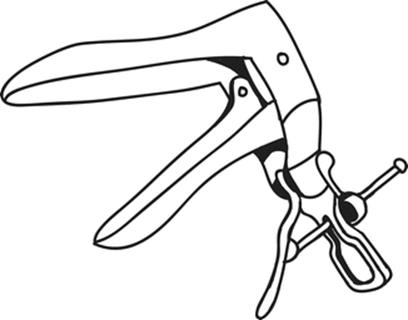
Fig. 4.1
Bivalve vaginal speculum
The original speculum was a Sims’s speculum, modeled after a bent spoon, as first developed by J Marion Simms in the mid 1800s to help him visualize the vagina during the fistula operations that he pioneered (Fig. 4.2). The use of this type of speculum necessitates the woman being examined lying on her side and whilst it has a place in women with prolapse, some women may feel uncomfortable being examined from behind.
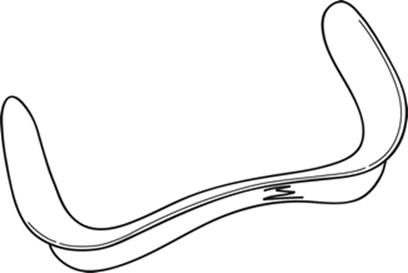
Fig. 4.2
Sim’s vaginal speculum
The advantage of the bivalve speculum is that after proper insertion, the speculum can be opened, and the vaginal muscles will keep it in place, allowing the operator to have two free hands to carry out procedures such as a cervical smear test, endometrial sampling, or IUC insertion. This may not be the case in women with atrophic vaginitis, where insertion may be difficult, or in women with prolapse, where muscle tone may be insufficient to keep the speculum in position.
The woman is asked to lie supine on the examination couch, with her knees apart. The labia are parted with the left hand, so that the pink vaginal skin can be seen, whilst the speculum is gently introduced, passing it backwards and upwards. Applying lubricant to the outside of the blades helps this process. Once inserted, the handle can be turned upwards or downwards (some operators have a preference for one or the other and the type of examination couch precludes turning downwards in some cases). The blades are opened allowing visualization of the cervix and vaginal walls. The blades are then fixed in place by tightening the locking screw.
Following the dictum of inspection before palpation, the cervix should be inspected, and any abnormalities such as an ectropion, polyps, or tears should be noted. If indicated a cervical smear test should be taken at this stage.
The speculum should then be removed, by loosening the screw and then gently withdrawing the blades.
The Bimanual Examination
This should be carried out in the same dorsal position as the speculum examination. The second and third fingers of the gloved right hand should be lubricated, and the left hand again used to part the labia as for the speculum examination. Two fingers (index and middle) should then be introduced into the vagina, until the cervix is felt. The cervix can be classified into “firm”- normal, “soft” during pregnancy, or “hard” if it is infiltrated by carcinoma – although this would be an unlikely way to make the diagnosis. Pelvic infection or blood in the Pouch of Douglas may be associated with extreme tenderness, known as cervical excitation. In this situation, cervical motion is associated with extreme pain, so bad that your patient will want to “hit the roof”.
The dominant hand is the “manipulating” hand, whilst the fingers of the other hand, placed on the abdomen is the “palpating” hand. If one imagines that the uterus is on an axle at the uterosacral ligaments, and it can be rocked forwards or backwards, then the anterior lip of the cervix needs to be pushed backwards to try and antevert the uterus (Fig. 4.3). If the uterus is palpable between the palpating and manipulating hands, the uterus is anteverted. If however despite efforts to rotate the uterus forwards, there is nothing between the two hands (Fig. 4.4a), then the uterus must be retroverted, in which case, putting the fingers into the posterior vaginal fornix, may facilitate palpation (Fig. 4.4b).
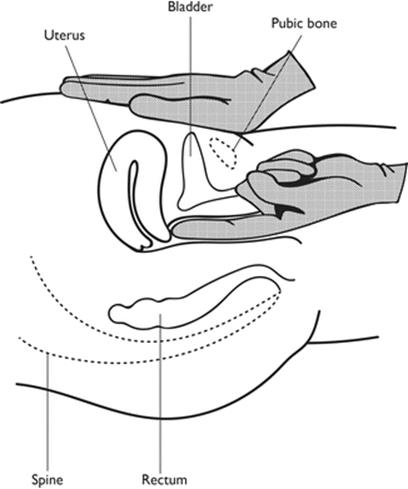
Fig. 4.3
Anteverted uterus on bimanual examination
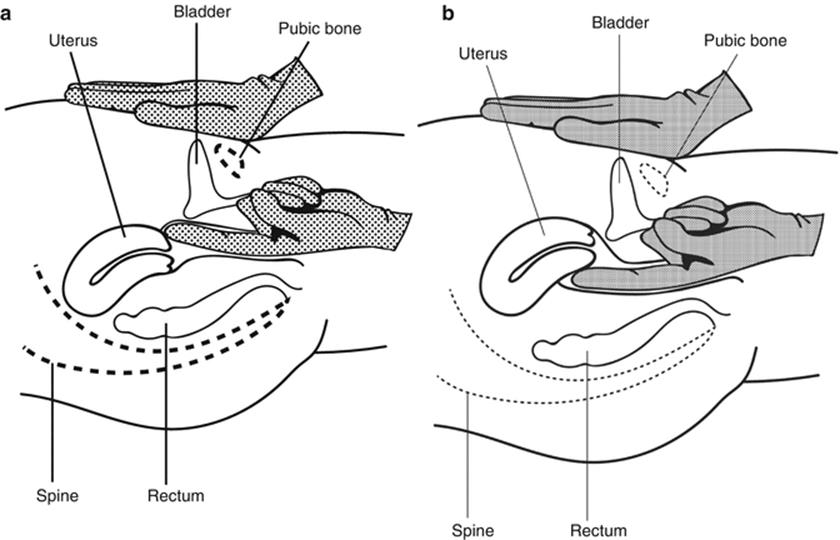
Fig. 4.4
(a) Retroverted uterus on bimanual examination. (b) Retroverted uterus with vaginal fingers in posterior fornix
Once the uterus has been palpated, and it is decided whether it is anteverted (65 % of women) or retroverted (25 % of women), or sometimes axial (10 %) of women, an assessment can then be made whether it is of normal. If the uterus is enlarged, it is most logical to describe it as equivalent to the number of weeks of pregnancy (See Chap. 5). Sometimes, it is described as the size of an orange, grapefruit etc, but this is less reliable.
An assessment should then be made regarding the mobility of the uterus. It may be fixed and retroverted, if there is extensive endometriosis in the Pouch of Douglas. It should also be noted if there are any specific enlargements, e.g. fibroids.
The final part of the bimanual examination is to examine the part of the pelvis beside the uterus – called the fornices. This assesses the ovaries and the Fallopian tubes. One may detect ovarian cysts, or inflammation of the tubes, manifest as tenderness (Table 4.1).
Table 4.1
Summary of gynaecological bimanual examination
|
The cervix |
Soft |
Firm |
Hard |
|
|
The uterus |
Anteverted |
Retroverted |
Erect |
Unsure |
|
Uterine size |
Not enlarged |
Enlarged: weeks of pregnancy |
Any discreet lumps |
|
|
Tender |
Non-tender |
|||
|
Fornices |
Masses palpated |
Tenderness detected |
Special Tests
The traditional way to exclude uterine pathology involves carrying out a dilatation and curettage (D & C) under general anaesthetic. Over the last two decades, the technique of hysteroscopy has become more common place and D&C is rarely done any longer.
Hysteroscopy requires the insertion of a narrow telescope through the cervix, distending the uterine cavity with fluid, and connecting the telescope to a light source and a video monitor. This enables inspection of the uterine cavity, with the potential to diagnose pathology such as polyps, submucous fibroids and uterine septae.
One can compare D & C to hysteroscopy, so that D &C is like walking around a dark room and feeling the walls, whereas hysteroscopy is like standing at the door, turning the light on, and looking around.
The degree of inconvenience can be decreased by carrying out hysteroscopy as an outpatient procedure without anaesthesia. Nevertheless this still requires expensive equipment, a degree of expertise, and a degree of discomfort for the patient.
Another option to investigate patients with abnormal bleeding is to sample the endometrium by endometrial biopsy. This can be performed alone or at the time of hysteroscopy and involves passing a narrow tube with a sampler into the endometrial cavity, similar to the insertion of an IUC (Fig. 4.5). Depending on the type of sampler, it aspirates or scrapes off a representative sample of the endometrium. This allows histological examination of the endometrium, to exclude cancers or pre-cancers. The disadvantage of endometrial sampling over hysteroscopy is that polyps may not be diagnosed, or that the sample obtained may not be representative of the whole endometrium. Nevertheless, combined with imaging techniques (see below) it is an effective investigation.
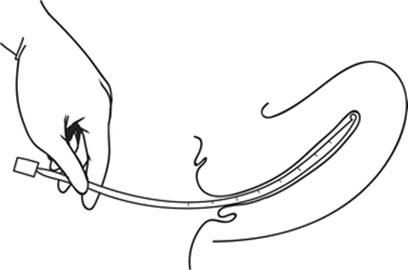
Fig. 4.5
Endometrial sampling
Ultrasound
There is no doubt that transvaginal ultrasound imaging of the pelvic contents has revolutionised assessment of the reproductive organs. Excellent views of the uterus and ovaries can be obtained (Fig. 4.6). Many gynaecologists and sexual and reproductive health physicians use ultrasound as an extention of the clinical examination.
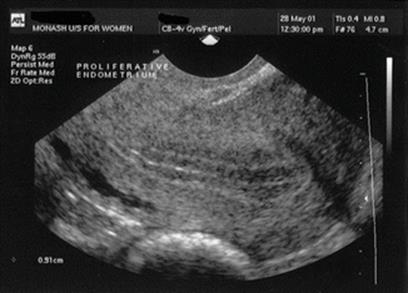
Fig. 4.6
Ultrasound view of the uterus, longitudinal section
Uterine pathology: Ultrasound can be used to identify fibroids and to describe the position of fibroids in relation to the uterus e.g. submucous, intramural or subserosal or pedunculated (Fig. 4.7).
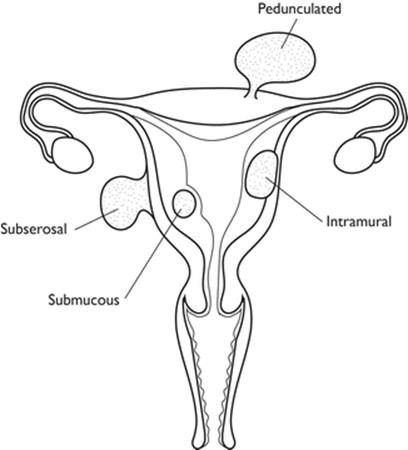
Fig. 4.7
Uterine fibroids
Ultrasound can also give an indication as to whether a polyp might be present and the views achieved can be further improved by instilling saline or an alternative negative contrast medium into the uterine cavity during the ultrasound examination.
Ovarian pathology: Functional cysts are commonly seen, particularly in association with progestogen only contraception. These can become quite large, but commonly resolve without any treatment. Women with functional ovarian cysts sometimes present with pelvic pain in association with unscheduled bleeding. They should be offered a repeat ultrasound examination in 2–3 months time, particularly if there is a septum present.
Dermoid cysts are identifiable due to the various components which might include teeth and hair!
Endometriosis cannot be seen on ultrasound unless there are endometriomata. These have a very specific ultrasound appearance (Fig. 4.8). In women with severe endometriosis the pelvic organs may be adherent to one another and this can be apparent when moving the transvaginal probe.
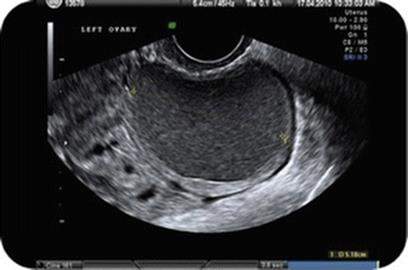
Fig. 4.8
Endometriotic ovarian cyst on ultrasound
Haemorrhagic cysts can occur at the time of ovulation and again these have a specific appearance (Fig. 4.9).
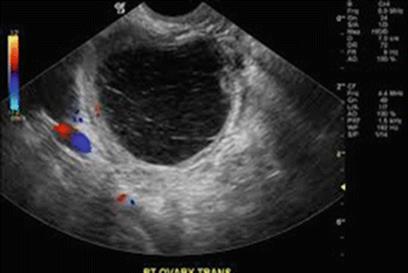
Fig. 4.9
Haemorrhagic cyst
Ovarian cancer is not a common finding and where there is a suspicion of such pathology on scan, blood should be taken to measure Ca125.
Using the technique of Hysterosalpingo-contrast-sonography (HyCoSy), the patency of the Fallopian tubes can be confirmed using ultrasound technology.
There is no doubt that ultrasound is now a vital part of the gynaecological examination.