
IN THIS CHAPTER
 Recognizing that sugary drinks can be dehydrating
Selecting the best beverages
Understanding that both carbs and calories add up
Pointing out the risks and effects of alcohol
Every day you make choices that affect your well-being. What you choose to sip or guzzle can have a big impact on your health, especially your blood-glucose levels. You lose fluid every day through urination, sweat, and simply breathing. It’s important to replace lost fluids and to choose your beverages wisely. Staying well-hydrated is essential for proper digestion and nutrient absorption and delivery, as well as for circulation, respiration, and body temperature regulation.
Watch what you reach for, though, because sugary, high-carb beverages can wreak havoc with blood-glucose levels. This chapter calls it like it is when it comes to liquid land mines. Thankfully, many tasty, refreshing beverages work in your favor, whether it’s water you reach for or something with flavor.
Noting the Importance of Hydration and Low-Carb Drinks
 Up to 60 percent of an adult’s body weight is water, so staying hydrated is critical to good health, especially when you have diabetes. You’ve probably heard that you should be drinking at least 8 cups of fluid per day. If blood-glucose levels are running above target, you may need more than that. Why? Because when blood-glucose levels are elevated, your kidneys will try to filter out some of the excess glucose, and in doing so they will create more urine. High blood glucose leads to increased urination. Frequent trips to the restroom can lead to dehydration. Dehydration is the result of losing more fluids than you take in. Fatigue, dizziness, muscle cramping, and perhaps rapid heartbeat follow. Dry mouth, dry skin, constipation, and dark-colored urine are also signs that you may be dehydrated. When you are well-hydrated, your urine should appear clear and pale in color. So drink up! But be aware that what you choose to drink can either help or hinder your health.
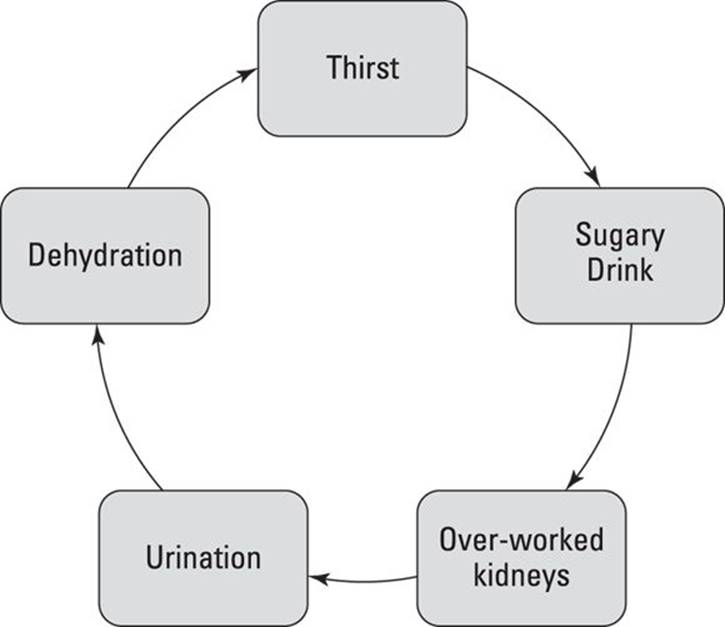
Consider the carb content of your beverage. If you are drinking sugar-sweetened beverages, regular soft drinks, frappa-yummies, or even fruit juice, you’re dumping even more sugar into your system. Your blood-glucose levels will likely rise quickly, your kidneys will work overtime to try to rid your body of the excess glucose, you’ll make more trips to the restroom and may end up dehydrated and thirsty … and around and around it goes. It’s a vicious cycle, as you can see in Figure 11-1 .
© John Wiley & Sons, Inc.
FIGURE 11-1: The cycle of dehydration.
The kidneys filter your blood just as the oil filter on your car filters the oil. It’s the kidneys’ job to decide what stays in the bloodstream and what gets dumped into the urine. The heart pumps blood throughout the body every minute of every day. Each trip around the track takes the blood through the kidneys for filtration. It’s a well-known fact that persistently elevated blood-glucose levels can lead to long-term complications, including kidney failure. The oil filter on your car can be changed at regular intervals, the kidneys — not so easily. You’re going to want to keep yours healthy, so skip the sugary beverages. (You can opt for some of the beverages in the next section instead.)
NOTICING THE UNQUENCHABLE THIRST
Jesse was in the clinic for his first visit with me. He was recounting the circumstances surrounding his initial diagnosis of diabetes: “In the months before I found out I had diabetes, I was feeling thirsty all the time. I work hard doing landscaping, so I figured that’s why I was so thirsty. My morning would start off with a big smoothie, and I would have a large soda at lunch. I might have another soda or a sweetened iced tea in the afternoon. I just couldn’t quench my thirst! I was waking up a few times a night to go to the bathroom. Something just didn’t seem right, so I went to see my doctor. She checked my blood sugar in her office, and it was 312. Yow! I was drinking plenty of fluids, but all the wrong kinds!”
Jesse started drinking more water. He replaced regular sodas with carbonated water and an occasional diet soda. He switched to unsweetened iced tea with lemon. He’s also happy to be sleeping better now that he isn’t getting up every few hours to use the bathroom.
Exploring the Pros and Cons of Different Drinks
Sugar-sweetened beverages have come under scrutiny in recent years. Some cities are putting measures on the ballot calling for a soda tax. Health experts are pointing out that sugary sodas are loaded with empty calories. Pediatricians are counseling families to limit the amount of juice they provide to children. Schools are removing soda machines from campuses. What’s all the fuss about? The problem is that sweetened drinks are being consumed in mass quantities while the country is reeling from an epidemic of obesity and diabetes.
When you have diabetes, drinking liquid concentrated carbs can cause your blood-glucose levels to rise sharply. The more you drink, the higher your blood-glucose level goes. Sodas, juices, and other sports and specialty drinks need to be carefully considered before you opt to partake; they often send blood glucose sailing above target levels. On the other hand, when treating hypoglycemia, it makes a lot of sense to swig 4–6 ounces of fruit juice to correct the low.
The following sections note the pros and cons of a variety of different drinks. Consider your options carefully!
Giving water a special place in your life
Staying healthy relies, in part, on staying well-hydrated. Every cell in the body requires water to function properly. Although thirst is usually a good indicator that you need more fluid, some people don’t feel thirsty until their hydration is already compromised. Plan ahead and prioritize your fluid intake. Aim for at least 8 cups of fluid per day. Water is the obvious choice when promoting hydration, but soup broth, tea, milk, and other fluids count.
Carbonated water, bubbly water, fizzy water, mineral water, bottled water, spring water, tap water, flavored water … you can’t go wrong with water. Squeeze a lemon or lime into the water for a little added zest. Plan ahead, pack a water bottle, keep a stash in the car, or fill a pitcher with the amount you want to consume each day. Having a pitcher in the refrigerator may get everyone in the house to drink more water.
 You can try infusing the water for added flavor. There are water bottles and pitchers that are designed for infusing. They provide a center cylinder, which is the reservoir to fill with your choice of fresh sliced fruits, vegetables, or herbs. You lower the cylinder into the water bottle or pitcher and allow the flavor to enhance the water. Hikers use these to enjoy refreshing water along the way, and they can always snack on the fruit from the cylinder later. You don’t have to be on a hike to enjoy infused water, though. You can infuse water in any pitcher you already own and strain out the fruit later. Favorite recipes include the following:
· Fill a pitcher with ice water, mint leaves, and lime.
· Try fresh cucumber slices with lemon slices and cilantro. Citrus peel can taste bitter, so peel the citrus before using.
Lots of recipe ideas are available online for infusing; just do a search for infused water and see what sounds interesting to you.
Sipping and swigging low-carb beverages
If you’re looking for flavor, lots of options provide a little pizzazz and still don’t drive the blood-glucose levels up. If you want a soda, you’re better off with a diet version than a regular sugary soft drink. If you aren’t looking for fizz, try drink mixes in powdered or liquid form that can be mixed up in a minute:
· Lemonade: Lemons and limes have very little carbohydrate. Make homemade lemonade by mixing freshly squeezed lemon juice with water and sweeten to taste with your choice of noncaloric sugar substitutes. Start with 2 tablespoons of lemon juice to 8–12 ounces of water, or make it by the pitcher with ½ cup of lemon juice per quart of water, and sweeten according to taste.
Try freezing a more concentrated version of your lemonade in ice-cube trays to add flavor to your water anytime.
· Tea: Whether you like herbal, green, or black, caffeinated or caffeine-free, there are countless options. Steep it and drink it hot or chill it for a tall glass of iced tea. Try mixing half a glass of iced tea with half a glass of the lemonade you made in the preceding entry.
· Diet drinks: Most sugar-sweetened soda brands offer a diet version. Diet is the way to go when you’re watching your blood-glucose levels. (Regular soft drinks wreak havoc.) Nobody benefits from getting hundreds of empty calories from beverages sweetened with sugar or high-fructose corn syrup. Diet sodas shouldn’t displace nutrient-rich milk or other calcium-fortified milk replacements, but a diet soda here and there isn’t going to hurt. For more information about the sugar substitutes used in diet soft drinks, see Chapter 12 .
· Sugar-free drink mixes: Check your supermarket shelves for sugar-free drink mixes that you can mix up by the glass or by the pitcher. They come in powdered form or in liquid drops. Look for resealable, multi-serve containers as well as boxes with single-serve packets. Or, buy sugar-free beverages bottled and ready to drink.
When dining out, carry single-serve, sugar-free powdered drink mixes to stir into your glass of water. Stir up a serving of no-sugar-added lemonade or a fruit-flavored beverage. You win in two ways: You get a noncaloric diet drink that doesn’t raise your blood sugar, and you save money. You can also carry the brands that come in liquid concentrate and plop a few drops into your ice water.
· Coffee: Don’t worry. I’m not going to be the one to take away your coffee! Plain, brewed coffee doesn’t affect your blood sugar, whether it is caffeinated or not. It boils down to what you put in it. A packet of your choice of sugar substitute doesn’t add carbohydrate. A splash of milk or half and half doesn’t add up to very much carb (unless you drink cup after cup). So just check the labels on what you’re stirring into your coffee. The latte or café con leche carb count depends on the amount of milk you use, whether it’s the moo kind or the soy variety. (Check out the next section for more on milk.)
Mentioning the merits of milk and nondairy milk substitutes
Milk has carbs and is liquid, but the carb count is really reasonable. An 8-ounce glass of milk contains somewhere between 12–16 grams of carb. Milk is an excellent source of protein, packing in 8–10 grams per cup. It also boasts some of the highest calcium counts per serving, with a whopping 300 milligrams per cup.
 A large percentage of kids don’t meet their daily calcium needs. (In truth a majority of adults don’t meet their calcium goals either.) That’s in part due to the overconsumption of soft drinks. When kids are sucking down soda rather than milk, they rack up the grams of sugar and empty calories, and they lose out on the protein, calcium, and other vitamins and minerals.
The recommended daily allowance for calcium is 1,000 milligrams per day for adults. With aging comes the risk of osteoporosis, so the calcium target bumps up to 1,200 milligrams per day for women aged 51 and older as well as men aged 70 and older. Kids aged 9–18 have the highest calcium needs, so their target is 1,300 milligrams per day. Three 8-ounce glasses of milk per day provide 900 milligrams of calcium, and four 8-ounce servings provide 1,200 milligrams of calcium.
The fat content of milk varies depending on whether you choose nonfat, low-fat, reduced fat, or whole. Your choice affects the calorie count and the saturated fat count, so choose wisely. The butterfat that is in milk is not a heart-healthy type of fat. Calories, carbs, protein, and fat are the same whether the milk is organic or not.
 If you love, love, love milk and drink more than 3 or 4 cups per day, you may be driving up your blood-glucose levels and your weight. Calories in milk may range from 90–150 per cup, depending on the version (from fat-free to whole). Milk is a liquid carb, so it makes sense that having too much at a time, or too much in a day, can cause issues if you have diabetes.
If lactose makes you gassy, try lactose-free milk. The carb count is the same; it’s just that the “double-sugar” lactose has been broken down into its two single sugar units so it’s easier to digest.
If you prefer nondairy milk substitutes, you have many options to choose from: soy milk, almond milk, other nut milks (like cashew), hemp milk, coconut milk, and rice milk. Other options will likely be available in the future. Look at labels to compare carbohydrate, protein, fat, and calories, and don’t forget to check for calcium. Many milk substitutes offer calcium-fortified versions that provide as much calcium as milk — or sometimes even more. For more label-reading tips, see Chapter 7 .
Food labels give calcium information as a percentage, but you can easily decipher the milligrams of calcium provided. Many milk replacements are fortified to provide the same amount of calcium as milk, 300 milligrams per cup. The %Daily Value for calcium is based on 1,000 milligrams a day. Thirty percent of 1,000 milligrams is 300 milligrams. A label that says a serving provides 20 percent for calcium contains 200 milligrams. If your label boasts 40 percent, then you’re getting 400 milligrams. You simply drop the percent sign and add a zero. (Read yogurt labels too.) The Dietary Reference Intake (DRI) for calcium varies by age and gender. DRI tables for a complete list of vitamins and minerals are available online.
Facing the facts about fruit juice
Fruit digests quickly, which is why it’s usually better for blood-glucose control to eat smaller amounts of fruit throughout the day rather than too much at one time. I suggest if it’s small, eat it all. If it’s big, cut the fruit in half. For melons, berries, and mixed fruit, you can ballpark it and aim for a cup of fruit as a suggested serving limit.
Fruit juice digests even faster than whole fruit. You can measure the effect on your blood glucose about 15 minutes after the time you drink it. That’s right, from lips to fingertips in just a few minutes. The effect occurs so rapidly because liquids digest faster than just about anything else. When you drink juice on an empty stomach, it races through the digestive system like water disappears down the drain (see Figure 11-2 ). Just as water empties from a sink into the drain, fluids move through the stomach and into the intestine, where the sugars are quickly transferred to the bloodstream.
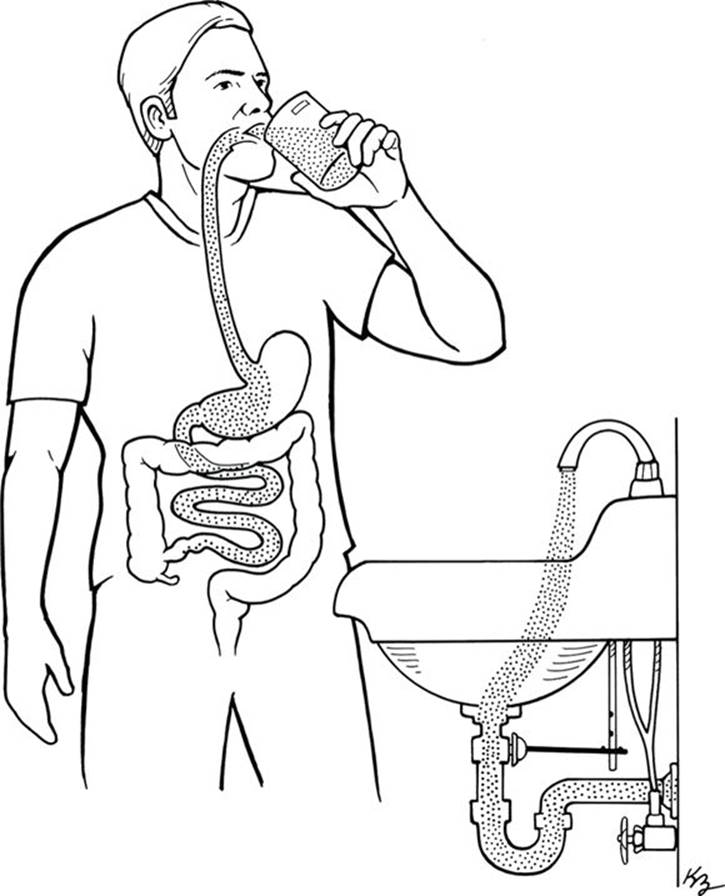
Illustration by Kathryn Born, MA
FIGURE 11-2: Juice goes through your system like water goes down the drain.
But wait — you may say, “I thought fruit juice was healthy!” Although it’s true that fruit is filled with vitamins, minerals, antioxidants, and many nutrients, fruit juice also contains a lot of natural sugar in liquid form. Eating fruit is part of a healthy, balanced diet, but it’s better to eat the fruit, not drink the juice. Eating a serving of fruit two or three times each day is recommended, but I don’t recommend eating all three portions at one time because large portions of fruit consumed in one sitting can cause a sharp rise in blood-glucose levels. When you drink a glass of fruit juice, you are having multiple servings of fruit at one time. The juice of one orange may fill your glass about one inch. A glass of juice is more like several fruits at one time.
Vegetables have many of the same vitamins and minerals that fruits have but with lower sugar content. You may find that you can enjoy a glass of vegetable juice without the same blood-sugar spike that fruit juice often causes. Portion size matters, so aim for about 4–8 ounces of vegetable juice at a time. An 8-ounce portion may contain close to 10–15 grams of carbohydrate, so you may not want to drink large volumes.
Before you nix juice completely, think about this: Fruit juice can actually come in handy in a couple of key situations. There’s no need to keep large bottles of juice in the fridge, though. Single-serving (4–6 ounce) containers can be used for treating and preventing low blood-glucose levels. See details in the following sections.
Treating hypoglycemia
Because juice raises blood-glucose levels quickly, it’s an excellent choice for treating hypoglycemia. When blood-glucose levels fall too low, then 4–6 ounces of fruit juice may be just what you need to quickly recover from the low. Remember to recheck your blood glucose again in 15 minutes to make sure you get back into a safe blood-glucose range.
When blood-glucose levels fall too low, typically defined as less than 70 milligrams per deciliter, then follow the Rule of 15:
· Take 15 grams of carbohydrate.
· Wait 15 minutes and recheck blood-glucose levels.
· Repeat until blood-glucose levels are back in a safe range.
Four ounces of fruit juice contain approximately 15 grams of quick-digesting carbohydrate. For more tips on treating low blood sugar, see Chapter 15 .
Preventing low blood glucose during exercise
Exercise is another time when juice may come in handy. That doesn’t mean that everyone should drink juice before exercising. If you’re on insulin or pills that could cause hypoglycemia, check your blood glucose before and during exercise to assess the need for carbs. Small amounts of fruit juice can be used to supply energy to the working muscles so that blood-glucose levels don’t fall too low during, or after, exercise. Diluting fruit juice and sipping it during prolonged or strenuous exercise can help prevent exercise-related hypoglycemia. You can choose to use an electrolyte beverage in the same manner, if you need it. Just be sure to check the label for the carb count.
Note: There is much to consider in balancing exercise with carbs and meds. You can find more info in Chapter 14 .
REALIZING THAT JUICING WASN’T HELPING
Maria came to a class that I was teaching on diabetes self-management for type 2 diabetes. I was explaining that juice and smoothies can have a big impact on blood-glucose levels, and that for the most part, it’s best to simply avoid the concentrated liquid carbohydrate drinks. I noticed her eyes widen as she let out a big sigh. She told the class, “When I was diagnosed with diabetes last month, I decided to take action and eat healthier. I went out and bought a high-powered juicer, and I’ve been blending orange juice with frozen berries and bananas ever since!”
It’s no surprise that Maria’s blood-glucose levels were not improving while she was drinking her homemade smoothies. In fact, once she stopped the smoothies and the fruit juices, and added some exercise, her blood-glucose levels improved greatly.
It’s Not Just the Carbs — It’s the Calories Too
Liquid carbohydrate sources can have an impact not only on your blood-glucose control but also on your weight. Sugar-sweetened beverages, sodas, juices, smoothies, energy drinks, shakes, and specialty blended coffee drinks all pack in the calories. Too many calories can lead to unwanted weight gain. Excess weight can make it harder for your insulin to do its job of controlling blood-glucose levels. Being overweight worsens insulin resistance and makes blood-glucose management more difficult.
Table 11-1 lists popular beverages with their carb and calorie counts.
TABLE 11-1 The Carb and Calorie Counts of Common Beverages
|
Beverage |
Carb Count in Grams |
Calorie Count |
|
8.4-oz. energy drink |
28 |
110 |
|
20-oz. electrolyte-replacement drink |
34 |
130 |
|
12-oz. can of soda |
40 |
150 |
|
16-oz. specialty coffee drink |
60 |
250 |
|
20-oz. bottle of soda |
65 |
240 |
|
16-oz. bottle of juice |
70 |
280 |
|
12-oz. fast-food chocolate shake |
100 |
575 |
|
32-oz. soda |
110 |
400 |
|
28-oz. fruit-juice smoothie |
120 |
509 |
The numbers listed in Table 11-1 represent the categories mentioned, but there is certainly variation, so check your Nutrition Facts food labels.
Did you know that 1 teaspoon of sugar has 4.2 grams of carbohydrate? To calculate the number of teaspoons of sugar in any of the beverages in the table, just take the number of grams of carb and divide it by 4.2.
For example, a 12-ounce can of soda with 40 grams of carbs equals nearly 10 teaspoons of sugar. Even though juice is natural, the standard 16-ounce bottle of juice is equivalent to nearly 17 teaspoons of sugar. Ounce for ounce, juice is similar to soda in sugar content. Whether you’re drinking fruit sugar or white sugar, the response in the blood-glucose level is about the same. What about the 12-ounce chocolate shake with 100 grams of carbs? Well, that shakes down to having nearly 24 teaspoons of sugar. A teaspoon of sugar has about 16 calories.
The sugars in sweetened beverages have nearly 4 calories per gram, and with the amount of sugar being swigged in sweetened beverages, the calories can really add up. Some beverages — a milkshake, for example — have additional calories coming from fat.
The American Diabetes Association (ADA) publishes the annual Standards of Medical Care for Diabetes. Guidelines are updated and released every January in the journal Diabetes Care. The ADA emphasizes that “people with diabetes and those at risk should limit or avoid intake of sugar-sweetened beverages to reduce risk for weight gain and worsening of cardiometabolic risk profile.” You can view the Standards of Care online by visiting the ADA website at www.diabetes.org . Click on the Professionals section, and then click on Standards of Care.
Last Call for Alcohol: What’s the Verdict?
Having diabetes and having a drink takes a little forethought, besides the usual warnings, such as don’t drink and drive and don’t drink too much. Managing diabetes safely means you should first discuss alcohol use with your doctor.
The following sections talk about alcohol’s risks, effects, carb counts, and calorie counts. You also get information on drinking alcohol safely.
Being informed about the risks
Talk to your doctor or nurse practitioner about alcohol use. Review your medication list and your overall health history to find out whether alcohol is safe for you to use in moderation. Alcohol may be unadvisable depending on your health history and the meds you take. If your doctor gives the green light, ask how much and how often you can safely drink.
Some considerations regarding alcohol use that apply to everyone, with or without diabetes, include the following:
· Alcohol is high in calories and can contribute to weight gain.
· The more you drink, the more likely you’ll suffer from high blood pressure.
· Drinking too much can raise triglyceride levels (blood fats).
· Excessive alcohol use can lead to liver disease, pancreatitis, neuropathy (nerve damage), and some forms of cancer.
· Heavy drinking is linked to depression and dementia.
· Overconsumption of alcohol increases the risk of heart disease and stroke.
· Too much alcohol impairs the immune system, making it harder to fight off illness and infection.
Alcohol holds an additional risk for a person with diabetes. Alcohol can lower blood-glucose levels and can lead to severe hypoglycemia for insulin users — that means all people with type 1 diabetes, and anyone with type 2 diabetes who is treated with insulin. The risk of hypoglycemia also applies to certain diabetes pills. Specifically, if you take any diabetes medication that stimulates your pancreas to make more insulin, including a class of medications known as sulfonylureas, then you, too, are at risk for hypoglycemia. If you aren’t sure, ask your doctor or pharmacist about the medications that you are on to find out whether you’re at risk for lows.
Going behind the scenes: How alcohol affects the body
It is important not to drink on an empty stomach. A mini physiology review may shed some light on why it’s so important to have carbs digesting when you have a drink.
Blood-glucose levels are at their highest typically one to two hours after eating a mixed meal. (A mixed meal is a meal that contains carbs, protein, and fat.) Protein and fat cause the carbs to digest slower. A mixed meal takes roughly four hours to finish digesting. During digestion, carbs are breaking down into glucose and entering the bloodstream. Normally, some of the glucose from the meal is packed away in the liver and saved, to be used later as needed. When the meal is completely done digesting, the liver is supposed to release the glucose that was previously stored. Your body must always have glucose in the blood to keep the vital organs functioning properly. (For more information on the physiology related to diabetes, see Chapter 4 .)
Alcohol goes to the liver to be detoxified, processed, and broken down into safe byproducts. While the liver is breaking down the alcohol, it may not be able to release glucose normally. If the glucose release from the liver is compromised, then the insulin (or certain diabetes pills/medications) may continue to push the blood-glucose levels lower and lower. A single drink can take two or more hours to be processed by the liver, so glucose regulation may be impaired for that amount of time or longer. The liver stays busy for two hours or more per drink, so the more drinks you consume, the longer you are at risk for low blood-glucose reactions. Figure 11-3helps clarify the concept.
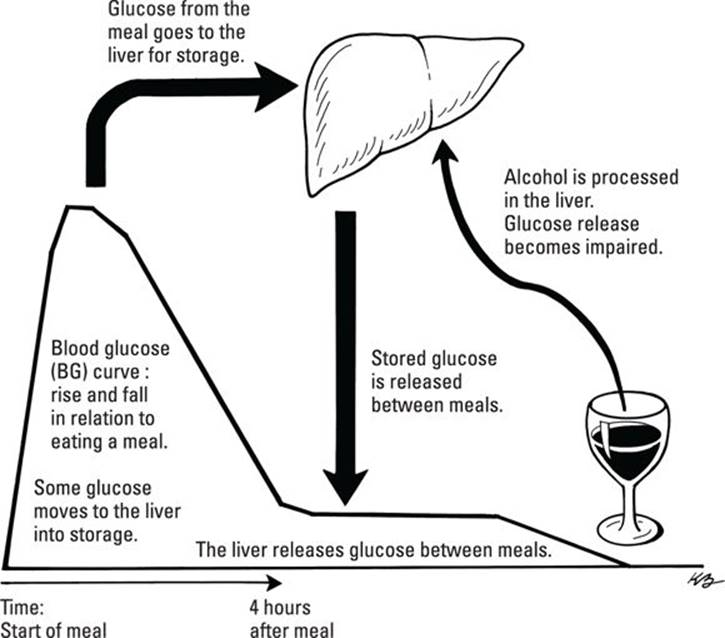
Illustration by Kathryn Born, MA
FIGURE 11-3: Alcohol impairs glucose regulation.
In Figure 11-3 , the gray shaded area represents the rise and fall of the blood glucose after eating a meal. When foods are finished being digested and absorbed, the liver’s job is to release glucose that had been previously stored. Alcohol impairs that process because the liver preferentially breaks down the alcohol. Hypoglycemia may ensue.
If you drink on an empty stomach, that means there is no carb digesting, so there’s no glucose supply via digestion. Your liver is supposed to release glucose between meals. If alcohol impairs the liver from releasing glucose, you cut off your only glucose supply. Your meds can make your blood glucose drop too low.
Looking at liquor’s carbs and calories
A common misconception about alcohol is that many people assume alcohol turns to sugar, or alcohol will raise their blood-glucose levels. Actually, hard liquor doesn’t have any carb, wine is very low in carb, and beer has about as much carb as a piece of bread:
· Hard alcohol (distilled spirits) doesn’t have any carbs, except for whatever it’s mixed with.
· Most wines have only 3–5 grams of carbohydrate per 5-ounce glass. The sugar from the grape juice turned into alcohol during the fermentation process.
· Beer has roughly 13 grams of carb per 12-ounce portion. The carbs in beer come from wheat, barley, or malt.
However, if your drink comes with a cherry and an umbrella, I’m guessing it has carbs, probably lots. Mixed drinks can be especially high in calories when you consider the alcohol and the mixers. Sugary mixers, soda, or juices can lead to a rise in blood glucose, at least temporarily, because the liquid carbs get into the bloodstream fast. But blood glucose may end up plummeting later.
Insulin users may wonder whether they should “cover the carbs” in their alcoholic beverages with insulin. That may work okay at mealtime for one drink: for example, if you have a beer with a carb-containing dinner. Say the beer has 13 grams of carb and the meal has 55 grams of carb. You may be fine counting the total as 68 grams of carb and taking the appropriate dose of insulin. The food and the insulin both last about four hours. The alcohol should be done processing within about two hours. That’s why you’re less likely to get low blood sugar if you have your drink with a meal.
However, drinking on an empty stomach is a different story. Consider this: If you take insulin to cover the carbs in an alcoholic beverage, the rapid-acting insulin will last about four hours, but the liquid carbs in a beer or in carb-containing mixers will be digested very quickly — within 15 minutes of drinking. On an empty stomach, alcohol has a blood-glucose-lowering effect for two or more hours per drink. The carbs won’t last as long as the alcohol and the insulin, which increases the risk of having hypoglycemia.
Talk to your doctor about insulin and alcohol. The discussion in this book is conceptual and not meant to provide insulin dosing instructions. Medication use and adjustments must be discussed with your doctor.
Some alcoholic beverages have carbs, but all of them have calories. Alcohol has 7 calories per gram, protein and carbohydrate have 4 calories per gram each, and fat has 9 calories per gram, so fat and alcohol are the most calorically dense. Alcohol can contribute to weight gain, so it’s important to account for the calories consumed. Table 11-2 lists popular alcoholic beverages and their average carb and calorie counts. Extra stout beers would have more carbs and calories than listed, and beers in general vary by brand. Mixed drinks have a wide range of carb and calorie counts — too wide to mention here — but some frou-frou drinks push upwards of 500 calories up that straw.
TABLE 11-2 The Carb and Calorie Counts of Common Alcoholic Beverages
|
Beverage |
Grams of Carb |
Calorie Count |
|
80 proof spirits — 1.5 oz. |
0 |
100 |
|
Wine (red or white) — 5 oz. |
3–5 |
125 |
|
Beer (light) — 12 oz. |
5–6 |
100 |
|
Beers (average) — 12 oz. |
11–15 |
150 |
The numbers listed in Table 11-2 represent some averages across the categories mentioned, but there is certainly variation. Check labels, look online, or contact manufacturers for details. I talk about the calorie counts of other beverages and why it’s important to know them earlier in this chapter.
Drinking safely
Drinking increases the risk of low blood-glucose levels (hypoglycemia) for anyone taking insulin or certain oral agents (pills) used to treat diabetes. Keep your meter handy and use it. Staying safe means limiting your intake of alcohol. It’s very important that you never drink alcohol on an empty stomach. If you’re going to have a drink, have it with a meal or snack that has adequate carbohydrates. And first and foremost, get your healthcare provider’s approval and advice before drinking.
The following sections provide additional pointers on drinking alcohol safely when you have diabetes.
Knowing the recommended limits and portions
Healthcare experts generally recommend that adult women limit their alcoholic beverages to one drink per day and that adult men limit consumption to two drinks per day at most.
The actual alcohol content of a standard drink is 14 grams of pure alcohol. Each of the following portions count as one alcoholic beverage:
· 5 ounces of wine
· 12 ounces of beer
· 1.5 ounces of distilled spirits (80 proof)
By the way, a shot glass holds 1.5 ounces.
Checking blood glucose levels and being prepared
Besides the health risks already discussed in this chapter, alcohol use with diabetes can cause a few more problems. Here are a few additional things to keep in mind:
· Alcohol can impair your judgment, and diabetes self-care may suffer.
· Alcohol may diminish your ability to feel the symptoms of hypoglycemia, so the lows can sneak up on you without warning.
· If your blood-glucose levels drop too low, you may become unsteady on your feet. Other people may think you’re drunk when in fact you may have low blood-glucose levels (hypoglycemia) and be in need of assistance.
The only way to stay on top of what your blood-glucose levels are doing is to take out your meter and check. (If you’re on a continuous glucose monitor, check it frequently.) Carry glucose tablets or other quick-acting carbs in case you need to treat low blood glucose. Be aware that if you have had one episode of hypoglycemia, you’re more likely to have another low in the coming hours.
While one generation may be having drinks at cocktail hour, before dinner, and another generation may be drinking into the wee hours of the morning, which may be many hours after dinner, both are at risk for hypoglycemia because these drinking times tend to be on an empty stomach. Consider the need for a carb snack. Late-night drinking can be especially treacherous because blood-glucose levels can fall extremely low and go undetected by you or anyone else once you are asleep.
Consider these safety pointers:
· Wear medical alert identification.
· Check your blood glucose more frequently if you’ve had alcohol.
· Carry carb snacks and quick carbs for treating lows.
· Set an alarm on loud to wake yourself up to check your blood glucose in the middle of the night if you’ve been drinking. Keep your meter and low supplies, such as juice, by the bedside.
· Educate family and friends on how to assist you, should the need arise.
· Be especially careful about drinking after exercise because you’re even more prone to hypoglycemia.
If you’re going to be enjoying a drink, be sure to do so safely. Be aware, be prepared, and pair your alcoholic beverage with a carbohydrate-containing snack or meal.