
IN THIS CHAPTER
 Identifying factors that can lead to lows
Recognizing signs and symptoms of hypoglycemia
Treating low blood glucose fast and effectively in various situations
Proactively problem-solving to reduce risks
Without diabetes, the human body does an amazing job at keeping blood-glucose levels in a fairly narrow and safe range. Fasting and pre-meal levels normally range from 70–99 milligrams per deciliter (mg/dl). Of course after eating, glucose levels rise as carbohydrates digest and enter the bloodstream. Normal post-meal blood-glucose levels range from 100 to 139 mg/dl.
Insulin, a hormone produced by the pancreas, helps the body use and store glucose. Insulin lowers blood-glucose levels. Other hormones, known as counter-regulatory hormones, raise blood-glucose levels by stimulating the liver to make and release glucose. Insulin and counter-regulatory hormones are supposed to work in orchestration to keep blood-glucose levels controlled.
When the pancreas is working properly, insulin production turns on and off as needed. Insulin that is made by the pancreas is secreted directly into the bloodstream and lasts only a few minutes before it is cleared from the bloodstream by the kidneys. The pancreas secretes insulin as needed and pauses when blood glucose drops to the lower limits of normal. Counter-regulatory hormones then get to work to raise blood glucose by stimulating the release of glucose from the liver. When glucose levels rise sufficiently, the counter-regulatory hormones subside. Back and forth it goes day after day. Hard-working hormones are behind the scenes regulating blood-glucose levels. Diabetes, however, interferes with that delicate balance.
Hypoglycemia means deficiency of glucose in the blood. Diabetes doesn’t cause hypoglycemia; some of the medications used to treat diabetes can lead to hypoglycemia if there is an imbalance between medications, foods, and activity levels. Diabetes can only cause high blood sugar, more accurately referred to as high blood glucose or hyperglycemia. Mild hypoglycemia is easily treated by consuming glucose or any other rapidly digesting form of sugar. Hypoglycemia is considered severe if treatment requires the help of another person or a paramedic. Low blood glucose is a complication that can lead to injuries and accidents. Severe hypoglycemia, if untreated, can lead to loss of consciousness, seizure, coma, and rarely even death. Luckily, with knowledge and preparation, you can prevent problems and stay safe.
 This chapter provides information for people who have diabetes and are at risk for hypoglycemia. Speak to your healthcare provider and review your medication list to find out whether or not you are at risk for hypoglycemia.
Understanding Hypoglycemia
Insulin is the main medication associated with the risk of low blood sugar, more accurately referred to as low blood glucose or hypoglycemia ; however, some diabetes pills can also cause hypoglycemia. Type 1 diabetes results in the inability to produce insulin, so people who have type 1 must take insulin for life. Many people with type 2 diabetes also take insulin to manage their diabetes because insulin is very effective in lowering blood-glucose levels. Insulin is a lifesaving but powerful medication, so proper training and self-management education are required for safe use.
Insulin is injected under the skin into fatty tissue called adipose. It takes time for the insulin to make its way from adipose to the bloodstream. Timing of action depends on the type of insulin. Insulin comes in rapid-acting, short-acting, intermediate-acting, and long-acting varieties. Once insulin is injected, it will continue to lower blood-glucose levels for its full duration of action. Insulin doses must be coordinated with carbohydrate intake and with consideration to planned activity and exercise.
Some oral medications that are used to treat type 2 diabetes work by stimulating the pancreas to secrete more insulin. Those medications can also cause hypoglycemia, particularly if a meal is missed or if too few carbs are eaten. Other diabetes medications pose no risk of hypoglycemia whatsoever. Blood-glucose monitoring provides important information that can be used to make adjustments to your treatment regimen. Monitor your blood-glucose levels, keep records, and share results with your healthcare providers. If you’re uncertain about your risk for hypoglycemia, speak to your doctor or a pharmacist.
This section explains what level of blood glucose is considered too low, identifies the causes and symptoms of hypoglycemia, and discusses hypoglycemia unawareness. The rest of this chapter provides information to help you treat, problem-solve, prevent, and get help with hypoglycemia.
Injected insulin and certain diabetes pills that increase insulin production can lead to hypoglycemia. The successful management of diabetes requires learning to strike the right balance between foods (particularly carbs), medications, and exercise. Discuss your personal blood-glucose targets with your healthcare provider and follow dosing instructions for all medications prescribed.
Defining a low blood-glucose level
A blood-glucose level that dips below 70 mg/dl is typically considered hypoglycemic. Young children and the elderly are at higher risk for severe hypoglycemia, so it makes sense to have a safety margin and strive to keep their blood-glucose levels safely above 90 mg/dl. Consider an elderly person who is at risk for falls. For a frail senior to take a fall and break a hip due to hypoglycemia would be a big setback. Young children are especially vulnerable because they have trouble recognizing symptoms and communicating the need for help.
Blood-glucose monitoring is an important part of diabetes management. Keeping records and learning from past experiences can improve blood-glucose control in the future. Problem-solving for prevention of hypoglycemia is addressed later in this chapter.
Identifying causes of hypoglycemia
Hypoglycemia occurs when there is an imbalance between insulin, carbs, and exercise. At times it may feel like you are walking a tightrope, trying to stay safely in the center and maintain stability without tipping too far to one side (hyperglycemia, or high blood glucose) or the other (hypoglycemia). You can reduce the risk of hypoglycemia by learning more about managing your diabetes. The most common causes of low blood glucose are discussed in this section, followed by information on how to recognize symptoms.
Everyone with insulin-treated diabetes should have a medical alert bracelet, necklace, or some form of identification that says you have diabetes. Many styles can pass as jewelry. If you don’t want a bracelet, consider a necklace chain with a tag that hangs inside your shirt. It’s discreet but still there if needed. I’ve even seen several people with medical alert tattoos! Anything goes. If you ever require assistance due to severe hypoglycemia, the medical alert provides critical information to help assure that you get the treatment you need. Health issues other than hypoglycemia can be included on medical alert tags, too. A wide variety of styles for women and men are available online. Just use your favorite search engine to look up medical alert tags.
Taking too much medication
If you take more insulin than needed or double the doses of some of the diabetes pills, the excess medication could lead to low blood-glucose levels. Sometimes medication dosing mistakes happen. The following are some such examples:
· Taking the wrong kind of insulin: If you ever mistakenly take your rapid-acting insulin at bedtime instead of your long-acting insulin, then you have no choice but to eat carbs. You must consume enough carbs to balance the insulin you took. Such a mistake also means you should stay awake and check your blood-glucose levels frequently in the coming hours. Prevent this error by carefully inspecting the insulin vial or pen prior to injecting.
· Calculating the wrong insulin dose: If you use insulin-to-carb ratios (see Chapter 6 ), it is very important to count carbs correctly. Nutrition Facts food labels list the grams of carbohydrate. I’m aware of situations when the insulin dose was accidentally based on the number associated with the weight of the product or the percent daily value instead of the number of grams of carbohydrate. If you are guesstimating on carb counts, you may end up with the wrong dose. See Chapter 7 for clarification on how to read food labels correctly and Chapter 8 to find out how to count carbs in foods that don’t have labels.
· Stacking doses: Many people with type 1 diabetes are taught how to calculate and take insulin correction doses when blood-glucose levels are above target. For example, the insulin dose taken at mealtime consists of two parts:
o The first variable to consider is the dose of insulin needed to balance the amount of carb in the meal, which is determined using the insulin-to-carb ratio.
o The second variable to consider is the pre-meal blood glucose value.
A correction ratio is used if the pre-meal blood glucose is above target. Take for example a person with a blood-glucose level of 200 before eating 45 grams of carb. Insulin is needed for the carbs, and additional insulin is needed to bring down the elevated glucose level. Rapid-acting insulin continues to lower blood glucose for about four hours. Yet many people get impatient if an hour passes and the blood-glucose level is still elevated. It would be a mistake to calculate another correction dose so soon. Taking another correction dose within three hours of the last correction dose puts you at risk for subsequent hypoglycemia. If one dose is working on top of another dose, then the synergy can cause blood-glucose levels to drop too low.
Discuss insulin correction doses with your healthcare provider. If you use an insulin pump, your pump likely has a feature called “insulin-on-board,” which takes previous doses into account when calculating subsequent correction doses.
· Doubling doses of diabetes pills: Have you ever second-guessed yourself and questioned whether or not you took your pills? If you end up taking a double dose, your blood glucose can drop too much. You may find it easier to keep track of doses if you organize your pills into a pill caddy.
If you forget a dose, don’t double up on the next dose. It’s important to take all medications as prescribed. Do not increase medication doses on your own, because doing so can cause hypoglycemia and other problems. See your healthcare provider to get a tune-up on your prescriptions if your blood glucose is not well controlled.
Failing to eat enough carb
Carbohydrates provide glucose to fuel your body. If you don’t eat enough carbs to meet your basic needs (as shown in the following examples), medications that are used to treat diabetes could cause hypoglycemia during the day or overnight while you sleep. See Chapter 5 for tips on setting a reasonable carbohydrate-intake goal. The following circumstances can lead to a carb shortage:
· Missing a meal: Distributing carbs throughout the day into three meals helps provide batches of glucose to fuel your body. During the day some of the available glucose from your meals is shuttled into your liver and muscles to be stored as glycogen. If you miss meals or have meals that don’t contain enough carb, you may not have spare glucose to satisfactorily fill glycogen storage sites. Depleted glycogen stores increase your risk of hypoglycemia.
· Undereating carbs at mealtime: If you take a dose of insulin to cover your meal but then eat less than planned, you could end up with low blood glucose. Once you take a dose of insulin, you are committed to eating the expected amount of carb. If you don’t finish an entrée, you may be able to make up the carbs by eating a serving of fruit. Or perhaps you could opt to check blood-glucose levels frequently in the hours after the injection and eat more carbs only if and when needed.
· Ongoing carb restriction: Carbs provide glucose to fuel vital organs, cells, tissues, and muscles. Glucose also supports physical activity. The vital organs use a sizable amount, as glucose is the preferred fuel for the brain, liver, and red blood cells. Muscles also burn glucose. You need enough carb to keep all systems running efficiently during the day and to maintain stable blood-glucose levels overnight. Carb food groups also provide important nutrients. Chapter 13 provides advice on healthy eating.
If you’re eating reasonable amounts of healthy foods and your blood-glucose levels are elevated, it may be time to meet with your doctor to discuss medication options.
Mismatching meals and meds
Understanding how your insulin works is critically important. See Chapter 6 to review onset, peak, and duration times for various types of insulin. Meals and injections must be timed so that the insulin is available at the same time that the food is being digested. The following list gives examples of mismatching meals and meds:
· Injecting off schedule: Rapid-acting insulin is designed to be taken right before eating or within 15 minutes of the meal. If you inject too far in advance, the insulin peaks before the food digests and blood glucose can plummet. Don’t inject at home and then drive to the restaurant! Regular insulin is slower to get going and is supposed to be injected 30 minutes before the meal.
If you aren’t sure what kind of insulin you take, be sure to review your insulin plan and dosing schedule with your doctor.
· Timing pitfalls with blended insulins: 70/30 insulin is a blend of two different types of insulin. It may be an appropriate option for treating type 2 diabetes but isn’t the insulin of choice for treating type 1 diabetes. It is 70 percent intermediate-acting insulin and 30 percent rapid- or short-acting insulin. When 70/30 is injected before breakfast, the rapid-acting insulin kicks in and covers the carbs in the breakfast meal. The intermediate-acting insulin will peak later to cover the carbs in lunch. If lunch is delayed or doesn’t contain enough carb, then blood-glucose levels can drop. The same concept holds true for the 75/25 and 50/50 blended insulin preparations.
Being regimented in meal timing and carb amounts is important when using blended insulin preparations. Plan to eat the same amount of carbs from day to day and keep the carb amounts at meals consistent. When using blended insulin (such as 70/30 or 75/25), it is important to eat lunch four to five hours after the morning injection. Taking blended insulin before dinner covers the carbs in dinner and the glucose that is released from the liver while you sleep. You do not need to eat another meal four to five hours after the dinner injection. Whether or not you should have a small bedtime snack depends on circumstances and should be discussed with your healthcare providers.
Exercising without carb compensation
Your liver and muscles hold a storage form of glucose called glycogen. When you exercise, you use glucose from the bloodstream and also tap into glycogen stored in the liver and muscles. The more you exercise, the more glucose you burn. If you don’t eat enough carbs to support your activity, you could end up with low blood glucose (as you see in the following list). Eat carbs as needed before, during, or after exercise to prevent hypoglycemia. Figuring out whether or not you need to snack to compensate for exercise or how many carbs you need for your particular workout is a matter of trial and error. See Chapter 14 for more about exercise.
· Being caught unprepared: Monitor blood-glucose levels before and throughout exercise. Snack as needed to prevent hypoglycemia. Be prepared; carry your meter, carb-containing snacks, and glucose tablets or other quick-digesting carbs in case your blood glucose drops. Stay hydrated; carry water. Appropriate carb options for treating lows are discussed later in this chapter.
· Depleting glycogen stores and causing delayed hypoglycemia: Exercise can use up significant amounts of glucose. If you don’t have an adequate amount of carb available to support your level of exercise, you’ll burn through some of the glucose that has been stored as glycogen in your muscles and liver. Glycogen stores strive to be refilled and will draw glucose from the bloodstream until fully replenished. That means blood-glucose levels can continue to drop for hours after strenuous or long-duration exercise sessions. Delayed hypoglycemia is a result of not eating enough carbohydrate to support the exercise session. In a more extreme example, someone who skis all day could experience hypoglycemia up to 24 hours later as glucose from the bloodstream is drawn upon to refill glycogen storage sites.
Drinking alcohol
Many people are surprised to find out that alcohol doesn’t turn to sugar. Wine is actually low in carbs even though it is made from grape juice. During fermentation, the yeast converts juice into alcohol. Hard liquor contains no carbs whatsoever unless you add mixers. But that doesn’t mean drinking alcohol has no impact on blood-glucose levels.
 Drinking alcohol can lead to significant hypoglycemia for anyone with diabetes who uses insulin or pills that stimulate insulin production. The reason, in simple terms, is that alcohol is processed in the liver. When the liver is busy detoxifying the alcohol, it may be unable to release normal amounts of glucose. The liver is the body’s key source of glucose when food is not digesting. A balanced meal may take about four hours to digest, but after that, the liver is supplying glucose between meals and while you sleep. Once the liver diverts its attention to breaking down the alcohol, it may not be able to supply adequate amounts of glucose. Blood-glucose levels can then drop because of the diabetes medications in your system.
If you become hypoglycemic after drinking alcohol, you could lose coordination and end up staggering. Anyone who may have seen you drinking could assume you are intoxicated and not realize you are in need of assistance. The following are alcohol-related causes of hypoglycemia (see Chapter 11 for more information on alcohol and other beverage options):
· Exceeding suggested limits: A single drink may take two or more hours for the liver to process. That means two drinks can tie up your liver for four hours, three drinks for six or more hours, and so on. You’re at risk for hypoglycemia the entire time the liver is busy breaking down the alcohol. The more you drink, the more prolonged the risk.
The American Diabetes Association and other health experts recommend limiting alcohol to not more than one drink per day for women and two drinks for men, and never on an empty stomach. Drinking in the evening can be especially treacherous as blood-glucose levels can dip dangerously low while you sleep. Late-night drinking at bars, clubs, concerts, and parties increases the risk of nocturnal hypoglycemia. It is unlikely that you or anyone around you will notice that you are low if you are sound asleep. Cocktail hour before dinner is also risky because lunch has likely finished digesting by then. Find a carb-containing snack as needed.
Some people should not drink at all because of medication interactions or other health concerns. Ask your doctor to assess your health history and medication list to provide personal guidance on safe alcohol use.
· Drinking on an empty stomach: It is safer to have your drink at mealtime. Be sure to eat something with carbs. The carbs from the meal will be digested and provide glucose, which leaves your liver free to devote its attention to detoxifying the alcohol. If you want an alcoholic beverage between meals, consider the need for a carbohydrate snack. Chicken wings and nuts don’t count because they do not supply carbs. Pretzels or crackers may be a better choice.
Recognizing the symptoms of hypoglycemia
It is important to use your meter to verify blood-glucose levels. It’s possible to perceive symptoms of hypoglycemia when your blood glucose is not actually low. If your body has grown accustomed to having persistently elevated blood-glucose levels, you may start to feel symptoms of hypoglycemia when you are actually safely in a normal range. Your body may send the signals of low blood glucose just because you are lower than you have been in a long while. If your blood glucose is not actually low, you don’t need to drink juice or treat the low. Wait and recheck later.
Some people don’t have any symptoms at all even when they have critically low blood-glucose levels. The lack of symptoms is known as hypoglycemia unawareness. This phenomenon indicates that your body has gotten used to being low and no longer perceives hypoglycemia as unusual so it stops sending signals. I discuss hypoglycemia unawareness in more detail in the next section.
Following are some of the most common symptoms of low blood glucose:
· Sweating, clamminess
· Shakiness, tremors
· Rapid heartbeat
· Nervousness, anxiety
· Irritability, impatience
· Blurred vision
· Nausea
· Hunger
· Tingly lips, numbness
· Lightheadedness
· Confusion
· Headaches
· Sleepiness, fatigue
· Pallor (paleness)
· Unsteadiness, dizziness
· Nightmares, thrashing
· Unresponsiveness
· Fainting, seizures
Losing symptoms of lows: Hypoglycemia unawareness
When blood-glucose levels dip close to 70 mg/dl, the counter-regulatory hormones should signal the liver to make and release glucose. Those hormones may cause rapid heartbeat, shaking, and sweating. If blood-glucose levels frequently dip too low, the body gets used to it so symptoms may not kick in until blood-glucose levels are below 65 mg/dl. If you dip below that too often, your body may adjust its panic response and not send signals until blood-glucose levels hit 60 mg/dl, then 55 mg/dl, then 50 mg/dl. If your levels get too low too often, your body may simply stop sending the signals of hypoglycemia.
Impaired awareness of hypoglycemia is really dangerous. Imagine driving down the freeway with a blood-glucose level of 40 mg/dl and having no symptoms at all. You could be driving one minute and passed out the next minute. Hypoglycemia unawareness can be hazardous to you and those around you; don’t drive until your body is recalibrated to sense the lows, and always check blood-glucose levels before driving.
It is possible to regain symptoms with the help of the following tactics:
· Reversing hypoglycemia unawareness: The best way to reverse hypoglycemia unawareness is to diligently avoid hypoglycemia. Keep blood-glucose levels higher for several weeks or longer. That may mean running your blood-glucose levels higher than typically recommended or higher than you are comfortable with. Discuss blood-glucose targets with your healthcare provider. If you avoid hypoglycemia long enough, your body can readjust and learn to recognize hypoglycemia and provide symptoms again. Symptoms are important warning signals that can prompt you to eat carbs before your blood glucose is dangerously low.
· Monitoring more frequently: Anyone with frequent hypoglycemia or any degree of hypoglycemia unawareness should monitor blood glucose with greater frequency and may benefit from a continuous glucose monitor (CGM). To use a continuous glucose monitoring system, the user inserts a disposable sensor probe under the skin; it is taped down and remains in place for about a week. The CGM checks your blood-glucose levels every few minutes around the clock. Blood-glucose readings are transmitted wirelessly, and results are displayed on a receiver or an insulin pump. Alarms can be set to alert you when your blood glucose is dropping. Setting the lower limit alarm for 80 or 90 mg/dl provides the opportunity to eat a snack before becoming hypoglycemic. The device also indicates the rate of change so you know how quickly your blood-glucose level is dropping (or rising) and can make appropriate management decisions. CGM systems can be used periodically for gathering detailed glucose data to guide diabetes management decisions, or the user can insert a new sensor immediately after the expired sensor is removed. For more on blood glucose monitoring, see Chapter 23 .
Treating Hypoglycemia
Anyone at risk for hypoglycemia should be prepared by carrying carbs at all times. It isn’t good enough to have glucose tablets in the car when you’re out walking around the lake. The carbs always need to be with you. Not all carbs are created equal when it comes to treating low blood glucose.
This section provides details on which carbs to use and how much to take when treating mild hypoglycemia. I also discuss the management of severe hypoglycemia with glucagon.
Choosing quick-acting carbs
When treating hypoglycemia, the objective is to get your blood glucose to come back up as quickly as possible. Glucose, available in tablet or gel form, works rapidly. Other carbs also work well, such as the following:
· Liquids get through the stomach quickly. Fruit juice and regular sugar-containing soft drinks such as soda (not diet) also have the potential to raise blood-glucose levels in just a few minutes.
· You can use candy as a treatment for lows provided it is pure sugar and doesn’t contain chocolate, fat, or nuts. Fat delays digestion, and chocolate, nuts, and butter are all high in fat. Fatty desserts, including candy bars, cookies, and pies, also won’t digest as quickly as jelly beans, gumdrops, Skittles, or Starburst candies. The pure sugar candies make their way through the stomach quickly. Fat delays gastric emptying, so fatty foods are held up in the stomach for too long.
· Fresh or dried fruit are appropriate options for treating lows. Fruit contains natural sugar, and there’s no fat or protein to delay absorption.
Taking the right amount of carb
When treating low blood glucose, you need enough carb to sufficiently raise blood glucose. If you overdo it and eat too much, you can end up with elevated blood-glucose levels.
The usual recommendation for treating hypoglycemia is to consume 15 to 20 grams of easily digested carbohydrate. Consider the severity of the low, however. Very low blood-glucose levels may need a more robust dose of carb. Blood-glucose levels below 50 mg/dl may need 20 to 30 grams of carb. Young children may need only 5 to 10 grams of carb to recover from hypoglycemia, due to their small body size, and their pediatric diabetes specialists should provide personalized advice.
Things to consider when deciding how much carb is needed to treat hypoglycemia include
· Body size: An adult athlete needs more than a ten-year-old.
· Previous exercise: You likely need more carbs if you just finished a game of tennis versus sitting in front of a computer.
· The timing and amount of the last dose of insulin: Considering insulin action is covered in detail later in this chapter.
I explore managing variables related to hypoglycemia in more depth later in this chapter.
Following are some appropriate choices for treating hypoglycemia. The carbohydrate options listed are approximately 15 grams of carb per choice. All of them digest quickly, making them good options when treating hypoglycemia:
· 4 glucose tabs (read labels to find the exact amount of carb contained)
· 1 tablespoon of sugar, honey, or syrup
· 4 ounces (½ cup) of fruit juice
· 4 ounces (½ cup) of regular soda (not diet)
· 4 Starburst candies
· 15 Skittles candies
· 2 tablespoons raisins (1 mini box)
· 8 ounces (1 cup) nonfat or 1 percent milk
Here are a few additional options for 15 grams of carbs:
· Fruit can be used to treat hypoglycemia. An appropriate portion would be an apple or orange the size of a tennis ball, half of a banana, 17 grapes, or a cup of melon. See Appendix A for a complete list of fruits with serving sizes equaling 15 grams of carb.
· You can opt for jelly beans, gummy drops, hard candies, or any pure-sugar candy that doesn’t contain protein or fat. Read labels to determine the correct portion to achieve 15 grams of carb.
Carrying candy for treating lows may be too tempting for some people. You’re the best judge. If the jelly beans are going to be “calling your name” all day, you may not want them in your purse or backpack. Glucose tablets have less appeal so they tend to stay tucked away safely until actually needed.
· Glucose gel is also available, and it’s easy to consume: No chewing is needed. Read labels for carb counts. Tubes of glucose gel come in handy for surfers or people who do water sports and need to keep a carb source handy. The glucose gel comes in a waterproof tube with a screw-off cap, and the tube can be slipped into the wetsuit.
Gel should not be put in the mouth of a person who has passed out from hypoglycemia. Nothing should go in the mouth during a seizure or loss of consciousness due to the risk of choking.
Rechecking your blood-glucose level
Rechecking your blood-glucose levels 15 minutes after treating hypoglycemia is highly recommended. Don’t assume 15 grams of carb was enough to fix the problem. If blood-glucose levels are still low after 15 minutes, repeat the process: Take another 15 grams of carb and recheck again in 15 minutes. Once your blood-glucose levels are back up, you can make a decision about whether or not you should eat a carb-containing snack to prevent recurrent hypoglycemia.
The rule of 15 for treating lows is as follows:
1. Take 15 grams of quick-digesting carb.
2. Wait 15 minutes; recheck blood glucose.
3. If still low, take another 15 grams of quick-digesting carb and recheck blood glucose levels again in 15 minutes.
Repeat these steps until the hypoglycemia resolves. Call your clinic for advice as needed.
If it will be more than 30 minutes until your next meal, you should consider the need for a snack with 10 to 20 grams of carb to reduce the chance of another episode of hypoglycemia. That snack should contain some protein or fat so it digests more slowly.
Let your doctor know if you’re having frequent episodes of hypoglycemia, if hypoglycemic events aren’t easily resolved, or if you notice a pattern of hypoglycemia occurring at a similar time of day. Contact your doctor to report severe hypoglycemia, which is defined as hypoglycemia that caused a seizure, loss of consciousness, or treatment requiring the assistance of another person (for example, you were confused or uncoordinated to the point of being unable to find and consume carbs).
Watching out for rebounds
When blood-glucose levels drop, internal hormones attempt to rescue you and raise your blood glucose. Adrenaline is the “fight-or-flight” hormone responsible for telling the liver to dump glucose into the bloodstream so you have energy to run or respond. Adrenaline is what causes your heart to pound and your hands and knees to shake if you are abruptly startled or in a precarious situation. Some of the symptoms of low blood glucose are caused by hormones such as adrenaline. Hypoglycemia can cause the heart to race and the hands to tremble. The body perceives hypoglycemia as a precarious situation.
Sometimes the liver is overzealous and lets out too much glucose, leading to hyperglycemia. It’s called a “rebound” when blood-glucose levels shoot up too high after being too low. Sometimes a high blood-glucose level after an episode of hypoglycemia is simply the result of eating too many carbs to treat the low. It can be hard to stop eating after just 15 grams of carb because hypoglycemia doesn’t feel good. It’s tempting to keep eating everything in sight until you feel better. Keep in mind that the uncomfortable feelings associated with hypoglycemia may persist for a while. Blood-glucose levels can be rising sufficiently, and yet you may still feel shaky and panicky for several more minutes. It takes time for the fight-or-flight hormones to get the message that you are going to be okay. Remember to follow the rule of 15 when treating hypoglycemia: Eat 15 grams of carb, wait 15 minutes, and recheck blood glucose. Repeat until blood-glucose levels recover.
Requiring assistance: Severe lows and glucagon
Glucagon is a hormone that raises blood glucose by stimulating the liver to make and release glucose. Normally the pancreas makes glucagon automatically when blood-glucose levels fall too low, but with long-standing diabetes, glucagon production can become compromised. Glucagon is available by prescription and is administered by injection. Glucagon kits should be prescribed to everyone with type 1 diabetes and for people with type 2 diabetes on intensive insulin therapy.
Glucagon by injection is an appropriate treatment for severe hypoglycemia — for example, if the person with diabetes cannot safely swallow, displays severe lack of coordination or combativeness, loses consciousness, or has a seizure. Glucagon needs to be administered by a family member, friend, teacher, or co-worker. Potential helpers need to be identified and trained ahead of time so they know how to respond in the event of an emergency.
Glucagon kits (which expire annually) typically contain a vial of powder and a syringe that is pre-filled with a fluid. The powder in the vial is the glucagon. The glucagon needs to be mixed before using. First the fluid in the syringe must be injected into the vial of powder. Then the vial is swirled to dissolve the glucagon powder. Once mixed, the glucagon dose is drawn back into the syringe and can be administered by injection into the thigh or upper arm. The dose for children is smaller than the dose for adults.
The instructions discussed here are simply to familiarize you with the concept and are not a substitution for proper in-person training by a healthcare provider.
If someone with diabetes has passed out or is having a seizure, call 911. Any person trained to give glucagon can do so but it is important to stay with the unresponsive person because glucagon can cause nausea and vomiting. It is critically important to protect the airway and prevent aspiration (vomit entering the lungs). Place the person in the recovery position by rolling him on onto his side with the upper leg bent. The knee should act as a support and prevent him from rolling. Gently tilt the chin upward to keep the air passage open. See Figure 15-1 .
Illustration by Kathryn Born, MA
FIGURE 15-1: The recovery position.
For someone who has passed out, glucagon is the treatment of choice because you can’t put any carbohydrates in the mouth of an unconscious person due to the risk of choking. Have a doctor, pharmacist, nurse, or diabetes educator review the use, procedure, and precautions of glucagon with you, then you in turn can train those who potentially may administer it.
Strategizing for Common Hypoglycemia Scenarios
Treating hypoglycemia appropriately is important. This section delves deeper into situations that call for additional considerations, such as treating lows at mealtime and bedtime. The amount of carbohydrate needed to recover from hypoglycemia depends on the amount and timing of the previous insulin injection, so that concept is also explored in more detail.
Managing mealtime lows
Without diabetes, normal fasting blood glucose ranges between 70–99 mg/dl. Striving for those levels is fine if you have type 2 diabetes and are not taking insulin or any pills that can cause hypoglycemia. Insulin treatment comes with the risk of hypoglycemia, so blood-glucose targets for people with type 1 diabetes are set a little higher to provide a margin of safety. Pre-meal blood glucose targets of 80–130 mg/dl may be more appropriate for a person using insulin.
If you check your blood glucose before a meal and it’s below 70 mg/dl, you may be tempted to simply eat your meal more quickly. That isn’t the best solution. Keep in mind that hypoglycemia should be treated with quick-digesting forms of carb as discussed earlier in this chapter. The goal is to consume carbs that can raise blood-glucose levels within 10 to 15 minutes. Regular meals contain fat, protein, and fiber, which can delay the digestion of the carbohydrate. A normal meal typically takes several hours to be fully digested. When you are hypoglycemic, you need something readily digestible.
When you’re hypoglycemic before a meal, you must first treat the low with rapidly digesting carbs. Once the blood glucose has stabilized, it is fine to strategize what to do about the dose of insulin needed for the pending meal.
Keep in mind that rapid-acting insulin works very quickly. The insulin may start to lower blood-glucose levels before the meal has had a chance to digest. This is particularly true for fatty meals. It is possible to become hypoglycemic with a belly full of fatty food. Low blood glucose in this situation is harder to treat because the heavy meal blocks the passageway through the stomach. The juice or carbs being used to treat the low may end up being soaked up into the wad of food in the stomach. Read ahead for steps that can prevent this tricky situation.
If you take rapid-acting insulin at mealtime (such as Humalog, NovoLog, or Apidra), consider the following steps for treating mealtime hypoglycemia. However, before making adjustments to your insulin plan, you should talk with your doctor. Discuss potential scenarios with your doctor in advance. Ask what you should do if you are hypoglycemic before a meal or before bed.
Steps to consider if you have hypoglycemia at mealtime and take rapid-acting insulin are as follows:
1. First treat the low blood glucose with 15–20 grams of quick-acting carbs.
2. Wait 10–15 minutes to allow the quick carbs to pass through the stomach.
3. Recheck blood glucose to assure you are no longer low.
If blood glucose is still below 70 mg/dl, take another 15 grams of quick-acting carbs. Recheck blood glucose in 15 minutes. Repeat the procedure until the blood-glucose level is above 70 mg/dl.
4. Once your blood glucose is back up above 70 mg/dl, you should eat your meal.
 The carbs in the meal still need insulin. When calculating the insulin dose for the meal, never count the carbs that you just consumed to treat the low blood sugar. Those carbs are free and were needed to recover from the low. Do not give insulin for the carbs used to treat hypoglycemia.
5. Having just been hypoglycemic before your meal puts you at risk for another episode of hypoglycemia later. You may need a reduced dose of insulin for the pending meal.
The actual insulin dose depends on the amount of carbs in the meal, the degree of hypoglycemia you just experienced, and previous or planned exercise. Discuss this potential situation with your doctor and find out in advance what your doctor suggests you should do.
6. Consider the composition of the meal. If the meal is fatty, fried, or cheesy, it is likely to digest more slowly than usual. Focus on eating the carbs in the meal first.
If you’ve just recovered from hypoglycemia before your meal, start your meal by eating the fruit, milk, or starch — not the salad or protein. It may not be a bad idea to eat at least part of your meal before giving the mealtime insulin dose to give your food a little head start. Discuss that option with your doctor.
If you take Regular insulin, Steps 1–5 still apply. Step 6 is specific to rapid-acting insulins.
Sleeping safely after a bedtime low
If you have an episode of hypoglycemia in the evening, it is important to make sure that you take every precaution to resolve the low and stabilize blood-glucose levels before going to bed. Don’t forget to recheck blood glucose after treating the low to make sure that you have fully recovered or else you may end up with another episode of hypoglycemia while sleeping. After recovering from hypoglycemia at bedtime, you may want to aim for a blood glucose level of 120–150 mg/dl before going to sleep. Consider the need for a bedtime snack that has about 15 grams of carb, and don’t take insulin for that small snack. A carb snack that has protein and fat will digest more slowly while you sleep, which may help stabilize blood-glucose levels for longer. Your snack may need to be smaller or bigger and depends on many variables, such as body size, amount of physical activity, and the timing and amount of your last insulin dose. If you want a big snack at bedtime, you will likely need insulin to cover the additional carb (but not the carb used for treating the actual hypoglycemia), and the insulin dose may need to be somewhat less than usual to reduce the risk of recurrent hypoglycemia. Discuss bedtime blood-glucose targets, snacking, and insulin dosing with your doctor.
 I’ve known many parents who haven’t had a good night’s sleep since their child was diagnosed with type 1 diabetes. They are up several times per night to look in on their child and perform blood-glucose checks. One benefit of a continuous glucose monitor (CGM) is that an alarm can be set to sound when blood-glucose levels drift toward low. Parents can put a baby monitor in the child’s room and a receiver next to their own bed. They sleep better knowing they will hear an alarm if their child drops too low. Continuous glucose monitors are not just for kids. Anyone can benefit from the low (and high) alarms. Some insulin pumps have a “low glucose suspend” feature. If the CGM detects low blood glucose, the pump automatically shuts off the basal insulin delivery for two hours, which helps prevent hypoglycemia. There are also service dogs that are trained to detect low blood glucose. The service dog alerts the person with diabetes or the caregiver when hypoglycemia is sensed. That’s pretty amazing stuff.
Considering insulin action when treating hypoglycemia
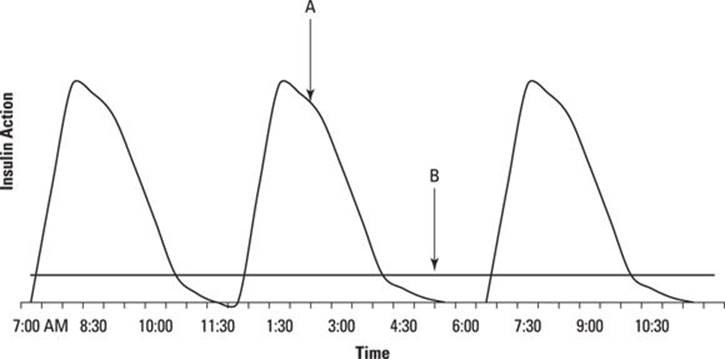
Low blood glucose indicates an imbalance between carbohydrate and insulin. Injected insulin has a set duration of action. If hypoglycemia occurs when the insulin is at its peak effect, the blood glucose can plummet further. When treating low blood glucose, think about the insulin that is at work in your system. See Figure 15-2 , which illustrates the action timing of mealtime rapid-acting insulin.
© John Wiley & Sons, Inc.
FIGURE 15-2: Considering insulin action when treating lows.
The curved lines represent the three mealtime injections of rapid-acting insulin. The horizontal line represents the long-acting insulin for someone who uses injected insulin (or may represent the pump basal rates for someone on an insulin pump). The two arrows, A and B, represent theoretical times when a person could experience hypoglycemia.
Consider a situation when hypoglycemia occurs at 2 p.m., as indicated by Arrow A. Notice that the insulin is near its peak effect. There are nearly two hours of insulin action left (when you consider that rapid-acing insulin works for about four hours). The injection given at noon will continue to lower blood-glucose levels until about 4 p.m. To adequately treat hypoglycemia at the time indicated by Arrow A, you would first require enough quick-digesting carbs to resolve the hypoglycemia, then you would need additional carbs to offset the remaining amount of insulin. As Arrow A indicates, about two hours of insulin action remain, so a snack is required to go with that insulin.
If hypoglycemia occurs at 5 p.m., as indicated by Arrow B, you would need enough quick-digesting carbs to treat the low blood sugar. There is no remaining insulin action from the 12 p.m. pre-lunch injection. At 5 p.m. the only insulin in the system is the baseline, long-acting insulin (or the pump basal rate for individuals using a pump.) You can consider whether or not you need an additional snack. If you’ve exercised or if your next meal is still more than a half-hour away, you may need some carbs. However, Situation A has stronger insulin action, so more carbs are needed in that situation than in Situation B.
The lesson here is to always consider the insulin that is actively working in your system. There are times when more than the usual amount of carbs is needed to recover from hypoglycemia.
Preventing Hypoglycemia
So far this chapter has provided information on recognizing and treating hypoglycemia. Better yet would be to learn how to prevent or at least minimize the frequency and severity of hypoglycemia. This section has tips on being properly prepared so that you can treat mild hypoglycemia before blood-glucose levels drop dangerously low. It also prompts you to reflect on variables that can lead to hypoglycemia and emphasizes using blood-glucose data for problem-solving. You are the most important person on your healthcare team because you can supply the information that is needed for making adjustments to your regimen.
Being prepared
The best way to stay safe is to be prepared. If you take insulin or any medications that can lead to hypoglycemia, then you should keep a few key things with you at all times:
· Carrying your meter: Carry your meter because it is important to verify your blood-glucose levels. Symptoms are not always a reliable indicator. After treating hypoglycemia, recheck blood-glucose levels again in 15 minutes to assure hypoglycemia has resolved (as I explain in the earlier section “Rechecking your blood-glucose level ”). If you do not have your meter with you and you think your blood glucose is low, it is best to treat the suspected low.
· Carrying snacks: Carry carb-containing snacks you can consume as needed for preventing hypoglycemia. Keep nonperishable foods handy. Ideas include pretzels, granola bars, crackers, or any easy-to-carry snack that provides carbohydrate.
· Carrying low supplies: Anyone at risk for hypoglycemia must be prepared at all times by carrying appropriate carbs for treating hypoglycemia. Always have some sort of quick-digesting carbs with you. Glucose tablets, juice, or sugary candies that do not contain nuts or chocolate are appropriate choices. Fat delays digestion and slows recovery. Fruit is another good option. (See the earlier section “Choosing quick-acting carbs ” for more information.) Keep something in your car’s glove compartment that won’t spoil or melt. Be prepared whether at work or at play.
Looking for patterns and problem-solving
Keep records and try to learn from past experiences. When you have a low, jot down a few notes related to the situation. Did you get low during exercise or have delayed hypoglycemia hours after exercise ended? Have you been having lows in the middle of the night? How much carbohydrate was needed to recover from the low? I discuss keeping records later in this chapter as well as in Chapter 23 .
Share your notes and thoughts with your diabetes specialist. It’s possible that the long-acting insulin dose needs to be adjusted, or it could be that the insulin-to-carb ratio or correction ratio needs to be changed. Maybe you need to count carbs with more accuracy. Hopefully you and your team can make adjustments to your routine to reduce your future risk of hypoglycemia.
Reflecting on prior exercise
Exercise increases insulin sensitivity so insulin works better when you are active. At the same time your muscles also burn more glucose when you exercise. If you don’t know how to make adjustments, exercise can lead to hypoglycemia.
Keep notes related to your exercise experiences. Through trial and error you may be able to figure out how many extra carbs you need to eat before and during your exercise session, or how to reduce your insulin doses on active days. Some people with type 1 diabetes use different doses of insulin on active versus sedentary days. Enlist the help of your diabetes specialist when it comes to making insulin adjustments.
Remembering your carb intake
Don’t skip meals and don’t eat too few carbs. Carbohydrate provides glucose, the body’s preferred fuel source. You need carb for immediate use and to store as glycogen for later use — between meals and overnight. Eating too few carbs can increase your risk of hypoglycemia. Chapter 5 provides guidance on estimating your daily carbohydrate needs.
Enlisting Your Doctor’s Help
If you have been experiencing episodes of hypoglycemia, speak to your doctor. Weight loss and exercise improve insulin sensitivity and are considered treatment strategies for type 2 diabetes. If you’ve increased your exercise or decreased your weight, you may be due for a medication tune-up. Diet, exercise, and medications sometimes need rebalancing. To resolve the situation effectively, you’ll need to gather some blood-glucose data. The following sections discuss the importance of record keeping and using that data to look for trends and patterns. Blood-glucose results drive management decisions, so share your data with your doctor.
Keeping and reviewing blood-glucose logs
It’s important to organize your blood-glucose data so that you can look for patterns and use the information to make diabetes management decisions. You can keep records electronically in apps, on spreadsheets, on paper, or written in logbooks. If you are computer savvy, you can create your own spreadsheet for keeping logs.
Write your blood-glucose results in columns that identify the time of the check. When you look back through your data, you can identify pre-meal and post-meal blood-glucose trends. See Table 15-1 for an example of a very basic form that would allow you to organize blood-glucose readings into columns.
TABLE 15-1 Sample Blood-Glucose Log Form
|
Date |
Pre-meal |
After meal |
Pre-meal |
After meal |
Pre-meal |
After meal |
Bedtime |
The setup in Table 15-1 doesn’t mean everyone with diabetes needs to check seven times per day. Someone with type 2 diabetes who is stable and well-controlled may be checking only several times per week. Someone else with type 2 diabetes may benefit by checking one to two times per day. A person who checks twice a day can vary the test times to get a more representative picture of blood-glucose trends. For example, one day check your fasting level upon waking and again after breakfast. The next day check before and after lunch. The following day check before and after dinner, or before bed. Rotating the times of the checks and then writing the results in the proper column on the logbook is more informative than only checking fasting and before dinner day after day.
People with type 1 diabetes need to check blood glucose more frequently, perhaps up to six to ten times daily. Insulin dosing decisions are based on blood-glucose readings. Times to check blood-glucose levels include mealtimes, before driving, during exercise, before bed, any time hypoglycemia is suspected, and occasionally in the middle of the night. More detailed log forms can be created to organize data according to the specific hour that the reading was obtained and to record details on carb counts and insulin doses.
Some meters have the capability to download blood-glucose data to your computer. The meter manufacturer may offer software that can organize the data into columns by the time of day or create graphs and charts that are able to identify the percentage of your readings that are within target range, or above and below target.
Sharing your data with your doctor
Share your blood glucose records with your healthcare providers. Bring your logs and meter to every single appointment. Most meters have memories. But most doctors don’t have time to scroll through the meter memory to look at the results one value at a time. The information is more useful when it’s organized into logs such as the one shown in Table 15-1 . Make sure that the time and date are set on your meter so the results properly reflect the time of the blood-glucose check. If you need help setting the time and date, check the owner’s manual or call the 800 number on the back of the meter and ask for help.
Blood-glucose data is valuable and is used to guide management decisions. If your data shows trends or patterns above target or below target, be proactive and contact your healthcare provider for advice. It isn’t uncommon to need medication dose adjustments. Try not to attach judgment to the numbers. I consider all numbers “good” numbers because all numbers provide information that is useful in managing your diabetes.