
During the early years of my integrated practice, I continued to study at Dr. Lai’s once a week. The pragmatist in me used TCM formulas and was gratified by good results, but the scientist in me still wanted to know more. What did TCM teachings actually mean? How and why did they work? As my knowledge increased, I was able to connect the dots.
More about TCM Organs
Discovering that TCM organs were not the same as the organs Westerners knew by the same names left me in a quandary. Since the TCM terms Liver, Spleen, and Kidney actually meant entire physiologic systems, what terms do TCM practitioners use when they want to refer to the actual organs?
Liver 
If the TCM Liver represents the adrenergic and sympathetic nervous system, then how does TCM address problems with the actual organ that Westerners know as the liver? Actually, in ancient times, TCM did not really know the organ as we understand it today. In antiquity, if someone had hepatitis, it was called Yellow Gallbladder  . Similarly, the Western lay term for hepatitis was yellow jaundice. These terms were descriptive. The skin and the whites of the eyes turn yellow in hepatitis patients because their livers’ ability to process and eliminate pigment from the breakdown of red blood cells is impaired. The TCM treatment for this condition is to clear Heat and cleanse toxins. Since hepatitis is usually from a viral infection, this treatment is appropriate. Today, the cause of Yellow Gallbladder is known, and there is a Chinese term for hepatitis, liver inflammation
  . The treatment principle of clearing Heat and cleansing toxin remains the same.
The TCM practitioner would diagnose cirrhosis, another disease of the liver, as hardening of the liver  . The TCM treatment is directed at improving circulation to the liver and dispersing scar tissue. When the TCM practitioner diagnoses Liver Fire
  or Liver Yang rising up
  , however, he is talking about an overactive sympathetic nervous system, and he then uses calming Liver Fire
  herbs, which decrease sympathetic activity. Therefore, it appears that when we hear the term “liver,” in order to know what the TCM practitioner is referring to, we have to consider the context.
Kidney 
I had the same question about the kidney. If the TCM Kidney represents the reproductive system, what about treatment for diseases of the actual kidney? As it does with the liver, TCM treats diseases of the kidney with appropriate herbal formulas. If there is a kidney infection, the TCM principle is to clear heat and cleanse toxins with a group of herbs that are effective against the commonly known bacteria involved in kidney infections. If a patient’s kidney is failing, the TCM practitioner says that the patient’s kidney function is low. With common signs of aging, the TCM practitioner says the Kidney is deficient. Again, context is the key.
Kidney and Life Gate 
Although the concept of Life Gate was presented in early lessons at my TCM school, I neither understood it nor paid much attention to it. It sounded like just another metaphor for life and death. As my understanding increased, I ventured into analyzing this concept further.
At ACTCM, the lecturer had said:
“Life Gate is closely related to kidney Qi. Life Gate is the fountainhead of Yuan or Original Qi; it is the root of all organs and root of all meridians; it is the door of breathing, the springhead of Triple Burner Qi; it is the abode of original Yang, compared to the kidney, which is the abode of original Yin. Original Yang is congenital fire. Original Yin is congenital water. Water and fire, Yin and Yang must be in equilibrium. If the Qi of Life Gate dies, life ends.”
Dr. Lai also used to say, “Death comes when the life gate closes.”
The epiphany came one day. What happens when someone dies? The heart stops. What do we do when we witness the heart stopping? We start CPR and then reach for adrenaline to try to restart the heart. One part of the adrenal gland, the medulla, makes adrenaline and noradrenaline. Both stimulate the heart to beat stronger. Noradrenaline constricts blood vessels to increase blood pressure, while Adrenaline makes the heart beat faster and stronger. The adrenal gland is always stimulated whenever there is a crisis, whether physical or emotional. I concluded that at least part of the Life Gate concept includes the adrenal medulla, which represents both fire  and original Yang
  .
.
The other part of the adrenal gland, the cortex, makes steroids, which tone down inflammation, a Yin function. Besides cortisol, this part of the adrenal gland also makes aldosterone, a hormone that helps the body retain fluid, also a Yin function. In this context, if Life Gate is the adrenal medulla, at least part of the TCM Kidney is the adrenal cortex. It is water, or original Yin,  . The teaching that “Water and fire, Yin and Yang must be in equilibrium”makes Western sense when all aspects of the adrenal gland are taken into consideration.
The TCM Kidney is far more complex than I had earlier conceived it to be. It encompasses not only the reproductive system but also the adrenal cortex and, as mentioned earlier, the bone marrow (see chapter 2). The bone marrow produces red and white blood cells, among which are B-lymphocytes, responsible for antibody production. The immune system, then, must be included in the Kidney concept as well.
Spleen 
My feeling about the TCM Spleen can best be expressed with the words Winston Churchill used to describe Russia’s war strategy during WWII: “It is a riddle wrapped in a mystery inside an enigma.” With the passage of time and new discoveries in Western medicine, I have been able to unwrap some layers of the enigma surrounding the riddle of the TCM Spleen. From my early days studying TCM, I knew that the Spleen concept included the digestive system and water metabolism. Yet the way Dr. Lai used Spleen herbs made me think it had to involve more. He used them to boost the immune system and to treat obesity. He told me people with Spleen deficiency  have a craving for sweets. When the Spleen is tonified, the craving goes away and they lose weight. He often pointed out the typical physical sign of a pale swollen tongue in patients with Spleen deficiency. What did all these swollen tongues signify? The things he taught about treating the Spleen prompted me to review my ACTCM class notes:
The spleen governs transporting nutrition: absorption and digestion of food. Every part of the body depends on the spleen meridian for nutrition. After birth, the spleen is essential. It nurtures body Yin and earth. Its nature is damp, but it dislikes dampness. Spleen Qi must be rising to be normal. Only if spleen Qi is rising does nutrition derived from food go all over. If spleen Qi is deficient, symptoms are anorexia, edema, and diarrhea; dampness is congested in the body.
The Spleen and Glucose Metabolism
Mary was a rather plump woman who attended occasional classes at ACTCM. After I left the school, I happened to ask Dr. Lai about her. He told me she was no longer overweight because he had treated her Spleen. Putting together what Dr. Lai taught about Spleen-deficient patients craving sweets and the success in treating Mary’s obesity with Spleen-tonifying herbs, I reasoned that the TCM Spleen must have something to do with glucose metabolism.
Normally, the food we eat is absorbed and changed to glucose that is carried in the blood. Glucose needs to enter muscle cells to provide them with energy. To understand the action of insulin, it helps to imagine that the muscle cell has a door with a lock. Insulin unlocks the door to let the glucose into the muscle cell. After the muscles take up the needed amount of glucose from the blood, the excess glucose is stored in the liver as glycogen. Whenever the muscles need more glucose, such as during exercise, the liver changes the glycogen back into glucose and releases it into the blood to again supply the muscle cells.
In type 2 diabetes, the body makes insulin, but the muscle cell lock changes, making it more difficult for insulin to open the door and let in glucose. This is called insulin resistance. The result is excess glucose levels in the blood. Adding to the problem is that the liver in type 2 diabetes seems to release too much glucose into the blood. The body reacts by making more and more insulin trying to overcome the problem. Excess insulin causes a multitude of maladies, among which are hypertension and obesity.
First-generation diabetes drugs stimulate the pancreas to produce more insulin. Second-generation diabetes drugs act in one of two ways. One class, the thiazolidinediones (TZDs), helps glucose get into muscle cells more easily. The undesirable side effect is that with improved insulin sensitivity, patients gain weight on TZDs. Another downside risk under investigation is a possible increase in cardiovascular complications among users of the TZD, Rosiglitazone (Nissen and Wolski 2007). The other class of second-generation drugs prevents the liver from releasing too much glucose. Metformin falls into this second category. Metformin encourages weight loss but it cannot be prescribed in patients with poor kidney function, and there is a danger of lactic acidosis when taken by extremely ill patients. Studies have shown that the Spleen herb, Radix Astragali  improves the liver’s ability to keep glucose stored as glycogen, similar to the action of metformin. Another Spleen herb, Atractyloidis Alba
  is known to lower blood sugar, but the mechanism has not been clarified.
A recent breakthrough discovery is that the intestines secrete a group of hormones called incretins, which act in several ways to counter the progression of type 2 diabetes (Ratner 2005). Incretins decrease the liver’s output of glucose, improve the efficiency of the pancreas by stimulating it to produce insulin only when the blood glucose is high, make food stay in the stomach longer so that the person feels full and eats less, and enhances the longevity of pancreatic beta cells responsible for making insulin. Since the TCM Spleen concept includes the digestive system, tonifying the system should help diabetics by enhancing incretin secretion. A drug is now available for enhancing incretin levels, but it needs to be injected.
Obesity leading to type 2 diabetes mellitus has reached epidemic proportions in developed countries. While the solution lies mainly in lifetsyle modification—changing eating habits and increasing exercise—using TCM treatments that tonify the Spleen can be an important adjunct.
The Spleen and the Immune System
Another enigmatic Spleen concept has been the meaning of “Its nature is damp, but it dislikes dampness.” When Dr. Lai treated patients with Spleen deficiency, patients who exhibited the typical pale, swollen tongues, he often said, “The problem here is wetness, causing congestion. We need to clean the Wet and clear it.” It is common for TCM terminology such as “clean the Wet  ” to sound incomplete to a Westerner. Clean the Wet from what? I had to remember that without a microscope or the knowledge of anatomy, that was as far as TCM could go with explanations. When I asked Dr. Lai why Spleen-deficient patients seemed to show these signs of water retention, he said it was from inflammation. I asked how that led to water retention. He said it was because of capillary leakage. His answer reminded me of what I learned about Wetness when I studied the Six Evils (see chapter 4).
Western medicine now recognizes that inflammation gives rise to a multitude of diseases such as clogged arteries and cancer. Inflammation is a nonspecific response by the immune system. With inflammation, the body attacks foreign invaders and becomes a war zone with dead white blood cells, dead foreign cells, and the fluid from capillary leakage. Normally, the immune system has T-Helper cells that direct fighting cells where to go and what to attack when there is an invader. The same immune system also has T-Suppressor cells that direct fighting cells when it is time to quit. Macrophages, also part of the immune system, eat up debris, and the lymphatic system carries the debris and excess fluid away from tissue and back into the circulation. In Spleen-deficient patients, the inflammatory response is inappropriate and prolonged. Fluid and debris in tissues may accumulate at a rate greater than the capacity of the cleanup mechanisms to remove them.
The TCM Spleen includes the thymus and lymphoid tissue, which produce the T-cell component of the immune system. It also includes the lymphatic system, which carries away debris and excess fluid. Its nature is damp means that the Spleen tends to generate an immune response, which involves capillary leakage. It dislikes dampness describes the normal function the immune system has of cleaning up after itself. Spleen-tonifying herbs help to normalize the immune system. They enhance not only the inflammatory phase but also the cease and desist and cleanup phase of immune function. The Spleen herb Radix Astragali  boosts immunity by stimulating T cell production. Other Spleen herbs such as Radix Diascoreae Oppositae
  and Atractylodis Alba
  have diuretic properties. They enhance macrophage function and facilitate fluid mobilization by the lymphatics.
Further revisiting the Spleen, I analyzed its other descriptions.
The spleen governs blood. It controls and regulates the direction of blood. If it malfunctions, the symptom is a deficient type of bleeding. The deficient type of bleeding is described here in contrast to bleeding from Heat conditions. In Heat conditions, there is inflammation. Blood tends to rush to inflamed areas where dilated blood vessels, when broken, will bleed profusely, such as in cases of tuberculosis or dysentery. Deficient bleeding, on the other hand, occurs in conditions where the patient is debilitated and does not suffer from a Heat condition or infection. I pondered for a long time over the meaning of the term regulates the direction of blood. To my Western mind, it is the heart’s pumping action that determines the direction of the blood. If blood is not pumped forward, the only other direction is backward, and that leads to heart failure, not bleeding. As I read more about the TCM theory of bleeding, it occurred to me that the ancients viewed bleeding as a problem of blood traveling in the wrong direction. A flashback came: The ancients were not aware of the cardiovascular system nor was the clotting mechanism clear to them. The cause of deficient type of bleeding is actually an abnormality in part of the clotting mechanism. Protein is needed for the bone marrow to make clotting factors. Absorption of protein depends on a normal digestive system, and digestion is part of the Spleen’s function.
The spleen governs muscle, goes all the way to the mouth, and flourishes in the lips. If his spleen is strong, the person is muscular and lips are red. Strong muscles and healthy lip color are signs of good nutrition, all of which TCM attributes to a healthy Spleen that actually represents the digestive system.
If spleen Qi is deficient, there is anorexia, edema, and diarrhea, meaning dampness is congested in the body. If we consider the Spleen as the digestive system, poor function leading to malabsorption can explain these symptoms. If we consider the TCM Spleen as representing the immune system, there is yet another explanation for the symptom of diarrhea. Diarrhea was a hallmark symptom of HIV-AIDS during the early days of the epidemic when the HIV virus had not yet been discovered. Later, we learned that these patients commonly suffered from intestinal infections that their immune systems were too weak to overcome. A weak immune system can lead to infectious diarrhea.
TCM Organ Interrelationships
The idea of one organ attacking or sustaining another organ, as taught in TCM, confounded my Western-trained mind. For a long time I simply discarded the dogma because I couldn’t make sense of it. It was not until much later that I understood what these interrelationships meant. I realized that the organs they talked about were not really organs but physiologic systems that interacted with one another.
Liver and Spleen 
For years, I puzzled over the TCM teaching: If liver Qi is congested, it invades the spleen. Symptoms are anorexia, diarrhea, and poor digestion. I kept questioning how one organ could invade another. One day the answer came to me. The TCM Liver is the sympathetic nervous system, which is turned on with stress. The opposing system is the parasympathetic, normally turned on for nonstressful states like digestion. One of the Spleen’s functions is digestion. It is obvious that when we are stressed, our digestion suffers. Sometimes we lose our appetites, and after a meal, we feel gaseous. That is because the overactive sympathetic system has overridden the parasympathetic system. The Liver has invaded the Spleen. I was in awe of how much sense this made.
Kidney and Lung 
More than one teacher at ACTCM taught us that in order to treat the Lung, we must also treat the Kidney. I used to follow this dictum when writing my herb prescriptions, not fully understanding the reasoning behind it. When I came to understand that the Kidney represented the adrenal cortex, which makes steroids, the connection with the lung became clearer. In recent years, Western practitioners recognize that inflammation plays a major role in asthma, and they recommend using steroid inhalers for asthma. If the TCM Kidney is the steroid-producing part of the adrenal gland, it makes perfect sense to enhance the Kidney to treat inflammatory lung conditions. It also makes sense when we consider the Kidney’s role in antibody formation as a producer of marrow. Most respiratory infections require efficient antibody formation to control the infectious invader, be it bacterial, viral, or fungal. A Western-trained physician might then question whether Kidney herbs are comparable to synthetic estrogens or steroids. Kidney herbs do not have the known side effects of synthetic hormones. They most likely act by improving blood flow to various glands.
Liver  , Spleen
  , Kidney
  , and Lung
Dr. Lai often said, “For lung diseases, we have to calm the Liver  to stop it from attacking the Spleen, as well as support the Spleen and Kidney
  to treat the Lung
  .” It was only when I used the TCM meaning of these various organs that I could understand his algorithm.
When we are emotionally stressed, our sympathetic system, the TCM Liver, is overactive. This overactive Liver, or sympathetic system, suppresses our normal digestion and immune response, represented by the TCM Spleen. Thus, the Liver needs to be calmed in order to allow proper Spleen function. The TCM Spleen includes the immune system, which is needed to ward off infection; therefore, we need to “support the Spleen.” Finally, the TCM Kidney, responsible for steroid production and antibody formation, should be tonified to control inflammation and boost immunity.
When I found this rather whimsical ancient depiction of human anatomy (fig. 6), I realized that six hollow organs (regarded mostly as conduits) and five solid organs plus the Life Gate were all the ancients knew about to explain diverse biological phenomena. It is understandable that they assigned functions of various organs, such as glands that they did not know about to their limited organ repertoire. The assignments may lack the precision familiar to Westerners. Spleen and Stomach are often used together, especially when diagnosing deficiencies. Kidney and Life Gate are frequently mentioned in tandem. Various brain functions were designated to several different organs. The cerebral cortex went to the Heart and Kidney. The amygdala, the area responsible for rage, went to the Liver. The adrenal medulla was assigned to the Liver and Life Gate. Of additional interest is the written explanation of how urine is made—at the junction of the small and large intestine where they thought solid and liquid waste are separated. The ancients did not realize that the kidney is the organ that makes urine. It is amazing nevertheless that the ancient Chinese, despite their limited knowledge of anatomy, were able to devise a workable system of diagnosis and develop some very effective, appropriate, and enduring treatments. Table 4 depicts TCM organ assignments.
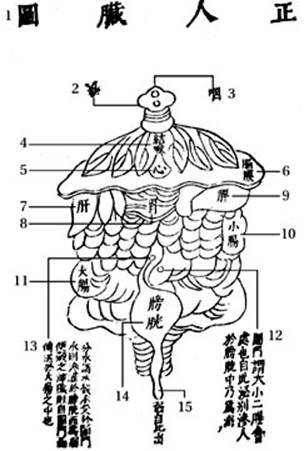
Fig. 6. Ancient Anatomical Diagram of Human Organs, courtesy of the Bibliotheque Nationale de France, Paris (Lyons and Petrucelli 1987, 126).
1. Normal Human Organ Anatomy; 2. Hypopharynx; 3. Pharynx; 4. Thyroid Cartilage; 5. Heart; 6. Diaphragm; 7. Liver; 8. Stomach; 9. Spleen; 10. Small Intestines; 11. Large Intestines; 12. Dividing Gate is the junction of small and large intestines; 13. At Dividing Gate, the remains of ingested food, after absorption and digestion, are separated into clear liquid, which is excreted through the bladder as urine, and solid, which is excreted through the colon as feces; 14. Bladder; 15. Urine is excreted here.
Table 4. TCM Organ Assignments

Modern Applications of the Eight Entities 
I found that most of TCM teaching was about infectious diseases. With modern antibiotics and vaccination programs, treating infectious diseases with TCM seemed obsolete. Today, the Western focus is on degenerative diseases and cancer. I sought to find how this ancient system could be adapted to contemporary needs.
Heat  and Solid
  Conditions
Viral infections represent a frontier the West has not completely conquered. People are still getting sick with colds and flus. Recent challenges include SARS, the West Nile virus, and Avian flu. We have been far more successful at developing antibiotics to treat bacterial infections because bacteria are complete living cells, making them easier to analyze. We can actually grow them in a lab, study their biology, and design drugs to kill them by foiling some stage of their multiplication and growth. Viruses, on the other hand, are incomplete cells. They need to parasitize a host cell and borrow its cell biology in order to grow and multiply, making them more difficult to study. Western drugs are designed with specificity. If we cannot analyze a virus or understand its metabolism, we cannot design our bullet to target it. The most effective Western approach for fighting viruses is to develop vaccines, but vaccine development takes time and requires intimate knowledge of how the virus acts. We are constantly threatened by new and unfamiliar viruses because there will always be a lag between when diseases occur and when vaccines are available.
TCM offers a nonspecific approach to treating viral infections. TCM practitioners do not have to pinpoint the exact infecting agent to treat. Viruses are classified as Heat toxins, against which the host mounts a Solid or immune response. I once asked Dr. Lai, “How can you know that the cleansing toxins and clearing Heat herbs you use for flu can kill the virus when the specific flu virus hasn’t been identified?” He told me that these herbs may not be working on just the one level to kill viruses but may also down-regulate the host’s Solid response to the infection, such as high fever and severe lung inflammation. Often what causes death with severe infections is not the invader but the patient’s own extreme response to infection. With severe pneumonia, for instance, the lung tissue gets so inflamed that oxygen cannot pass through the swollen air sacs of the lung to get to the blood. With the SARS epidemic, it was after the virus was no longer detectable that severe respiratory failure set in, and steroids were used in an attempt to diminish the inflammatory reaction. TCM clearing-Heat herbs may similarly decrease the inflammation without the side effects of steroids. Combinations of these herbs are quite effective for colds, the flu, and viral gastroenteritis (stomach flu). In fact, some common formulas of these herbs are available in either pill form or other forms such as powder or bouillon cubes easily reconstituted with hot water. They are sold over the counter in herbal shops or even in Chinese supermarkets. For colds and flus, preparations of Yin-qiao  , Ban Lan Gen
  , or Gum Wall
  tea are available; for viral gastroenteritis, Huang Lien Shang Ching Pien
  is.
is.
Despite advances in antimicrobial and antiparasitic development, we face the constant challenge of drug resistance. It seems that bacteria and parasites, by the process of mutation and natural selection, are constantly developing new strains that are resistant to existing drugs. This problem is worsened by physicians’ over-prescribing antibiotics and by the drug companies’ development of longer-acting antibiotics, which are very popular because of their convenience. Some antibiotics need to be taken only once instead of the usual ten days. Evidently, the long-acting nature of new antibiotics allows the active ingredient in the blood to become lowered to the point that some hardy bacteria survive the treatment to return with a vengeance another day. In many parts of the world, drug-resistant malaria is becoming prevalent, and the World Health Organization is recommending treatment with the herb Artimesia Apiaceae  (Vega and Barclay 2005, 1–5). The herb Pulsatillae Chinensis
  is known to be effective for amoebic dysentery. Other herbs in the cold-cleansing category have been shown to have antibacterial activity and warrant further studies. Resorting to herbal remedies may become an option for other infections where drug resistance is a problem.
We are just beginning to find out that many conditions, such as arteriosclerosis and tumors, which in the past were considered degenerative, actually start from an inflammatory process. Some cancers, and even heart disease, are linked to infections. Cervical cancer is caused by human papillomavirus. As for heart disease, there is possible association between it and certain infections (Wierzbicki and Hagmeyer 2000). Heart disease and tumors are not mentioned much in ancient TCM literature because people commonly died of infectious diseases and simply did not live long enough to acquire these other ailments. With current knowledge, we can categorize these conditions as Heat and Solid. Herbs for clearing Heat  and cleansing toxins
  have potential use in these cases.
Deficiency  Conditions
The Deficient  state occurred in antiquity often as the aftermath of a severe infection when the patient became weak and exhausted. Today, while people do not so commonly suffer from the ravages of severe infection, the Deficiency state still exists, but the cause has changed: now the Deficient state is from the stress of modern life. This was true in most of my patients. Thus, various TCM tonifying herbs to restore energy are still relevant to today’s patients.
Blood Stasis and Ecchymosis 
Cardiovascular diseases constitute the leading cause of death in Western countries and continue to be the focus of intense research into prevention as well as treatment. Any discussion of modern application of TCM would be incomplete without mentioning the treatment of Blood Stasis and Ecchymosis as it applies to cardiovascular disease. The term, vitalizing or mobilizing blood  , used to puzzle me. Blood has no ability to move of its own accord; it moves because the heart and blood vessels control it. In order to make sense of this term, I needed to remind myself that the ancients had an incomplete knowledge of the cardiovascular system, which they called Qi. Often in TCM, “moving blood” and “moving Qi”
  are used together. Herbs in this category move Qi
  by dilating blood vessels to improve circulation. They move blood (also known as dispersing blood
  ) by thinning it, somewhat like aspirin. If the blood is thinner and the blood vessels are dilated, it will “move” better. Moving-blood and moving-Qi herbs are comparable to vasodilators and antiplatelet drugs commonly used for coronary heart disease that dilate blood vessels and thin blood. The West could benefit from further investigating these herbs and considering them as either potential adjuncts to Western therapy or alternatives when patients do not tolerate drugs such as aspirin.
With time and patience, I slowly found answers to many of my questions. In my TCM journey, I learned to persevere and constantly keep in mind the meanings behind its unique terminology.