
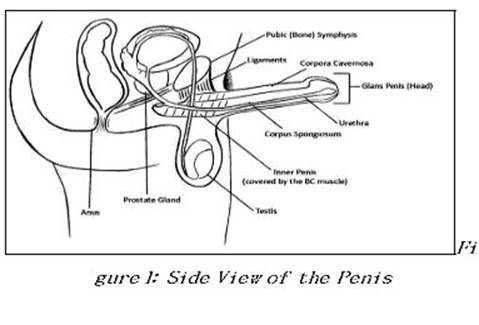
Throughout this book, the anatomy jargon is kept to a minimum so that everyone—regardless of their anatomy knowledge—can build a solid foundation of how to perform penis exercises. But many men find that once they start performing penis exercises, they want to know more about how their favorite organ really works. So, here it is: the penis uncovered and exposed, as you’ve never seen it before.9
The Penis
The penis is like the rest of our body. For the most part, we have a basic sense of what everything is, but don’t exactly know how and why it all works. The penis is a complex organ composed of many different tissues, including ligaments, skeletal muscle, smooth muscle, veins, arteries, and other tissues that cooperate in perfect harmony when your penis goes from flaccid to erect, and vice versa.
The Three Corpus Chambers
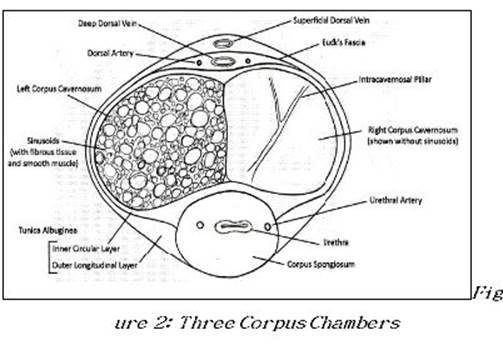
The main body of the penis is composed of three circular chambers. Together, the top two chambers make up the corpora cavernosa. The bottom chamber holds the urethra and makes up the corpus spongiosum. All three chambers are largely composed of smooth muscle and collagen—a protein that forms the connective tissue within the penis. The mini jelq—an exercise designed to fix a penis curve—focuses on jelqing only one of the top corpus cavernosum chambers.
The Pelvic Floor Muscles
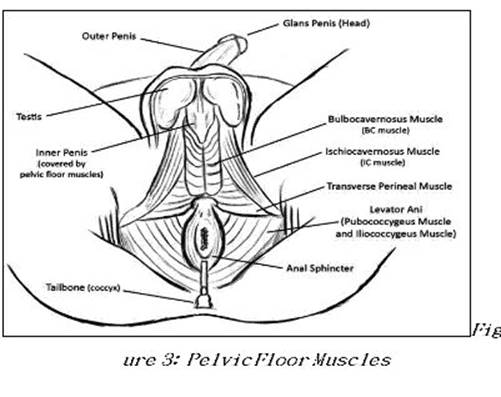
Most men think of the penis as a completely external organ. But when you stand naked in the mirror, you’re only seeing half of the picture. The other half of your penis extends inside your body—and is known as the inner penis. Your inner penis is encircled by and composed of the pelvic floor muscles—largely the bulbocavernosus (BC) muscle and the ischiocavernosus (IC) muscle.
Together, the two muscles pump blood into the penis, causing a chain reaction that leads to an erection. These muscles are vital to a healthy genital region. Fortunately, kegeling keeps these muscles in shape.
You can feel the inner penis and the pelvic floor muscles by touching your perineum—the area between your testicles and your anus. Sex pioneer Dr. Alfred Kinsey noticed that the perineum is “highly sensitive to touch, and tactile stimulation of the area may provide considerable erotic arousal.” This sensitivity is most likely due to the fact that you are actually rubbing your penis (the inner portion of it). You are also rubbing your prostate, which is on the other side of your pelvic floor muscles.
Arteries and Veins
Whereas the pelvic floor muscles pump blood into the penis, the arteries and veins provide the plumbing for the blood to get in and out. The penis has many penile arteries and veins. The most prominent being the dorsal vein and dorsal artery, located on the top part of the penis. The majority of the veins are on the outside of the corpus chambers. The majority of the arteries take a direct route inside the chambers.
The placement of the veins and arteries are a critical part of the erection process. When you become aroused, the arteries inside the chambers pump the penis full of blood. Once the penis is full of blood, the veins are pressed against the tunica, which stops blood from leaving the penis so you can maintain a hard, strong erection. If your pelvic floor muscles are weak, or if you have heart trouble or any other medical ailment that causes poor blood flow, your penis won’t fill up with enough blood to press the veins against the tunica. This leads to a viscous cycle of blood quickly going into the penis, but leaving just as quickly—which causes erectile dysfunction.
The Smooth Muscle
Located inside the three corpus chambers, the smooth muscle cells help form the shape and size of your penis. When the smooth muscle is contracted, the penis is in its flaccid state. When the smooth muscle relaxes, the corpus chambers fill with blood, and an erection takes place.
Healthy smooth muscle is essential to the overall well-being of the penis and its erections. “Complete smooth muscle relaxation is both necessary and sufficient to [obtain] an erection,” says Dr. George J. Christ in an article published in Urologic Clinics of North America. And studies suggest that men who have low amounts of smooth muscle (generally less than 40 percent) have higher incidents of erectile dysfunction.
The Tunica
Once the smooth muscle relaxes, it presses against the tunica. The tunica is a strong tendon-like tissue that surrounds all three corpus chambers—and the smooth muscle within the chambers. Medically known as tunica albuginea, the tunica is actually an extension of the pelvic floor muscles. Peyronie’s disease—a painful curve—is caused by plaque and fibrosis in the tunica.
The tunica typically consists of two layers: the inner circular layer and the outer longitudinal layer. The inner circular layer serves to govern the size of the erect penis similar to how a bicycle tire limits the expansion of the inner tube inside. As with a bike tire, once the limit of the tunica is reached, further pressure results in stiffness rather than expansion. Along with the intracavernosal pillars, the inner circular layer of the tunica holds up the corpus chambers. The outer longitudinal layer encircles all the corpus chambers together and functions to regulate the length of the expanding penis.
Oddly enough, not every man has the same amount of layers of tunica. Some men only have one layer in their penis. Others have as much as three layers. Some people speculate that the men who have a hard time gaining might have three layers of tunica, whereas the easy gainers might only have one layer. For the penis to enlarge, the tunica presumably needs to enlarge too; and a thicker tunica is in all likelihood harder to stretch than a thinner one.
The Glans
The head of the penis is also known as the glans. Housing an abundance of nerves, the head is the most sensitive part of your body. Inside the glans is a tough ligament known as the distal ligament. This hard ligament is a continuation of the tunica and acts as a coating for the glans, which makes the tip of the penis hard enough to penetrate the vagina during sex.
When born, the male glans is covered with a coat of skin that is cut off (circumcised) in many Western countries. The benefits and risks of circumcision have been under harsh debate in recent years, with the medical community at war on whether the procedure causes permanent harm physically and mentally for a child. Some believe that circumcision decreases sensitivity in the penis, and a few men have gone as far as hanging a particularly type of weight device from their penis in an effort to grow back their foreskin. Others believe that the whole debate is nonsense. Clive Peters, author of How to Maximize Your Manhood: What every red-blooded male needs to know, says, “Contrary to what you might think, there is little or no difference in sensitivity between cut and uncut men.”
The Ligaments
To keep your penis and scrotum properly stabilized, there are two main ligaments that attach to the penis: the fundiform ligament and the suspensory ligament. Both ligaments are located near the pubic bone. The suspensory ligament attaches the pubic bone to the penis in a web-like manner. The fundiform ligament comes from the lower abdomen, and encircles both the penis and scrotum.
The ligaments are cut during penis enlargement surgery, which exposes more of the inner penis—the part of the penis that is inside the body. Stretching downward similarly stretches the ligaments, also turning more of the inner penis into outer penis.
The Mechanism Behind Penis Enlargement and the Factors that Limit Enlargement
We've talked, in depth, about the anatomy of the penis, but it's important to understand the mechanics behind why penis enlargement works as well as the physical factors of your penis that limit enlargement, to get the most of your penis enlargement efforts. As we noted earlier, your penis consists of three chambers:
Ø Two chambers of the corpus spongiosum and
Ø One chamber of the corpus cavernosum.
When blood flows into the chambers, your penis becomes erect.
The chambers are separated by a thick band of connective tissue, called the tunica albuginea. This gives your penis the elasticity it needs to expand, when it's erect, and contract when it's flaccid. It's this elasticity, and being able to stretch the tunica albuginea more so the penis can grow larger, that is so important in penis enlargement.
The challenge is that the tunica albuginea is made up of not only elastic tissue, but also collagen. Collagen is an extremely tough connective tissue, used in the body to give structural strength to parts. Body parts like tendons and ligaments are made of collagen, as is most of our body's structural framework, in addition to bone.
How do we overcome this tough collagen, so our penis can grow to its maximum potential?
We break the bonds within the collagen.
Penis Enlargement Like Building a Brick Wall:
Imagine you have a brick wall in front of you. To make it taller, instead of simply adding another row of bricks on top, you suspend the top portion of the brick wall, take out a line of mortar from the center of wall, and then insert another row of bricks. You now have a taller brick wall.
This is what we do to the collagen in the penis, when we do penis enlargement. We break the bonds of collagen, then the collagen rebuilds itself longer than before. Through mitosis, the other tissue in the penis also rebuilds, and the peripheral nerves elongate, making your whole package bigger!
For men new to penis enlargement, you may see some easy first gains due to the nature of the collagen within the penis. Your penis naturally has some crimps or slack in it, if you've never done penis exercises before. When you start your penis exercising routine, these crimps are removed, giving you some fairly quick gains. It's not until the critical traction is applied that the collagen bonds are broken and real enlargement begins.
Ligaments, Skeletal Muscles and Penis Enlargement:
Ligaments also have an effect on your success with penis enlargement. These too are made of collagen fibers and are again relatively inelastic, prohibiting enlargement growth. Like the collagen in the chambers of the penis, the collagen in the ligaments naturally has crimps in it that will straighten out and lengthen, early in the penis exercising process. After that, then the molecular bond breaking and remodeling of the ligaments is what needs to happen to lengthen the ligaments permanently.
The skeletal muscles that serve as attachment points at the base of your penis also affect your penis enlargement results. When you apply traction to the penis, these skeletal muscles undergo hypertrophy, which allows them to then strengthen and allow for enlargement. Think of it similarly as when you do arm curls, and your biceps and triceps get bigger and stronger.
Only by breaking the collagen bonds, so they rebuild longer, and lengthening the other tissues, can you get the penis enlargement results you want.8