
Midway along the journey of our life
I woke to find myself in some dark woods,
for I had wandered off from the straight path.
—Dante1
WHAT ARE THE CHANCES YOU’VE GOT or will get a chronic medical condition such as diabetes, heart disease, cancer, headaches, arthritis, backache, or stomach trouble? What are the chances you’ve tried a lot of potential remedies for your condition—a lot of doctors, a lot of pills, a lot of treatments? And what are the chances you’re still suffering, and find yourself anxious about your health and your future? Speaking as a doctor with a lot of experience, I can tell you the chances are very high. Every day, people just like you arrive at my office looking pained, desperate for relief, and just about hopeless. The fact that you’ve picked up this book means you’re probably a lot like those people. You or someone you love probably suffers from an aggravating health problem that often seems out of control, even though you or they have seen plenty of smart doctors.
There’s good news for you. There’s no health challenge you face that won’t get better with my slow medicine Rx: 77 Questions for Skillful Living. I’m here to tell you that patients with all of the most common health challenges begin to see improvement in their overall health, their specific condition, and their health outlook on the very first day they begin the program outlined in this book.
Whether you’re facing a particular health or personal challenge, trying to muddle through the dizzying array of available health information, seeking greater balance in your day-to-day life, or even taking care of a loved one with a health problem, it’s my sincerest hope that this book will provide you with needed insights and inspiration. I’m confident that if you take this process seriously, open your mind to an expanded definition of health, complete a comprehensive survey of your condition, and devote the necessary time and energy to answer the 77 Skillful Questions I’m going to present, your health will improve. I’m going to tell you about those questions and explain in detail what I mean by “an expanded definition of health” soon, and I think you’ll be excited about the prospect.
Meantime, the fact that you’ve picked up this book encourages me greatly: it means that despite your years of disappointment with the standard of care in our health system, you intuitively understand there are answers for even the most persistent and destructive health problems—and these answers lie largely in your own reckoning, in your own hands.
While I make the promise up front that your health can improve, there are a few caveats. I can’t promise to give you a Band-Aid solution or some other quick fix. You’ve tried that before, and I think you know that health just doesn’t work that way. I can’t promise that every specific health challenge you might have will simply vanish by wishing it away. It won’t, and you probably understand why. But I trust that you understand there might be another way to deal with the symptoms you’re experiencing and the challenges you face. That’s why I wrote this book, and why you’re reading it.
I’m not going to water down the message, either. I believe that each one of us has the intelligence, the ability, and the responsibility to make better choices. Again, I promise if you keep your mind open and devote the necessary attention to the whole of your life, your problems will diminish—you’ll get healthier. And this form of health will be more achievable, more extensive, more sustainable. It will be, in a word, extraordinary.
By contrast, most health books give people messages that they want to hear, packaged in a way that’s safe and comfortable and easy: Lose 30 Pounds in 30 Days! Kick Smoking with Kiwi Juice! The advice comes sugarcoated and oversimplified. The truth is, extraordinary health requires that we actually face and embrace our challenges, that we dig deep into our lives and look at all the roots and branches. Programs based on simple, formulaic prescriptions often lack this kind of examination, addressing only one specific health issue, such as weight loss or high blood pressure. True, following such advice will sometimes work in the short term, but you know the benefits won’t last, because such programs are not designed to be truly integrated into the whole of your life, as a part of meaningful life change.
Also lost in this kind of advice is the real value in our becoming as interested in learning from our health challenges as we are in finding quick fixes for them. Finally, such counsel lacks a fundamental honesty: that sometimes, you just have to learn to live with certain conditions; that such a life can be “healthy” and offer infinitely more rewarding prospects than you can imagine.
What else can I promise? I can promise you will finally regain control, starting this very day. By taking the approach that I will outline and guide you through, you will start to see how everything in your life fits together like puzzle pieces to create your overall health picture. This alone will provide a sense of relief. Then, by asking yourself certain key questions about your condition and your life, you’ll see where you need to take action, where holes in that puzzle are making a brighter future difficult to discern. You’ll be able to formulate a plan that makes complete sense and allows you, step by step, to put the pieces of your life and health back together. Sooner than you think, maybe even immediately, you will begin to feel something you might not have experienced since childhood: a powerful sense of vitality, vigor, serenity—and hope for the future. This might feel unfamiliar at first, maybe even slightly uncomfortable. But you will eventually come to recognize this feeling as extraordinary health, and you’ll want to embrace it like a long-lost friend. As a physician, healer, and fellow health traveler, it’s my deepest desire to help facilitate that reunion.
It won’t always be easy or obvious. I ask you to lend me your trust for a short while as I introduce you to what I call Skillful Questions, which encourage us to think about those aspects of our health and our overall lives that we often neglect—but which have profound consequences on the way we feel. That’s what they did for me when I first encountered Dr. Robert Ivker’s Wellness Self Test, now called the Fully Alive Questionnaire, the prototype for the Skillful Questions that comprise the formula for this book.2 The questions and our thoughtful answers gently coach us to live our lives more effectively, more harmoniously with nature and our surroundings, and certainly more healthfully.
To find true health, we must consider an expanded paradigm for health that intelligently—skillfully—integrates science, spirit, and nature. This approach is far-reaching—it goes way beyond simply lowering our weight or blood sugar. But this sensible, “integrative” approach doesn’t burn bridges to conventional medicine. Instead, it bridges gaps.
While my definition of health is broader than you’re probably used to, I have a pretty simple slow medicine prescription to help you get to that state of health. I call it Skillful Living—an approach that you can develop and learn, just as you might hone the skills of fly-fishing, gourmet cooking, or knitting. This approach is built on four principles:
1.Asking the right questions
2.Identifying the right path
3.Transforming obstacles into opportunities
4.Growing with every turn
Getting healthy starts with asking the right questions. Some of the questions you’ll find here are simple and straightforward, and following through on them will seem easy or obvious: I’ll ask you if your water intake is adequate and whether you maintain a healthy diet. But as we progress in the program, you might find some of the questions more surprising, and perhaps even a little disconcerting: I’ll ask you if you’re happy with your sex life and whether you’ve resolved lingering issues in your relationships with your children and your parents. I will ask you to open your heart and mind to such questions—in some ways to take a leap of faith—and suspend your usual thinking about conventional medicine and the reductionist way it’s trained us all to think about the human body and health in general. In my opinion, if you can’t do that, you can’t really ever get healthy, even if all your “numbers” are good.
I know this process might at first seem daunting. But how daunting is the prospect of continuing to feel the way you’ve been feeling? To keep running on that hamster wheel of health care until you burn yourself out? I assure you that I know what you’re going through: I know the pain, I know the frustration, and I know the despair that attends long-term health challenges when it seems they will never go away. But I also know, from personal experience and from guiding thousands of people like you through this journey, that it doesn’t have to be that way. You don’t have to feel this way anymore. Sure, as with everything worthwhile in life, you’ll have to spend time and energy going beyond conventional medicine. But aren’t you worth it? Isn’t it time? What do you have to lose?
A NEW DEFINITION OF HEALTH
What do you think is the first thing that comes to mind when you ask the average person to define “health”? Is it as simple as a healthy state of well-being free from disease?
Are you prepared to shift your view and think of health in much broader terms than toned muscles, clear skin, a youthful glow, a low resting heart rate and cholesterol level, or the affirmation of these by well-intentioned physicians? Are you willing to go beyond the limited and limiting definition of conventional medicine into more skillful terrain? I hope so!
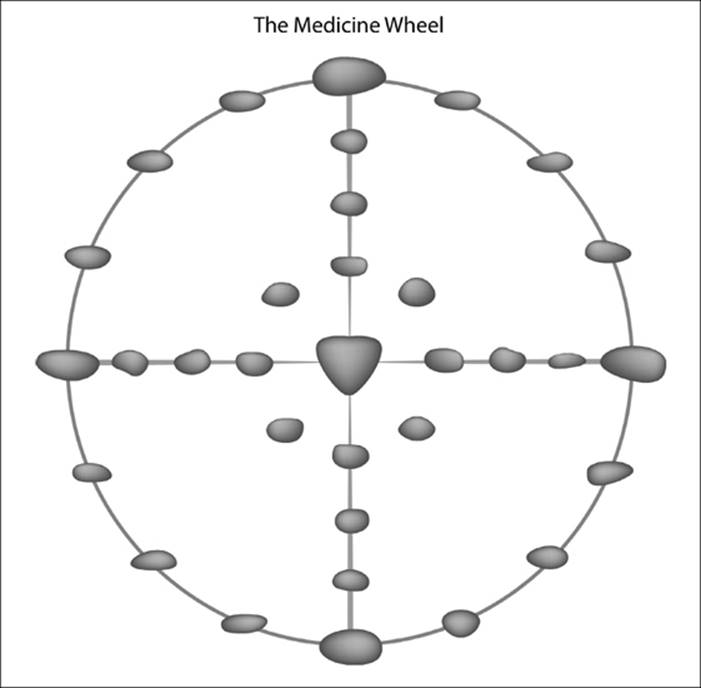
You know, it’s only a recent phenomenon that we’ve reduced the idea of “health” to such narrow diagnostic terms. Have you ever seen a traditional Native American medicine wheel? It provides a good example of what I mean by “beyond” conventional medicine. The wheel has four distinct quadrants, representing the physical, mental, emotional, and spiritual realms of human existence. Each of these quadrants works with the others to help one achieve a balanced, harmonious, and healthy life. The archetypal twelve-pointed medicine wheel represents more than just heart, lung, and digestive health, but goes well beyond, taking in the core Native American values of gratitude, respect, speaking, hearing, honoring, service, walking, loving, learning, working, and acceptance. These values in turn form the foundation of integrity (another word for “wholeness”), balance, and happiness on which traditional Native American society operates, and from which we can learn a lot. These Cycles of Truth, as they are often called, clearly show that the concept of “authentic” (healthy) life in Native American society transcends oversimplified definitions of “health” and “medicine” to encompass unity of mind, body, and spirit. It’s about living a “skillful” existence in harmony with the universe. That’s what I wish for you.
Maybe you think all that’s hokey or New Age. That’s okay. I don’t need you to start dancing around a campfire. I just want you to get healthier. In order to do that, it’s important to recognize that “to heal” and “to make whole” are very similar concepts. It’s a great tragedy that the modern medical model has abandoned the concept of wholeness, which, to me, is the true meaning of health. I like the word “wholeness,” because it implies unity. At times we may be working with specific parts of the body, but we should never lose sight of the whole.
The health we should be looking for is not determined by longevity, wrinkle-free skin, an hourglass figure—or even the complete absence of disease. Look at it this way: Does it really matter that your heart is strong if your relationships with your spouse and children are so awful that you suffer daily agony in your own family? Are you healthy because you’re losing weight when all you’re eating are some miserably unsatisfying lettuce leaves? How significant is the achievement of finishing the New York City Marathon if you know you’re just running away from lingering childhood pain? We must deal with these issues in an integrative way—they’re all connected, and they all contribute to our sense of well-being.
Don’t be intimidated by the fact that this book is based around seventy-seven questions. It’s not a test! And, really, there’s just one answer we’re all after. The 77 Skillful Questions in this book will help reveal our whole state of health. They fall into four key categories, all of which work together in creating our overall health:
1.Self
2.Relationships
3.Nature
4.Beyond
How these four dimensions interact is what we experience as health, and as a result, they are the keys to unlocking what ails us—from chronic inflammation to heart disease to psychic pain. I will constantly remind you how the physical self is just a single component of a broader matrix of health. I’ll share anecdotes from my practice to expand and reframe your understanding of how these physical, psychological, environmental, and spiritual factors connect to our wellness. Yes, there are physiological symptoms of, say, abdominal distress, and some of those can be eased with physical treatments. But no less important are the other causes of the condition, the underlying sources of the disorder, which often lie well outside the stomach and the intestines—causes such as unhealthy relationships, ignorance of natural cycles, and negative energies.
I’m going to guide you through the list of 77 Skillful Questions that connect all the dots and reveal what’s really going on with your overall state of health:
•Whether we have a purpose in life—i.e., how satisfying and fulfilling our work and life missions are
•The quality of our relationships today
•How in tune we are with the rhythms of nature
•How we maintain our connection to life before and after us
But understanding that we’re most healthy when we’ve best integrated all the parts of ourselves does not necessarily translate to success. Once again, we have to ask the right questions to uncover our real current state of health, beginning with the correct definition of “health” itself; we have to answer honestly and completely; and, most important, we have to execute a sensible plan to work on each of those areas, with a specific goal in mind. Although I’d like to get you to think deeply about your health and your life, the plan you undertake will be practical, not academic and theoretical. When we do this, even when we do it gradually, slowly, and incrementally, we begin to experience true health. Here’s the kind of health I’m talking about, an integrated paradigm I want you to keep in mind as we proceed:
Health is a natural state of wholeness, marked by the establishment of dynamic balance, encompassing and fully integrating the areas of our mental/emotional, physical, spiritual, social, and environmental condition.
THE 77 SKILLFUL QUESTIONS
How do we get there? My slow medicine prescription is called Skillful Living, a commonsense approach to the practical day-to-day way we conduct our lives. Living skillfully reflects a wiser orientation that will help propel your health forward. It will help you filter all the other advice you receive and test it for its compatibility with your goals, without compromising the integrity of your life along the way.
A foundation of my philosophy is that we should live our lives more skillfully. What does “skillful” mean in this context?
Sure, we all want our headaches and toe fungus to go away—but what if we could make more sense of our lives to boot? What if we could learn to overcome our most pernicious challenges in and out of the health arena? What if we could be healthier and happier at the same time? What if we finally realized how interconnected those two seemingly disparate states are? What if we could make our lives worth living, even when we must experience pain and loss and frustration? What if all our friends and the world were aligned in support of this ideal? It’s not just a dream. We can achieve this, if we ask the right questions and follow through. The most important step in Skillful Living is that we learn to ask the best questions that we can of ourselves. Better questions make for better answers. And the first questions in the Skillful Living survey ask us to reflect on the question of health itself: What is health for us, and how can we find it? If health is defined by benchmark numbers—such as the ideal blood sugar and blood pressure—then, sure, we will pursue them. These are often valuable frames of reference, especially if we aim for optimal rather than just acceptable numbers. Yet we’ll soon find out that sometimes “normal” numbers often don’t make for normal, balanced, or particularly “healthy” lives when we consider life’s entirety, inclusive of our true well-being, the feeling state that inhabits our mind all the time and determines the quality of our experience while alive. Again, your level of happiness, balance, peace, and control matter a lot more to your overall health than the difference between a 100/65 and a 130/90 blood pressure reading.
Asking the right questions, and taking an honest look at ourselves, is critical to revealing our current and true state of health in this expanded definition, and to determining the unique ideal we’ve set for ourselves. In developing the 77 Skillful Questions, I relied heavily on the Wellness Self Test, which was designed by my friend Dr. Robert Ivker and his colleagues at the American Board of Integrative Holistic Medicine for exactly the same purpose as mine. I adopted, adapted, expanded, and fine-tuned these questions, using a number of other influences, including extensive trial and error in my practice; surveying of patients and doctors; collaboration from wise friends and colleagues; and incorporating other traditions, such as Native American and Taoist. What I’ve come up with is the most extensive and comprehensive list out there.
Simply by asking yourself these questions, you can begin to become more in touch with your own innate intelligence and get reacquainted with your intuitive sense of what you really need. In so doing, you will restore your confidence in your ability to see things clearly, including the best path to actually getting the health you want.
However, to reiterate, the 77 Skillful Questions don’t call for us to reject science. They include conventional medicine, then transcend it—making the best use of the science, but placing it into a broader frame of reference. For example, what if I asked you, right now, the following questions:
•Are you aware of and able to safely express anger?
•Do you believe it is possible to change on a fundamental level?
•Are creative activities a part of your work or leisure time?
Would you believe that these things have anything to do with your current and future states of health? What if I told you they’re as important as your blood pressure or your weight—in fact, they’re so intimately tied up with your physical health that they cannot be extricated from it? I’m sure your doctor has never asked you these kinds of questions before. But I’m equally certain that if he or she did ask—and if you both considered your answers to these questions—he or she would be far better prepared to help you heal yourself of many of your physical problems. And I know that if your doctor helped guide you through a series of questions like these, that process alone would dramatically improve the quality of your health, even without any other treatment.
As we move through all the questions, keep in mind both your current health condition and your health goals and objectives. We’ll return to these as our work together progresses. You might find, as our exploration moves forward, that your questions and goals change. My role, as a skillful doctor, is not to simply give you “right” answers, but to help you ask the right questions and learn to find the answers for yourself.
MY MEDICAL A-GAME
I’ve been asking those questions of myself for a long time. I think I was around seven when my grandmother first said to me, “Michael, you should become a doctor.” Perhaps auspiciously, that same year I also failed penmanship—my career path seemed destined! And, as it turned out, growing up I was fascinated with nature and enjoyed studying it, so a career in medicine seemed to suit me. Twenty years later, through equal amounts of determination, focus, and hard work, I fulfilled my ambition of becoming a doctor.
I was already well into a successful medical career when I learned that the word “doctor” actually means “teacher,” its origin rooted in the Latin verb docere, to teach. This realization was perhaps the first step on the new career path upon which I was about to embark. It caused a critical shift in thinking that’s at the core of my health belief system now and forms the basis for this book. Like many doctors, up until that point, I had the feeling that something was missing from my career as a doctor and my mission to help people enjoy better health. For much of the time I practiced medicine, I was haunted by a peculiar sense that I was somehow out of place—that system itself was so limited and limiting that I felt uneasy all the time. I wasn’t really healing people, and I certainly wasn’t helping them heal themselves by the right thoughts and actions. Instead, I saw a revolving door of suffering patients, wrote a lot of prescriptions, dispensed a lot of pills. I had very little time or opportunity to get to know any of my patients the way I wanted to—in a way that would help shed light on their larger lives.
While my patients thanked me a lot, I knew they were as unhappy as I with the sorry state of our health care system. While the United States spends about two trillion dollars on health care annually, Americans by and large find the system complicated, expensive, wasteful, and underperforming.3 Indeed, 66 percent of those surveyed give the health care system a grade of C or lower.4 A C! Where I come from, if I brought home a C, I’d be hitting the books until I brought that grade way up. Americans on the whole, of course, are not particularly healthy despite all the money we spend and scientific advances we make—in fact, I’d grade us at about a C minus, if that. I want to deliver, and I want you to receive, A-level medicine—the essence of which, ironically, we can find summarized through a simple nursery school song: The knee bone is connected to the thigh bone; the thigh bone is connected to the hip bone . . .
If we’re chronically sick, tired, or depressed, we need an examination that includes, but goes beyond, the exact location of our symptoms. That’s because everything is inter-dependent—muscles and nerves, bodies and minds, people and planet. Each connecting thread has a domino effect on the other. Toxins in our neighborhood, for example, might cause liver damage, leading to chronic illness that makes us unable to get out of the house or work—leaving us isolated, broke, and as a result, severely depressed. In this scenario, the quick fix of anti-depressants will overlook the root of, and therefore solution for, our depression.
To achieve and sustain optimal health, we need perspective that goes beyond the obvious symptoms. Yes, we need to zoom our lens on the area first calling for attention, but then we must pan our lens to take in the bigger picture, and finally, use our intelligence and intuition to connect all the dots in-between. We need to become aware of each area of our lives and explore how to optimize our wellness, not only within each of these areas—through nutrient-dense foods, a loving partner, artistic expression, and so on—but also through their harmonious integration.
We all have the capacity to understand the interconnected web of our health and to channel that domino effect in a positive direction. This individualized process requires exploration and experimentation, patience and perseverance, which takes time but ultimately allows us to cultivate lasting wellness. The best “quick fix” for your health, you see, is not a quick fix at all; rather, it is slow medicine—a methodical, step-by-step process of asking questions that lead to awareness that turns into action that results in extraordinary health. And along the way, as you embark on this journey of discovery, you’ll find treasure on the side of the path. Indeed, there’s even more waiting for you than the mere relief of symptoms.
Are you ready to begin?