
I understood that within the soul from its primordial beginnings there has been a desire for light and an irrepressible urge to rise out of the primal darkness. The longing for light is the longing for consciousness.
—Carl Jung1
OUR DISCUSSION ABOUT RECLAIMING OUR ENERGY in order to climb this mountain of extraordinary health leads us to the next subject: overcoming our fear of death and the pain of loss. Indeed, these are two of the biggest potential holes that we can fall into on our path. To be sure, these challenges are unpleasant—but they’re inevitable. We’re all going to face them. So we need some directions on how to acknowledge these potential holes without plunging into them, without getting sucked into the attendant anxiety that swirls around and within them. Yes, the unease and the worry that surrounds loss—the loss of jobs, loved ones, health, even life itself—is real. But it needn’t be all-consuming. The fact is, all change, including loss and ultimately death, is natural. And we can find skillful ways to deal with natural change and even welcome it. Certainly change can help us learn and grow.
We all resist change and lose a lot of sleep and a lot of living as a result. We might even prefer a familiar bad situation to the promise of something better if achieving that better situation requires uncomfortable change. So, what’s up with that? “Change,” in our culture, is a bad word. The thought itself shakes us and threatens our vital stability. We become attached to the things we’ve gotten used to—even when they hurt us. And even though we fully comprehend and understand that nothing is permanent, many of us live under the pretense that exceptions can be made. For us, things won’t change.
In order to overcome this unskillful belief and behavior, we must understand our attachment to attachment. We come into this world physically attached to our mothers, and the initial separation from our mother’s womb gives us our first wrenching taste of physical and emotional discomfort. We spend the rest of our lives deeply longing to experience security, warmth, and comfort again. But too often, this deep and natural longing gets transferred in unnatural, unsustainable, and unskillful ways. We become attached to material objects, unfulfilling relationships, and unhealthy beliefs, creating the sense of endless dissatisfaction that too many of us live with—and which manifests in real and perceived bad health.
But this longing for connection obviously goes deeper than the loss of our physical bond with our mothers. We yearn to connect with the deeper source of life and consciousness that our mothers merely symbolize, a connection with which most of us in the West have lost touch, to the peril of our health. If this sounds like impractical New Age bunk to you, just think about it: Why do you pray? Why do you seek love? Why do you wonder at nature? What is at the root of your dreams, your art? What do you wish for your children? All of these uniquely human questions are the manifestations of a profound force that motivates us throughout life. We’re searching for existential answers: Why are we here? Where did we come from? What’s our purpose? What happens after this life is over?
These questions are primal, visceral, and inseparable from human consciousness—and much more meaningful in our pursuit of health than, say, What’s my resting heart rate? But these questions are nonetheless scary and disconcerting. So we try vainly to shut them up, stuffing ourselves and drowning them out with the superficial, and seek easy fixes for our immediate problems. But our avoidance of those existential quandaries has been detrimental to the health of our minds, bodies, and spirits. We need only remind ourselves that it’s natural to yearn for a connection to something larger and more meaningful than ourselves. And the answers are not supposed to be easy. In fact, in many ways, the questions matter more than the answers. Finally, we need to satisfy our longing for connection and attachment in more sensible, skillful, and healthful ways.
You already know that no number of expensive creature comforts will bring back that feeling of connectedness you once knew in the womb of your mother. No “toys” or intense adventures will ever make up for the loss you experienced when you were wrenched from her loving arms to grow up and move on.
On one level, the comfort and pleasure we derive from material and sensory stimuli might momentarily re-create the security we experienced at the start of life. The problem is that to sustain and maintain this feeling, we would need to buy, experience, or feel something exciting every moment of every day. Many of us fall into the trap of seeking in vain just such a life. But without more meaningful, substantive, and sustainable connections, we’ll go through our lives in a constant state of withdrawal, like addicts scrambling from fix to fix. That’s the very definition of poor health and lack of balance.
In fact, the more unnatural and unsustainable the frills to which you become attached, the harder it will be to reconnect with the real source of health, comfort, and ease. To find evidence of this paradox, just study a young child one afternoon. Is she happiest dressed up in the latest Abercrombie & Fitch outfit, or naked in the tub? Would she rather play with an expensive electronic toy from Brookstone, or make mud pies in the yard? It’s only as the child grows disconnected from such natural pleasure and contentment, and suffers the materialistic acculturation of our society, that she begins this process of transference—looking in all the wrong places for that which is right in front of her, and even within her. And they call that maturation?
So what will make us whole again? What will provide us that sense of security we’ve been missing since birth? Money and material things won’t do it, and neither will rank and position. We mistakenly become attached to our jobs, our titles, our place in the hierarchy, and constantly clamber for a sense of belonging, a comfortable womb that feeds us and connects us to the pulse of the world. But we sacrifice real connection, real comfort, in this endless pursuit. We lose touch with nature. We forget the rhythms and the cycles of the universe. We trample over each other and the natural world. We don’t appreciate what we have. And, paradoxically, we never arrive at this mythical place. As soon as we “get somewhere,” we’re overcome with the urge to move on, to get somewhere “better.” Forever unsettled, our bodies pay the price: stress headaches, intestinal distress, back pain, eyestrain, inflammation of all sorts, eating away at us like a cancer.
In the most extreme paradox of attachment, we can find ourselves attached to things that are physically bad for us, like alcohol and junk food, as much as or more than things that are good, like love, community, and nature. We can even become attached to pain or sickness itself if it’s become familiar and comfortable. We “cling to that which [has] robbed [us], as people will,” William Faulkner writes.2 What’s robbed us? Our parents, sometimes. Abusive relationships. Anger. Resentment. Hate. Fear. As you attempt this journey toward extraordinary health, you might already realize you’ve been clinging to things like these.
To be clear, it’s only when we cling to what has “robbed us” that we get into trouble. We should strive to understand—rather than judge—our own experience of attachment, and begin to discriminate between the kind of attachment that needs to be cultivated and the kind that we need to learn to transcend. As a physician I have had the privilege of being with many people right before their death. And they get it then, for sure. So why do we wait?
MY MAJOR TRANSITION
When it comes to overcoming the fear of change, I’m not preaching from on high here. I’ve been working on learning these lessons myself for many years. Like most of you, I’ve made many difficult transitions in my life. At the height of my medical career, I was the medical director at a reputable hospital and enjoyed a successful internal medicine practice in the community where I lived. I felt secure and relatively happy in the professional, personal, and financial cocoon I had spun for myself. I had become attached to my way of life, my title, my salary, my two-and-a-half-car garage. I had reached the pinnacle of a career in medicine and achieved a level of respect in my community that others envied.
Yet behind the veneer of success was a gnawing feeling of discontent, which led me off the path of conventional medicine and in an entirely new direction—the one that ultimately led to this book. Looking back, I realize that there was a series of transitions that led me to this place. The process actually began years earlier, when I started working as the assistant director of the department of medicine at a prestigious New York City hospital. Having just completed my own residency program, I saw an opportunity to make changes that I believed would benefit up-and-coming physicians. However, I needed help with this objective from my colleagues in the department of medicine. Much to my dismay, though, many of the department’s senior physicians had grown complacent with the status quo and resisted my efforts, which they interpreted as a threat to their status and methodology. They made it difficult for me to stay, so I moved on.
I left New York City for the suburban life in a smaller town. I opened my own practice. But I hit another wall, this one called managed care. During one unpleasant period in the 1990s, when the insurance companies’ interference with medical decision making actually intensified to life-threatening proportions—it seemed that every recommendation I made was second-guessed by some remote automaton in an office thousands of miles away—I was dying a slow death. Patients came seeking more information, more tests, more specialists, but too often, as a result of the growing bureaucrazy as well as the limits and limitations of the current Western medical system, that process brought them and me only more frustration, and very little healing. It was as though we were all running on one of those hamster wheels. It was time to change or suffer the consequences.
It took its toll on me. Even my body seemed to be telling me to stop that rat race and get off the wheel. As I struggled to employ the lessons learned during my medical training, I also struggled with a growing pain in my stomach and rising blood pressure.
This kind of thing happens to so many doctors, it’s no wonder that physicians have the highest suicide rate of any profession. We’re supposed to be all about healing, yet we’re twice as likely to commit suicide than those in the general population.3 Between three hundred and four hundred of my doctor colleagues commit suicide every year in the United States—roughly one every day.4 Clearly, that was not an option for me, but I could empathize with those who gave up in various ways. My story, however, came to a crossroads after one particularly agonizing weekend spent worrying about a woman who didn’t receive the requisite insurance company permission for an MRI of her brain, which we needed to rule out a life-threatening condition (we couldn’t reach a live person late on a Friday afternoon). It was the final straw for me. After much thought, I made the decision to terminate my agreements with all the managed care companies and their draconian rules. I quit.
This decision led to a significant transition in my life, and put many things I had grown accustomed to at risk. I had no idea what lay ahead, or what path my career would take.
Nevertheless, I willingly gave up years of training and professional experience in favor of an approach that did not often call upon that knowledge base. Friends and colleagues joked that I was either very brave or very foolish. Looking back, I now realize that the decision to abandon much of what I had achieved to fulfill a deeper, more personal longing was not simply a choice. I needed to do it. Interestingly, my “ulcer” symptoms immediately resolved themselves, and my blood pressure returned to normal.
Bolstered, I wrote a letter to my patients, informing them of my decision, stating that I needed to practice my principles, even at the expense of the popularity (not to mention financial success) of my medical practice. Many of my patients wrote letters back applauding my courage and integrity. Among my medical colleagues, I became a topic of discussion. Some expressed respect for my decision and wishes that they could do the same. Some scoffed openly. Sadly, many of the same patients who had applauded my move could no longer afford to see me. Still, I felt at peace with my decision and proud of the care I was now providing.
It didn’t take long before my new career hit the fast track. A new door opened, and at just thirty-six, I accepted the position of medical director at Northern Westchester Hospital, a well-regarded community hospital located forty miles north of New York City. The hospital was committed to improving the quality of patient care. I thought this would give me a good chance to influence the system from within. While I was satisfied to some degree with this new position on the institutional level, I was still troubled by my inability to answer one question that my patients nearly always asked whenever I prescribed a medication or suggested a procedure, or even worse, when I told them there was nothing I could do: “Isn’t there another way?” As a career internist working within the boundaries set by the Western medical paradigm, I met so many people like you—desperate for better, more complete answers and solutions.
Honestly, I didn’t know the answer then, though I suspected there was one out there. I just wasn’t educated about any unconventional approaches to healing. Like most physicians, I understood that lifestyle choices played a role in many common conditions such as heart disease, diabetes, and cancer. However, I was still ill equipped to help people make important changes in their lives. I knew there was more to learn.
It was this growing awareness of, and dissatisfaction with, the limitations of the Western medical paradigm that started me on the road to becoming a different kind of doctor. I began to appreciate the idea of integrative medicine and soon was presented with an opportunity to study with a pioneer in the field, Dr. Andrew Weil. Weil was a bestselling author (Spontaneous Healing and 8 Weeks to Optimum Health) and the public face of the field. With Dr. Weil as mentor, I began to understand healing as a discipline, and even learned to heal myself. My thoughts became clearer, my work became more focused and effective, and I enjoyed greater balance in my life. Coincidental (I would say “synchronistic”) encounters began to lead me down a new path of greater depth and meaning. My overdeveloped logical thinking brain was met by the reemergence of a more heart-centered awareness. I actually felt more human. This is sometimes tough for doctors, who are forced to suppress their humanity to cope with constant pain and death. My connections to people grew deeper. For the first time in many years, I felt sanguine about my work.
None of this would have happened had I not looked in the mirror and done a careful inventory of where I was in life and where I wanted to be. I had to stop feeling resentful and angry about where I’d wound up and become proactive, taking responsibility for my own future. I had to slough off my attachments to my training, my title, my prestige, and the things that accompanied all that. I had to face the fundamental fear of change. I’m not saying it was easy—but it was necessary, according to my intuition, and a higher calling.
Two years later, once I completed Dr. Weil’s Program in Integrative Medicine at the University of Arizona School of Medicine, I felt retrained and “retooled.” Soon after, I guided the Northern Westchester Hospital to create its own Center for Health and Healing—an integrative medicine practice. As its new director, I was able to develop close working relationships with some of the area’s most respected complementary and alternative medicine practitioners, all of whom willingly shared their different approaches to healing. On our staff we had a holistic nurse and holistic nutritionists, several acupuncturists, massage therapists, yoga instructors, hypnotherapists, an osteopath, a Reiki specialist, and a spiritual counselor. It was a great team and an exciting time during which I learned a lot.
But as I delved further into the realm of integrative medicine, I grew more and more uncomfortable with the medical office label that still implied I was the “fix-it man.” Eventually, I closed my internal medicine practice to concentrate my efforts on the Center for Health and Healing. I no longer tried to “fix” people. Instead, I saw my new mission as helping people help themselves through slow medicine. Because I was no longer under the stranglehold of the insurance companies, I could finally spend hours with individual patients. No longer was I simply diagnosing illnesses and prescribing medicines. Now I began to focus on teaching, guiding, and healing. I was finally free to help, to genuinely make a difference in the lives of those who were suffering and frustrated—people like Karen and her mother Miriam, who were some of my first visitors at the Center for Health and Healing.
47. Are You Accepting of All Your Feelings?
KAREN’S STORY: EXPRESSING THE FEELINGS
“I don’t really believe in any of this alternative crap, you know.”
The young mother, Miriam, had clearly reached the end of her rope. Karen, her bright, beautiful, and energetic twelve-year-old daughter, a multisport athlete and member of a traveling soccer team, had been reduced to a veritable “cripple,” she said. Things had gotten so bad that now it was no longer a matter of whether her daughter would play soccer again, but whether she would ever be able walk normally, or move around without pain. For more than two years, Karen had been experiencing intense pain in her hips and knees.
Miriam arrived in my office skeptical and frustrated. She had consulted at least half a dozen specialists, who had subjected her daughter to countless exams and diagnostic tests but offered no viable answers. There seemed to be no consensus among these physicians, not even a real understanding of the problem. Miriam had even spoken with an orthopedic surgeon, who was willing to operate—though he conceded he couldn’t find anything medically wrong with Karen. (Like many surgeons, even when there is no clearly identifiable cause, he was ready to “go in there,” assuming some pathology would leap out at him onto the operating table, where he would conquer and slay it, a true hero.)
Out of desperation, Miriam decided it was time to at least consider another approach. That was a good enough start for me.
Looking at her daughter, I could feel both their pain. Karen walked with a noticeable limp. She winced in agony when she sat down. This otherwise delightful and allegedly once vibrant child, with no obvious reason for developing such severe symptoms, was falling apart. Every aspect of her life was diminished by this very specific but idiopathic (mysterious) pain.
Their frantic campaign for an explanation and cure for the problem was understandable. But in this case, I didn’t feel that continuing that particular search would lead us to the outcome we were seeking: a healthy girl. I was also not interested in attaching more labels to Karen’s condition; my job was to help her find solutions that would lead to better health.
After I spoke with Karen at length, it was clear to me that she was out of balance. My role, then, was to come up with some suggestions about how she could restore this balance, so she could get back to a healthy state. Suspending any assumptions, I listened to her talk about her life, her anxieties, dreams, passions, hurts, fears, and aspirations. Eventually, I turned my attention to the progression of her current physical condition, helping her reconstruct a timeline. In the process, several things became obvious.
What stood out during our discussion was the volume and intensity of the emotional turmoil challenging this sensitive young girl. Aside from her obvious physical discomfort, she was also adjusting to a new school, not to mention a new teacher who, she said, was giving her a tough time (clearly an understatement). She was entering early adolescence and dealing with the vagaries that come with it. There was a lot of change in her life—and, as we know, change can be frightening and disruptive. Up until this point, her athletic ability had been a source of great pride, and a means by which she fit in with her peers. Now, she was lonely and miserable, not to mention that she wasn’t getting the physical and emotional health benefits of her previous athletic lifestyle.
In the dominant medical paradigm, Karen’s condition would be labeled “inflammatory.” And I agree with that. But the conventional approach would be to prescribe anti-inflammatory medications. Indeed, Karen had been given one pill after another. Looking at her challenges through a holistic lens, however, I came up with several better suggestions.
I suggested to her the easy-to-adopt principles of the anti-inflammatory lifestyle I introduced you to in chapter 1. This was a logical step, because I’d noticed a clue in the answers to an extensive questionnaire she had completed with her mother before our appointment: she craved certain foods, particularly dairy products. More and more evidence suggests that dairy contributes greatly to inflammation. And while it’s not unusual for teenagers and adults to crave certain foods, Karen’s food preferences were not varied, but quite limited. This was suggestive of another imbalance that is often implicated in inflammatory conditions—the paradoxical craving of the substance that produces the pain.
And there was more. I could see this girl’s stress was accumulating, and I knew she needed a way to express some of the stagnant energy that was literally becoming trapped in her body—especially as she couldn’t play soccer anymore. So I talked with her about the principles of Eastern medical philosophies, to help her to understand the relationship between stagnant energy and pain. Chinese medicine theory holds that certain sickness—and especially pain—happens as a result of blockage of the meridians (pathways) that circulate chi (energy) through the body. Indeed, it’s an interesting question whether the energy was trapped because Karen stopped playing soccer or vice versa. Either way, it was trapped and accumulating. And beyond this, it was also clear that her energy was further affected by her feelings about the limitations imposed by her physical discomfort. As I have learned to understand, the question is more important than the answer, because the “treatment” is the same either way: in this case, getting the energy flowing was the key to helping Karen reintegrate into a unified whole. A large part of the plan, then, beyond the anti-inflammatory dietary changes I suggested, was to help her express her feelings rather than hold on to them.
The first step toward expressing feelings is to acknowledge them, to accept them as your own, without shame or other judgment. For Karen, it was natural to feel angry and resentful toward her parents, her teachers, and other authority figures, even as she simultaneously relied on them. And it was particularly frustrating for her to deal with her limitations. We all can relate. Without such feelings, we’d never have grown up to reach a state of independence. But holding on to anger leads to resentment that swells inside us, hence the inflammation. It might hurt only in your bones, but it can seep even deeper and become more destructive, leading to more serious ailments and disease.
Similarly, it’s normal to feel sadness when you lose a friend, or a way of life, such as you do when you change schools or jobs. Without sadness, we wouldn’t be human. But unexpressed sadness taken to an extreme creates a depressed state, which is deeply connected to profoundly poor health, making you sluggish and more vulnerable to injury and infection.
I explained to Karen that we have two problems related to emotions. The first is that many of us don’t allow ourselves to have the simple feelings that are a natural, wholesome, and healthy part of the experience of human life. The second is that some of us obsess over those same emotions, turning them over and over internally, but never letting them “out.”
I told Karen I suspected two things were going on simultaneously in her body. The trapped energy seemed to be exacerbated by the underlying imbalance that promoted inflammation. The intersection of these two forces was the intense, debilitating pain running from her knee to her hip. For Karen to achieve a state of better health and balance, she would need to remove (or move) some of the trapped energy, as well as moderate her diet. Now, how do you release trapped energy? How do you express it rather than retain it? There are two ways. Once again, the physical and the metaphysical—and both ways are powerful.
Physically, Chinese medicine holds that you can manipulate the points along the energy pathways by using techniques such as acupuncture, pressure (e.g., shiatsu or tuina), and the application of heat, electrical current, or suction, in order to get the energy moving normally again. Patients often experience dramatic relief with this approach, especially in reducing pain and increasing flexibility and general wellness. For many, simple movement is also useful, and then there are physical therapies, such as traditional PT, but also massage and other “alternative” approaches. In all of these, the healing power of the hand is paramount. Interestingly, in the gospels, Christ is often depicted as a healer using his hands in such a way.
And then there is the metaphysical. After my initial assessment of her life situation and her symptoms, I asked Karen a question that surprised her. Are you able to express your feelings? I could tell by her body language what the answer was. I went on: Would you be willing to consider that expressing feelings like anger and fear can make a big difference in your current and future states of health? I told her that I believe they’re as important as her physical activity and her diet—in fact, they’re so intimately tied up with her physical health that they can’t be extricated from it. I asked her, Would you be willing to try something different? To her credit, she nodded. Then I inquired whether any of her other doctors had ever asked her those kinds of questions before. She said no. I’ll bet yours haven’t either.
There are proven ways to release trapped feelings (which are just forms of energy, after all), catharsis chief among them. Catharsis is a Freudian psychoanalytical technique with which we’re all familiar in principle. If you’ve bottled up pain, anger, and fear, you have to uncork the bottle once in a while before the whole system blows. I didn’t want to encourage my young patient to engage in violent outbursts toward her teacher and others, but just to get some of her emotions “flowing.” So I suggested she write letters to her parents, her friends, and her troublesome teacher, with no intention of sending them, but simply to express the thoughts and feelings that she was keeping locked inside her. This sounds simple—it might even sound hokey to some—but it’s a powerful tool that’s been used for thousands of years, since Aristotle applied it to the effect that emotionally charged characters in plays exert on their audiences. Just imagine the cathartic effect of chasing and then kicking a soccer ball—then suddenly not being able to express energy that way anymore.
And we talked. I became a confidant for Karen, with whom she could share some of her anger, her frustration, and her fear. It sounds simple, but it’s true: surprisingly often, the simple expression of these emotions releases their stranglehold and makes us feel much better. Think about weeping or laughing. These are just the physical body’s releasing of emotional states. You can’t control the giggles—they’ll eventually show themselves in physical “symptoms.” But laughing is more socially acceptable—and less embarrassing—than the expression of more painful, personal emotions such as anger or resentment. So we tend to lock those up inside ourselves. And, unexpressed in natural ways, these powerful emotions will find other ways of coming out through the body’s processes: maybe stiffening the joints, maybe tightening the blood vessels in the head, maybe balling up the stomach, maybe dividing cells into a tumor.
Karen was letting it out, and she was grateful to do so. She was more willing to write the letters than give up her beloved ice cream, milk, and cheese, but, finally, she consented to give both a try, at least for a few weeks. I was impressed by her willingness to make the effort. She was willing to change, and that’s a huge step that bodes very well for her future.
After Karen followed my advice for a week, Miriam reported that her daughter’s symptoms started to improve dramatically. Despite the fact that she had to endure the same teacher, and continues to live through the transitions of adolescence, today Karen is free of pain. She’s returned to competitive sports, including her much-loved soccer. She’s experienced only a single relapse, which occurred after she had a slice of pizza at a friend’s birthday. I suspect that as she finds more and more outlets for any trapped energy, some of her sensitivity to dairy products might also improve. She will then be able to live in more balance.
To this day, I don’t have a clinical label for Karen’s mysterious ailment. I was never interested in finding a disease diagnosis. For Karen, I found something much more important: the slow medicine path to health. I found this through focusing on restoring balance and easing inflammation by dealing up front in a natural way with the pain of loss (her childhood) and fear of change (impending adulthood). With this approach, I continually find that things fall into place. And what was most gratifying about working with Karen was the opportunity to influence this young person not just in the short term, but over the course of her lifetime. It was also a lesson for Miriam, who, like so many people in our culture today, had become dependent on the established medical paradigm to the extent that it almost paralyzed her. In the process of finding health for her daughter, she found something for herself: a new openness, empowerment, and sense of possibility.
48. Are You Aware of and Able to Safely Express Sadness, Anger, and Fear, and Do You Have the Ability to Cry?
ANGER MANAGEMENT
While we’re talking about the acknowledgment and expression of all of these feelings, I want to focus more on anger, as it’s the most visible. Perhaps it’s the most damaging to our health as well, affecting our liver and our cardiovascular system, among other things. Most of us have firsthand experience with the destructive force of anger, which usually leads to our own suffering and often to the suffering of those we come into contact with. Unchecked anger is like a fire that consumes everything in its path. When we’re lost in anger, we literally lose our minds. In particular, prolonged anger, better understood as brooding resentment, eventually intensifies our experience of fear and anxiety as we become more self-centered, separate, and isolated.
The Buddha urged his followers to give up anger, to conquer anger with love, and to avoid speaking harshly to anyone. Admittedly, this seems to be an idealistic view. The Buddha never had to drive on the West Side Highway. For most of us, the complete elimination of anger doesn’t seem possible or reasonable. I would argue it’s not even the goal. Anger is an appropriate response to certain life circumstances. The key is in safely and appropriately expressing it, in the right proportion.
In this regard, Chinese medicine views anger as the motivational energy needed for creativity, movement, and growth. The inability to get angry enough to defend yourself when appropriate is just as bad as holding on to anger when you ought to let it go.
This pragmatic view of anger implies that we shouldn’t bind up our feelings or try to avoid getting angry at all costs. In fact, once we block the anger impulse, our feelings get bottled up, simmer in our bodies, and eventually boil over in some health crisis. Rather, we should express this energy mindfully and constructively. As long as we’re alive, we’re subject to injury or hurt by the actions and words of others. We should expect this. How we react makes all the difference. What’s the point in holding on to and replaying your anger at others and the world? Is it hurting them? Or you? What’s really getting in the way of your success—the people you’re angry with, or the anger itself?
Again, this is a good opportunity to really look in the mirror and see how your responses to or actions after being hurt (or the fear of being hurt) contribute to your overall sense of well-being. In the book Anger, Thich Nhat Hanh admonishes, “Recognize first that the main cause of your suffering is the seed of anger in you, and that the other person is only a second cause.”5 Acknowledging and not becoming so attached to anger is skillful; it’s the first step to regaining control and bringing joy and peace to your life and to those around you.
How do you achieve this? First, survey your feelings. Ask yourself how you feel about a given situation. Meditate on it. Then, acknowledge your emotions as your own. Ask yourself why you feel the way you do. What part did you play in what made you angry? With whom or what are you really frustrated? What would it take to feel less angry? Finally, express them. Not with rage or violence, but with appropriate demonstration. If you’re angry, perhaps you could talk with the person who you perceive is the cause. Tell her you’re angry, and tell her why. The idea here is not to cause conflict but to alleviate it. If both sides have that as a goal, this might be all it takes to prevent immediate anger from turning into long-term, unhealthy resentment that eats away at your health. There are other ways to express your anger appropriately: creative acts such as making art, sports or other physical activities, or simply writing it down, as I suggested to Karen. But, ultimately, I believe that dealing with anger head-on is the ideal method.
49. If You Have Experienced the Loss of a Loved One, Have You Fully Grieved That Loss?
A “HEALTHY” PERSPECTIVE ON GRIEF
As powerful as anger, grief can also cripple us if we don’t deal with it skillfully.
Growing up, I was fortunate enough to know Jon, two years older than I, and a friend who would become an important role model in my life. There were lots of parallels in our lives, including the fact that we both became doctors. Our families were close, and my parents and siblings, along with many others in our little community, valued him both as a friend and physician.
At the exact time I sat down to write the first draft of this chapter, some fifty miles away, in suburban Long Island, a phone call interrupted Jon’s weekly golf game. It was his wife asking him if he wouldn’t mind stopping on the way home to pick up a pizza for his three young daughters. As he ran across the street to the pizza parlor, a hit-and-run driver struck and killed him. In an instant, his life and the life of his extended world—family, friends, patients, colleagues—came to a crashing halt. More than a thousand people attended his funeral, nearly all of whom were clearly overwhelmed by the enormity and suddenness of this loss.
I was crushed. And since then, I’ve spent a lot of time wondering, Why are we so challenged by the unexpected (particularly since we know to expect it)? Why do we have trouble coping with death? To begin, I believe we’re woefully unprepared. Our culture avoids talk of death. Knowing that life can change in an instant unnerves us, making our world seem more fragile and less safe. Moreover, we fear the intangible, of which death is the most obvious example. Death is an unwelcome visitor, stripping our defenses bare.
In fact, experiencing the loss of a loved one might be the single most painful life event we face. We’re left stunned, lost, and overwhelmed by pain. And while it’s critical that we really feel our pain and loss when someone close to us dies, it’s not at all uncommon to sink into long-term, deep depression owing to that loss—and here we enter the realm of unskillful grieving.
The American Psychiatric Association has even considered revising its definition of depression to include grief.6 But is that necessary? Does our society need another diagnosis, or another reason to pop a pill? Jerome Wakefield, M.D., author of The Loss of Sadness, has fought this revision. He argues, “An estimated eight to ten million people lose a loved one every year, and something like a third to a half of them suffer depressive symptoms for up to a month afterward. The proposed change would pathologize them for behavior previously thought to be normal.”7
Grief and feelings of loss are normal. Dealing with grief is quite different from overcoming it. There’s a series of stages and realizations we go through once we face the loss of a loved one. Acknowledging the loss is an important first step, as many of us live in denial for a time. This is perhaps our defensive way of coping with terrible trauma. After acknowledgment comes acceptance, perhaps the most critical early stage. We doctors have to face it all the time, as we lose patients despite our best efforts. A recent study found that oncologists who denied grieving over their lost patients suffered a slew of psychological and physical health issues.8 The study found that the taboo against doctors expressing grief can lead to “inattentiveness, impatience, irritability, emotional exhaustion, and burnout.”9 The study also found that the oncologists were less likely to visit their patients as the patients neared death. That’s an awful shame. When patients do die, grief affects not only the doctors themselves but also their families.10 Losing a spouse, family member, or close friend can have even more intense effects when we don’t acknowledge the loss, when we try to soldier on as though it never happened.
We must all grieve in our own way and in our own time, but there are a few lessons I’ve learned that might help you. Accepting that our loved ones never really leave us is the best step to overcome the difficulty of grief. Avery Corman, author of Kramer vs. Kramer, recently discussed in a New York Times article the grief he experienced after the death of his wife. He was at first unwilling to let go of the furniture his wife had bought for their house. “Furniture” is an apt metaphor. Corman finally came to the realization that “her spirit is also within [my son], and his brother and me. And I came to accept, slowly, that these are only physical possessions. I don’t really need to keep things Judy merely bought.”11
That’s instructive. Judy Corman didn’t live in the sofa, but in the love that Avery and his family felt for her. Western culture has long pitted the concepts of loss and death as the antithesis of life and living. We do everything in our power to ignore and even negate their existence. We hide our vulnerability with fancy clothes, relationships, and luxurious homes and other “furnishings,” but in the end we’re still naked and frail. We still lose those we love the most, and they lose us.
Acknowledging the real value of loss, suffering, grief, and death adds meaning to life. How do we learn not to fear these inextricable parts of human existence, and instead embrace them and grow from the experience?
Western culture regards human life as a single period of physical existence. In this context, it is indeed tragic to have a life cut short abruptly. Conversely, cultures that view life as a continuum and look at all experiences, positive and negative, as opportunities for growth, hold an altogether different understanding of loss. As difficult as this is to say in the wake of losing a beloved friend under such tragic circumstances, I suspect that those other cultures, particularly those that ascribe to a less dualistic perspective on life, would likely view Jon’s untimely passing as auspicious in some way. This is not to negate the intensity of sadness and grief. Rather, it’s to change the context from calamity to opportunity, and use these moments to achieve a state of realization that forces us to wake up, look in the mirror, and take the steps needed to prepare for the moment when tragedy will visit our doorstep. Should I be interminably sad when the tomato plants in my garden die? Why? Did I really think they would survive the winter?
Failing to appreciate what we have when we have it is the real tragedy. No one should live with regret after the loss of a loved one. I often wonder what Jon might have done differently had he known that July day would be the last day of his life. Perhaps he wouldn’t have done anything differently, as he was already living up to his potential, based on the number and nature of the eulogies I heard at his funeral. The real question for me is, what would those who cared for Jon have done differently knowing his time was coming to end? Did we say what we should have said? Did we express how we really felt? Did we appreciate him while he was alive, and did he know it? Did we fully love and give ourselves the best chance for fulfillment? Do we maintain hope for the future? If not, why not?
FINDING MEANING IN PAIN AND ILLNESS
Sometimes life sucks. You lose your job. Your spouse leaves. Your children get sick. You get sick. Maybe even someone you love dies. You live with constant pain, actual or anticipated. And when things suck, you really feel it. I’m not suggesting that you simply flip some switch in your head that will get you thinking, Hey, it’s pretty neat that I got fired. Life doesn’t work that way, nor should it. Instead I’m recommending you try to recast painful events, including serious illnesses, as Rick Foster and Greg Hicks, founders of the Brilliant Health System, suggest:
Recasting is not about Pollyanna thinking or making lemonade out of lemons. . . . There are some events that will always be lemons: sad, fear-inducing, or maddening. With Recasting we learn to deal with them as a natural part of life, extract their value, and then, when we are able, return to a happy life. We don’t allow them to pervade our entire existence or become our identity. The exact opposite of denial, Recasting accepts the reality of any trauma or illness and constructs a context around it, leaving us in a more emotionally capable, elevated, and powerful state of mind.12
Foster and Hicks have worked with the Mayo Clinic’s Complementary and Integrative Health Program, as well as the NYU Medical Center. They frame the idea of “Recasting” into three critical phases, all of which I’ve used with my patients, too—even those close to death—to great success:
1. Feel your feelings. Dig deep. Get help. Talk it out. Weep. Write it down. Studies show that even the sickest patients who actively embrace and share their feelings live twice as long as those who don’t, and experience half the pain.
2.Find meaning. Ask what this trauma can teach you. Ask what you—your beliefs and your behaviors—had to do with the pain you’re experiencing. How did this begin? Why did it begin now? How did it manifest itself? What does it mean? “Meaning” means an understanding of how all the pieces of your life—including this trauma or loss or illness—fit together.
3.Recognize opportunities. Ask where you can go from here. What can you do to make yourself feel better? To whom do you need to speak? What changes do you have to make? Who else can help? Where might this all lead if you handle it skillfully? Is there any blessing here?13
DON’T FEAR THE REAPER
When it comes to transcending our attachments, we can start with caffeine and Twinkies. And we can gradually deal with deeper attachments to unskillful feelings like resentment and anxiety. We can even learn to acknowledge and live with the pain of the loss of a loved one. But in this process, we need to work our way up to even more intense feelings and attachments. Perhaps the greatest of these is our fear of our own death.
We’re obsessed with not dying, desperate to remain young forever, caught up in the frenzy to manipulate nature and recapture our lost youth. We spend years of our lives and billions of dollars to fend off the ravages of time, and in the meantime, we miss out on living. Most of us operate in a state of profound denial of our own mortality—and that’s not skillful in the least. If we weren’t so afraid, I think, we would be less prone to denial.
So I’m going to ask you to question this deepest of fears, and consider a different approach to aging and death—one that embraces and celebrates it as a natural part of the cycle of life. Ironically, in order to experience a sense of health, we must revise our attitudes toward death. We hear stories of people who transform remarkably on their deathbeds, healing old wounds and leaving this world with grace and harmony among their loved ones. It happens: I’ve seen it! The trick is to achieve this state while there’s still plenty of time left in our life to enjoy it.
First, let’s face facts. Whether in good health or bad, we are all technically deteriorating, falling apart, dying. It might be cancer or heart disease or simple “old age” that gets you. But in the end, something will kill you, and there’s no way to stop it. A sense of the relentless nature of looming death tends to manifest in a fear of death, rather than a logical and more productive mind-set that accepts the inevitability of death and stacks the cards with skillful choices that maximize potential for two key goals: longevity and, maybe even more important, a high quality of life during the whole lifetime.
Denial seems to surface most often around the subject of death. We cover up the signs of mortality with hip clothes, cool cars, cosmetics, and surgery, and hide the reality of death by slathering makeup on corpses to make them appear “lifelike.” As Professor John Powers observed in his book Introduction to Tibetan Buddhism, “We are even taught to avoid discussion of death, since this is seen as being inappropriate in polite company and overly morbid. Instead, people tend to focus on things that turn their attention from death and surround themselves with images of superficial happiness.”14 In The Tibetan Book of Living and Dying, Sogyal Rinpoche maintains that denial of death fosters a generalized state of anxiety that leads to reckless action and a loss of compassion: “We’re demolishing, poisoning, and destroying all life-systems on the planet,”15 even as we pretend we can all live forever.
In short, obsessively worrying about death (and living in a state of denial of death’s existence) steers us away from the path to a more authentic existence—a life lived in extraordinary health.
For better or worse, we’re the only animals that have been given the gift of knowing that we’re going to die. This gift provides us with the opportunity to live in something other than an instinctual state. And this awareness gives us choices. Living without a specific, purposeful intention is squandering a golden opportunity. All of us can choose to live well with integrity and authenticity, or we can live recklessly, indifferently, and in denial.
So why are we so fearful of death? Are we really afraid that we’re not living our lives now to the fullest? Are we afraid because we don’t feel like we have any control? We feel we have no control because we’re not exercisingany control. We’re not being proactive in any aspect of our lives, from our marriages to our jobs to our health. We’re just moving along with the herd. So it goes without saying we’re afraid.
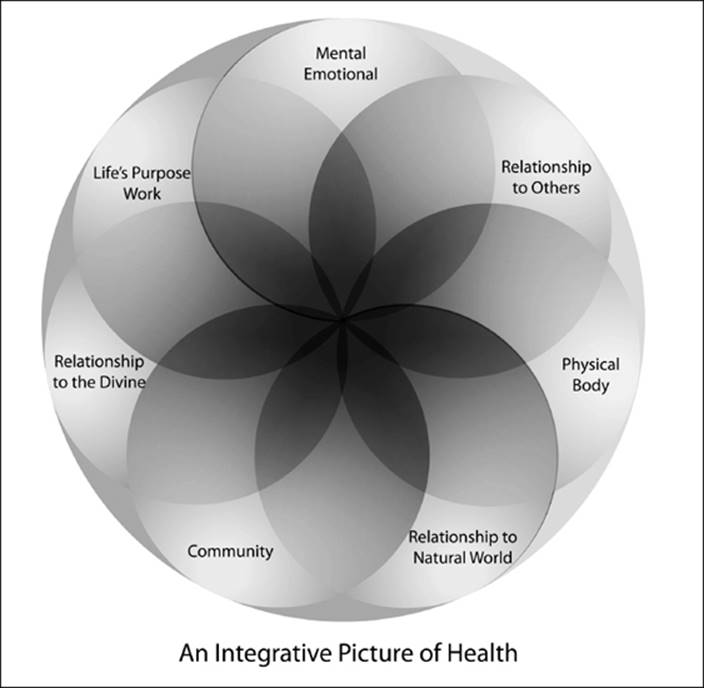
But what if we started looking into and working on the challenges in the various spheres of our lives? Doesn’t it make sense that if you’re happy and content today with your family, your job, your contribution to society, your mission and purpose, your sense of a greater power in the universe, and so on, that it would be, to paraphrase the Native American concept, a better day to die than if you feel it’s all out of control and meaningless? One of the secrets to the 77 Skillful Questions is that they lead us to a more fulfilling, happier life, but following where they lead you also makes each day a “good day to die.” Perhaps it’ll take you a while to get comfortable with that phrase, which I can understand. So for now, if you prefer, think about Skillful Living instead.
50. Do You Take Risks or Exceed Previous Limits?
CHANGING FOR GOOD
I know that the discussion of death can be uncomfortable. But the extent to which you “push” yourself versus remaining in your comfort zone is a good barometer for your present level of denial and fear, and your willingness to change for the healthier. I’m talking about both denying the reality of your circumstances and what it will lead to—and the fear of changing it. Studies show that fewer than 20 percent of a problem population (such as people who drink too much or don’t control their blood sugar) are actually ready for action at any given time.16 New research in overcoming bad habits and achieving health through motivation has uncovered six well-defined stages of change:
1.You’re in denial. Everyone you know might know you have a problem like obesity or drug abuse, but somehow it seems to have escaped you. You’re not ready to change your behavior because you haven’t even acknowledged that anything’s wrong. In this stage, no amount of prompting—even the most state-of-the-art rehabilitation therapy—will be helpful.
2.You’re thinking about it. You’ve begun to acknowledge there’s a problem. You recognize you don’t want to be fat or suffer anymore from migraines. At this stage, you might not be ready to take specific action, but you’re seeing the problem, thinking about the causes, and wondering how to solve it. This is a critical stage that you must go through before you can effect change. Sometimes it takes a long time, and sometimes there’s a moment of epiphany that foreshortens this stage.
3.You’re getting ready. You’re starting to organize your life toward making a change. You might be making definitive statements to yourself or others, such as “I’m sick of feeling lazy.” Or you might be articulating a specific plan, such as “I’m going on a diet after Christmas.” You might be buying books or reading about possible solutions on the Internet. During this stage, you’re really working on overcoming your fear of and anxiety about change. You’re beginning to ask the right questions and reflecting on the intuitive answers.
4.You’re making a change. You’re actually modifying your behavior. You stop smoking, or go on a diet, or start exercising. Very often, people jump right to this stage (and more often than not, self-help programs are designed around this stage, with no acknowledgment of the other, equally important stages). If you try to make some change cold turkey before going through the three previous changes, chances are that you’re not going to succeed.
5.You’re keeping it going. You’ve done well and seen results from your initial actions. But you realize that the action you took must be maintained. You hone your actions. You work on not relapsing. You appreciate your gains, but you don’t rest on your laurels. You continue to ask deeper and more meaningful questions to keep up the benefits of the change. Ignoring this stage has been the bane of many dieters.
6.You’re done? You’ve reached a stage where the actions you took have become a lifestyle, and you’re confident that the original problem (smoking, overeating) is not likely to return. For some people (and some problems), this stage might never come, and they might need to work on maintenance forever. For others, this ultimate stage might happen after a solid period of maintenance.17
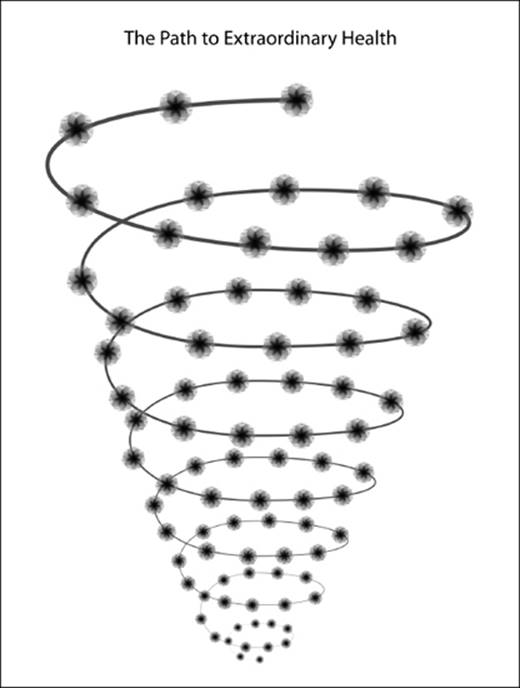
The important part about this revolutionary new thinking about change is to consider where you are in the continuum of stages for each of your problem areas. It’s okay not to be ready to make certain changes. In fact, if you force yourself to, say, stop eating sweets before you’re ready, it’s simply not going to work. You’re this far along in my book, so I take it that for at least one of your health issues, you’re no longer in denial. You’re contemplating the causes and effects of your behaviors and considering a new paradigm for getting better. Emotions, though—especially the fear of change—can prevent you from moving into the action stage. So focus on the questions here that get you to start moving from stage 3 toward stage 4, and through the maintenance necessary for stage 5.
Don’t try to tackle too much at once. Instead, do a kind of personal health triage, identifying (using your intuition, a mirror, a close friend, and/or a doctor) one or two places to start. While it’s true that action cures fear, don’t act until you’re emotionally ready to act. Don’t beat yourself up if you’re not quite ready. You’re only human.
Having said that, don’t wait until it’s too late to act. Use your intuition and skillful self-questioning to reveal to you where you must act—and act relatively soon. Then try to push yourself just a little bit more each day. Maybe you’re not entirely ready to act on adopting an extraordinarily healthy diet cold turkey, starting today. But we eat one meal and one snack at a time. So here, “exceeding previous limits” means allowing yourself the responsibility to make some better choices, one at a time. So you’ve snatched a handful of candy from that bowl at the bank: Does that mean you have to eat another, and another, and then go out for a pizza?
Finally, a word on taking risks. The risks I’m talking about here are not like BASE jumping or swimming with sharks. I’m talking about acknowledging the fears you live with daily, and taking slow, safe, and incremental steps to overcome them on your path to extraordinary health.
51. Do You Have the Ability to Concentrate for Extended Periods of Time?
FOCUS AND HEALTH
It took Karen a considerable amount of time and energy to focus on her problems, rather than denying them. And it might for you, too. The solutions, too, as we’ve seen from the new research on changing our behaviors, often take prolonged concentration, which is in short supply these days. Who has the time to sit down and focus on one particular task anymore, even when we know it’s imperative? We live in a multitasking age, with around-the-clock access to the world at our fingertips, and a barrage of devices and temptations yelping for our attention.
Multitasking is a myth. You don’t need to consult a hundred studies to understand that. Just look at your cell phone (which you often do when you should be paying attention to your work, your health, your kid, your spouse, or your driving). We think we can do it all, but studies show we can’t very well.18 It’s not natural. Our brains have a built-in bottleneck against multitasking. You can’t exactly compose a poem for your cave-wife while you’re trying to outrun a woolly mammoth. Nor can you effectively compose a text message while you’re driving at sixty-five miles an hour. Trying to do more than one thing at the same time leads to a gross loss in efficiency.19 It can cost us 2.1 hours of our day, and it costs the economy $588 billion each year.20 But multitasking and lack of focus and concentration aren’t only costing companies money—they’re costing us our health and sanity. In the case of texting while driving and other extreme examples, they can cost us our lives. More subtly and more commonly, they create psychological and physical health deficits in people that we’re just beginning to understand.
Just look at the number of people who exhibit the symptoms of attention-deficit disorder (ADD), often called attention-deficit/hyperactivity disorder (ADHD). Many of these patients cannot be clinically diagnosed with ADD/ADHD because they have no inherent brain or nervous system defect: The ADD/ADHD symptoms are created by the physical and environmental factors21 we all face nowadays. In other words, it’s the modern world that’s making us this way.
In fact, recent studies show that these ADD/ADHD symptoms are more prevalent in developed countries, such as in the West.22 L. Alan Sroufe, a psychologist, explains in a recent article in the New York Times that “findings in neuroscience are being used to prop up the argument for drugs to treat the hypothesized ‘inborn defect.’ These studies show that children who receive an ADD diagnosis have different patterns of neurotransmitters in their brains and other anomalies. . . . Of course the brains of children with behavior problems will show anomalies on brain scans.”23 But it’s not as simple as a physical problem in the brain, but also the brain responding to challenges in the modern world.
It’s clear to me as a physician that we have an integrated problem that requires an integrative solution. But what about our lifestyle is causing either these inborn defects or similar symptoms to develop in people with no genetic markers or history of ADD/ADHD? As Dr. Edward Hallowell points out in one study, a leading factor is anxiety,24 which makes perfect sense to me.
Anxiety is universal to both adults and children. Anxiety about what? Our performance. Fear of what others are thinking about us. Fear of losing our jobs. Fear of being rejected by our choice of school or mate or . . . fill in the blank. In short, when we’re anxious, we can’t focus. When we can’t focus, we can’t perform. And when we can’t perform, we get down on ourselves even more, losing even more ability to focus, and we wind up in a never-ending spiral.25, 26Very soon, the stress of this situation causes physical symptoms. Sleep disorders. Headaches. High blood pressure. Infections. Inflammation. The whole panoply of Big 8 conditions.
If you find you can’t focus for sustained periods, if your concentration is weak, you’re likely experiencing some anxiety, and it’s worth trying to get to the bottom of that before you move on. Look in the mirror or just slow down for a moment: What are you afraid of? At first, it might seem like you’re afraid of failing the “test,” but if you drill down, your real fear is about death and dying. And before that, the pain that threatens loss and the anger and frustration and grief that result.
PRACTICAL PRESCRIPTION 6: ENVISIONING EXTRAORDINARY HEALTH
This prescription uses a technique called guided imagery, a program of directed thoughts and suggestions that guide your imagination toward a relaxed, and focused state. For some reminders about how to achieve that state, you might want to review Practical Prescription 4 on page 154.
Guided imagery relies on an understanding of the mind-body connection. The mind cannot distinguish between “real” and “imagined” when you employ all your senses. In other words, if you picture something—and really see, feel, hear, and even taste it—the mind interprets this as real, and responds accordingly. You know this to be intuitively true. If you really imagine your grandmother’s cooking—really remember the smell and the taste and the feel of her food in your mouth—you’re liable to salivate. Similarly, if you imagine something terrible happening—a fire in your home or your child in an accident—your blood pressure goes up, your heart beats faster, and you might even start to sweat.
The idea here is to guide your imagination toward the peaceful, relaxed, and positive, of course. You can get to this state by using all your senses to imagine a safe, comfortable environment, such as a mountain lake or your childhood bedroom—whatever works for you. Start with your favorite peaceful place, then expand this vision:
Envision a world that’s in greater harmony and resonance, one that supports a divine plan of creation, that includes even more beauty and wonder, in which you and all other beings get to fulfill their purpose. A world where you and others are free of fear and pain. What would this world look like, feel like, sound like?
Now envision your role there. Envision a world where you are very aware of your distinct role in supporting this plan. What are you doing in your ideal, healthy, balanced world? What do you look like? How does it feel?
Now bring an awareness into your vision, that your health is intricately connected to your relationship to others and to the greater cosmic reality. Try to feel the energy all around you. Whatever anxiety and pain you experience goes well beyond your physical symptoms, though these play an important role in your process, if only you could learn, grow, and transcend them. Envision your particular circumstance now and witness it dissolve into the light source around you. Repeat to yourself that your health is not as severely limited by age, disease, or even death as you have been taught. There is so much more to your existence. Bring to mind your purpose. Reassure yourself that there is no need to give up trying to alleviate your discomfort. But there are other questions to ask that will contribute to your healing. Don’t lose sight of those, and see how, one by one, you step closer and closer to that state of harmony and resonance you seek—the feeling of security, warmth, and comfort you experienced just before birth.
This kind of guided imagery with its related relaxed state can aid healing and lead to extraordinary health. It can help with learning, with creativity, with performance, and in our efforts to change. I have found that it helps people face their challenges—even the big ones—to recover their spirit.
QUESTIONS FOR FURTHER REFLECTION
52. Is Your Sleep Free from Disturbing Dreams, and Do You Explore the Symbolism and Emotional Content of Your Dreams?
53. Are You Free of Any Drug or Alcohol Dependency (Including Nicotine and Caffeine)?
Nightmares. We don’t ask for them, but they happen nonetheless. Are we courageous enough to hear and heed their messages? Are we wise enough to listen without judgment and with curiosity? Similarly, can we accept ourselves when our addictive behavior leads us into darkness? Can we maintain the equanimity to see through the veil and find the beauty that awaits us when we choose to evolve? Indeed, there are many levels of our consciousness. The idea is to look at them all, learn, and grow.