
At its heart, the ADAPT Framework offers clinicians the opportunity to provide true healing, not merely temporary solutions. Most commonly prescribed drugs are just palliative—in other words, they offer some relief for symptoms but don’t address the underlying cause (see table).
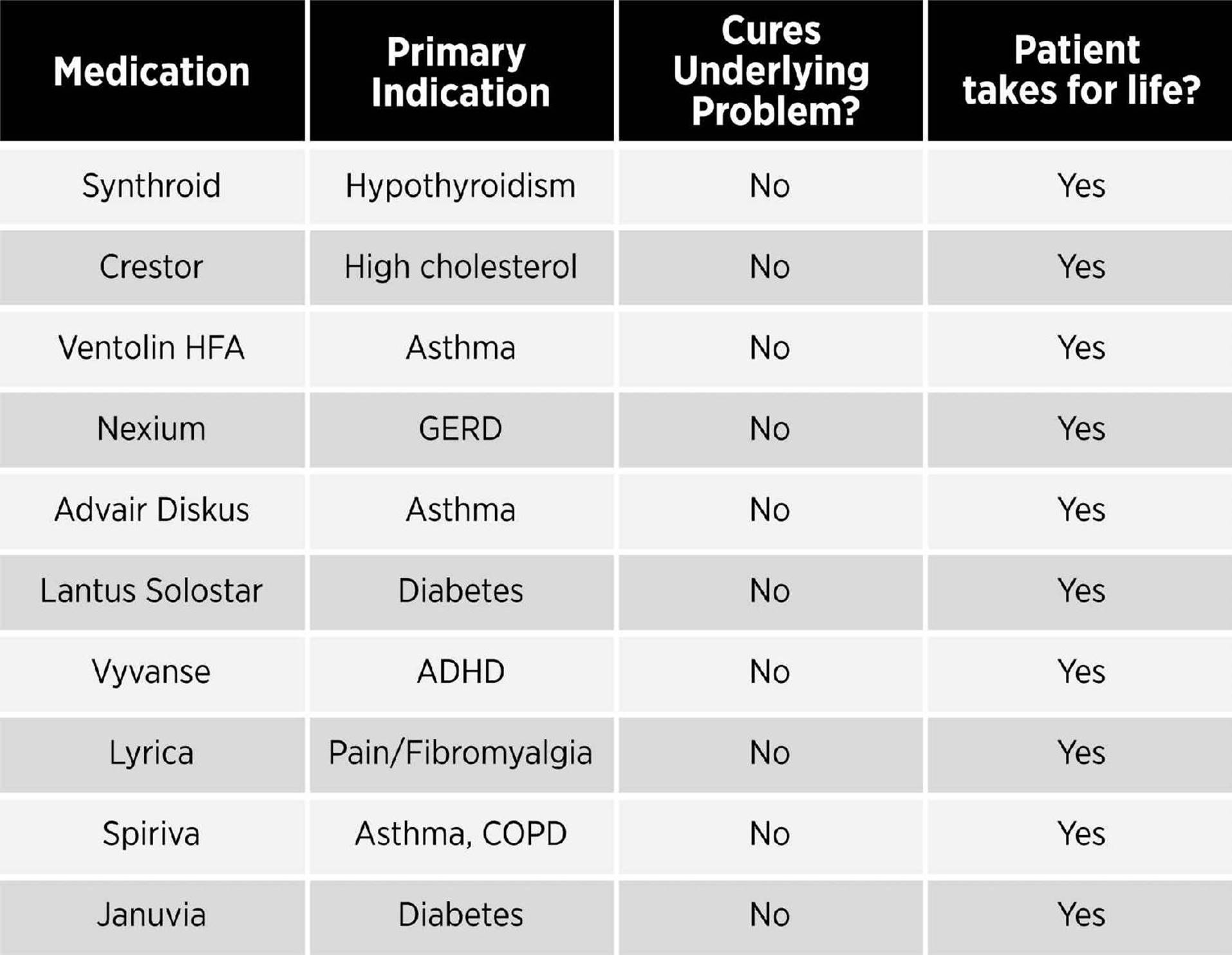
Indications and usage of top 10 most prescribed drugs in the U.S. (Brown 2015)
What if practitioners could genuinely offer people the chance to reverse or even prevent chronic conditions, primarily through diet and lifestyle change, and occasionally supplements or other natural treatments? A practice like that would produce a myriad of positive results: reducing side effects, providing hope for patients who often don’t have it, saving money over the long-term, dramatically improving quality of life, and providing a sense of empowerment for patients by putting them in charge of their own health and taking meaningful steps to improve it.
Let’s compare how the ADAPT Framework differs from the conventional approach using four of the most commonly prescribed medications, and the conditions those medications are designed to treat.
Statins
Let’s consider statins. Prescribing these drugs is typically the first step in conventional treatment of heart disease. In the Functional Medicine approach, we would look first at diet and lifestyle because that’s the primary cause of dyslipidemia and hypercholesterolemia. After evaluating the patient’s diet, we consider her physical activity, examine her sleep and stress management, and inspect her exposure to toxins—all areas that can affect lipoprotein and cholesterol levels.
Keeping the Exposome in mind, we remember that an ancestral diet and lifestyle will make a tremendous impact on this patient’s cardiac health. Traditional populations, living closer to a hunter-gatherer diet and lifestyle, don’t typically have high cholesterol or dyslipidemia, nor do they have any objective evidence of atherosclerosis (remember the Tsimané?). They’re not taking statins, and they’re not dying of heart attacks either. Therefore, we tackle diet and lifestyle first, recognizing that healthy change in these areas will make a profound difference as we move to subsequent steps.
Testing comes next, to identify any pathologies or underlying mechanisms that might be contributing to high cholesterol. We might test for poor thyroid function, which has been known for some time to impact cholesterol. We would also look at gut issues, like intestinal permeability (“leaky gut”) or disrupted gut microbiome, as those also can contribute to high cholesterol. Then we’d move to examining metabolic issues like insulin or leptin resistance, which is common with diabetes. We might also look at exposure to heavy metals like lead and mercury and infections like Helicobacter pylori. These problems can all lead to high cholesterol and a high LDL particle number (Kresser 2013b; Asgary et al. 2017). After testing, we would do specific treatments to address those issues.
To be fair, although most conventional practitioners are not testing for these underlying causes, it’s likely that many would at least encourage diet and lifestyle changes. At that point in a conventional model, the doctor would simply issue his or her recommendations: “Okay, eat better. Exercise more. Do this protocol.” The patient would walk away and then likely struggle or fail to follow through. But in the ADAPT Framework, we use allied providers like nurse practitioners, physician assistants, health coaches, and nutritionists, all of whom can help the patient implement the clinician’s recommendations. This collaboration among team members—a team that includes the patient—is far more likely to ensure the patient makes the necessary changes to improve his or her long-term health.
DIET VS. DRUGS
In his book, Catastrophic Care, David Goldhill remarked: “Before the invention of statins, [a cardiac patient] would have needed a change of diet to reduce the risk of heart disease. The invention of statins provided not only a medical alternative, but an alternative that others, through insurance, would help me pay for.” (Goldhill 2013, 103.)
Goldhill is arguing that his cardiologist told him he needed to eat more fish, fruits, and vegetables, and less ice cream, burgers, and donuts—or, just take a statin. The implication is that these two approaches are equivalent, as if a statin will have the same impact of not eating donuts and ice cream. This exemplifies the natural consequences of a system that puts most of its emphasis on drugs.
Patients conclude, “Well, if my doctor isn’t taking time to emphasize diet and lifestyle, then this drug must be an alternative. Taking the drug is easier, and my insurance pays for it. Insurance isn’t going to pay for new groceries or a gym membership, though—plus, changing my diet and lifestyle sounds like a lot of work.” Yet patients need to recognize that the system is set up to support and subsidize drugs—its mode of intervention is superficial. When patients grow accustomed to being passive recipients of care, rather than being actively engaged in their own lifestyle changes, symptomatic problems will persist, and root cause healing will elude them.
Bronchodilators
Albuterol, used for asthma, is the third most prescribed medication in the United States (Brown 2015). The conventional narrative that accompanies an asthma diagnosis is this: “You have difficulty breathing, so carry around this inhaler and use it whenever an attack starts up. That’s what you’ll want to do for the rest of your life. Good luck!” Many people have heard some version of this diagnosis. Asthma is a huge problem, affecting almost 10 percent of the population—25 million Americans—a number that increases every day (CDC 2011).
How would we approach an asthmatic patient in the ADAPT Framework? Many aspects of the modern diet and lifestyle have been identified as contributors to asthma, such as processed and refined food, sensitivities to food additives and dyes, and environmental toxins (especially airborne toxins). Research has found that a sedentary lifestyle, chronic stress, and sleep deprivation can all be contributing factors, too. Our modern diet and lifestyle—so clearly mismatched to how humans were made to function—make this problem more common.
Our functional model would then lead us to look for the pathologies behind the asthma, especially gut dysfunction. The modern lifestyle has disrupted the gut microbiome, causing intestinal permeability and increases in food sensitivity, all of which contribute to asthma. We would look at nutrient status with blood testing, examine hormone levels, and check vitamin D levels. We would do extensive testing to find the contributing underlying mechanisms and address each one as they were discovered.
Like the high cholesterol and statin example, the ADAPT Framework would then set up this asthmatic patient with allied providers and a higher-touch level of care, so that the patient had the support needed to make these meaningful changes.
Antidepressants
Abilify, the anti-psychotic medication we touched on briefly in Chapter Eleven, is also worth examining as a case study on how Functional Medicine approaches illness differently. To recap: on-label, Abilify is used to treat schizophrenia, bipolar disorder, and Tourette’s syndrome. It’s also being used off-label to treat depression and is even being used with children to treat irritability associated with autism spectrum disorder.
Let’s look more closely at how drugs like this came to be accepted as treatments for disorders like depression. Early research on depression suggested that it stems from an imbalance in brain chemistry; some people are susceptible and others are not. If a patient has low serotonin levels in the brain, the thinking went, they can take a drug that boosts serotonin availability. Then, they continue taking the drug for the rest of their lives.
Many of the assumptions made in this scenario turned out to be problematic. Research suggests that depression is not actually caused by low serotonin (Cowen and Browning 2015). Large reviews have shown that serotonin-basedantidepressants may not be any more effective than placebos, at least for mild to moderate depression (Fournier et al. 2010). Even more concerning from a Functional Medicine perspective, the drugs don’t address the underlying causes of depression in a curative way.
One of the most recent theories about potential causes of depression is called the “Immune Cytokine Model of Depression” (Smith 2010; Kresser 2016). This theory holds that inflammation, often originating in the gut, produces chemical messengers called cytokines. These cytokines then travel through the blood stream, cross the blood brain barrier, and suppress the activity of the frontal cortex. That, in turn, causes the symptoms that we label as depression. If that’s the case, then the solution to depression is not to increase serotonin availability in the brain, but to reduce inflammation, particularly in the gut.
Once again, we start with the Exposome, looking at any diet, behavior, or lifestyle triggers that would cause inflammation. Certainly, there are many triggers to be found in our inflammatory highly processed and refined diet. Other culprits might be a sedentary lifestyle, shallow sleep, poor stress management, a lack of social support, and/or exposure to environmental toxins that provoke an inflammatory response. We would systematically identify and address all diet, lifestyle, and behavior factors that contribute to inflammation.
From a Functional Medicine perspective, we would, of course, do a thorough work-up to determine any other hidden causes of inflammation, such as parasite infection, disrupted gut microbiome, and intestinal permeability. We would look at HPA access dysregulation (problems with cortisol and stress-related pathology), which is known to be a trigger for inflammation. We would look at nutrient balance, checking for deficiencies of iron, magnesium, B-vitamins, and vitamin D, or an excess such as iron overload. Blood sugar issues would be examined, as high blood sugar can contribute to an inflammatory response. We would also look for things like mold and biotoxin exposure, and chronic infections. There are several underlying pathologies that provoke inflammation. We would look at them all.
The high touch aspect of the ADAPT model is especially important for a patient working through a psychological ailment. In a higher-touch practice model, the doctor has more time to spend with the patient and truly get a sense of what other factors might be contributing to depression—both from a diet, lifestyle, and behavior perspective, and from a psychological and emotional perspective. The support from staff allied providers can remind the patient he or she is not alone in making lifestyle changes.
Stimulants
Behavioral disorders like ADHD are becoming increasingly common, especially in children. The CDC estimates that 11 percent of children four to seventeen years of age have been diagnosed with ADHD, and that diagnoses have increased by 42 percent in the last eight years (CDC 2017a).
The conventional approach to treating ADHD typically involves prescribing a stimulant drug such as Vyvanse (which explains why it is the seventh most frequently prescribed drug in the United States). Although these medications can be helpful in controlling the symptoms, they do not address the underlying cause of the problem.
What might these causes be? If you look up ADHD on mainstream health websites, they will tell you that the causes of ADHD are unknown. They mention that some genetic predispositions have been identified, but otherwise we don’t know. Some sources even go out of their way to suggest that diet has not been shown to have any effect on ADHD.
If you look in the scientific literature, however, and consider ADHD from a Functional Medicine perspective, you’ll find that there are several compelling theories for what causes it and why it has increased so significantly over the past several years. One such theory is known as the “Three Hit Paradigm,” in which three key influences—or “hits”—combine and contribute to not only ADHD but other behavioral conditions in both children and adults (Slattery et al. 2016). The three hits are:
1. Biome depletion: this refers to the depletion of the microbiome due to poor diet, overuse of antibiotics, and other aspects of the modern lifestyle.
2. Environmental stimulus at critical times in development: e.g. acetaminophen exposure, vitamin D deficiency, antibiotic exposure, and other diet and lifestyle influences.
3. Genetic and/or epigenetic predisposition.
With this perspective, we can examine a wide range of potential underlying causes, including poor diet, nutrient deficiency, exposure to toxins (including pharmaceutical drugs like acetaminophen that can have a toxic effect), poor folate metabolism or absorption, and gut health. Then, we can address each of these causes and significantly improve or even completely reverse the condition, instead of just suppressing symptoms with drugs.
The differences between these approaches have a profound impact on both the children suffering from these conditions and their parents. The conventional approach offers little hope for true healing; it simply suggests that the child has a deficiency of some kind that can only be managed by a lifetime of medication use. On the other hand, the Functional Medicine approach offers the possibility of real transformation. It provides an explanation for why the child is suffering from these problems, one that recognizes the many external factors that have contributed to the attention deficit behaviors. And with that, it enables the parents, the child, and the healthcare provider to work together to address these causes and promote meaningful and lasting change.