
By now, I hope I’ve convinced you that the ADAPT Framework is truly the future of medicine.
That future can’t arrive soon enough. The healthcare debate in 2017 revealed, among other things, just how precarious our current system has become. No recent political issue has drawn more public comments and interest. When the Trump administration proposed changes to the Affordable Care Act that would result in millions of people losing coverage, and fewer benefits for those who do have coverage, politicians were overwhelmed with the response. During standing-room only town hall meetings, people across the U.S. shared how they would be affected by the proposed changes. A mother in tears described how her daughter, who had been diagnosed with leukemia, wouldn’t be able to get the treatment she needed. A disabled man in a wheelchair who depends on Medicaid wondered how he’d survive without it. Hundreds of citizens across the U.S. expressed their anger, fear, and opposition to the proposed changes.
The symptoms are clear, but the diagnosis and treatment are wrong
These stories are heartbreaking, and the needs they reveal are serious and demanding of attention and support. But the public discussion of these issues fell short in one crucial way: it correctly recognized the symptom (a failing healthcare system), but the diagnosis (not enough insurance coverage) and the prescription for solving it (more insurance coverage) were incomplete. Throughout the entire debate, neither politicians nor the media acknowledged the real reason that healthcare is doomed to fail in this country, nor did they propose a solution that was anything other than the equivalent of bailing water from a sinking boat.
Back in Chapter Four, I said:
Making a few small tweaks to our current system and expecting that to work is like rearranging the deck furniture on the Titanic as it inexorably sinks into the ocean. Too little, too late.
If chronic disease continues to grow at the current pace, an insurance-based healthcare system is destined to fail. There’s just no way to effectively pay for the care needed in a country this large, when one in two adults and one in four children have a chronic disease. This is the “dirty secret” that no one wants to acknowledge.
We have come to equate health with healthcare, but that is a fallacy. As David Goldhill explains in Catastrophic Care, “The factors that most predict your health are your wealth, education, and lifestyle—not your access to healthcare. These personal and societal investments are the real ‘preventative’ care, yet they are buried under our growing demand for tests and procedures.” (Goldhill 2013, 26.)
Along the same lines, health insurance isn’t health care. Health insurance is a method for paying for health care. Although it’s the one we’re most familiar with, it’s relatively new. Private group insurance was introduced in 1929, employer-based insurance didn’t take off until World War II, and as late as the mid-1950s only a minority of Americans had health insurance. At that time, Congress introduced legislation that made employer contributions to employee health plans tax deductible for businesses, and the number of people with health insurance grew exponentially. Goldhill again explains, “In short, a minor tax benefit passed more than half a century ago is the source of all of our cultural assumptions surrounding health care.” (Goldhill 2013, 26.)
A Better Way
I’m not arguing that health insurance isn’t helpful, or that it shouldn’t be part of the solution. I’m saying that depending on our insurance-based healthcare model to address the chronic disease epidemic is misguided and shortsighted. The changes we need to make don’t simply involve insuring more people, lowering the cost of prescription drugs, or mandating more twelve-minute “preventative check-ups.” They are much more fundamental.
Today, we spend 86 percent of our healthcare dollars on treating chronic disease but just three percent on public health measures (NCCDPHP 2016). This gross imbalance nearly guarantees that our focus will remain on the far right end of the disease spectrum I introduced earlier in the book. Instead of preventing disease before it occurs, we’re forced to spend our time and resources trying to mitigate its effects after it’s firmly entrenched.
Preventing chronic disease before it occurs should always be the primary goal. But it’s unrealistic to expect that we’ll always be successful in that effort, which is why we also need a method for reversing it once it has taken hold. Our current approach to managing disease with drugs is not the answer. Instead, Functional Medicine offers a methodology for addressing the root cause of chronic problems, so patients can get well—and stay well—without unnecessary drugs and surgery.
Finally, we need a completely new model for delivering care. A brief appointment every six months is completely inadequate when the patient has multiple chronic diseases, is on multiple treatments, and is presenting with a new symptom. We can achieve the goal of true healthcare by connecting patients with a team of people who can work effectively with them on diet, lifestyle, and behavior change.
From Resistance to Revolution
Sounds good, right? So why isn’t everybody already practicing this way?
There’s a famous saying, often attributed to Arthur Schopenhauer: “All truth passes through three stages: First, it is ridiculed. Second, it is violently opposed. Third, it is accepted as being self-evident.” For a while, Functional Medicine was ignored. More recently, some large conventional organizations have issued statements about Functional Medicine, a sign that it’s starting to get traction. Some skeptics, and some conventional practitioners, still don’t take Functional Medicine seriously. For many caregivers, however, this new model of healthcare is the self-evident solution to the current broken conventional model.
The launch of Cleveland Clinic Center for Functional Medicine has served to open many people’s eyes to the potential of this model. Cleveland Clinic, as many people know, is a prestigious medical institution. They’re often on the forefront of the newest treatments, therapies, and diagnostic procedures. In many ways, they’re more progressive than the typical conventional establishment. The same is true for Mayo Clinic; they have a model that makes progressive care possible, as they’re not beholden to some of the influences that limit progress in a conventional setting.
The mission of Cleveland Clinic Center for Functional Medicine, in addition to providing care for patients, is to do research on Functional Medicine that helps it to gain broader acceptance in the medical world. They’ve already taken some steps toward doing that, and have had promising results. Dr. Mark Hyman, the clinic director, travels all over the world to educate people about Functional Medicine. He’s gone to places like Dubai, which is trying to set itself up as a center for medical tourism. They have expressed great interest in adopting Functional Medicine as the primary care model for delivering care to patients from all over the world, people who want to get the highest quality care and travel to Dubai for that reason.
Obviously, there’s also a tremendous amount of interest in Functional Medicine from patients directly. Search volume for “Functional Medicine” on Google has nearly tripled in the past five years.
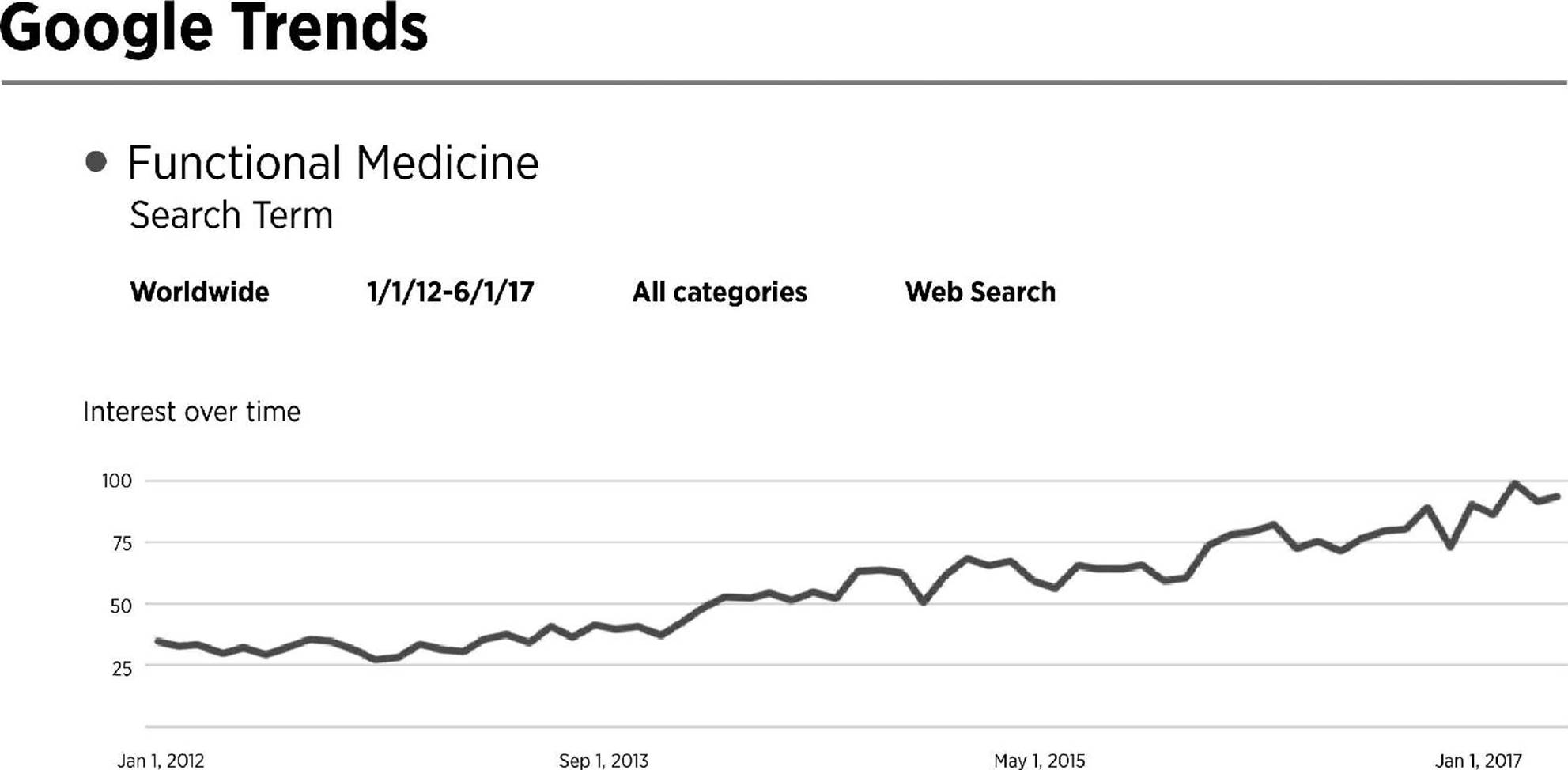
Search volume for “Functional Medicine” from 2012–2017
Well over a million people visit ChrisKresser.com and KresserInstitute.com each month, and we have nearly half a million email subscribers. Close to 400 practitioners have either already been trained or are in some stage of the ADAPT Practitioner Training Program at Kresser Institute, with hundreds more training each month through the ADAPT Academy. Institute for Functional Medicine, the oldest international training organization for Functional Medicine, has trained thousands of practitioners from around the world.
Admittedly, Functional Medicine is still a niche. The average person on the street hasn’t heard of it, but that’s changing quickly. I’ve seen a difference even in the last three years. It doesn’t take much for people to get excited about the concept once they’re informed. When I explain Functional Medicine, they seem to immediately get it—it makes sense. Especially when we think of medical care in terms of analogies like the rock and the shoe, and the leaky boat, it’s apparent which medical approach makes the most logical sense for patient health.
Doctors are often quick to buy in as well, even though they’ve typically been steeped in a conventional paradigm based in symptom suppression and disease management, rather than root cause resolution. Perhaps they are already feeling frustrated with a system that keeps them from making the impact they want to have on their patients. Some might be skeptical initially, but when they get some information on Functional Medicine, many doctors will ask for even more.
For these reasons, I firmly believe that the model we’ve discussed in this book will eventually become the de facto way that medicine is practiced, both in this country and abroad. We won’t refer to it as the ADAPT Framework or Functional Medicine because it will simply be woven into the fabric of the healthcare system. This transition won’t happen overnight, and we’ll face many significant challenges on the way. But we have no choice. The dramatic rise in chronic disease, coupled with the inadequacy of our current system to address it, demands that we adopt a new model, no matter how painful or difficult that might be initially. We owe it to ourselves, but perhaps most importantly, we owe it to our children and future generations.
On the Cutting Edge
Although the model discussed in this book hasn’t yet become mainstream, there are several exciting examples of how it is being applied in today’s healthcare landscape. Let’s examine three case studies, each illustrating implementation of this approach in a different setting: a large institution, a primary care group, and a private clinic.
Cleveland Clinic
Cleveland Clinic’s Center for Functional Medicine was spearheaded by Dr. Toby Cosgrove, the former president and CEO of Cleveland Clinic, and Dr. Mark Hyman, the chairman of Institute for Functional Medicine. Both are pioneers in the healthcare field. Dr. Cosgrove has been described as the “Wayne Gretsky of healthcare” (because he goes where the puck is going to be, not where it currently is). In other words, he’s known for his ability to predict future trends and be on the forefront of those trends. Dr. Hyman, whom we met earlier in the book, has perhaps done more than any other person to advance and popularize Functional Medicine.
Cleveland Clinic has bet heavily on the success of Functional Medicine, investing tens of millions of dollars in their new center. They started out in a relatively small space with a few doctors but quickly outgrew it. Within months, they moved into a 17,000-square-foot facility in the renowned Glickman Tower, which houses the Cleveland Clinic cardiovascular and urology departments—both ranked number one in the world. They now have sixteen clinicians and over fifty employees and are continuing to grow at a breakneck pace.
That’s a good thing because the demand from patients has been off the charts. At the time of this writing, they have a wait list of 2,600 patients from nine countries. Twenty-three percent of these patients are entirely new to Cleveland Clinic, which indicates that this new Center for Functional Medicine is driving demand.
They’re also working in a cross-disciplinary way with other departments at Cleveland Clinic, exploring new models of care that group patients with doctors, nurse practitioners, nutritionists, and health coaches (similar to the collaborative model I’ve described in this book), performing research on the efficacy of Functional Medicine interventions and how they can reduce the cost of care, and even integrating nutrition and Functional Medicine curricula into the Cleveland Clinic Lerner College of Medicine.
The success of Cleveland Clinic’s Center for Functional Medicine is perhaps the most exciting proof of concept we’ve seen yet because it demonstrates a strong demand for this type of medicine among patients, a recognition of its value by some of the most progressive thinkers in medicine, and the success of the model when implemented on a significant scale.
Iora Health
The second example is quite different from Cleveland Clinic but no less exciting. Iora Health is a primary care organization based in Denver, CO, and operating primarily in the Rocky Mountain region. They are blazing a trail in the collaborative care model; specifically, integrating health coaches into primary care.
Their focus is reversing type 2 diabetes with diet and lifestyle change. They achieve this not with lab testing and medications (though these are sometimes part of the treatment), but by teaming patients up with health coaches. Here’s how it works.
They start by hiring coaches directly from the communities they will serve. This is important because it increases the likelihood that the coaches will be able to relate well to their clients and understand the challenges and obstacles that are specific to those communities. They don’t hire people with significant experience or education in nutrition or healthcare. Instead, they screen for people who can form warm, empathetic connections with others. They’ve realized that this is the single most important quality that determines the success of a coaching intervention, and it’s easier to train people in nutrition and lifestyle principles than it is to impart these relationship skills.
Once the coaches are trained, they begin working intensively with their clients. They teach them how to eat, go shopping with them, do pantry cleanouts, and even help them learn to cook and prepare foods with their new diet. They support them in adopting a new physical activity and exercise routine. They provide moral support and hold their client’s hands through the entire process.
Another factor that sets Iora apart is their payment model. They accept “risk-adjusted, capitated fees,” which is healthcare-speak for saying their compensation is performance-based: if they don’t achieve the targets they set out, they don’t receive full payment. On the other hand, if they exceed their targets, they earn a bonus. This performance-based pay structure, which is rare in mainstream medicine, has been adopted by many other progressive medical institutions as a way of controlling costs and improving the quality of care.
The Iora model has been incredibly successful. They’re taking people from type 2 diabetes back to the pre-diabetic and even non-diabetic stage, and pre-diabetics back to non-diabetic blood sugar levels. What’s more, they’re doing this with minimal intervention from the physician. Patients do meet with the doctor for lab testing and a review of medications (if they’re taking them), but these appointments are less frequent than they would be in a conventional model without health coaches. The primary relationship is between the patient and the coach, not the patient and the doctor—which, as I’ve argued throughout the book, is likely the best approach in cases where diet, behavior, and lifestyle change are the most important interventions.
Perhaps the best sign of Iora’s success is how enthusiastic their patients are. The Net Promoter Score (NPS) is an index ranging from -100 to 100 that measures the willingness of customers to recommend a company’s products or services to others. The national average NPS in primary care is four. The highest NPS in the traditional healthcare world is Kaiser Permanente, at 35. Apple, with its raving fans, has a NPS of 72. Iora’s NPS is an impressive 90. They also boast a patient engagement score of 80 percent, versus the industry average of just 2 percent. These measurements show that Iora’s patients are deeply engaged, satisfied, and highly likely to recommend the company toothers.
Investors have also taken notice of Iora’s success: Iora has raised over $30 million in venture capital, and venture capitalists are also investing in other similar models in this space.
California Center for Functional Medicine
My own clinic, California Center for Functional Medicine (CCFM), is an example of how the ADAPT Framework can be applied in the setting of a private, outpatient clinic. I was a solo practitioner using a “micropractice” approach for the first several years of my career. Initially, it was just myself and an office manager who doubled as a bookkeeper. After a couple years, I added a patient coordinator to provide more support to my patients, but I was still operating as a micropractice.
In 2014, I decided to join forces with Dr. Sunjya Schweig to create the California Center for Functional Medicine. Dr. Schweig and I shared a vision for creating a clinic that could support patients on a much larger scale, a place where we could implement many of the practices and principles that we’ve discussed throughout this book.
Just three years later, CCFM now has four clinicians, a nurse practitioner, a health coach, two nutritionists, an administrative staff of thirteen, and thousands of patients. We’ve developed a care model that incorporates the three elements of the ADAPT Framework: Functional Medicine, an ancestral diet and lifestyle, and a collaborative practice structure.
Patients start their work with us via a thirty-minute telephone or videoconference appointment, which we call the Initial Consult. The Initial Consult is conducted by a nurse practitioner, who collects the patient’s chief complaints or primary goals for working with us, documents relevant background and history, orders the necessary laboratory tests, and sends the detailed new patient intake paperwork. The nurse practitioner will also make diet and lifestyle recommendations for the patient to start with while she is completing the labs and waiting for her first in-person appointment. This means that the patient can make meaningful progress before she has even seen the clinician, either on her own or under the guidance of the nurse practitioner and the health coach.
Once the tests have been completed and the results are in—usually about six to eight weeks after the Initial Consult—the patient has their Case Review. This is an in-person, sixty to seventy-five-minute appointment in our office. Prior to the appointment, the clinician will have reviewed the patient’s intake paperwork (electronically, of course) and lab test results, and prepared a “report of findings” that summarizes the underlying patterns contributing to the patient’s complaints, recommendations for further testing if necessary, and outlining the treatment plan. The clinician then presents this report of findings to the patient, answers any questions they have, and explains how the treatment process will work.
Patients love the Case Review. We consistently hear comments like, “No one has ever taken the time to put these pieces together,” and, “I finally feel like someone is seeing the full picture,” and, “I feel hopeful for the first time in years because I now understand the causes of my symptoms and what to do about them.” The clinicians at CCFM also love the Case Review process because it provides us the time and information we need to make more accurate diagnoses and create more effective treatment plans. It also offers plenty of time for us to interact with the patient, answer questions, and build a relationship that will support long-term health and well-being.
At the end of the Case Review, the clinician will suggest that the patient schedule a check-in with the nurse practitioner every two weeks, for as long as the patient is on a protocol. These check-ins provide a means for addressing any side effects or difficulties the patient may be having with the protocol and answering any questions that the patient may have. The clinician may also refer the patient to our health coach, who can provide a deeper level of assistance with the diet, lifestyle, and behavior changes the clinician recommended. Our patients tend to be highly motivated, especially compared to the general population, so not all of them need or want this support. But it’s extremely helpful for those who do.
We also offer standalone appointments with the health coach, and with our two staff nutritionists. These can be helpful for our patients who are no longer on an intensive protocol but are still addressing lingering symptoms or optimizing their health and need additional support.
In addition to the live, human support mentioned above, we’ve developed over a hundred patient handouts on topics ranging from the Low FODMAP diet, to FAQs on how to properly prepare for and perform the lab tests that we prescribe, to strategies for stress management. These handouts support patient compliance and can also reduce the number of questions that the clinicians and administrative staff would otherwise receive, thus lowering overhead.
We’ve also started developing six- to eight-week classes/groups on specific health topics, such as weight loss, autoimmune disease, pain relief, and fertility. These classes, which will be offered both locally and virtually, are efficient ways of delivering additional education and tools to patients with similar needs. They’re also a way of building community and reducing the isolation and loneliness that often accompanies chronic disease.
At the time of this writing, we’re developing a wellness program for the local fire department in Berkeley, CA. They reached out for help with their newest recruits. Their goals were to learn skills and techniques for better performance, reduce workers’ compensation injuries, reduce the amount of sick days, increase mental and physical well-being, and to provide long-term tools for sustainability to take with them throughout their career. We created a program that includes a whole foods, nutrient-dense diet, bodyweight training exercises, stress management and meditation, and improved sleep hygiene. We’ll be incorporating blood tests, continuous glucose monitors, and other hardware devices that monitor steps, sleep patterns, and heart rate variability to track their progress.
These examples suggest that the ADAPT Framework principles we’ve discussed throughout the book are applicable in a wide variety of settings, ranging from large institutions like Cleveland Clinic, to regional primary care groups like Iora Health, to private outpatient clinics like California Center for Functional Medicine. This is truly the future of medicine!